Computation and Language · arXiv:2610.13912 v1 · submitted 9 Oct 2026 · 53 references
RSI-Anything: Unlocking Recursive Self-Improvement with World Models
The paper says
“Recursive self-improvement (RSI) aims to transform interaction experience into persistent improvements, yet external feedback is costly and world-model predictions may become unreliable as policies evolve.”
more of the abstract
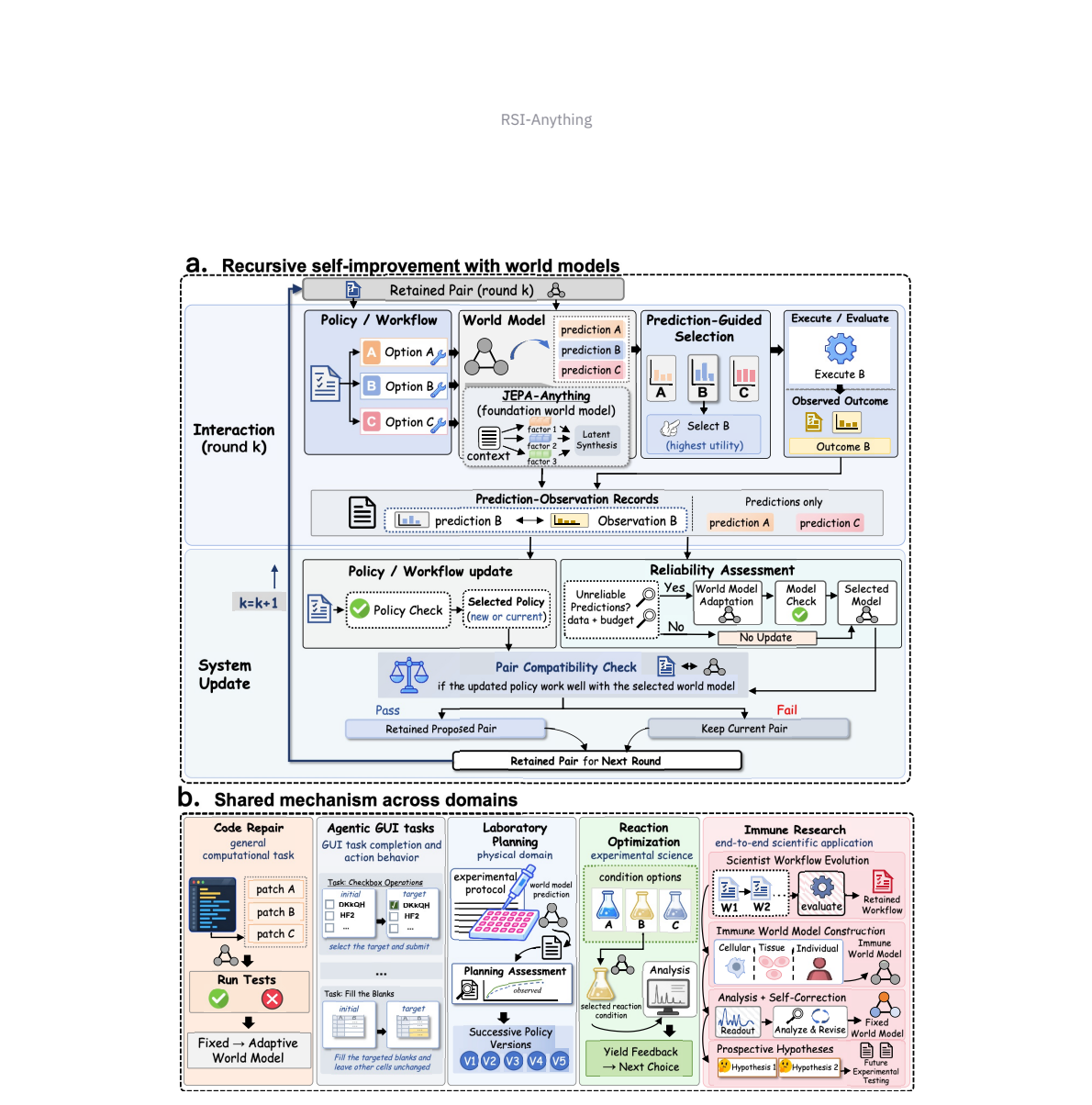
We introduce RSI-Anything, a domain-general framework built on JEPA-Anything that uses predictive world models to guide action and learning-data selection. Observed feedback drives policy or workflow improvement and conditional world-model adaptation, while component and compatibility checks govern the retention of updated policy-model pairs. Across diverse computational and scientific domains, RSI-Anything demonstrates substantial gains. In code repair, with the coder fixed, success increases from 26.3% with a static verifier to 29.2% through predictive selection and 31.2% after world-model adaptation, at comparable test usage. Graphical user interface (GUI) evaluations showed higher task completion, while average actions decrease by 39.4%. Across five successive policy versions, laboratory-planning scores more than double from 21.80% to 46.01%. In reaction optimization, RSI-Anything achieves 96.15% mean best observed yield versus 82.16% for Bayesian optimization under the same 40-experiment budget. An end-to-end immune-science application further connects workflow evolution and predictive modeling with therapeutic hypothesis generation. These results demonstrate how predictive world models and retained system updates enable recursive improvement across diverse environments.
from the abstract
Pith says
Machine review · deepseek-v4-flash · 12 Oct 2026 · what was read was not recorded · not checked by a person
It can be wrong. Challenge this review or reply to it.
Holds up, with conditions. A serious framework paper with one genuinely solid paired result in code repair, but the central retention gates are defined only symbolically, so the recursive-improvement claim is not yet auditable. This line is wrong
4 major objections · 5 minor
How often objections from reviews like this one are right: not yet measured
Not checked: figures, code, what the 53 references say.
The paper says, at §2.5, Eqs. (13)–(18); Table 4
The review did not quote this passage.
Pith says: Objection 1 of 4 · major
The acceptance gates that the paper presents as its distinctive mechanism are never instantiated in any reported experiment. Q_π, Q_W, and Q_pair are defined symbolically, with the text stating only that each check 'returns one only when its specified criteria are met'; Section 6 and Table 4 bind models, prediction targets, and update scope but report no acceptance thresholds, gate datasets, rejection counts, or gate computation costs for any application.
more of objection 1
As a result, the five successive policy versions of §3.3 could be the survivors of an unobserved selection process, the GUI and chemistry gains cannot be attributed to the retention mechanism rather than to ordinary feedback-driven updating, and the matched figures in Table 2 count only external test calls, not re-evaluation or acceptance computation. To be fair, §2.4 does separate external feedback use from update and evaluation computation and states that the budget 'accounts for adaptation, historical re-evaluation, and acceptance checks,' so the matched-budget claim concerns the external-feedback resource; but the gate costs themselves are never reported. Because the abstract's closing claim ('retained system updates enable recursive improvement') rests on the retention mechanism, please instantiate the gates per application (criteria, thresholds, rejected-candidate counts, check costs) or explicitly state where the checks were vacuous and correspondingly weaken the retention claims.
The paper says, at §3.3 and §6.1
The review did not quote this passage.
Pith says: Objection 2 of 4 · major
The laboratory-planning evaluation does not state which role the F200 benchmark played in the improvement process, although the framework's own taxonomy (§2.5) distinguishes update data, gate data, and held-out audit sets. The paper evaluates five consecutive 4B policy versions 'from one self-improvement process' 'in development order on the same 200-task F200 Level-2 benchmark,' and the version scores (0.2180 to 0.4601) are exactly the F200 Final Scores.
more of objection 2
If F200 evaluations were used to gate or select these versions, the reported 21.80% to 46.01% progression is an in-sample selection record rather than evidence of improvement on an independent benchmark, and the comparison with the Actor–Simulator–Selector reference (46.01% vs 45.32%) is not audit-proof. Please state whether F200 served as update data, gate data, or audit set for version retention and, if any role overlaps, report the audit-set evaluation separately.
The paper says, at §3.4, §6.1, §6.2
The review did not quote this passage.
Pith says: Objection 3 of 4 · major
The reaction-optimization headline rests on two screens with no reported replication or uncertainty. The GC-screen gain (93.0% vs 87.5% at 20 experiments, +5.5pp) is the difference of what appears to be a single optimization trajectory per method; for the flow screen, 'mean best observed yield' (96.15% vs 82.16% at 40 experiments) is reported without stating how many sequences the mean covers, and neither screen reports run-level variance or intervals.
more of objection 3
The Bayesian-optimization baseline is underspecified (surrogate model and acquisition rule, initial-design size, number of repetitions), and the ReactionT5–JEPA-Anything adapter's training data is not described: the paper does not say whether the yield predictor was fitted from scratch on the accumulating screen measurements, pretrained on external reaction data, or both, which is relevant to information leakage. The acknowledgment in §5 that the chemistry results cover two Suzuki–Miyaura screens does not resolve these gaps. Please add run-level replicates with intervals, a full specification of the BO setup, and a training-data statement for the yield predictor, or temper the corresponding abstract claims.
The paper says, at §3.1 and §6.2
The review did not quote this passage.
Pith says: Objection 4 of 4 · major
The successive-gains narrative (26.3% to 29.2% to 31.2%) is only partly supported statistically, which matters because the abstract presents these as 'substantial gains.' The first increment is well reported (paired +2.83pp, 95% CI [+0.17, +5.50], clustered by task), but the world-model-adaptation increment (+2.0pp, 29.2% to 31.2%) is given as a point estimate with no interval or test, so the claim that adaptation 'produced an additional gain' is currently unsupported at the same standard.
more of objection 4
Also, the capacity-matched static verifier (26.3%) is nearly indistinguishable from random selection (26.0%), and the paired interval's lower bound is +0.17pp; in absolute terms the best-controlled effect is small, so 'substantial gains' overstates the evidence. Please report paired evidence for the adaptation increment and scale the language to the effect size.
5 minor objections
The paper says, at §3.2
Pith says: minor objection 1 of 5
GUI evaluations report no episode counts and no uncertainty, the 'World-based control' is never defined, and the control outperforms RSI-Anything at the adapted configuration (96% vs 79% success) without comment; please define the control, give episode counts, and interpret the crossover.
The paper says, at §3.2, Figure 4d
Pith says: minor objection 2 of 5
Absolute OSWorld success rates are missing; the relative gains (5.5% over RLAnything, 18.4% over the initial agent) are uninterpretable without the underlying values for the initial agent and RLAnything.
show 3 more
The paper says, at §2.4 and Table 2
Pith says: minor objection 3 of 5
The caption of Table 2 should state that 'online calls/task' counts external feedback only and excludes update, re-evaluation, and acceptance computation, since the framework explicitly separates these resources.
The paper says, at §3.1, Figure 3e,f
Pith says: minor objection 4 of 5
APPS Introductory and LiveCodeBench results report only seed means; adding the three seed-level values (or a spread) would let the reader assess the stability of the 46.37% and 33.05% figures.
The paper says, at Throughout
Pith says: minor objection 5 of 5
Numerous spacing and typographical errors should be cleaned, e.g., 'We introduceRSI-Anything' (Introduction), 'JEPA-Anythingsuppliesacontext' (§2.2), '0.2180to0 .4601' (§6.1), and 'result are reported' (§6.2).
What would settle it
Run the CodeContests comparison again with Eqs. 13–18 replaced by always-accept (skip Q_pi/Q_W/Q_pair) while keeping identical proposal, selection, and adaptation code; compare hidden-test success and online calls. Simultaneously instrument the gated run to log every update attempt, the gate outcome, and the gate cost in the same budget units as Table 2. If always-accept matches gated performance, or if no candidate version was ever rejected by a check, the recursive-retention mechanism has no demonstrated effect in the paper's strongest experiment.
from the skeptic's reading
How the review went
4 readings by deepseek-v4-flash · 12 Oct 2026
- Reader holds up, with conditions
- Skeptic agrees
- Editor wrote the verdict above
- Referee major revision: 4 major objections, 5 minor
Not run on this paper: the simulated authors' defence.
Pith did not check this review's objections against the paper.
The review in full
The review in brief, machine-written
Quick take: this is a serious framework paper with one genuinely solid result and a central mechanism that currently cannot be audited. The code-repair comparison is the backbone, and it is handled better than most agent papers: fixed coder, four candidates per round, online tests for feedback, hidden tests for measurement, 600 task-seed evaluations, clustered inference, and a 95% interval [+0.17, +5.50] on the +2.83-point gain. That result alone is worth citing.
The framework contribution is real too. Composing predictive world-model selection with feedback-driven updates is a legitimate move, and the reliability protocol in Section 2.4 is a genuine methodological point: predictions are attributed to the model version that generated them, and earlier-version predictions are excluded from error estimates. That is the right way to think about world-model adaptation under policy drift, and it is stated more cleanly here than in prior work. The paper also concedes its biggest scope gap up front—no sustained joint multiround policy-and-model improvement in a single task (b270)—which is more honesty than this literature usually offers.
The soft spots are in proportion. The retention gates—the paper’s claimed novelty over prior work—are defined only symbolically in Equations 13–18. No acceptance thresholds, rejection counts, or costs of the checks against the matched budgets are reported anywhere, even though Section 2.4 says the budget specification accounts for re-evaluation and acceptance checks. If the gates never rejected anything, or the thresholds were chosen after outcomes were known, the results support only offline selection plus fine-tuning, not a recursive protocol. The stress-test note is right about this, and it is the paper’s central gap, not a fatal flaw: it is fixable by reporting thresholds, rejection counts, and consumed budget per domain.
The other results are thinner than the abstract implies. The chemistry comparison has a single baseline, no variance in the GC screen, and “best observed yield” is an optimistic metric. Lab planning is five versions from one improvement trajectory, so the 21.80 to 46.01 progression is one trajectory’s evidence, and the 0.69-point edge over the reference is within noise. GUI rests mostly on one MiniWoB++ task. The immune-science section is an illustrative vignette tied to a companion preprint. None of these are disqualifying; they just should be labelled as demonstrations, not confirmations.
Who this is for: people working on self-improving agents, verifier-guided coding, or world-model-assisted RL. It deserves a serious referee and a request for revision, not a desk reject. The framework is clear enough that the gate audit is a tractable ask, and the paired code-repair result gives the paper a floor that survives even if the retention mechanism turns out to be a no-op.
The strongest objection
The central claim—that acceptance-gated retention closes a recursive loop—is not auditable in the reported experiments. Section 2.5 defines G_pi, G_W, and G_pair only symbolically (Eqs. 13–18): Q_pi, Q_W, and Q_pair are said to return 1 "when its specified criteria are met," but no acceptance thresholds, gate datasets, rejection counts, or check costs are reported for any application. Section 6 gives model bindings and metrics, not gate instantiations. As a result, the five lab-planning versions in §3.3 could be the survivors of an unobserved selection process; GUI and chemistry gains cannot be attributed to the retention mechanism rather than to ordinary feedback-driven updating; and the "comparable online test usage" claim in Table 2 excludes whatever re-evaluation and acceptance computation occurred. The paper concedes that sustained joint multiround policy-and-model improvement is not demonstrated (b270), but it does not concede or report the unobservability of the gates themselves. This matters because the contribution over prior work is precisely the recursive retention protocol; if every proposed update passes the gates, or the thresholds are chosen after outcomes are known, the reported results support only a weaker offline-selection-plus-fine-tuning claim.
The risk is substantive, not a missing footnote. Equations 13–18 are syntactically coherent, but the predicates Q_pi, Q_W, and Q_pair are uninterpreted across all five evaluations: §2.4 calls the criteria "predeclared" and §2.5 "prespecified," while §6.1 describes models and metrics yet never states the thresholds, the gate datasets (D_pi_gate, D_W_gate, D_compat), rejection counts, or check costs. Section 2.4 says the budget specification "accounts for adaptation, historical re-evaluation, and acceptance checks," but no such accounting appears in §6.2 or Table 2; only online test-suite calls are reported. This is the reader's concern, and I agree. The consequences are concrete: the lab-planning trajectory (21.80% to 46.01%) reports five retained versions without saying how many candidate versions the gates rejected; the GUI and chemistry results do not separate gated retention from plain feedback updating; and the code-repair "comparable test usage" comparison cannot be verified once acceptance-check costs are included. The code-repair paired CI (b164) remains a solid, gate-independent result for predictive selection, so the paper is not fatally undermined; but the framework-level claim of recursive, acceptance-gated improvement is unevidenced. A revised version with gate specifications, rejection statistics, and the always-accept ablation could resolve this, so the CONDITIONAL verdict stands unchanged.
The referee's report
The paper has real strengths. The code-repair comparison is paired and cluster-aware (600 task-seed evaluations, 95% interval), which is better statistical practice than is typical for agent papers. The framework's separation of update data, gate data, and audit sets, and its version-attribution rule for reliability assessment (§2.4), are genuine methodological improvements over naive self-training loops. The authors are candid about scope, acknowledging that joint multiround improvement is not demonstrated, that lab results are planning-only, that chemistry evidence is two screens, and that the immune-science hypothesis is untested. Code and model links are advertised, and the immune nomination is a concrete falsifiable prospective hypothesis. The weakness is that the paper's distinctive mechanism—acceptance-gated retention—is never instantiated in the experiments, so the empirical sections chiefly evidence predictive ranking plus ordinary feedback-driven updating rather than recursive retention as defined.
Pith's reading of the paper (a machine's summary, not the authors')
RSI-Anything sets out to make recursive self-improvement dependable: a system should get lastingly better at acting and learning from its own experience without spending more on external feedback. The proposed answer is to put a predictive world model inside the loop, using its forecasts to choose which actions deserve costly external evaluation, and to let the observed feedback revise the policy and, conditionally, the predictor itself. Every proposed revision then has to pass component checks and a pair-compatibility check before it is retained, so that a better policy cannot silently invalidate the model that evaluates it, and vice versa. If the framework is right, the same gated loop transfers across code repair, GUI interaction, laboratory planning, and reaction optimization, with each domain's gains measured under matched feedback or experiment budgets. The wider point is that the condition for safe self-improvement is not just better components but a rule for when the system may change any component at all.
What carries the argument. The load-bearing mechanism is the update-and-retention protocol of Equations 13 through 18: separate component checks for the policy and the predictor, plus a pair-compatibility check, decide whether a candidate policy or world-model version is retained, always with the current version as comparator under matched evaluation conditions. This acceptance-gated loop is what lets the policy and world model evolve asynchronously without the coupled-update failure in which a changed policy invalidates the model that ranks its candidates. Beneath it sits the predictive foundation provided by JEPA-Anything, whose orthogonal predictive factorization decomposes latent target states into complementary factors, predicts each from observed context, and recombines them into a complete latent state; domain readouts convert that latent state into outcome predictions, such as five-class execution probabilities in code repair or yield distributions in chemistry, that stand in for expensive external evaluation. The meeting point of the two parts is feedback that links each stored prediction to the action, context, and evidence that produced it, so the same experience can drive both better selection and better prediction.
Core claim. RSI-Anything's central claim is that recursive self-improvement should be governed at the level of the policy--world-model system rather than either component alone. World-model predictions rank candidate actions and learning data so that scarce external feedback is spent where it helps most; observed feedback then drives policy or workflow improvement and, when a reliability assessment judges the current predictor unreliable, conditional world-model adaptation. Proposed updates are retained only if they pass component checks and a pair-compatibility check under matched evaluation conditions, and the retained pair shapes the next round's candidates, so later interaction and learning depend on earlier accepted revisions. The empirical core is a string of matched-budget gains: with the coder fixed in code repair, hidden-test success rises from 26.3 percent with a static verifier to 29.2 percent with predictive selection and 31.2 percent after world-model adaptation, at statistically indistinguishable online test-suite usage; in two Suzuki--Miyaura screens, prediction- and feedback-guided search reaches 96.15 percent mean best observed yield versus 82.16 percent for Bayesian optimization under the same 40-experiment budget; GUI checkbox success rises from 51 percent to 99 percent while mean actions per episode fall by 39.4 percent; and five retained laboratory-planning policy versions score 21.80, 38.03, 41.99, 44.56, and 46.01 percent in development order. These results are offered as evidence that the same update-and-retention loop produces persistent improvement across computational and scientific domains.
The premise it rests on. The whole argument rides on the acceptance gate being cheap relative to the external feedback it controls: if reliability assessments, held-out audits, and component or pair checks consume a meaningful share of the same online test-suite calls or experiments that the matched-budget comparisons are measured on, the reported gains over the static verifier and Bayesian optimization shrink, and the paper does not report the acceptance criteria or check costs needed to rule that out.
If the paper is right (Pith's inferences, not the authors')
World-model-guided candidate selection beats a capacity-matched static verifier in code repair at nearly identical online test-suite usage (29.2 percent vs 26.3 percent hidden-test success; paired gain +2.83 points, 95 percent interval from +0.17 to +5.50).
Adapting the world model with execution feedback adds a further 2.0 points (31.2 percent) without raising online test usage, so external feedback improves the selector as well as the policy it is spent on.
Retaining successive accepted policy versions produces steadily rising scores in laboratory planning (21.80 percent to 46.01 percent over five versions), which is what persistent, accumulating improvement would look like.
Prediction- and feedback-guided search beats Bayesian optimization at matched experiment counts (96.15 percent vs 82.16 percent best observed yield over 40 experiments), implying world-model priors can substitute for experiments in reaction optimization.
The same retention contract transfers to GUI control (99 percent checkbox-task success, 39.4 percent fewer actions) and to an end-to-end immune-science workflow, which the paper offers as evidence of domain generality.
The decisive accounting question the paper leaves open is whether the acceptance gate consumes part of the same feedback budget it governs; Sections 2.4 and 2.5 describe reliability re-evaluation that can require re-applying the current model to recorded inputs, and the acceptance criteria for the component and pair checks are only reported as prespecified, without values, rejection counts, or com
A cleaner decomposition of mechanism would separate ranking quality from predictor adaptation in chemistry exactly as the code-repair section does with its fixed-model versus adaptive-model pair; the yield data as reported conflate the two.
If the gate is doing real work, rejection rates should be observable and meaningful: recording how often component or pair checks reject proposed updates would let other groups test whether retention itself, and not just prediction quality, drives the reported improvements.
The paper's own discussion notes that no single task yet shows sustained mutual improvement of policy and world model together, so the natural stress test of the recursive-self-improvement claim is a long-horizon run in one domain where both components update repeatedly and every joint revision is audited.
Check this review
Pith stored no record of this review's passes and took no fingerprint of it. Reviews made by code from 13 Nov 2026 on carry both.
How often reviews like this one are right
Reviews like this one: written by deepseek-v4-flash, where what was read was not recorded.
How often objections from reviews like this one are right: not yet measured
Reviews by people
This review was written by a machine. No person has reviewed this paper on Pith yet. A scientist listed on Pith can review it for a fee, and their review is published here whatever it concludes.
The paper
Abstract
Recursive self-improvement (RSI) aims to transform interaction experience into persistent improvements, yet external feedback is costly and world-model predictions may become unreliable as policies evolve. We introduce RSI-Anything, a domain-general framework built on JEPA-Anything that uses predictive world models to guide action and learning-data selection. Observed feedback drives policy or workflow improvement and conditional world-model adaptation, while component and compatibility checks govern the retention of updated policy-model pairs. Across diverse computational and scientific domains, RSI-Anything demonstrates substantial gains. In code repair, with the coder fixed, success increases from 26.3% with a static verifier to 29.2% through predictive selection and 31.2% after world-model adaptation, at comparable test usage. Graphical user interface (GUI) evaluations showed higher task completion, while average actions decrease by 39.4%. Across five successive policy versions, laboratory-planning scores more than double from 21.80% to 46.01%. In reaction optimization, RSI-Anything achieves 96.15% mean best observed yield versus 82.16% for Bayesian optimization under the same 40-experiment budget. An end-to-end immune-science application further connects workflow evolution and predictive modeling with therapeutic hypothesis generation. These results demonstrate how predictive world models and retained system updates enable recursive improvement across diverse environments.
The paper's own sentences, arranged, kept beside the review and separate from it. Each label is drawn from a closed vocabulary; the number beside it is the probability the classifier gave that label. No sentence in this record was written by a model.
abstract compiled · 2026-10-12
The authors' main claim, as the classifier picked it out 1.00
“These results demonstrate how predictive world models and retained system updates enable recursive improvement across diverse environments.”
How the main claim is stated: asserted 1.00
What the abstract itself states, as probabilities: claims first 0.06 · states limitation 0.55 · human participants 0.12 · controlled comparison 0.95 · randomized assignment 0.02 · states quantitative result 0.99 · compares with prior results 0.97 · mentions code or data availability 0.03
The abstract, sentence by sentence
This table labels the abstract only (arXiv listing abstract v1). The number is the probability the classifier gave the label.
| Sentence | Role | The authors' own work | States the main conclusion | Strength |
|---|---|---|---|---|
| Recursive self-improvement (RSI) aims to transform interaction experience into persistent improvements, yet external feedback is costly and world-model predictions may become unreliable as policies evolve. | background 0.89 | 0.07 | 0.04 | hedged possibility 0.70 |
| We introduce RSI-Anything, a domain-general framework built on JEPA-Anything that uses predictive world models to guide action and learning-data selection. | contribution 0.95 | 0.85 | 0.06 | asserted 0.99 |
| Observed feedback drives policy or workflow improvement and conditional world-model adaptation, while component and compatibility checks govern the retention of updated policy-model pairs. | method 0.99 | 0.44 | 0.11 | asserted 0.99 |
| Across diverse computational and scientific domains, RSI-Anything demonstrates substantial gains. | result 0.96 | 0.90 | 0.21 | asserted 1.00 |
| In code repair, with the coder fixed, success increases from 26.3% with a static verifier to 29.2% through predictive selection and 31.2% after world-model adaptation, at comparable test usage. | result 1.00 | 0.94 | 0.07 | asserted 1.00 |
| Graphical user interface (GUI) evaluations showed higher task completion, while average actions decrease by 39.4%. | result 1.00 | 0.93 | 0.04 | asserted 1.00 |
| Across five successive policy versions, laboratory-planning scores more than double from 21.80% to 46.01%. | result 1.00 | 0.94 | 0.08 | asserted 1.00 |
| In reaction optimization, RSI-Anything achieves 96.15% mean best observed yield versus 82.16% for Bayesian optimization under the same 40-experiment budget. | result 1.00 | 0.94 | 0.07 | asserted 1.00 |
| An end-to-end immune-science application further connects workflow evolution and predictive modeling with therapeutic hypothesis generation. | result 0.54 | 0.84 | 0.06 | asserted 0.99 |
| These results demonstrate how predictive world models and retained system updates enable recursive improvement across diverse environments. | interpretation 1.00 | 0.83 | 0.89 | asserted 1.00 |
What kind of paper the classifier reports this is: method or tool 1.00 · evidence from observation or experiment 0.82
What was examined, and what was not
Sources read
- arXiv listing abstract v1
Not examined
- full text
- figures and tables
- references and citing sentences
- relations to other papers
Levels run
- P abstract
Not run
- S sections
- T body sentences
- C citations
- R cross-paper relations
How the labels were made
Compiled by classifier-1.13.0 via TypeSafe API, question bank abstract-p1-20260923, 2026-10-12: 1 request, 7,553 input tokens.
Every quoted sentence on this record is the authors'. Every label is from Pith's closed vocabulary, with the probability shown beside it. This record as JSON
Figures (7)



Figures are the authors', reproduced from the paper.
References (53)
- [1] Karl Cobbe, Vineet Kosaraju, Mohammad Bavarian, Mark Chen, Heewoo Jun, Lukasz Kaiser, Matthias Plappert, Jerry Tworek, Jacob Hilton, Reiichiro Nakano, Christopher Hesse, and John Schulman. Training verifiers to solve math word problems.arXiv preprint arXiv:2110.14168, 2021. UR... on PithPith's reviewarXiv
- [3] Caglar Gulcehre, Tom Le Paine, Srivatsan Srinivasan, Ksenia Konyushkova, Lotte Weerts, Abhishek Sharma, Aditya Siddhant, Alex Ahern, Miaosen Wang, Chenjie Gu, Wolfgang Macherey, Arnaud Doucet, Orhan Firat, and Nando de Freitas. Reinforced self-training (ReST) for language mode... on PithPith's reviewarXiv
- [4] Rafael Rafailov, Archit Sharma, Eric Mitchell, Stefano Ermon, Christopher D. Manning, and Chelsea Finn. Direct preference optimization: Your language model is secretly a reward model. InAdvances in Neural Information Processing Systems, volume 36, 2023 on Pith
- [5] Eric Zelikman, Yuhuai Wu, Jesse Mu, and Noah D. Goodman. STaR: Bootstrapping reasoning with reasoning. InAdvances in Neural Information Processing Systems, volume 35, pages 15476–15488, 2022 on Pith
- [6] David Ha and Jürgen Schmidhuber. World Models.arXiv preprint arXiv:1803.10122, 2018. URL https://arxiv.org/abs/1803.10122 on PithPith's reviewarXiv
- [7] Danijar Hafner, Jurgis Pasukonis, Jimmy Ba, and Timothy Lillicrap. Mastering diverse control tasks through world models.Nature, 640:647–653, 2025. doi: 10.1038/s41586-025-08744-2 on Pithdoi:10.1038/s41586-025-08744-2
- [8] Julian Schrittwieser, Ioannis Antonoglou, Thomas Hubert, et al. Mastering atari, go, chess and shogi by planning with a learned model.Nature, 588:604–609, 2020. doi: 10.1038/s41586-020-03051-4 on PithPith's reviewdoi:10.1038/s41586-020-03051-4
- [9] Taoyong Cui, Zhongyao Wang, Xinyue Xu, Weiyang Liu, Zhaochen Yu, Yuying Zhang, Qiang Gao, Mengyue Yang, Wanli Ouyang, Pheng Ann Heng, Yingcheng Wu, Zhenfei Yin, and Ling Yang. JEPA- Anything: Learning predictive models across different worlds.arXiv preprint arXiv:2609.20800, 2... on PithPith's reviewarXiv
- [10] Mahmoud Assran, Quentin Duval, Ishan Misra, Piotr Bojanowski, Pascal Vincent, Michael Rabbat, Yann LeCun, and Nicolas Ballas. Self-supervised learning from images with a joint-embedding predictive architecture.arXiv preprint arXiv:2301.08243, 2023. URL https://arxiv.org/abs/ 2... on PithPith's reviewarXiv
- [11] Adrien Bardes, Quentin Garrido, Jean Ponce, Xinlei Chen, Michael Rabbat, Yann LeCun, Mahmoud Assran, and Nicolas Ballas. Revisiting feature prediction for learning visual representations from video.arXiv preprint arXiv:2404.08471, 2024. URLhttps://arxiv.org/abs/2404.08471 on PithPith's reviewarXiv
- [12] Mido Assran, Adrien Bardes, David Fan, et al. V-JEPA 2: Self-supervised video models enable understanding, prediction and planning.arXiv preprint arXiv:2506.09985, 2025. URL https: //arxiv.org/abs/2506.09985 on PithPith's reviewarXiv
- [13] Taoyong Cui, Xi Wang, Zonghang Li, Jinchao Ding, Lingsen You, Yuzhi Xu, Wanghan Xu, Fang Wu, Kejun Ying, Wanli Ouyang, Pheng Ann Heng, Ling Yang, Zhenfei Yin, and Yingcheng Wu. An immune world model for multiscale forecasting and therapeutic hypothesis generation.arXiv preprin... on PithPith's reviewarXivdoi:10.48550/arxiv.2609.14709
- [14] Yinjie Wang, Ling Yang, Ye Tian, Ke Shen, and Mengdi Wang. Co-evolving LLM coder and unit tester via reinforcement learning.arXiv preprint arXiv:2506.03136, 2025. doi: 10.48550/arXiv.2506.03136. URLhttps://arxiv.org/abs/2506.03136 on Pithdoi:10.48550/arxiv.2506.03136
- [15] Yujia Li, David Choi, Junyoung Chung, Nate Kushman, Julian Schrittwieser, Rémi Leblond, Tom Eccles, James Keeling, Felix Gimeno, Agustin Dal Lago, et al. Competition-level code generation with AlphaCode.Science, 378(6624):1092–1097, 2022. doi: 10.1126/science.abq1158 on Pithdoi:10.1126/science.abq1158
- [16] Glenn W. Brier. Verification of forecasts expressed in terms of probability.Monthly Weather Review, 78(1):1–3, 1950. doi: 10.1175/1520-0493(1950)078<0001:VOFEIT>2.0.CO;2 on Pithdoi:10.1175/1520-0493(1950)078
- [17] Dan Hendrycks, Steven Basart, Saurav Kadavath, Mantas Mazeika, Akul Arora, Ethan Guo, Collin Burns, Samir Puranik, Horace He, Dawn Song, and Jacob Steinhardt. Measuring coding challenge competence with APPS.arXiv preprint arXiv:2105.09938, 2021. doi: 10.48550/arXiv.2105.09938.... on PithPith's reviewarXivdoi:10.48550/arxiv.2105.09938
- [18] Naman Jain, King Han, Alex Gu, Wen-Ding Li, Fanjia Yan, Tianjun Zhang, Sida Wang, Armando Solar- Lezama, Koushik Sen, and Ion Stoica. LiveCodeBench: Holistic and contamination free evaluation of large language models for code.arXiv preprint arXiv:2403.07974, 2024. doi: 10.4855... on PithPith's reviewarXivdoi:10.48550/arxiv.2403.07974
- [19] Evan Zheran Liu, Kelvin Guu, Panupong Pasupat, Tianlin Shi, and Percy Liang. Reinforcement learning on web interfaces using workflow-guided exploration. InInternational Conference on Learning Representations, 2018. URLhttps://arxiv.org/abs/1802.08802 on PithPith's reviewarXiv
- [20] Tianbao Xie, Danyang Zhang, Jixuan Chen, Xiaochuan Li, Siheng Zhao, Ruisheng Cao, Toh Jing Hua, Zhoujun Cheng, Dongchan Shin, Fangyu Lei, Yitao Liu, Yiheng Xu, Shuyan Zhou, Silvio Savarese, Caiming Xiong, Victor Zhong, and Tao Yu. OSWorld: Benchmarking multimodal agents for op... on PithPith's reviewarXivdoi:10.48550/arxiv.2404.07972
- [21] Yinjie Wang, Tianbao Xie, Ke Shen, Mengdi Wang, and Ling Yang. RLAnything: Forge environment, policy, and reward model in completely dynamic RL system.arXiv preprint arXiv:2602.02488, 2026. doi: 10.48550/arXiv.2602.02488. URLhttps://arxiv.org/abs/2602.02488 on Pithdoi:10.48550/arxiv.2602.02488
show 33 more
- [22] Stanford Cong Lab. Pushing the limits of laboratory 3D perception and long-horizon planning via protocol-aligned action prediction. Public benchmark repository, 2026. URLhttps://github. com/Stanford-CongLab/LabHorizon. Accessed September 30, 2026 on Pith
- [23] xAI. Grok 4.3. xAI model documentation, 2026. URL https://docs.x.ai/developers/ models/grok-4.3. Accessed September 30, 2026 on Pith
- [24] Google. Gemini 3.1 Pro. Official model announcement, February 2026. URL https: //blog.google/innovation-and-ai/models-and-research/gemini-models/ gemini-3-1-pro/. 24 RSI-Anything on Pith
- [25] OpenAI. Introducing GPT-5.5. OpenAI product release, April 2026. URLhttps://openai.com/ index/introducing-gpt-5-5/ on Pith
- [26] Moonshot AI. Kimi K2.6. Hugging Face model card, 2026. URLhttps://huggingface.co/ moonshotai/Kimi-K2.6. Accessed September 30, 2026 on Pith
- [27] Qwen Team. Qwen3.6-35B-A3B. Hugging Face model card, 2026. URLhttps://huggingface. co/Qwen/Qwen3.6-35B-A3B. Accessed September 30, 2026 on Pith
- [28] Benjamin J. Shields, Jason Stevens, Jun Li, et al. Bayesian reaction optimization as a tool for chemical synthesis.Nature, 590:89–96, 2021. doi: 10.1038/s41586-021-03213-y on Pithdoi:10.1038/s41586-021-03213-y
- [29] Maxime Robeyns, Martin Szummer, and Laurence Aitchison. A self-improving coding agent.arXiv preprint arXiv:2504.15228, 2025. doi: 10.48550/arXiv.2504.15228. URLhttps://arxiv.org/ abs/2504.15228 on PithPith's reviewarXivdoi:10.48550/arxiv.2504.15228
- [30] Jenny Zhang, Shengran Hu, Cong Lu, Robert Lange, and Jeff Clune. Darwin gödel machine: Open- ended evolution of self-improving agents.arXiv preprint arXiv:2505.22954, 2025. doi: 10.48550/ arXiv.2505.22954. URLhttps://arxiv.org/abs/2505.22954 on PithPith's reviewarXivdoi:10.48550/arxiv.2505.22954
- [31] Dhruv Srikanth, Bingchen Zhao, Dixing Xu, Yuxiang Wu, and Zhengyao Jiang. Recursive self- improvement of AI research agents.arXiv preprint arXiv:2609.26457, 2026. doi: 10.48550/arXiv. 2609.26457. URLhttps://arxiv.org/abs/2609.26457 on PithPith's reviewarXivdoi:10.48550/arxiv.2609.26457
- [32] Guanzhi Wang, Yuqi Xie, Yunfan Jiang, Ajay Mandlekar, Chaowei Xiao, Yuke Zhu, Linxi Fan, and Anima Anandkumar. Voyager: An open-ended embodied agent with large language models.arXiv preprint arXiv:2305.16291, 2023. doi: 10.48550/arXiv.2305.16291. URLhttps://arxiv.org/ abs/2305.16291 on PithPith's reviewarXivdoi:10.48550/arxiv.2305.16291
- [33] Jiacheng Guo, Ling Yang, Peter Chen, Qixin Xiao, Yinjie Wang, Xinzhe Juan, Jiahao Qiu, Ke Shen, and Mengdi Wang. GenEnv: Difficulty-aligned co-evolution between LLM agents and environment simulators.arXiv preprint arXiv:2512.19682, 2025. doi: 10.48550/arXiv.2512.19682. URL htt... on Pithdoi:10.48550/arxiv.2512.19682
- [34] Peng Xia, Kaide Zeng, Jiaqi Liu, Can Qin, Fang Wu, Yiyang Zhou, Caiming Xiong, and Huaxiu Yao. Agent0: Unleashing self-evolving agents from zero data via tool-integrated reasoning.arXiv preprint arXiv:2511.16043, 2025. doi: 10.48550/arXiv.2511.16043. URL https://arxiv.org/abs/... on PithPith's reviewarXivdoi:10.48550/arxiv.2511.16043
- [35] Yinjie Wang, Xuyang Chen, Xiaolong Jin, Mengdi Wang, and Ling Yang. OpenClaw-RL: Train any agent simply by talking.arXiv preprint arXiv:2603.10165, 2026. doi: 10.48550/arXiv.2603.10165. URLhttps://arxiv.org/abs/2603.10165 on PithPith's reviewarXivdoi:10.48550/arxiv.2603.10165
- [36] Zhaochen Yu, Yingcheng Wu, Zhenfei Yin, Kaiyuan Chen, Zhe Zhao, Mengdi Wang, Shuicheng Yan, and Ling Yang. Recursive experiential-working memory evolution for long-horizon agent harnesses.arXiv preprint arXiv:2608.24876, 2026. doi: 10.48550/arXiv.2608.24876. URL https: //arxiv... on PithPith's reviewarXivdoi:10.48550/arxiv.2608.24876
- [37] Shuhan Xue, Jianyuan Zhong, Ziyuan Nan, Wenbin Li, Zhaochen Yu, Jinchao Ding, Qiang Gao, Pengyu Zhan, Yuntong Zhang, Tian Cheng, Zhenfei Yin, Yingcheng Wu, and Ling Yang. Science- Buddy: Recursive-in-recursive self-improvement for interactive scientific agents.arXiv preprint a... on PithPith's reviewarXivdoi:10.48550/arxiv.2609.17523
- [38] Jake Bruce, Michael Dennis, Ashley Edwards, et al. Genie: Generative interactive environments. arXiv preprint arXiv:2402.15391, 2024. URLhttps://arxiv.org/abs/2402.15391 on PithPith's reviewarXiv
- [39] Anthony Brohan, Noah Brown, Justice Carbajal, et al. RT-2: Vision-language-action models transfer web knowledge to robotic control.arXiv preprint arXiv:2307.15818, 2023. URLhttps://arxiv. org/abs/2307.15818 on PithPith's reviewarXiv
- [40] Open X-Embodiment Collaboration, Abby O’Neill, Abdul Rehman, et al. Open X-Embodiment: Robotic learning datasets and RT-X models.arXiv preprint arXiv:2310.08864, 2023. URLhttps: //arxiv.org/abs/2310.08864. 25 RSI-Anything on PithPith's reviewarXiv
- [41] Alexander Khazatsky, Karl Pertsch, Suraj Nair, et al. DROID: A large-scale in-the-wild robot manip- ulation dataset.arXiv preprint arXiv:2403.12945, 2024. URL https://arxiv.org/abs/2403. 12945 on PithPith's reviewarXiv
- [42] Daniil A. Boiko, Robert MacKnight, Ben Kline, and Gabe Gomes. Autonomous chemical research with large language models.Nature, 624:570–578, 2023. doi: 10.1038/s41586-023-06792-0 on Pithdoi:10.1038/s41586-023-06792-0
- [43] Andres M. Bran, Sam Cox, Oliver Schilter, et al. Augmenting large language models with chemistry tools.Nature Machine Intelligence, 6:525–535, 2024. doi: 10.1038/s42256-024-00832-8 on Pithdoi:10.1038/s42256-024-00832-8
- [44] Philippe Schwaller, Alain C. Vaucher, Teodoro Laino, and Jean-Louis Reymond. Prediction of chemical reaction yields using deep learning.Machine Learning: Science and Technology, 2:015016, 2021. doi: 10.1088/2632-2153/abc81d on Pithdoi:10.1088/2632-2153/abc81d
- [45] Benjamin Burger, Phillip M. Maffettone, Vladimir V. Gusev, et al. A mobile robotic chemist.Nature, 583:237–241, 2020. doi: 10.1038/s41586-020-2442-2 on Pithdoi:10.1038/s41586-020-2442-2
- [46] NathanJ.Szymanski,BernardusRendy,YuxingFei,etal. Anautonomouslaboratoryfortheaccelerated synthesis of inorganic materials.Nature, 624:86–91, 2023. doi: 10.1038/s41586-023-06734-w on Pithdoi:10.1038/s41586-023-06734-w
- [47] Tatsuya Sagawa and Ryosuke Kojima. ReactionT5: A pre-trained transformer model for accurate chemical reaction prediction with limited data.Journal of Cheminformatics, 17:126, 2025. doi: 10.1186/s13321-025-01075-4 on Pithdoi:10.1186/s13321-025-01075-4
- [48] Haotian Cui, Chloe Wang, Hassaan Maan, et al. scGPT: Toward building a foundation model for single-cell multi-omics using generative AI.Nature Methods, 21:1470–1480, 2024. doi: 10.1038/ s41592-024-02201-0 on Pith
- [49] Christina V. Theodoris, Ling Xiao, Anant Chopra, et al. Transfer learning enables predictions in network biology.Nature, 618:616–624, 2023. doi: 10.1038/s41586-023-06139-9 on Pithdoi:10.1038/s41586-023-06139-9
- [50] Yusuf Roohani, Kexin Huang, and Jure Leskovec. Predicting transcriptional outcomes of novel multigene perturbations with GEARS.Nature Biotechnology, 42:927–935, 2024. doi: 10.1038/ s41587-023-01905-6 on Pith
- [51] CharlotteBunne, StefanG.Stark, GabrieleGut, etal. Learningsingle-cellperturbationresponsesusing neural optimal transport.Nature Methods, 20:1759–1768, 2023. doi: 10.1038/s41592-023-01969-x on Pithdoi:10.1038/s41592-023-01969-x
- [52] Binyuan Hui, Jian Yang, Zeyu Cui, Jiaxi Yang, Dayiheng Liu, Lei Zhang, Tianyu Liu, Jiajun Zhang, Bowen Yu, et al. Qwen2.5-Coder technical report.arXiv preprint arXiv:2409.12186, 2024. doi: 10.48550/arXiv.2409.12186. URLhttps://arxiv.org/abs/2409.12186 on PithPith's reviewarXivdoi:10.48550/arxiv.2409.12186
- [53] Edward J. Hu, Yelong Shen, Phillip Wallis, Zeyuan Allen-Zhu, Yuanzhi Li, Shean Wang, Lu Wang, and Weizhu Chen. LoRA: Low-rank adaptation of large language models. InInternational Conference on Learning Representations, 2022. 26 RSI-Anything A. Author Affiliations and Correspon... on Pith
- [2023] URLhttps://arxiv.org/abs/2303.11366 on PithPith's reviewarXiv
Cited by 3 Pith papers
Reviewed papers on Pith that cite this one. The full citation record
Challenges and discussion
Disagree with the review, or know something it missed? Leave a comment, or challenge this review formally: a challenge becomes a permanent entry in this paper's record, and its decision is published here.
Come back by email
A short list of the week's newly reviewed papers. Nothing is sent until you confirm from your inbox, and every email has a link that stops it. No account.
No comments yet.
Sign in to comment