Artificial Intelligence · arXiv:2610.21055 v1 · submitted 15 Oct 2026 · 84 references
Athanor: An Agent-Native System for Autonomous Post-Training Research
The paper says
“Recursive self-improvement, in which AI systems build stronger AI systems, is one promising route to superintelligence.”
more of the abstract
We study a weaker form that can be measured today: frontier agents post-training a small raw base model with public data, as a test of their research potential. We build Athanor, an open agent-native system for autonomous post-training research (AutoPostTrain) on real GPUs. We give the agents full research autonomy, low-friction engineering tools, and efficient starter code. The agents carry out the research themselves: they read datasets and evaluation results, build their training data, write and modify training algorithms, tune hyperparameters, and analyze the results to decide what to try next. They work in a sandbox and cannot use external teacher models. Athanor's services supply frozen evaluation, managed jobs, decontaminated data, a persistent research record, and a held-out suite the agents are unaware of. In a 104-hour campaign, a team of four Claude Opus 5.5 agents, each on an eight-GPU node and given no research advice, improves Qwen3-4B-Base from 15.9 to 67.3 on a six-task development suite and from 9.2 to 48.2 on a held-out suite, against 66.5 and 47.9 for the official Qwen3-4B-Instruct-2507. To our knowledge, this is the first demonstration that a team of frontier agents can autonomously post-train a raw base model into a cross-domain generalist model that matches or surpasses the official instruct version on average. The campaign's full record shows that the agents reach this level by recombining known methods and each other's models: SFT on public reasoning data, RL with a rollout change one agent introduced, weight merges across agents, and rounds of self-distillation. With execution handled, today's agents already have the engineering and research ability to conquer this task. We hope Athanor provides a foundation for scaling autonomous AI research.
from the abstract
Pith says
Machine review · deepseek-v4-flash · 16 Oct 2026 · what was read was not recorded · not checked by a person
It can be wrong. Challenge this review or reply to it.
Holds up, with conditions. First solid empirical demonstration that frontier agents can autonomously post-train a small base model to match a vendor instruct release, with transparent evaluation and honest limitations; the single-campaign design and incomplete contamination audit are real but well-acknowledged caveats. This line is wrong
2 major objections · 4 minor
How often objections from reviews like this one are right: not yet measured
Not checked: figures, code, what the 84 references say.
The paper says, at Appendix C, "Contamination audit," and §4.2
The review did not quote this passage.
Pith says: Objection 1 of 2 · major
The central held-out claim (48.2 vs 47.9, paired CI -2.0 to +2.6) depends on the sealed suite being uncontaminated, and the audit leaves a quantified gap that the paper itself reports: 47 of the 108 datasets the submission descends from were never scanned (30 lost on node-local disks, 17 over the scan's time or row limit), and the statement that …
more of objection 1
… these are 'reformatted copies and mixtures of datasets from the decontaminated pool, logic puzzles, and samples from the team's checkpoints' is an assertion rather than a verification. The pre-campaign decontamination of the pool against both suites (40,113 rows removed) and the ALFWorld generator argument (the starter's replay drops the 1,346 held-out-type trajectories) are solid, but three points remain unresolved: (i) it is not stated whether model-generated training samples such as GRPO rollouts and self-distillation outputs were run through the decontamination service, since the paper describes the 12 re-checks only for 'generated logic puzzles and ALFWorld trajectories'; (ii) no sensitivity analysis quantifies how many items with direct or paraphrased overlap would be needed to move the held-out means; and (iii) because the held-out mathematics task has only 93 items, one item moves the suite mean by roughly 0.18 points, so even a small number of contaminated items is material at the 0.3-point margin. I ask the authors to report the share of training rows drawn from the unscanned datasets, state the contamination magnitude that would change the conclusion, and temper the §4.2 sentence that 'the gain holds on tasks the agents never saw' to reflect the audit gap explicitly.
The paper says, at §4.1 "References and measurement protocols," Table 3, Appendix C
The review did not quote this passage.
Pith says: Objection 2 of 2 · major
The abstract's headline numbers (67.3 and 48.2) come from the 'final measurement,' which Table 3 states was 'added after the campaign,' while the pre-specified campaign protocol gives 66.1/46.7 against 66.4/48.0: on the held-out suite the team trails by 1.3 points (CI -4.0 to +1.3) under the pre-specified protocol and leads by 0.3 under the post-hoc one.
more of objection 2
The motivation for the protocol change (the reasoning releases truncating at the 16,384-token limit) is legitimate, and the control check showing that Instruct-2507 scores no higher under its own recommended settings is reassuring. However, the protocol change moves the comparison in the direction that favors the team's long-reasoning models, so the manuscript should state when the final measurement was decided relative to scoring the held-out suite, justify that the choice was made without knowledge of the held-out results, and present the pre-specified campaign-protocol numbers as primary in the abstract, with the final measurement as the declared robustness check it evidently is.
4 minor objections
The paper says, at Abstract and §4.2
Pith says: minor objection 1 of 4
The phrase 'matches or surpasses' is stronger than the CI-based evidence: the paired confidence intervals contain negative values on both suites, so the accurate claim is 'indistinguishable from Instruct-2507 within statistical noise'; please align the abstract's wording with the interval-based conclusion.
The paper says, at Throughout
Pith says: minor objection 2 of 4
There are numerous missing-space typos that a proofreading pass should fix, for example 'forautonomous post-training research' and 'forfull research autonomy' in the abstract, and 'staysefficient', 'onegeneralist', 'newbest', and 'arecord' in the introduction.
show 2 more
The paper says, at Table 1 and §4.1
Pith says: minor objection 3 of 4
The two blocks of Table 1 mix different decoding rules (mathematics sampled and other tasks greedy under the campaign protocol, all tasks sampled in the final measurement) and different seed counts; the caption should state the per-block seed counts and decoding rules explicitly so that readers do not treat all rows as one protocol.
The paper says, at Figure 8b and Appendix D.6
Pith says: minor objection 4 of 4
The claim that the merge-extrapolation factor f = 1.2 is optimal rests on single-seed points whose differences the text itself notes may be noise; consider reporting multi-seed means for at least f = 1.0, 1.2, and 1.3, or explicitly labeling the figure as single-seed exploratory evidence.
What would settle it
Reconstruct each of the 47 unscanned datasets from the lineage record and run the full decontamination scan against all held-out items. For the 30 datasets lost on local disks, reconstruct by re-executing the data-preparation scripts from the commit hashes in the agent transcripts; for the 17 that exceeded time/row limits, run the scan with relaxed limits. If any held-out item matches, the transfer result on that task is compromised and the claim of matching Instruct-2507 weakens accordingly.
from the skeptic's reading
How the review went
4 readings by deepseek-v4-flash · 16 Oct 2026
- Reader holds up, with conditions
- Skeptic agrees
- Editor wrote the verdict above
- Referee major revision: 2 major objections, 4 minor
Not run on this paper: the simulated authors' defence.
Pith did not check this review's objections against the paper.
The review in full
The review in brief, machine-written
You should read this paper. It's the first public result where a team of four Claude Opus 5.5 agents, given no human advice and no teacher model, takes Qwen3-4B-Base from 15.9 to 67.3 on a six-task development suite and 48.2 on a held-out twin suite — essentially matching the vendor's Instruct-2507 (66.5 and 47.9). The held-out differences are within confidence intervals that contain zero. That's a real step forward.
What makes the paper worth your time is not just the headline number but how it's built. Athanor is a well-designed system that separates research decisions from execution, externalizes the research state, and keeps the loop productive. The evaluation design is sound: held-out tasks matched to development tasks by capability, multiple seeds, contamination audits, and first-seed inflation documented. The trajectory analysis is unusually detailed — you can see the agents recombine SFT, GRPO with a greedy-rollout tweak, weight merging with extrapolation, and self-distillation. The paper is honest about its limits: single campaign, one agent model, one base model, and 47 of 108 descendant datasets not fully scanned for contamination.
On the soft spots. The contamination audit is incomplete for 44% of the datasets, as the stress-test note says. But the paper flags this clearly in Appendix C, rebuilds two key mixtures and finds them clean, and the held-out advantage over Instruct-2507 is only 0.3 points — any contamination big enough to flip that would be detectable. I'm less worried than the stress-test: the central claim is that agents matched the vendor release, not that they beat it, and the CI spans zero either way. The bigger limitation to my mind is that all four agents converged on one recipe within the first hour, testing few alternatives. That's a pattern also seen in other agent teams, and it limits what we learn about the search space.
Who should read this. Anyone working on automated post-training, agent-based research, or recursive self-improvement. The paper provides a concrete system, a reproducible (in principle) protocol, and candid failure analysis.
Recommendation: deserves a serious referee. The empirical contribution is important enough that the field needs to engage with it, verify the claims, and build on the system.
The strongest objection
The central claim that agents autonomously post-trained a model matching Instruct-2507 on a held-out suite depends critically on the held-out scores being uncontaminated. The paper's contamination audit could not fully scan 47 of the 108 datasets the submission descends from: 30 were lost on local disks before scanning, and 17 exceeded the scan's time or row limit (Appendix C). While the paper argues these datasets are 'reformatted copies and mixtures of datasets from the decontaminated pool, logic puzzles, and samples from the team's checkpoints,' the fact remains that for 44% (47/108) of the datasets, no scan was completed. The 13-word n-gram decontamination procedure has a real but unknown detection rate; it would miss contamination that uses different phrasings. The paper shows that two fine-tuning mixtures were rebuilt and found clean, but the other 47 were not tested. A single held-out item from any of these untested datasets could shift the mean by a small amount. Given that the team's held-out advantage over Instruct-2507 is only 0.3 points (48.2 vs 47.9, 95% CI -2.0 to +2.6), even minor contamination could change whether the claim of matching holds. The paper's honest disclosure of this gap is commendable, but it makes the central result less certain than the abstract suggests.
The reader identified contamination as the weakest assumption, and I agree that it is the most load-bearing concern: if held-out contamination occurred, the central transfer claim collapses. The paper is transparent about the 47 unscanned datasets, which is commendable, but the gap remains real. My concern does not change the verdict to REJECT because (1) the paper provides strong indirect evidence that the unscanned datasets derive from already-decontaminated sources, (2) two fine-tuning mixtures were rebuilt and verified clean, and (3) the agents never visited held-out dataset sites. However, the concern reinforces the CONDITIONAL verdict: the claim rests on a single campaign with one base model and one agent type, and the held-out verification is incomplete. The concrete test would settle whether the contamination gap is real or benign.
The referee's report
If the held-out result holds, this is a notable first: autonomous frontier agents converting a raw 4B base model into an instruct-level generalist, confirmed on a sealed held-out suite, and the system design (frozen evaluator, sealed held-out suite, persistent lineage, managed job execution) is a sensible template for honest long-horizon agent campaigns. The evaluation is unusually careful: multiple seeds, paired item-level confidence intervals, an explicit analysis of first-seed inflation (19 of 23 re-evaluated checkpoints read high on the first seed, sign test p=0.003), and a layered contamination audit that decontaminated the 447-dataset pool against both suites before the campaign (40,113 rows removed) and scanned the submission's 108 descendant datasets afterwards. A further strength is auditability: because every job, score, fetch, and checkpoint lineage is recorded, the four behavioral findings are checkable claims about a published trajectory rather than anecdotes, and the limitations section candidly lists the single-campaign, single-base-model, and single-agent-model scope.
Pith's reading of the paper (a machine's summary, not the authors')
The paper introduces Athanor, a system that enables a team of AI agents to autonomously conduct post-training research on a small language model. Over a 104-hour campaign, four Claude Opus 5.5 agents, each with eight GPUs and no human research advice, improved Qwen3-4B-Base from 15.9 to 67.3 on a six-task development suite and from 9.2 to 48.2 on a held-out suite of different questions for the same capabilities. These scores are statistically indistinguishable from the vendor's Qwen3-4B-Instruct-2507 (66.5 and 47.9), marking the first demonstration that frontier agents can post-train a raw base model into a cross-domain generalist without a teacher model. The agents achieved this by recombining known methods — supervised fine-tuning on public reasoning data, GRPO with a greedy-rollout modification they invented, weight merges across teammates, and self-distillation — and by sharing progress through a persistent research record. The paper also provides a detailed trajectory analysis showing early recipe convergence, uneven data verification, and the slowing of gains after day one.
What carries the argument. Athanor, an open agent-native system for autonomous post-training research that separates research decisions from execution, externalizes the research state in a persistent record, and keeps the loop productive through asynchronous job management. The system provides agents with atomic commands (job, eval, data, artifact), a frozen evaluator, decontaminated data, and a shared research record, allowing a team of frontier agents to run multi-day training campaigns on real GPUs with minimal infrastructure friction.
Core claim. A team of four Claude Opus 5.5 agents, working autonomously with no research advice and no teacher model, post-trained Qwen3-4B-Base into a generalist model that matches the official Qwen3-4B-Instruct-2507 on both a six-task development suite (67.3 vs. 66.5) and a sealed held-out suite of different questions for the same capabilities (48.2 vs. 47.9). The 95% confidence intervals for the differences contain zero on both suites. The agents composed four known methods — SFT on public reasoning data, GRPO with a share of greedy rollouts, weight merging with extrapolation, and self-distillation — and the campaign record reveals that ideas and checkpoints flowed between agents within hours, with all four converging on the same data corpus within the first hour.
The premise it rests on. The decontamination procedure, removing any training row with at least half its 13-word n-grams appearing in a benchmark item, is sufficient to prevent data contamination; if it fails, the transfer results overstate genuine capability improvement.
If the paper is right (Pith's inferences, not the authors')
If this result generalizes to other base models and agent models, then organizations could automate the post-training of small models for custom capabilities, reducing the need for human research engineers.
The agents' ability to recombine known methods and invent small but effective modifications (e.g., greedy-rollout mix in GRPO) suggests that automated research can quickly discover effective post-training recipes within the space of existing techniques.
The held-out suite design provides a template for evaluating autonomous research without contamination, which could become a standard in the field for measuring genuine capability improvement.
The detailed trajectory analysis (500 jobs, 255 evaluations) demonstrates that multi-agent collaboration with shared records can produce a generalist model, pointing toward larger-scale automated research teams that can tackle more complex post-training tasks.
If the agents had been given more diverse starting priors (different agent models or distinct initial contexts), they might have explored a wider range of recipes and avoided early convergence on one data corpus, potentially reaching higher performance or finding more novel methods.
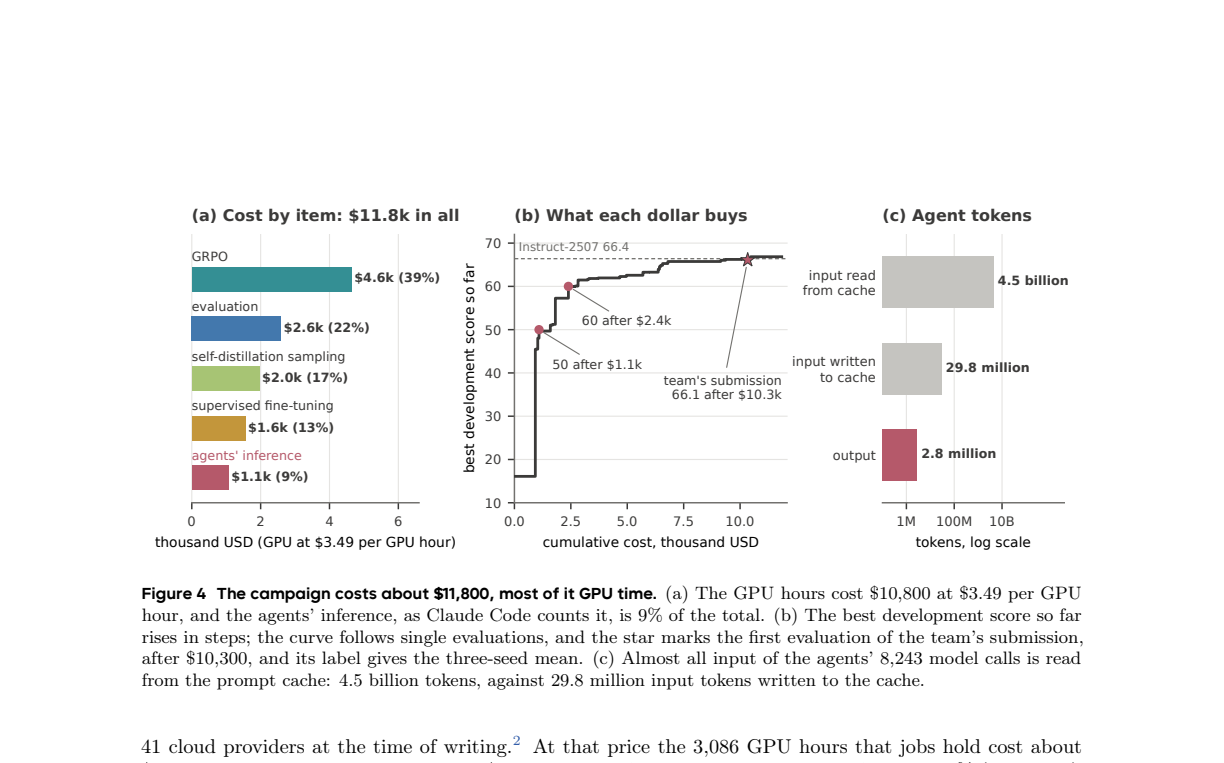
The campaign's total cost of ~$12,000 (GPU + inference) suggests that automated post-training is already economically viable for practical applications at the 4B scale, and cost could drop further with more efficient agents or hardware.
The finding that agents rarely verify answer correctness points to a systematic weakness in current agent-based research: they trust data quality rather than ground truth. A future system could add automated answer verification as a service, potentially improving data quality and model safety.
Check this review
Pith stored no record of this review's passes and took no fingerprint of it. Reviews made by code from 13 Nov 2026 on carry both.
How often reviews like this one are right
Reviews like this one: written by deepseek-v4-flash, where what was read was not recorded.
How often objections from reviews like this one are right: not yet measured
Reviews by people
This review was written by a machine. No person has reviewed this paper on Pith yet. A scientist listed on Pith can review it for a fee, and their review is published here whatever it concludes.
The paper
Abstract
Recursive self-improvement, in which AI systems build stronger AI systems, is one promising route to superintelligence. We study a weaker form that can be measured today: frontier agents post-training a small raw base model with public data, as a test of their research potential. We build Athanor, an open agent-native system for autonomous post-training research (AutoPostTrain) on real GPUs. We give the agents full research autonomy, low-friction engineering tools, and efficient starter code. The agents carry out the research themselves: they read datasets and evaluation results, build their training data, write and modify training algorithms, tune hyperparameters, and analyze the results to decide what to try next. They work in a sandbox and cannot use external teacher models. Athanor's services supply frozen evaluation, managed jobs, decontaminated data, a persistent research record, and a held-out suite the agents are unaware of. In a 104-hour campaign, a team of four Claude Opus 5.5 agents, each on an eight-GPU node and given no research advice, improves Qwen3-4B-Base from 15.9 to 67.3 on a six-task development suite and from 9.2 to 48.2 on a held-out suite, against 66.5 and 47.9 for the official Qwen3-4B-Instruct-2507. To our knowledge, this is the first demonstration that a team of frontier agents can autonomously post-train a raw base model into a cross-domain generalist model that matches or surpasses the official instruct version on average. The campaign's full record shows that the agents reach this level by recombining known methods and each other's models: SFT on public reasoning data, RL with a rollout change one agent introduced, weight merges across agents, and rounds of self-distillation. With execution handled, today's agents already have the engineering and research ability to conquer this task. We hope Athanor provides a foundation for scaling autonomous AI research.
The paper's own sentences, arranged, kept beside the review and separate from it. Each label is drawn from a closed vocabulary; the number beside it is the probability the classifier gave that label. No sentence in this record was written by a model.
abstract compiled · 2026-10-16
The authors' main claim, as the classifier picked it out 0.65
“To our knowledge, this is the first demonstration that a team of frontier agents can autonomously post-train a raw base model into a cross-domain generalist model that matches or surpasses the official instruct version on average.”
How the main claim is stated: asserted 0.99
What the abstract itself states, as probabilities: claims first 0.93 · states limitation 0.73 · human participants 0.06 · controlled comparison 0.84 · randomized assignment 0.02 · states quantitative result 0.99 · compares with prior results 0.96 · mentions code or data availability 0.76
The abstract, sentence by sentence
This table labels the abstract only (arXiv listing abstract v1). The number is the probability the classifier gave the label.
| Sentence | Role | The authors' own work | States the main conclusion | Strength |
|---|---|---|---|---|
| Recursive self-improvement, in which AI systems build stronger AI systems, is one promising route to superintelligence. | background 1.00 | 0.04 | 0.03 | hedged possibility 0.64 |
| We study a weaker form that can be measured today: frontier agents post-training a small raw base model with public data, as a test of their research potential. | background 0.48 | 0.44 | 0.04 | asserted 0.88 |
| We build Athanor, an open agent-native system for autonomous post-training research (AutoPostTrain) on real GPUs. | contribution 0.88 | 0.96 | 0.04 | asserted 1.00 |
| We give the agents full research autonomy, low-friction engineering tools, and efficient starter code. | method 0.68 | 0.85 | 0.03 | asserted 0.99 |
| The agents carry out the research themselves: they read datasets and evaluation results, build their training data, write and modify training algorithms, tune hyperparameters, and analyze the results to decide what to try next. | method 0.97 | 0.68 | 0.05 | asserted 1.00 |
| They work in a sandbox and cannot use external teacher models. | method 0.62 | 0.73 | 0.02 | asserted 1.00 |
| Athanor's services supply frozen evaluation, managed jobs, decontaminated data, a persistent research record, and a held-out suite the agents are unaware of. | method 0.93 | 0.88 | 0.03 | asserted 1.00 |
| In a 104-hour campaign, a team of four Claude Opus 5.5 agents, each on an eight-GPU node and given no research advice, improves Qwen3-4B-Base from 15.9 to 67.3 on a six-task development suite and from 9.2 to 48.2 on a held-out suite, against 66.5 and 47.9 for the official Qwen3-4B-Instruct-2507. | result 1.00 | 0.95 | 0.27 | asserted 1.00 |
| To our knowledge, this is the first demonstration that a team of frontier agents can autonomously post-train a raw base model into a cross-domain generalist model that matches or surpasses the official instruct version on average. | interpretation 0.50 | 0.93 | 0.74 | asserted 0.99 |
| The campaign's full record shows that the agents reach this level by recombining known methods and each other's models: SFT on public reasoning data, RL with a rollout change one agent introduced, weight merges across agents, and rounds of self-distillation. | interpretation 0.55 | 0.94 | 0.13 | asserted 1.00 |
| With execution handled, today's agents already have the engineering and research ability to conquer this task. | interpretation 1.00 | 0.67 | 0.45 | asserted 0.98 |
| We hope Athanor provides a foundation for scaling autonomous AI research. | future work 1.00 | 0.11 | 0.07 | hedged possibility 0.55 |
What kind of paper the classifier reports this is: method or tool 0.82 · evidence from observation or experiment 0.97
What was examined, and what was not
Sources read
- arXiv listing abstract v1
Not examined
- full text
- figures and tables
- references and citing sentences
- relations to other papers
Levels run
- P abstract
Not run
- S sections
- T body sentences
- C citations
- R cross-paper relations
How the labels were made
Compiled by classifier-1.13.0 via TypeSafe API, question bank abstract-p1-20260923, 2026-10-16: 1 request, 9,134 input tokens.
Every quoted sentence on this record is the authors'. Every label is from Pith's closed vocabulary, with the probability shown beside it. This record as JSON
Figures (12)




Showing 10 of the paper's 12 figures. Figures are the authors', reproduced from the paper.
References (84)
- [1] a-m-team. AM-Thinking-v1-Distilled. Hugging Face dataset, https://huggingface.co/datasets/a-m-team/AM-Thinking-v1-Distilled , 2025 on Pith
- [2] Dario Amodei. We must pace the frontier.https://darioamodei.com/post/we-must-pace-the-frontier , September 2026 on Pith
- [3] Anthropic. Introducing Claude Opus 5.5.https://www.anthropic.com/claude-opus-5-5, September 2026 on Pith
- [4] Anthropic Frontier Red Team. Patterns and problems in emerging multiagent systems. https://www.anthropic.com/research/multiagent-systems, August 2026 on Pith
- [5] Bake AI. RSI Arena: Can AI agents train a model that wins in human evaluation?https://rsiarena.org/, September 2026 on Pith
- [6] Mislav Balunović, Jasper Dekoninck, Ivo Petrov, Nikola Jovanović, and Martin Vechev. MathArena: Evaluating LLMs on uncontaminated math competitions. InAdvances in Neural Information Processing Systems, volume 38. Curran Associates, Inc., 2025. doi: 10.52202/085713-0679. URLhtt... on Pithdoi:10.52202/085713-0679
- [7] Ziyang Cai, Christos Ziakas, Vasilis Kontonis, Tim Pearce, Siddhartha Sen, Akshay Krishnamurthy, Shivam Garg, and Dimitris Papailiopoulos. Fork-and-flush: Escaping idea basins in autoresearch agents.arXiv preprint arXiv:2610.07447, 2026 on PithPith's reviewarXiv
- [8] Alan Chan, Christoph Winter, Andrew Barto, Jakub Pachocki, Geoffrey Hinton, et al. What if automating AI R&D triggers an intelligence explosion?arXiv preprint arXiv:2609.36054, 2026 on PithPith's reviewarXiv
- [9] Jun Shern Chan, Neil Chowdhury, Oliver Jaffe, James Aung, Dane Sherburn, Evan Mays, Giulio Starace, Kevin Liu, Leon Maksin, Tejal Patwardhan, Aleksander Madry, and Lilian Weng. MLE-bench: Evaluating machine learning agents on machine learning engineering. InThe Thirteenth Inte... on Pith
- [10] Guhong Chen, Yingcheng Shi, Yongbin Li, Binhua Li, Xander Xu, Hu Wei, Shiwen Ni, Min Yang, and Jieping Ye. EvoTrainer: Co-evolving LLM policies and training harnesses for autonomous agentic reinforcement learning. arXiv preprint arXiv:2606.03108, 2026. URL https://arxiv.org/ab... on PithPith's reviewarXiv
- [11] Huanran Chen, Huaqing Zhang, Xiao Li, Yinpeng Dong, Ke Shen, and Jun Zhu. Nexus: Same pretraining loss, better downstream generalization via common minima.arXiv preprint arXiv:2604.09258, 2026. URL https://arxiv.org/abs/2604.09258 on PithPith's reviewarXiv
- [12] Wanyi Chen, Xiao Yang, Xu Yang, Tianming Sha, Qizheng Li, Zhuo Wang, Bowen Xian, Fang Kong, Weiqing Liu, and Jiang Bian. Agent2 RL-Bench: Can LLM agents engineer agentic RL post-training?arXiv preprint arXiv:2604.10547, 2026 on PithPith's reviewarXiv
- [13] Yueh-Han Chen, Jiaxin Wen, and Jan Hendrik Kirchner. Automated researchers can mitigate well-characterized alignment failures. arXiv preprint arXiv:2608.28945, 2026. URL https://arxiv.org/abs/2608.28945 on PithPith's reviewarXiv
- [14] DeepSeek-AI. DeepSeek-V4: Towards highly efficient million-token context intelligence.arXiv preprint arXiv:2606.19348, 2026. URL https://arxiv.org/abs/2606.19348 on PitharXiv
- [15] Xeron Du, Yifan Yao, Kaijing Ma, Bingli Wang, Tianyu Zheng, et al. SuperGPQA: Scaling LLM evaluation across 285 graduate disciplines. InAdvances in Neural Information Processing Systems, volume 38. Curran Associates, Inc., 2025. doi: 10.52202/085713-3766. URLhttps://proceeding... on Pithdoi:10.52202/085713-3766
- [16] Yaxin Du, Xiyuan Yang, Zhifan Zhou, Yujie Ge, Cheng Wang, et al. RSI-Master: Structuring experiments to guide autonomous model improvement.arXiv preprint arXiv:2609.35561, 2026 on PithPith's reviewarXiv
- [17] Yaxin Du, Xiyuan Yang, Zhifan Zhou, Wanxu Liu, Zixing Lei, Zimeng Chen, Fenyi Liu, Haotian Wu, Yuzhu Cai, Zexi Liu, et al. DataMaster: Data-centric autonomous AI research.arXiv preprint arXiv:2605.10906, 2026 on PithPith's reviewarXiv
- [18] Haoyang Fang, Wei Zhu, Boran Han, Alex Zhang, Zhenyu Pan, Shuo Yang, Shuai Zhang, Jiading Gai, Peng Tang, Cuixiong Hu, Xuan Zhu, Huzefa Rangwala, George Karypis, and Bernie Wang. LLMZero: Discovering adaptive training strategies for RL post-training via LLM agents.arXiv prepri... on PithPith's reviewarXiv
- [19] Marina Favaro and Jack Clark. When AI builds itself. The Anthropic Institute, https://www.anthropic.com/institute/recursive-self-improvement, 2026 on Pith
- [20] Tim Genewein, Matija Franklin, Alexander Lerchner, Laurent Orseau, Samuel Albanie, et al. From AGI to ASI. arXiv preprint arXiv:2606.12683, 2026. 18 on PithPith's reviewarXiv
show 64 more
- [21] Charles Goddard, Shamane Siriwardhana, Malikeh Ehghaghi, Luke Meyers, Vladimir Karpukhin, Brian Benedict, Mark McQuade, and Jacob Solawetz. Arcee’s MergeKit: A toolkit for merging large language models. In Franck Dernoncourt, Daniel Preoţiuc-Pietro, and Anastasia Shimorina, ed... on Pithdoi:10.18653/v1/202
- [22] Xuchen Gong, Shane Gu, Haokun Liu, Dixi Yao, Chenhao Tan, and Tian Li. Learning scientific exploration from human research decision trajectories.arXiv preprint arXiv:2610.07184, 2026 on PithPith's reviewarXiv
- [23] Irving John Good. Speculations concerning the first ultraintelligent machine. InAdvances in Computers, volume 6, pages 31–88. Elsevier, 1966. doi: 10.1016/S0065-2458(08)60418-0. URL https://www.sciencedirect.com/science/article/pii/S0065245808604180 on Pithdoi:10.1016/s0065-2458(08)60418-0
- [24] Aaron Grattafiori, Abhimanyu Dubey, Abhinav Jauhri, Abhinav Pandey, Abhishek Kadian, Ahmad Al-Dahle, Aiesha Letman, Akhil Mathur, Alan Schelten, Alex Vaughan, et al. The Llama 3 herd of models.arXiv preprint arXiv:2407.21783, 2024 on PithPith's reviewarXiv
- [25] Daya Guo, Dejian Yang, Haowei Zhang, Junxiao Song, Peiyi Wang, Qihao Zhu, Runxin Xu, Ruoyu Zhang, Shirong Ma, Xiao Bi, et al. DeepSeek-R1 incentivizes reasoning in LLMs through reinforcement learning.Nature, 645(8081):633–638, 2025. doi: 10.1038/s41586-025-09422-z. URL https:/... on Pithdoi:10.1038/s41586-025-09422-z
- [26] Karen Hambardzumyan, Nicolas Baldwin, Edan Toledo, Rishi Hazra, Michael Kuchnik, Bassel Al Omari, Thomas Simon Foster, Anton Protopopov, Jean-Christophe Gagnon-Audet, Ishita Mediratta, Kelvin Niu, Michael Shvartsman, Alisia Lupidi, Alexis Audran-Reiss, Parth Pathak, Tatiana Sh... on PithPith's reviewarXiv
- [27] Jordan Hoffmann, Sebastian Borgeaud, Arthur Mensch, Elena Buchatskaya, Trevor Cai, Eliza Rutherford, Diego de Las Casas, Lisa Anne Hendricks, Johannes Welbl, Aidan Clark, et al. Training compute-optimal large language models. InAdvances in Neural Information Processing Systems... on Pithdoi:10.52202/068431-2176
- [28] Gabriel Ilharco, Marco Tulio Ribeiro, Mitchell Wortsman, Suchin Gururangan, Ludwig Schmidt, Hannaneh Hajishirzi, and Ali Farhadi. Editing models with task arithmetic. InInternational Conference on Learning Representations, 2023 on Pith
- [29] Intology. Scaling automated post-training. https://intology.ai/blog/scaling-automated-post-training, 2026 on Pith
- [30] Naman Jain, King Han, Alex Gu, Wen-Ding Li, Fanjia Yan, Tianjun Zhang, Sida I. Wang, Armando Solar-Lezama, Koushik Sen, and Ion Stoica. LiveCodeBench: Holistic and contamination free evaluation of large language models for code. InThe Thirteenth International Conference on Lea... on Pith
- [31] Jiajie Jin, Yuyang Hu, Kai Qiu, Qi Dai, Chong Luo, Guanting Dong, Xiaoxi Li, Tong Zhao, Xiaolong Ma, Gongrui Zhang, Zhirong Wu, Bei Liu, Zhengyuan Yang, Linjie Li, Lijuan Wang, Hongjin Qian, Yutao Zhu, and Zhicheng Dou. Toward generalist autonomous research via hypothesis-tree... on PithPith's reviewarXiv
- [32] Keller Jordan, Jeremy Bernstein, Brendan Rappazzo, @fernbear.bsky.social, Vlado Boza, Jiacheng You, Franz Cesista, Braden Koszarsky, and @Grad62304977. modded-nanogpt: Speedrunning the NanoGPT baseline, 2024. URL https://github.com/KellerJordan/modded-nanogpt on Pith
- [33] Jared Kaplan, Sam McCandlish, Tom Henighan, Tom B Brown, Benjamin Chess, Rewon Child, Scott Gray, Alec Radford, Jeffrey Wu, and Dario Amodei. Scaling laws for neural language models.arXiv preprint arXiv:2001.08361, 2020 on PithPith's reviewarXiv
- [34] Devvrit Khatri, Lovish Madaan, Rishabh Tiwari, Rachit Bansal, Venkata Sai Surya Subramanyam Duvvuri, Manzil Zaheer, Inderjit S. Dhillon, David Brandfonbrener, and Rishabh Agarwal. The art of scaling reinforcement learning compute for LLMs. InThe Fourteenth International Confer... on Pith
- [35] Nathan Lambert. Reinforcement Learning from Human Feedback: LLM Alignment and Post-Training. Manning 19 Publications, July 2026. ISBN 9781633434301. URL https://www.manning.com/books/reinforcement-learning-from-human-feedback on Pith
- [36] Nathan Lambert, Jacob Morrison, Valentina Pyatkin, Shengyi Huang, Hamish Ivison, Faeze Brahman, Lester James Validad Miranda, Alisa Liu, Nouha Dziri, Xinxi Lyu, et al. Tülu 3: Pushing frontiers in open language model post-training. InSecond Conference on Language Modeling, 202... on Pith
- [37] Jin Li, Ahmed Murtadha, Zhiyu Wang, Qiwen Chen, William Chen, Yifei Wu, Guan Wang, Andy L. Siy, Jiayi Yang, Mengsha Huang, Wenhao Li, Yixuan Liu, Shuailin Pan, Mingli Yuan, Sen Song, and Yuhao Sun. Praxist: From experimental artifacts to solution lineages.arXiv preprint arXiv:... on PithPith's reviewarXiv
- [38] Qizheng Li, Yifei Zhang, Xiao Yang, Xu Yang, Zhuo Wang, Bowen Xian, Weiqing Liu, and Jiang Bian. FT-Dojo: Towards autonomous LLM fine-tuning with language agents. InForty-third International Conference on Machine Learning, 2026. URL https://icml.cc/virtual/2026/poster/63475 on Pith
- [39] Joy Jia Yin Lim, Xin Huang, Hao Peng, Yaxi Lu, Xin Cong, Zhong Zhang, Maosong Sun, and Yankai Lin. What is missing from AI post-training AI: An empirical analysis.arXiv preprint arXiv:2608.19072, 2026. URL https://arxiv.org/abs/2608.19072 on PithPith's reviewarXiv
- [40] Bill Yuchen Lin, Ronan Le Bras, Kyle Richardson, Ashish Sabharwal, Radha Poovendran, Peter Clark, and Yejin Choi. ZebraLogic: On the scaling limits of LLMs for logical reasoning. InInternational Conference on Machine Learning, 2025 on Pith
- [41] Haozhe Liu, Tian Ye, Sensen Gao, Qihang Cao, Yitong Li, et al. SoL-Pi: Recursively scaling auto-research loops for efficient agent harness.arXiv preprint arXiv:2609.20519, 2026 on PithPith's reviewarXiv
- [42] Hong Liu, Sang Michael Xie, Zhiyuan Li, and Tengyu Ma. Same pre-training loss, better downstream: Implicit bias matters for language models. InProceedings of the 40th International Conference on Machine Learning, 2023. URL https://icml.cc/virtual/2023/oral/25498 on Pith
- [43] Chris Lu, Cong Lu, Robert Tjarko Lange, Yutaro Yamada, Shengran Hu, Jakob Foerster, David Ha, and Jeff Clune. Towards end-to-end automation of AI research.Nature, 651(8107):914–919, 2026. doi: 10.1038/s41586-026-10265-5. URL https://www.nature.com/articles/s41586-026-10265-5 on Pithdoi:10.1038/s41586-026-10265-5
- [44] Bohan Lyu, Yucheng Yang, Siqiao Huang, Jiaru Zhang, Qixin Xu, Xinghan Li, Xinyang Han, Yicheng Zhang, Huaqing Zhang, Runhan Huang, et al. MLS-Bench: A holistic and rigorous assessment of AI systems on building better AI. arXiv preprint arXiv:2605.08678, 2026. URL https://arxiv... on PithPith's reviewarXiv
- [45] Lovish Madaan, Aaditya K. Singh, Rylan Schaeffer, Andrew Poulton, Sanmi Koyejo, Pontus Stenetorp, Sharan Narang, and Dieuwke Hupkes. Quantifying variance in evaluation benchmarks.arXiv preprint arXiv:2406.10229, 2024 on PithPith's reviewarXiv
- [46] Fanqing Meng, Lingxiao Du, Qiguang Chen, Ziqi Zhao, Haocheng Lu, Mengkang Hu, and Michael Qizhe Shieh. RSIBench-Data: Benchmarking data-centric research for recursive self-improvement.arXiv preprint arXiv:2607.25886, 2026 on PithPith's reviewarXiv
- [47] Fanqing Meng, Lingxiao Du, Haocheng Lu, Qiguang Chen, Ziqi Zhao, Zijian Wu, Jiayuan Zhuo, Mengkang Hu, and Michael Qizhe Shieh. RSIGym: A flexible environment for recursive self-improvement.arXiv preprint arXiv:2610.10310, 2026 on PithPith's reviewarXiv
- [48] Alexander Novikov, Ngân V˜ u, Marvin Eisenberger, Emilien Dupont, Po-Sen Huang, Adam Zsolt Wagner, Sergey Shirobokov, Borislav Kozlovskii, Francisco J. R. Ruiz, Abbas Mehrabian, et al. AlphaEvolve: A coding agent for scientific and algorithmic discovery.arXiv preprint arXiv:25... on PithPith's reviewarXiv
- [49] OpenAI. Learning to reason with LLMs.https://openai.com/index/learning-to-reason-with-llms/ , 2024 on Pith
- [50] OpenAI. Research acceleration: The view inside OpenAI. https://openai.com/index/research-acceleration-view-inside-openai/ , September 2026 on Pith
- [51] Jongho Park, Vasilis Kontonis, Shivam Garg, Akshay Krishnamurthy, and Dimitris Papailiopoulos. Scaling discovery through test-time communication.arXiv preprint arXiv:2609.21032, 2026 on PithPith's reviewarXiv
- [52] Valentina Pyatkin, Saumya Malik, Victoria Graf, Hamish Ivison, Shengyi Huang, Pradeep Dasigi, Nathan Lambert, and Hanna Hajishirzi. Generalizing verifiable instruction following. InAdvances in Neural Information Processing Systems, volume 38. Curran Associates, Inc., 2025. doi... on Pithdoi:10.52202/085713-1645
- [53] Ao Qu, Han Zheng, Zijian Zhou, Yihao Yan, Yihong Tang, Shao Yong Ong, Fenglu Hong, Kaichen Zhou, Chonghe Jiang, Minwei Kong, Jiacheng Zhu, Xuan Jiang, Sirui Li, Cathy Wu, Bryan Kian Hsiang Low, Jinhua Zhao, and Paul Pu Liang. CORAL: Towards autonomous multi-agent evolution for... on PithPith's reviewarXiv
- [54] Qwen Team. Qwen3.5: Towards native multimodal agents.https://qwen.ai/blog?id=qwen3.5, 2026 on Pith
- [55] Ben Rank, Hardik Bhatnagar, Ameya Prabhu, Shira Eisenberg, Karina Nguyen, Matthias Bethge, and Maksym Andriushchenko. PostTrainBench: Can LLM agents automate LLM post-training? InForty-third International Conference on Machine Learning, 2026. URL https://icml.cc/virtual/2026/p... on Pith
- [56] Stuart Russell and Peter Norvig.Artificial Intelligence: A Modern Approach. Pearson, 4th edition, 2021 on Pith
- [57] Jürgen Schmidhuber. Gödel machines: Fully self-referential optimal universal self-improvers. InArtificial General Intelligence, pages 199–226. Springer, 2007. doi: 10.1007/978-3-540-68677-4_7. URL https://link.springer.com/chapter/10.1007/978-3-540-68677-4_7 on Pithdoi:10.1007/978-3-540-68677-4_7
- [58] Ozan Sener and Vladlen Koltun. Multi-task learning as multi-objective optimization. InAdvances in Neural Information Processing Systems, volume 31. Curran Associates, Inc., 2018. URLhttps: //proceedings.neurips.cc/paper_files/paper/2018/file/432aca3a1e345e339f35a30c8f65edce-Paper.pdf on Pith
- [59] Zhihong Shao, Peiyi Wang, Qihao Zhu, Runxin Xu, Junxiao Song, Xiao Bi, Haowei Zhang, Mingchuan Zhang, Y. K. Li, Y. Wu, and Daya Guo. DeepSeekMath: Pushing the limits of mathematical reasoning in open language models. arXiv preprint arXiv:2402.03300, 2024 on PithPith's reviewarXiv
- [60] Guangming Sheng, Chi Zhang, Zilingfeng Ye, Xibin Wu, Wang Zhang, Ru Zhang, Yanghua Peng, Haibin Lin, and Chuan Wu. HybridFlow: A flexible and efficient RLHF framework. InProceedings of the Twentieth European Conference on Computer Systems, pages 1279–1297. Association for Comp... on Pithdoi:10.1145/3689031.3696075
- [61] Zhan Shi, Bing He, Yisi Sang, Benoit Dumoulin, and Hanqing Lu. A-Evolve-Training: Autonomous post-training of a 30B model.arXiv preprint arXiv:2606.20657, 2026 on PithPith's reviewarXiv
- [62] Mohit Shridhar, Xingdi Yuan, Marc-Alexandre Côté, Yonatan Bisk, Adam Trischler, and Matthew Hausknecht. ALFWorld: Aligning text and embodied environments for interactive learning. InInternational Conference on Learning Representations, 2021 on Pith
- [63] Richard S. Sutton. The bitter lesson.http://www.incompleteideas.net/IncIdeas/BitterLesson.html, March 2019 on Pith
- [64] Xiaohua Wang, Muzhao Tian, Yuqi Zeng, Zisu Huang, Jiakang Yuan, Bowen Chen, Jingwen Xu, Mingbo Zhou, Wenhao Liu, Muling Wu, et al. Reward hacking in the era of large models: Mechanisms, emergent misalignment, challenges. arXiv preprint arXiv:2604.13602, 2026 on PithPith's reviewarXiv
- [65] Yubo Wang, Xueguang Ma, Ge Zhang, Yuansheng Ni, Abhranil Chandra, Shiguang Guo, Weiming Ren, Aaran Arulraj, Xuan He, Ziyan Jiang, Tianle Li, Max Ku, Kai Wang, Alex Zhuang, Rongqi Fan, Xiang Yue, and Wenhu Chen. MMLU-Pro: A more robust and challenging multi-task language unders... on Pithdoi:10.52202/079017-3018
- [66] Hjalmar Wijk, Tao Roa Lin, Joel Becker, Sami Jawhar, Neev Parikh, Thomas Broadley, Lawrence Chan, Michael Chen, Joshua M. Clymer, Jai Dhyani, Elena Ericheva, Katharyn Garcia, Brian Goodrich, Nikola Jurkovic, Megan Kinniment, Aron Lajko, Seraphina Nix, Lucas Jun Koba Sato, Will... on Pith
- [67] Mitchell Wortsman, Gabriel Ilharco, Samir Yitzhak Gadre, Rebecca Roelofs, Raphael Gontijo-Lopes, Ari S. Morcos, Hongseok Namkoong, Ali Farhadi, Yair Carmon, Simon Kornblith, and Ludwig Schmidt. Model soups: averaging weights of multiple fine-tuned models improves accuracy with... on Pith
- [68] Peng Xia, Rujun Han, Zifeng Wang, Yanfei Chen, Yufan Zhuang, Yoonho Lee, Chengsong Huang, Han Yu, Zhongying CuiZhu, Yifei Ming, Huaxiu Yao, Burak Gokturk, Tomas Pfister, and Chen-Yu Lee. RRSI: Regularized recursive self-improvement of agent harnesses.arXiv preprint arXiv:2609.... on PithPith's reviewarXiv
- [69] Cheng Xu, Shuhao Guan, Derek Greene, and M-Tahar Kechadi. Benchmark data contamination of large language models: A survey.arXiv preprint arXiv:2406.04244, 2024. 21 on PithPith's reviewarXiv
- [70] Zhangchen Xu, Junda Chen, Yue Huang, Dongfu Jiang, Jiefeng Chen, Hang Hua, Zijian Wu, Zheyuan Liu, Zexue He, Lichi Li, Shizhe Diao, Jiaxin Pei, Jinsung Yoon, Hao Zhang, Mengdi Wang, Radha Poovendran, Misha Sra, Alex Pentland, and Zichen Chen. AutoLab: Can frontier models solve... on PithPith's reviewarXiv
- [71] Prateek Yadav, Derek Tam, Leshem Choshen, Colin Raffel, and Mohit Bansal. TIES-merging: Resolving interference when merging models. InAdvances in Neural Information Processing Systems, 2023 on Pith
- [72] An Yang, Anfeng Li, Baosong Yang, Beichen Zhang, Binyuan Hui, Bo Zheng, Bowen Yu, Chang Gao, Chengen Huang, Chenxu Lv, et al. Qwen3 technical report.arXiv preprint arXiv:2505.09388, 2025 on PithPith's reviewarXiv
- [73] Zhuolin Yang, Zihan Liu, Yang Chen, Wenliang Dai, Boxin Wang, Sheng-Chieh Lin, Chankyu Lee, Yangyi Chen, Dongfu Jiang, Jiafan He, et al. Nemotron-Cascade 2: Post-training LLMs with cascade RL and multi-domain on-policy distillation. arXiv preprint arXiv:2603.19220, 2026 on PitharXiv
- [74] Le Yu, Bowen Yu, Haiyang Yu, Fei Huang, and Yongbin Li. Language models are super Mario: Absorbing abilities from homologous models as a free lunch. InProceedings of the 41st International Conference on Machine Learning, 2024 on Pith
- [75] Zhaojian Yu, Penghao Yin, Shuzheng Gao, Shilin He, Kai Cai, and Xiao-Ping Zhang. AutoTrainess: Teaching language models to improve language models autonomously.arXiv preprint arXiv:2606.31551, 2026 on PithPith's reviewarXiv
- [76] Zheng Yuan, Hongyi Yuan, Chengpeng Li, Guanting Dong, Keming Lu, Chuanqi Tan, Chang Zhou, and Jingren Zhou. Scaling relationship on learning mathematical reasoning with large language models.arXiv preprint arXiv:2308.01825, 2023 on PithPith's reviewarXiv
- [77] Z.ai. Toward recursive self-improvement: How GLM built its own inference infrastructure. Z.ai blog, https://z.ai/blog/glm-built-its-inference-infrastructure , September 2026 on Pith
- [78] Eric Zelikman, Yuhuai Wu, Jesse Mu, and Noah D. Goodman. STaR: Bootstrapping reasoning with reasoning. In Advances in Neural Information Processing Systems, 2022 on Pith
- [79] Charlie Zhang, Graham Neubig, and Xiang Yue. On the interplay of pre-training, mid-training, and RL on reasoning language models. InForty-third International Conference on Machine Learning, 2026. URL https://openreview.net/forum?id=TBaUfO9znF on Pith
- [80] Jenny Zhang, Shengran Hu, Cong Lu, Robert Tjarko Lange, and Jeff Clune. Darwin Gödel machine: Open-ended evolution of self-improving agents. InThe Fourteenth International Conference on Learning Representations, on Pith
- [81] Tianyu Zhang, Hanlin Gao, Yusong Gao, and Yun Zhang. Infer-forge: Harness, loop, and graph engineering around SGLang. LMSYS Org blog, https://www.lmsys.org/blog/2026-08-28-infer-forge-loop-engineering/ , August 2026 on Pith
- [82] Yifan Zhang, Yunheng Zou, Shaokun Zhang, Jian Hu, Hao Zhang, Binfeng Xu, Jan Kautz, and Yi Dong. Agora: Git as shared memory for collective AutoResearch.arXiv preprint arXiv:2609.18094, 2026 on PithPith's reviewarXiv
- [83] Jeffrey Zhou, Tianjian Lu, Swaroop Mishra, Siddhartha Brahma, Sujoy Basu, Yi Luan, Denny Zhou, and Le Hou. Instruction-following evaluation for large language models.arXiv preprint arXiv:2311.07911, 2023. URL https://arxiv.org/abs/2311.07911. 22 Contents 1 Introduction . . . .... on PithPith's reviewarXiv
- [2026] URL https://openreview.net/forum?id=pUpzQZTvGY on Pith
Cited by 2 Pith papers
Reviewed papers on Pith that cite this one. The full citation record
Challenges and discussion
Disagree with the review, or know something it missed? Leave a comment, or challenge this review formally: a challenge becomes a permanent entry in this paper's record, and its decision is published here.
Come back by email
A short list of the week's newly reviewed papers. Nothing is sent until you confirm from your inbox, and every email has a link that stops it. No account.
No comments yet.
Sign in to comment