Computation and Language · arXiv:2610.24944 v1 · submitted 18 Oct 2026 · 36 references
Epi: Towards a Persistent, Self-Improving Agent for Autonomous Research
The paper says
“We present Épi, an autonomous research agent that sustains investigations across model sessions and evolves its methods through accumulated experience. Épi combines persistent research history, hierarchical memory, branching and independent review to maintain research continuity, learn from experiments, and explore and revisit alternative approaches.”
more of the abstract
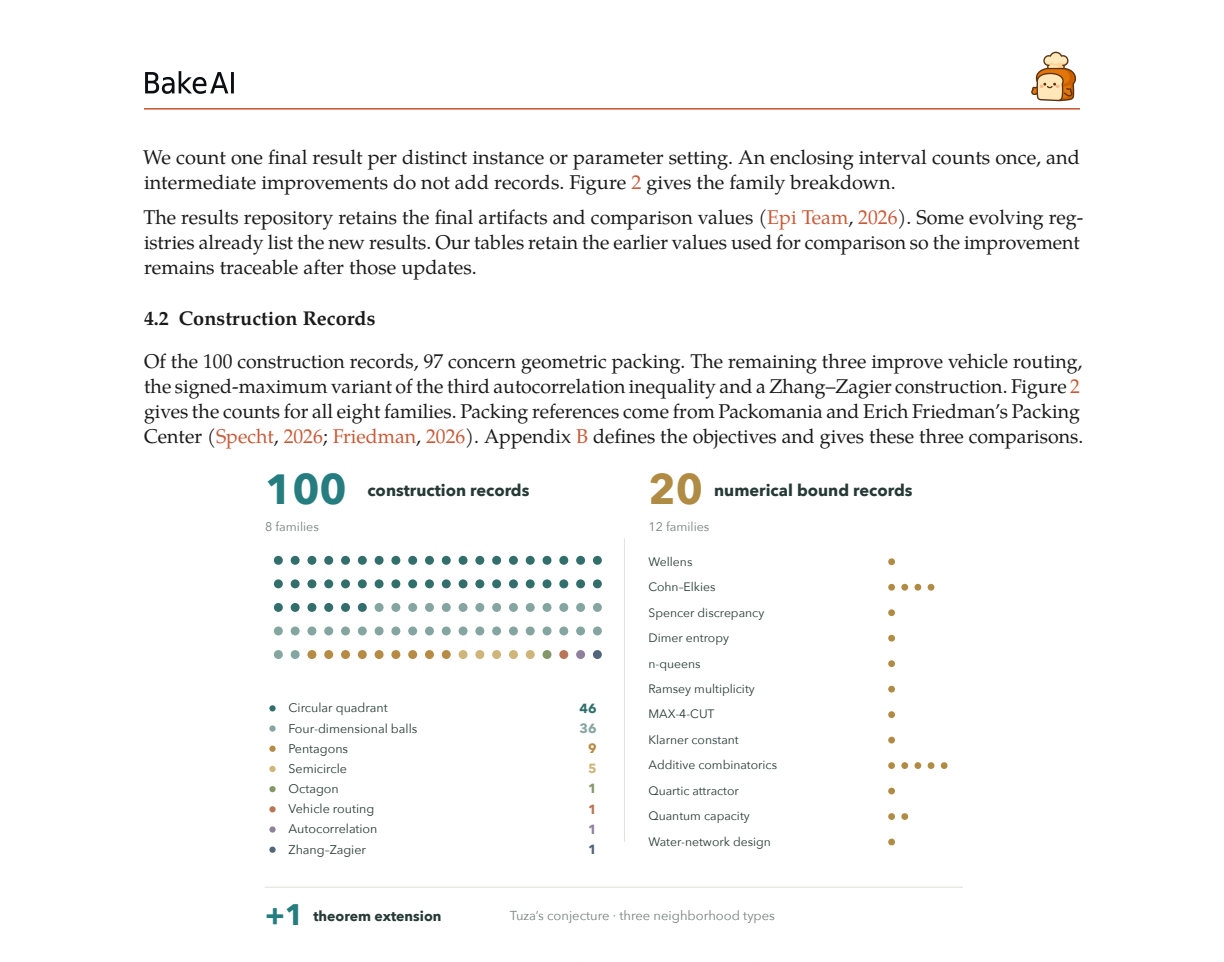
Its experiments run across session boundaries, and a fixed verifier evaluates their outputs. Épi produced 120 record-setting results, comprising 20 numerical bound records across 12 families and 100 construction records across eight families. These include an approximately 84-fold narrower interval for the n-queens constant and a more than 3.6-million-fold narrower rigorous interval for the quartic Feigenbaum attractor dimension. Exact dual certificates establish that the Cohn-Elkies linear-programming bound cannot be sharp in dimensions 10 and 11. Beyond numerical improvements, Épi gives a computer-assisted proof of Tuza's conjecture for split graphs with an eight-vertex clique part and at most three triangle-active neighborhood types, with arbitrary multiplicities. We extend this research process to algorithmic coding with Épi-turbo, a lightweight configuration that develops executable solvers for tasks including vehicle routing, scheduling and production planning. On 30 FrontierOR tasks, Épi-turbo achieves a 5.4% higher total benchmark score than Codex at 64% of its model cost, using the same underlying model and reasoning effort. Épi is designed to support human understanding by connecting computational results to explicit methods and mathematical arguments that researchers can examine and build upon.
from the abstract
Pith says
Machine review · deepseek-v4-flash · 20 Oct 2026 · what was read was not recorded · not checked by a person
It can be wrong. Challenge this review or reply to it.
The passes disagreed. Reader: holds up. Skeptic: holds up only with conditions. Referee: major revision.
A technically impressive autonomous-research paper with a load-bearing gap in its signature proof that a referee can address. This line is wrong
2 major objections · 6 minor
How often objections from reviews like this one are right: not yet measured
Not checked: figures, code, what the 36 references say.
The paper says, at Section 5.7, Appendix A.13
The review did not quote this passage.
Pith says: Objection 1 of 2 · major
The proof of Theorem 1 (Tuza's conjecture for three neighborhood types) depends on a 'multiplicity-truncation lemma' cited as 'Zeng, 2026, Preprints.org'—an unpublished, non-peer-reviewed source. The paper provides no statement of the lemma, no verification of its hypotheses in the specific profile settings, and no independent proof.
more of objection 1
The finite enumeration of 872 profiles and 18,444 boxes is machine-checked, but extending these checks to arbitrary infinite multiplicities rests entirely on the lemma. If the lemma is incorrect or inapplicable, the advertised computer-assisted proof is incomplete. The authors must either supply a self-contained proof of the truncation lemma, cite a peer-reviewed publication that contains it, or explicitly state the result as conditional on the lemma's validity, explaining why the finite checks suffice under the assumed hypotheses.
This review says the paper's mathematics is wrong. Pith did not check that against the paper's source.
The paper says, at Section 6.3, Table 3
The review did not quote this passage.
Pith says: Objection 2 of 2 · major
The FrontierOR evaluation reports a single run per task per system. The authors acknowledge 'we do not report statistical significance' (Section 6.2), yet the abstract and conclusion present the 5.4% improvement as a definitive result. Single-run comparisons are subject to considerable variance; without multiple runs or a significance test, the claim of superiority is not robust.
more of objection 2
The authors should either provide multiple runs (e.g., 5–10) with standard errors, or explicitly state that the reported scores are observed values from one trial each and refrain from claiming a general improvement without caveats. This does not invalidate the results but weakens their generality.
6 minor objections
The paper says, at Section 4.3, Table 1
Pith says: minor objection 1 of 6
The table uses arrows (↑, ↓) to indicate improving direction, but the meaning is not defined in the caption or nearby text. Please add a sentence clarifying that the arrow shows the direction of improvement (e.g., ↑ means higher is better).
The paper says, at Section 5.5
Pith says: minor objection 2 of 6
The phrase 'Exhausting its 256 sign assignments gives row-maximum norms of five or seven, so the minimum is five' could be misread. The row-maximum norms are computed for each assignment; the minimum across assignments is five. Consider rephrasing to 'For each of the 256 sign assignments, the row-maximum norm is either five or seven; the minimum over all assignments is therefore five.'
show 4 more
The paper says, at Appendix A.4
Pith says: minor objection 3 of 6
The reported upper bound 0.452010 is described as 'rounded upward.' It would be helpful to specify the number of safe digits or the exact bound used for rounding, to allow reproducibility.
The paper says, at Appendix A.13
Pith says: minor objection 4 of 6
The sentence 'Every triangle uses a clique edge, so a packing uses at most 28 triangles and at most 28 independent vertices of any type' is unclear. Please clarify the reasoning that bounds the packing size by 28 per type, given that a triangle packing can include triangles from different types. Provide a brief justification or reference to the lemma.
The paper says, at References
Pith says: minor objection 5 of 6
Several references are to arXiv preprints with version numbers (e.g., 'arXiv:2605.09138v2'). While acceptable, the authors should verify that these are the most current versions or that the cited version contains the claimed result. For the Zeng (2026) preprint, the URL is 'https://www.preprints.org/manuscript/202608.1304'—this is a non-standard repository that may not be indexed; consider providing a more accessible version or a detailed summary.
The paper says, at General
Pith says: minor objection 6 of 6
The paper uses 'ruler' to denote the evaluation rule. The term is unconventional and may confuse readers. Consider using 'evaluation rule' or 'scoring rule' consistently, or define 'ruler' more prominently in the introduction.
What would settle it
Independently derive and formally verify the multiplicity-truncation lemma for the specific case of an 8-vertex clique and three neighborhood types, either by a complete combinatorial argument or using a proof assistant (e.g., Lean), confirming that truncating each type to 28 copies preserves both τ△ and ν△ for all 560 non-trivial profiles. The authors could supply a self-contained proof of the lemma in a revision.
from the skeptic's reading
How the review went
4 readings by deepseek-v4-flash · 20 Oct 2026
- Reader holds up
- Skeptic agrees: says it holds up only with conditions The computer-assisted proof of Tuza's conjecture (Theorem 1) depends on an unpublished, non-peer-reviewed lemma (Zeng, 2026, Preprints.org) that is neither reproduced nor independently verified; if the lemma is incorrect the proof fails.
- Editor wrote the verdict above
- Referee major revision: 2 major objections, 6 minor
Not run on this paper: the simulated authors' defence.
Pith did not check this review's objections against the paper.
The review in full
The review in brief, machine-written
This paper reports an autonomous research agent that produces 120 verifiable record-setting results across packing, numerical bounds, and combinatorial optimization. The architecture—hierarchical memory, versioned branches, independent review, fixed verifier—is well-described and clearly motivated. The verification protocol is rigorous: exact arithmetic, outward rounding, independent checkers, released artifacts. Most results, including the 84-fold narrower n-queens interval, the 3.6-million-fold narrower Feigenbaum interval, and the Cohn-Elkies separation in dimensions 10 and 11, stand on their own even if the Tuza part is set aside.
The soft spot is the computer-assisted proof of Tuza's conjecture (Theorem 1). The proof depends on a multiplicity-truncation lemma cited as 'Zeng, 2026, Preprints.org'—an unpublished, non-peer-reviewed preprint. The paper gives no derivation, no check of the lemma's hypotheses in the specific setting, and no independent verification. The finite enumeration of 872 profiles and 18,444 boxes is machine-checked, but the infinite extension relies entirely on the lemma. If the lemma has a hidden assumption or error, Theorem 1 is unproven. The paper does not overstate this—it cites the source—but the claim is load-bearing for that case. The other 120 records do not share this vulnerability.
Minor concerns: The FrontierOR benchmark has only one run per task, so the 5.4% score improvement lacks statistical significance. The authors note this honestly. Some reference values are acknowledged as weak. These are minor.
Overall, the paper shows serious engineering and produces genuinely checkable advances. The Tuza gap is real but bounded: it affects one theorem, not the collection. A referee should examine the lemma carefully; the rest of the paper will hold up.
This paper is for researchers building automated discovery systems and for mathematicians interested in computer-assisted proof. It deserves a serious referee. I would accept peer review and recommend citing the numerical and construction results.
The strongest objection
The Tuza proof (Section 5.7, Appendix A.13) asserts that Zeng's multiplicity-truncation lemma extends finite certificates to arbitrary infinite multiplicities. This lemma is cited as 'Zeng, 2026, Preprints.org'—an unpublished, non-peer-reviewed source. The paper provides no derivation, no check of the lemma's hypotheses in the specific profile settings, and no independent verification. The finite enumeration of 872 profiles and 18,444 boxes is machine-checked, but that only shows correctness for truncated graphs; the infinite claim depends entirely on the lemma. If the lemma has a hidden assumption or error, Theorem 1 is unproven. This is load-bearing because the paper advertises a computer-assisted proof as a central achievement; without the lemma the proof is incomplete.
The reader identified the same weakest assumption: reliance on the unpublished Zeng lemma. I concur that this is the most load-bearing concern because the Tuza proof is a prominently advertised contribution, yet its infinite extension step rests entirely on an unchecked external result. The rest of the paper's contributions—120 record-setting results including packing constructions, Cohn-Elkies separation, n-queens constant, quartic attractor dimension, MAX-4-CUT gap, etc.—are supported by released certificates and do not depend on this lemma. Thus the overall paper remains strong; the Tuza claim is a separate part. The reader's ACCEPT verdict is reasonable given the paper's breadth, but the Tuza claim warrants a conditional acceptance: the proof can be accepted only if the lemma is independently verified or the authors provide a self-contained derivation. This adjustment reflects the fragility of a single load-bearing step in an otherwise well-supported work.
The referee's report
If the claims hold, the paper demonstrates a substantial advance in autonomous research agents that can produce verifiable, non-trivial results across multiple mathematical domains and algorithmic coding tasks. The verification methodology (exact arithmetic, outward rounding, independent checkers, released artifacts) sets a high standard for reproducibility in AI-driven discovery. The collection of 120 record-setting results, particularly the drastic narrowing of certified intervals and the separation result for the Cohn-Elkies bound, would be of immediate interest to researchers in optimization, discrete geometry, and combinatorics. The Épi-turbo results suggest that persistent, structured research processes can yield more efficient algorithm design than standard coding agents. However, the overall significance is tempered by the reliance of the Tuza proof on an unpublished lemma and by the limited statistical basis of the FrontierOR evaluation.
Pith's reading of the paper (a machine's summary, not the authors')
The paper introduces Épi, an autonomous research agent designed to sustain long-term investigations across model sessions. It combines hierarchical memory, versioned branches for exploring alternatives, and independent review to improve its methods over time. The agent produced 120 record-setting results across mathematical optimization, packing problems, and algorithmic coding. These include a 3.6-million-fold narrowing of the Feigenbaum attractor dimension interval and a separation of the Cohn-Elkies bound in dimensions 10 and 11. Épi also provides a computer-assisted proof of Tuza's conjecture for split graphs with eight-vertex clique part and three neighborhood types, with arbitrary multiplicities.
What carries the argument. Hierarchical memory that separates immediate context from reusable experience, versioned branches for developing and comparing alternative methods, independent review (a separate model evaluating research progress), and a fixed verifier that evaluates all candidates under a common ruler. Together, these allow the agent to sustain investigations across sessions and accumulate knowledge.
Core claim. The central claim is that a persistent, self-improving agent can achieve state-of-the-art results across diverse mathematical and algorithmic domains by using a fixed verifier, hierarchical memory for lessons and dead ends, and branching to explore method variations. The agent's campaigns produced 100 improved constructions (mostly geometric packings) and 20 numerical bound records. Specifically, it narrowed the n-queens constant interval by a factor of 84, tightened the quartic Feigenbaum attractor dimension interval by over 3.6 million times, and found exact dual certificates proving the Cohn-Elkies LP bound cannot be sharp in dimensions 10 and 11. In algorithmic coding, the lightweight Épi-turbo configuration outperformed Codex on 30 FrontierOR tasks, achieving 5.4% higher total score at 64% of the cost.
The premise it rests on. The Tuza theorem proof relies on a finite reduction lemma from an unpublished preprint that extends finite checks to arbitrary infinite multiplicities; if that lemma fails, the proof does not cover the infinite family.
If the paper is right (Pith's inferences, not the authors')
Autonomous research agents can now tackle problems requiring sustained effort and method evolution beyond single-session constraints.
The Cohn-Elkies method is definitively limited in dimensions 10 and 11, guiding future sphere-packing bound research.
The Tuza proof technique extends to infinite graph families via finite truncation, a template for other combinatorial conjectures.
Self-improving coding agents can match or exceed dedicated baselines at lower compute cost.
The record constructions provide new reference points for geometric packing and optimization.
The architecture suggests a general recipe: persistent storage plus fixed verifier plus branching plus review could be applied to other verifiable domains like formal mathematics or automated hardware design.
The gap between agent performance and human-only discovery is narrowing; the Tuza case shows computational proof can reach beyond brute-force enumeration.
The reliance on a third-party preprint (Zeng 2026) for the truncation lemma creates a fragility: if that lemma is flawed, the Tuza theorem part collapses.
The agent's 'self-improvement' is on a per-campaign basis; cross-campaign transfer is demonstrated only implicitly through lessons retrieved, not rigorously measured.
Check this review
Pith stored no record of this review's passes and took no fingerprint of it. Reviews made by code from 13 Nov 2026 on carry both.
How often reviews like this one are right
Reviews like this one: written by deepseek-v4-flash, where what was read was not recorded.
How often objections from reviews like this one are right: not yet measured
Reviews by people
This review was written by a machine. No person has reviewed this paper on Pith yet. A scientist listed on Pith can review it for a fee, and their review is published here whatever it concludes.
The paper
Abstract
We present Épi, an autonomous research agent that sustains investigations across model sessions and evolves its methods through accumulated experience. Épi combines persistent research history, hierarchical memory, branching and independent review to maintain research continuity, learn from experiments, and explore and revisit alternative approaches. Its experiments run across session boundaries, and a fixed verifier evaluates their outputs. Épi produced 120 record-setting results, comprising 20 numerical bound records across 12 families and 100 construction records across eight families. These include an approximately 84-fold narrower interval for the n-queens constant and a more than 3.6-million-fold narrower rigorous interval for the quartic Feigenbaum attractor dimension. Exact dual certificates establish that the Cohn-Elkies linear-programming bound cannot be sharp in dimensions 10 and 11. Beyond numerical improvements, Épi gives a computer-assisted proof of Tuza's conjecture for split graphs with an eight-vertex clique part and at most three triangle-active neighborhood types, with arbitrary multiplicities. We extend this research process to algorithmic coding with Épi-turbo, a lightweight configuration that develops executable solvers for tasks including vehicle routing, scheduling and production planning. On 30 FrontierOR tasks, Épi-turbo achieves a 5.4% higher total benchmark score than Codex at 64% of its model cost, using the same underlying model and reasoning effort. Épi is designed to support human understanding by connecting computational results to explicit methods and mathematical arguments that researchers can examine and build upon.
The paper's own sentences, arranged, kept beside the review and separate from it. Each label is drawn from a closed vocabulary; the number beside it is the probability the classifier gave that label. No sentence in this record was written by a model.
abstract compiled · 2026-10-20
The authors' main claim, as the classifier picked it out 0.58
“We present \'{E}pi, an autonomous research agent that sustains investigations across model sessions and evolves its methods through accumulated experience.”
How the main claim is stated: asserted 1.00
What the abstract itself states, as probabilities: claims first 0.08 · states limitation 0.18 · human participants 0.04 · controlled comparison 0.76 · randomized assignment 0.01 · states quantitative result 0.99 · compares with prior results 0.97 · mentions code or data availability 0.05
The abstract, sentence by sentence
This table labels the abstract only (arXiv listing abstract v1). The number is the probability the classifier gave the label.
| Sentence | Role | The authors' own work | States the main conclusion | Strength |
|---|---|---|---|---|
| We present \'{E}pi, an autonomous research agent that sustains investigations across model sessions and evolves its methods through accumulated experience. | contribution 1.00 | 0.86 | 0.30 | asserted 1.00 |
| \'{E}pi combines persistent research history, hierarchical memory, branching and independent review to maintain research continuity, learn from experiments, and explore and revisit alternative approaches. | method 0.92 | 0.68 | 0.12 | asserted 1.00 |
| Its experiments run across session boundaries, and a fixed verifier evaluates their outputs. | method 1.00 | 0.60 | 0.04 | asserted 1.00 |
| \'{E}pi produced 120 record-setting results, comprising 20 numerical bound records across 12 families and 100 construction records across eight families. | result 0.99 | 0.95 | 0.23 | asserted 1.00 |
| These include an approximately 84-fold narrower interval for the $n$-queens constant and a more than 3.6-million-fold narrower rigorous interval for the quartic Feigenbaum attractor dimension. | result 1.00 | 0.91 | 0.09 | asserted 1.00 |
| Exact dual certificates establish that the Cohn-Elkies linear-programming bound cannot be sharp in dimensions 10 and 11. | result 0.99 | 0.88 | 0.08 | asserted 1.00 |
| Beyond numerical improvements, \'{E}pi gives a computer-assisted proof of Tuza's conjecture for split graphs with an eight-vertex clique part and at most three triangle-active neighborhood types, with arbitrary multiplicities. | result 0.96 | 0.94 | 0.12 | asserted 1.00 |
| We extend this research process to algorithmic coding with \'{E}pi-turbo, a lightweight configuration that develops executable solvers for tasks including vehicle routing, scheduling and production planning. | contribution 0.96 | 0.93 | 0.07 | asserted 1.00 |
| On 30 FrontierOR tasks, \'{E}pi-turbo achieves a 5.4% higher total benchmark score than Codex at 64% of its model cost, using the same underlying model and reasoning effort. | result 0.99 | 0.95 | 0.10 | asserted 1.00 |
| \'{E}pi is designed to support human understanding by connecting computational results to explicit methods and mathematical arguments that researchers can examine and build upon. | contribution 0.47 | 0.46 | 0.13 | asserted 0.98 |
What kind of paper the classifier reports this is: method or tool 1.00 · evidence from simulation or computation 0.90
What was examined, and what was not
Sources read
- arXiv listing abstract v1
Not examined
- full text
- figures and tables
- references and citing sentences
- relations to other papers
Levels run
- P abstract
Not run
- S sections
- T body sentences
- C citations
- R cross-paper relations
How the labels were made
Compiled by classifier-1.13.0 via TypeSafe API, question bank abstract-p1-20260923, 2026-10-20: 1 request, 7,722 input tokens.
Every quoted sentence on this record is the authors'. Every label is from Pith's closed vocabulary, with the probability shown beside it. This record as JSON
Figures (7)



Figures are the authors', reproduced from the paper.
References (36)
- [8] URLhttps://arxiv.org/abs/2102.11239v1. Pedro M. Castro. Global Optimization of QCPs Using MIP Relaxations with a Base-2 Logarithmic Partitioning Scheme. Industrial & Engineering Chemistry Research, 62(28):11053–11066, on PithPith's reviewarXiv
- [10] URLhttps://arxiv.org/abs/2206.15373v1. CVRPLIB. Capacitated Vehicle Routing Problem Library, on PithPith's reviewarXiv
- [14] URLhttps://arxiv.org/abs/2602.08990v1. Erich Friedman. Pentagons in Triangles. Erich’s Packing Center, on PitharXiv
- [16] URLhttps://arxiv.org/abs/2609.06366v1. Juraj Gottweis, Wei-Hung Weng, Alexander Daryin, et al. Accelerating scientific discovery with Co-Scientist.Nature, 655: 487–496, on PithPith's reviewarXiv
- [18] URLhttps://arxiv.org/abs/2603.26499v2. Qidong He. A new upper bound on the dimer constant ofZ3. arXiv:2607.28810v2, on PithPith's reviewarXiv
- [19] URL https://arxiv.org/abs/2607.28810v2. Jie Huang, Xinyun Chen, Swaroop Mishra, Huaixiu Steven Zheng, Adams Wei Yu, Xinying Song, and Denny Zhou. Large Language Models Cannot Self-Correct Reasoning Yet. InInternational Conference on Learning Representations, on PithPith's reviewarXiv
- [20] URLhttps://arxiv.org/abs/2310.01798. Yue Huang, Wenjie Wang, Han Bao, Yuchen Ma, Xiaonan Luo, Yi Nian, Haomin Zhuang, Zheyuan Liu, Yue Zhao, and Xiangliang Zhang. MemoHarness: Agent Harnesses That Learn from Experience. arXiv:2607.14159v1, on PithPith's reviewarXiv
- [21] URL https://arxiv.org/abs/2607.14159v1. 17 Hyra Team. Hyra: Hunyuan Research Agent. Tencent Hunyuan research artifact repository, on PithPith's reviewarXiv
- [23] URLhttps://arxiv.org/abs/2605.25246. Dénes Kőnig. Graphok és matrixok.Matematikai és Fizikai Lapok, 38, on PithPith's reviewarXiv
- [25] URLhttps://arxiv.org/abs/2206.09876v3. maaxgrin. Code and certification data for an improved C82 Zhang–Zagier bound, on PithPith's reviewarXiv
- [27] URLhttps://arxiv.org/abs/2511.02824v2. Ansh Nagda, Prabhakar Raghavan, and Abhradeep Thakurta. Reinforced Generation of Combinatorial Structures: Hardness of Approximation. arXiv:2509.18057v7, on PithPith's reviewarXiv
- [28] URLhttps://arxiv.org/abs/2509.18057v7. Parth Nobel, Akshay Agrawal, and Stephen Boyd. Computing tighter bounds on the n-queens constant via Newton’s method.Optimization Letters, 17:1229–1240, on PitharXiv
- [30] URL https://arxiv.org/abs/2506.13131v1. OpenAI. Codex. Version 0.158.0, on PithPith's reviewarXiv
- [32] URLhttps://arxiv.org/abs/2310.08560. Olaf Parczyk, Sebastian Pokutta, Christoph Spiegel, and Tibor Szabó. New Ramsey Multiplicity Bounds and Search Heuristics. arXiv:2206.04036v3, 2022a. URLhttps://arxiv.org/abs/2206.04036v3. Olaf Parczyk, Sebastian Pokutta, Christoph Spiegel,... on PithPith's reviewarXiv
- [33] URL https://arxiv.org/abs/2304.03442. Bernardino Romera-Paredes, Mohammadamin Barekatain, Alexander Novikov, Matej Balog, M. Pawan Kumar, Emilien Dupont, Francisco J. R. Ruiz, Jordan S. Ellenberg, Pengming Wang, Omar Fawzi, Pushmeet Kohli, and Alhussein Fawzi. Mathematical dis... on PithPith's reviewarXiv
- [34] doi: 10.1038/s41586-023-06924-6. URLhttps://www.nature.com/articles/s41586-023-06924-6. Samuel Schmidgall and Michael Moor. AgentRxiv: Towards Collaborative Autonomous Research. Preprint, on Pithdoi:10.1038/s41586-023-06924-6
- [37] URL https://arxiv.org/abs/2504.08066v1. Haotian Ye, Haowei Lin, Jingyi Tang, et al. Structured Scaling of AI Discovery Across Diverse Scientific Domains. arXiv:2604.19341v2, on PithPith's reviewarXiv
- [38] URLhttps://arxiv.org/abs/2604.19341v2. Mert Yuksekgonul, Daniel Koceja, Xinhao Li, Federico Bianchi, Jed McCaleb, Xiaolong Wang, Jan Kautz, Yejin Choi, James Zou, Carlos Guestrin, and Yu Sun. Learning to Discover at Test Time. arXiv:2601.16175v2, on PithPith's reviewarXiv
- [39] URL https://arxiv.org/abs/2601.16175v2. Zijian Zeng. Tuza’s Conjecture for Split Graphs with an Eight-Vertex Clique Part and Two Neighborhood Types. Preprints.org, version 1 (preprint), on PithPith's reviewarXiv
- [41] URLhttps://arxiv.org/abs/2608.14354v2. 18 Tong Zheng, Xidong Wu, Zheng Zhang, Zhankui He, Chaoyi Zhang, Benjamin Coleman, Ruoqiao Wei, Di Bai, Haolin Liu, Rui Liu, Xue Wang, Yue Zhuan, Wang-Cheng Kang, Renkai Xiang, Heng Huang, Xinwu Cheng, and Yunsong Guo. Dream-RSI: Recursiv... on PithPith's reviewarXiv
show 16 more
- [42] URL https://arxiv.org/abs/2609.14858v1. 19 A Mathematical Results and Supporting Evidence This appendix records the twelve numerical result families and the Tuza theorem presented in the report. Numerical entries state the new bound, its previous record, and the final artifact... on PithPith's reviewarXiv
- [43] The four Cohn–Elkies dimensions, five Bh[g] coefficients and two quantum channels each count as separate parameter settings in the 20 numerical records. A.1 Relevant Variables of Boolean Functions The record bound on Wellens’ quantityD∞ decreases from4.3935 to 4.3654674227 (We... on Pith
- [45] establishes the separation in dimensions 10 and 11 described in Section 5.2. These values bound the optimum of the Cohn–Elkies program from below. A.3 Spencer Discrepancy Constant For ann×nreal matrixAwith entries of magnitude at most one, define disc(A) =min ε∈{−1,1} n ∥Aε∥ ∞... on Pith
- [46] The new values are rounded upward. Table 6:Improved upper-bound coefficients forBh[g]sets. h Published coefficient Épi coefficient 314.3 14.287390218082 471.49 70.289552594834 5413.07 408.104453996958 62774.16 2749.492485514635 721294.74 21149.189776156220 Each certificate sup... on Pith
- [47] preserves bothτ△ and ν△ when each type is truncated to 28 copies. Every triangle uses a clique edge, so a packing uses at most 28 triangles and at most 28 independent vertices of any type. For covers, all 28 clique edges suffice. If a minimum cover of the truncated graph has f... on Pith
- [48] The published formulation combines these per-degree certificates into the bound onD∞. A.2 Cohn–Elkies Linear Programming The final dual vectors establish the lower bounds in Table 2, using Li’s discrete reduction (Li, 2022). Each dimension has a retained vector and an exact bo... on Pith
- [49] B Additional Construction Results For the 34-pentagon case in Section 5.1, the enclosing triangle side length decreases from12.98141 to 12.97563735803487. The released coordinates retain the construction at full precision. Table 7 records the three non-packing records in the c... on Pith
- [1931] URL https://arxiv.org/abs/2009.03780. English translation by Gábor Szárnyas (2020), arXiv:2009.03780. Rupert Li. Dual Linear Programming Bounds for Sphere Packing via Discrete Reductions. arXiv:2206.09876v3, on PithPith's reviewarXiv
- [1968] doi: 10.1016/S0079-7421(08)60422-3. URL https://doi.org/10.1016/S0079-7421(08)60422-3. Marthe Bonamy, Łukasz Bożyk, Andrzej Grzesik, Meike Hatzel, Tomáš Masařík, Jana Novotná, and Karolina Okrasa. Tuza’s Conjecture for Threshold Graphs.Discrete Mathematics & Theoretical Comput... on Pithdoi:10.1016/s0079-7421(08)60422-3
- [2016] URL https://arxiv.org/abs/1604.00661v1. Jake Wellens. Relationships between the number of inputs and other complexity measures of Boolean functions. arXiv:2005.00566v2, on PithPith's reviewarXiv
- [2020] URLhttps://arxiv.org/abs/2005.00566v2. Yutaro Yamada, Robert Tjarko Lange, Cong Lu, Shengran Hu, Chris Lu, Jakob Foerster, Jeff Clune, and David Ha. The AI Scientist-v2: Workshop-Level Automated Scientific Discovery via Agentic Tree Search. arXiv:2504.08066v1, on PithPith's reviewarXiv
- [2021] URLhttps://arxiv.org/abs/2002.07925v2. Vuong Bui. A convolutional approach to bounding the number of polyominoes. arXiv:2511.00461v2, on PithPith's reviewarXiv
- [2022] doi: 10.46298/dmtcs.7660. URLhttps://arxiv.org/abs/2105.09871v3. Article on PithPith's reviewarXiv
- [2024] URL https://arxiv.org/abs/2406.10162. EinsteinArena. Third Autocorrelation Inequality (Upper Bound), on PithPith's reviewarXiv
- [2025] URL https://arxiv.org/abs/2511.00461v2. Revised May on PithPith's reviewarXiv
- [2026] URL https://arxiv.org/abs/2605.09138v2. Richard C. Atkinson and Richard M. Shiffrin. Human memory: A proposed system and its control processes. In Kenneth W. Spence and Janet T. Spence, editors,The Psychology of Learning and Motivation, volume 2, pages 89–195. Academic Press, on PithPith's reviewarXiv
Challenges and discussion
Disagree with the review, or know something it missed? Leave a comment, or challenge this review formally: a challenge becomes a permanent entry in this paper's record, and its decision is published here.
Come back by email
A short list of the week's newly reviewed papers. Nothing is sent until you confirm from your inbox, and every email has a link that stops it. No account.
No comments yet.
Sign in to comment