Quantum Physics · arXiv:2610.28748 v1 · submitted 20 Oct 2026 · 50 references
CoDecoder: Make Quantum Decoders Up to 100x Faster and Even More Accurate
The paper says
“Fault-tolerant quantum computers need fast and accurate error decoding. We present CoDecoder, a small neural frontend that composes with an existing decoder to improve accuracy and reduce mean decoding time.”
more of the abstract
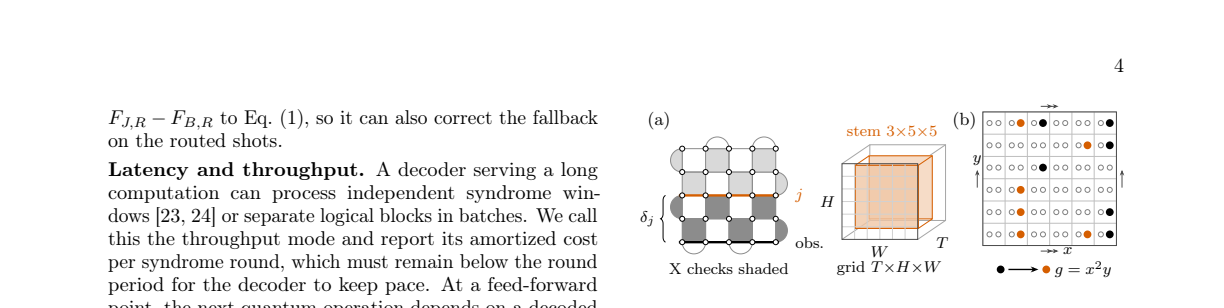
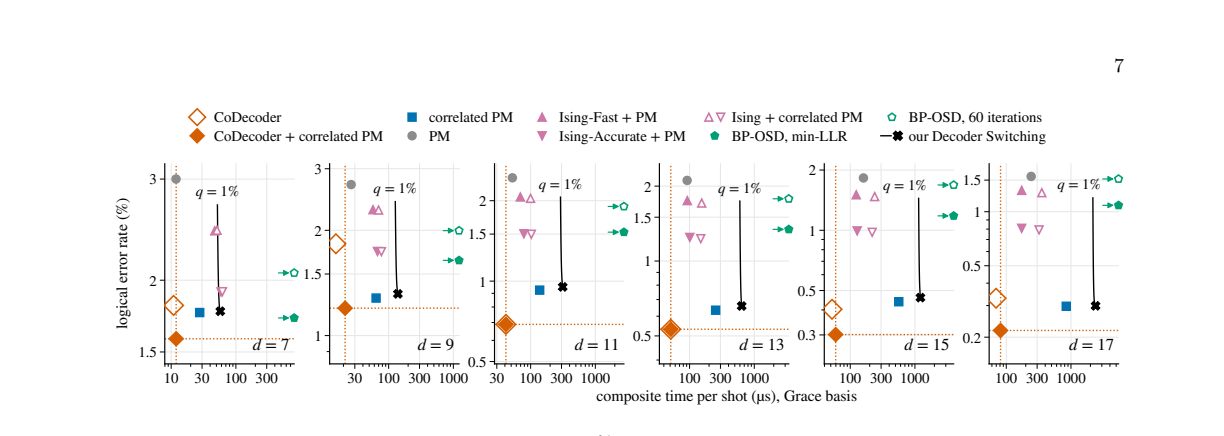
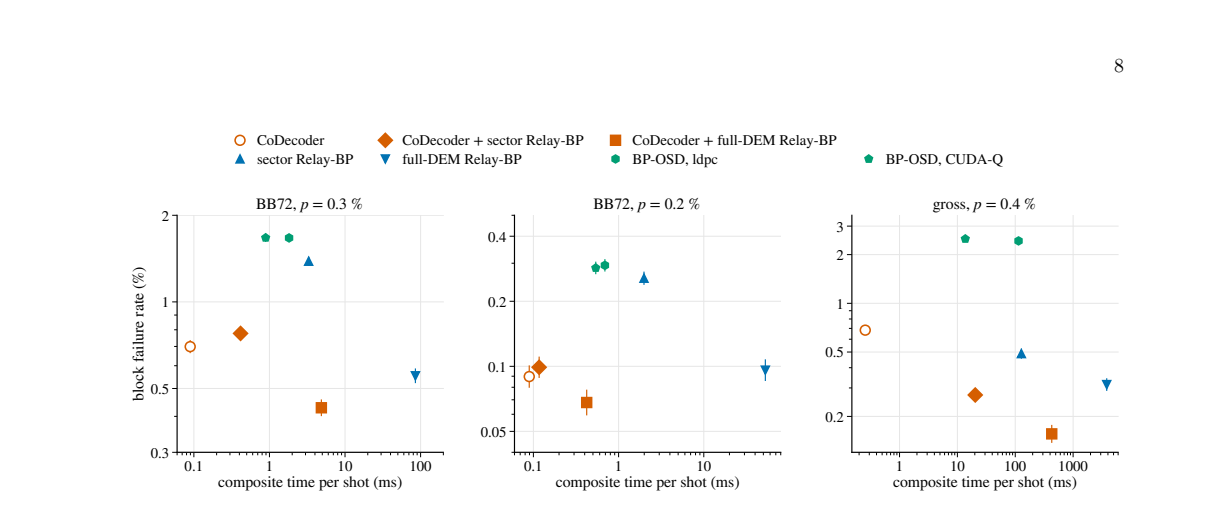
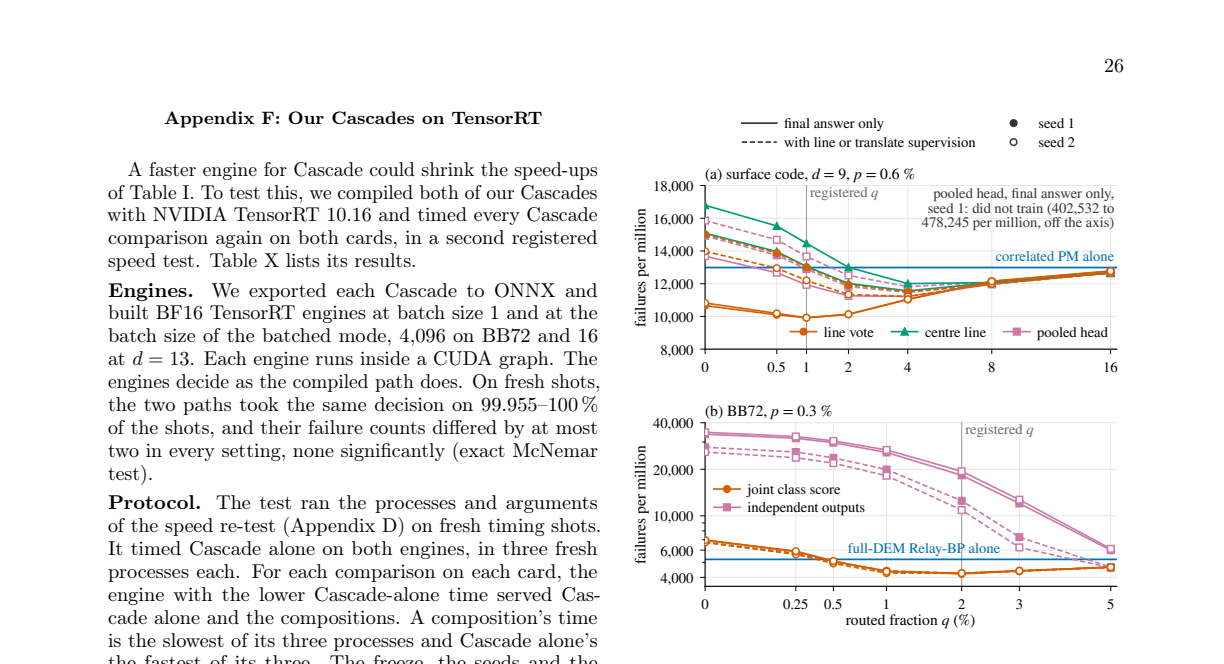
It predicts each shot's logical outcome, retains confident predictions and routes the remaining shots to the unchanged fallback. A logical-operator-aware output head scores shifted logical operators, combining equivalent logical lines on surface codes and deciding logical qubits jointly on bivariate-bicycle (BB) codes. Fused GPU inference and efficient routing reduce the overhead paid on every shot. In registered tests under circuit-level noise, composition reduces failures by 6.4-31.4% relative to correlated matching on surface codes of distance 7-17 and by 22-50% relative to full-DEM Relay-BP on two BB codes, with 2.3-124-fold speed-ups across these comparisons. With our re-implementations of the neural decoder Cascade, composition reduces decoding time in all four settings. A joint decision of both decoders on the routed shots keeps this speed and makes the composition more accurate than Cascade in all four, with 14-18% fewer failures on the [[72,12,6]] code. On the [[72,12,6]] BB code, a conventional head with independent logical outputs fails 3.8-5.0 times as often as our joint class score under matched training conditions. Per-shot analysis shows how composition gains accuracy. On retained shots, the frontend corrects more fallback errors than it introduces, even when it is less accurate overall.
from the abstract
Pith says
Machine review · deepseek-v4-flash · 22 Oct 2026 · what was read was not recorded · not checked by a person
It can be wrong. Challenge this review or reply to it.
Holds up. A serious, well-engineered decoder frontend with registered experiments, but the Cascade comparisons rest on re-implementations that might differ from the published work. This line is wrong
3 major objections · 5 minor
How often objections from reviews like this one are right: not yet measured
Not checked: figures, code, what the 50 references say.
The paper says, at IV D, Appendix E, Table I
The review did not quote this passage.
A classifier read this sentence of the paper as acknowledging the concern (probability 0.68):
“A second training seed or a mismatched noise level with the routing policy held fixed would test whether both results hold beyond these conditions.”
Pith says: Objection 1 of 3 · major
The Cascade re-implementations are a critical part of the claim that composition improves accuracy over a strong neural decoder. The authors note that Cascade's code is not public and that the noise model on BB72 is fitted to aggregate failure rates, leaving open whether the error structure matches.
more of objection 1
On the surface code, the width is inferred (256) and may differ from the deployment-sized network. Furthermore, the three-block frontend showed no improvement in the first registered test; the six-block network that produced the gains was chosen after exploratory analysis of that test's results. While the follow-up was pre-registered on fresh shots, the selection process reduces the strength of the claim that composition generically improves Cascade. The authors should discuss how the results might change with different training seeds, noise models, or original Cascade weights, and consider additional independent replications.
The paper says, at IV D, Table I, Figure 5
The review did not quote this passage.
Pith says: Objection 2 of 3 · major
The accuracy gains over Cascade are very small in absolute terms: 0.31–1.1% fewer failures on BB72 without the joint decision. The joint decision yields 14–18% fewer failures, but this also depends on Cascade's logits and is fitted on separate fresh shots.
more of objection 2
As the authors note, only 4.3% and 3.1% of Cascade's failures occur on kept shots at the two error rates, limiting the possible gain from routing alone. The practical significance of such small improvements should be discussed, especially in the context of the tail-latency increases reported in Section VIII.
The paper says, at VIII, Table VI
The review did not quote this passage.
Pith says: Objection 3 of 3 · major
The paper reports that the 99.9th-percentile single-shot latency of compositions is higher than that of the fallback alone (e.g., 486–626 µs vs. 397–546 µs for Cascade alone at d=13). For real-time decoding at feed-forward points, tail latency matters as much as mean time.
more of objection 3
The authors acknowledge this and propose to bound the tail by capping fallback time, but no results are given. The paper should either provide tail-latency data for all comparisons or explain why the mean-based speed claims are still relevant given the tail increase.
5 minor objections
The paper says, at I, Fig. 1
Pith says: minor objection 1 of 5
The figure shows a dashed line for the joint decision path but the caption does not fully explain the conditions under which the joint decision is used. Adding a brief note that it applies only when the fallback reports logits would improve clarity.
The paper says, at Table II
Pith says: minor objection 2 of 5
The entry 'Training failed' for seed 1 of the pooled head should be explicitly defined in the caption or a footnote. The text mentions that the network stayed at the constant-guess loss, but the table would benefit from a standard notation.
show 3 more
The paper says, at Appendix D, Table V
Pith says: minor objection 3 of 5
The raw-basis times are informative and help assess the sensitivity to the Grace conversion. Consider moving a brief summary of the raw-basis results (e.g., the number of speed comparisons that hold) into the main text, since the speed claims are partly tied to the conversion.
The paper says, at Abstract and Section IV
Pith says: minor objection 4 of 5
The abstract states 'up to 100× faster and even more accurate', but the observed speed-ups range from 2.3-fold to 124-fold. The 124-fold speed-up occurs in a specific low-error-rate BB72 setting with full-DEM Relay-BP. The phrasing is acceptable as a headline, but consider clarifying the range in the abstract to avoid over-generalization.
The paper says, at II B, Eq. (1)–(3)
Pith says: minor objection 5 of 5
The derivation of accuracy and speed conditions is clear and useful. However, the assumption that the fallback's decision is unchanged when used in the composition (Section IIB, fourth paragraph) should be stated explicitly in the main text, not only in Appendix H.
What would settle it
Independently train at least three seeds of the six-block CoDecoder-BB and the Cascade re-implementation on the BB72 code under the fitted noise model, then evaluate the composition with joint decision on fresh shots. If the percentage improvement in failures (composition vs Cascade alone) is consistently positive across all three seed pairs, the concern about re-implementation specificity is mitigated. Alternatively, if the Cascade authors release their networks, reproduce the comparison using the original model.
from the skeptic's reading
How the review went
4 readings by deepseek-v4-flash · 22 Oct 2026
- Reader holds up
- Skeptic agrees
- Editor wrote the verdict above
- Referee minor revision: 3 major objections, 5 minor
Not run on this paper: the simulated authors' defence.
Pith did not check this review's objections against the paper.
The review in full
The review in brief, machine-written
This paper is worth a serious look. The core idea — a small neural frontend that routes low-confidence shots to a stronger decoder — is not new (Decoder Switching, Chongder), but CoDecoder extends it with a well-designed output head that respects logical-operator geometry, efficient GPU engines, and a joint-decision rule for neural fallbacks. The experimental apparatus is first-rate: registered tests, McNemar statistics, code release, and careful timing decomposition. The comparisons with correlated matching and Relay-BP on surface and BB codes show clear accuracy and speed improvements, and those results hold up under scrutiny.
The main soft spot is the Cascade comparison. Cascade's code and weights are not public, so the authors re-implemented it. As they acknowledge (Appendix E), the fit leaves open whether their network shares the error structure of the published one, and on the surface code the width is inferred. The first registered test on BB72 showed no improvement; the six-block network that eventually produced gains was selected after an exploratory look at those results. The follow-up was pre-registered on fresh shots, which is good practice, but the selection process weakens the claim that the composition generically beats Cascade. The gains over Cascade are also very small (0.31–1.1% fewer failures) and might stem from details of the re-implementation's training dynamics. Without access to the original Cascade or multiple independent training seeds, it is hard to know how far these results generalize.
The CPU timing conversion to the Grace basis is a secondary concern; the authors are transparent about it, and their raw-basis figures still support most speed claims.
Who gets value from this paper? Researchers building practical decoder pipelines for fault-tolerant quantum computers, especially those interested in confidence-based routing and GPU acceleration. The paper is technically solid and honestly reported.
Recommendation: send to peer review. The referee should push for more evidence that the Cascade re-implementations are faithful (e.g., cross-check on one of Cascade's own circuits if available, or a second training seed). The exploratory selection of the six-block network should be discussed more candidly as a limitation. But the core contribution — the frontend design and its validation against matching and BP decoders — stands on its own and deserves circulation.
The strongest objection
The paper's strongest claims — that composition with a neural fallback can improve both accuracy and speed, and that the joint decision beats Cascade in all settings — rest on re-implementations of Cascade whose fidelity is not fully established. The noise model on BB72 is fitted to match aggregate failure rates from Cascade's paper, but as the authors note, 'the fit leaves open whether our network shares the published network's error structure' (Appendix E). On the surface code, the width is inferred (256) and may not match the actual deployment-sized network (width 128 is mentioned as 'deployment-sized' in the Cascade paper). The first registered test showed no accuracy improvement with the three-block frontend; the six-block configuration that eventually produced the gains was selected after an exploratory look at the first test's results. While the follow-up was pre-registered on fresh shots, the selection process reduces the strength of the claim that composition generically improves Cascade. Furthermore, the composition's gain over Cascade is very small in some settings (0.31-1.1% fewer failures), and the joint decision gain is driven by correcting small-margin Cascade mistakes that may be specific to the re-implementation's training dynamics. Without access to the original Cascade or multiple independent training seeds, it is unclear whether the reported improvements would generalize.
The reader identified the re-implementation of Cascade as the weakest assumption. This is indeed the most load-bearing concern because the paper's central claims about improving over a strong neural decoder hinge on the fidelity of those re-implementations. The paper is transparent about the limitations (noise model fitting, inferred width, exploratory selection), and the experimental methodology (registration, re-tests, statistical controls) is rigorous. However, the concern is not fully resolved because the re-implementation's error structure may differ from the published Cascade's, and the magnitude of the improvement (14-18% on BB72) could be sensitive to these differences. The paper's own exploratory results showed that the three-block network did not improve accuracy at all, and the six-block network only yielded small gains. This suggests that the success of composition depends on specific network properties and training details. A multi-seed replication would provide evidence that the effect is not due to chance or peculiarities of a single training run. Nonetheless, the paper's conclusions about composition in general (with matching and BP) are not affected by this concern, and the Cascade results are presented with appropriate caveats. Therefore, the verdict remains ACCEPT.
The referee's report
If the results hold, CoDecoder addresses a key challenge in fault-tolerant quantum computing: reconciling decoder accuracy with real-time speed. The confidence-based routing framework is simple and compatible with a variety of existing decoders. The logical-operator-aware output head is a novel architectural contribution that improves prediction quality. The paper is thorough: it pre-registers tests, releases code and trained weights, uses careful statistical comparisons (McNemar tests, Holm correction), and measures both accuracy and runtime on two GPU models. The speed-ups over classical decoders are substantial, and the multi-shot engine achieves sub-microsecond per-round latency. The head comparison and per-shot analysis provide mechanistic insight. The limitations (Cascade re-implementation fidelity, small gains over Cascade on kept shots, tail latency, CPU basis conversion) are acknowledged transparently. The system is an open-source design that makes a strong decoder faster and more accurate on important code families.
Pith's reading of the paper (a machine's summary, not the authors')
The paper presents CoDecoder, a compact neural network that acts as a frontend to any existing quantum decoder. It predicts the logical outcome of each error-correction round and only passes the shot to the fallback decoder when its confidence is low. CoDecoder's logical-operator-aware output head and efficient GPU execution allow it to improve the fallback's accuracy while reducing mean decoding time. In registered tests, composition with correlated matching on surface codes reduced failures by 6.4–31.4% and achieved 2.3–124-fold speed-ups; composition with full-DEM Relay-BP on bivariate-bicycle codes reduced failures by 22–50% with similar speed-ups. The key insight is that even a less accurate frontend can improve an accurate fallback if it is more accurate on the shots it keeps and if the saved fallback work outweighs the frontend overhead.
What carries the argument. The core mechanisms are (1) a logical-operator-aware output head that transforms convolutional features into predictions and confidence: on surface codes it sums scores of equivalent logical lines weighted by stabilizer parities, on BB codes it scores all 2^k joint logical flip patterns using scores of translated logical operators; (2) confidence-based routing that keeps shots whose margin between top two scores exceeds a threshold; (3) efficient GPU execution including a resident surface-code kernel, fused Triton kernels, and a multi-shot BB engine that share weight loads across shots.
Core claim. The central claim is that a small neural frontend (CoDecoder) can be placed before any strong decoder (matching, belief-propagation, or neural) to simultaneously reduce logical failures and lower mean decoding time. This works when two conditions hold: (C1) the frontend fails less often than the fallback on the shots it keeps (those with high confidence), and (C2) the sum of frontend inference time, handoff overhead, and fallback time on routed shots is less than the fallback's time alone. CoDecoder's design—a logical-operator-aware output head that scores shifted logical operators and a joint class score for BB codes—together with optimized GPU execution (fused kernels, resident kernel, multi-shot engine) makes these conditions satisfiable across code families and noise levels.
The premise it rests on. The re-implementations of the neural decoder Cascade faithfully reproduce the published architecture and performance, and the noise model fitted to match Cascade's reported failure rates is accurate enough to make the comparison valid.
If the paper is right (Pith's inferences, not the authors')
Composition with a slow but accurate decoder (like full-DEM Relay-BP or Cascace) can bring the per-round decoding time below 1 us, matching the round period of current superconducting qubits, while reducing failures.
The joint-decision variant, which uses both the frontend's and the fallback's logits on routed shots, can correct fallback errors on the routed subset and beat the fallback alone even when the frontend's accuracy is low.
The head design (joint class score vs independent outputs) is critical: on BB codes a joint score fails 3.8–5.0× less often than independent outputs under matched training, and only the joint score allows composition to beat full-DEM Relay-BP.
The conditions C1 and C2 provide a general framework for designing frontend-fallback compositions: the frontend must be accurate on high-confidence shots, and the handoff and fallback overhead must be amortized over the saved fallback work.
The paper's results suggest that neural decoders need not be the sole decider; a hybrid approach where a small network handles easy shots and a strong decider handles the tough ones can break the speed-accuracy tradeoff. This is analogous to 'learning to defer' in machine learning but applied to quantum error correction.
The requirement that the fallback's decisions are deterministic and that the frontend's confidence ranking isolates its failures suggests that the method may extend to other code families and noise models, as long as the frontend's failures corentrate in low-confidence shots.
The expenential cost of the joint class score (doubles with every logical qubit) is a scalability limit. Future work may need approximate search methods or alternative confidence scores for codes with many logical qubits; the paper acknowledges this.
The claim of 'up to 100× faster' is benchmark-dependent: it requires comparing the composition (using GPU frontend and fallback) to a CPU-only fallback (e.g., full-DEM Relay-BP). On a fair hardware comparison the speed-up may be smaller but still sizable.
Check this review
Pith stored no record of this review's passes and took no fingerprint of it. Reviews made by code from 13 Nov 2026 on carry both.
How often reviews like this one are right
Reviews like this one: written by deepseek-v4-flash, where what was read was not recorded.
How often objections from reviews like this one are right: not yet measured
Reviews by people
This review was written by a machine. No person has reviewed this paper on Pith yet. A scientist listed on Pith can review it for a fee, and their review is published here whatever it concludes.
The paper
Abstract
Fault-tolerant quantum computers need fast and accurate error decoding. We present CoDecoder, a small neural frontend that composes with an existing decoder to improve accuracy and reduce mean decoding time. It predicts each shot's logical outcome, retains confident predictions and routes the remaining shots to the unchanged fallback. A logical-operator-aware output head scores shifted logical operators, combining equivalent logical lines on surface codes and deciding logical qubits jointly on bivariate-bicycle (BB) codes. Fused GPU inference and efficient routing reduce the overhead paid on every shot. In registered tests under circuit-level noise, composition reduces failures by 6.4-31.4% relative to correlated matching on surface codes of distance 7-17 and by 22-50% relative to full-DEM Relay-BP on two BB codes, with 2.3-124-fold speed-ups across these comparisons. With our re-implementations of the neural decoder Cascade, composition reduces decoding time in all four settings. A joint decision of both decoders on the routed shots keeps this speed and makes the composition more accurate than Cascade in all four, with 14-18% fewer failures on the [[72,12,6]] code. On the [[72,12,6]] BB code, a conventional head with independent logical outputs fails 3.8-5.0 times as often as our joint class score under matched training conditions. Per-shot analysis shows how composition gains accuracy. On retained shots, the frontend corrects more fallback errors than it introduces, even when it is less accurate overall.
The paper's own sentences, arranged, kept beside the review and separate from it. Each label is drawn from a closed vocabulary; the number beside it is the probability the classifier gave that label. No sentence in this record was written by a model.
abstract compiled · 2026-10-22
The authors' main claim, as the classifier picked it out 0.84
“In registered tests under circuit-level noise, composition reduces failures by 6.4-31.4% relative to correlated matching on surface codes of distance 7-17 and by 22-50% relative to full-DEM Relay-BP on two BB codes, with 2.3-124-fold speed-ups across these comparisons.”
How the main claim is stated: asserted 1.00
What the abstract itself states, as probabilities: claims first 0.04 · states limitation 0.39 · human participants 0.02 · controlled comparison 0.96 · randomized assignment 0.03 · states quantitative result 0.99 · compares with prior results 0.98 · mentions code or data availability 0.04
The abstract, sentence by sentence
This table labels the abstract only (arXiv listing abstract v1). The number is the probability the classifier gave the label.
| Sentence | Role | The authors' own work | States the main conclusion | Strength |
|---|---|---|---|---|
| Fault-tolerant quantum computers need fast and accurate error decoding. | background 1.00 | 0.04 | 0.03 | asserted 1.00 |
| We present CoDecoder, a small neural frontend that composes with an existing decoder to improve accuracy and reduce mean decoding time. | contribution 0.99 | 0.92 | 0.23 | asserted 1.00 |
| It predicts each shot's logical outcome, retains confident predictions and routes the remaining shots to the unchanged fallback. | method 0.98 | 0.74 | 0.07 | asserted 1.00 |
| A logical-operator-aware output head scores shifted logical operators, combining equivalent logical lines on surface codes and deciding logical qubits jointly on bivariate-bicycle (BB) codes. | method 0.97 | 0.80 | 0.04 | asserted 0.99 |
| Fused GPU inference and efficient routing reduce the overhead paid on every shot. | method 0.95 | 0.76 | 0.04 | asserted 1.00 |
| In registered tests under circuit-level noise, composition reduces failures by 6.4-31.4% relative to correlated matching on surface codes of distance 7-17 and by 22-50% relative to full-DEM Relay-BP on two BB codes, with 2.3-124-fold speed-ups across these comparisons. | result 1.00 | 0.94 | 0.62 | asserted 1.00 |
| With our re-implementations of the neural decoder Cascade, composition reduces decoding time in all four settings. | result 0.99 | 0.89 | 0.09 | asserted 1.00 |
| A joint decision of both decoders on the routed shots keeps this speed and makes the composition more accurate than Cascade in all four, with 14-18% fewer failures on the [[72,12,6]] code. | result 0.99 | 0.94 | 0.18 | asserted 1.00 |
| On the [[72,12,6]] BB code, a conventional head with independent logical outputs fails 3.8-5.0 times as often as our joint class score under matched training conditions. | result 1.00 | 0.93 | 0.10 | asserted 1.00 |
| Per-shot analysis shows how composition gains accuracy. | contribution 0.46 | 0.75 | 0.04 | asserted 0.96 |
| On retained shots, the frontend corrects more fallback errors than it introduces, even when it is less accurate overall. | result 0.54 | 0.91 | 0.07 | asserted 1.00 |
What kind of paper the classifier reports this is: method or tool 1.00 · evidence from simulation or computation 0.88
What was examined, and what was not
Sources read
- arXiv listing abstract v1
Not examined
- full text
- figures and tables
- references and citing sentences
- relations to other papers
Levels run
- P abstract
Not run
- S sections
- T body sentences
- C citations
- R cross-paper relations
How the labels were made
Compiled by classifier-1.13.0 via TypeSafe API, question bank abstract-p1-20260923, 2026-10-22: 1 request, 8,258 input tokens.
Every quoted sentence on this record is the authors'. Every label is from Pith's closed vocabulary, with the probability shown beside it. This record as JSON
Figures (9)



Figures are the authors', reproduced from the paper.
References (50)
- [1] E. Dennis, A.Kitaev, A. Landahl, and J.Preskill,Topolog- ical quantum memory, Journal of Mathematical Physics 43, 4452 (2002) on Pith
- [2] A. G. Fowler, M. Mariantoni, J. M. Martinis, and A. N. Cleland, Surface codes: Towards practical large-scale quantum computation, Physical Review A86, 032324 (2012) on Pith
- [3] Google Quantum AI and Collaborators, Quantum error correction below the surface code threshold, Nature638, 920 (2025) on Pith
- [4] F. Battistel et al., Real-time decoding for fault-tolerant quantum computing: progress, challenges and outlook, Nano Futures7, 032003 (2023) on Pith
- [5] S. Bravyi, A. W. Cross, J. M. Gambetta, D. Maslov, P. Rall, and T. J. Yoder, High-threshold and low-overhead fault-tolerant quantum memory, Nature627, 778 (2024) on Pith
- [6] T. Müller et al. , Improved belief propagation is suf- ficient for real-time decoding of quantum memory, arXiv:2506.01779 (2025) on PithPith's reviewarXiv
- [7] A. W. Senioret al., A scalable and real-time neural de- coder for topological quantum codes, arXiv:2512.07737 (2025) on PitharXiv
- [8] A. Gu, J. P. Bonilla Ataides, M. D. Lukin, and S. F. Yelin, Scalable neural decoders for practical fault-tolerant quantum computation, arXiv:2604.08358 (2026) on PithPith's reviewarXiv
- [9] G. Yan, S. Li, S. Xiao, P. Ma, H. Cao, F. Pan, and Y. Du, Efficient foundation decoders for fault-tolerant quantum computing, arXiv:2606.27119 (2026) on PithPith's reviewarXiv
- [10] R. Toshio, K. Kishi, J. Fujisaki, H. Oshima, S. Sato, and K. Fujii, Decoder switching: breaking the speed- accuracy tradeoff in real-time quantum error correction, arXiv:2510.25222 (2025) on PitharXiv
- [11] S. Chongder, Latency-constrained hardware-aware quan- tum error correction co-design with adaptive confidence- gated neural decoding for the rotated surface code, arXiv:2607.05814 (2026) on PithPith's reviewarXiv
- [12] T. Wagner, H. Kampermann, and D. Bruß, Symmetries for a high-level neural decoder on the toric code, Physical Review A102, 042411 (2020) on Pith
- [13] E. Egorov, R. Bondesan, and M. Welling, The END: An equivariant neural decoder for quantum error correction, ICLR 2023 Workshop on Physics for Machine Learning, arXiv:2304.07362 (2023) on PithPith's reviewarXiv
- [14] Y. Guang, Y. Xiong, X. Gao, and Y. Chen, CoDe- coder: training and decoding code, trained weights, test sets and commands, https://github.com/a85tract/ CoDecoder (2026) on Pith
- [15] C. Gidney, Stim: a fast stabilizer circuit simulator, Quan- tum 5, 497 (2021) on Pith
- [16] O. Higgott, PyMatching: A Python package for decoding quantum codes with minimum-weight perfect matching, ACM Transactions on Quantum Computing3, 1 (2022) on Pith
- [17] O. Higgott and C. Gidney, Sparse Blossom: correcting a million errors per core second with minimum-weight matching, Quantum9, 1600 (2025) on Pith
- [18] A. G. Fowler, Optimal complexity correction of correlated errors in the surface code, arXiv:1310.0863 (2013) on PithPith's reviewarXiv
- [19] C. Chamberland, J. Olle, M. Li, S. Thornton, and I. Baratta, Fast and accurate AI-based pre-decoders for surface codes, arXiv:2604.12841 (2026) on PithPith's reviewarXiv
- [20] NVIDIA, Ising-Decoding: a set of training recipes for AI quantum error correction decoders,https://github. com/NVIDIA/Ising-Decoding (2026) on Pith
show 30 more
- [21] P. Panteleev and G. Kalachev, Degenerate quantum LDPC codes with good finite length performance, Quan- tum 5, 585 (2021) on Pith
- [22] J. Roffe, D. R. White, S. Burton, and E. Campbell, De- coding across the quantum low-density parity-check code landscape, Physical Review Research2, 043423 (2020) on Pith
- [23] L. Skoric, D. E. Browne, K. M. Barnes, N. I. Gillespie, and E.T.Campbell,Parallelwindowdecodingenablesscalable fault tolerant quantum computation, Nature Communica- tions 14, 7040 (2023) on Pith
- [24] X. Tan, F. Zhang, R. Chao, Y. Shi, and J. Chen, Scalable surface-code decoders with parallelization in time, PRX Quantum 4, 040344 (2023) on Pith
- [25] N. Meister, C. A. Pattison, and J. Preskill, Efficient soft- output decoders for the surface code, arXiv:2405.07433 (2024) on PithPith's reviewarXiv
- [26] S. C. Smith, B. J. Brown, and S. D. Bartlett, Mitigating errors in logical qubits, Communications Physics7, 386 (2024) on Pith
- [27] H. Mozannar and D. Sontag, Consistent estimators for learning to defer to an expert, inProceedings of the 37th International Conference on Machine Learning (ICML 2020), Proceedings of Machine Learning Research, Vol. 119 (2020) pp. 7076–7087 on Pith
- [28] N. Delfosse, Hierarchical decoding to reduce hardware requirements for quantum computing, arXiv:2001.11427 (2020) on PithPith's reviewarXiv
- [29] C. Chamberland, L. Goncalves, P. Sivarajah, E. Peterson, and S. Grimberg, Techniques for combining fast local decoders with global decoders under circuit-level noise, Quantum Science and Technology8, 045011 (2023) on Pith
- [30] G. S. Ravi et al., Better than worst-case decoding for quantum error correction, inProc. 28th ACM Int. Conf. Architectural Support for Programming Languages and Operating Systems (ASPLOS) (2023) pp. 88–102 on Pith
- [31] N. Alavisamani, S. Vittal, R. Ayanzadeh, P. Das, and M. Qureshi, Promatch: Extending the reach of real-time quantum error correction with adaptive predecoding, in Proc. 29th ACM Int. Conf. Architectural Support for Pro- gramming Languages and Operating Systems (ASPLOS) (2024) ... on Pith
- [32] K. Zhang, J. Xu, F. Zhang, L. Kong, Z. Ji, and J. Chen, LATTE: A decoding architecture for quantum comput- ing with temporal and spatial scalability, ACM Trans- actions on Quantum Computing (2026), just accepted, arXiv:2509.03954 on PithPith's reviewarXiv
- [33] H. Bombín, M. Pant, S. Roberts, and K. I. Seetharam, Fault-tolerant postselection for low-overhead magic state preparation, PRX Quantum5, 010302 (2024) on Pith
- [34] C. Gidney, M. Newman, P. Brooks, and C. Jones, Yoked surface codes, Nature Communications16, 4498 (2025) on Pith
- [35] N. Shutty, M. Newman, and B. Villalonga, Efficient near- optimal decoding of the surface code through ensembling, Physical Review Letters136, 070603 (2026) on Pith
- [36] D. Madras, T. Pitassi, and R. Zemel, Predict responsibly: Improving fairness and accuracy by learning to defer, in Advances in Neural Information Processing Systems 31 (NeurIPS 2018) (2018) pp. 6147–6157. 35 on Pith
- [37] G. Torlai and R. G. Melko, Neural decoder for topological codes, Physical Review Letters119, 030501 (2017) on Pith
- [38] K. Meinerz, C.-Y. Park, and S. Trebst, Scalable neural decoder for topological surface codes, Physical Review Letters 128, 080505 (2022) on Pith
- [39] B. M. Varbanov, M. Serra-Peralta, D. Byfield, and B. M. Terhal, Neural network decoder for near-term surface-code experiments, Physical Review Research7, 013029 (2025) on Pith
- [40] J. Bausch et al., Learning high-accuracy error decoding for quantum processors, Nature635, 834 (2024) on Pith
- [41] J. Blue, H. Avlani, Z. He, L. Ziyin, and I. L. Chuang, Ma- chine learning decoding of circuit-level noise for bivariate bicycle codes, Quantum10, 2149 (2026) on Pith
- [42] J. P. Bonilla Ataides, A. Gu, S. F. Yelin, and M. D. Lukin, Neural decoders for universal quantum algorithms, PRX Intelligence 1, 013008 (2026) on Pith
- [43] N. Delfosse and N. H. Nickerson, Almost-linear time de- coding algorithm for topological codes, Quantum5, 595 (2021) on Pith
- [44] Y. Wu, N. Liyanage, and L. Zhong, Micro Blossom: Ac- celerated minimum-weight perfect matching decoding for quantum error correction, inProc. 30th ACM Int. Conf. Architectural Support for Programming Languages and Operating Systems (ASPLOS) (2025) pp. 639–654 on Pith
- [45] T. Hillmann, L. Berent, A. O. Quintavalle, J. Eisert, R. Wille, and J. Roffe, Localized statistics decoding for quantum low-density parity-check codes, Nature Commu- nications 16, 8214 (2025) on Pith
- [46] L. Aghababaie Beni, O. Higgott, and N. Shutty, Tesser- act: a search-based decoder for quantum error correction, arXiv:2503.10988 (2025) on PithPith's reviewarXiv
- [47] T. Maurer et al., Real-time decoding of the gross code memory with FPGAs, arXiv:2510.21600 (2025) on PitharXiv
- [48] S. Maurya, T. Maurer, M. Bühler, D. Vandeth, and M. E. Beverland, FPGA-tailored algorithms for real-time decod- ing of quantum LDPC codes, arXiv:2511.21660 (2025) on PitharXiv
- [49] K. Zhou et al., Vegapunk: Accurate and fast decoding for quantum LDPC codes with online hierarchical algorithm and sparse accelerator, in Proc. 58th IEEE/ACM Int. Symp. Microarchitecture (MICRO) (2025) pp. 719–732 on Pith
- [50] League of Entropy, drand: distributed randomness beacon, https://drand.love (2026) on Pith
Cited by 1 Pith paper
Reviewed papers on Pith that cite this one. The full citation record
- Machine-learning decoders for fusion-based quantum computing in real time quant-ph · Nov 2026
Challenges and discussion
Disagree with the review, or know something it missed? Leave a comment, or challenge this review formally: a challenge becomes a permanent entry in this paper's record, and its decision is published here.
Come back by email
A short list of the week's newly reviewed papers. Nothing is sent until you confirm from your inbox, and every email has a link that stops it. No account.
No comments yet.
Sign in to comment