Artificial Intelligence · arXiv:2610.30790 v1 · submitted 22 Oct 2026 · 30 references
Agentic Knowledge-Model Co-Evolution via Consistency Regularization
The paper says
“LLM agents can evolve by learning from accumulated experience. Existing approaches extract reusable external knowledge, such as skills and memories, from experience to guide subsequent task solving, with some further internalizing this knowledge through model training.”
more of the abstract
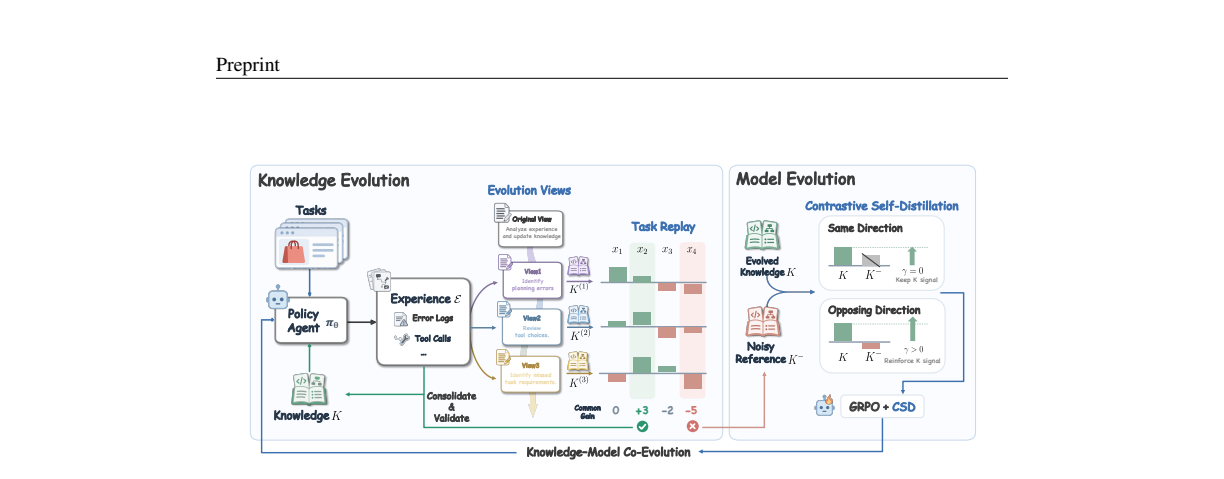
However, different ways of analyzing and transforming the same experience can yield knowledge with substantially different utility, even when the resulting guidance appears reasonable. Inspired by consistency regularization, we identify consistent utility gains across different ways of analyzing the same experience, rather than relying on any single way of analyzing it. We introduce SPLICE, a framework for consistency-regularized knowledge-model co-evolution. It constructs evolution views by perturbing how the same experience is analyzed, producing different knowledge candidates. Knowledge updates are then guided by common gain, which accounts for utility gains and their consistency across views. During model evolution, self-distillation internalizes the evolved knowledge alongside reinforcement learning, using knowledge associated with consistent utility degradation as a contrastive reference. The two processes interleave, with model updates driving further knowledge evolution. Experiments across diverse domains show that SPLICE outperforms knowledge evolution and model training baselines by up to 7.1 and 4.6 points in average accuracy, while its evolved knowledge reduces output tokens per correct solution by up to 44% and transfers across model sizes and families.
from the abstract
Pith says
Machine review · deepseek-v4-flash · 23 Oct 2026 · what was read was not recorded · not checked by a person
It can be wrong. Challenge this review or reply to it.
Holds up, with conditions. Clean empirical framework for consistency-regularized knowledge evolution, but the central theoretical guarantee rests on an i.i.d. assumption that is unlikely to hold in practice. This line is wrong
3 major objections · 8 minor
How often objections from reviews like this one are right: not yet measured
Not checked: figures, code, what the 30 references say.
The paper says, at Table 1 and Section 4.2
The review did not quote this passage.
Pith says: Objection 1 of 3 · major
The table reports no standard deviations or confidence intervals for SPLICE (Co-Evo) or any training-based method. The reader's note and the paper's own evaluation protocol (Appendix A.3) state that training-free methods are averaged over three seeds, but no equivalent is stated for training-based methods.
more of objection 1
Given the inherent variance of reinforcement learning and self-distillation, the claimed gains (3.0 points for 4B, 4.6 points for 9B) may not be statistically significant. The authors should run at least three seeds for all training-based methods and report mean and standard deviation (or individual run values).
The paper says, at Proposition 1 (Section 3.1, Appendix E)
The review did not quote this passage.
Pith says: Objection 2 of 3 · major
The proof assumes i.i.d. evolution views, but views are generated by LLM prompt perturbations that may be dependent (e.g., all emphasize similar failure modes). The paper acknowledges distribution shifts in Appendix F but does not address dependence. The bound Pr(Δ>0) ≥ C/μ relies on independence for the step E[(Δ-a)1{Δ'>a}] = (μ-a)Pr(Δ'>a).
more of objection 2
If views are positively correlated, this equality fails and the bound may not hold. The authors should discuss this limitation explicitly and, if possible, provide a bound under a weaker dependence assumption (e.g., pairwise exchangeability or bounded covariance).
The paper says, at Section 3.1 and Appendix G
The review did not quote this passage.
Pith says: Objection 3 of 3 · major
The exact prompts used to generate the evolution views (the 'textual revisions' δ_j in Eq. 2) are not provided. The case studies in Appendix G show examples of candidate knowledge but not the prompt templates that produced them. Without these prompts, the method cannot be reproduced. The authors should include the actual prompt instructions (e.g., for 'identify planning errors', 'review tool choices') in the appendix or as supplementary material.
8 minor objections
The paper says, at Section 3.1, Eq. (3)
Pith says: minor objection 1 of 8
The common gain C_i is defined as the average of pairwise minima. The text says 'averaging over pairs', but the equation shows two equivalent forms; the derivation from mean gain minus inconsistency penalty is clear. It would help to state explicitly that the sum is over all unordered pairs j<ℓ.
The paper says, at Table 1
Pith says: minor objection 2 of 8
The 'Δ' column shows improvement over Base, but the table also has 'Avg.' and then 'Δ' separately. For readability, include the base accuracy in the Avg. row or note that Δ is Avg - Base.
show 6 more
The paper says, at Appendix A.2
Pith says: minor objection 3 of 8
The knowledge optimizer is described as 'an external LLM'. Which specific model is used? (e.g., GPT-4, Claude, etc.) This affects reproducibility and computational cost. Please specify.
The paper says, at Figure 3 (right)
Pith says: minor objection 4 of 8
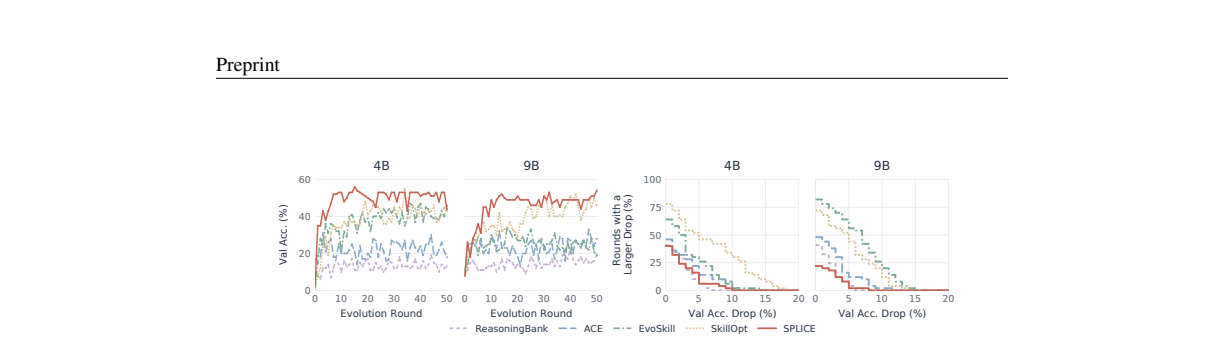
The y-axis label 'Rounds with a Larger Drop (%)' is ambiguous. It appears to show the fraction of rounds where the validation accuracy drop exceeds a given threshold (the x-axis). Label it more clearly, e.g., 'Cumulative fraction of rounds with absolute validation drop > threshold'.
The paper says, at Table 3
Pith says: minor objection 5 of 8
The metric 'Output tokens per correct attempt (k, ↓)' uses the unit 'k' for thousands. Spell this out in the caption or use 'K'. Also clarify that the denominator is number of correct attempts (not total attempts), so all output tokens (including from incorrect attempts) are counted.
The paper says, at Section 4.3, 'Beyond scaling computation'
Pith says: minor objection 6 of 8
The comparison with 'Best branch' and 'Merge-all' is informative, but the paper should note that these variants also use N=3 views, so the extra computation is held constant. The gains are therefore from the selection method, not from additional computing. This point is already well made.
The paper says, at Appendix B.3, Algorithm 2
Pith says: minor objection 7 of 8
The asynchronous co-evolution procedure allows knowledge evolution to run concurrently with model training. This introduces a risk that replay gains become stale due to model drift (as discussed in Appendix B.4). Consider adding a simple diagnostic figure (e.g., the correlation between round number and replay gain) to assess how often this occurs in practice.
The paper says, at General
Pith says: minor objection 8 of 8
The paper states 'up to 44% fewer output tokens per correct solution' (abstract and Section 4.3). This is a strong claim that could be misread as per-solution efficiency. Clarify that it's the total output tokens across all test attempts divided by the number of correct attempts, which is a system-level cost metric.
What would settle it
On a fixed benchmark (e.g., WebShop with Qwen3.5-9B), generate a larger set of 50 evolution views by randomly sampling from a broader space of prompt perturbations (e.g., random subsets of failure aspects, shuffled order). For each of 50 held-out tasks, compute Δ_j for each view via replay. Then test the i.i.d. assumption: (1) compute pairwise correlations between Δ vectors of different views; if the mean pairwise correlation significantly exceeds 0 (e.g., 95% CI above 0.05), independence is violated. (2) Use a Kolmogorov-Smirnov test between the distributions of Δ from prompt perturbations vs. a random split-half of the same set; if p<0.05, identical distribution is rejected. If either violation is found, Proposition 1's guarantee does not apply, and the paper's claim that consistency implies generalizability is unsupported.
from the skeptic's reading
How the review went
4 readings by deepseek-v4-flash · 23 Oct 2026
- Reader holds up, with conditions
- Skeptic agrees
- Editor wrote the verdict above
- Referee major revision: 3 major objections, 8 minor
Not run on this paper: the simulated authors' defence.
Pith did not check this review's objections against the paper.
The review in full
The review in brief, machine-written
SPLICE does something sensible: instead of trusting any single way of turning experience into knowledge, it requires the utility gain to show up across multiple analysis perspectives. The framework is clean, the experiments are thorough (four benchmarks, two model sizes, careful ablations), and the results are consistent. The efficiency and transfer findings are a nice bonus. This is real, reproducible work from a group that knows the literature.
The soft spot is the theory. Proposition 1 says that if evolution views are i.i.d., then common gain gives a lower bound on the probability of improvement under a new view. But the views are generated by an LLM given different prompt instructions—they are hand-crafted, not random draws from a fixed distribution. The paper acknowledges distribution shifts in Appendix F and gives a bounded-reweighting analysis, but that analysis assumes Q ≪ P and a bounded density ratio. It does not address the more fundamental issue: within the original distribution P, the views may share systematic dependencies (e.g., both overemphasize recent errors). If the views are not i.i.d., the probabilistic guarantee collapses. The authors are honest about the assumptions, but the theoretical section is therefore more a motivating analogy than a genuine proof of robustness.
Practically, this matters less than it sounds. The empirical ablations (common gain vs. mean gain, best branch vs. merge-all) convincingly show that the consistency criterion helps, and the validation gate catches bad updates. The paper does not oversell the theory—it is presented as a bound under stated conditions, not as a universal claim. Still, a reader who cares about formal guarantees will be left wanting.
Other concerns: the main training results lack error bars, and the code is not released. These are fixable in revision.
Verdict: solid incremental work that is worth engaging with. The empirical contributions stand on their own, even if the theory is weaker than it looks at first glance. I would send it to review, with the expectation that the authors either strengthen the analytical grounding or downgrade the theoretical claims to what the experiments actually support.
The strongest objection
The central Proposition 1 (Section 3.1) assumes that utility gains Δ and Δ' from two evolution views are independent and identically distributed. This i.i.d. assumption is critical for the bound Pr(Δ>0) ≥ C/μ and for the selection rationale that common gain implies generalizability. However, in practice the N=3 evolution views are generated by an LLM instructed to emphasize different aspects of a failure (e.g., planning errors vs. tool choices). These prompt variations are not random draws from a fixed distribution; they are hand-crafted and may share systematic biases or dependencies (e.g., both overemphasize recent errors). The paper acknowledges distribution shifts in Appendix F but only provides a bound under the condition Q≪P and bounded density ratio (Eq. 20). This does not address the more fundamental issue: if views are not i.i.d. even under the original distribution P, the probabilistic guarantee of Proposition 1 may not hold. The experimental success of SPLICE could therefore stem from other design choices (e.g., the validation gate) rather than from the consistency principle itself. The reader correctly identifies this as the weakest assumption.
The reader's weakest assumption correctly identifies the i.i.d. condition as fragile. The paper's Appendix F analysis addresses distribution shifts but not the violation of the i.i.d. assumption itself. Proposition 1 is the theoretical backbone for why common gain selects generalizable evidence. If that assumption is unrealistic, the theoretical motivation weakens, though the empirical results may still stand due to other mechanisms (validation gate, contrastive learning). The concrete test would directly probe the assumption. Until such a test is performed, the theoretical claim remains unsubstantiated. Therefore the verdict should remain CONDITIONAL, as the reader already gave, since additional evidence is needed to confirm the robustness of the i.i.d. assumption.
The referee's report
The central idea of using consistency across multiple ways of analyzing experience to guide knowledge evolution is novel and well-motivated. The empirical results are impressive across diverse benchmarks, and the knowledge transfer experiments (Figure 6) are a strong demonstration of generalizability. If the results hold with proper statistical rigor, this work would be a meaningful advance in continual learning for LLM agents, addressing the practical problem that single-perspective knowledge updates can be unreliable. The framework is modular and the co-evolution design (knowledge updates interleaved with model training) is thoughtful, with clear handling of the non-stationarity of knowledge utility.
Pith's reading of the paper (a machine's summary, not the authors')
The paper addresses how LLM agents can reliably turn accumulated experience into reusable knowledge. It argues that different ways of analyzing the same experience can yield knowledge with very different utility, and that relying on any single analysis is unreliable. The central claim is that utility gains that are consistent across multiple independent analyses (evolution views) provide a more effective signal for updating knowledge than gains observed under a single view. The authors introduce SPLICE, which computes a 'common gain' combining mean utility gain with a penalty for inconsistency across views, and uses it to select task experience for knowledge updates. Experiments on math, coding, office work, and web shopping show that SPLICE outperforms existing knowledge evolution and model training baselines, while producing more compact and transferable knowledge.
What carries the argument. Common gain (Equation 3): for a task, the mean of pairwise minimum utility gains across evolution views. It combines mean gain with an inconsistency penalty (half the mean absolute pairwise difference). The knowledge optimizer uses common gain to select which task experience drives knowledge updates. Gated contrastive self-distillation (Equations 6-7): the model is trained with GRPO plus a self-distillation term that uses knowledge K as positive guidance and noisy knowledge K− (built from tasks with consistent utility degradation) as a contrastive reference, weighted by a task-level benefit weight and a token-level gate that activates only when K and K− change token probabilities in opposing directions.
Core claim. SPLICE demonstrates that consistency regularization, originally developed for prediction consistency under parameter perturbations, transfers to the domain of knowledge evolution where it governs utility consistency across different analytical perspectives. The core discovery is that the common gain—the minimum utility gain shared across a pair of evolution views, averaged over all pairs—selects task evidence that corrects more errors while preserving more existing successes, compared to selections based on mean gain or single-view gain. Furthermore, knowledge that consistently degrades utility across views can be repurposed as a noisy contrastive reference during model internalization, where a token-level gate preserves shared useful guidance.
The premise it rests on. The paper assumes that evolution views are drawn independently from a fixed distribution, so that the common gain defined in Eq. 3 provides a reliable bound on the probability of improvement under a new view (Proposition 1). In practice, views are generated by prompting an LLM, so the i.i.d. condition is violated; the paper acknowledges this and provides a robustness analysis with bounded reweighting in Appendix F.
If the paper is right (Pith's inferences, not the authors')
Knowledge evolution becomes more stable: updates selected by common gain degrade validation accuracy far less frequently than those from baselines (only 2% of SPLICE updates cause >5 point drops vs. up to 56% for baselines).
Evolved knowledge is more efficient: SPLICE reduces output tokens per correct solution by up to 44% on WebShop and LiveCode.
Knowledge generalizes across models: knowledge evolved with Qwen3.5-9B transfers to other sizes and families with larger accuracy gains than baseline methods.
Co-evolution dynamics show that knowledge utility shrinks as the model internalizes it, motivating validation-based adoption of knowledge during training.
The common-gain principle might extend to other forms of agent learning, such as curriculum design or data selection, where multiple criteria for judging data quality could be ensembled via utility consistency.
Because the i.i.d. assumption on evolution views is violated in practice (views are generated by an LLM from prompt variations), the theoretical guarantee of Proposition 1 is approximate; the empirical robustness shown in Appendix F partially addresses this but the gap between theory and practice invites further analysis.
The contrastive reference constructed from consistently degrading knowledge suggests that negative signals from knowledge evolution can be systematically harvested, offering a principled alternative to ad-hoc negative sampling in RL for agents.
Check this review
Pith stored no record of this review's passes and took no fingerprint of it. Reviews made by code from 13 Nov 2026 on carry both.
How often reviews like this one are right
Reviews like this one: written by deepseek-v4-flash, where what was read was not recorded.
How often objections from reviews like this one are right: not yet measured
Reviews by people
This review was written by a machine. No person has reviewed this paper on Pith yet. A scientist listed on Pith can review it for a fee, and their review is published here whatever it concludes.
The paper
Abstract
LLM agents can evolve by learning from accumulated experience. Existing approaches extract reusable external knowledge, such as skills and memories, from experience to guide subsequent task solving, with some further internalizing this knowledge through model training. However, different ways of analyzing and transforming the same experience can yield knowledge with substantially different utility, even when the resulting guidance appears reasonable. Inspired by consistency regularization, we identify consistent utility gains across different ways of analyzing the same experience, rather than relying on any single way of analyzing it. We introduce SPLICE, a framework for consistency-regularized knowledge-model co-evolution. It constructs evolution views by perturbing how the same experience is analyzed, producing different knowledge candidates. Knowledge updates are then guided by common gain, which accounts for utility gains and their consistency across views. During model evolution, self-distillation internalizes the evolved knowledge alongside reinforcement learning, using knowledge associated with consistent utility degradation as a contrastive reference. The two processes interleave, with model updates driving further knowledge evolution. Experiments across diverse domains show that SPLICE outperforms knowledge evolution and model training baselines by up to 7.1 and 4.6 points in average accuracy, while its evolved knowledge reduces output tokens per correct solution by up to 44% and transfers across model sizes and families.
The paper's own sentences, arranged, kept beside the review and separate from it. Each label is drawn from a closed vocabulary; the number beside it is the probability the classifier gave that label. No sentence in this record was written by a model.
abstract compiled · 2026-10-23
The authors' main claim, as the classifier picked it out 1.00
“Experiments across diverse domains show that SPLICE outperforms knowledge evolution and model training baselines by up to 7.1 and 4.6 points in average accuracy, while its evolved knowledge reduces output tokens per correct solution by up to 44% and transfers across model sizes and families.”
How the main claim is stated: asserted 1.00
What the abstract itself states, as probabilities: claims first 0.06 · states limitation 0.08 · human participants 0.04 · controlled comparison 0.94 · randomized assignment 0.02 · states quantitative result 0.99 · compares with prior results 0.98 · mentions code or data availability 0.02
The abstract, sentence by sentence
This table labels the abstract only (arXiv listing abstract v1). The number is the probability the classifier gave the label.
| Sentence | Role | The authors' own work | States the main conclusion | Strength |
|---|---|---|---|---|
| LLM agents can evolve by learning from accumulated experience. | background 1.00 | 0.06 | 0.02 | asserted 0.64 |
| Existing approaches extract reusable external knowledge, such as skills and memories, from experience to guide subsequent task solving, with some further internalizing this knowledge through model training. | background 1.00 | 0.03 | 0.02 | asserted 0.99 |
| However, different ways of analyzing and transforming the same experience can yield knowledge with substantially different utility, even when the resulting guidance appears reasonable. | gap 0.85 | 0.16 | 0.03 | asserted 0.93 |
| Inspired by consistency regularization, we identify consistent utility gains across different ways of analyzing the same experience, rather than relying on any single way of analyzing it. | contribution 0.68 | 0.56 | 0.13 | asserted 0.94 |
| We introduce SPLICE, a framework for consistency-regularized knowledge-model co-evolution. | contribution 0.97 | 0.92 | 0.05 | asserted 0.99 |
| It constructs evolution views by perturbing how the same experience is analyzed, producing different knowledge candidates. | method 0.99 | 0.88 | 0.03 | asserted 1.00 |
| Knowledge updates are then guided by common gain, which accounts for utility gains and their consistency across views. | method 1.00 | 0.84 | 0.06 | asserted 1.00 |
| During model evolution, self-distillation internalizes the evolved knowledge alongside reinforcement learning, using knowledge associated with consistent utility degradation as a contrastive reference. | method 1.00 | 0.87 | 0.05 | asserted 1.00 |
| The two processes interleave, with model updates driving further knowledge evolution. | method 1.00 | 0.67 | 0.04 | asserted 1.00 |
| Experiments across diverse domains show that SPLICE outperforms knowledge evolution and model training baselines by up to 7.1 and 4.6 points in average accuracy, while its evolved knowledge reduces output tokens per correct solution by up to 44% and transfers across model sizes and families. | result 1.00 | 0.96 | 0.85 | asserted 1.00 |
What kind of paper the classifier reports this is: method or tool 1.00 · evidence from observation or experiment 0.99
What was examined, and what was not
Sources read
- arXiv listing abstract v1
Not examined
- full text
- figures and tables
- references and citing sentences
- relations to other papers
Levels run
- P abstract
Not run
- S sections
- T body sentences
- C citations
- R cross-paper relations
How the labels were made
Compiled by classifier-1.13.0 via TypeSafe API, question bank abstract-p1-20260923, 2026-10-23: 1 request, 7,493 input tokens.
Every quoted sentence on this record is the authors'. Every label is from Pith's closed vocabulary, with the probability shown beside it. This record as JSON
Figures (10)






Figures are the authors', reproduced from the paper.
References (30)
- [1] Rishabh Agarwal, Nino Vieillard, Yongchao Zhou, Piotr Stanczyk, Sabela Ramos Garea, Matthieu Geist, and Olivier Bachem. On-policy distillation of language models: Learning from self- generated mistakes. InInternational Conference on Learning Representations, volume 2024, pp. 2... on Pith
- [2] runs knowledge evolution and model evolution at the same time. Knowledge evolution keeps improving its own copy of knowledge,Kevo, using experience generated during training, while model evolution trains with K, the most recent Kevo that improves 17 Preprint held-out validatio... on Pith
- [6] Naman Jain, Alex Gu, Wen-Ding Li, Fanjia Yan, Tianjun Zhang, Sida Wang, Armando Solar-Lezama, Koushik Sen, and Ion Stoica. Livecodebench: Holistic and contamination free evaluation of large language models for code. InInternational Conference on Learning Representations, volum... on Pith
- [7] Samuli Laine and Timo Aila. Temporal ensembling for semi-supervised learning.arXiv preprint arXiv:1610.02242, on PithPith's reviewarXiv
- [9] Zhengxi Lu, Zhiyuan Yao, Zhuowen Han, Zi-Han Wang, Jinyang Wu, Qi Gu, Xunliang Cai, Weiming Lu, Jun Xiao, Yueting Zhuang, et al. Self-distilled agentic reinforcement learning.arXiv preprint arXiv:2605.15155, 2026a. 10 Preprint Zhengxi Lu, Zhiyuan Yao, Jinyang Wu, Chengcheng Ha... on PithPith's reviewarXiv
- [10] Bodhisattwa Prasad Majumder, Bhavana Dalvi Mishra, Peter Jansen, Oyvind Tafjord, Niket Tandon, Li Zhang, Chris Callison-Burch, and Peter Clark. Clin: A continually learning language agent for rapid task adaptation and generalization.arXiv preprint arXiv:2310.10134, on PithPith's reviewarXiv
- [11] Siru Ouyang, Jun Yan, I Hsu, Yanfei Chen, Ke Jiang, Zifeng Wang, Rujun Han, Long Le, Samira Daruki, Xiangru Tang, et al. Reasoningbank: Scaling agent self-evolving with reasoning memory. InInternational Conference on Learning Representations, volume 2026, pp. 94327–94354, on Pith
- [12] Leyi Pan, Shuchang Tao, Yunpeng Zhai, Lingzhe Zhang, Zhaoyang Liu, Bolin Ding, Aiwei Liu, and Lijie Wen. Rlcsd: Reinforcement learning with contrastive on-policy self-distillation.arXiv preprint arXiv:2606.11709, on PithPith's reviewarXiv
- [13] Zhihong Shao, Peiyi Wang, Qihao Zhu, Runxin Xu, Junxiao Song, Xiao Bi, Haowei Zhang, Mingchuan Zhang, YK Li, Yang Wu, et al. Deepseekmath: Pushing the limits of mathemat- ical reasoning in open language models.arXiv preprint arXiv:2402.03300, on PithPith's reviewarXiv
- [14] Guobin Shen, Xiang Cheng, Chenxiao Zhao, Lei Huang, Jindong Li, Dongcheng Zhao, and Xing Yu. Anti-self-distillation for reasoning rl via pointwise mutual information.arXiv preprint arXiv:2605.11609, on PithPith's reviewarXiv
- [15] Yaorui Shi, Yuxin Chen, Zhengxi Lu, Yuchun Miao, Shugui Liu, Qi Gu, Xunliang Cai, Xiang Wang, and An Zhang. Skill1: Unified evolution of skill-augmented agents via reinforcement learning. arXiv preprint arXiv:2605.06130, on PithPith's reviewarXiv
- [17] Bo Tang, Yang Zhang, Guomian Zhuang, Wenqiang Wei, Gaoyang Zheng, Lindong Xie, Yanchao Tan, Feiyu Xiong, Qingyu Yang, Edward Chung, et al. From memory to skills: Evidence-grounded co-evolution governance for long-horizon llm agents.arXiv preprint arXiv:2607.16621, on PithPith's reviewarXiv
- [19] Zora Zhiruo Wang, Jiayuan Mao, Daniel Fried, and Graham Neubig. Agent workflow memory.arXiv preprint arXiv:2409.07429, on PithPith's reviewarXiv
- [20] URLhttps://arxiv.org/abs/2608.15071. Lijun Wu, Juntao Li, Yue Wang, Qi Meng, Tao Qin, Wei Chen, Min Zhang, Tie-Yan Liu, et al. R-drop: Regularized dropout for neural networks.Advances in neural information processing systems, 34: 10890–10905, on PithPith's reviewarXiv
- [22] Peng Xia, Jianwen Chen, Hanyang Wang, Jiaqi Liu, Kaide Zeng, Yu Wang, Siwei Han, Yiyang Zhou, Xujiang Zhao, Haifeng Chen, et al. Skillrl: Evolving agents via recursive skill-augmented reinforcement learning.arXiv preprint arXiv:2602.08234, on PithPith's reviewarXiv
- [23] Yifan Yang, Ziyang Gong, Weiquan Huang, Qihao Yang, Ziwei Zhou, Zisu Huang, Yan Li, Xuemei Gao, Qi Dai, Bei Liu, et al. Skillopt: Executive strategy for self-evolving agent skills.arXiv preprint arXiv:2605.23904, on PithPith's reviewarXiv
- [25] 12 Preprint Xing Zhang, Yanwei Cui, Guanghui Wang, Ziyuan Li, Wei Qiu, Bing Zhu, and Peiyang He. Library drift: Diagnosing and fixing a silent failure mode in self-evolving llm skill libraries.arXiv preprint arXiv:2605.19576, 2026c. Andrew Zhao, Daniel Huang, Quentin Xu, Matth... on PithPith's reviewarXiv
- [26] Siyan Zhao, Zhihui Xie, Mengchen Liu, Jing Huang, Guan Pang, Feiyu Chen, and Aditya Grover. Self-distilled reasoner: On-policy self-distillation for large language models.arXiv preprint arXiv:2601.18734, 2026a. Yanjun Zhao, Tianxin Wei, Jiaru Zou, Xuying Ning, Yuanchen Bei, Li... on PithPith's reviewarXiv
- [27] 13 Preprint APPENDIX A Implementation Details 15 A.1 Benchmarks . . . . . . . . . . . . . . . . . . . . . . . . . . . . . . . . . . . . . . 15 A.2 Models and Baselines . . . . . . . . . . . . . . . . . . . . . . . . . . . . . . . . . 15 A.3 Evaluation Protocol . . . . . . . . ... on Pith
- [29] or strong data augmentation (Xie et al., 2020). The idea has been extended to supervised training and fine-tuning through consistency between dropout sub-models (Wu et al., on Pith
show 10 more
- [30] or under parameter perturbations (Ni et al., 2024). These methods assume that the correct output is invariant to the perturbation and enforce consistency through a training loss. In knowledge evolution, this assumption does not hold at the level of content, since different evo... on Pith
- [2014] Yuzheng Cai, Siqi Cai, Yuchen Shi, Zihan Xu, Lichao Chen, Yulei Qin, Xiaoyu Tan, Gang Li, Zongyi Li, Haojia Lin, et al. Training-free group relative policy optimization.arXiv preprint arXiv:2510.08191, on PitharXiv
- [2016] Xiangyi Li, Yimin Liu, Wenbo Chen, Bingran You, Zonglin Di, Yifeng He, Shenghan Zheng, Kyoung Whan Choe, Jiankai Sun, Shuyi Wang, et al. Skillsbench: Benchmarking how well agent skills work across diverse tasks.arXiv preprint arXiv:2602.12670, 2026a. Yunhe Li, Hao Shi, Wenhao ... on PithPith's reviewarXiv
- [2017] Guanzhi Wang, Yuqi Xie, Yunfan Jiang, Ajay Mandlekar, Chaowei Xiao, Yuke Zhu, Linxi Fan, and Anima Anandkumar. V oyager: An open-ended embodied agent with large language models.arXiv preprint arXiv:2305.16291, on PithPith's reviewarXiv
- [2021] Rong Wu, Xiaoman Wang, Jianbiao Mei, Pinlong Cai, Daocheng Fu, Cheng Yang, Licheng Wen, Xuemeng Yang, Yufan Shen, Yuxin Wang, et al. Evolver: Self-evolving llm agents through an experience-driven lifecycle.arXiv preprint arXiv:2510.16079, on PithPith's reviewarXiv
- [2022] Haozhen Zhang, Quanyu Long, Jianzhu Bao, Tao Feng, Weizhi Zhang, Haodong Yue, and Wenya Wang. Memskill: Learning and evolving memory skills for self-evolving agents.arXiv preprint arXiv:2602.02474, 2026a. Qizheng Zhang, Changran Hu, Shubhangi Upasani, Boyuan Ma, Fenglu Hong, V... on PithPith's reviewarXiv
- [2023] Charlie Snell, Dan Klein, and Ruiqi Zhong. Learning by distilling context.arXiv preprint arXiv:2209.15189, on PithPith's reviewarXiv
- [2024] Salaheddin Alzubi, Noah Provenzano, Jaydon Bingham, Weiyuan Chen, and Tu Vu. Evoskill: Automated skill discovery for multi-agent systems.arXiv preprint arXiv:2603.02766, on PithPith's reviewarXiv
- [2025] Gen Dong, Yanjie Gao, Liqun Li, Tianyin Xu, Yu Hua, and Fan Yang. Agent skills can be harmful: An empirical study of skill-induced failures in llm agents.arXiv preprint arXiv:2608.11888, on PithPith's reviewarXiv
- [2026] URL https://arxiv.org/abs/2607. 02770. Linyang He, Qiyao Yu, Hanze Dong, Baohao Liao, Xinxing Xu, Micah Goldblum, Jiang Bian, and Nima Mesgarani. Livemathematicianbench: A live benchmark for mathematician-level reasoning with proof sketches.arXiv preprint arXiv:2604.01754, 202... on PithPith's reviewarXiv
Challenges and discussion
Disagree with the review, or know something it missed? Leave a comment, or challenge this review formally: a challenge becomes a permanent entry in this paper's record, and its decision is published here.
Come back by email
A short list of the week's newly reviewed papers. Nothing is sent until you confirm from your inbox, and every email has a link that stops it. No account.
No comments yet.
Sign in to comment