Artificial Intelligence · arXiv:2610.33658 v1 · submitted 24 Oct 2026 · 32 references
Power-of-Two Leaky Integrate-and-Fire Neurons for Event-Driven Vision-Language-Action Inference
The paper says
“Vision-language-action (VLA) models have demonstrated strong capabilities in robotic manipulation, yet their reliance on dense, continuous-valued computation presents a fundamental challenge for energy-constrained deployment.”
more of the abstract
Inspired by the sparse, event-driven signaling and temporal integration mechanisms of biological neurons, a promising alternative is to introduce spiking computation into VLA models. However, enabling such computation without restructuring pretrained policies or compromising closed-loop control remains an open challenge. To address this challenge, we introduce the Power-of-Two Leaky Integrate-and-Fire (PoT-LIF) neuron, which emits signed spikes with power-of-two amplitudes. By combining magnitude-coded spike events with residual-preserving membrane dynamics, PoT-LIF enables continuous information to be progressively represented through discrete spikes. The Heartbeat formulation further localizes this process within weighted projections, bridging biologically inspired spiking computation and pretrained VLA architectures without modifying their external inference interfaces. We integrate PoT-LIF into the vision projection, vision-language projection, and action projection of π0.5 and evaluate both operating modes over 2,000 paired closed-loop LIBERO episodes per configuration. Standard-mode PoT-LIF VLA achieves success rates of 96.90% and 96.35% at T = 1 and T = 2, respectively, while Heartbeat mode achieves 97.25% and 96.90% at T = 2 and T = 4, compared with 96.70% for the original continuous-activation π0.5 baseline. At T = 1 with a 60.01% firing rate, PoT-LIF uses approximately 1/7.67 of the dense-reference arithmetic energy, corresponding to a modeled reduction of 86.95%.
from the abstract
Pith says
Machine review · deepseek-v4-flash · 27 Oct 2026 · what was read was not recorded · not checked by a person
It can be wrong. Challenge this review or reply to it.
Holds up, with conditions. A well-executed, incremental contribution that convincingly preserves VLA task success while reducing arithmetic energy—but the headline savings shrink dramatically once data movement is included, as the authors themselves show. This line is wrong
5 minor
How often objections from reviews like this one are right: not yet measured
Not checked: figures, code, what the 32 references say.
5 minor objections
The paper says, at Abstract
Pith says: minor objection 1 of 5
The abstract reports a 'modeled reduction of 86.95%' without explicitly stating that this applies only to arithmetic operations. Please revise to 'modeled arithmetic energy reduction of 86.95%' for clarity, as the main text does.
The paper says, at Appendix B, line 157
Pith says: minor objection 2 of 5
The reference to 'Figure 6 in Sec. ?? reports fits' contains a placeholder '??'. Please replace with the correct section number (e.g., 'Sec. H').
show 3 more
The paper says, at Appendix D, Table 3
Pith says: minor objection 3 of 5
The comparison with Spike-driven VLA (0.15B) and DS-VLA (size not listed) against PoT-LIF on π0.5 (3.3B) is not controlled for parameter count or training protocol. The claim that 'PoT-LIF achieves the highest reported nominal success among the models in Table 3' should be qualified by noting the large difference in model scale and that the comparisons use different architectures and training settings.
The paper says, at Section 6, Figure 4 and 5 captions
Pith says: minor objection 4 of 5
The captions include conditional phrases such as 'These estimates conditionally transfer BF16-derived activity to FP8 weights'. Consider adding a brief note in the main text (Section 6) reminding readers that the FP8 analysis is supplementary and relies on transferred activity counts.
The paper says, at Section 5.3, line 216
Pith says: minor objection 5 of 5
'The latter requires approximately 1.83 times as many SAC operations, while scoring 96.90%.' Replace 'scoring' with 'achieving' for consistency with the rest of the paper.
What would settle it
Reproduce the T=1 firing rate measurement (60.01%) on held-out LIBERO episodes; if the rate deviates by more than 5 percentage points, the arithmetic-energy savings would shift proportionally. Also verify that the McNemar test for Heartbeat T=2 vs. continuous control remains non-significant when evaluated with a different random seed (e.g., seed 42 instead of 7).
from the skeptic's reading
How the review went
4 readings by deepseek-v4-flash · 27 Oct 2026
- Reader holds up, with conditions
- Skeptic agrees
- Editor wrote the verdict above
- Referee minor revision: 5 minor
Not run on this paper: the simulated authors' defence.
Pith did not check this review's objections against the paper.
The review in full
The review in brief, machine-written
The paper introduces PoT-LIF, a spiking neuron that emits signed power-of-two events and retains a residual, and applies it to the π0.5 VLA model. The core empirical claim—that task performance stays within 0.8 percentage points of the dense baseline across 2,000 paired LIBERO episodes—is solid. The experimental design is thorough: paired episodes, McNemar tests with Holm correction, multiple configurations, and careful reporting of event statistics. The reconstruction analysis in Section 3.3 is mathematically sound under the stated assumptions (λ=1, exact arithmetic, no clipping). The authors are transparent about their energy model: it covers only arithmetic operations (multiply-accumulate vs. scaling-accumulation), explicitly excluding data movement, memory access, and system-level costs. That honesty is commendable, and the supplementary FP8 analysis that includes a fixed data-movement budget (showing savings shrink from 86.95% to 32.79% at T=1) confirms that the real-world advantage is heavily contingent on hardware with very cheap data access. This is the main soft spot. The headline 86.95% reduction is easily misinterpreted, and while the paper qualifies it, the narrative still centers that number. A second concern: no code or weights are released, making independent verification difficult. The method itself is an incremental combination of known ideas (power-of-two arithmetic, LIF dynamics, residual decomposition) applied to a pretrained VLA. That is not a flaw—it is a pragmatic engineering contribution—but it limits the novelty. The paper is clearly written, the thinking is honest, and the limitations are acknowledged. For researchers working on energy-efficient edge robotics or spiking neural network deployment, this is a useful case study. It deserves a serious referee. My recommendation: accept after minor revision. The key revision should be to reframe the energy claims so that the arithmetic-only savings are presented as an upper bound, and to include the supplementary FP8 analysis (or an equivalent) in the main paper. Ideally, release the evaluation scripts at least.
The strongest objection
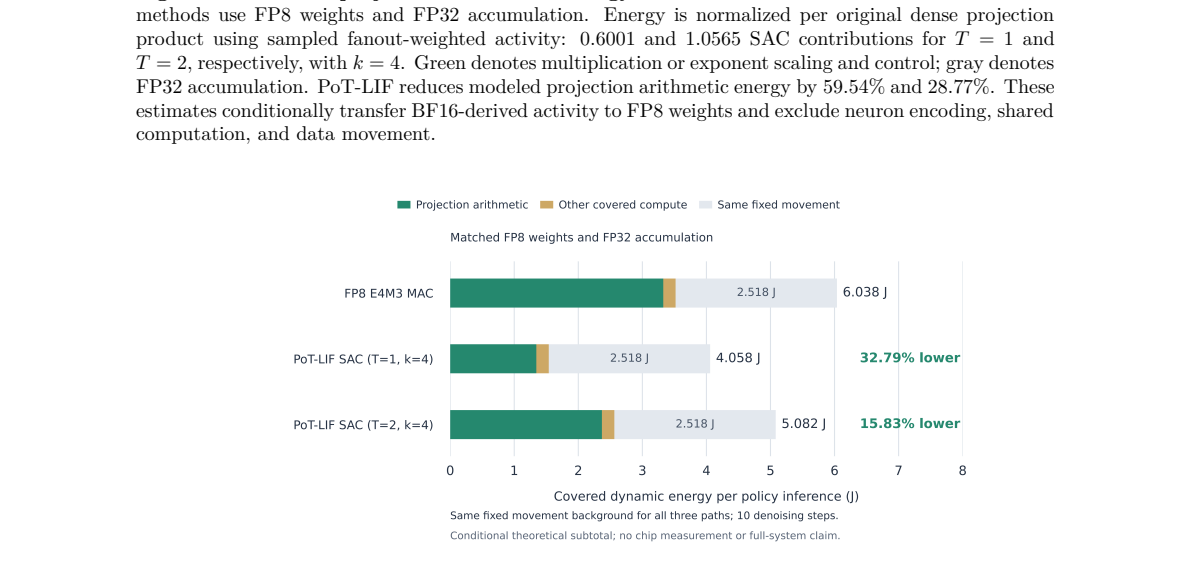
The paper is transparent about the scope of its claims. The 86.95% arithmetic-energy reduction is explicitly qualified as excluding data movement and system-level costs (b220, b322). The paper also provides a supplementary FP8 analysis that includes a fixed data-movement budget, where the savings shrink to 32.79% (T=1) and 15.83% (T=2) — consistent with the acknowledged limitation. The success-rate comparisons are supported by McNemar tests showing no significant differences after Holm correction; the paper does not claim a statistically significant improvement. All central claims hold within their stated assumptions. No additional load-bearing concern was identified.
The paper's own limitations and extended analyses address the primary concern about system-level energy costs. The success-rate claims are statistically non-significant improvements, which the paper honestly reports. The missing code/weights are a reproducibility limitation but not a load-bearing concern about the argument's correctness.
The referee's report
If the reported results hold, this work provides a practical route to reducing the energy consumption of large VLA models on edge devices without sacrificing task performance. The PoT-LIF formulation is novel, biologically motivated, and backed by a reconstruction guarantee under leak-free assumptions. The experimental protocol is rigorous (2000 episodes, paired statistics, multiple sweeps), and the authors are transparent about the limitations of the energy model (exclusion of data movement, system overheads). The Heartbeat integration strategy is clean and preserves the original architecture, making it applicable to other VLA frameworks. The paper advances the state of the art in energy-efficient robotic manipulation and is likely to influence future neuromorphic and edge-AI research.
Pith's reading of the paper (a machine's summary, not the authors')
The paper introduces the Power-of-Two Leaky Integrate-and-Fire (PoT-LIF) neuron, which emits signed spikes with power-of-two amplitudes and retains a residual membrane state. Combined with a Heartbeat schedule that confines event extraction to individual projections, it allows continuous-valued computations in pretrained vision-language-action (VLA) models to be replaced by sparse, magnitude-coded events without degrading closed-loop task performance. Integrated into the π0.5 VLA model, PoT-LIF achieves 97.25% success on the LIBERO benchmark (vs. 96.70% baseline) while reducing modeled arithmetic energy by 86.95% at a single extraction step. The energy model excludes data movement and system overheads, and the savings diminish with larger event budgets. The central claim is that amplitude-bearing spike events can substitute dense multiply-accumulate operations in pretrained VLA models while preserving both task success and interface compatibility.
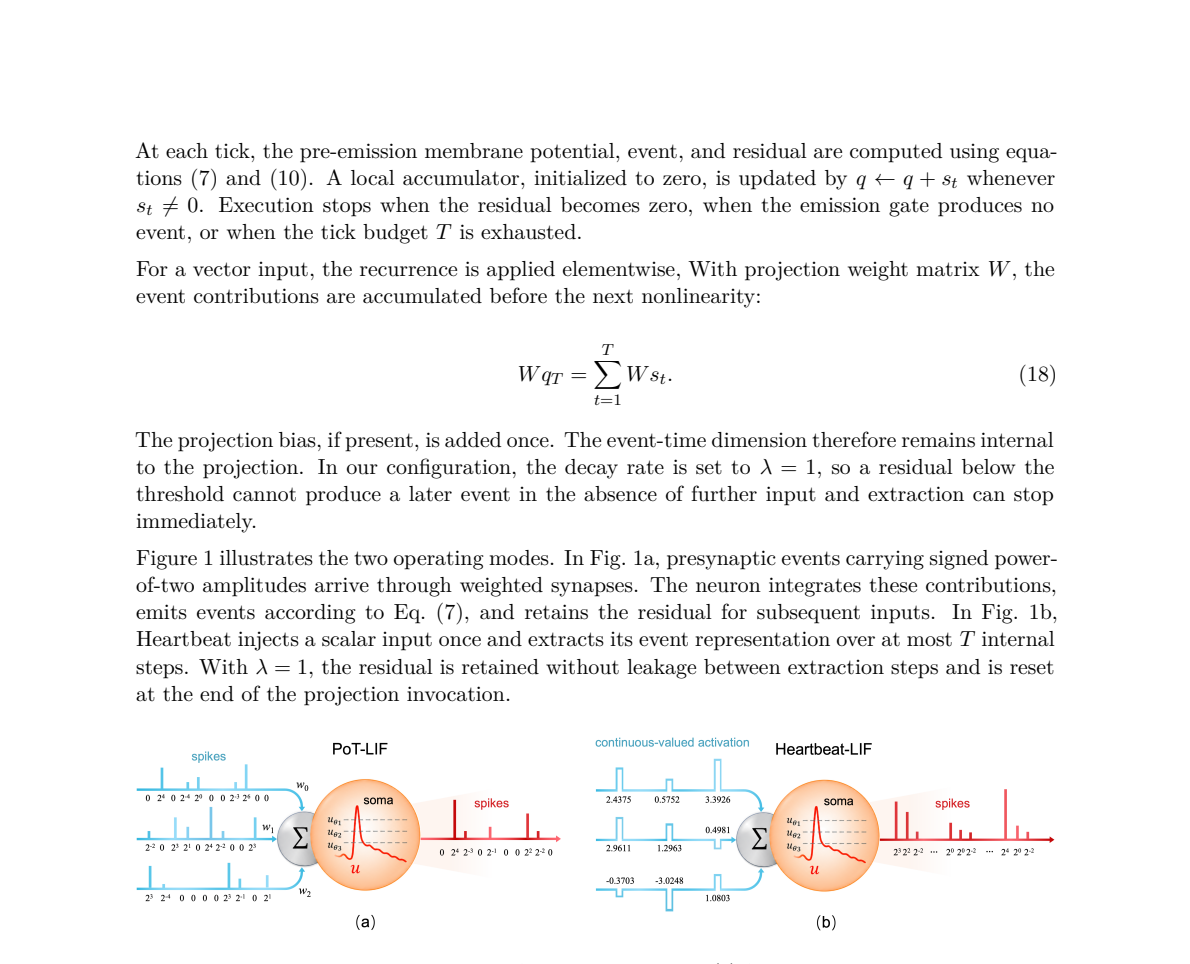
What carries the argument. The central object is the Power-of-Two Leaky Integrate-and-Fire (PoT-LIF) neuron, which emits signed events with amplitude $2^e$ ($e$ integer) and retains the unrepresented fraction as a residual membrane state. The Heartbeat input schedule applies this recurrence locally within each weighted projection: a single input is injected and decomposed into a bounded sequence of events, whose weighted contributions are accumulated via scaling-accumulation (SAC) rather than multiply-accumulate. This confinement keeps temporal processing internal to the projection and preserves the pretrained model's external interface.
Core claim. The core discovery is that signed power-of-two spike events with residual membrane dynamics can replace continuous-valued activations in the weighted projections of a pretrained VLA model without significant performance loss, while enabling large reductions in arithmetic energy. The paper shows that the PoT-LIF neuron's discrete event sequence approximates the continuous input to bounded error under leak-free dynamics, and that the Heartbeat schedule confines this process within individual projections, preserving token layout, residual connections, and KV caches. On LIBERO, all PoT-LIF configurations differ from the dense baseline by at most 0.80 percentage points, and at T=1 the modeled arithmetic energy is 1/7.67 of the dense reference, corresponding to an 86.95% reduction.
The premise it rests on. The 86.95% energy reduction applies only to arithmetic operations (multiply-accumulate replaced by scaling-accumulation) and excludes data movement, memory access, control logic, event encoding, and other system-level costs, which often dominate total energy in practice.
If the paper is right (Pith's inferences, not the authors')
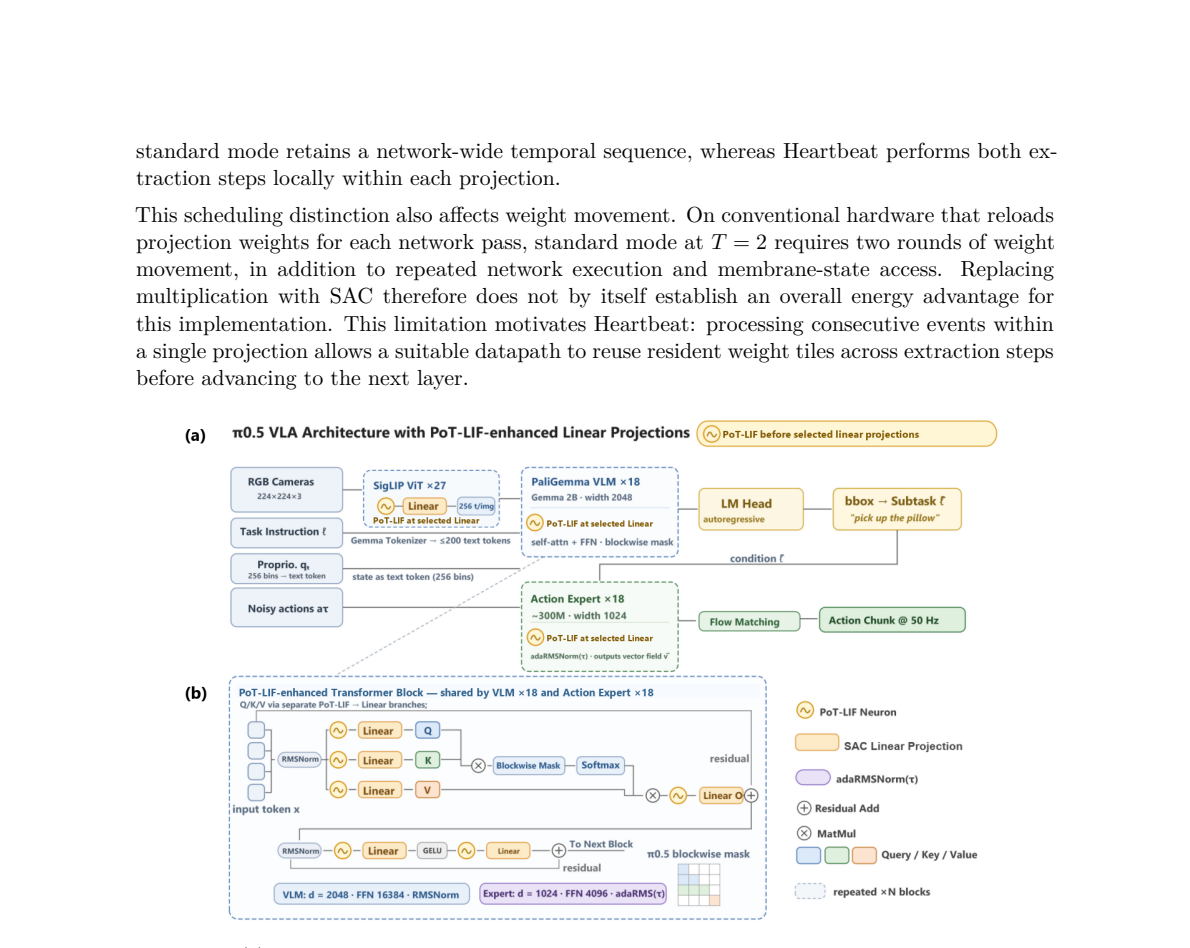
PoT-LIF can be inserted into pretrained VLA architectures without changing token layout, residual connections, or KV-cache organization, making it applicable beyond π0.5 to other transformer-based models.
Heartbeat mode at T=2 achieves 97.25% LIBERO success (higher than the 96.70% continuous baseline), demonstrating that event-based computation need not sacrifice task performance.
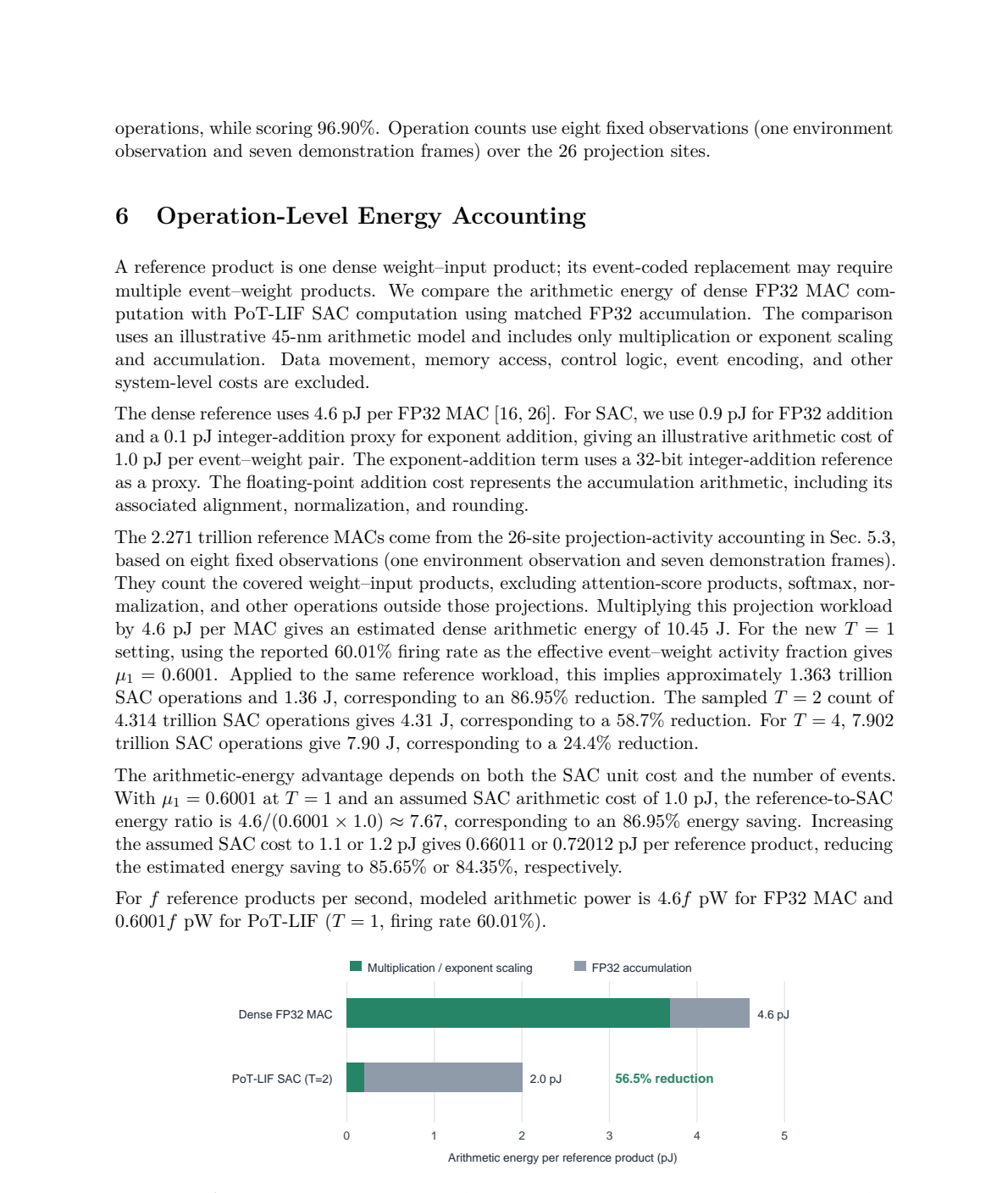
At a 60.01% firing rate and T=1, the modeled arithmetic energy is reduced by 86.95% relative to dense FP32 MACs, though this excludes data movement and system-level costs.
The energy advantage decreases with larger event budgets: T=2 gives a 58.7% reduction and T=4 a 24.4% reduction, while success rates remain essentially unchanged.
The reconstruction guarantees under leak-free dynamics show that the event representation has bounded relative error ($2^{-T}$) and can exactly reconstruct inputs with finitely many power-of-two components, providing theoretical backing for the approach.
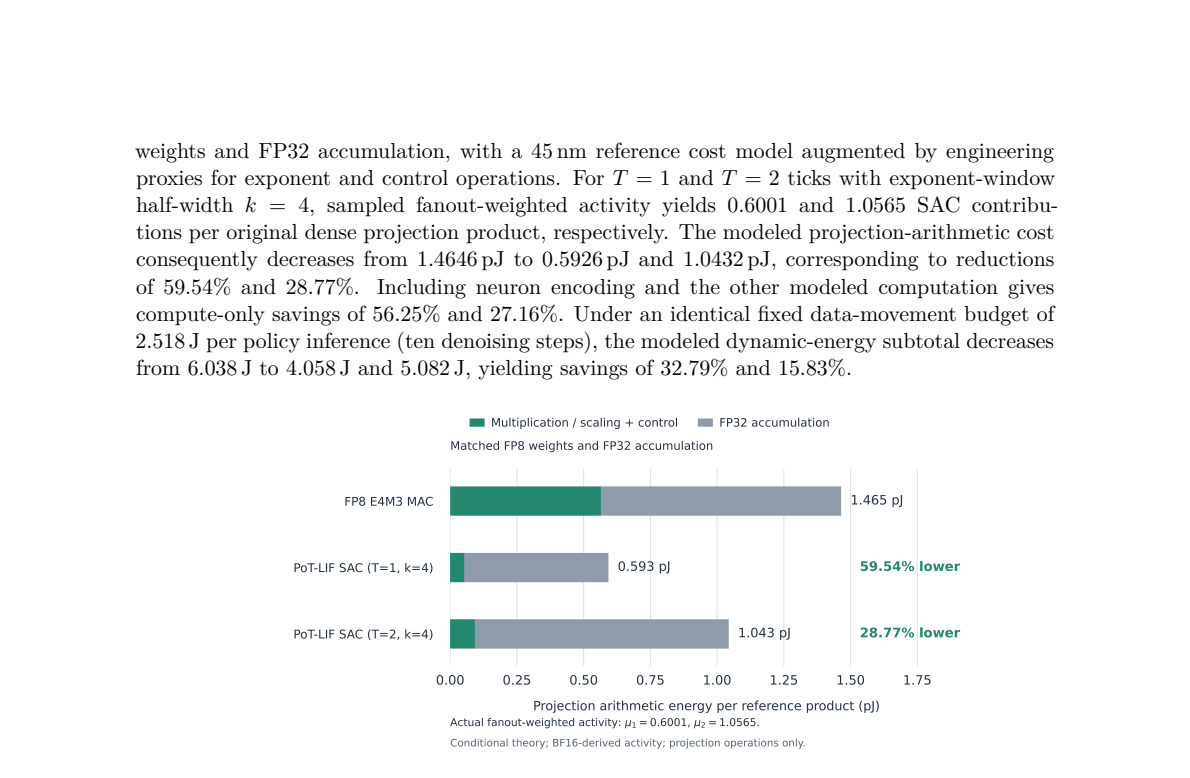
If realistic data movement costs were included (often dominant in modern hardware), the headline 86.95% arithmetic savings would shrink substantially, potentially reducing the practical energy benefit on conventional platforms.
The method's reliance on fine-tuning with surrogate gradients suggests it could be applied to other transformer-based VLA or multimodal models without retraining from scratch, broadening its potential impact.
The Heartbeat schedule's confinement of temporal processing to single projections opens the door to hardware designs that reuse resident weight tiles across extraction steps, reducing weight movement overhead—a point the paper mentions but does not evaluate.
The energy comparison accounts only for arithmetic operations; a fair system-level comparison with binary-spike VLA models would require including all computational steps (encoding, neuron dynamics, communication), which are excluded here.
Check this review
Pith stored no record of this review's passes and took no fingerprint of it. Reviews made by code from 13 Nov 2026 on carry both.
How often reviews like this one are right
Reviews like this one: written by deepseek-v4-flash, where what was read was not recorded.
How often objections from reviews like this one are right: not yet measured
Reviews by people
This review was written by a machine. No person has reviewed this paper on Pith yet. A scientist listed on Pith can review it for a fee, and their review is published here whatever it concludes.
The paper
Abstract
Vision-language-action (VLA) models have demonstrated strong capabilities in robotic manipulation, yet their reliance on dense, continuous-valued computation presents a fundamental challenge for energy-constrained deployment. Inspired by the sparse, event-driven signaling and temporal integration mechanisms of biological neurons, a promising alternative is to introduce spiking computation into VLA models. However, enabling such computation without restructuring pretrained policies or compromising closed-loop control remains an open challenge. To address this challenge, we introduce the Power-of-Two Leaky Integrate-and-Fire (PoT-LIF) neuron, which emits signed spikes with power-of-two amplitudes. By combining magnitude-coded spike events with residual-preserving membrane dynamics, PoT-LIF enables continuous information to be progressively represented through discrete spikes. The Heartbeat formulation further localizes this process within weighted projections, bridging biologically inspired spiking computation and pretrained VLA architectures without modifying their external inference interfaces. We integrate PoT-LIF into the vision projection, vision-language projection, and action projection of π0.5 and evaluate both operating modes over 2,000 paired closed-loop LIBERO episodes per configuration. Standard-mode PoT-LIF VLA achieves success rates of 96.90% and 96.35% at T = 1 and T = 2, respectively, while Heartbeat mode achieves 97.25% and 96.90% at T = 2 and T = 4, compared with 96.70% for the original continuous-activation π0.5 baseline. At T = 1 with a 60.01% firing rate, PoT-LIF uses approximately 1/7.67 of the dense-reference arithmetic energy, corresponding to a modeled reduction of 86.95%.
The paper's own sentences, arranged, kept beside the review and separate from it. Each label is drawn from a closed vocabulary; the number beside it is the probability the classifier gave that label. No sentence in this record was written by a model.
abstract compiled · 2026-10-27
The authors' main claim, as the classifier picked it out 0.87
“Standard-mode PoT-LIF VLA achieves success rates of 96.90% and 96.35% at $T = 1$ and $T = 2$, respectively, while Heartbeat mode achieves 97.25% and 96.90% at $T = 2$ and $T = 4$, compared with 96.70% for the original continuous-activation $\pi_{0.5}$ baseline.”
How the main claim is stated: asserted 1.00
What the abstract itself states, as probabilities: claims first 0.06 · states limitation 0.28 · human participants 0.03 · controlled comparison 0.97 · randomized assignment 0.02 · states quantitative result 0.99 · compares with prior results 0.97 · mentions code or data availability 0.03
The abstract, sentence by sentence
This table labels the abstract only (arXiv listing abstract v1). The number is the probability the classifier gave the label.
| Sentence | Role | The authors' own work | States the main conclusion | Strength |
|---|---|---|---|---|
| Vision-language-action (VLA) models have demonstrated strong capabilities in robotic manipulation, yet their reliance on dense, continuous-valued computation presents a fundamental challenge for energy-constrained deployment. | background 1.00 | 0.06 | 0.03 | asserted 1.00 |
| Inspired by the sparse, event-driven signaling and temporal integration mechanisms of biological neurons, a promising alternative is to introduce spiking computation into VLA models. | background 0.98 | 0.05 | 0.04 | hedged possibility 0.83 |
| However, enabling such computation without restructuring pretrained policies or compromising closed-loop control remains an open challenge. | gap 1.00 | 0.04 | 0.03 | asserted 0.99 |
| To address this challenge, we introduce the Power-of-Two Leaky Integrate-and-Fire (PoT-LIF) neuron, which emits signed spikes with power-of-two amplitudes. | contribution 0.81 | 0.90 | 0.07 | asserted 1.00 |
| By combining magnitude-coded spike events with residual-preserving membrane dynamics, PoT-LIF enables continuous information to be progressively represented through discrete spikes. | method 0.94 | 0.66 | 0.08 | asserted 0.96 |
| The Heartbeat formulation further localizes this process within weighted projections, bridging biologically inspired spiking computation and pretrained VLA architectures without modifying their external inference interfaces. | method 0.87 | 0.72 | 0.10 | asserted 1.00 |
| We integrate PoT-LIF into the vision projection, vision-language projection, and action projection of $\pi_{0.5}$ and evaluate both operating modes over 2,000 paired closed-loop LIBERO episodes per configuration. | method 0.96 | 0.97 | 0.05 | asserted 0.97 |
| Standard-mode PoT-LIF VLA achieves success rates of 96.90% and 96.35% at $T = 1$ and $T = 2$, respectively, while Heartbeat mode achieves 97.25% and 96.90% at $T = 2$ and $T = 4$, compared with 96.70% for the original continuous-activation $\pi_{0.5}$ baseline. | result 1.00 | 0.96 | 0.41 | asserted 1.00 |
| At $T = 1$ with a 60.01% firing rate, PoT-LIF uses approximately 1/7.67 of the dense-reference arithmetic energy, corresponding to a modeled reduction of 86.95%. | result 1.00 | 0.94 | 0.15 | asserted 0.95 |
What kind of paper the classifier reports this is: method or tool 1.00 · evidence from observation or experiment 0.63
What was examined, and what was not
Sources read
- arXiv listing abstract v1
Not examined
- full text
- figures and tables
- references and citing sentences
- relations to other papers
Levels run
- P abstract
Not run
- S sections
- T body sentences
- C citations
- R cross-paper relations
How the labels were made
Compiled by classifier-1.13.0 via TypeSafe API, question bank abstract-p1-20260923, 2026-10-27: 1 request, 7,310 input tokens.
Every quoted sentence on this record is the authors'. Every label is from Pith's closed vocabulary, with the probability shown beside it. This record as JSON
Figures (6)
Figures are the authors', reproduced from the paper.
References (32)
- [1] Kevin Black, Noah Brown, Danny Driess, et al. π0: A vision-language-action flow model for general robot control. arXiv preprint arXiv:2410.24164 , 2024 on PithPith's reviewarXiv
- [2] Physical Intelligence, Kevin Black, Noah Brown, et al. π0.5: A vision-language-action model with open-world generalization. arXiv preprint arXiv:2504.16054 , 2025 on PithPith's reviewarXiv
- [3] Anthony Brohan, Noah Brown, Justice Carbajal, et al. RT-2: Vision-language-action models transfer web knowledge to robotic control. arXiv preprint arXiv:2307.15818 , 2023 on PithPith's reviewarXiv
- [4] Moo Jin Kim, Karl Pertsch, Siddharth Karamcheti, et al. OpenVLA: An open-source vision- language-action model. arXiv preprint arXiv:2406.09246 , 2024 on PithPith's reviewarXiv
- [5] Wulfram Gerstner, Werner M. Kistler, Richard Naud, and Liam Paninski. Neuronal Dynam- ics: From Single Neurons to Networks and Models of Cognition . Cambridge University Press, on Pith
- [6] Louis Lapicque. Recherches quantitatives sur l’excitation électrique des nerfs traitée comme une polarisation. Journal de Physiologie et de Pathologie Générale , 9:620–635, 1907. English translation by N. Brunel and M. C. W. van Rossum, Biological Cybernetics, 97:341–349, 2007... on Pithdoi:10.1007/s00422-007-0189-6
- [7] Nicolas Brunel and Mark C. W. van Rossum. Lapicque’s 1907 paper: From frogs to integrate- and-fire. Biological Cybernetics, 97(5–6):337–339, 2007. doi: 10.1007/s00422-007-0190-0 on Pithdoi:10.1007/s00422-007-0190-0
- [8] Shuai Wang, Malu Zhang, Mingquan Liu, Weihui Dai, Dehao Zhang, Jieyuan Zhang, Yimeng Shan, Zijian Zhou, and Yang Yang. Spike-driven Vision-Language-Action Model. arXiv preprint arXiv:2609.39514 , 2026 on PithPith's reviewarXiv
- [9] Yaxing Lyu, Jingyi Li, Mingkun Xu, and Yujie Wu. DS-VLA: A Dendritic-inspired Vision- Language-Action Model for Robust Action Control. arXiv preprint arXiv:2609.32253 , 2026 on PithPith's reviewarXiv
- [10] Fabrizio Gabbiani, Holger G. Krapp, Christof Koch, and Gilles Laurent. Multiplicative computation in a visual neuron sensitive to looming. Nature, 420:320–324, 2002. doi: 10. 1038/nature01190 on Pith
- [11] Yousheng Shu, Andrea Hasenstaub, Alvaro Duque, Yuguo Yu, and David A. McCormick. Modulation of intracortical synaptic potentials by presynaptic somatic membrane potential. Nature, 441:761–765, 2006. doi: 10.1038/nature04720 on Pithdoi:10.1038/nature04720
- [12] Bo Liu, Yifeng Zhu, Chongkai Gao, Yihao Feng, Qiang Liu, Yuke Zhu, and Peter Stone. LIBERO: Benchmarking knowledge transfer for lifelong robot learning. In Advances in Neural Information Processing Systems , volume 36, pages 44776–44791, 2023 on Pith
- [13] Alain Destexhe, Zachary F. Mainen, and Terrence J. Sejnowski. An efficient method for computing synaptic conductances based on a kinetic model of receptor binding. Neural Computation, 6(1):14–18, 1994. doi: 10.1162/neco.1994.6.1.14 on Pithdoi:10.1162/neco.1994.6.1.14
- [14] M. V. Tsodyks and H. Markram. The neural code between neocortical pyramidal neurons depends on neurotransmitter release probability. Proceedings of the National Academy of Sciences, 94(2):719–723, 1997. doi: 10.1073/pnas.94.2.719 on Pithdoi:10.1073/pnas.94.2.719
- [15] Yongqiang Cao, Yang Chen, and Deepak Khosla. Spiking Deep Convolutional Neural Net- works for Energy-Efficient Object Recognition. International Journal of Computer Vision , 113(1):54–66, 2015. doi: 10.1007/s11263-014-0788-3 on Pithdoi:10.1007/s11263-014-0788-3
- [16] Abhronil Sengupta, Yuting Ye, Ramakrishnan Wang, Chiao Liu, and Kaushik Roy. Going Deeper in Spiking Neural Networks: VGG and Residual Architectures. Frontiers in Neuro- science, 13:95, 2019. doi: 10.3389/fnins.2019.00095. 22 on Pithdoi:10.3389/fnins.2019.00095
- [17] Emre O. Neftci, Hesham Mostafa, and Friedemann Zenke. Surrogate gradient learning in spiking neural networks: Bringing the power of gradient-based optimization to spiking neural networks. IEEE Signal Processing Magazine , 36(6):51–63, 2019. doi: 10.1109/MSP.2019. 2931595 on Pithdoi:10.1109/msp.2019
- [18] William B. Levy and Robert A. Baxter. Energy efficient neural codes. Neural Computation, 8(3):531–543, 1996. doi: 10.1162/neco.1996.8.3.531 on Pithdoi:10.1162/neco.1996.8.3.531
- [19] Julia J. Harris, Renaud Jolivet, Elisabeth Engl, and David Attwell. Energy-efficient infor- mation transfer by visual pathway synapses. Current Biology, 25(24):3151–3160, 2015. doi: 10.1016/j.cub.2015.10.063 on Pithdoi:10.1016/j.cub.2015.10.063
- [20] Daisuke Miyashita, Edward H. Lee, and Boris Murmann. Convolutional neural networks using logarithmic data representation. arXiv preprint arXiv:1603.01025 , 2016 on PithPith's reviewarXiv
show 12 more
- [21] Mostafa Elhoushi, Zihao Chen, Farhan Shafiq, Ye Henry Tian, and Joey Yiwei Li. DeepShift: Towards multiplication-less neural networks. In Proceedings of the IEEE/CVF Conference on Computer Vision and Pattern Recognition Workshops , pages 2359–2368, 2021 on Pith
- [22] Hanting Chen, Yunhe Wang, Chunjing Xu, Boxin Shi, Chao Xu, Qi Tian, and Chang Xu. AdderNet: Do we really need multiplications in deep learning? In Proceedings of the IEEE/CVF Conference on Computer Vision and Pattern Recognition , pages 1468–1477, on Pith
- [23] Intel Labs. Taking Neuromorphic Computing to the Next Level with Loihi 2. Technol- ogy brief, Intel Corporation, 2021. URL https://download.intel.com/newsroom/2021/ new-technologies/neuromorphic-computing-loihi-2-brief.pdf on Pith
- [24] Xiaohua Zhai, Basil Mustafa, Alexander Kolesnikov, and Lucas Beyer. Sigmoid loss for language image pre-training. arXiv preprint arXiv:2303.15343 , 2023 on PithPith's reviewarXiv
- [25] Lucas Beyer, Andreas Steiner, André Susano Pinto, et al. PaliGemma: A versatile 3B VLM for transfer. arXiv preprint arXiv:2407.07726 , 2024 on PithPith's reviewarXiv
- [26] Mark Horowitz. Computing’s energy problem (and what we can do about it). In IEEE International Solid-State Circuits Conference Digest of Technical Papers , pages 10–14, 2014. doi: 10.1109/ISSCC.2014.6757323 on Pithdoi:10.1109/isscc.2014.6757323
- [27] Paulius Micikevicius et al. FP8 formats for deep learning. arXiv preprint arXiv:2209.05433 , 2022 on PithPith's reviewarXiv
- [28] Ilya Loshchilov and Frank Hutter. Decoupled weight decay regularization. In International Conference on Learning Representations , 2019. arXiv:1711.05101 on PithPith's reviewarXiv
- [29] Quinn McNemar. Note on the sampling error of the difference between correlated proportions or percentages. Psychometrika, 12:153–157, 1947. doi: 10.1007/BF02295996 on Pithdoi:10.1007/bf02295996
- [30] Sture Holm. A simple sequentially rejective multiple test procedure. Scandinavian Journal of Statistics , 6(2):65–70, 1979. URL https://www.jstor.org/stable/4615733. 23 on Pith
- [2014] doi: 10.1017/CBO9781107447615 on Pithdoi:10.1017/cbo9781107447615
- [2020] doi: 10.1109/CVPR42600.2020.00154 on Pithdoi:10.1109/cvpr42600.2020.00154
Challenges and discussion
Disagree with the review, or know something it missed? Leave a comment, or challenge this review formally: a challenge becomes a permanent entry in this paper's record, and its decision is published here.
Come back by email
A short list of the week's newly reviewed papers. Nothing is sent until you confirm from your inbox, and every email has a link that stops it. No account.
No comments yet.
Sign in to comment