Quantum Physics · arXiv:2611.15000 v1 · submitted 11 Nov 2026 · 49 references
QSim-Arena: an evolving developer for quantum simulation advantage
The paper says
“Where practical advantage emerges in quantum dynamics simulation remains a central debate in quantum computing. Claimed advantages can be rapidly narrowed or overturned by stronger classical methods, while progress on both sides can outpace the journal publication cycle.”
more of the abstract
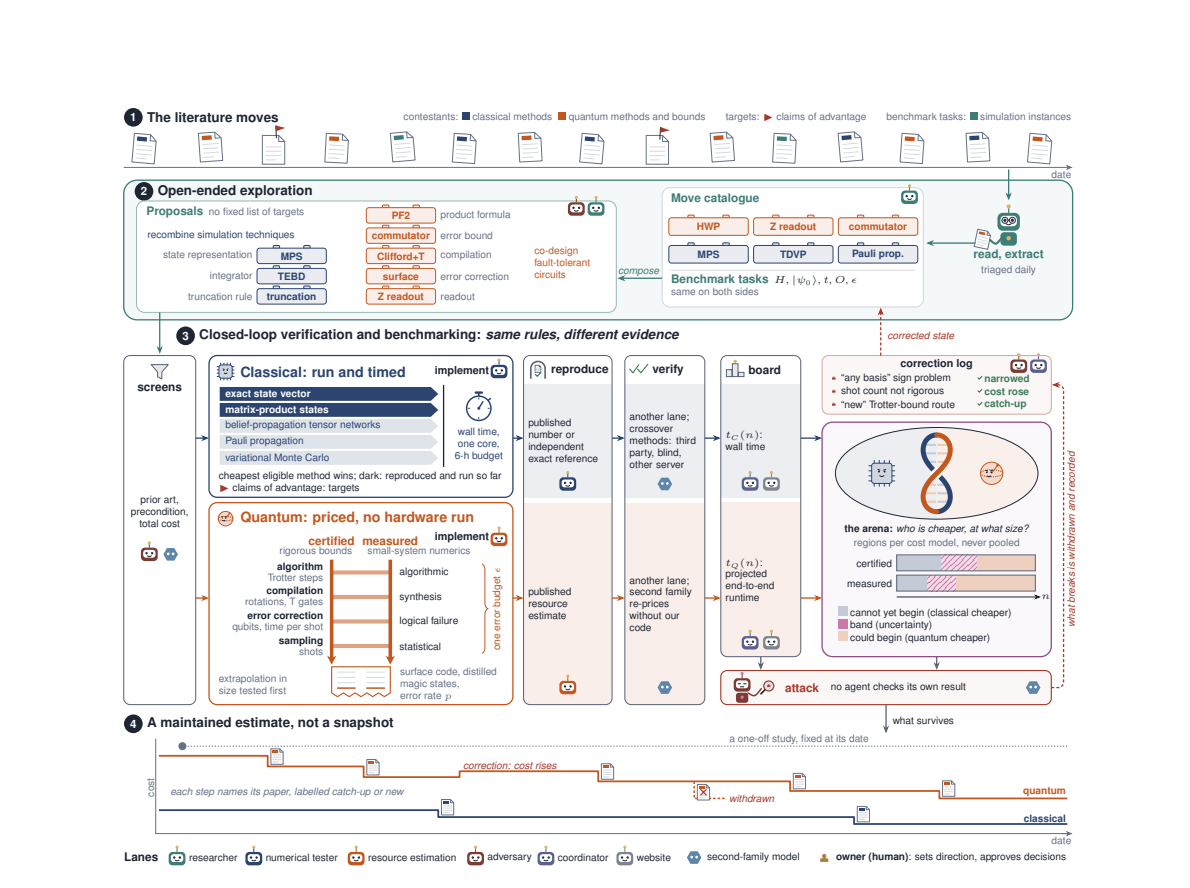
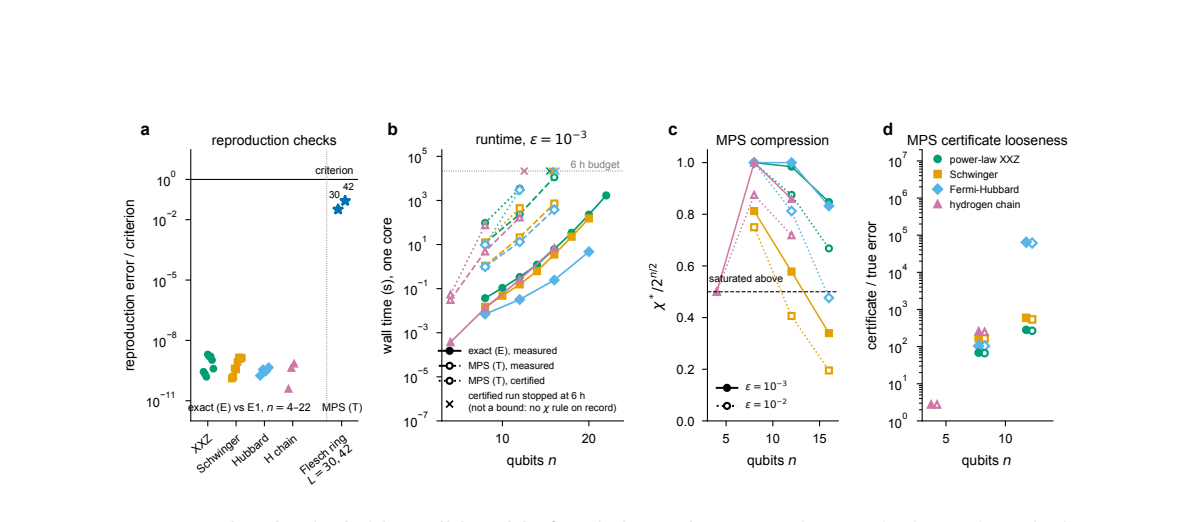
We present QSim-Arena, a research framework in which AI agents combine a closed loop of verification and benchmarking with open exploration. Hamiltonians, initial states and accuracy targets for evolved states or observable expectation values provide explicit specifications for evaluating simulation methods. Agents translate published techniques into executable components, reproduce reported results and benchmark their performance across diverse Hamiltonian families. Competing classical methods are implemented and independently crosschecked, providing credible baselines for end-to-end quantum resource estimates based on rigorous error bounds and empirical calibration. Alongside this closed loop, agents recombine classical simulation techniques and co-design fault-tolerant quantum circuits using knowledge extracted from the literature. Initial applications improve baseline resource estimates through the integration of established techniques. QSim-Arena thus treats quantum advantage assessment as an evolving, reproducible research process that can respond to advances in algorithms, error analysis and hardware.
from the abstract
Pith says
Machine review · deepseek-v4-flash · 13 Nov 2026 · what was read was not recorded · not checked by a person
It can be wrong. Challenge this review or reply to it.
Holds up. QSim-Arena is a thoughtfully designed, transparently documented framework for maintaining quantum-classical crossover estimates, but its central assumption about AI reliability is honestly flagged rather than resolved. This line is wrong
6 minor
How often objections from reviews like this one are right: not yet measured
Not checked: figures, code, what the 49 references say.
6 minor objections
The paper says, at Fig. 2
Pith says: minor objection 1 of 6
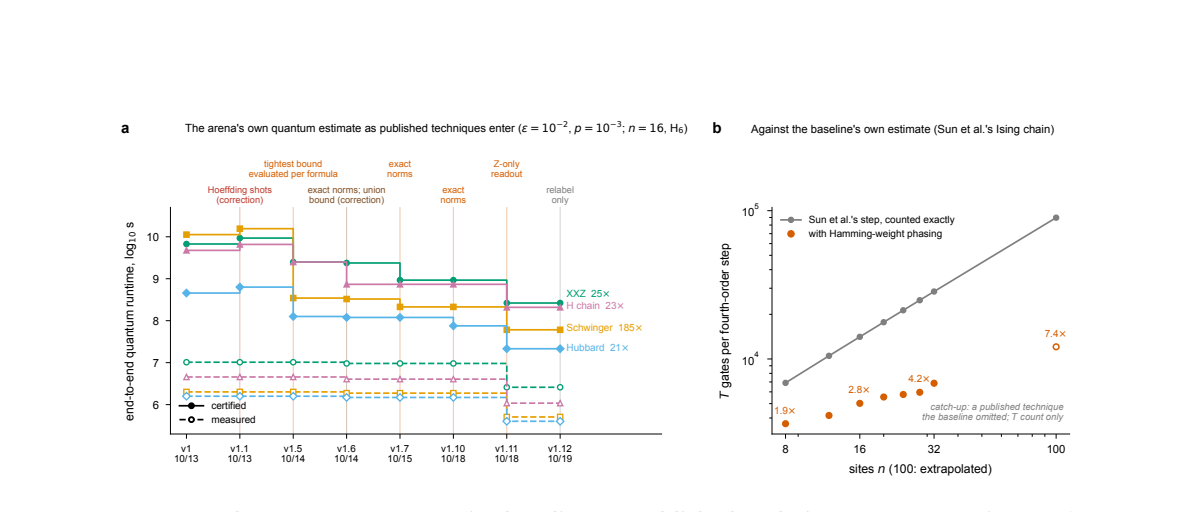
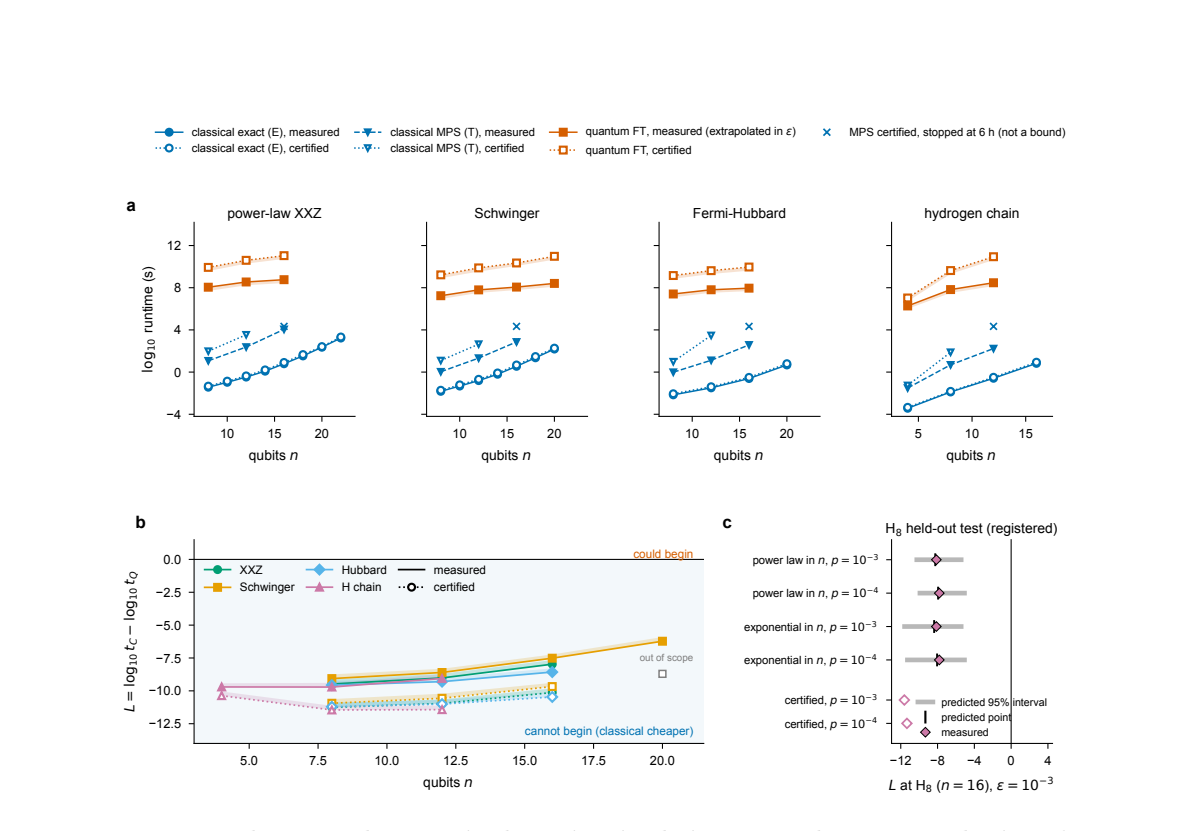
The vertical axis in Fig. 2a is labelled 'end-to-end quantum runtime, log10 s'. It would be clearer to write 'log10(end-to-end quantum runtime / s)' so that the unit is explicit and the log scaling is unambiguous.
The paper says, at §3, around Eq. numbers
Pith says: minor objection 2 of 6
In the paragraph describing the three techniques that entered (commutator bound, exact norms, symmetry-aware readout), the text lists the gain factors but does not state explicitly which technique caused which factor reduction. A brief mapping between each technique and the factor it contributed (where separable) would improve readability.
show 4 more
The paper says, at §4, Table 1
Pith says: minor objection 3 of 6
Table 1 is valuable, but it would be helpful to add a column or a footnote indicating whether the correction increased or decreased the reported quantum cost (or left it unchanged), since two of the four rows moved the estimate in opposite directions.
The paper says, at §5, Fig. 5
Pith says: minor objection 4 of 6
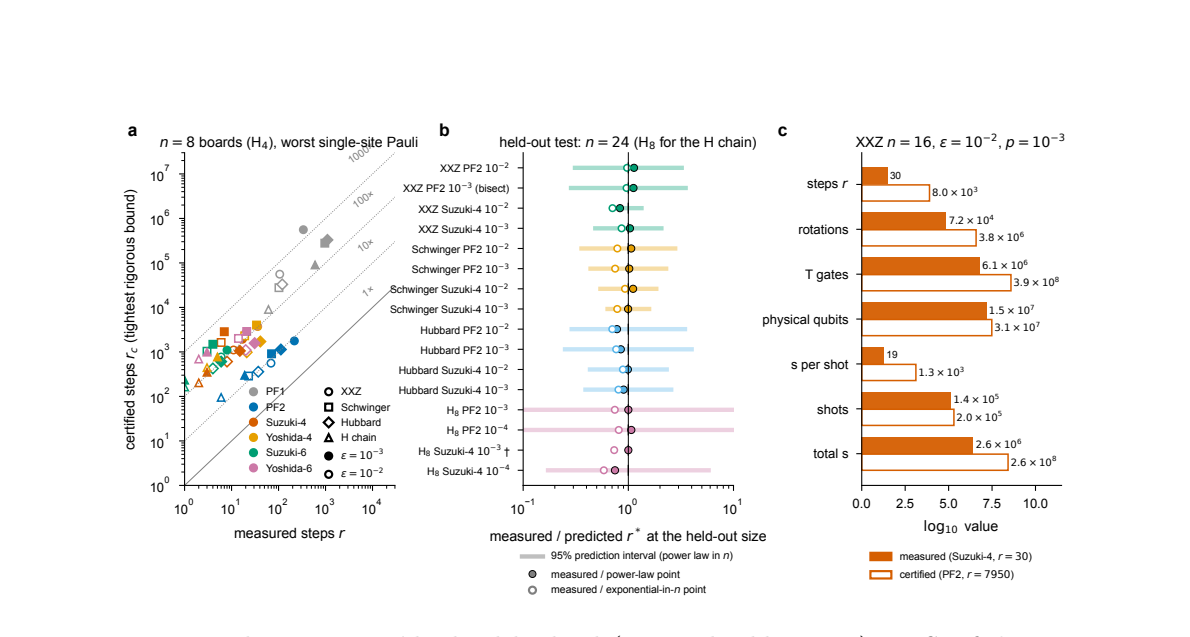
Fig. 5c shows the held-out test for the hydrogen chain. The caption says 'bars, 95% prediction interval; ticks, point', but the legend distinguishes the two fitting laws (power law vs exponential in n) only by fill. Consider using both shape and colour to make the symbols distinguishable in grayscale.
The paper says, at §6, second paragraph
Pith says: minor objection 5 of 6
The sentence 'the fraction of errors it misses is unknown' is stated, but the paper does not quantify the total number of implemented components or the number of errors caught. A brief summary of the raw counts (how many proposals, how many caught errors) would give context for the case studies in Table 1.
The paper says, at Refs.
Pith says: minor objection 6 of 6
Several references are to arXiv preprints that have not yet appeared in peer-reviewed venues (e.g., [24], [25], [26], [30]–[35]). This is appropriate for a fast-moving field, but the authors should consider adding a statement about the review status of the most heavily cited preprints (e.g., Sun et al. [24]) if known.
What would settle it
Execute the sealed-manifest test proposed by the paper (Section 4): an independent party plants a set of known errors (sign errors, metric misapplications, violated provenance rules, etc.) into new benchmark tasks, mixes them with fault-free tasks, runs the full verification pipeline and a version without the adversarial lane, and measures the fraction of planted errors detected and the false-alarm rate. Comparing detection rates across lanes would quantify the verification process's effectiveness, directly addressing the acknowledged blind spot.
from the skeptic's reading
How the review went
4 readings by deepseek-v4-flash · 13 Nov 2026
- Reader holds up
- Skeptic agrees
- Editor wrote the verdict above
- Referee minor revision: 6 minor
Not run on this paper: the simulated authors' defence.
Pith did not check this review's objections against the paper.
The review in full
The review in brief, machine-written
This paper's real contribution isn't the numbers—it's the framework design. The authors built a system where AI agents continuously read the literature, implement techniques, verify each other's work, and update crossover estimates. They did this with unusual discipline: lane separation, adversarial checks, catch-up labeling, and append-only correction logs. The initial demonstration, where the system lowered its own first estimates by factors of 21–185 within a week by integrating published techniques, shows the design works as described. The paper is also refreshingly honest about its limitations—it explicitly says it doesn't know its error detection rate, that all gains so far are catch-up, and that the crossover remains beyond computed sizes.
The soft spots are mostly ones the authors already name. The biggest open question is whether the AI implementations are correct enough, and whether the multi-lane verification catches enough errors to keep the leaderboard trustworthy. The paper acknowledges this and proposes a prospective fault-planting test but hasn't run it yet. Another concern is that all the reported improvements come from applying techniques published before the run started; the arena's ability to respond to genuinely new literature is demonstrated only by the design, not yet by a case. Neither soft spot undermines the framework claim—the paper presents QSim-Arena as an evolving system, not a final answer—but they limit what a reader can conclude about reliability.
For whom is this paper? Anyone working on quantum advantage assessment, reproducible research pipelines, or AI-driven scientific workflows will find it worth reading. The paper deserves serious peer review because it proposes a novel methodology that addresses a real problem (snapshot estimates aging out). I would bring it to a reading group and would encourage the editor to send it to reviewers who can evaluate the systems design and the verification logic, not just the physics numbers.
The strongest objection
The paper's central claim is that QSim-Arena provides a workable framework for evolving, reproducible quantum advantage assessment. The evidence supports this: agents integrated published techniques, verified them through multi-lane checks, and recorded corrections. The most critical assumption — that AI implementations are sufficiently correct and that the verification process catches enough errors — is explicitly acknowledged by the authors as an open issue (Section 4: 'The arena cannot yet say what fraction of its errors it catches…'). The paper does not overclaim; it describes the initial operation and transparently lists limitations, including unknown error detection rate, reliance on techniques published before the run, and lack of hardware validation. No internal inconsistency or unsupported inference undermines the framework-level claim. The reader's weakest_assumption correctly identifies this limitation, and the paper even proposes a prospective test (sealed manifest of planted faults). Therefore, no additional load-bearing concern is present beyond what the paper already discloses.
The reader's verdict of ACCEPT is well-supported. The paper is methodologically sound: it makes modest claims about a framework's design and initial operation, supports them with concrete evidence (reproduction checks, multi-lane verification, logged corrections), and candidly states all limitations. The strongest claim — that QSim-Arena enables evolving, reproducible advantage assessment — is substantiated by the demonstrated ability to lower resource estimates by integrating published techniques and by the transparent record of errors and corrections. The weakest assumption (AI implementation fidelity and verification sufficiency) is explicitly acknowledged and a path to resolution is outlined; it does not invalidate the framework's demonstrated function. No hidden flaws or overstatements are present. Therefore, the verdict should remain unchanged.
The referee's report
If the framework scales as intended, it could address the acute reproducibility and timeliness problems in quantum advantage assessment by replacing static snapshots with a maintained, dated estimate that moves with the literature. The paper demonstrates an initial proof of concept: the design is concrete, the verification protocols are specified, and the first results show that integrating established published techniques within a single framework can produce large cost reductions in days. The explicit labelling of every gain as catch-up and the inclusion of held-out extrapolation tests add credibility. The significance is high for the subfield of resource estimation and crossover studies, though the evidence is still preliminary and confined to techniques that were published before the run began.
Pith's reading of the paper (a machine's summary, not the authors')
The paper aims to establish that the quantum-classical crossover for dynamics simulation should be tracked as a living process rather than fixed in a snapshot study. It introduces QSim-Arena, a framework where AI agents read the literature, implement techniques, verify them across independent lanes, and update cost estimates. In an initial application, the arena reduced its own certified quantum runtime estimates by factors of 21 to 185 within a week by applying known techniques the baseline study omitted. A sympathetic reader should care because the central question of where quantum advantage begins is inherently moving, and static estimates are quickly outdated; QSim-Arena offers a way to keep that answer current and reproducible.
What carries the argument. The arena operates through multiple lanes (researcher, numerical tester, resource estimation, adversarial, etc.), each running as an independent AI agent session. Techniques from the literature are translated into typed executable components (product formulas, error bounds, compilations, error-correction profiles, readout schemes) that can be composed. A closed loop of verification ensures that every result is independently checked by another lane, reproduces a published number, and is attacked by an adversarial lane before entering a leaderboard. The cost model is split into certified (rigorous bounds) and measured (empirical numerics), never pooled, and the entire process is recorded in append-only logs.
Core claim. QSim-Arena is a research framework in which AI agents combine closed-loop verification and benchmarking with open exploration, enabling quantum-classical crossover estimates to be continuously updated as the literature evolves. In an initial application, the arena lowered its first quantum runtime estimates by factors of 21 to 185 within a week by integrating published techniques that the baseline study omitted. The paper states: 'QSim-Arena thus treats quantum advantage assessment as an evolving, reproducible research process that can respond to advances in algorithms, error analysis and hardware.'
The premise it rests on. AI agents can faithfully translate published simulation techniques into correct, verified executable components, and the verification process catches enough errors to keep the leaderboard trustworthy.
If the paper is right (Pith's inferences, not the authors')
Quantum advantage claims can now be tested against a constantly updating classical portfolio, reducing the lag between a new classical technique and its impact on crossover estimates.
Resource estimates for fault-tolerant quantum simulation become living documents that incorporate new algorithm improvements, better error bounds, and cheaper compilation methods as they appear.
The framework's design—separation of concerns, independent verification, open record of corrections—provides a template for other compute-intensive research comparisons, such as ground-state energy or thermal crossovers.
The quantitative results (21–185x runtime reduction) suggest that many published crossover estimates may be significantly pessimistic because they omit known techniques; the arena can systematically fill those gaps.
The held-out size extrapolation test (Fig. 4b) offers a method for validating predictions before relying on them in the crossover comparison.
The arena's design implies that the relevant bottleneck for quantum advantage assessment is no longer the pace of new algorithms but the pace at which those algorithms can be faithfully implemented and verified. If the verification pipeline can be made robust enough, the crossover estimate could track the literature in near real-time.
The fact that the arena lowered its own estimate by integrating techniques that were 'all published before the run began' suggests that many existing crossover studies systematically undercount classical capabilities, and that the true crossover may be farther away than most snapshot estimates indicate.
A prospective test of the arena's error-detection rate (planted faults by an external party) would be a crucial next step; without it, the reliability of self-correction remains unknown. The paper explicitly calls for this experiment.
The framework could be extended to other domains, such as optimization or quantum chemistry ground-state problems, wherever there is a moving frontier between quantum and classical methods.
Check this review
Pith stored no record of this review's passes and took no fingerprint of it. Reviews made by code from 13 Nov 2026 on carry both.
How often reviews like this one are right
Reviews like this one: written by deepseek-v4-flash, where what was read was not recorded.
How often objections from reviews like this one are right: not yet measured
Reviews by people
This review was written by a machine. No person has reviewed this paper on Pith yet. A scientist listed on Pith can review it for a fee, and their review is published here whatever it concludes.
The paper
Abstract
Where practical advantage emerges in quantum dynamics simulation remains a central debate in quantum computing. Claimed advantages can be rapidly narrowed or overturned by stronger classical methods, while progress on both sides can outpace the journal publication cycle. We present QSim-Arena, a research framework in which AI agents combine a closed loop of verification and benchmarking with open exploration. Hamiltonians, initial states and accuracy targets for evolved states or observable expectation values provide explicit specifications for evaluating simulation methods. Agents translate published techniques into executable components, reproduce reported results and benchmark their performance across diverse Hamiltonian families. Competing classical methods are implemented and independently crosschecked, providing credible baselines for end-to-end quantum resource estimates based on rigorous error bounds and empirical calibration. Alongside this closed loop, agents recombine classical simulation techniques and co-design fault-tolerant quantum circuits using knowledge extracted from the literature. Initial applications improve baseline resource estimates through the integration of established techniques. QSim-Arena thus treats quantum advantage assessment as an evolving, reproducible research process that can respond to advances in algorithms, error analysis and hardware.
The paper's own sentences, arranged, kept beside the review and separate from it. Each label is drawn from a closed vocabulary; the number beside it is the probability the classifier gave that label. No sentence in this record was written by a model.
abstract compiled · 2026-11-13
The authors' main claim, as the classifier picked it out 0.97
“QSim-Arena thus treats quantum advantage assessment as an evolving, reproducible research process that can respond to advances in algorithms, error analysis and hardware.”
How the main claim is stated: asserted 0.97
What the abstract itself states, as probabilities: claims first 0.05 · states limitation 0.19 · human participants 0.02 · controlled comparison 0.79 · randomized assignment 0.01 · states quantitative result 0.05 · compares with prior results 0.79 · mentions code or data availability 0.06
The abstract, sentence by sentence
This table labels the abstract only (arXiv listing abstract v1). The number is the probability the classifier gave the label.
| Sentence | Role | The authors' own work | States the main conclusion | Strength |
|---|---|---|---|---|
| Where practical advantage emerges in quantum dynamics simulation remains a central debate in quantum computing. | background 0.94 | 0.03 | 0.03 | asserted 0.93 |
| Claimed advantages can be rapidly narrowed or overturned by stronger classical methods, while progress on both sides can outpace the journal publication cycle. | background 0.87 | 0.04 | 0.03 | asserted 0.86 |
| We present QSim-Arena, a research framework in which AI agents combine a closed loop of verification and benchmarking with open exploration. | contribution 1.00 | 0.88 | 0.12 | asserted 0.99 |
| Hamiltonians, initial states and accuracy targets for evolved states or observable expectation values provide explicit specifications for evaluating simulation methods. | method 0.96 | 0.25 | 0.04 | asserted 0.96 |
| Agents translate published techniques into executable components, reproduce reported results and benchmark their performance across diverse Hamiltonian families. | method 0.96 | 0.68 | 0.04 | asserted 1.00 |
| Competing classical methods are implemented and independently crosschecked, providing credible baselines for end-to-end quantum resource estimates based on rigorous error bounds and empirical calibration. | method 0.96 | 0.79 | 0.07 | asserted 1.00 |
| Alongside this closed loop, agents recombine classical simulation techniques and co-design fault-tolerant quantum circuits using knowledge extracted from the literature. | method 0.90 | 0.65 | 0.07 | asserted 0.99 |
| Initial applications improve baseline resource estimates through the integration of established techniques. | result 0.98 | 0.73 | 0.14 | asserted 1.00 |
| QSim-Arena thus treats quantum advantage assessment as an evolving, reproducible research process that can respond to advances in algorithms, error analysis and hardware. | interpretation 0.83 | 0.45 | 0.68 | asserted 0.97 |
What kind of paper the classifier reports this is: method or tool 1.00 · evidence from simulation or computation 0.94
What was examined, and what was not
Sources read
- arXiv listing abstract v1
Not examined
- full text
- figures and tables
- references and citing sentences
- relations to other papers
Levels run
- P abstract
Not run
- S sections
- T body sentences
- C citations
- R cross-paper relations
How the labels were made
Compiled by classifier-1.13.0 via TypeSafe API, question bank abstract-p1-20260923, 2026-11-13: 1 request, 6,783 input tokens.
Every quoted sentence on this record is the authors'. Every label is from Pith's closed vocabulary, with the probability shown beside it. This record as JSON
Figures (5)
Figures are the authors', reproduced from the paper.
References (49)
- [1] Feynman, R. P. Simulating physics with computers.Int J Theor Phys21, 467–488 (1982). URLhttps://doi.org/10.1007/ BF02650179 on Pith
- [2] Lloyd, S. Universal Quantum Simula- tors.Science273, 1073–1078 (1996). URLhttps://science.sciencemag.org/ content/273/5278/1073 on Pith
- [3] Daley, A. J.et al.Practical quantum advan- tage in quantum simulation.Nature607, 667– 676 (2022). URLhttps://www.nature.com/ articles/s41586-022-04940-6 on Pith
- [4] Gross, C. & Bloch, I. Quantum sim- ulations with ultracold atoms in opti- cal lattices.Science357, 995–1001 (2017). URLhttps://www.science.org/ doi/10.1126/science.aal3837 on Pithdoi:10.1126/science.aal3837
- [5] Monroe, C.et al.Programmable Quan- tum Simulations of Spin Systems with Trapped Ions.Rev. Mod. Phys.93, 025001 (2021). URLhttp://arxiv.org/abs/1912. 07845.1912.07845 on PithPith's reviewarXiv
- [6] Scholl, P.et al.Quantum simulation of 2D antiferromagnets with hundreds of Ryd- berg atoms.Nature595, 233–238 (2021). URLhttps://www.nature.com/articles/ s41586-021-03585-1 on Pith
- [7] King, A. D.et al.Quantum critical dynamics in a 5,000-qubit programmable spin glass.Nature617, 61–66 (2023). URLhttps://www.nature.com/articles/ s41586-023-05867-2.2207.13800 on PithPith's reviewarXiv
- [8] Kim, Y.et al.Evidence for the util- ity of quantum computing before fault tol- erance.Nature618, 500–505 (2023). URLhttps://www.nature.com/articles/ s41586-023-06096-3 on Pith
- [9] Tindall, J., Fishman, M., Stoudenmire, E. M. & Sels, D. Efficient Tensor Network Sim- ulation of IBM’s Eagle Kicked Ising Exper- iment.PRX Quantum5, 010308 (2024). URLhttps://link.aps.org/doi/10.1103/ PRXQuantum.5.010308.2306.14887 on PithPith's reviewarXiv
- [10] Beguˇ si´ c, T., Gray, J. & Chan, G. K.-L. Fast and converged classical simulations of evi- dence for the utility of quantum computing before fault tolerance.Sci. Adv.10, eadk4321 (2024). URLhttps://www.science.org/ doi/10.1126/sciadv.adk4321.2308.05077 on Pithdoi:10.1126/sciadv.adk4321.2308.05077
- [11] King, A. D.et al.Beyond-classical computation in quantum simulation. Science388, 199–204 (2025). URL https://www.science.org/doi/10.1126/ science.ado6285 on Pith
- [12] Tindall, J., Mello, A. F., Fishman, M., Stoudenmire, E. M. & Sels, D. Dynam- ics of disordered quantum systems with two- and three-dimensional tensor net- works.Science392, 868–872 (2026). URL https://www.science.org/doi/10.1126/ science.adx2728.2503.05693 on PithPith's reviewarXiv
- [13] Haghshenas, R.et al.Digital quan- tum magnetism on a trapped-ion quan- tum computer.Nature653, 56–62 (2026). URLhttps://www.nature.com/articles/ s41586-026-10445-3.2503.20870 on PithPith's reviewarXiv
- [14] Mandr` a, S.et al.A Heuristic for Matrix Prod- uct State Simulation of Out-of-Equilibrium Dynamics of Two-Dimensional Quantum Spin Systems.PRX Quantum7, 033048 (2026). URLhttps://link.aps.org/doi/10.1103/ qq2m-v44w.2511.23438 on PithPith's reviewarXiv
- [15] Alam, F.et al.Fermionic dynamics on a trapped-ion quantum computer beyond ex- act classical simulation (2025). URLhttp: //arxiv.org/abs/2510.26300.2510.26300 on PitharXiv
- [16] Alam, F.et al.Programmable digital quantum simulation of 2D Fermi-Hubbard dynamics using 72 superconducting qubits (2025). URLhttp://arxiv.org/abs/2510. 26845.2510.26845 on PithPith's reviewarXiv
- [17] Rausch, R., Singh, S., Jahromi, S. S., Kshetri- mayum, A. & Orus, R. Pushing the Clas- sical Frontier of 1D Fermi-Hubbard Quench Dynamics Beyond Current Quantum Simula- tions (2026). URLhttp://arxiv.org/abs/ 2606.04771.2606.04771. 10 on PithPith's reviewarXiv
- [18] Ouyang, X.-Y., Chi, R. & Chan, G. K.- L. Fast classical simulation of ‘Fast, accu- rate, high-resolution simulation of large-scale Fermi-Hubbard models on a digital quantum processor’ (2026). URLhttp://arxiv.org/ abs/2608.13805.2608.13805 on PithPith's reviewarXiv
- [19] Abanin, D. A.et al.Observation of con- structive interference at the edge of quan- tum ergodicity.Nature646, 825–830 (2025). URLhttps://www.nature.com/articles/ s41586-025-09526-6.2506.10191 on PithPith's reviewarXiv
- [20] Chang, S. Y., Thanasilp, S., Holmes, Z. & Cerezo, M. The cost of simulating classi- cally tractable quantum circuits and dynamics (2026). URLhttp://arxiv.org/abs/2609. 11847.2609.11847 on PithPith's reviewarXiv
show 29 more
- [21] Childs, A. M., Maslov, D., Nam, Y., Ross, N. J. & Su, Y. Toward the first quantum simulation with quantum speedup.Proc Natl Acad Sci USA115, 9456–9461 (2018). URLhttp://www.pnas.org/lookup/doi/ 10.1073/pnas.1801723115.1711.10980 on Pithdoi:10.1073/pnas.1801723115.1711.10980
- [22] Childs, A. M., Su, Y., Tran, M. C., Wiebe, N. & Zhu, S. Theory of Trotter Error with Com- mutator Scaling.Phys. Rev. X11, 011020 (2021). URLhttp://arxiv.org/abs/1912. 08854.1912.08854 on PithPith's reviewarXiv
- [23] Yoshioka, N., Okubo, T., Suzuki, Y., Koizumi, Y. & Mizukami, W. Hunting for quantum-classical crossover in condensed matter problems.npj Quantum Inf10, 1– 10 (2024). URLhttps://www.nature.com/ articles/s41534-024-00839-4 on Pith
- [24] Sun, J.et al.Quantum-classical crossover in fault-tolerant quantum dynamics simulation (2026). URLhttp://arxiv.org/abs/2607. 16116.2607.16116 on PithPith's reviewarXiv
- [25] Chung, M.-Z.et al.Partially Fault-Tolerant Quantum Computation for Megaquop Ap- plications (2026). URLhttp://arxiv.org/ abs/2603.13093.2603.13093 on PitharXiv
- [26] Ismail, R.et al.Fast and Parallel High-Rate STAR Architecture for Megaquop Quantum Simulation (2026). URLhttp://arxiv.org/ abs/2606.25011.2606.25011 on PithPith's reviewarXiv
- [27] Lanes, O.et al.A Framework for Quantum Advantage (2025). URLhttp://arxiv.org/ abs/2506.20658.2506.20658 on PithPith's reviewarXiv
- [28] N¨ agele, M. & Marquardt, F. Agentic Ex- ploration of Physics Models.Phys. Rev. X 16, 031002 (2026). URLhttps://link.aps. org/doi/10.1103/xnqc-q6nt on Pithdoi:10.1103/xnqc-q6nt
- [29] Miao, J., Davis, J. R., Zhang, Y., Pritchard, J. K. & Zou, J. Reimagining research papers as interactive and reliable AI agents.Nature 1–9 (2026). URLhttps://www.nature.com/ articles/s41586-026-11044-y on Pith
- [30] Du, Y.et al.Reimagining computa- tional quantum research with AI scientists (2026). URLhttp://arxiv.org/abs/2611. 02833.2611.02833 on PithPith's reviewarXiv
- [31] Li, W., Ren, J., Cheng, L. & Gong, C. Autonomous Quantum Simulation through Large Language Model Agents (2026). URL http://arxiv.org/abs/2601.10194.2601. 10194 on PitharXiv
- [32] Lu, C.et al.Towards end-to-end automa- tion of AI research.Nature651, 914– 919 (2026). URLhttps://www.nature.com/ articles/s41586-026-10265-5 on Pith
- [33] Gu, A., Kemeny, A. H., Yelin, S. F. & Lukin, M. D. Discovering state-of-the-art quantum circuits with large language models (2026). URLhttps://arxiv.org/abs/2610.22367 on PithPith's reviewarXiv
- [34] Crichigno, M. & Flammia, S. Automating quantum circuit optimization with AI agents (2026). URLhttp://arxiv.org/abs/2610. 31352.2610.31352 on PithPith's reviewarXiv
- [35] Khattar, T.et al.Leveraging verifiable struc- ture in quantum circuits to find more efficient compilations with agentic AI (2026). URL http://arxiv.org/abs/2610.23832.2610. 23832 on PithPith's reviewarXiv
- [36] White, S. R. Density matrix formula- tion for quantum renormalization groups. Phys. Rev. Lett.69, 2863–2866 (1992). URLhttps://link.aps.org/doi/10.1103/ PhysRevLett.69.2863 on Pith
- [37] Vidal, G. Efficient simulation of one- dimensional quantum many-body systems. Phys. Rev. Lett.93, 040502 (2004). URL http://arxiv.org/abs/quant-ph/0310089. quant-ph/0310089 on PithPith's reviewarXiv
- [38] Carleo, G. & Troyer, M. Solving the Quantum Many-Body Problem with Artificial Neural Networks.Science355, 602–606 (2017). URL http://arxiv.org/abs/1606.02318.1606. 02318 on PithPith's reviewarXiv
- [39] Schmitt, M. & Heyl, M. Quantum Many- Body Dynamics in Two Dimensions with Artificial Neural Networks.Phys. Rev. Lett.125, 100503 (2020). URL https://link.aps.org/doi/10.1103/ PhysRevLett.125.100503. 11 on Pith
- [40] Rudolph, M. S., Jones, T., Teng, Y., An- grisani, A. & Holmes, Z. Pauli Propagation: A Computational Framework for Simulating Quantum Systems.PRX Quantum7, 032001 (2026). URLhttps://link.aps.org/doi/ 10.1103/6vd7-l9bn.2505.21606 on Pithdoi:10.1103/6vd7-l9bn.2505.21606
- [41] Shrikhande, C., Bachhar, A., Rodr ´ ıguez- Jim´ enez, J. A., Valeev, E. F. & Mayhall, N. J. Pauli Propagation Enables Fast Clas- sical Simulation of Strongly Correlated Quan- tum Systems.PRX Quantum7, 043022 (2026). URLhttps://link.aps.org/doi/ 10.1103/kq3v-whcq on Pithdoi:10.1103/kq3v-whcq
- [42] Campbell, E. T. Early fault-tolerant sim- ulations of the Hubbard model.Quantum Sci. Technol.7, 015007 (2022). URLhttp: //arxiv.org/abs/2012.09238.2012.09238 on PithPith's reviewarXiv
- [43] Kivlichan, I. D.et al.Improved Fault- Tolerant Quantum Simulation of Condensed- Phase Correlated Electrons via Trotterization. Quantum4, 296 (2020). URLhttp://arxiv. org/abs/1902.10673.1902.10673 on PithPith's reviewarXiv
- [44] Low, G. H. & Chuang, I. L. Hamiltonian Simulation by Qubitization.Quantum3, 163 (2019). URLhttp://arxiv.org/abs/1610. 06546.1610.06546 on PithPith's reviewarXiv
- [45] Motlagh, D. & Wiebe, N. Generalized Quantum Signal Processing.PRX Quantum 5, 020368 (2024). URLhttps://link.aps. org/doi/10.1103/PRXQuantum.5.020368. 2308.01501 on PithPith's reviewarXiv
- [46] Babbush, R.et al.Encoding Electronic Spec- tra in Quantum Circuits with Linear T Com- plexity.Phys. Rev. X8, 041015 (2018). URLhttps://link.aps.org/doi/10.1103/ PhysRevX.8.041015 on Pith
- [47] Schollw¨ ock, U. The density-matrix renormal- ization group.Rev. Mod. Phys.77, 259– 315 (2005). URLhttp://arxiv.org/abs/ cond-mat/0409292.cond-mat/0409292 on PithPith's reviewarXiv
- [48] Troyer, M. & Wiese, U.-J. Computa- tional complexity and fundamental limita- tions to fermionic quantum Monte Carlo simulations.Phys. Rev. Lett.94, 170201 (2005). URLhttp://arxiv.org/abs/ cond-mat/0408370.cond-mat/0408370 on PithPith's reviewarXiv
- [49] Huang, H.-Y., Kueng, R. & Preskill, J. Pre- dicting Many Properties of a Quantum Sys- tem from Very Few Measurements.Nat. Phys. 16, 1050–1057 (2020). URLhttp://arxiv. org/abs/2002.08953.2002.08953. 12 on PithPith's reviewarXiv
Challenges and discussion
Disagree with the review, or know something it missed? Leave a comment, or challenge this review formally: a challenge becomes a permanent entry in this paper's record, and its decision is published here.
Come back by email
A short list of the week's newly reviewed papers. Nothing is sent until you confirm from your inbox, and every email has a link that stops it. No account.
No comments yet.
Sign in to comment