Quantum Physics · arXiv:2610.31352 v1 · submitted 22 Oct 2026 · 50 references
Automating quantum circuit optimization with AI agents
The paper says
“Compiling quantum algorithms for real devices involves hard optimization problems that can decide whether an algorithm runs at scale. We present a general method for solving such problems with AI agents, with every result certified.”
more of the abstract
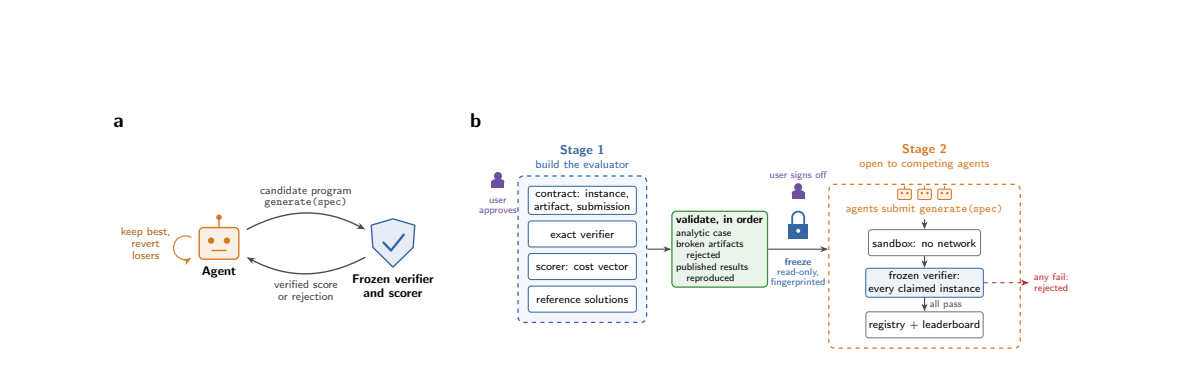
It builds on autoresearch loops, in which agents iteratively improve programs against a fixed evaluator and which have recently improved quantum cryptanalysis circuits, and adds two elements: a frozen, exact verifier certifies every result, and this verifier, together with the challenge around it, is built by an agent that formulates the problem with a researcher and validates the verifier against a solved case, deliberately broken solutions and published results before any solution exists. The method applies to any optimization problem whose solutions can be verified exactly and efficiently. We apply it to three compilation problems in quantum simulation, namely fermion-to-qubit encoding, Hamiltonian layout and unitary synthesis. In each, the agents improved substantially on published or standard constructions, reducing the cost being optimized by up to 73% at the largest sizes tested and outperforming a state-of-the-art optimizer for fermion-to-qubit encodings. Every submission is a program accompanied by its agent's notes, so the ideas behind each improvement are recorded in human-readable form; later agents built on them, and we describe them here. These results open the way to automated, certified discovery across quantum circuit design and beyond.
from the abstract
Pith says
Machine review · deepseek-v4-flash · 23 Oct 2026 · what was read was not recorded · not checked by a person
It can be wrong. Challenge this review or reply to it.
Holds up, with conditions. A genuinely useful paper on certified AI-autoresearch for circuit optimization; the math is clean and the honesty is real, but the load-bearing claim rests on agent-built verifiers that are neither shipped nor independently checkable. This line is wrong
3 major objections · 4 minor
How often objections from reviews like this one are right: not yet measured
Not checked: figures, code, what the 50 references say.
The paper says, at Section 2.2, Methods ('Challenge construction'), Table S2
The review did not quote this passage.
Pith says: Objection 1 of 3 · major
The certification claim is load-bearing and needs an independent check. The frozen evaluator is agent-written, and its correctness is established only by a finite validation gate: an analytic case, deliberately broken artifacts, and reproduction of published results. The paper itself reports that this gate caught two evaluator defects, including a verifier that compared only phases and would have accepted circuits implementing the wrong unitary at half cost (Section 3.1, Table S2).
more of objection 1
A finite gate cannot by itself certify correctness on all later instances, and the Supplementary analyses re-execute submissions with the same evaluators rather than an independent one. The record's synthesis gain depends precisely on correct parity tracking and linear-map comparison for circuits that reuse parities heavily, so this is not a remote failure mode. I recommend re-verifying the headline artifacts with a second, independently implemented verifier—direct linear algebra for the 15×15 encoding, an independent circuit simulator for the eight-qubit circuits, and an independent replay for the 8×8 layouts—and reporting the results. The text should also state explicitly that 'certified' means verified by a frozen, validated-but-not-formally-proved evaluator, rather than implying formal proof.
The paper says, at Methods, 'Agents and submissions'; no code/data availability statement
The review did not quote this passage.
Pith says: Objection 2 of 3 · major
The reproducibility of the paper's central claims requires access to the frozen evaluator source code, the instance generators, the registered submissions, the agent notes, and the validation transcripts. The paper currently provides no repository link or artifact description. Without these, readers cannot independently confirm that the reported scores were produced by the claimed frozen evaluators, nor can they apply the method to new problems.
more of objection 2
Please make the full challenge artifacts available in a public repository, including the evaluator fingerprint hashes and the exact versions used for every reported score.
The paper says, at Sections 3.1–3.2 and Methods ('Fermion-to-qubit encoding challenge')
The review did not quote this passage.
Pith says: Objection 3 of 3 · major
The comparison with the state-of-the-art optimizer of Ref. [20] needs clarification. The paper reports that the frozen evaluator assigns the Jordan–Wigner encoding a lower total weight than the published Table I values at every size, and that the published 3×3 minimum of 237 is not optimal (201, by exhaustive search over all 9! orderings).
more of objection 3
The subsequent claim that agents outperform the optimizer by 15–23% uses those same published Table I numbers as the 'best published' baseline. If the published totals are suboptimal or were computed under a different convention, the agent improvement over Ref. [20] may be overstated. Please state explicitly whether the comparison is to the published numbers or to re-scored optima, and provide a like-for-like comparison by re-scoring the reference encodings with the frozen evaluator where the underlying data permit.
4 minor objections
The paper says, at Methods, 'Unitary synthesis challenge'
Pith says: minor objection 1 of 4
The sentence 'with weights 2, 4 and 3 for subsets of size one, two and three' is ambiguous: it is not clear whether these are sampling weights, counts of terms of each size, or coefficients. Please state explicitly how the min(2n, 2^n−1) target terms are generated.
The paper says, at Abstract and Section 2.1
Pith says: minor objection 2 of 4
The abstract says the method applies to problems whose solutions can be verified exactly and efficiently, but the unitary-synthesis verifier checks phases on all 2^n basis states, which is exponential in n. This is fine for the small instances treated, but the scope statement should acknowledge that the synthesis verifier is exact but not polynomial-time in n.
show 2 more
The paper says, at Section 3.4 and S2.3.3
Pith says: minor objection 3 of 4
The paper acknowledges that the unitary-synthesis submission stores per-instance circuits and that the search program was not submitted, but the abstract's general 'automating quantum circuit optimization' framing could still be read as claiming a general synthesis algorithm. A sentence in the abstract or introduction noting that the synthesis result is a set of verified per-instance constructions would remove this ambiguity.
The paper says, at Methods, 'Analysis'
Pith says: minor objection 4 of 4
For the randomized submissions, the paper notes that repeated runs of the layout record differ by about 2% per instance, but the figures use means over nine instances without dispersion information. Reporting standard errors or per-seed values for the layout results would help quantify the stability of the 73% reduction.
What would settle it
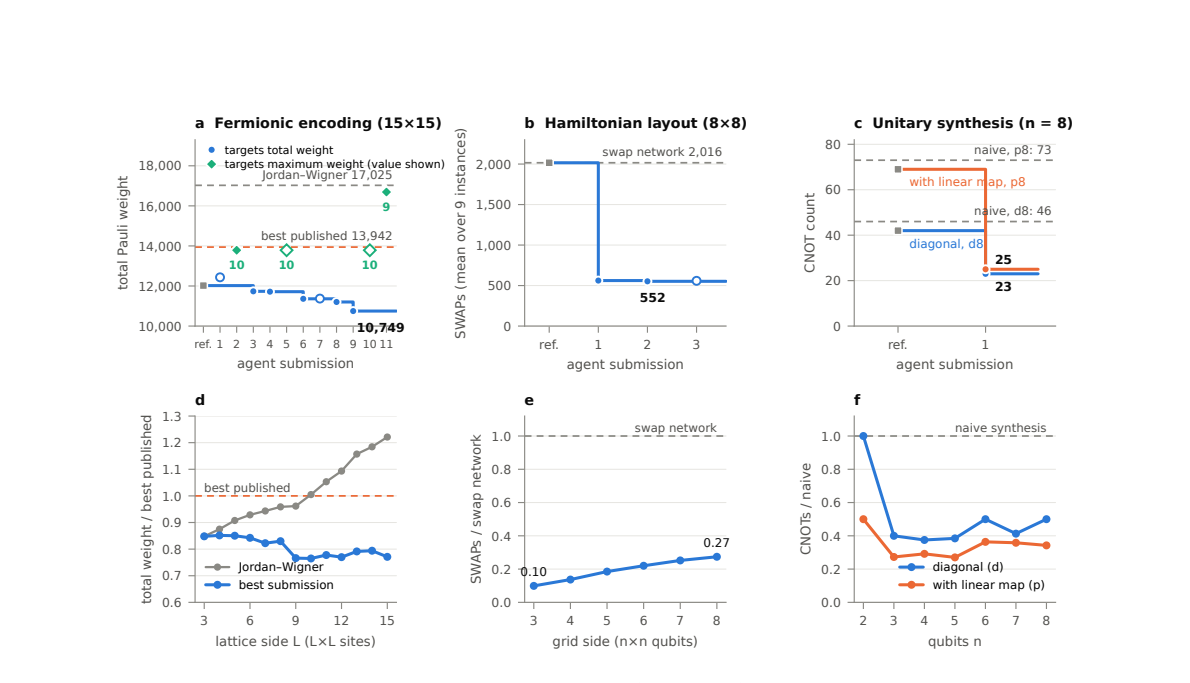
Release the frozen evaluator files, registered submission programs, and their outputs. Have an independent party re-implement the three verifier/scorer pairs from the paper's Methods and Table S2 alone, re-score the registered artifacts, and compare every headline number: the L=15 fermionic encoding (expect total 10,749 vs Jordan-Wigner 17,025, with a fresh symplectic Gram matrix check confirming all-anticommutation), the nine 8x8 layouts (expect mean 552 SWAPs), and the fourteen n=2..8 synthesis circuits (expect 23 and 25 CNOTs). If the independent evaluators reproduce all headline scores, the certification concern is settled empirically; if any score differs, run a second ground-truth oracle (an independent exhaustive replay or a brute-force phase enumeration) on that artifact to determine which implementation is wrong.
from the skeptic's reading
How the review went
4 readings by deepseek-v4-flash · 23 Oct 2026
- Reader holds up, with conditions
- Skeptic agrees
- Editor wrote the verdict above
- Referee major revision: 3 major objections, 4 minor
Not run on this paper: the simulated authors' defence.
Pith did not check this review's objections against the paper.
The review in full
The review in brief, machine-written
Two things to know. First, the paper reports large verified reductions across three quantum compilation problems, and the mathematical scaffolding checks out. Second, the certification claim rests on verifiers written by AI agents and validated by a finite gate; without the code and frozen artifacts, that claim is not independently auditable. The paper earns credit for saying this plainly, but the gap is real.
What is new: the challenge-construction system that has an agent build the evaluator and forces it through an analytic case, broken artifacts, and reproduction of published results before freezing. That turns evaluator construction into a repeatable procedure. The three problem-specific constructions are also genuinely new—Clifford transvection search for fermionic encodings, reverse-walk local search plus fitted potential for routing, and the walk-through-invertible-matrices framing for CNOT-phase circuits. The math I checked is correct: transvections preserve the symplectic form, the CNOT circuit as a walk through GL(n,F2) is standard and well used, the counting bound S≥(m−|E(G)|)/6 is valid, and the moment-equivalence proposition in S2.3.2 has a clean proof. The exhaustive optimality check for n≤4 synthesis is good evidence.
The soft spots, in order of weight. First, no evaluator code, challenge artifacts, or submission programs are shipped. The reader cannot re-run a single headline score. That makes the central "every result certified" claim unverifiable from the paper alone. Second, the certification is only as strong as the finite validation gate. The paper itself shows the gate is fallible—it caught a synthesis verifier that compared only phases, which is exactly the failure mode adjacent to the record's shared-parity strategy. A subtler bug of that kind could inflate the reported 66% without detection by the gate. This is a genuine concern, though not evidence of actual fraud; the authors disclose it. Third, the baselines are weak by design—swap network ignores graph structure, naive synthesis shares no parities—so the impressive percentage reductions are not against strong optimizers. The authors say this. The repeated-run variance and per-instance nature of the synthesis results are also disclosed.
Who this is for: anyone working on AI-driven quantum compilation, program search with verifiable rewards, or benchmark construction for open problems. It deserves a serious referee. My recommendation: send it to review, and make the code, verifier source, and registered artifacts a condition of acceptance. If they are released and the scores reproduce, the central claim becomes solid. Without them, the paper is a well-described method with plausible but unauditable numbers.
The strongest objection
Every reported result is certified only to the extent that the frozen evaluator is correct on the claimed instances, and the evaluator is written by an AI agent whose correctness is established by a finite validation gate: an analytic case, deliberately broken artifacts, and reproduction of published results, all applied before any solution existed (Section 2.2; Methods 'Challenge construction'; Table S2). The paper's own history shows the gate is not a formality: two evaluator implementations were initially wrong, including a unitary-synthesis verifier that compared only phases and would have accepted a circuit implementing the wrong unitary at half the cost (Section 3.1, Table S2). That caught defect is not adjacent to the headline by coincidence: the record's CNOT reduction comes from not paying for uncomputation and sharing parities along one walk ('the linear map... costs only 2', Section 3.4), so the failure mode the gate intercepted is the one whose survivor would most directly inflate the 66% claim. The gate's broken artifacts exercise designer-chosen violations on small test cases, while the numbers at stake are at the largest instances (225 sites, 8x8 grid, n=8), where the artifacts are structurally novel (transvected encodings with no closed form, reversed routing walks, circuits reusing parities heavily), and a parity-tracking or phase-accumulation bug triggered only by such reuse would not be exercised by tests built on ladder-style circuits. Because no evaluator code, challenge artifacts, or submission programs are shipped, a reader cannot attempt an independent check of any headline score; and because rejected submissions are not recorded, exploitation attempts cannot be excluded (the authors state this in Section 4). The finite-gate assumption is therefore the load-bearing step, and independent re-verification of the registered artifacts is the only way to close it.
Reading in good faith: the central claim is that a verified autoresearch loop produced certified, substantial improvements across three quantum-compilation problems, with the evaluator itself built and validated by an agent before any solution existed. For the claim to hold, the frozen evaluators must be correct on every claimed instance, and the registered scores must be the evaluators' true outputs on the registered runs. The mathematical content is correct as presented: transvections preserve anticommutation (S2.1.2, Eq. S1), the layout problem reduces to a covering walk with the counting bound of Eq. S2, and the CNOT-walk and moment-equivalence characterizations (S2.3.1-S2.3.2) are sound, including the real-coefficient argument that angles not multiple of pi/4 cannot reduce the CNOT count for n<=4. The verifier checks are genuinely exact (symplectic Gram matrix, deterministic replay, exhaustive 2^n-state phase check), which is real support: these are not sampled evaluators of the kind reward-hacking results exploit.
The load-bearing concern is implementation correctness of agent-written verifiers relative to the finite gate. The paper's own Section 3.1 and Table S2 show the gate caught real defects, including a synthesis verifier whose phase-only check would have certified wrong-linear-map circuits at half cost. That bug class is structurally the 'free lunch' the record exploits (shared parities, no uncomputation, linear map costing 2), so the residual risk is concrete: a subtler bug of the same class surviving the gate would directly inflate the 66% headline or the map-cost claim, and the gate's test set (analytic cases, designer-chosen broken artifacts, small-size published reproduction) does not exercise the large, structurally novel artifacts whose scores are claimed. The paper explicitly notes (Section 4) that rejected submissions are not recorded, so exploitation attempts cannot be excluded; this is an honest stated limitation and I weigh it as in-scope evidence for the residual risk. The absence of shipped code, evaluators, and artifacts converts this residual risk into an untestable one from the paper alone, which is the same reproducibility condition the reader set.
Secondary observation, not a separate objection: the 23% SOTA comparison uses published totals that the paper's own evaluator shows are miscalibrated (JW totals lower at every size; the 3x3 published minimum 237 beaten by an exhaustive 201). Under the same evaluator, the standard ternary-tree snake already scores 12,020, so the like-for-like margin over the best standard construction is about 11% (12,020 to 10,749), while the 37% versus Jordan-Wigner is unaffected. The authors flag the calibration (Section 3.1), but the abstract's 'outperforming a state-of-the-art optimizer by 23%' overstates the like-for-like margin.
The referee's report
If the reported results hold, this is a notable demonstration that large-language-model agents can discover substantially improved quantum compilation constructions, with a more disciplined verification procedure than previous autoresearch challenges. The mathematical core is sound: the transvection map preserves the symplectic form (S2.1.2), the CNOT-circuit-as-walk characterization is standard and correctly applied, the counting lower bound S≥(m−|E(G)|)/6 is valid, and the moment-equivalence Proposition in S2.3.2 has a correct proof. The paper is also unusually honest about limitations, including the per-instance nature of the unitary-synthesis submission, the weakness of two of the three baselines, unknown optimality beyond small sizes, and the finite validation gate for the evaluators. The validation-gate design, frozen hashed evaluators, registration of agent notes, and reporting of negative results are genuine strengths.
Pith's reading of the paper (a machine's summary, not the authors')
The paper claims that hard quantum-compilation problems—the kind that decide whether an algorithm runs at scale—can be solved by AI coding agents in a way that is both effective and trustworthy. Its method extends the autoresearch loop, in which an agent iteratively improves a program against a fixed evaluator, with a frozen exact verifier that certifies every reported result, and a challenge-construction system in which an agent builds and validates that verifier against known cases before any candidate solution is submitted. Across 19 verified submissions in three problems, the agents reduced the total Pauli weight of fermion-to-qubit encodings on a 225-site lattice by 37 percent relative to Jordan–Wigner, the SWAP count of Hamiltonian layouts on a 64-qubit grid by 73 percent relative to the standard swap network, and the CNOT count of eight-qubit phase-polynomial circuits by up to 66 percent, with circuits optimal at every size up to four qubits. The load-bearing claim is that every reported score was checked exactly by an evaluator whose correctness was established before search began. If the method is right, the bottleneck in such AI-driven discovery shifts from searching to formulating problems and building evaluators that cannot be fooled.
What carries the argument. The argument is carried by the pairing of a frozen evaluator with an agent-built verifier. A challenge fixes an instance specification, an artifact format, and submissions that are programs rather than artifacts; the evaluator consists of an exact verifier that returns a diagnosis on malformed input and a scorer that reports costs as a vector without combining them. The challenge-construction system is a fixed agent procedure that drafts a contract with the researcher, implements verifier, scorer, and reference constructions, and must pass a validation gate—an analytically solved case, deliberately broken artifacts that must each be rejected with a specific diagnosis, and reproduction of published results—before the evaluator is frozen and fingerprinted, so that any edit invalidates all stored scores. The search results ride on three reformulations the agents converged on: transvections $\tau_P(O)=O+\langle O,P\rangle P$ over the symplectic group for encodings, reversible SWAP walks with fitted distance potentials and rollout-ranked beam search for layouts, and walks through the Cayley graph of GL$(n,\mathbb{F}_2)$ for CNOT circuits, aided by a moment condition that exactly characterizes when two phase polynomials define the same unitary.
Core claim. On the paper's own terms, the discovery is that three notoriously hard compilation optimizations yield to a single discipline: let agents write programs that build solutions, judge every artifact with an exact verifier that never changes, and establish the verifier's correctness before any solution exists. Each problem turned out to admit a search over moves that cannot break validity. Fermion-to-qubit encodings are refined by Clifford transvections—linear symplectic moves $\tau_P(O)=O+\langle O,P\rangle P$ that preserve every anticommutation relation and generate the full symplectic group—bringing the total Pauli weight on the $15\times15$ lattice to 10,749 against 17,025 for Jordan–Wigner and 13,942 for the best published value. Hamiltonian layout becomes a walk through placements whose reversal is itself a valid walk of equal cost, so the expensive tail of a route can be regenerated from either end, cutting SWAPs from 2,016 to 552 on the $8\times8$ grid. Unitary synthesis becomes a single walk through the invertible matrices over $\mathbb{F}_2$ that visits every required parity and ends at the target linear map, making the map nearly free: 2 CNOTs instead of 27 at eight qubits, and 23 or 25 CNOTs total against 46 or 73 for naive synthesis. Because each submission is a program with the agent's notes, the reasoning behind each improvement is recorded and later agents built on it; the paper further claims that no result needs to be taken on the agents' word, since the frozen evaluator checked every score exactly.
The premise it rests on. Everything hangs on the assumption that a finite validation gate—one analytic case, a set of deliberately broken artifacts, and reproduction of published results, all run before any solution exists—guarantees that the agent-written verifier is correct on every instance it will later certify; the authors themselves show the gate is fallible, since it caught defects in the first implementations of two evaluators, one of which would have accepted circuits implementing the wrong unitary at half cost.
If the paper is right (Pith's inferences, not the authors')
If the certifications hold, the reported numbers become reproducible records: any later agent or researcher can rerun a registered program under the same frozen, fingerprinted evaluator and obtain the same score.
The three discovered mechanisms—lattice-adapted tree geometry refined by transvections, potential-guided reversible routing walks, and single-walk synthesis—transfer as reusable construction ideas to other compilation problems, including the table-lookup circuits, rewrite rules, and magic-state distillation protocols the paper names as fitting the same mould.
For fermionic simulation in particular, a 37 percent reduction in total Pauli weight directly lowers the cost of simulated Hamiltonian evolution, and the consistent 15–23 percent margin over the best published optimizer suggests the published values themselves are substantially improvable at every tested size.
Constructed challenges double as controlled benchmarks for AI systems on research problems whose answers are unknown in advance, because the frozen evaluator keeps results comparable across agents and over time and permits reopening whenever a new method appears.
Because each record is the endpoint of a lineage of submissions, the approach compounds: later agents read earlier code and notes, independently reproduce reported gains, and extend them, which the paper documents in all three challenges.
The walk-reversal symmetry used in the layout challenge is a general design principle: any optimization over reversible moves with a cost that does not depend on time direction can repair the tail of a solution by repairing its head, which should transfer to other routing and scheduling problems such as token swapping and general qubit mapping.
The moment condition for phase-polynomial equivalence is the structure of Reed–Muller coding, which the paper cites only in passing; a natural test is whether other code-theoretic constructions yield equally short walks for $n\geq 5$, where the paper concedes the optimum is unknown.
The strongest test the authors did not run is a held-out challenge—freeze an evaluator, generate new targets after the search, and measure whether the method generalizes; the paper itself acknowledges that its synthesis record is per-instance and that such a challenge would measure the method rather than the constructions.
Because the validation gate proved fallible in the authors' own hands, catching defects in the first drafts of two evaluators, the certification claim would be tightened by an independent second implementation of the analytic case and broken-artifact suite, rather than relying on the same agent that wrote the verifier.
Check this review
Pith stored no record of this review's passes and took no fingerprint of it. Reviews made by code from 13 Nov 2026 on carry both.
How often reviews like this one are right
Reviews like this one: written by deepseek-v4-flash, where what was read was not recorded.
How often objections from reviews like this one are right: not yet measured
Reviews by people
This review was written by a machine. No person has reviewed this paper on Pith yet. A scientist listed on Pith can review it for a fee, and their review is published here whatever it concludes.
The paper
Abstract
Compiling quantum algorithms for real devices involves hard optimization problems that can decide whether an algorithm runs at scale. We present a general method for solving such problems with AI agents, with every result certified. It builds on autoresearch loops, in which agents iteratively improve programs against a fixed evaluator and which have recently improved quantum cryptanalysis circuits, and adds two elements: a frozen, exact verifier certifies every result, and this verifier, together with the challenge around it, is built by an agent that formulates the problem with a researcher and validates the verifier against a solved case, deliberately broken solutions and published results before any solution exists. The method applies to any optimization problem whose solutions can be verified exactly and efficiently. We apply it to three compilation problems in quantum simulation, namely fermion-to-qubit encoding, Hamiltonian layout and unitary synthesis. In each, the agents improved substantially on published or standard constructions, reducing the cost being optimized by up to 73% at the largest sizes tested and outperforming a state-of-the-art optimizer for fermion-to-qubit encodings. Every submission is a program accompanied by its agent's notes, so the ideas behind each improvement are recorded in human-readable form; later agents built on them, and we describe them here. These results open the way to automated, certified discovery across quantum circuit design and beyond.
The paper's own sentences, arranged, kept beside the review and separate from it. Each label is drawn from a closed vocabulary; the number beside it is the probability the classifier gave that label. No sentence in this record was written by a model.
abstract compiled · 2026-10-23
The authors' main claim, as the classifier picked it out 0.92
“These results open the way to automated, certified discovery across quantum circuit design and beyond.”
How the main claim is stated: hedged possibility 0.61
What the abstract itself states, as probabilities: claims first 0.09 · states limitation 0.50 · human participants 0.18 · controlled comparison 0.71 · randomized assignment 0.01 · states quantitative result 0.98 · compares with prior results 0.97 · mentions code or data availability 0.16
The abstract, sentence by sentence
This table labels the abstract only (arXiv listing abstract v1). The number is the probability the classifier gave the label.
| Sentence | Role | The authors' own work | States the main conclusion | Strength |
|---|---|---|---|---|
| Compiling quantum algorithms for real devices involves hard optimization problems that can decide whether an algorithm runs at scale. | background 1.00 | 0.06 | 0.02 | asserted 0.91 |
| We present a general method for solving such problems with AI agents, with every result certified. | contribution 1.00 | 0.91 | 0.26 | asserted 1.00 |
| It builds on autoresearch loops, in which agents iteratively improve programs against a fixed evaluator and which have recently improved quantum cryptanalysis circuits, and adds two elements: a frozen, exact verifier certifies every result, and this verifier, together with the challenge around it, is built by an agent that formulates the problem with a researcher and validates the verifier against a solved case, deliberately broken solutions and published results before any solution exists. | method 0.89 | 0.78 | 0.08 | asserted 1.00 |
| The method applies to any optimization problem whose solutions can be verified exactly and efficiently. | limitation 0.41 | 0.29 | 0.08 | asserted 1.00 |
| We apply it to three compilation problems in quantum simulation, namely fermion-to-qubit encoding, Hamiltonian layout and unitary synthesis. | contribution 0.69 | 0.93 | 0.04 | asserted 1.00 |
| In each, the agents improved substantially on published or standard constructions, reducing the cost being optimized by up to 73% at the largest sizes tested and outperforming a state-of-the-art optimizer for fermion-to-qubit encodings. | result 1.00 | 0.96 | 0.25 | asserted 1.00 |
| Every submission is a program accompanied by its agent's notes, so the ideas behind each improvement are recorded in human-readable form; later agents built on them, and we describe them here. | method 0.63 | 0.90 | 0.05 | asserted 1.00 |
| These results open the way to automated, certified discovery across quantum circuit design and beyond. | interpretation 0.91 | 0.26 | 0.77 | hedged possibility 0.61 |
What kind of paper the classifier reports this is: method or tool 1.00 · evidence from simulation or computation 0.98
What was examined, and what was not
Sources read
- arXiv listing abstract v1
Not examined
- full text
- figures and tables
- references and citing sentences
- relations to other papers
Levels run
- P abstract
Not run
- S sections
- T body sentences
- C citations
- R cross-paper relations
How the labels were made
Compiled by classifier-1.13.0 via TypeSafe API, question bank abstract-p1-20260923, 2026-10-23: 1 request, 6,292 input tokens.
Every quoted sentence on this record is the authors'. Every label is from Pith's closed vocabulary, with the probability shown beside it. This record as JSON
Figures (2)
Figures are the authors', reproduced from the paper.
References (50)
- [20] Mitchell Chiew, Brian Ibrahim, Ilya Safro, and Sergii Strelchuk. Optimal fermion-qubit mappings via quadratic assignment. arXiv:2504.21636, 2025 on PitharXiv
- [1] Sergey B. Bravyi and Alexei Yu. Kitaev. Fermionic quantum computation.Annals of Physics, 298(1):210–226, 2002. doi:10.1006/ aphy.2002.6254 on Pith
- [2] Zhang Jiang, Amir Kalev, Wojciech Mruczkiewicz, and Hartmut Neven. Opti- mal fermion-to-qubit mapping via ternary trees with applications to reduced quan- tum states learning.Quantum, 4:276, 2020. doi:10.22331/q-2020-06-04-276 on Pithdoi:10.22331/q-2020-06-04-276
- [3] Alwin Zulehner, Alexandru Paler, and Robert Wille. An efficient methodology for mapping quantum circuits to the IBM QX architectures. IEEE Transactions on Computer-Aided Design of Integrated Circuits and Systems, 38(7):1226–1236, on Pith
- [4] Gushu Li, Yufei Ding, and Yuan Xie. Tack- ling the qubit mapping problem for NISQ-era quantum devices. InProceedings of the Twenty- Fourth International Conference on Architectural Support for Programming Languages and Operat- ing Systems (ASPLOS), pages 1001–1014, 2019. doi:1... on Pithdoi:10.1145/3297858.3304023
- [5] Alexander Cowtan, Silas Dilkes, Ross Duncan, Alexandre Krajenbrink, Will Simmons, and Seyon Sivarajah. On the qubit routing problem. In14th Conference on the Theory of Quantum Compu- tation, Communication and Cryptography (TQC 2019), volume 135 ofLeibniz International Pro- cee... on Pith
- [6] Bochen Tan and Jason Cong. Optimal layout syn- thesis for quantum computing. InProceedings of the 39th International Conference on Computer- Aided Design (ICCAD), pages 137:1–137:9, 2020. doi:10.1145/3400302.3415620 on Pithdoi:10.1145/3400302.3415620
- [7] doi:10.4230/LIPIcs.TQC.2019.5 on Pithdoi:10.4230/lipics.tqc.2019.5
- [8] Matthew Amy, Dmitri Maslov, and Michele Mosca. Polynomial-time T-depth optimization of Clifford+T circuits via matroid partitioning. IEEE Transactions on Computer-Aided Design of Integrated Circuits and Systems, 33(10):1476– 1489, 2014. doi:10.1109/TCAD.2014.2341953 on Pithdoi:10.1109/tcad.2014.2341953
- [9] Ieva ˇCepait˙ e, Niam Vaishnav, Leo Zhou, and Ash- ley Montanaro. Quantum-enhanced optimization by warm starts. arXiv:2508.16309, 2025 on PithPith's reviewarXiv
- [10] Ross Duncan, Aleks Kissinger, Simon Perdrix, and John van de Wetering. Graph-theoretic simplification of quantum circuits with the ZX- calculus.Quantum, 4:279, 2020. doi:10.22331/ q-2020-06-04-279 on Pith
- [11] Yunseong Nam, Neil J. Ross, Yuan Su, Andrew M. Childs, and Dmitri Maslov. Automated optimiza- tion of large quantum circuits with continuous pa- rameters.npj Quantum Information, 4:23, 2018. doi:10.1038/s41534-018-0072-4 on Pithdoi:10.1038/s41534-018-0072-4
- [12] Neil J. Ross and Peter Selinger. Optimal ancilla- free Clifford+T approximation of z-rotations. Quantum Information and Computation, 16(11– 12):901–953, 2016. URLhttps://arxiv.org/ abs/1403.2975 on PithPith's reviewarXiv
- [13] Ketan N. Patel, Igor L. Markov, and John P. Hayes. Optimal synthesis of linear reversible cir- cuits.Quantum Information and Computation, 8(3):282–294, 2008. URLhttps://arxiv.org/ abs/quant-ph/0302002 on PithPith's reviewarXiv
- [14] Jieyi Long et al. ECDSA.Fail: Open autore- search for optimizing elliptic-curve point addition in Shor’s algorithm. arXiv:2609.09582, 2026 on PithPith's reviewarXiv
- [15] Andrej Karpathy. autoresearch.https:// github.com/karpathy/autoresearch, 2026 on Pith
- [16] Alexander Novikov et al. AlphaEvolve: A cod- ing agent for scientific and algorithmic discovery. arXiv:2506.13131, 2025 on PithPith's reviewarXiv
- [17] Bernardino Romera-Paredes, Mohammadamin Barekatain, Alexander Novikov, Matej Balog, M. Pawan Kumar, Emilien Dupont, Fran- cisco J. R. Ruiz, Jordan S. Ellenberg, Peng- ming Wang, Omar Fawzi, Pushmeet Kohli, and Alhussein Fawzi. Mathematical discoveries from program search with ... on Pith
- [18] Joar Skalse, Nikolaus H. R. Howe, Dmitrii Krasheninnikov, and David Krueger. Defin- ing and characterizing reward hacking. InAd- vances in Neural Information Processing Systems (NeurIPS), 2022. URLhttps://arxiv.org/abs/ 2209.13085 on PithPith's reviewarXiv
- [19] Bogdan Georgiev, Javier G´ omez-Serrano, Ter- ence Tao, and Adam Zsolt Wagner. Math- ematical exploration and discovery at scale. arXiv:2511.02864, 2025. 9 on PithPith's reviewarXiv
show 30 more
- [21] Audrey Cheng, Shu Liu, Melissa Pan, Zhifei Li, Shubham Agarwal, Mert Cemri, Bowen Wang, Alexander Krentsel, et al. Let the barbarians in: How AI can accelerate systems performance re- search. arXiv:2512.14806, 2025 on PitharXiv
- [22] Tanuj Khattar, Nicholas C. Rubin, Craig Gidney, Michael Broughton, Guang Hao Low, and Ryan Babbush. Leveraging verifiable structure in quan- tum circuits to find more efficient compilations with agentic AI. arXiv:2610.23832, 2026 on PithPith's reviewarXiv
- [23] Andi Gu, Alek H. Kemeny, Susanne F. Yelin, and Mikhail D. Lukin. Discovering state-of-the- art quantum circuits with large language models. arXiv:2610.22367, 2026 on PithPith's reviewarXiv
- [24] Nathan Lambert, Jacob Morrison, Valentina Py- atkin, et al. T¨ ulu 3: Pushing frontiers in open language model post-training. arXiv:2411.15124, 2024 on PithPith's reviewarXiv
- [25] Carlos E. Jimenez, John Yang, Alexander Wettig, Shunyu Yao, Kexin Pei, Ofir Press, and Karthik Narasimhan. SWE-bench: Can language mod- els resolve real-world GitHub issues? InInter- national Conference on Learning Representations (ICLR), 2024. URLhttps://arxiv.org/abs/ 2310.06770 on PithPith's reviewarXiv
- [26] Google Cloud. AlphaEvolve on Google Cloud: client library, examples and agent skills.https://github.com/Google-Cloud-AI/ alphaevolve-on-googlecloud, 2026 on Pith
- [27] Daya Guo, Dejian Yang, Haowei Zhang, et al. DeepSeek-R1 incentivizes reasoning in LLMs through reinforcement learning.Nature, 645:633– 638, 2025. doi:10.1038/s41586-025-09422-z on Pithdoi:10.1038/s41586-025-09422-z
- [28] Robert Tjarko Lange, Luca Grillotti, Yutaro Yamada, Rujikorn Charakorn, and David Ha. The agentic scientist: Orchestrating coding agents for automated scientific (co-)discovery. arXiv:2610.18933, 2026 on PithPith's reviewarXiv
- [29] Robert Tjarko Lange, Yuki Imajuku, and Edoardo Cetin. ShinkaEvolve: Towards open- ended and sample-efficient program evolution. arXiv:2509.19349; agent skills athttps:// github.com/SakanaAI/ShinkaEvolve, 2025 on PithPith's reviewarXiv
- [30] Federico Bianchi, Yongchan Kwon, Aneesh Pappu, and James Zou. Harnessing the collec- tive intelligence of AI agents in the wild for new discoveries. arXiv:2606.10402, 2026 on PithPith's reviewarXiv
- [31] Epoch AI. FrontierMath: Open problems.https: //epoch.ai/frontiermath/open-problems, 2026 on Pith
- [32] Andrew Zhao, Yiran Wu, Yang Yue, Tong Wu, Quentin Xu, et al. Absolute zero: Reinforced self-play reasoning with zero data. InAd- vances in Neural Information Processing Systems (NeurIPS), 2025. URLhttps://arxiv.org/abs/ 2505.03335 on PithPith's reviewarXiv
- [33] Yifei Zhou, Sergey Levine, Jason Weston, Xian Li, and Sainbayar Sukhbaatar. Self-challenging language model agents. InAdvances in Neural Information Processing Systems (NeurIPS), 2025. URLhttps://arxiv.org/abs/2506.01716 on PithPith's reviewarXiv
- [34] Junqi Liu et al. VERA: Scaling verifiable environ- ments for agentic co-evolution. arXiv:2610.05923, 2026 on PithPith's reviewarXiv
- [35] Hanane Nour Moussa et al. D3-Gym: Construct- ing real-world verifiable environments for data- driven discovery. arXiv:2604.27977, 2026 on PithPith's reviewarXiv
- [36] Pascual Jordan and Eugene Wigner. ¨Uber das Paulische ¨ aquivalenzverbot.Zeitschrift f¨ ur Physik, 47(9–10):631–651, 1928. doi:10.1007/ BF01331938 on Pith
- [37] Ziqian Zhong, Ivgeni Segal, Ivan Bercovich, Shashwat Saxena, Kexun Zhang, and Aditi Raghunathan. Hardening agent benchmarks with adversarial hacker-fixer loops. arXiv:2606.08960, 2026 on PithPith's reviewarXiv
- [38] Bryan O’Gorman, William J. Huggins, Eleanor G. Rieffel, and K. Birgitta Whaley. Generalized swap networks for near-term quantum computing. arXiv:1905.05118, 2019 on PithPith's reviewarXiv
- [39] Charles Derby, Joel Klassen, Johannes Bausch, and Toby Cubitt. Compact fermion to qubit map- pings.Physical Review B, 104(3):035118, 2021. doi:10.1103/PhysRevB.104.035118 on Pithdoi:10.1103/physrevb.104.035118
- [40] Ian D. Kivlichan, Jarrod McClean, Nathan Wiebe, Craig Gidney, Al´ an Aspuru-Guzik, Garnet Kin- Lic Chan, and Ryan Babbush. Quantum simula- tion of electronic structure with linear depth and connectivity.Physical Review Letters, 120:110501, on Pith
- [41] Lingling Lao and Dan E. Browne. 2QAN: A quan- tum compiler for 2-local qubit hamiltonian simula- tion algorithms. InProceedings of the 49th Annual International Symposium on Computer Architec- ture (ISCA), pages 351–365, 2022. doi:10.1145/ 3470496.3527394 on Pith
- [42] Katsuhisa Yamanaka, Erik D. Demaine, Take- hiro Ito, Jun Kawahara, Masashi Kiyomi, Yoshio Okamoto, Toshiki Saitoh, Akira Suzuki, Kei Uchizawa, and Takeaki Uno. Swapping labeled tokens on graphs.Theoretical Computer Science, 586:81–94, 2015. doi:10.1016/j.tcs.2015.01. 052 on Pithdoi:10.1016/j.tcs.2015.01
- [43] Hans-Georg Beyer and Hans-Paul Schwefel. Evo- lution strategies – a comprehensive introduction. Natural Computing, 1:3–52, 2002. doi:10.1023/A: 1015059928466 on Pithdoi:10.1023/a:
- [44] Matthew Amy, Parsiad Azimzadeh, and Michele Mosca. On the controlled-NOT complexity of controlled-NOT–phase circuits.Quantum Science and Technology, 4(1):015002, 2018. doi:10.1088/ 2058-9565/aad8ca. 10 on Pith
- [45] Matthew Amy and Michele Mosca. T-count op- timization and Reed–Muller codes.IEEE Trans- actions on Information Theory, 65(8):4771–4784, on Pith
- [47] Dimitri P. Bertsekas, John N. Tsitsiklis, and Cy- nara Wu. Rollout algorithms for combinatorial optimization.Journal of Heuristics, 3:245–262, on Pith
- [50] doi:10.1109/TIT.2019.2906374. 11 Supplementary Material Contents S1 The challenge-construction system 12 S1.1 The three challenges . . . . . . . . . . . . . . . . . . . . . . . . . . . . . . . . . . . . . . . . . . 12 S1.2 Limitations . . . . . . . . . . . . . . . . . . . . . ... on Pithdoi:10.1109/tit.2019.2906374
- [1997] doi:10.1023/A:1009635226865 on Pithdoi:10.1023/a:1009635226865
- [2018] doi:10.1103/PhysRevLett.120.110501 on Pithdoi:10.1103/physrevlett.120.110501
- [2019] doi:10.1109/TCAD.2018.2846658 on Pithdoi:10.1109/tcad.2018.2846658
Cited by 4 Pith papers
Reviewed papers on Pith that cite this one. The full citation record
- QSim-Arena: an evolving developer for quantum simulation advantage quant-ph · Nov 2026
- Discovering formally verified quantum programs with AI quant-ph · Nov 2026
- On Reaction Depth and Fast Fault-Tolerant Boolean Logic quant-ph · Nov 2026
- Reimagining computational quantum research with AI scientists quant-ph · Nov 2026
Challenges and discussion
Disagree with the review, or know something it missed? Leave a comment, or challenge this review formally: a challenge becomes a permanent entry in this paper's record, and its decision is published here.
Come back by email
A short list of the week's newly reviewed papers. Nothing is sent until you confirm from your inbox, and every email has a link that stops it. No account.
No comments yet.
Sign in to comment