Artificial Intelligence · arXiv:2610.05923 v1 · submitted 5 Oct 2026 · 48 references
VERA: Scaling Verifiable Environments for Agentic co-Evolution
The paper says
“Competent agents need precise and verifiable environments, such as sandboxes that are resumable at any stage and evolve from observable evidence.”
more of the abstract
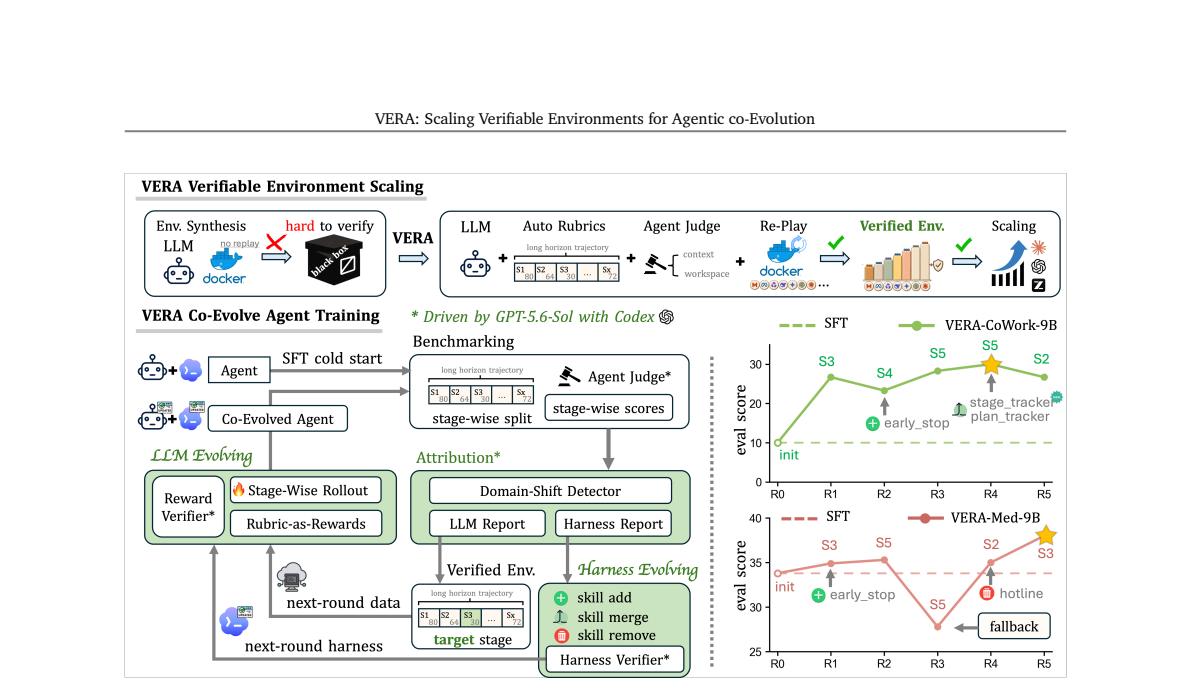
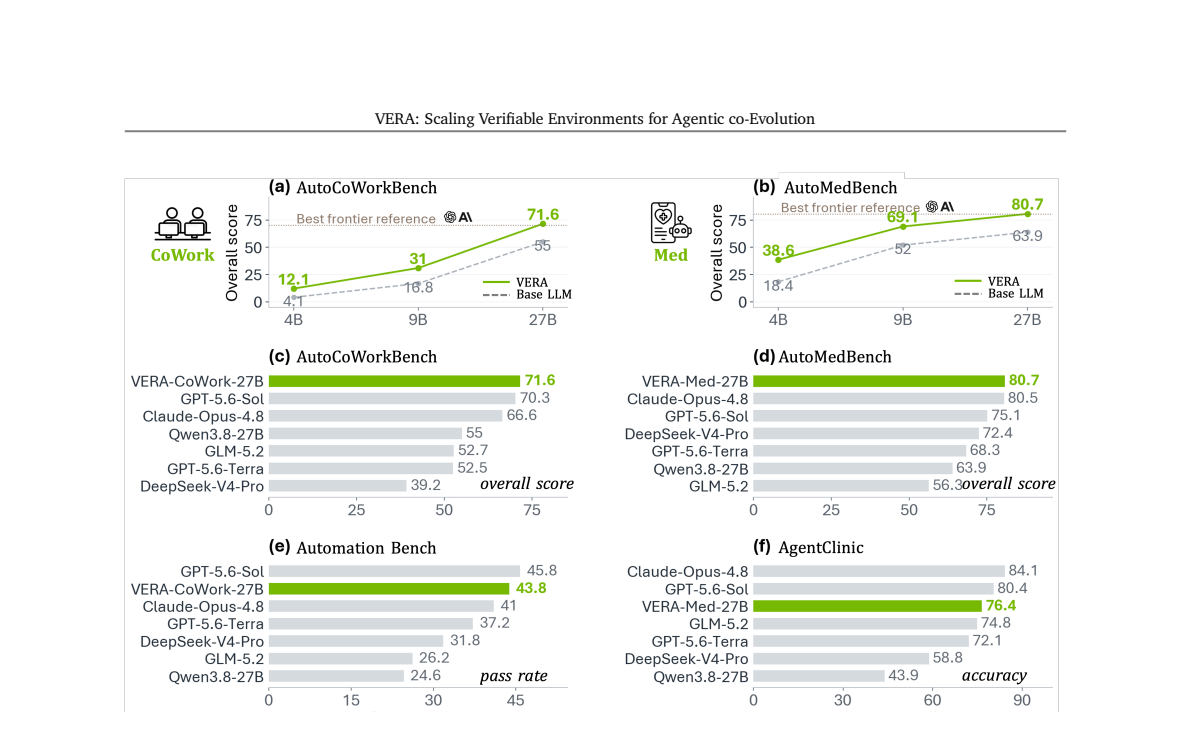
However, most long-horizon work exposes how rare these are: for example, an agent in medical research must ground a finding, classify it, and write a report over dozens of dependent steps, yet recent environments score only the outcome. To address the challenges in stable training, we present VERA, which builds such environments at scale and lets agents evolve on them. VERA builds these environments from initial trajectories: an agent writes rubrics, executable checks, a judge verifies each sandbox, and only those that pass enter the training bank. On these environments, VERA alternates between two updates: train the model with rubric rewards, or edit the harness skills. We also create a verifier which gates model checkpoints and harness edits using explicit development-set acceptance criteria. This attribution distinguishes VERA's co-evolution from single-axis baselines: its updates target not only the cause but the outcome. With an open-source corpus of 9,000+ long-horizon verifiable environments, a 9B model paired with its co-evolved agent beats the strongest baseline by 10.3 and 13.0 points in the two domains. At 27B, it surpasses the baseline on AutoCoWorkBench (71.6) and AutoMedBench (80.7), transfers to unseen workflows, and retains general capabilities.
from the abstract
Pith says
Machine review · deepseek-v4-flash · 6 Oct 2026 · what was read was not recorded · not checked by a person
It can be wrong. Challenge this review or reply to it.
Holds up, with conditions. A well-built, honestly-reported co-evolution system whose MedResearch result is genuinely strong but whose CoWork headline rests entirely on the judged axis — deserves referee time. This line is wrong
4 major objections · 4 minor
How often objections from reviews like this one are right: not yet measured
Not checked: figures, code, what the 48 references say.
The paper says, at §4.1 and Table 14
The review did not quote this passage.
Pith says: Objection 1 of 4 · major
The headline 'beats the strongest single-axis baseline by 10.3 points' is not supported by the Task axis. Table 14 decomposes the 31.0 vs 20.7 Overall margin into Agentic 45.3 vs 22.3 and Task 16.7 vs 19.1: VERA's entire CoWork margin sits on the judged Agentic axis, and its official Task score trails ADAS (19.1), COS-PLAY (21.6), and OPD (24.0).
more of objection 1
Because the trajectory judge of Appendix A.1 uses a five-stage structure that mirrors the rubrics VERA optimizes (Appendix C.1), the margin is at risk of reflecting rubric–judge alignment rather than task competence. The decomposition should appear in the main text, and the 10.3-point claim should be qualified accordingly.
The paper says, at Appendix F.3
The review did not quote this passage.
Pith says: Objection 2 of 4 · major
The 'strongest single-axis baseline' ADAS used for the CoWork headline was not meaningfully selected: all 27 eligible candidates scored zero on the development-selection metric, so the first registered candidate was chosen under the fixed tie rule, and the paper itself states 'This search outcome does not establish a development performance gain.'
more of objection 2
The abstract, §1, and §4.1 still present 'exceeds the strongest single-axis baseline by 10.3 points' without this caveat. The main text should carry the F.3 qualification, since the comparison currently establishes superiority over a specific ADAS artifact rather than over the best achievable ADAS run.
The paper says, at Section 6, Appendix C.3, Appendix H
The review did not quote this passage.
A classifier read this sentence of the paper as acknowledging the concern (probability 0.86):
“Limitations Our study leaves five aspects for further investigation.(1) Environment scaling:We do not vary environment counts or compare construction methods.(2) Harness ablations:Runtime settings, including reasoning effort, are fixed and not ablated.(3) Judge dependence:Judging, verification, and attribution rely on GPT-5.6-Sol; executable checks constrain its judgments, but sensitivity to judge choice remains untested.(4) Baseline scale: Full baseline comparisons are limited to 9B; a 27B co-evolution run costs approximately 5,000-8,000 GPU- hours.(5) Comparison scope:We compare learning alg”
Pith says: Objection 3 of 4 · major
The judge-fidelity risk is load-bearing for the CoWork claim yet explicitly untested. The medical rubrics are 'not a verbatim copy of official benchmark scoring' (C.3), judge sensitivity is listed as untested (Limitation 3), and Appendix H concedes the hacking verifier 'does not measure whether every cheating judgment was correct.'
more of objection 3
Given that the entire CoWork margin comes from the judged Agentic axis, the paper should either provide an empirical judge-fidelity check (e.g., correlation of judge scores with official Task/Pass@1 outcomes on the evaluation episodes, or seed-level variance over the 40 tasks) or explicitly rescope the CoWork claim to process-quality rather than task competence.
The paper says, at §2.1 and Appendix G
The review did not quote this passage.
Pith says: Objection 4 of 4 · major
The attribution claim is weaker than stated. A model checkpoint is accepted if the development score drops by at most 20% relative to the previously accepted checkpoint, so a round can substantially regress and still pass the gate; 'every gain is attributable to a single axis' holds for accepted improvements, but not for the round-by-round trajectory. The text should state that single-axis attribution is conditional on acceptance and that later gains may partly recover an accepted regression.
4 minor objections
The paper says, at Appendix A.1, Table 14
Pith says: minor objection 1 of 4
The scoring protocol averages three seeds (Appendix A.1), but all reported scores are point estimates. Reporting the per-seed spread, particularly for the 40-task CoWork evaluation, would materially strengthen the 10.3-point comparison.
The paper says, at Author list, page 1
Pith says: minor objection 2 of 4
The author affiliation contains spacing and spelling errors ('Y ongyang Pan'; 'Xian Jiaotong University' should be 'Xi'an Jiaotong University').
show 2 more
The paper says, at §4.4
Pith says: minor objection 3 of 4
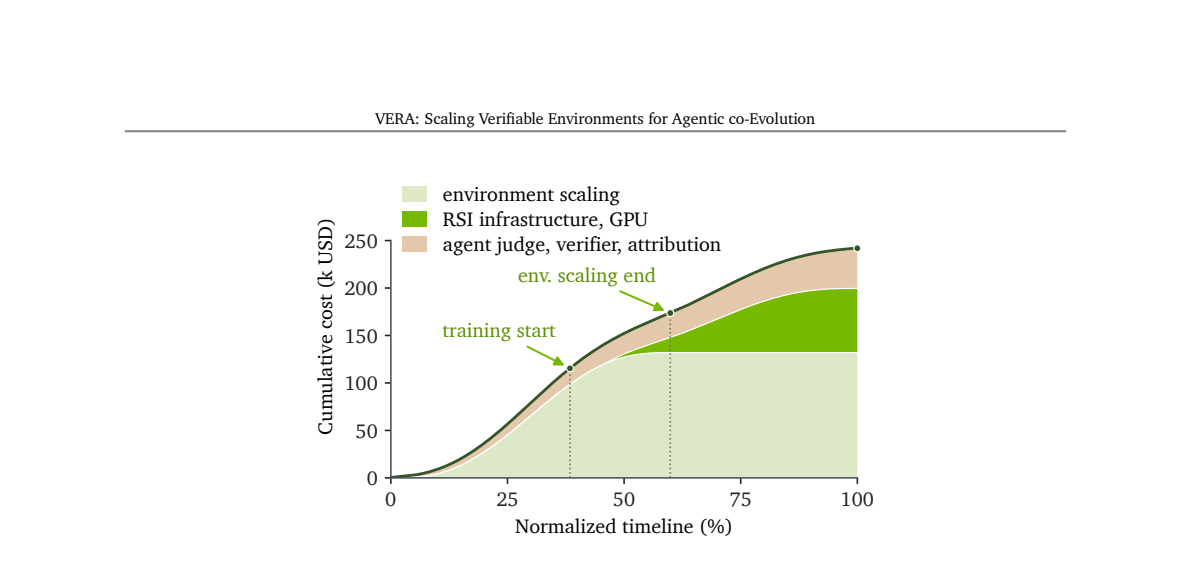
The cost analysis is clearly labeled as a normalized, illustrative, replacement-cost estimate; consider stating this in the section's opening sentence as well as in the figure caption, since §4.4 is presented as a headline result.
The paper says, at Appendix F.2
Pith says: minor objection 4 of 4
The SFT-200 initializer used for COS-PLAY 'did not complete a full epoch'; please clarify whether the VERA and other baseline lines use the same initialization point, so the reader can judge comparability of update budgets.
What would settle it
Primary test: freeze the Table 14 CoWork episodes and rerun the AutoCoWorkBench Agentic scoring with an independent trajectory judge (different model family, e.g., Claude or DeepSeek, blinded to method identity, keeping the published five-stage rubric contract fixed), then recompute Overall for VERA Agent, ADAS, COS-PLAY, and OPD. If VERA's Agentic advantage (45.3 vs 22.3/18.2/15.6) shrinks materially, the 10.3-point headline margin is judge-specific rather than task competence; if it persists, the co-evolution claim survives judge choice. Secondary check: rerun the ADAS arm with a functioning development selector (or a tuned single-axis harness search of comparable compute) and verify that no single-axis configuration reaches or approaches 31.0 Overall on the same 40-task denominator with seed-level variance reported.
from the skeptic's reading
How the review went
4 readings by deepseek-v4-flash · 6 Oct 2026
- Reader holds up, with conditions
- Skeptic partly agrees
- Editor wrote the verdict above
- Referee major revision: 4 major objections, 4 minor
Not run on this paper: the simulated authors' defence.
Pith did not check this review's objections against the paper.
The review in full
The review in brief, machine-written
VERA is worth reading. The core design is genuinely new: it turns benchmark trajectories into restartable, rubric-scored sandboxes (Auto-Rubric), gates admission with executable checks plus an agent judge, then co-evolves model and harness in alternating rounds with a verifier deciding each update, so every gain is attributable to a single axis. That, plus an open corpus of 9,000+ environments, is a real contribution. COS-PLAY co-evolves without verification; ADAS is harness-only without verified evidence. VERA is the first of this kind I've seen that attributes failures to a stage and verifies each update.
The paper is also unusually honest. The appendices disclose the embarrassing details themselves: the ADAS baseline search produced 27 eligible candidates that all scored zero, so the selected baseline won by tie rule (F.3); the hacking verifier checks record consistency, not judgment correctness (H); judge sensitivity is untested (Limitation 3). Credit where it's due — most groups would bury these.
Where the result actually holds: MedResearch. VERA-9B beats its harness-only variant by 13 Overall points, and the Task-axis margin (61.3 vs 49.5) uses official scorers independent of the training rubrics. There is real task competence there, not just process credit.
The soft spot is CoWork, and the stress-test note is right about it. The 10.3-point headline decomposes as Agentic 45.3 vs 22.3 and Task 16.7 vs 19.1: the entire margin sits in the judged process axis, where the trajectory judge's five-stage structure mirrors the rubrics VERA optimizes, and VERA's official Task score trails three baselines. That is a rubric–judge alignment risk on CoWork specifically. Two aggravators: no error bars on the 40-task denominator (there is a three-seed protocol, but no variance reported), and the judge is a proprietary model that also does attribution and verification, with sensitivity untested. The authors flag all of this, so the CoWork claim is honest but not yet load-bearing for the two-domain narrative.
One place I'd push back on the skeptic: the ADAS tie rule is a red herring. Swap in OPD or COS-PLAY, the strongest of the other baselines, and VERA still wins Overall by roughly 11 points. The axis decomposition is the real concern, not the baseline choice.
This deserves peer review. Send it out. The conditions to close: a judge-sensitivity run with a different judge model, seed-level variance on the 40-task set, and an ADAS rerun that actually searches. Anyone working on RL for long-horizon agents, or on building verifiable training environments, should read it. I'll cite the corpus.
The strongest objection
On CoWork, the 31.0-vs-20.7 headline decomposes (Table 14) as Agentic 45.3 vs 22.3 and Task 16.7 vs 19.1: the full 10.3-point margin sits in the judged process axis while VERA's official Task score trails three baselines (OPD 24.0, COS-PLAY 21.6, ADAS 19.1). The Agentic score comes from a trajectory judge (A.1) whose five-stage structure mirrors the rubrics VERA optimizes (C.1); the medical rubrics are explicitly 'not a verbatim copy of official benchmark scoring' (C.3); judging, attribution, and verification all rely on GPT-5.6-Sol, with judge sensitivity untested (Limitation 3); and Appendix H concedes the hacking verifier 'does not measure whether every cheating judgment was correct.' Additionally, the CoWork headline uses ADAS as the 'strongest single-axis baseline' even though its development selection failed (F.3: all eligible candidates scored zero; first registered candidate won by tie rule; 'This search outcome does not establish a development performance gain'). The attribution story is also looser than stated: model checkpoints are accepted if development score drops by at most 20%, so a round can regress and still pass the gate. Fairness: the MedResearch pillar is genuinely strong (Task 61.3 vs 49.5, Agentic 76.8 vs 63.4), and Task/Pass@1 evaluations use official scorers independent of the training rubrics. But the central claim is two-domain, and the CoWork pillar now rests on an untested judge's process scores over 40 tasks with no reported error bars.
The reader's verdict (CONDITIONAL) already flags judge fidelity as the weakest assumption; this pass confirms that assumption is load-bearing and makes it concrete using only the paper's own tables. The 10.3-point CoWork margin decomposes to +23.0 on the Agentic axis and -2.4 on the official Task axis, so every point of the headline gain lives in the process score assigned by a trajectory judge whose fidelity is untested (Limitation 3) and whose five-stage scoring structure matches the rubrics VERA trains on (C.1). The same proprietary model family (GPT-5.6-Sol) supplies reward judging, attribution, and verification, and Appendix H explicitly disclaims correctness measurement of the hacking verifier. The comparison baseline is additionally degenerate: Appendix F.3 documents that ADAS's development selection failed and the deployed harness was picked by the tie rule, so 'strongest single-axis baseline' is an arbitrary candidate, not a tuned search result. I note two points of genuine support that keep this from being a rejection: the MedResearch pillar shows large gains on both Task (61.3 vs 49.5) and Agentic (76.8 vs 63.4), and the final evaluation metrics (Task, Pass@1, SWE-Bench Verified, MedXpertQA) come from official scorers independent of the training rubrics. The paper also reports the ADAS failure and verifier caveats honestly, which is evidence of good faith. The attribution mechanism is weaker than advertised (model checkpoints may regress up to 20% and still be accepted), further loosening the 'every gain attributable to one axis' claim, though this does not affect the empirical comparison. My proposed judge-swap test settles whether the CoWork pillar is task competence or rubric-judge alignment; pending that test, CONDITIONAL remains the right verdict.
The referee's report
The paper is ambitious and largely well executed. The core design — alternating model and harness updates with a verifier gating each step, so that accepted improvements are attributable to a single axis — is a sensible and nontrivial contribution, and the honest limitation statements (Appendix F.3, Appendix H, Section 6) are a genuine strength. The MedResearch pillar is solid: the Task-axis gain (61.3 vs 49.5) and higher Pass@1 on MedXpertQA are evaluated with official scorers that are independent of the training rubrics, so the main empirical claim in that domain is not fitted into existence. The released open corpus and the two-domain protocol are useful resources. However, the CoWork pillar, which carries half of the headline claim, rests on a judged process metric whose fidelity is untested and on an ADAS baseline whose development selection failed; the headline '10.3 points' therefore overstates what the evidence establishes. If the judge-fidelity concern is addressed or the claim rescoped, the paper would be a solid contribution.
Pith's reading of the paper (a machine's summary, not the authors')
Long-horizon agent tasks — medical research, repository repair, multi-step automation — have resisted self-improvement, and this paper argues the bottleneck is the environment, not the learning algorithm: typical benchmarks score only a final outcome and cannot be restarted mid-task. VERA converts benchmark trajectories into restartable sandboxes, each broken into five stages scored by binary rubric items grounded in observable evidence, and then co-evolves the model and its harness in alternating rounds with a verifier gating each update. The paper reports that this verification-gated co-evolution beats every single-axis baseline: 31.0 versus 20.7 Overall on AutoCoWorkBench and 69.1 versus 56.1 on AutoMedBench at 9B, rising to 71.6 and 80.7 at 27B, with transfer to unseen workflows and, at 27B, retention of general capabilities. The accompanying release of 9,000+ verifiable training environments is offered as the raw material for further work of this kind.
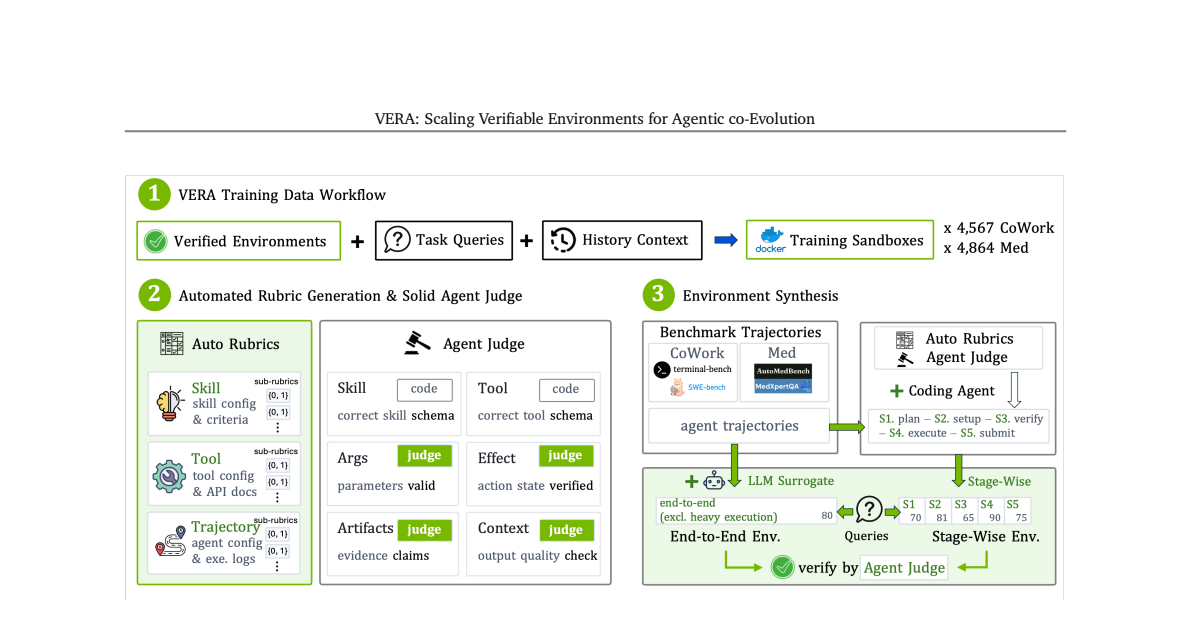
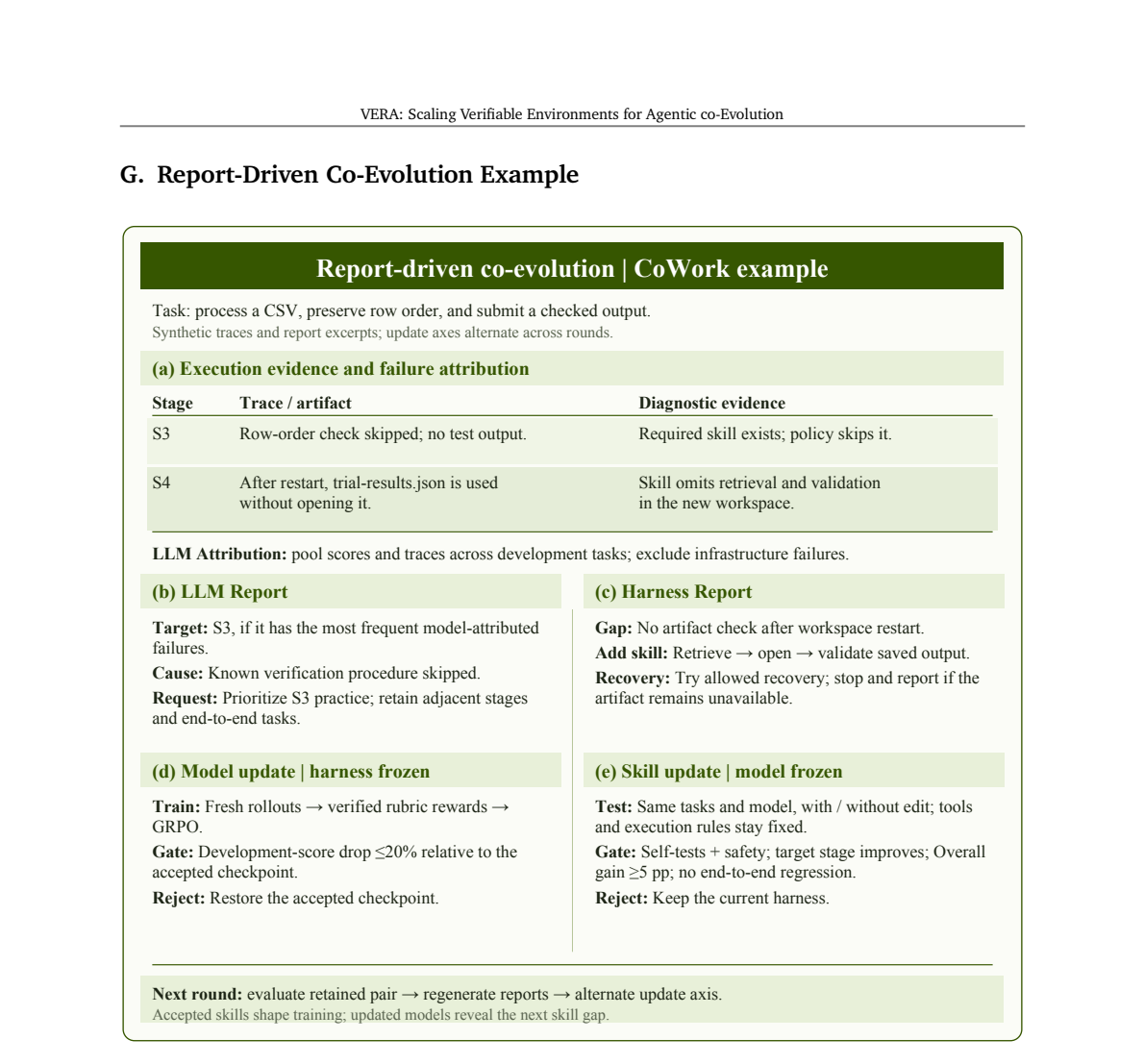
What carries the argument. The central mechanism is a pair of pipelines run in sequence. Auto-Rubric turns benchmark trajectories into training sandboxes: a coding agent writes binary rubric items scored 0/1 from observable evidence; stage-wise sandboxes restore the workspace at the start of each of five stages — plan, setup, verify, execute, submit — so any stage can be practiced and scored alone; end-to-end sandboxes use an LLM surrogate for slow tool calls; and executable code checks plus an Agent Judge admit only environments that run and score from evidence, with a failed executable check overriding any judge score. The training loop then alternates two updates with the other component frozen: full-parameter GRPO armed with rubric rewards (a Reward Verifier checks the rollout evidence behind each reward), and harness skill edits that add, merge, or remove skills (a Harness Verifier tests each edit by paired reruns of the same frozen model with and without the edit). LLM Attribution reads stage-wise scores and execution traces to produce an LLM Report naming the target stage and a Harness Report proposing skill changes. Because only one axis changes per round, every accepted checkpoint or skill edit is traceable to a single update, which is the property the authors say distinguishes their co-evolution from the compared baselines.
Core claim. VERA's central claim is that an agent can improve itself on long-horizon work if its training environments decompose each task into restartable stages, score each stage with binary rubric checks that must be supported by observable evidence (execution records, workspace artifacts, tool effects) rather than by a single final test, and let the model and its harness — skills, tools, execution rules — update one at a time while a verifier accepts or rejects each candidate change against fixed development-set criteria. The authors' stated result is that this alternating, verifier-gated co-evolution outperforms both harness-only and model-only training and the strongest compared baseline in each domain: 31.0 Overall on AutoCoWorkBench versus 20.7 for the best single-axis baseline, and 69.1 on AutoMedBench versus 56.1 for its harness-only variant, at 9B. At 27B the co-evolved agent reaches 71.6 on AutoCoWorkBench and 80.7 on AutoMedBench, surpasses Claude Opus 4.8 on the former and comes within 1.2 points on the latter, transfers to Automation-Bench and AgentClinic, and retains or improves general reasoning capability where the 4B and 9B runs degrade it. The load-bearing assertion is that the alternating structure with one axis frozen is what makes each gain attributable and therefore learnable.
The premise it rests on. The whole loop leans on the GPT-5.6-Sol judge's rubric scores and acceptance decisions being accurate, non-gameable proxies for genuine task competence — an assumption the paper itself leaves untested for judge sensitivity and only consistency-checked, never correctness-checked, for its hacking verifier.
If the paper is right (Pith's inferences, not the authors')
Rubric-scored restartable stage sandboxes can replace outcome-only environments for long-horizon agent training in domains as different as coding and medical research.
Freezing one axis while updating the other turns every accepted checkpoint or skill edit into a cause-attributable change, which is the property that lets the loop decide where to intervene next.
Verified gains transfer out of distribution: at 27B the co-evolved agent improves over its base by 19.2 points on Automation-Bench and 32.5 on AgentClinic, neither of which contributed sandboxes.
Self-evolution is only capability-preserving at the stronger backbone: the 4B and 9B runs degrade AIME and other general benchmarks, while the 27B runs mostly improve them, pointing to a scale threshold for non-destructive co-evolution.
Environment preparation and curation dominate estimated recursive-self-improvement cost at roughly 55%, with training infrastructure at 28% and verification and attribution at 17%.
The freeze-one-axis attribution design is portable beyond VERA: it can serve as a diagnostic instrument for any agent-training pipeline to determine whether a performance gain came from the weights or the harness, independent of the training loop itself.
Since judge sensitivity is untested and the medical rubrics only approximate the official benchmark's scoring, the released 9,000-environment corpus makes a direct experiment available: rerun co-evolution with a different judge and watch whether the claimed margins hold.
The 4B/9B degradation versus 27B retention suggests a measurable model-strength threshold for safe self-evolution that could be mapped across sizes, informing when co-evolution should be deployed at all.
Check this review
Pith stored no record of this review's passes and took no fingerprint of it. Reviews made by code from 13 Nov 2026 on carry both.
How often reviews like this one are right
Reviews like this one: written by deepseek-v4-flash, where what was read was not recorded.
How often objections from reviews like this one are right: not yet measured
Reviews by people
This review was written by a machine. No person has reviewed this paper on Pith yet. A scientist listed on Pith can review it for a fee, and their review is published here whatever it concludes.
The paper
Abstract
Competent agents need precise and verifiable environments, such as sandboxes that are resumable at any stage and evolve from observable evidence. However, most long-horizon work exposes how rare these are: for example, an agent in medical research must ground a finding, classify it, and write a report over dozens of dependent steps, yet recent environments score only the outcome. To address the challenges in stable training, we present VERA, which builds such environments at scale and lets agents evolve on them. VERA builds these environments from initial trajectories: an agent writes rubrics, executable checks, a judge verifies each sandbox, and only those that pass enter the training bank. On these environments, VERA alternates between two updates: train the model with rubric rewards, or edit the harness skills. We also create a verifier which gates model checkpoints and harness edits using explicit development-set acceptance criteria. This attribution distinguishes VERA's co-evolution from single-axis baselines: its updates target not only the cause but the outcome. With an open-source corpus of 9,000+ long-horizon verifiable environments, a 9B model paired with its co-evolved agent beats the strongest baseline by 10.3 and 13.0 points in the two domains. At 27B, it surpasses the baseline on AutoCoWorkBench (71.6) and AutoMedBench (80.7), transfers to unseen workflows, and retains general capabilities.
The paper's own sentences, arranged, kept beside the review and separate from it. Each label is drawn from a closed vocabulary; the number beside it is the probability the classifier gave that label. No sentence in this record was written by a model.
abstract compiled · 2026-10-06
The authors' main claim, as the classifier picked it out 0.81
“With an open-source corpus of 9,000+ long-horizon verifiable environments, a 9B model paired with its co-evolved agent beats the strongest baseline by 10.3 and 13.0 points in the two domains.”
How the main claim is stated: asserted 1.00
What the abstract itself states, as probabilities: claims first 0.09 · states limitation 0.12 · human participants 0.08 · controlled comparison 0.95 · randomized assignment 0.01 · states quantitative result 0.99 · compares with prior results 0.98 · mentions code or data availability 0.72
The abstract, sentence by sentence
This table labels the abstract only (arXiv listing abstract v1). The number is the probability the classifier gave the label.
| Sentence | Role | The authors' own work | States the main conclusion | Strength |
|---|---|---|---|---|
| Competent agents need precise and verifiable environments, such as sandboxes that are resumable at any stage and evolve from observable evidence. | background 1.00 | 0.08 | 0.04 | asserted 0.99 |
| However, most long-horizon work exposes how rare these are: for example, an agent in medical research must ground a finding, classify it, and write a report over dozens of dependent steps, yet recent environments score only the outcome. | gap 0.82 | 0.12 | 0.03 | asserted 1.00 |
| To address the challenges in stable training, we present VERA, which builds such environments at scale and lets agents evolve on them. | contribution 1.00 | 0.86 | 0.11 | asserted 0.99 |
| VERA builds these environments from initial trajectories: an agent writes rubrics, executable checks, a judge verifies each sandbox, and only those that pass enter the training bank. | method 0.99 | 0.89 | 0.05 | asserted 1.00 |
| On these environments, VERA alternates between two updates: train the model with rubric rewards, or edit the harness skills. | method 1.00 | 0.86 | 0.05 | asserted 1.00 |
| We also create a verifier which gates model checkpoints and harness edits using explicit development-set acceptance criteria. | method 0.93 | 0.92 | 0.04 | asserted 1.00 |
| This attribution distinguishes VERA's co-evolution from single-axis baselines: its updates target not only the cause but the outcome. | interpretation 0.75 | 0.66 | 0.08 | asserted 0.99 |
| With an open-source corpus of 9,000+ long-horizon verifiable environments, a 9B model paired with its co-evolved agent beats the strongest baseline by 10.3 and 13.0 points in the two domains. | result 1.00 | 0.95 | 0.43 | asserted 1.00 |
| At 27B, it surpasses the baseline on AutoCoWorkBench (71.6) and AutoMedBench (80.7), transfers to unseen workflows, and retains general capabilities. | result 1.00 | 0.94 | 0.40 | asserted 1.00 |
What kind of paper the classifier reports this is: method or tool 0.99 · evidence from observation or experiment 0.89
What was examined, and what was not
Sources read
- arXiv listing abstract v1
Not examined
- full text
- figures and tables
- references and citing sentences
- relations to other papers
Levels run
- P abstract
Not run
- S sections
- T body sentences
- C citations
- R cross-paper relations
How the labels were made
Compiled by classifier-1.13.0 via TypeSafe API, question bank abstract-p1-20260923, 2026-10-06: 1 request, 7,053 input tokens.
Every quoted sentence on this record is the authors'. Every label is from Pith's closed vocabulary, with the probability shown beside it. This record as JSON
Figures (5)
Figures are the authors', reproduced from the paper.
References (48)
- [1] Judging llm-as-a-judge with mt-bench and chatbot arena , author=. Advances in neural information processing systems , volume= on Pith
- [2] GTM: Simulating the World of Tools for AI Agents , author=. ArXiv , year= on Pith
- [3] Training Language Models to Follow Instructions with Human Feedback , author=. Advances in Neural Information Processing Systems , volume= on Pith
- [4] Terminal-Bench: Benchmarking Agents on Hard, Realistic Tasks in Command Line Interfaces , author =. International Conference on Learning Representations (ICLR) , year = on Pith
- [5] Chan, Jun Shern and Chowdhury, Neil and Jaffe, Oliver and Aung, James and Sherburn, Dane and Mays, Evan and Starace, Giulio and Liu, Kevin and Maksin, Leon and Patwardhan, Tejal and Weng, Lilian and M. arXiv preprint arXiv:2410.07095 , year = on PithPith's reviewarXiv
- [6] Zhou, Shuyan and Xu, Frank F. and Zhu, Hao and Zhou, Xuhui and Lo, Robert and Sridhar, Abishek and Cheng, Xianyi and Ou, Tianyue and Bisk, Yonatan and Fried, Daniel and Alon, Uri and Neubig, Graham , booktitle =. 2024 , url = on Pith
- [7] Jimenez, Carlos E. and Yang, John and Wettig, Alexander and Yao, Shunyu and Pei, Kexin and Press, Ofir and Narasimhan, Karthik R. , booktitle =. 2024 , url = on Pith
- [8] Yao, Shunyu and Shinn, Noah and Razavi, Pedram and Narasimhan, Karthik , booktitle =. 2025 , url = on Pith
- [9] Jain, Naman and Singh, Jaskirat and Shetty, Manish and Zheng, Liang and Sen, Koushik and Stoica, Ion , journal =. 2025 , url = on Pith
- [10] Let's Verify Step by Step , author =. arXiv preprint arXiv:2305.20050 , year = on PithPith's reviewarXiv
- [11] Luo, Xufang and Zhang, Yuge and He, Zhiyuan and Wang, Zilong and Zhao, Siyun and Li, Dongsheng and Qiu, Luna K. and Yang, Yuqing , journal =. Agent Lightning: Train. 2025 , url = on Pith
- [12] COS-PLAY: Co-Evolving LLM Decision and Skill Bank Agents for Long-Horizon Tasks , author=. arXiv preprint arXiv:2604.20987 , year= on PithPith's reviewarXiv
- [13] Rein, David and others , journal= on Pith
- [14] Shridhar, Mohit and Yuan, Xingdi and C. International Conference on Learning Representations (ICLR) , year= on Pith
- [15] Generalizing Verifiable Instruction Following , author=. Advances in Neural Information Processing Systems (NeurIPS) Datasets and Benchmarks Track , year= on Pith
- [16] Patil, Shishir G. and Mao, Huanzhi and Yan, Fanjia and Ji, Charlie Cheng-Jie and Suresh, Vishnu and Stoica, Ion and Gonzalez, Joseph E. , booktitle=. The Berkeley Function Calling Leaderboard ( on Pith
- [17] Schmidgall, Samuel and others , journal= on Pith
- [18] Zuo, Yuxin and Qu, Shang and Li, Yifei and Chen, Zhangren and Zhu, Xuekai and Hua, Ermo and Zhang, Kaiyan and Ding, Ning and Zhou, Bowen , booktitle= on Pith
- [19] DeepSeekMath: Pushing the Limits of Mathematical Reasoning in Open Language Models , author=. 2024 , eprint= on Pith
- [20] Automated Design of Agentic Systems , author=. International Conference on Learning Representations (ICLR) , year= on Pith
show 28 more
- [21] On-Policy Distillation of Language Models: Learning from Self-Generated Mistakes , author=. 2024 , eprint= on Pith
- [22] Bi, Jinhe and Zhou, Chennan and Jin, Zengjie and others , journal= on Pith
- [23] Math-shepherd: Verify and reinforce llms step-by-step without human annotations , author=. Proceedings of the 62nd Annual Meeting of the Association for Computational Linguistics (Volume 1: Long Papers) , pages= on Pith
- [24] Lambert, Nathan and Morrison, Jacob and Pyatkin, Valentina and others , journal= on Pith
- [25] arXiv preprint arXiv:2501.12948 , year= on PithPith's reviewarXiv
- [26] Checklists Are Better Than Reward Models For Aligning Language Models , author=. arXiv preprint arXiv:2507.18624 , year= on PitharXiv
- [27] Agent-as-a-Judge: Evaluate Agents with Agents , author=. arXiv preprint arXiv:2410.10934 , year= on PithPith's reviewarXiv
- [28] Scaling Laws for Reward Model Overoptimization , author=. International Conference on Machine Learning (ICML) , year= on Pith
- [29] Pan, Jiayi and Wang, Xingyao and Neubig, Graham and Jaitly, Navdeep and Ji, Heng and others , journal=. Training Software Engineering Agents and Verifiers with on Pith
- [30] Yang, John and Lieret, Kilian and Jimenez, Carlos E. and Wettig, Alexander and Khandpur, Kabir and others , journal= on Pith
- [31] Reflexion: Language agents with verbal reinforcement learning , author=. Advances in Neural Information Processing Systems , volume= on Pith
- [32] Voyager: An Open-Ended Embodied Agent with Large Language Models , author=. arXiv preprint arXiv:2305.16291 , year= on PithPith's reviewarXiv
- [33] Khattab, Omar and Singhvi, Arnav and Maheshwari, Paridhi and Zhang, Zhiyuan and Santhanam, Keshav and others , booktitle= on Pith
- [34] Agrawal, Lakshya A and Tan, Shangyin and Soylu, Dilara and Ziems, Noah and Khare, Rishi and others , journal= on Pith
- [35] Zhang, Jiayi and Xiang, Jinyu and Yu, Zhaoyang and Teng, Fengwei and Chen, Xionghui and others , booktitle= on Pith
- [36] Lee, Yoonho and Nair, Roshen and Zhang, Qizheng and Lee, Kangwook and Khattab, Omar and others , journal= on Pith
- [37] Zhang, Jenny and Hu, Shengran and Lu, Cong and Lange, Robert and Clune, Jeff , journal=. Darwin on Pith
- [38] Wu, Siwei and Ren, Jincheng and Li, Yizhi and Li, Haau-Sing and Yang, Chengran and others , journal= on Pith
- [39] Liu, Junqi and He, Yufan and He, Yexiao and Guo, Pengfei and Yang, Dong and Myronenko, Andriy and Zhao, Can and Ye, Hanrong and Qi, Tianhao and Zhou, Yuyin and Xu, Daguang and Tang, Yucheng , journal = on Pith
- [40] Liu, Junqi and Song, Selena and Wang, Yuhan and Mao, Jiawei and Chen, Hardy and Huang, Xiaoke and Qi, Tianhao and Guo, Pengfei and Tang, Yucheng and He, Yufan and Zhao, Can and Myronenko, Andriy and Yang, Dong and Xu, Daguang and Zhou, Yuyin , journal = on Pith
- [41] Rubrics as Rewards: Reinforcement Learning Beyond Verifiable Domains , author =. arXiv preprint arXiv:2507.17746 , year = on PithPith's reviewarXiv
- [42] Zhang, Zili and Zhong, Yinmin and Yang, Chengxu and Jin, Chao and Wu, Bingyang and Wei, Xinming and Liu, Yuliang and Jin, Xin , journal = on Pith
- [43] Kingma, Diederik P. and Ba, Jimmy , title=. arXiv preprint arXiv:1412.6980 , year= on PithPith's reviewarXiv
- [44] Dao, Tri and Fu, Daniel Y. and Ermon, Stefano and Rudra, Atri and R. arXiv preprint arXiv:2205.14135 , year= on PithPith's reviewarXiv
- [45] Zheng, Lianmin and Yin, Liangsheng and Xie, Zhiqiang and Sun, Chuyue and Huang, Jeff and Yu, Cody Hao and Cao, Shiyi and Kozyrakis, Christos and Stoica, Ion and Gonzalez, Joseph E. and Barrett, Clark and Sheng, Ying , title=. arXiv preprint arXiv:2312.07104 , year= on PithPith's reviewarXiv
- [46] 2026 , howpublished = on Pith
- [47] Liu, Tianyu and Dai, Dingyuan and Xuan, Weihao and Chen, Jialin and Zeng, Qingcheng and Yang, Rui and Fang, Ada and Yang, Zhen and Cui, Peng and Dong, Yinpeng and Du, Yuanqi and Zitnik, Marinka and Zou, James and Tang, Jie , title =. SSRN , year = on Pith
- [48] From AI Agents to AI Scientists in Health: Emerging Landscape, Challenges, and the Path Forward , author= on Pith
Cited by 2 Pith papers
Reviewed papers on Pith that cite this one. The full citation record
- Work Agents: Systems, Capabilities, and Optimization cs.LG · Oct 2026
- Automating quantum circuit optimization with AI agents quant-ph · Oct 2026
Challenges and discussion
Disagree with the review, or know something it missed? Leave a comment, or challenge this review formally: a challenge becomes a permanent entry in this paper's record, and its decision is published here.
Come back by email
A short list of the week's newly reviewed papers. Nothing is sent until you confirm from your inbox, and every email has a link that stops it. No account.
No comments yet.
Sign in to comment