Quantum Physics · arXiv:2611.24687 v1 · submitted 18 Nov 2026 · 118 references
On Reaction Depth and Fast Fault-Tolerant Boolean Logic
The paper says
“Reducing runtimes of quantum applications is critical for practical viability. On quantum computers, the runtime can depend both on the speed of quantum operations and on how often the program must wait for the classical coprocessor to determine adaptive operations.”
more of the abstract
Some recent approaches to reducing this overhead have focused on minimizing the "reaction depth" of a computation, informally defined as the number of times the classical coprocessor must be consulted while running a quantum program. In this work, we formalize the notion of reaction depth. We find several subtleties in this theory. For example, we distinguish the reaction depth of a circuit from that of a circuit run, and show that the magic depth of a unitary can be higher than the reaction depth once compiled into Clifford computation and magic state injection. We then focus on the specific case of coherent Boolean logic, a common and expensive component in quantum algorithms. We use a natural gateset for fast operations with Low-Density Parity Check (LDPC) codes, which consists of homogeneous Z- and X-type Pauli Product Measurements (PPMs), alongside a supply of Toffoli states. We prove that, using this gateset, any Boolean arithmetic circuit can be implemented on a quantum computer with constant quantum depth and constant reaction depth, at the cost of exponential space and leaving some qubits "dirty". Using the same gateset we find two efficient AutoAND circuits that require only a Toffoli state and homogeneous PPMs. We then give efficient implementations of the quantum ripple-carry adder and quantum schoolbook multiplier, which require a low number of heterogeneous PPMs for uncomputation. We find implementations competitive with the state-of-the-art despite the restricted gateset.
from the abstract
Pith says
Machine review · deepseek-v4-flash · 19 Nov 2026 · read the full text (506,606 characters) · not checked by a person
It can be wrong. Challenge this review or reply to it.
Holds up, with conditions. This paper formalizes reaction depth and shows that any Boolean function can be computed with constant quantum and reaction depth using only homogeneous Pauli product measurements and Toffoli states, at exponential space cost. This line is wrong
11 minor · 1 open question
How often objections from reviews like this one are right: not yet measured
The paper, first character to last
The reviewer was given the whole text, 506,606 characters. Not checked: figures, code, what the 118 references say.
11 minor objections
The paper says, at §2.1, Definition 1 (DAG)
Pith says: minor objection 1 of 11
The definition of vertex-length and edge-length uses 'Size_v(p)' and 'Size_e(p)' but these are not defined for paths; they are defined for graphs. The text should clarify that the size of a path is the number of vertices/edges in that path.
The paper says, at §3.2, Definition 9 (reaction depth of a circuit)
Pith says: minor objection 2 of 11
The definition of reaction depth uses $\mathrm{Depth}_e^\mathtt{c}(H(\mathcal{C}))$, the longest path along classical edges. However, the example of qubit teleportation claims reaction depth 1 because 'There is no path through the DAG which includes both classical wires.' This is correct only if the classical edges are considered as edges in the DAG. The definition should explicitly state that paths can include both quantum and classical edges, and the reaction depth counts only the classical edges along the path.
show 9 more
The paper says, at §3.2, Definition 11 (p-reaction depth)
Pith says: minor objection 3 of 11
The definition of Pauli-deferred circuit $\mathcal{C}^\mathtt{p}$ says 'commuting all Pauli gates to the end of the circuit, past any final measurements.' However, if there are intermediate measurements, commuting Paulis past them may change the measurement basis or introduce dependencies. The definition should specify that Paulis are commuted only past Clifford gates and measurements that they commute with, or that the Pauli frame is updated classically. The current wording is ambiguous.
The paper says, at §4.1, Lemma 1 (out-of-place XOR)
Pith says: minor objection 4 of 11
The proof states 'using the facts that $Z\ket{x_i} = (-1)^{x_i}\ket{x_i}$ for a computational basis state $\ket{x_i}$ and $\ket{+} + (-1)^a \ket{-} = \ket{a}$, up to normalization.' The second fact is missing a factor of $1/\sqrt{2}$: $\ket{+} + (-1)^a \ket{-} = \sqrt{2} \ket{a}$. The proof should include the normalization factor, though it is ultimately absorbed into the state.
The paper says, at §4.2, Lemma 3 (delayed-choice PPMs)
Pith says: minor objection 5 of 11
The proof for the X-basis measurement case ends with '$\propto (-1)^{\ell m} P^\ell \ket{\phi} \propto P^\ell \ket{\phi}$.' The factor $(-1)^{\ell m}$ is a global phase only if $\ell$ and $m$ are known constants, but they are measurement outcomes that may be used for later corrections. The paper should clarify that this phase can be tracked classically and does not affect the logical operation.
The paper says, at §4.3, Lemma 7 (Wandering AND gate)
Pith says: minor objection 6 of 11
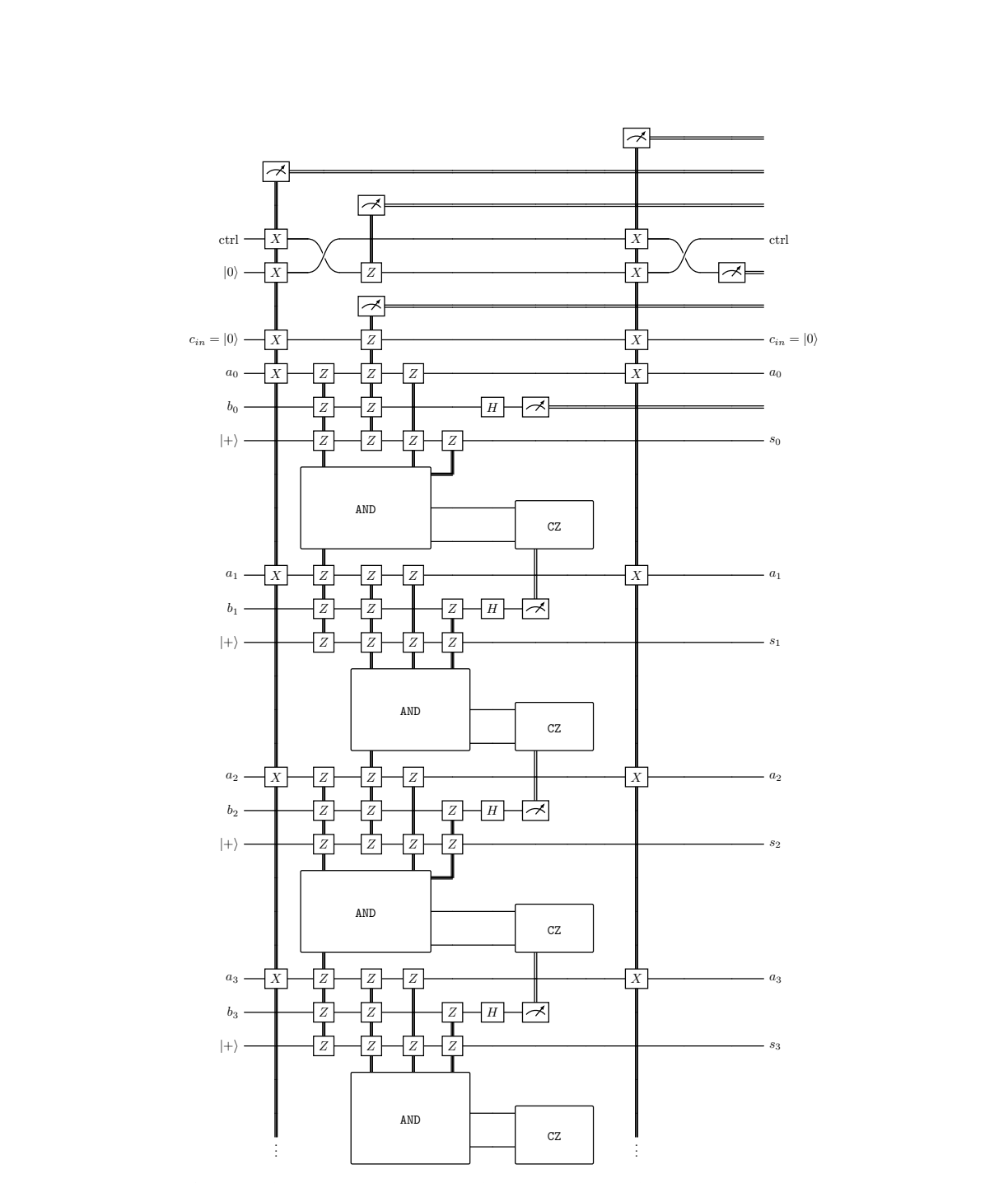
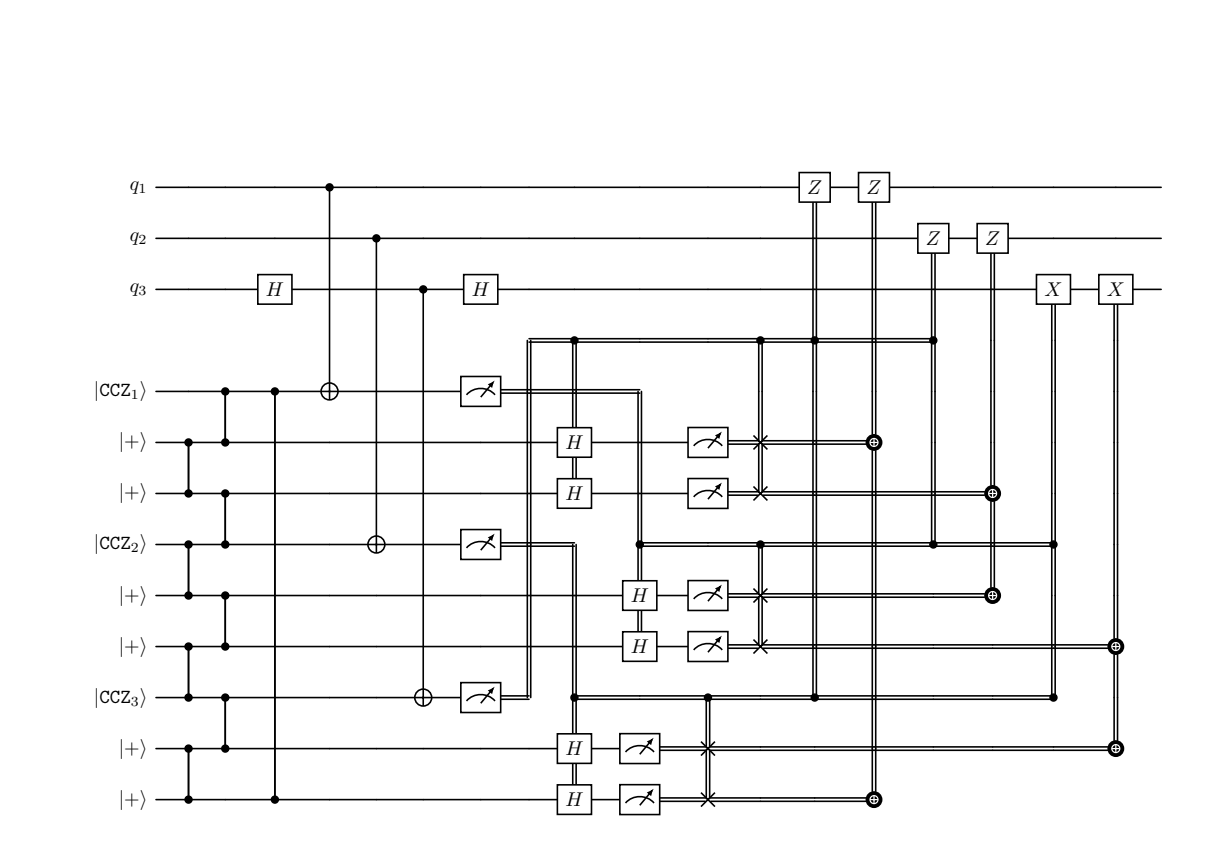
The circuit diagram in Figure 5 uses non-standard notation (e.g., parity controls, thick wires for PPMs). While Appendix A explains the notation, the figure caption should reference the appendix for clarity. Also, the Quirk links in the figure captions are not accessible in the printed version and may become stale; consider providing a stable alternative.
The paper says, at §4.4, Lemma 10 (Wandering monomial construction)
Pith says: minor objection 7 of 11
The proof states 'After the $\ket{\mathtt{wandering\_mon}(x)}$ state is constructed, all ancilla qubits not used in the construction can be measured out in the $\ket{\pm}$ basis, and phase errors can be corrected by Pauli $Z$ operations applied to the $\ket{\mathtt{wandering\_mon}(x)}$ state, adding at most one additional layer of quantum depth.'
more of objection 7
This assumes that the Pauli Z corrections can be applied simultaneously, which requires that they act on disjoint qubits or that the architecture supports parallel Z gates. The paper should note this assumption.
The paper says, at §5.2, Ripple-carry adder
Pith says: minor objection 8 of 11
The circuit diagram for the adder bit slice (Lemma 12) is extremely large and difficult to read. The paper should consider breaking it into smaller subcircuits or providing a higher-level description. The current presentation makes verification challenging.
The paper says, at §5.2, Lemma 12 (adder circuit)
Pith says: minor objection 9 of 11
The proof of Lemma 12 says 'The XORs can be merged into the Z-type PPMs which perform the injection; this can be seen by the fact that the output of, say, $(a_k \oplus s_k)$ is used only in the $Z$ PPM for the \gateautoand, so the output can be subsumed into the PPM doing the injection.' This is not obvious and should be explained more explicitly. How exactly are the XORs merged into the PPMs?
The paper says, at §6, Discussion
Pith says: minor objection 10 of 11
The paper states 'It is unclear if the constant reaction-depth Boolean logic circuits given in Section 4 have a constant magic-depth analogue, without relying on a different gateset that includes e.g. small angle rotations.' This is an interesting open question, but the paper does not provide any evidence or conjecture. Consider expanding this discussion or removing the speculation.
The paper says, at Appendix B, Example of reaction counterexample
Pith says: minor objection 11 of 11
The proof that the CS gate has CCX-depth 2 uses a symplectic argument that is not fully explained. The claim that 'q_{S_b\circ CZ_{ab}}(x) = u_b' is stated without derivation. This example is important for showing that reaction depth can be strictly less than magic depth, so the proof should be more self-contained.
Open questions (1)
Pith raised these and could not confirm them against the text of the paper it read. They are questions for the authors, not findings.
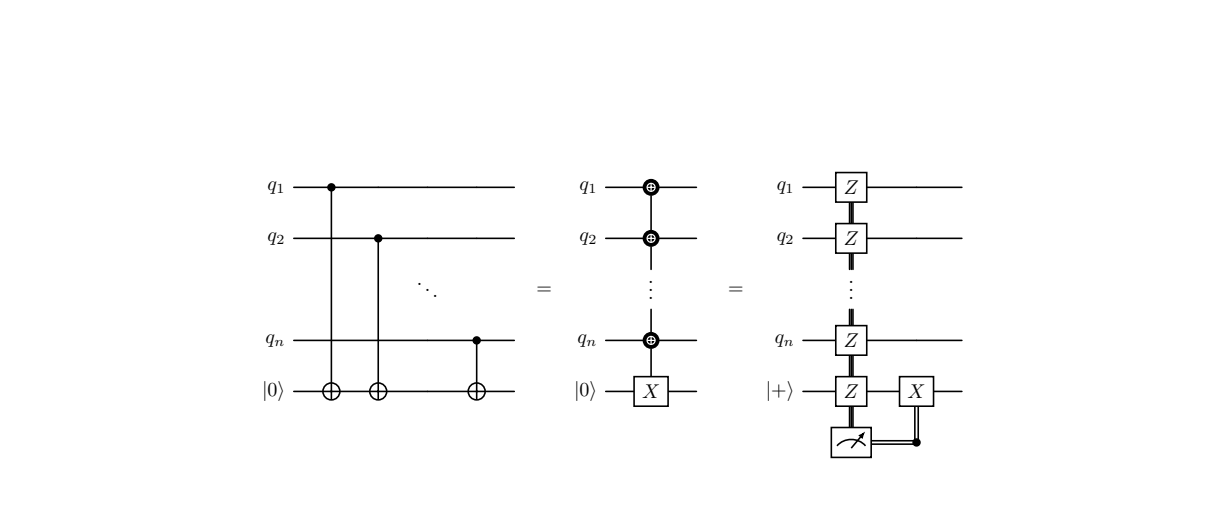
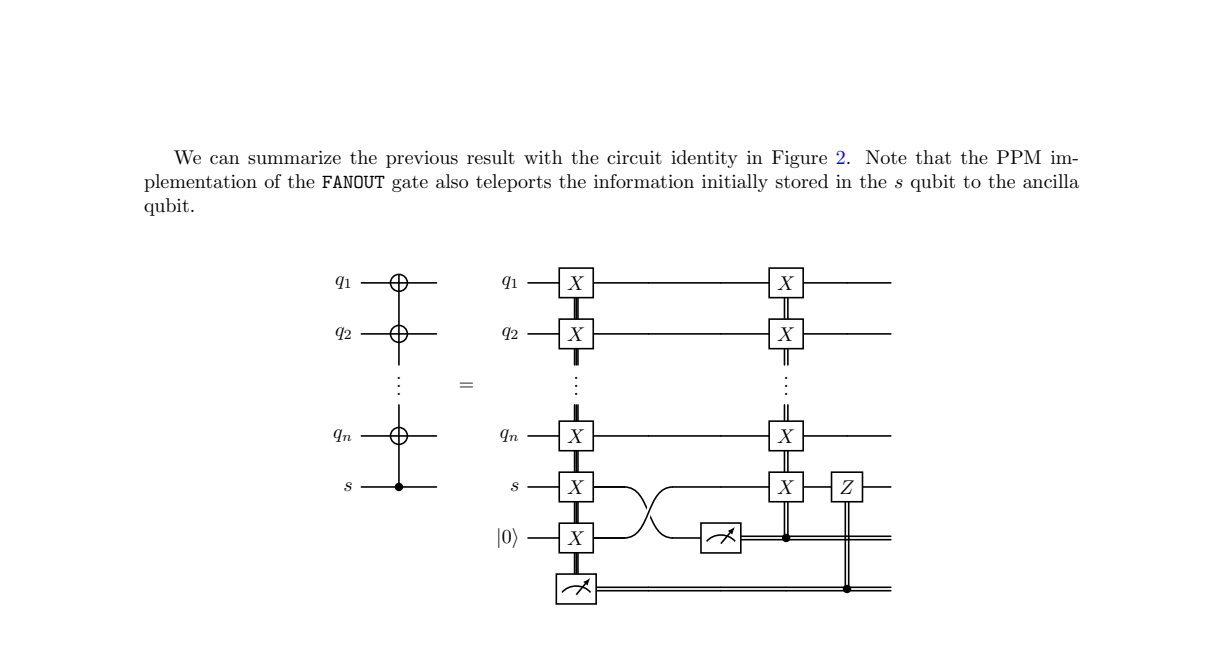
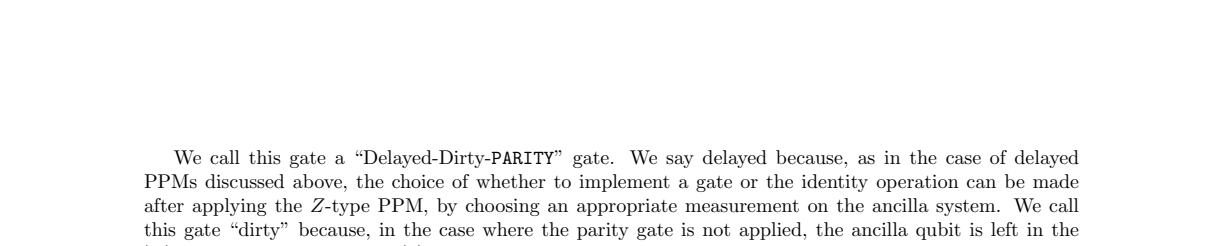
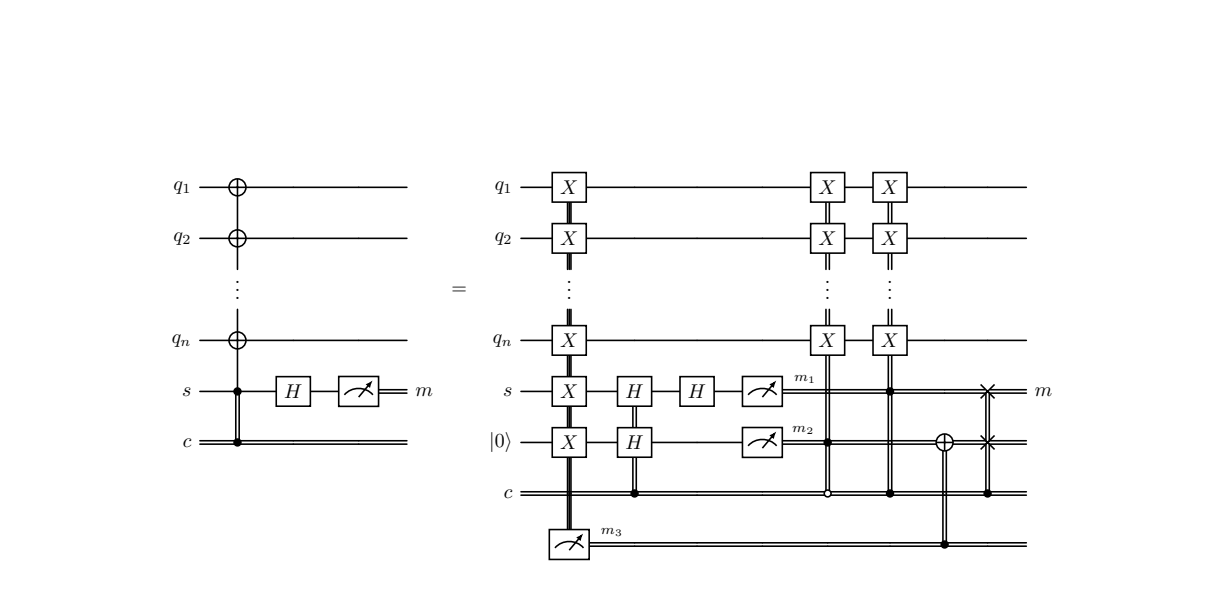
- §4.2, Lemma 5 (PPM-based fanout) Pith raised a concern here that it could not check against the text of the paper it was given, so it is not published as an objection.
What would settle it
If a concrete LDPC architecture is built that cannot perform homogeneous PPMs on arbitrary subsets of qubits (e.g., only supports measurements on fixed-size or geometrically local supports), the constant-depth constructions would break. Alternatively, if a Boolean function is found that requires more than constant reaction depth under any circuit using only homogeneous PPMs and Toffoli states, the theorem would be falsified.
from Pith's summary of the paper
How the review went
5 passes by deepseek-v4-flash · 19 Nov 2026
- Reader holds up, with conditions
- Skeptic concern withdrawn: Pith's reviewer misread the paper
- Referee 11 minor
- Check against the paper kept 0 of 6 objections
- Editor wrote the verdict above
Not run on this paper: the simulated authors' defence.
Pith's passes raised 6 objections. A check against the paper's text kept 0, withdrew 5 (1 the paper already says; 4 Pith's reviewer misread the paper) and left 1 as a question.
The review in full
The review in brief, machine-written
This paper does two things, and does them both well. First, it gives a careful formal definition of reaction depth—the number of times a quantum circuit must consult the classical coprocessor—and distinguishes circuit-level reaction depth from per-shot reaction depth. This fills a gap in the literature, where the concept was used informally. The definitions are clean and the discussion of subtleties (Pauli frame tracking, contributive depth, measurement cascades) is useful for anyone compiling fault-tolerant circuits.
Second, the paper constructs explicit circuits for coherent Boolean logic using only homogeneous Z- and X-type Pauli product measurements (PPMs) and Toffoli resource states. The main theorem—that any Boolean function can be implemented with constant quantum depth and constant reaction depth using O(2n) ancilla left dirty—is a genuine result. The two AutoAND circuits (parity-based and fanout-based) are new and improve on prior work by using only homogeneous PPMs. The ripple-carry adder and multiplier compilations are practical contributions for the qLDPC architecture community.
The soft spots are real but acknowledged. The constant-depth theorem requires exponentially many ancilla and leaves them dirty; the authors say this. The proof of the parity-based AutoAND states "We do not prove the Pauli corrections here", which is a gap. Several proofs rely on figures (tikz) that were not viewable in the supplied copy, so I could not verify the DAG analyses or ZX derivations. The load-bearing assumption that homogeneous PPMs are addressable on arbitrary qubit subsets is stated by the authors and is a genuine constraint for some fast-surgery LDPC schemes.
This paper is for researchers working on fault-tolerant compilation, especially for qLDPC architectures. It deserves a serious referee. The formalization of reaction depth is a service to the field, and the constructions are concrete enough to be built on. The gaps (unproved Pauli corrections, figure-dependent proofs) are the kind a referee can check.
Recommendation: send to peer review.
The stress test's concern
Withdrawn: Pith's reviewer misread the paper.
The paper says
“To avoid this, we introduce an additional $2^n$ ancilla in the $\ket{+}$ and $\ket{0}$ states and use $2^n$ delayed choice fanout operations (\Cref{lem:delayed-fanout}), each controlled on a different wandering monomial and targeting a fresh ancilla which are used to copy only the wandering monomials whose parity is required to compute $f(x)$, then apply a fixed XOR operation on all $2^n$ ancilla to compute the desired function.”
The referee's report
Not published. Pith's referee wrote this assessment before its objections were checked against the paper, and 5 of its 5 major objections did not survive that check.
Pith's reading of the paper (a machine's summary, not the authors')
The paper formalizes the notion of reaction depth—the number of sequential consultations with a classical coprocessor needed to run a quantum circuit—and then shows that any Boolean function can be implemented with constant reaction depth and constant quantum depth using only homogeneous Z- and X-type Pauli product measurements (PPMs) and Toffoli resource states. This is significant because high-rate quantum LDPC codes, a leading architecture for fault-tolerant quantum computing, naturally support only homogeneous PPMs. The construction uses exponentially many ancilla qubits that are left in a dirty (garbage) state, but the authors also give more practical circuits for adders and multipliers that use few non-homogeneous PPMs and are competitive with state-of-the-art surface-code compilations.
What carries the argument. The central objects are homogeneous Pauli product measurements (PPMs) of Z-type and X-type, which implement out-of-place XOR and in-place fanout respectively, and delayed-choice versions of these operations that allow the classical control decision to be made after the multi-qubit measurement. The 'wandering monomial' state construction uses these to build all monomials in parallel, then a fixed XOR extracts the function value.
Core claim. The paper claims that any Boolean function f on n variables can be realized by a circuit that uses only homogeneous Z- and X-type Pauli product measurements and Toffoli (|CCX>) states, with constant quantum depth and constant reaction depth, at the cost of O(2^n) ancilla qubits that are left in a dirty state. The construction works by first preparing a 'wandering monomial' state that encodes all monomials of the input bits, then using delayed-choice parity and fanout operations to extract the desired function. The authors also present two new AutoAND circuits (parity-based and fanout-based) that require only a single Toffoli state and homogeneous PPMs, with contributive depth 1.
The premise it rests on. The constructions assume that homogeneous Z- and X-type Pauli product measurements can be applied to any arbitrary subset of qubits (addressability), which may not be available in all fast-surgery LDPC schemes.
If the paper is right (Pith's inferences, not the authors')
If the construction is practical, coherent Boolean logic on qLDPC architectures could be performed with minimal classical coprocessor interaction, reducing runtime bottlenecks.
The AutoAND circuits with contributive depth 1 could be used as building blocks for larger arithmetic circuits without increasing the critical path depth.
The formalization of reaction depth provides a framework for comparing compilation strategies across different fault-tolerant architectures.
The constant-depth construction shows that, in principle, any Boolean function can be evaluated with only two layers of classical feedback, regardless of circuit complexity.
The exponential space cost of the constant-depth construction likely limits it to small subroutines or functions with few input variables; the practical value is in the techniques (delayed-choice PPMs, AutoAND) rather than the asymptotic theorem.
The paper's distinction between reaction depth of a circuit and of a circuit run suggests that average-case reaction depth may be a more relevant metric for many algorithms, especially those with repeat-until-success patterns.
The reliance on addressable PPMs (arbitrary subsets of qubits) may be a significant practical constraint, as many fast-surgery LDPC schemes restrict measurement supports.
Check this review
What was read
The passes were given all 506,606 characters of the paper's LaTeX source.
Fingerprint of that text (SHA-256): 1a46f86253c112570c5aa429f6d778935f0d24167e0fb4205c9a9df2c12326d0
Pith does not keep that text. Rebuilt from the paper's source or PDF by the same code, it has this fingerprint if it is the same text. From a copy of Pith's code:
PYTHONPATH=. python scripts/review_input_check.py 2611.24687
The passes, in the order they ran
- Reader deepseek-v4-flash · medium effort · $0.027 · instructions of the Reader, fingerprint f9ead7300382…
- Skeptic deepseek-v4-flash · medium effort · $0.016 · instructions of the Skeptic, fingerprint 8f88c0f61488…
- Referee deepseek-v4-flash · medium effort · $0.016 · instructions of the Referee, fingerprint a852d99aea0d…
- Check against the paper deepseek-v4-flash · medium effort · $0.017 · instructions of the Check against the paper, fingerprint 6c7a6883d551…
- Editor deepseek-v4-flash · medium effort · $0.016 · instructions of the Editor, fingerprint e7211f6a3d27…
- Circularity check deepseek-v4-flash · medium effort · $0.016 · instructions of the Circularity check, fingerprint e9946e39d67b…
- Summary for the page deepseek-v4-flash · medium effort · temperature 0.2 · $0.016 · instructions of the Summary for the page, fingerprint e4f56bf568e7…
The passes cost $0.123 in model calls together.
Version stamped on this review: pith-pipeline@v1.4.1-daily-deepseek-or-medium+deepseek/deepseek-v4-flash+p.d60f54226f00
Each link opens a pass's instructions as plain text, the exact bytes its fingerprint was taken over. Every stored set of instructions.
curl -s https://pith.science/methodology/prompts/f9ead730038216984cfb56d7cb34332bdf691828296a1de4245f3d6667d4bf56 | sha256sum
prints the fingerprint of the reader's instructions. The same works for every pass.
The receipt
The review's fingerprint was taken on 19 Nov 2026. The review you are reading still matches it.
Fingerprint of the review (SHA-256): e64ed17f30798a0af4eb4eb0532d101b542f4c79b52081671c2e9e5c4ac5e85d
curl -s 'https://pith.science/api/v1/verdicts/2611.24687?form=canonical' | sha256sum
prints the fingerprint of the review as it stands now. The rule, in four steps.
A matching fingerprint shows the review has not changed since that date. It does not show that the review is right.
How often reviews like this one are right
Reviews like this one: written by deepseek-v4-flash, from the paper's LaTeX source.
How often objections from reviews like this one are right: not yet measured
Reviews by people
This review was written by a machine. No person has reviewed this paper on Pith yet. A scientist listed on Pith can review it for a fee, and their review is published here whatever it concludes.
The paper
Abstract
Reducing runtimes of quantum applications is critical for practical viability. On quantum computers, the runtime can depend both on the speed of quantum operations and on how often the program must wait for the classical coprocessor to determine adaptive operations. Some recent approaches to reducing this overhead have focused on minimizing the "reaction depth" of a computation, informally defined as the number of times the classical coprocessor must be consulted while running a quantum program. In this work, we formalize the notion of reaction depth. We find several subtleties in this theory. For example, we distinguish the reaction depth of a circuit from that of a circuit run, and show that the magic depth of a unitary can be higher than the reaction depth once compiled into Clifford computation and magic state injection. We then focus on the specific case of coherent Boolean logic, a common and expensive component in quantum algorithms. We use a natural gateset for fast operations with Low-Density Parity Check (LDPC) codes, which consists of homogeneous Z- and X-type Pauli Product Measurements (PPMs), alongside a supply of Toffoli states. We prove that, using this gateset, any Boolean arithmetic circuit can be implemented on a quantum computer with constant quantum depth and constant reaction depth, at the cost of exponential space and leaving some qubits "dirty". Using the same gateset we find two efficient AutoAND circuits that require only a Toffoli state and homogeneous PPMs. We then give efficient implementations of the quantum ripple-carry adder and quantum schoolbook multiplier, which require a low number of heterogeneous PPMs for uncomputation. We find implementations competitive with the state-of-the-art despite the restricted gateset.
The paper's own sentences, arranged, kept beside the review and separate from it. Each label is drawn from a closed vocabulary; the number beside it is the probability the classifier gave that label. No sentence in this record was written by a model.
abstract compiled · 2026-11-19
The authors' main claim, as the classifier picked it out 0.99
“We prove that, using this gateset, any Boolean arithmetic circuit can be implemented on a quantum computer with constant quantum depth and constant reaction depth, at the cost of exponential space and leaving some qubits "dirty".”
How the main claim is stated: asserted 1.00
What the abstract itself states, as probabilities: claims first 0.05 · states limitation 0.95 · human participants 0.01 · controlled comparison 0.14 · randomized assignment 0.01 · states quantitative result 0.57 · compares with prior results 0.82 · mentions code or data availability 0.02
The abstract, sentence by sentence
This table labels the abstract only (arXiv listing abstract v1). The number is the probability the classifier gave the label.
| Sentence | Role | The authors' own work | States the main conclusion | Strength |
|---|---|---|---|---|
| Reducing runtimes of quantum applications is critical for practical viability. | background 1.00 | 0.04 | 0.02 | asserted 1.00 |
| On quantum computers, the runtime can depend both on the speed of quantum operations and on how often the program must wait for the classical coprocessor to determine adaptive operations. | background 1.00 | 0.08 | 0.02 | asserted 0.66 |
| Some recent approaches to reducing this overhead have focused on minimizing the "reaction depth" of a computation, informally defined as the number of times the classical coprocessor must be consulted while running a quantum program. | background 1.00 | 0.04 | 0.03 | asserted 0.85 |
| In this work, we formalize the notion of reaction depth. | contribution 1.00 | 0.94 | 0.03 | asserted 0.98 |
| We find several subtleties in this theory. | contribution 0.58 | 0.94 | 0.03 | asserted 0.99 |
| For example, we distinguish the reaction depth of a circuit from that of a circuit run, and show that the magic depth of a unitary can be higher than the reaction depth once compiled into Clifford computation and magic state injection. | result 0.95 | 0.95 | 0.07 | asserted 1.00 |
| We then focus on the specific case of coherent Boolean logic, a common and expensive component in quantum algorithms. | contribution 0.73 | 0.60 | 0.03 | asserted 0.88 |
| We use a natural gateset for fast operations with Low-Density Parity Check (LDPC) codes, which consists of homogeneous $Z$- and $X$-type Pauli Product Measurements (PPMs), alongside a supply of Toffoli states. | method 0.98 | 0.63 | 0.03 | asserted 0.97 |
| We prove that, using this gateset, any Boolean arithmetic circuit can be implemented on a quantum computer with constant quantum depth and constant reaction depth, at the cost of exponential space and leaving some qubits "dirty". | result 0.98 | 0.96 | 0.64 | asserted 1.00 |
| Using the same gateset we find two efficient AutoAND circuits that require only a Toffoli state and homogeneous PPMs. | result 0.69 | 0.97 | 0.08 | asserted 1.00 |
| We then give efficient implementations of the quantum ripple-carry adder and quantum schoolbook multiplier, which require a low number of heterogeneous PPMs for uncomputation. | contribution 0.74 | 0.95 | 0.08 | asserted 1.00 |
| We find implementations competitive with the state-of-the-art despite the restricted gateset. | result 0.74 | 0.92 | 0.13 | asserted 1.00 |
What kind of paper the classifier reports this is: theoretical result 0.93 · evidence from proof or derivation 1.00
What was examined, and what was not
Sources read
- arXiv listing abstract v1
Not examined
- full text
- figures and tables
- references and citing sentences
- relations to other papers
Levels run
- P abstract
Not run
- S sections
- T body sentences
- C citations
- R cross-paper relations
How the labels were made
Compiled by classifier-1.13.0 via TypeSafe API, question bank abstract-p1-20260923, 2026-11-19: 1 request, 8,898 input tokens.
Every quoted sentence on this record is the authors'. Every label is from Pith's closed vocabulary, with the probability shown beside it. This record as JSON
Figures (22)




Showing 20 of the paper's 22 figures. Figures are the authors', reproduced from the paper.
References (118)
- [1] Sam McArdle et al.The Fast for the Curious: How to accelerate fault-tolerant quantum applications on Pith
- [2] Mark Webber et al. “The impact of hardware specifications on reaching quantum advantage in the fault tolerant regime”. In:A VS Quantum Science4.1 (Jan. 2022), p. 013801.issn: 2639-0213.doi: 10.1116/5.0073075. eprint:https://pubs.aip.org/avs/aqs/article- pdf/doi/10.1116/5. 0073... on Pithdoi:10.1116/5.0073075
- [3] Google Quantum AI and Collaborators. “Quantum error correction below the surface code threshold”. In:Nature638 (2025), pp. 920–926.doi:10.1038/s41586-024-08449-y.url:https://www.nature. com/articles/s41586-024-08449-y(cit. on pp. 3, 11) on Pithdoi:10.1038/s41586-024-08449-y.url:https://www.nature
- [4] H. Aghaee Rad et al. “Scaling and networking a modular photonic quantum computer”. In:Nature 638.8052 (2025), pp. 912–919 (cit. on pp. 3, 11) on Pith
- [5] Anthony Ransford et al. “A 98-qubit trapped-ion quantum computer with all-to-all connectivity”. In: Nature655.8121 (2026), pp. 81–86 (cit. on pp. 3, 11) on Pith
- [6] Dolev Bluvstein et al. “A fault-tolerant neutral-atom architecture for universal quantum computa- tion”. In:Nature649.8095 (2026), pp. 39–46 (cit. on pp. 3, 11) on Pith
- [7] Stepan Fomichev et al. “Fast simulations of X-ray absorption spectroscopy for battery materials on a quantum computer”. In:arXiv preprint arXiv:2506.15784(2025) (cit. on p. 3) on PithPith's reviewarXiv
- [8] Min Ye, Andrii Maksymov, and Nicolas Delfosse. “Real-time decoder for a MegaQuOp quantum computer using a single CPU”. In:arXiv preprint arXiv:2608.25027(2026) (cit. on p. 3) on PithPith's reviewarXiv
- [9] Michael A Perlin et al. “Fault-tolerant execution of error-corrected quantum algorithms”. In:arXiv preprint arXiv:2603.04584(2026) (cit. on p. 3) on PithPith's reviewarXiv
- [10] Nikolas P. Breuckmann and Jens Niklas Eberhardt. “Quantum Low-Density Parity-Check Codes”. In:PRX Quantum2 (4 Oct. 2021), p. 040101.doi:10.1103/PRXQuantum.2.040101.url:https: //link.aps.org/doi/10.1103/PRXQuantum.2.040101(cit. on pp. 3, 8) on Pithdoi:10.1103/prxquantum.2.040101.url:https:
- [11] Pavel Panteleev and Gleb Kalachev. “Degenerate Quantum LDPC Codes With Good Finite Length Performance”. In:Quantum5 (Nov. 2021), p. 585.issn: 2521-327X.doi:10.22331/q-2021-11-22- 585.url:https://doi.org/10.22331/q-2021-11-22-585(cit. on pp. 3, 11, 60) on Pithdoi:10.22331/q-2021-11-22-
- [12] Pavel Panteleev and Gleb Kalachev. “Asymptotically good Quantum and locally testable classical LDPC codes”. In:Proceedings of the 54th Annual ACM SIGACT Symposium on Theory of Com- puting. STOC 2022. Rome, Italy: Association for Computing Machinery, 2022, pp. 375–388.isbn: 978... on Pith
- [13] Sergey Bravyi et al. “High-threshold and low-overhead fault-tolerant quantum memory”. In:Nature 627.8005 (2024), pp. 778–782 (cit. on p. 3) on Pith
- [14] Zhiyang He et al. “Extractors: QLDPC Architectures for Efficient Pauli-Based Computation”. In: arXiv preprint arXiv:2503.10390(2025).doi:10.48550/arxiv.2503.10390.url:https://arxiv. org/abs/2503.10390(cit. on pp. 3, 7, 8, 10) on Pithdoi:10.48550/arxiv.2503.10390
- [15] Alexander Cowtan et al. “Fast and fault-tolerant logical measurements: Auxiliary hypergraphs and transversal surgery”. In:arXiv preprint arXiv:2510.14895(2025) (cit. on pp. 3, 8, 60) on PitharXiv
- [16] Alexander Cowtan et al. “Parallel logical measurements via quantum code surgery”. In:PRX Quan- tum(Apr. 2026).issn: 2691-3399.doi:10.1103/gj8x-n5gg.url:http://dx.doi.org/10.1103/ gj8x-n5gg(cit. on pp. 3, 7, 8, 10, 30, 60) on Pithdoi:10.1103/gj8x-n5gg.url:http://dx.doi.org/10.1103/
- [17] Boren Gu et al. “QGPU: Parallel logic in quantum LDPC codes”. In:arXiv preprint arXiv:2603.05398 (2026).doi:10.48550/arxiv.2603.05398.url:https://arxiv.org/abs/2603.05398(cit. on pp. 3, 8, 10). 43 on Pithdoi:10.48550/arxiv.2603.05398
- [18] Guo Zhang and Ying Li. “Time-Efficient Logical Operations on Quantum Low-Density Parity Check Codes”. In:Physical Review Letters134.7 (Feb. 2025).issn: 1079-7114.doi:10.1103/physrevlett. 134.070602.url:http://dx.doi.org/10.1103/physrevlett.134.070602(cit. on pp. 3, 7, 8) on Pithdoi:10.1103/physrevlett
- [19] Nou´ edyn Baspin, Lucas Berent, and Lawrence Z. Cohen. “Fast surgery for quantum LDPC codes”. In:arXiv preprint arXiv:2510.04521(2025). arXiv:2510.04521 [quant-ph].url:https://arxiv. org/abs/2510.04521(cit. on pp. 3, 8, 60) on PitharXiv
- [20] Qian Xu et al. “Batched high-rate logical operations for quantum LDPC codes”. In: (Oct. 2025). arXiv:2510.06159.url:http://arxiv.org/abs/2510.06159(cit. on p. 3) on PitharXiv
show 80 more
- [21] Louis Golowich, Kathleen Chang, and Guanyu Zhu. “Constant-Overhead Addressable Gates via Single-Shot Code Switching”. In:arXiv preprint arXiv:2510.06760(2025).doi:10.48550/arxiv. 2510.06760.url:https://arxiv.org/abs/2510.06760(cit. on p. 3) on Pithdoi:10.48550/arxiv.2510.06760
- [22] Shi Jie Samuel Tan et al. “Single-Shot Universality in Quantum LDPC Codes via Code-Switching”. In:arXiv preprint arXiv:2510.08552(2025) (cit. on p. 3) on PitharXiv
- [23] Guo Zheng, Liang Jiang, and Qian Xu. “High-Rate Surgery: towards constant-overhead logical op- erations”. In:arXiv preprint arXiv:2510.08523(2025).doi:10 . 48550 / arxiv . 2510 . 08523.url: https://arxiv.org/abs/2510.08523(cit. on pp. 3, 8) on Pithdoi:10.48550/arxiv.2510.08523
- [24] Timo Hillmann et al. “Single-shot and measurement-based quantum error correction via fault com- plexes”. In:Physical Review A112.4 (2025).doi:10.1103/cjb4-l57n.url:https://doi.org/10. 1103/cjb4-l57n(cit. on pp. 3, 8, 10) on Pithdoi:10.1103/cjb4-l57n.url:https://doi.org/10
- [25] Hengyun Zhou et al. “Low-overhead transversal fault tolerance for universal quantum computation”. In:Nature646 (2025), pp. 303–308.doi:10 . 1038 / s41586 - 025 - 09543 - 5.url:https : / / www . nature.com/articles/s41586-025-09543-5(cit. on p. 3) on Pith
- [26] Shilin Huang, Tomas Jochym-O’Connor, and Theodore J. Yoder. “Homomorphic Logical Measure- ments”. In:PRX Quantum4.3 (3 July 2023), p. 030301.doi:10.1103/PRXQuantum.4.030301.url: https://link.aps.org/doi/10.1103/PRXQuantum.4.030301(cit. on pp. 3, 8, 60) on Pithdoi:10.1103/prxquantum.4.030301.url:
- [27] Qian Xu et al. “Fast and Parallelizable Logical Computation with Homological Product Codes”. In:Phys. Rev. X15 (2 May 2025), p. 021065.doi:10.1103/PhysRevX.15.021065.url:https: //link.aps.org/doi/10.1103/PhysRevX.15.021065(cit. on pp. 3, 8) on Pithdoi:10.1103/physrevx.15.021065.url:https:
- [28] Christine Li, John Preskill, and Qian Xu.Transversal dimension jump for product qLDPC codes on Pith
- [29] Alexander Cowtan and Benjamin Ide.Near-optimal high-rate surgery from linear PCPPs. 2026. arXiv: 2609.26973 [quant-ph].url:https://arxiv.org/abs/2609.26973(cit. on pp. 3, 8) on PithPith's reviewarXiv
- [30] Nou´ edyn Baspin.2 Fast 2 Surgery: Fast surgery on QLDPC codes with ˜O(n(k+d))space overhead on Pith
- [31] Barbara M. Terhal. “Quantum error correction for quantum memories”. In:Reviews of Modern Physics87.2 (Apr. 2015), pp. 307–346.issn: 1539-0756.doi:10.1103/revmodphys.87.307.url: http://dx.doi.org/10.1103/RevModPhys.87.307(cit. on pp. 3, 10) on Pithdoi:10.1103/revmodphys.87.307.url:
- [32] Luka Skoric et al. “Parallel window decoding enables scalable fault tolerant quantum computation”. In:Nature Communications14.1 (2023), p. 7040.doi:10.1038/s41467-023-42482-1.url:https: //doi.org/10.1038/s41467-023-42482-1(cit. on pp. 3, 10) on Pithdoi:10.1038/s41467-023-42482-1.url:https:
- [33] arXiv:2610.11079 [quant-ph].url:https://arxiv.org/abs/2610.11079(cit. on pp. 3, 30, 60) on PithPith's reviewarXiv
- [34] Christopher Chamberland et al. “Techniques for combining fast local decoders with global decoders under circuit-level noise”. In:Quantum Science and Technology8.4 (July 2023), p. 045011.doi: 10.1088/2058-9565/ace64d.url:https://doi.org/10.1088/2058-9565/ace64d(cit. on pp. 3, 10). 44 on Pithdoi:10.1088/2058-9565/ace64d.url:https://doi.org/10.1088/2058-9565/ace64d(cit
- [35] F Battistel et al. “Real-time decoding for fault-tolerant quantum computing: progress, challenges and outlook”. In:Nano Futures7.3 (Aug. 2023), p. 032003.doi:10 . 1088 / 2399 - 1984 / aceba6.url: https://doi.org/10.1088/2399-1984/aceba6(cit. on pp. 3, 10) on Pithdoi:10.1088/2399-1984/aceba6(cit
- [36] Ben Barber et al. “A real-time, scalable, fast and resource-efficient decoder for a quantum computer”. In:Nature Electronics8.1 (2025), pp. 84–91.doi:10 . 1038 / s41928 - 024 - 01319 - 5.url:https : //doi.org/10.1038/s41928-024-01319-5(cit. on p. 3) on Pithdoi:10.1038/s41928-024-01319-5(cit
- [37] Christopher Chamberland, Pavithran Iyer, and David Poulin. “Fault-tolerant quantum computing in the Pauli or Clifford frame with slow error diagnostics”. In:Quantum2 (2018), p. 43 (cit. on p. 3) on Pith
- [38] Austin G. Fowler.Time-optimal quantum computation. 2013. arXiv:1210.4626 [quant-ph].url: https://arxiv.org/abs/1210.4626(cit. on pp. 3, 17) on PithPith's reviewarXiv
- [39] D. Litinski. “A Game of Surface Codes: Large-Scale Quantum Computing with Lattice Surgery”. In:Quantum3 (Mar. 2019), p. 128.issn: 2521-327X.doi:10 . 22331 / q - 2019 - 03 - 05 - 128.url: http://dx.doi.org/10.22331/q-2019-03-05-128(cit. on pp. 3, 7, 10, 19) on Pithdoi:10.22331/q-2019-03-05-128(cit
- [40] Peter Selinger. “Quantum circuits ofT-depth one”. In:Physical Review A87 (4 Apr. 2013), p. 042302. doi:10.1103/PhysRevA.87.042302.url:https://link.aps.org/doi/10.1103/PhysRevA.87. 042302(cit. on pp. 3, 4, 7, 42) on Pithdoi:10.1103/physreva.87.042302.url:https://link.aps.org/doi/10.1103/physreva.87
- [41] Tanuj Khattar et al.Leveraging verifiable structure in quantum circuits to find more efficient compi- lations with agentic AI. 2026. arXiv:2610.23832 [quant-ph].url:https://arxiv.org/abs/2610. 23832(cit. on pp. 3, 42) on PithPith's reviewarXiv
- [42] Craig Gidney. “How to factor 2048 bit RSA integers with less than a million noisy qubits”. In:arXiv preprint arXiv:2505.15917(2025).doi:10.48550/arxiv.2505.15917.url:https://arxiv.org/ abs/2505.15917(cit. on pp. 3–5, 7, 9, 10, 13, 14, 17, 26, 35) on PithPith's reviewarXivdoi:10.48550/arxiv.2505.15917
- [43] Ryan Babbush et al.Securing Elliptic Curve Cryptocurrencies against Quantum Vulnerabilities: Re- source Estimates and Mitigations. 2026. arXiv:2603.28846 [quant-ph].url:https://arxiv.org/ abs/2603.28846(cit. on p. 3) on PithPith's reviewarXiv
- [44] Craig Gidney and Martin Eker ˚ a. “How to factor 2048 bit RSA integers in 8 hours using 20 million noisy qubits”. In:Quantum5 (Apr. 2021), p. 433.issn: 2521-327X.doi:10.22331/q-2021-04-15-433. url:https://doi.org/10.22331/q-2021-04-15-433(cit. on pp. 3, 13) on Pithdoi:10.22331/q-2021-04-15-433
- [45] Guang Hao Low et al.A Denser Planar Surface Code. 2026. arXiv:2605.30455 [quant-ph].url: https://arxiv.org/abs/2605.30455(cit. on pp. 3, 4, 9, 14) on PithPith's reviewarXiv
- [46] Danial Motlagh et al. “Quantum algorithm for vibronic dynamics: case study on singlet fission solar cell design”. In:Quantum Science and Technology10.4 (2025), p. 045048 (cit. on pp. 3, 9) on Pith
- [48] Madelyn Cain et al. “Shor’s algorithm is possible with as few as 10,000 reconfigurable atomic qubits”. In:arXiv preprint arXiv:2603.28627(2026) (cit. on pp. 3, 8) on PithPith's reviewarXiv
- [49] Alexander M. Dalzell et al.Quantum Algorithms: A Survey of Applications and End-to-end Complex- ities. Cambridge University Press, Apr. 2025.isbn: 9781009639668.doi:10.1017/9781009639651. url:http://dx.doi.org/10.1017/9781009639651(cit. on pp. 3, 9) on Pithdoi:10.1017/9781009639651
- [50] Vera von Burg et al. “Quantum computing enhanced computational catalysis”. In:Physical Review Research3.3 (2021).issn: 2643-1564.doi:10 . 1103 / physrevresearch . 3 . 033055.url:http : //dx.doi.org/10.1103/PhysRevResearch.3.033055(cit. on pp. 3, 9) on Pithdoi:10.1103/physrevresearch.3.033055(cit
- [51] Ryan Babbush et al. “Encoding Electronic Spectra in Quantum Circuits with Linear T Complexity”. In:Physical Review X8.4 (Oct. 2018).issn: 2160-3308.doi:10.1103/physrevx.8.041015.url: http://dx.doi.org/10.1103/PhysRevX.8.041015(cit. on pp. 3, 9, 14) on Pithdoi:10.1103/physrevx.8.041015.url:
- [52] Priyanka Mukhopadhyay, Torin F Stetina, and Nathan Wiebe. “Quantum simulation of the first- quantized Pauli-Fierz Hamiltonian”. In:PRX Quantum5.1 (2024), p. 010345 (cit. on pp. 3, 9). 45 on Pith
- [53] Alexander M. Dalzell.A shortcut to an optimal quantum linear system solver. 2024. arXiv:2406.12086 [quant-ph].url:https://arxiv.org/abs/2406.12086(cit. on pp. 3, 9) on PithPith's reviewarXiv
- [54] Joonho Lee et al. “Even More Efficient Quantum Computations of Chemistry Through Tensor Hy- percontraction”. In:PRX Quantum2 (3 July 2021), p. 030305.doi:10.1103/PRXQuantum.2.030305. url:https://link.aps.org/doi/10.1103/PRXQuantum.2.030305(cit. on pp. 3, 9) on Pithdoi:10.1103/prxquantum.2.030305
- [55] Austin G. Fowler and Craig Gidney.Low overhead quantum computation using lattice surgery. 2019. arXiv:1808.06709 [quant-ph].url:https://arxiv.org/abs/1808.06709(cit. on p. 3) on PithPith's reviewarXiv
- [56] Daniel Litinski and Naomi Nickerson. “Active volume: An architecture for efficient fault-tolerant quantum computers with limited non-local connections”. In:arXiv preprint arXiv:2211.15465(2022). doi:10.48550/arxiv.2211.15465.url:https://arxiv.org/abs/2211.15465(cit. on pp. 3, ... on PithPith's reviewarXivdoi:10.48550/arxiv.2211.15465
- [57] Craig Gidney and Austin G. Fowler.Flexible layout of surface code computations using AutoCCZ states. 2019. arXiv:1905.08916 [quant-ph].url:https://arxiv.org/abs/1905.08916(cit. on pp. 3, 5, 10, 11, 17, 19, 53) on PithPith's reviewarXiv
- [58] Daniel Litinski.Quantum schoolbook multiplication with fewer Toffoli gates. 2024. arXiv:2410.00899 [quant-ph].url:https://arxiv.org/abs/2410.00899(cit. on pp. 4, 41, 42) on PithPith's reviewarXiv
- [59] Craig Gidney, Noah Shutty, and Cody Jones. “Magic state cultivation: growing T states as cheap as CNOT gates”. In:arXiv preprint arXiv:2409.17595(2024).doi:10.48550/arxiv.2409.17595.url: https://arxiv.org/abs/2409.17595(cit. on p. 7) on PithPith's reviewarXivdoi:10.48550/arxiv.2409.17595
- [60] Steven A. Cuccaro et al.A new quantum ripple-carry addition circuit. 2004. arXiv:quant-ph/0410184 [quant-ph].url:https://arxiv.org/abs/quant-ph/0410184(cit. on pp. 4, 9, 34, 35) on PithPith's reviewarXiv
- [61] Daniel Litinski. “Magic state distillation: Not as costly as you think”. In:Quantum3 (2019), p. 205. url:https://quantum-journal.org/papers/q-2019-12-02-205/(cit. on pp. 7, 19) on Pith
- [62] M. E. Beverland et al. “Assessing requirements to scale to practical quantum advantage”. In:arXiv:2211.07629 (2022) (cit. on p. 7) on PithPith's reviewarXiv
- [63] Kaavya Sahay et al. “Fold-transversal surface code cultivation”. In:PRX Quantum7.3 (2026), p. 033006 (cit. on p. 7) on Pith
- [64] Peter Selinger.Efficient Clifford+T approximation of single-qubit operators. 2014. arXiv:1212.6253 [quant-ph].url:https://arxiv.org/abs/1212.6253(cit. on pp. 7, 42) on PithPith's reviewarXiv
- [65] Vadym Kliuchnikov et al. “Shorter quantum circuits via single-qubit gate approximation”. In:Quan- tum7 (Dec. 2023), p. 1208.issn: 2521-327X.doi:10 . 22331 / q - 2023 - 12 - 18 - 1208.url:http : //dx.doi.org/10.22331/q-2023-12-18-1208(cit. on p. 7) on Pithdoi:10.22331/q-2023-12-18-1208(cit
- [66] Alex Bocharov, Martin Roetteler, and Krysta M. Svore. “Efficient synthesis of probabilistic quantum circuits with fallback”. In:Physical Review A91.5 (May 2015).issn: 1094-1622.doi:10 . 1103 / physreva.91.052317.url:http://dx.doi.org/10.1103/PhysRevA.91.052317(cit. on p. 7) on Pithdoi:10.1103/physreva.91.052317(cit
- [67] Priyanka Mukhopadhyay. “A quantum random access memory (QRAM) using a polynomial encoding of binary strings”. In:Scientific Reports15.1 (2025), p. 11002 (cit. on p. 7) on Pith
- [68] S. Bravyi, G. Smith, and J. A. Smolin. “Trading Classical and Quantum Computational Resources”. In:Physical Review X6.2 (June 2016).issn: 2160-3308.doi:10.1103/physrevx.6.021043.url: http://dx.doi.org/10.1103/PhysRevX.6.021043(cit. on p. 7) on Pithdoi:10.1103/physrevx.6.021043.url:
- [69] Guang Hao Low, Vadym Kliuchnikov, and Luke Schaeffer. “Trading T gates for dirty qubits in state preparation and unitary synthesis”. In:Quantum8 (June 2024), p. 1375.issn: 2521-327X.doi: 10.22331/q-2024-06-17-1375.url:https://doi.org/10.22331/q-2024-06-17-1375(cit. on p. 7) on Pithdoi:10.22331/q-2024-06-17-1375.url:https://doi.org/10.22331/q-2024-06-17-1375(cit
- [70] John van de Wetering and Matt Amy.Optimising quantum circuits is generally hard. 2024. arXiv: 2310.05958 [quant-ph].url:https://arxiv.org/abs/2310.05958(cit. on pp. 8, 10). 46 on PithPith's reviewarXiv
- [71] Lawrence Z. Cohen et al. “Low-overhead fault-tolerant quantum computing using long-range connec- tivity”. In:Science Advances8.20 (May 2022), eabn1717.issn: 2375-2548.doi:10.1126/sciadv. abn1717.url:http://dx.doi.org/10.1126/sciadv.abn1717(cit. on p. 8) on Pithdoi:10.1126/sciadv
- [72] Daniel Bochen Tan, Murphy Yuezhen Niu, and Craig Gidney. “A SAT Scalpel for Lattice Surgery: Representation and Synthesis of Subroutines for Surface-Code Fault-Tolerant Quantum Computing”. In:2024 ACM/IEEE 51st Annual International Symposium on Computer Architecture (ISCA). IE... on Pithdoi:10.1109/isca59077.2024.00032.url:http://dx.doi.org/10.1109/
- [73] Benjamin Ide et al. “Fault-Tolerant Logical Measurements via Homological Measurement”. In:Phys- ical Review X15 (2025), p. 021088.doi:10.1103/PhysRevX.15.021088.url:https://journals. aps.org/prx/abstract/10.1103/PhysRevX.15.021088(cit. on pp. 8, 60) on Pithdoi:10.1103/physrevx.15.021088.url:https://journals
- [74] Dominic J. Williamson and Theodore J. Yoder. “Low-overhead fault-tolerant quantum computation by gauging logical operators”. In:Nature Physics(2026).doi:10.1038/s41567-026-03220-8.url: https://www.nature.com/articles/s41567-026-03220-8(cit. on pp. 8, 60) on Pithdoi:10.1038/s41567-026-03220-8.url:
- [75] Alexander Cowtan and Simon Burton. “CSS code surgery as a universal construction”. In:Quantum 8 (2024), p. 1344 (cit. on p. 8) on Pith
- [76] Theodore J Yoder et al. “Tour de gross: A modular quantum computer based on bivariate bicycle codes”. In:arXiv preprint arXiv:2506.03094(2025) (cit. on p. 8) on PithPith's reviewarXiv
- [77] Paul Webster et al. “The Pinnacle Architecture: Reducing the cost of breaking RSA-2048 to 100 000 physical qubits using quantum LDPC codes”. In:arXiv preprint arXiv:2602.11457(2026) (cit. on p. 8) on PithPith's reviewarXiv
- [78] John Blue et al.Full Extractors for Logical Processing in Hypergraph Product Codes. 2026. arXiv: 2606.03507 [quant-ph].url:https://arxiv.org/abs/2606.03507(cit. on p. 8) on PithPith's reviewarXiv
- [79] Aditya Bhardwaj et al.High-rate qLDPC processors. 2026. arXiv:2607 . 28795 [quant-ph].url: https://arxiv.org/abs/2607.28795(cit. on pp. 8, 11) on PithPith's reviewarXiv
- [80] Alexei Yu Kitaev, Alexander Shen, and Mikhail N Vyalyi.Classical and quantum computation. 47. American Mathematical Soc., 2002 (cit. on pp. 9, 42) on Pith
- [81] Han Zheng et al.Logical computation with canonical lifted product codes. 2026. arXiv:2607.28605 [quant-ph].url:https://arxiv.org/abs/2607.28605(cit. on p. 8) on PithPith's reviewarXiv
- [82] Eric Blais.10. Boolean Circuits.url:https://cs.uwaterloo.ca/ ~eblais/cs365/w25/circuits (cit. on p. 9) on Pith
- [83] Mathias Soeken. “Determining the multiplicative complexity of boolean functions using SAT”. In: arXiv preprint arXiv:2005.01778(2020) (cit. on pp. 9, 10) on PithPith's reviewarXiv
- [84] Guang Hao Low et al. “Fast Quantum Simulation of Electronic Structure by Spectral Amplification”. In:Phys. Rev. X15 (4 Oct. 2025), p. 041016.doi:10.1103/pb2g-j9cw.url:https://link.aps. org/doi/10.1103/pb2g-j9cw(cit. on pp. 9, 13) on Pithdoi:10.1103/pb2g-j9cw.url:https://link.aps
- [85] Mathias Soeken et al. “LUT-based hierarchical reversible logic synthesis”. In:IEEE Transactions on Computer-Aided Design of Integrated Circuits and Systems38.9 (2018), pp. 1675–1688 (cit. on p. 10) on Pith
- [86] Leonid A Levin. “The tale of one-way functions”. In:Problems of Information Transmission39.1 (2003), pp. 92–103 (cit. on p. 10) on Pith
- [87] Meltem Sonmez Turan. “Optimizing Implementations of Boolean Functions”. In:Cryptology ePrint Archive(2024) (cit. on p. 10) on Pith
- [88] Craig Gidney. “A Classical-Quantum Adder with Constant Workspace and Linear Gates”. In:arXiv preprint arXiv:2507.23079(2025) (cit. on p. 10) on PithPith's reviewarXiv
- [89] Niel de Beaudrap and Dominic Horsman. “The ZX calculus is a language for surface code lattice surgery”. In:Quantum4 (2020), p. 218 (cit. on p. 10) on Pith
- [90] Magnus Gausdal Find. “On the complexity of computing two nonlinearity measures”. In:International Computer Science Symposium in Russia. Springer. 2014, pp. 167–175 (cit. on p. 10) on Pith
- [91] Tanuj Khattar et al. “Verifiable quantum advantage via optimized DQI circuits”. In:arXiv preprint arXiv:2510.10967(2025) (cit. on p. 10). 47 on PithPith's reviewarXiv
- [92] Aranya Chakraborty and Daniel Gottesman.No-Go Theorem on Fault Tolerant Gadgets for Multiple Logical Qubits. 2026. arXiv:2602.13395 [quant-ph].url:https://arxiv.org/abs/2602.13395 (cit. on p. 10) on PithPith's reviewarXiv
- [93] Athena Caesura et al. “Faster quantum chemistry simulations on a quantum computer with improved tensor factorization and active volume compilation”. In:PRX Quantum6.3 (2025), p. 030337 (cit. on p. 10) on Pith
- [95] J. Roffe et al. “Decoding across the quantum low-density parity-check code landscape”. In:Physical Review Research2.4 (Dec. 2020).issn: 2643-1564.doi:10.1103/physrevresearch.2.043423.url: http://dx.doi.org/10.1103/PhysRevResearch.2.043423(cit. on p. 11) on Pithdoi:10.1103/physrevresearch.2.043423.url:
- [96] Timo Hillmann et al. “Localized statistics decoding for quantum low-density parity-check codes”. In: Nature Communications16.1 (2025), p. 8214 (cit. on p. 10) on Pith
- [97] Craig Gidney.How to eat magic states. 2026.url:https://docs.google.com/presentation/d/ 1b0r3pKWi3_Bu64Rc5Ojc_9eVjWyZPWRP3-UBnqNdJB0/edit?slide=id.g3c5dc6b3abe_0_312(cit. on pp. 12, 52, 53) on Pith
- [99] Brendan Fong.Decorated Cospans. 2015. arXiv:1502.00872 [math.CT].url:https://arxiv.org/ abs/1502.00872(cit. on p. 12) on PithPith's reviewarXiv
- [100] Hector Bombin et al. “Unifying flavors of fault tolerance with the ZX calculus”. In:Quantum8 (2024), p. 1379 (cit. on p. 17) on Pith
- [101] Yifan Zhang and Yuxuan Zhang. “Classical simulability of quantum circuits with shallow magic depth”. In:PRX Quantum6.1 (2025), p. 010337 (cit. on p. 42) on Pith
- [102] E. Knill. “Quantum computing with realistically noisy devices”. In:Nature434.7029 (Mar. 2005), pp. 39–44.issn: 1476-4687.doi:10 . 1038 / nature03350.url:http : / / dx . doi . org / 10 . 1038 / nature03350(cit. on p. 15) on Pith
- [103] Peter Høyer and Robert ˇSpalek. “Quantum fan-out is powerful”. In:Theory of computing1.1 (2005), pp. 81–103 (cit. on p. 42) on Pith
The first 100 of 118 references are listed here. All of them are in this paper's citation record.
Challenges and discussion
Disagree with the review, or know something it missed? Leave a comment, or challenge this review formally: a challenge becomes a permanent entry in this paper's record, and its decision is published here.
Come back by email
A short list of the week's newly reviewed papers. Nothing is sent until you confirm from your inbox, and every email has a link that stops it. No account.
No comments yet.
Sign in to comment