High Energy Astrophysical Phenomena · arXiv:2611.16421 v1 · submitted 12 Nov 2026 · 192 references
EP250226a: A fast X-ray transient associated with GRB 250226A and its multiwavelength afterglow properties
The paper says
“Recent advances in fast X-ray transient studies have been driven by the wide-field, sensitive soft X-ray monitoring capabilities of the Einstein Probe (EP), enabling the prompt detection and localization of previously underexplored events.”
more of the abstract
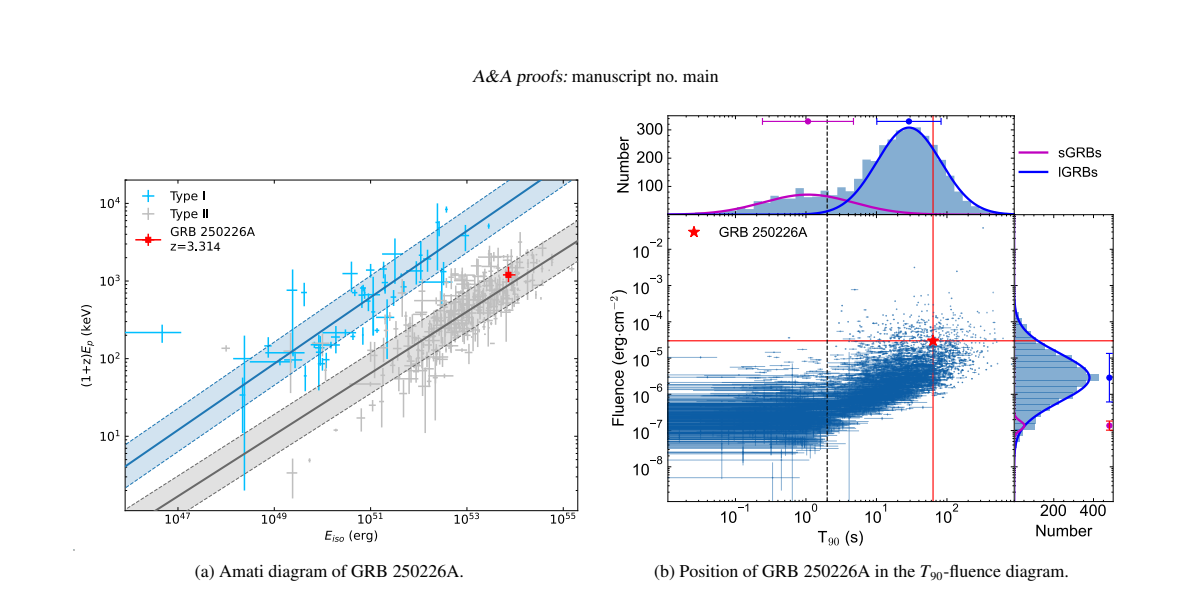
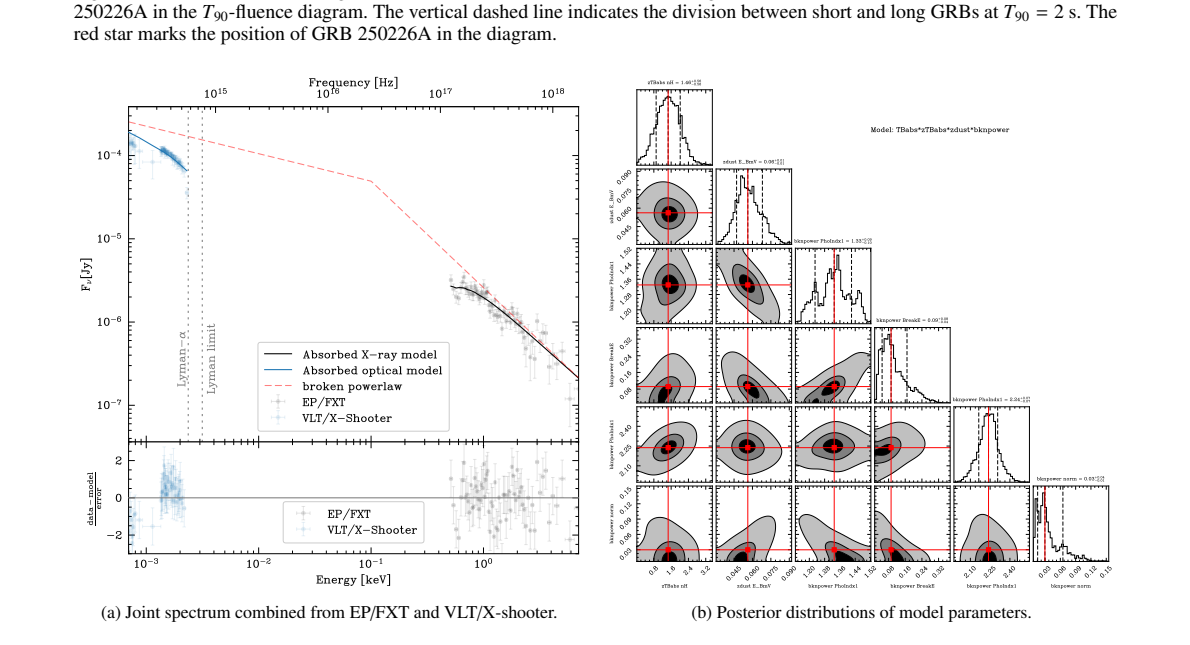
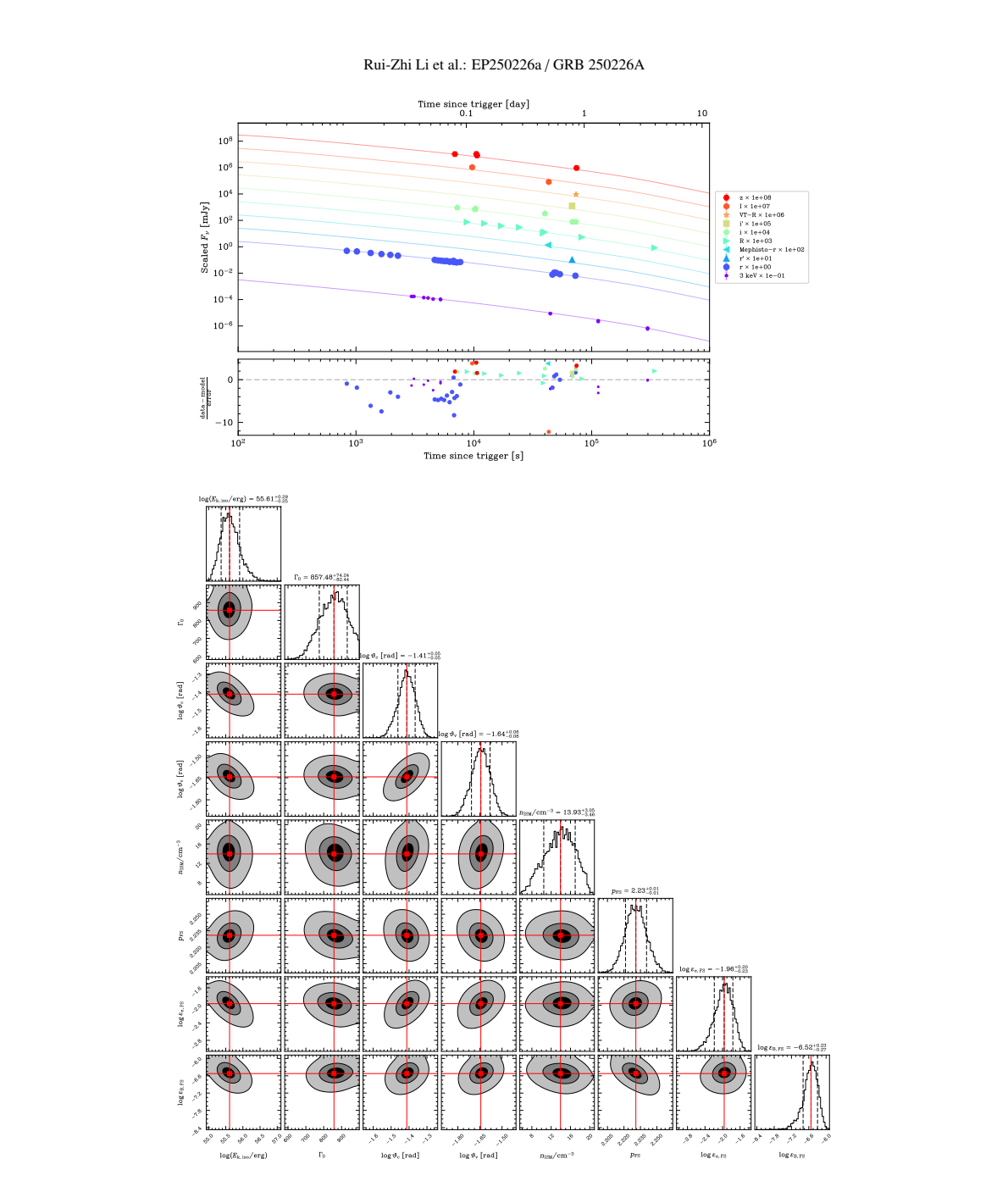
EP observations offer new opportunities to investigate the origins, emission mechanisms, and population properties of newly discovered fast X-ray transients. We present multiwavelength observations of EP250226a, an extragalactic fast X-ray transient associated with GRB 250226A. We jointly analyze the prompt emission from soft X-rays to gamma rays and the X-ray afterglow spectra. We collect optical photometric data, perform empirical and afterglow model-based analyses, and present optical-to-infrared spectroscopy, measuring the equivalent widths of absorption lines. The spectroscopic redshift is z = 3.314, and the isotropic-equivalent gamma-ray energy is Eiso ≃ 7.32 × 1053 erg. Its location in the Amati diagram is consistent with a massive-star core-collapse origin (Type II GRB). The fluence ratio $\rm{S}(25-50\,\rm{keV})/\rm{S}(50-100\,\rm{keV})=0.57\pm0.06$ supports its classification as a classical GRB. The X-ray and optical afterglows show achromatic behavior. Among the models considered, a top-hat jet propagating into a uniform interstellar medium best describes the multiwavelength afterglow. This model suggests a highly collimated, nearly on-axis jet, with an isotropic-equivalent kinetic energy of Ek,iso ≃ 4.07 × 1055 erg, a gamma-ray radiative efficiency of ηγ ≃ 1.77%, and a low magnetic-field energy fraction of logεB,FS ≃ −6.52. EP250226a exhibits typical long-duration GRB properties, with the first soft X-ray peak coinciding with the gamma-ray prompt emission, while the soft X-ray emission lasts significantly longer than the gamma-ray emission.
from the abstract
Pith says
Machine review · deepseek-v4-flash · 13 Nov 2026 · what was read was not recorded · not checked by a person
It can be wrong. Challenge this review or reply to it.
The passes disagreed. Reader: holds up. Skeptic: agrees with the reader. Referee: major revision.
Solid multiwavelength study of a new EP GRB, but the paper's claim of achromatic decay is not formally tested and the data show a ~3.6σ difference in optical vs. X-ray decay indices that should be discussed. This line is wrong
3 major objections · 5 minor
How often objections from reviews like this one are right: not yet measured
Not checked: figures, code, what the 192 references say.
The paper says, at §3.2
The review did not quote this passage.
Pith says: Objection 1 of 3 · major
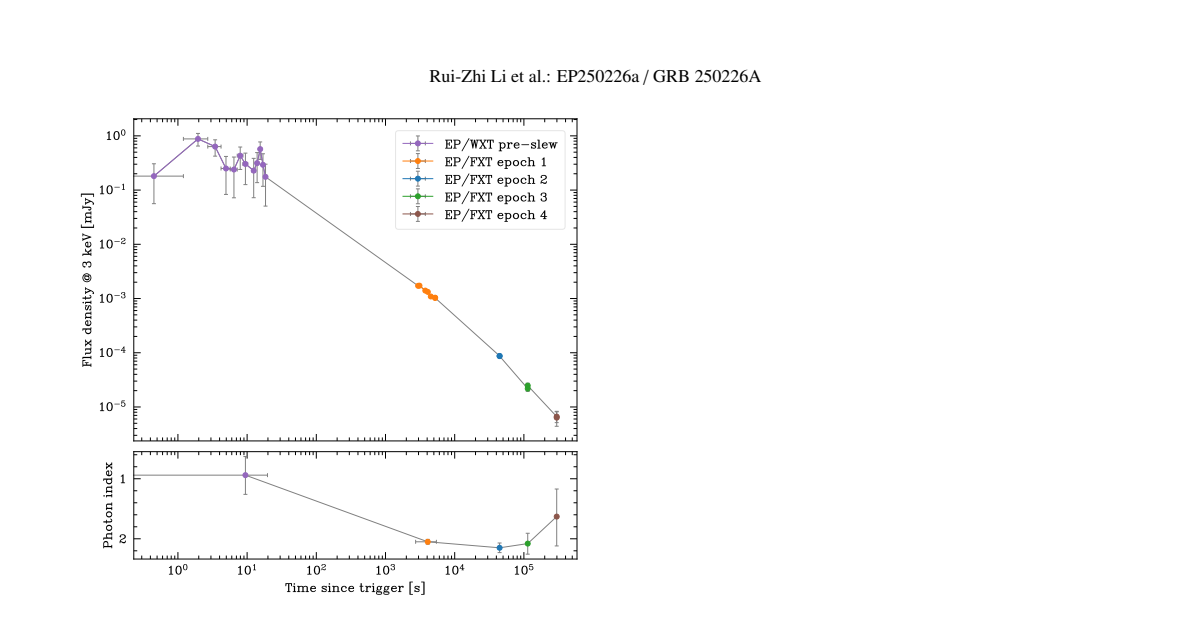
The claim of achromatic afterglow behavior is not adequately tested. The authors report independent temporal decay indices for the optical (α_o,obs = 1.02±0.02) and X-ray (α_x,obs = 1.12±0.02) bands. The difference ~0.10 has a quadrature error ~0.028, corresponding to about 3.6σ formal significance, casting doubt on the achromatic assumption.
more of objection 1
The joint fit yielding α_ox=1.01 does not test whether a single power law can simultaneously describe both bands; it enforces achromaticity. The paper then uses this achromaticity as a key justification for selecting a single-component forward-shock model. If the indices are genuinely different, the afterglow requires additional components (e.g., reverse shock, structured jet, or evolving microphysics), which would affect the inferred physical parameters (E_k,iso, θ_c, ε_B). The authors should perform a formal statistical test (e.g., F-test or Bayesian evidence comparison) of a shared decay index vs. independent indices, and discuss the implications if the data disfavor achromaticity. This point is load-bearing for the central afterglow interpretation.
The paper says, at §4.3, Eq. (3)/Table 2
The review did not quote this passage.
Pith says: Objection 2 of 3 · major
The Gaussian prior on Γ0 (centered at 500, σ=150) is derived from the Liang et al. (2010) empirical relation log Γ0 vs. log E_iso, using the E_iso measured from the same burst. This introduces mild circularity; the posterior on Γ0 is therefore partially informed by a relation that already involves the burst's own properties.
more of objection 2
While the authors acknowledge other degeneracies, they do not discuss how this prior choice influences the Bayesian evidence comparison between Posteriors 1–5. A sensitivity test using a flat prior on Γ0 over a wide range (e.g., [10,3000]) would clarify whether the inferred parameters in Posterior-5 are robust.
The paper says, at §4.3, Table 2
The review did not quote this passage.
Pith says: Objection 3 of 3 · major
The Bayesian evidence values (lnZ) for Posteriors 1–3 are nearly identical (-271.45, -271.72, -272.10), yet the derived parameters differ dramatically (e.g., n_ISM spans ~10^3.8 to ~10^4.96 cm^{-3}). This indicates strong degeneracies that are not broken by the current data. The statement that Posterior-5 is 'strongly preferred' over Posterior-4 (ΔlnZ ~14.6) is correct, but the comparison among Posteriors 1–3 and 5 is less straightforward because different prior widths affect lnZ.
more of objection 3
The authors should explicitly discuss that the data do not distinguish between very high n_ISM (with corresponding high Γ0) and the more moderate values adopted in Posterior-5, and that the uncertainty in the inferred jet energy and opening angle is accordingly large.
5 minor objections
The paper says, at §3.2
Pith says: minor objection 1 of 5
The sentence 'The temporal decay indices derived from the independent fits … consistently indicate a common decay behavior' is contradicted by the numbers given (α_o,obs and α_x,obs differ at ~3.6σ). This should be reworded to reflect the need for a formal test (see major comment).
The paper says, at §4.3, Table C.1
Pith says: minor objection 2 of 5
The label 'N(3,0.2)' in Table 2 for logθ_c and logθ_v priors is likely a formatting error; it should read 'Uniform prior U(-3,0.2)' as stated in the text.
show 3 more
The paper says, at §2.6
Pith says: minor objection 3 of 5
The redshift precision (z=3.3140±0.0001) seems unrealistically small given the line identification from Voigt fits. Please clarify whether this is the formal fitting uncertainty or includes systematic wavelength calibration errors.
The paper says, at Figure 7 caption
Pith says: minor objection 4 of 5
The caption says 'The light curves and posterior distributions are obtained using Posterior-5 from Table 2', but the posterior plot in Figure 7 seems to show marginal contours consistent with Posterior-5; this is fine, but consider adding a note that the optical data points have been scaled for visibility (as done).
The paper says, at Throughout
Pith says: minor objection 5 of 5
Some references (e.g., 'Y. Liu et al., in preparation' for WXTDAS) should be updated or marked as private communications if not yet published.
What would settle it
Perform a joint fit of the optical and X-ray flux densities (in mJy) with a model F_ν(t) = A_opt t^{-α} + A_X t^{-α} (shared α) and compare via likelihood-ratio test against the separate fits F_ν,opt = A_opt t^{-α_opt}, F_ν,X = A_X t^{-α_X}. If the joint fit is rejected at p<0.01 (Δχ²>6.63 for 1 additional degree of freedom), the achromatic claim is unsupported and the afterglow modeling must be revisited.
from the skeptic's reading
How the review went
4 readings by deepseek-v4-flash · 13 Nov 2026
- Reader holds up
- Skeptic disagrees
- Editor wrote the verdict above
- Referee major revision: 3 major objections, 5 minor
Not run on this paper: the simulated authors' defence.
Pith did not check this review's objections against the paper.
The review in full
The review in brief, machine-written
This is a thorough, well-observed paper on EP250226a, a classical long GRB at z=3.314. The dataset is genuinely rich — EP, Fermi, INTEGRAL, GECAM, extensive optical photometry, and a VLT/X-shooter spectrum. The spectral analysis is careful, with honest treatment of degeneracies (WXT bandpass, SAA contamination in GBM). The afterglow modeling explores multiple priors and selects a physically motivated solution. The classification as a Type II GRB via the Amati diagram and fluence ratios is clean.
The main soft spot is the achromaticity claim. The paper reports optical αo=1.02±0.02 and X-ray αx=1.12±0.02 from independent fits. The difference is ~0.10, about 3.6σ (if Gaussian). The authors then adopt a joint fit α_ox=1.01±0.02 and state “common decay behavior” without a formal test of whether a single power law can simultaneously describe both bands. If the indices are genuinely different, that breaks a key assumption for the top-hat ISM model selection. The paper should either quantify the statistical significance of the difference or provide a joint fit that allows a spectral break. This doesn't sink the paper, but it needs addressing.
Other minor concerns: (i) The Liang et al. relation used to set the Gamma0 prior involves E_iso from the same burst — mild circularity, but the authors note it and the central parameters don't pivot on it. (ii) The final posterior (Posterior-5) adopts Gaussian priors on Gamma0 and n_ISM; the inferred low ϵB (~−6.5) is model-dependent and not surprising, but it's clearly flagged.
Overall this is a competent addition to the growing sample of EP-discovered GRBs. The paper will be useful for GRB afterglow modelers and anyone interested in the Einstein Probe's capabilities. It deserves serious peer review, though the achromaticity issue should be tightened.
The strongest objection
In §3.2, the authors report optical decay index α_o,obs = 1.02±0.02 and X-ray decay index α_x,obs = 1.12±0.02 from independent power-law fits. The difference is 0.10, which is 5 times the quadrature sum of the 1σ errors (~0.028), i.e., ~3.6σ if errors are Gaussian. The authors then adopt a joint fit (α_ox = 1.01±0.02) and claim 'common decay behavior' without a formal test of whether a single power law can simultaneously describe both bands. If the indices are genuinely different, the light curves are not achromatic, breaking a key assumption used to select a uniform-ISM forward-shock model. The afterglow modeling in §4.3 assumes achromaticity and treats the optical and X-ray data with a single set of physical parameters. A color-dependent decay would require additional components (e.g., reverse shock, evolving microphysics, or a structured jet), which would substantially alter the inferred jet parameters (E_k,iso, θ_c, ε_B). The paper does not discuss this discrepancy or test its statistical significance.
The reader's weakest assumption focuses on model-dependent parameter degeneracies, which are openly discussed. My concern is more fundamental: the data themselves may not support the underlying assumption of achromatic decay. If the optical and X-ray light curves have different slopes, the standard forward-shock model with a single injection/evolution would be disfavored, and the derived energy, opening angle, and microphysical parameters become unreliable. This is a concrete, testable point that the reader did not flag. However, the paper's central claim (EP250226a is a classical long GRB) relies on prompt emission properties and spectral classification, which are less affected. Therefore the verdict need not change, but the afterglow interpretation should be considered conditional on resolving this discrepancy.
The referee's report
If the results hold, this work provides a well-characterized example of an EP-detected fast X-ray transient firmly linked to the classical long GRB population, demonstrating the new discovery space opened by the Einstein Probe. The comprehensive multiwavelength dataset and careful modeling offer constraints on jet geometry and microphysics for a burst at z~3. The low ε_B value and the comparison with the Amati and T90-fluence diagrams add to the growing sample of high-redshift GRBs. The paper is a useful contribution to GRB afterglow studies.
Pith's reading of the paper (a machine's summary, not the authors')
The paper establishes that the fast X-ray transient EP250226a is a classical long-duration gamma-ray burst (GRB) at a redshift of $z=3.314$, with an isotropic-equivalent gamma-ray energy of $7.32\times10^{53}$ erg. The transient's location in the Amati diagram and its fluence ratio support a massive star core-collapse origin (Type II GRB). Multi-wavelength afterglow data from X-ray to optical bands are well described by a top-hat jet propagating into a uniform interstellar medium, implying a highly collimated, nearly on-axis relativistic jet. The derived parameters include a low magnetic energy fraction ($\log\epsilon_{B,\text{FS}} \simeq -6.52$) and a low gamma-ray radiative efficiency ($\eta_\gamma\simeq 1.77\%$), indicating that most of the jet energy remains kinetic. The soft X-ray emission lasts significantly longer than the gamma-ray emission, a trait common among Einstein Probe-detected GRBs.
What carries the argument. The central modeling framework is the forward shock synchrotron emission from a top-hat jet expanding into a uniform ISM, implemented with the VEGAS-Afterglow code and sampled via Bayesian inference (Bilby and PyMultiNest). This machinery translates observed light curves and spectra into physical parameters: isotropic-equivalent kinetic energy, initial Lorentz factor, jet opening angle, viewing angle, ISM density, electron power-law index, and energy fractions in electrons and magnetic fields.
Core claim. The paper demonstrates that EP250226a (GRB 250226A) is a classical long-duration GRB (Type II) based on its spectroscopic redshift, Amati correlation, fluence ratio, and achromatic afterglow evolution. Using Bayesian inference applied to multiband data, the afterglow is best fitted by a forward shock from a top-hat jet in a uniform interstellar medium (ISM), yielding a highly collimated, nearly on-axis geometry. The best-fit model gives an isotropic-equivalent kinetic energy of $E_{\text{k,iso}}\simeq 4.07\times10^{55}$ erg, a jet half-opening angle of $\theta_c \sim 2^\circ$, and a viewing angle $\theta_v \sim 1.3^\circ$. The inferred low magnetic energy fraction ($\epsilon_{B,\text{FS}} \sim 3\times10^{-7}$) suggests the post-shock magnetic field is dominated by shock compression of the pre-existing ISM seed field.
The premise it rests on. The afterglow modeling assumes a top-hat jet profile and a uniform interstellar medium, together with efficient electron acceleration (χ=1); alternative geometries or a wind-like medium are tested but only the ISM top-hat fits the available data, yet the jet opening angle is weakly constrained because no jet break is observed.
If the paper is right (Pith's inferences, not the authors')
The event adds a well-measured data point to the Type II GRB population, consistent with the Amati relation and the empirical $E_{\text{iso}}$–$\Gamma_0$ correlation.
The low $\epsilon_{B,\text{FS}}$ implies that magnetic field amplification in the forward shock is inefficient in this burst, possibly requiring a seed-field origin rather than turbulent amplification.
The nearly on-axis, highly collimated jet geometry suggests a true gamma-ray energy of $E_\gamma \sim 5.5\times10^{50}$ erg, consistent with the canonical energy reservoir of long GRBs.
The multi-wavelength afterglow's achromatic decay with $\alpha \sim 1$ and the presence of a cooling break between optical and X-rays confirm the standard forward-shock model in an ISM environment.
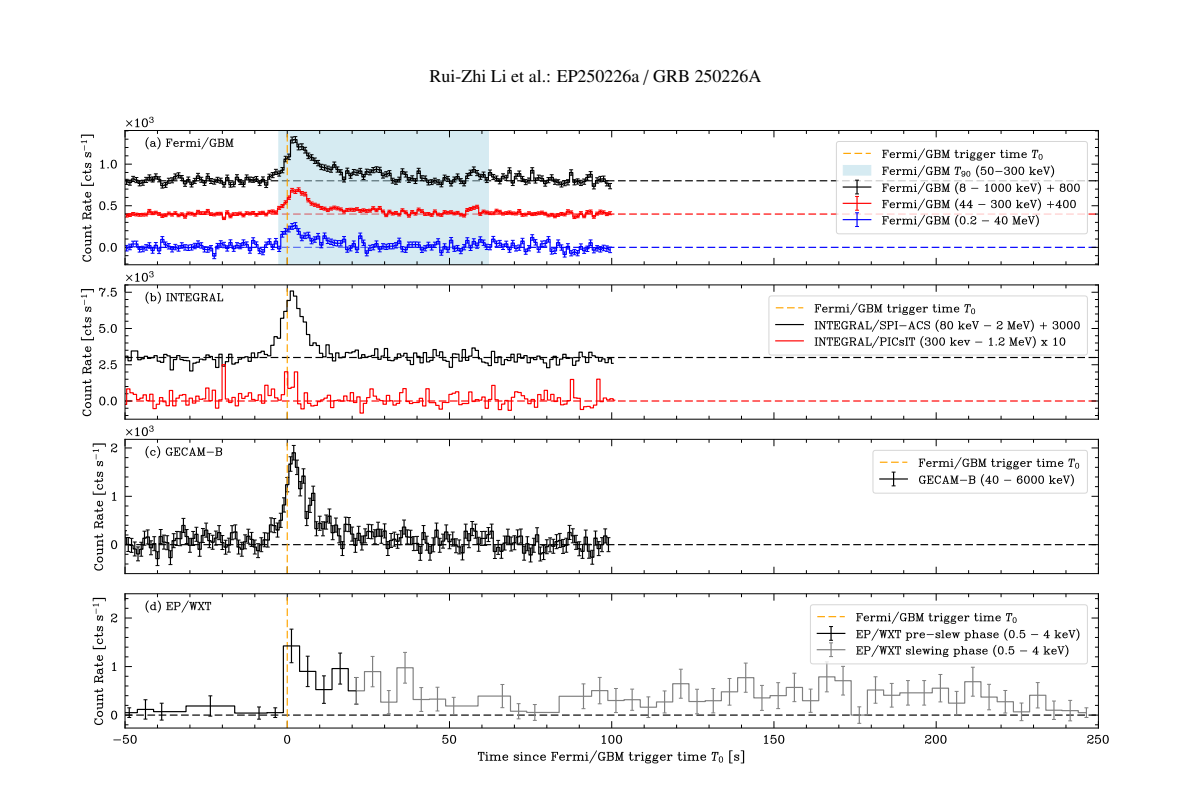
The temporal extension of soft X-ray emission beyond the gamma-ray episode (250 s vs 61 s) supports the idea that the central engine or external shock continues to produce soft X-rays after prompt emission ceases.
If the low $\epsilon_{B,\text{FS}}$ is common among Epstein-Probe-detected transients, it may challenge models that rely on strong magnetic field amplification for synchrotron emission; future X-ray polarization observations could test this.
The fact that no jet break is seen in the first few days implies a relatively wide jet or a very low ambient density; future late-time observations could break this degeneracy.
The simultaneous detection by EP (soft X-ray) and traditional gamma-ray instruments suggests that many EP fast X-ray transients may be hidden GRBs; this could double the known rate of high-redshift GRBs.
The extended soft X-ray emission may arise from late-time central engine activity rather than afterglow; distinguishing these scenarios requires very early X-ray monitoring beyond the first 250 seconds.
Check this review
Pith stored no record of this review's passes and took no fingerprint of it. Reviews made by code from 13 Nov 2026 on carry both.
How often reviews like this one are right
Reviews like this one: written by deepseek-v4-flash, where what was read was not recorded.
How often objections from reviews like this one are right: not yet measured
Reviews by people
This review was written by a machine. No person has reviewed this paper on Pith yet. A scientist listed on Pith can review it for a fee, and their review is published here whatever it concludes.
The paper
Abstract
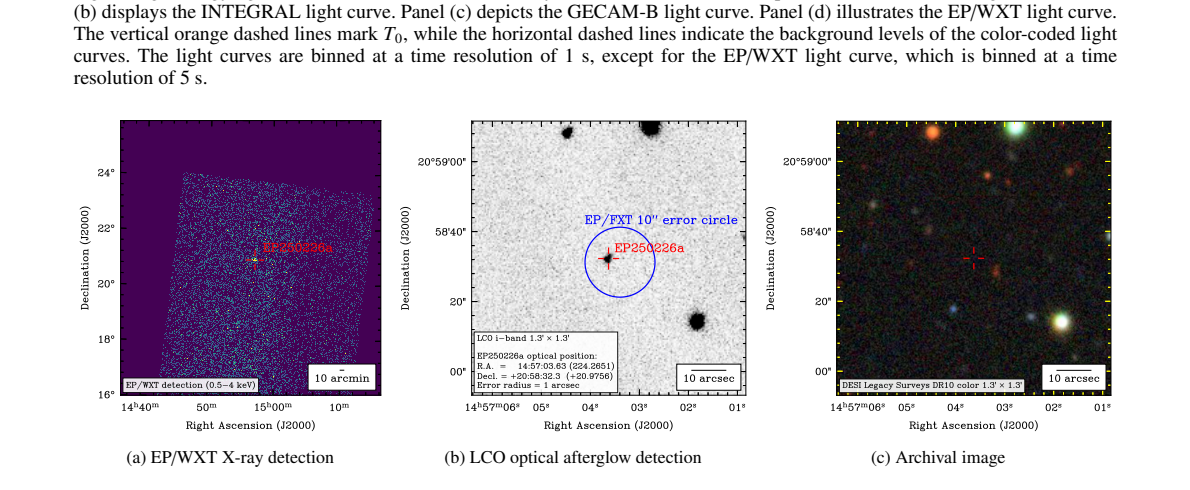
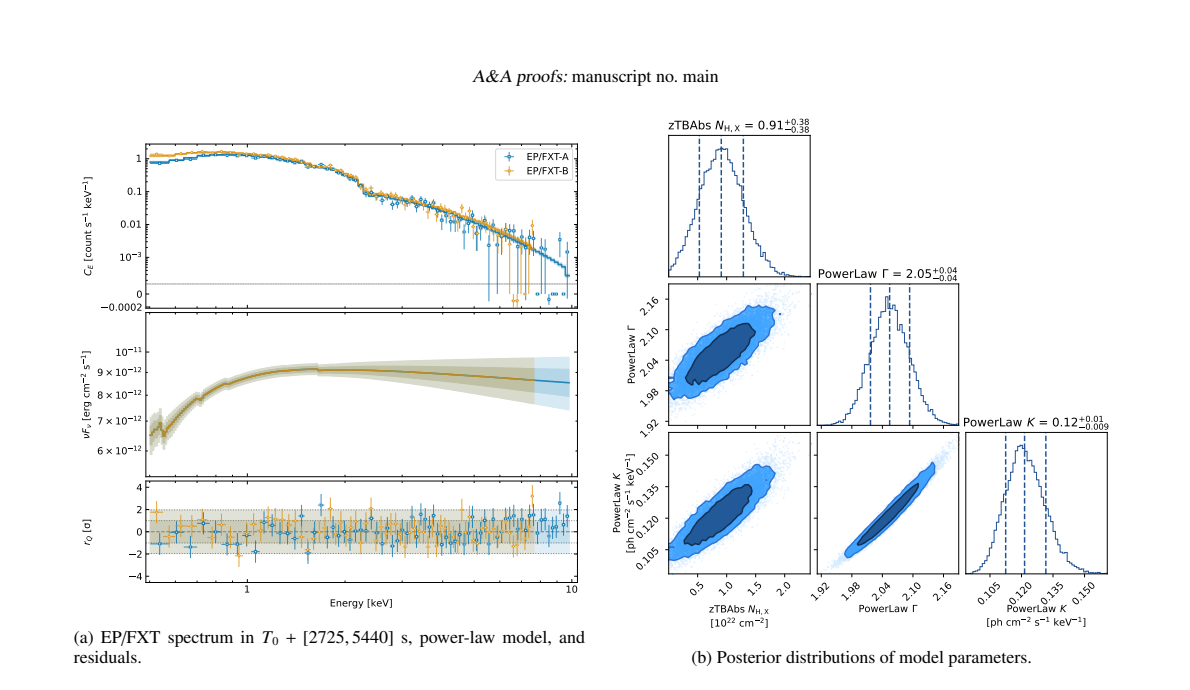
Recent advances in fast X-ray transient studies have been driven by the wide-field, sensitive soft X-ray monitoring capabilities of the Einstein Probe (EP), enabling the prompt detection and localization of previously underexplored events. EP observations offer new opportunities to investigate the origins, emission mechanisms, and population properties of newly discovered fast X-ray transients. We present multiwavelength observations of EP250226a, an extragalactic fast X-ray transient associated with GRB 250226A. We jointly analyze the prompt emission from soft X-rays to gamma rays and the X-ray afterglow spectra. We collect optical photometric data, perform empirical and afterglow model-based analyses, and present optical-to-infrared spectroscopy, measuring the equivalent widths of absorption lines. The spectroscopic redshift is z = 3.314, and the isotropic-equivalent gamma-ray energy is Eiso ≃ 7.32 × 1053 erg. Its location in the Amati diagram is consistent with a massive-star core-collapse origin (Type II GRB). The fluence ratio $\rm{S}(25-50\,\rm{keV})/\rm{S}(50-100\,\rm{keV})=0.57\pm0.06$ supports its classification as a classical GRB. The X-ray and optical afterglows show achromatic behavior. Among the models considered, a top-hat jet propagating into a uniform interstellar medium best describes the multiwavelength afterglow. This model suggests a highly collimated, nearly on-axis jet, with an isotropic-equivalent kinetic energy of Ek,iso ≃ 4.07 × 1055 erg, a gamma-ray radiative efficiency of ηγ ≃ 1.77%, and a low magnetic-field energy fraction of logεB,FS ≃ −6.52. EP250226a exhibits typical long-duration GRB properties, with the first soft X-ray peak coinciding with the gamma-ray prompt emission, while the soft X-ray emission lasts significantly longer than the gamma-ray emission.
The paper's own sentences, arranged, kept beside the review and separate from it. Each label is drawn from a closed vocabulary; the number beside it is the probability the classifier gave that label. No sentence in this record was written by a model.
abstract compiled · 2026-11-13
The authors' main claim, as the classifier picked it out 0.67
“EP250226a exhibits typical long-duration GRB properties, with the first soft X-ray peak coinciding with the gamma-ray prompt emission, while the soft X-ray emission lasts significantly longer than the gamma-ray emission.”
How the main claim is stated: asserted 1.00
What the abstract itself states, as probabilities: claims first 0.04 · states limitation 0.06 · human participants 0.02 · controlled comparison 0.03 · randomized assignment 0.01 · states quantitative result 0.99 · compares with prior results 0.27 · mentions code or data availability 0.02
The abstract, sentence by sentence
This table labels the abstract only (arXiv listing abstract v1). The number is the probability the classifier gave the label.
| Sentence | Role | The authors' own work | States the main conclusion | Strength |
|---|---|---|---|---|
| Recent advances in fast X-ray transient studies have been driven by the wide-field, sensitive soft X-ray monitoring capabilities of the Einstein Probe (EP), enabling the prompt detection and localization of previously underexplored events. | background 1.00 | 0.06 | 0.03 | asserted 1.00 |
| EP observations offer new opportunities to investigate the origins, emission mechanisms, and population properties of newly discovered fast X-ray transients. | background 1.00 | 0.07 | 0.03 | asserted 0.57 |
| We present multiwavelength observations of EP250226a, an extragalactic fast X-ray transient associated with GRB 250226A. | contribution 1.00 | 0.88 | 0.09 | asserted 1.00 |
| We jointly analyze the prompt emission from soft X-rays to gamma rays and the X-ray afterglow spectra. | method 0.71 | 0.96 | 0.04 | asserted 0.93 |
| We collect optical photometric data, perform empirical and afterglow model-based analyses, and present optical-to-infrared spectroscopy, measuring the equivalent widths of absorption lines. | method 0.91 | 0.97 | 0.03 | asserted 1.00 |
| The spectroscopic redshift is $z = 3.314$, and the isotropic-equivalent gamma-ray energy is $E_\mathrm{iso}\simeq7.32\times10^{53}$ erg. | result 1.00 | 0.92 | 0.09 | asserted 1.00 |
| Its location in the Amati diagram is consistent with a massive-star core-collapse origin (Type II GRB). | interpretation 0.90 | 0.82 | 0.13 | hedged possibility 0.99 |
| The fluence ratio $\rm{S}(25-50\,\rm{keV})/\rm{S}(50-100\,\rm{keV})=0.57\pm0.06$ supports its classification as a classical GRB. | result 0.59 | 0.87 | 0.06 | asserted 0.94 |
| The X-ray and optical afterglows show achromatic behavior. | result 1.00 | 0.92 | 0.07 | asserted 1.00 |
| Among the models considered, a top-hat jet propagating into a uniform interstellar medium best describes the multiwavelength afterglow. | result 0.75 | 0.91 | 0.37 | asserted 0.93 |
| This model suggests a highly collimated, nearly on-axis jet, with an isotropic-equivalent kinetic energy of $E_\mathrm{k,iso}\simeq4.07\times10^{55}$ erg, a gamma-ray radiative efficiency of $\eta_{\gamma}\simeq 1.77\%$, and a low magnetic-field energy fraction of $\log \epsilon_\mathrm{B,FS} \simeq -6.52$. | result 0.77 | 0.89 | 0.23 | hedged possibility 0.98 |
| EP250226a exhibits typical long-duration GRB properties, with the first soft X-ray peak coinciding with the gamma-ray prompt emission, while the soft X-ray emission lasts significantly longer than the gamma-ray emission. | result 0.77 | 0.92 | 0.22 | asserted 1.00 |
What kind of paper the classifier reports this is: empirical study 1.00 · evidence from observation or experiment 0.94
What was examined, and what was not
Sources read
- arXiv listing abstract v1
Not examined
- full text
- figures and tables
- references and citing sentences
- relations to other papers
Levels run
- P abstract
Not run
- S sections
- T body sentences
- C citations
- R cross-paper relations
How the labels were made
Compiled by classifier-1.13.0 via TypeSafe API, question bank abstract-p1-20260923, 2026-11-13: 1 request, 9,357 input tokens.
Every quoted sentence on this record is the authors'. Every label is from Pith's closed vocabulary, with the probability shown beside it. This record as JSON
Figures (7)
Figures are the authors', reproduced from the paper.
References (192)
- [1] Cox, A. N.,& Stewart, J. N. 1969, on Pith
- [2] Tscharnuter W. M. 1987, on Pith
- [3] Terlevich, R. 1992, in ASP Conf. Ser. 31, on Pith
- [4] Zheng, W., Davidsen, A. F., Tytler, D. & Kriss, G. A on Pith
- [5] Handbook of X-ray and Gamma-ray Astrophysics , doi = on Pith
- [6] Science China Physics, Mechanics, and Astronomy , keywords =. doi:10.1007/s11433-024-2600-3 , eid = on Pithdoi:10.1007/s11433-024-2600-3
- [7] doi:10.1007/s41605-025-00526-8 , journal = on Pithdoi:10.1007/s41605-025-00526-8
- [8] , keywords =. doi:10.1016/S0370-1573(98)00127-6 , eprint = on Pithdoi:10.1016/s0370-1573(98)00127-6
- [9] Research in Astronomy and Astrophysics , keywords =. doi:10.1088/1674-4527/ae75cd , eid = on Pithdoi:10.1088/1674-4527/ae75cd
- [10] doi:10.1093/mnras/staf2021 , eid =. arXiv , author =:2508.13039 , journal = on PitharXiv
- [11] Society of Photo-Optical Instrumentation Engineers (SPIE) Conference Series , doi = on Pith
- [12] doi:10.48550/arXiv.2411.16470 , eid =. arXiv , author =:2411.16470 , journal = on PithPith's reviewarXivdoi:10.48550/arxiv.2411.16470
- [13] Instrumentation in astronomy VI , doi = on Pith
- [14] doi:10.1086/172359 , journal = on Pithdoi:10.1086/172359
- [15] doi:10.1086/172995 , journal = on Pithdoi:10.1086/172995
- [16] Astronomical Data Analysis Software and Systems II , editor = on Pith
- [17] doi:10.1086/174178 , journal = on Pithdoi:10.1086/174178
- [18] , keywords =. doi:10.1086/187446 , eprint = on Pithdoi:10.1086/187446
- [19] Astronomical Data Analysis Software and Systems V , editor = on Pith
- [20] , keywords =. doi:10.1086/303625 , eprint = on Pithdoi:10.1086/303625
show 80 more
- [21] , keywords =. doi:10.1093/mnras/287.1.110 , eprint = on Pithdoi:10.1093/mnras/287.1.110
- [22] , keywords =. doi:10.1086/311269 , eprint = on Pithdoi:10.1086/311269
- [23] ascl , author =:9910.005 , howpublished = on Pith
- [24] , keywords =. doi:10.1086/317090 , eprint = on Pithdoi:10.1086/317090
- [25] , keywords =. doi:10.1086/338119 , eprint = on Pithdoi:10.1086/338119
- [26] Gamma-ray Bursts in the Afterglow Era , doi = on Pith
- [27] , keywords =. doi:10.1086/342175 , eprint = on Pithdoi:10.1086/342175
- [28] doi:10.1103/RevModPhys.74.1015 , journal = on Pithdoi:10.1103/revmodphys.74.1015
- [29] doi:10.1051/0004-6361:20031482 , journal = on Pithdoi:10.1051/0004-6361:20031482
- [30] doi:10.1051/0004-6361:20031224 , journal = on Pithdoi:10.1051/0004-6361:20031224
- [31] , keywords =. doi:10.1086/375193 , eprint = on Pithdoi:10.1086/375193
- [32] , keywords =. doi:10.1086/375341 , eprint = on Pithdoi:10.1086/375341
- [33] , keywords =. doi:10.1086/377125 , eprint = on Pithdoi:10.1086/377125
- [34] , keywords =. doi:10.1086/422091 , eprint = on Pithdoi:10.1086/422091
- [35] , keywords =. doi:10.1086/423026 , eprint = on Pithdoi:10.1086/423026
- [36] doi:10.1016/j.nuclphysbps.2004.04.047 , journal = on Pithdoi:10.1016/j.nuclphysbps.2004.04.047
- [37] Reviews of Modern Physics , keywords =. doi:10.1103/RevModPhys.76.1143 , eprint = on Pithdoi:10.1103/revmodphys.76.1143
- [38] X-Ray and Gamma-Ray Instrumentation for Astronomy XIII , doi = on Pith
- [39] , keywords =. doi:10.1086/426938 , eprint = on Pithdoi:10.1086/426938
- [40] doi:10.1086/431235 , journal = on Pithdoi:10.1086/431235
- [41] doi:10.1103/PhysRevLett.94.111102 , eid =. arXiv , author =:astro-ph/0408489 , journal = on PithPith's reviewarXiv
- [42] , keywords =. doi:10.1007/s11214-005-5096-3 , eprint = on PithPith's reviewdoi:10.1007/s11214-005-5096-3
- [43] , keywords =. doi:10.1051/0004-6361:20066405 , eprint = on PithPith's reviewdoi:10.1051/0004-6361:20066405
- [44] , keywords =. doi:10.1086/500723 , eprint = on Pithdoi:10.1086/500723
- [45] , keywords =. doi:10.1111/j.1365-2966.2006.10840.x , eprint = on Pithdoi:10.1111/j.1365-2966.2006.10840.x
- [46] , keywords =. doi:10.1038/nature04787 , eprint = on Pithdoi:10.1038/nature04787
- [47] , keywords =. doi:10.1086/518023 , eprint = on Pithdoi:10.1086/518023
- [48] , keywords =. doi:10.1088/1009-9271/7/1/01 , eprint = on Pithdoi:10.1088/1009-9271/7/1/01
- [49] doi:10.1109/MCSE.2007.55 , journal = on Pithdoi:10.1109/mcse.2007.55
- [50] , keywords =. doi:10.1086/586884 , eprint = on Pithdoi:10.1086/586884
- [51] , keywords =. doi:10.1111/j.1365-2966.2007.12353.x , eprint = on Pithdoi:10.1111/j.1365-2966.2007.12353.x
- [52] , keywords =. doi:10.1088/0004-637X/702/1/791 , eprint = on Pithdoi:10.1088/0004-637x/702/1/791
- [53] , keywords =. doi:10.1088/0067-0049/185/2/526 , eprint = on PithPith's reviewdoi:10.1088/0067-0049/185/2/526
- [54] , keywords =. doi:10.1146/annurev.astro.46.060407.145147 , eprint = on Pithdoi:10.1146/annurev.astro.46.060407.145147
- [55] , keywords =. doi:10.1111/j.1365-2966.2009.14548.x , eprint = on PithPith's reviewdoi:10.1111/j.1365-2966.2009.14548.x
- [56] , keywords =. doi:10.1111/j.1745-3933.2009.00766.x , eprint = on Pithdoi:10.1111/j.1745-3933.2009.00766.x
- [57] , keywords =. doi:10.1088/0004-6256/139/5/1782 , eprint = on Pithdoi:10.1088/0004-6256/139/5/1782
- [58] , keywords =. doi:10.1088/0004-637X/711/2/641 , eprint = on Pithdoi:10.1088/0004-637x/711/2/641
- [59] , keywords =. doi:10.1088/2041-8205/716/2/L135 , eprint = on Pithdoi:10.1088/2041-8205/716/2/l135
- [60] , keywords =. doi:10.1088/0004-637X/720/2/1513 , eprint = on Pithdoi:10.1088/0004-637x/720/2/1513
- [61] , keywords =. doi:10.1088/0004-637X/725/2/2209 , eprint = on Pithdoi:10.1088/0004-637x/725/2/2209
- [62] doi:10.48550/arXiv.1004.2316 , eid =. arXiv , author =:1004.2316 , journal = on PithPith's reviewarXivdoi:10.48550/arxiv.1004.2316
- [63] ascl , author =:1010.068 , howpublished = on Pith
- [64] Compact Stellar X-ray Sources , editor = on Pith
- [65] , keywords =. doi:10.1111/j.1365-2966.2009.16006.x , eprint = on Pithdoi:10.1111/j.1365-2966.2009.16006.x
- [66] , keywords =. doi:10.1111/j.1365-2966.2010.17274.x , eprint = on Pithdoi:10.1111/j.1365-2966.2010.17274.x
- [67] doi:10.1051/0004-6361/201117752 , eid =. arXiv , author =:1110.1944 , journal = on PithPith's reviewarXiv
- [68] doi:10.1088/0004-637X/734/2/96 , eid =. arXiv , author =:0804.1959 , journal = on PithPith's reviewarXiv
- [69] doi:10.1088/0004-637X/737/2/103 , eid =. arXiv , author =:1012.4804 , journal = on PithPith's reviewarXiv
- [70] doi:10.1051/0004-6361/201219894 , eid =. arXiv , author =:1209.0891 , journal = on PithPith's reviewarXiv
- [71] , keywords =. doi:10.1111/j.1365-2966.2012.20428.x , eprint = on Pithdoi:10.1111/j.1365-2966.2012.20428.x
- [72] doi:10.1051/0004-6361/201322068 , eid =. arXiv , author =:1307.6212 , journal = on PithPith's reviewarXiv
- [73] doi:10.1051/0004-6361/201322494 , eid =. arXiv , author =:1311.5411 , journal = on PithPith's reviewarXiv
- [74] doi:10.1088/0004-637X/764/2/167 , eid =. arXiv , author =:1207.5578 , journal = on PithPith's reviewarXiv
- [75] doi:10.1088/0004-637X/779/1/14 , eid =. arXiv , author =:1310.7238 , journal = on PithPith's reviewarXiv
- [76] , keywords =. doi:10.1093/mnras/stt175 , eprint = on Pithdoi:10.1093/mnras/stt175
- [77] , keywords =. doi:10.1016/j.newar.2013.10.001 , eprint = on Pithdoi:10.1016/j.newar.2013.10.001
- [78] doi:10.1051/0004-6361/201322971 , eid =. arXiv , author =:1402.0004 , journal = on PithPith's reviewarXiv
- [79] doi:10.1051/0004-6361/201321591 , eid =. arXiv , author =:1303.5076 , journal = on PithPith's reviewarXiv
- [80] doi:10.1088/0004-637X/785/1/29 , eid =. arXiv , author =:1309.3277 , journal = on PithPith's reviewarXiv
- [81] Space Telescopes and Instrumentation 2014: Ultraviolet to Gamma Ray , doi =. arXiv , author =:1406.7759 , keywords = on PithPith's reviewarXiv
- [82] doi:10.1088/0004-637X/804/2/105 , eid =. arXiv , author =:1503.07449 , journal = on PithPith's reviewarXiv
- [83] doi:10.1088/0067-0049/219/1/9 , eid =. arXiv , author =:1503.03193 , journal = on PithPith's reviewarXiv
- [84] doi:10.48550/arXiv.1506.07735 , eid =. arXiv , author =:1506.07735 , journal = on PithPith's reviewarXivdoi:10.48550/arxiv.1506.07735
- [85] doi:10.48550/arXiv.1507.04544 , eid =. arXiv , author =:1507.04544 , journal = on PithPith's reviewarXivdoi:10.48550/arxiv.1507.04544
- [86] , keywords =. doi:10.1016/j.physrep.2014.09.008 , eprint = on PithPith's reviewdoi:10.1016/j.physrep.2014.09.008
- [87] doi:10.3847/0004-637X/816/1/20 , eid =. arXiv , author =:1511.01206 , journal = on PithPith's reviewarXiv
- [88] doi:10.3847/0004-637X/818/2/190 , eid =. arXiv , author =:1601.01264 , journal = on PithPith's reviewarXiv
- [89] doi:10.48550/arXiv.1610.06892 , eid =. arXiv , author =:1610.06892 , journal = on PithPith's reviewarXivdoi:10.48550/arxiv.1610.06892
- [90] doi:10.48550/arXiv.1612.05560 , eid =. arXiv , author =:1612.05560 , journal = on PithPith's reviewarXivdoi:10.48550/arxiv.1612.05560
- [91] , keywords =. doi:10.1093/pasj/psw016 , eid = on Pithdoi:10.1093/pasj/psw016
- [92] , keywords =. doi:10.1093/mnras/stx417 , eprint = on Pithdoi:10.1093/mnras/stx417
- [93] American Astronomical Society Meeting Abstracts \#231 , eid = on Pith
- [94] doi:10.3847/1538-3881/aabc4f , eid =. arXiv , author =:1801.02634 , journal = on PithPith's reviewarXiv
- [95] doi:10.3847/1538-4357/aadcf8 , eid =. arXiv , author =:1810.03079 , journal = on PithPith's reviewarXiv
- [96] doi:10.3847/1538-4357/aadba8 , eid =. arXiv , author =:1802.07730 , journal = on PithPith's reviewarXiv
- [97] doi:10.3847/1538-4365/aabaf3 , eid =. arXiv , author =:1712.09390 , journal = on PithPith's reviewarXiv
- [98] doi:10.48550/arXiv.1803.01187 , eid =. arXiv , author =:1803.01187 , journal = on PithPith's reviewarXivdoi:10.48550/arxiv.1803.01187
- [99] , keywords =. doi:10.1093/mnras/sty1380 , eprint = on Pithdoi:10.1093/mnras/sty1380
- [100] doi:10.1017/9781139226530 , title = on Pithdoi:10.1017/9781139226530
The first 100 of 192 references are listed here. All of them are in this paper's citation record.
Challenges and discussion
Disagree with the review, or know something it missed? Leave a comment, or challenge this review formally: a challenge becomes a permanent entry in this paper's record, and its decision is published here.
Come back by email
A short list of the week's newly reviewed papers. Nothing is sent until you confirm from your inbox, and every email has a link that stops it. No account.
No comments yet.
Sign in to comment