Computation and Language · arXiv:2611.20693 v1 · submitted 16 Nov 2026 · 76 references
Fast at the Frontier, Wrong at the Fallback: A Commit-Level Analysis of Threshold Decoding in Diffusion Language Models
The paper says
“Diffusion language models (DLMs) can write several tokens per forward pass. Open-weight DLMs commit, in any order, every masked position whose confidence passes a threshold.”
more of the abstract
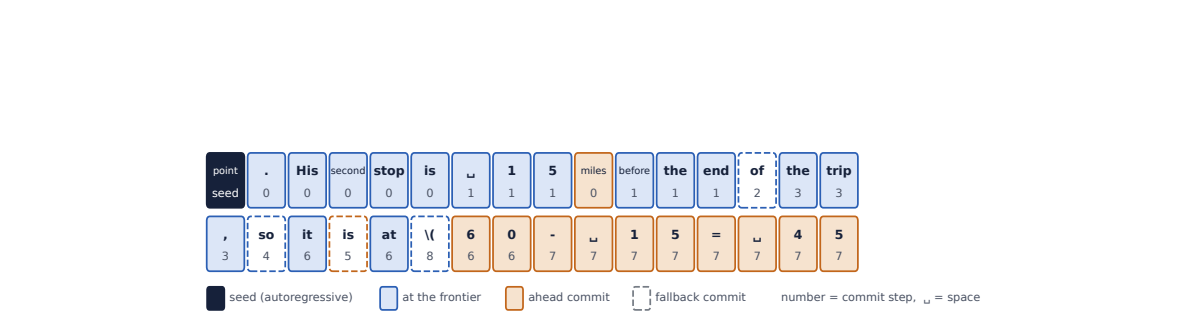
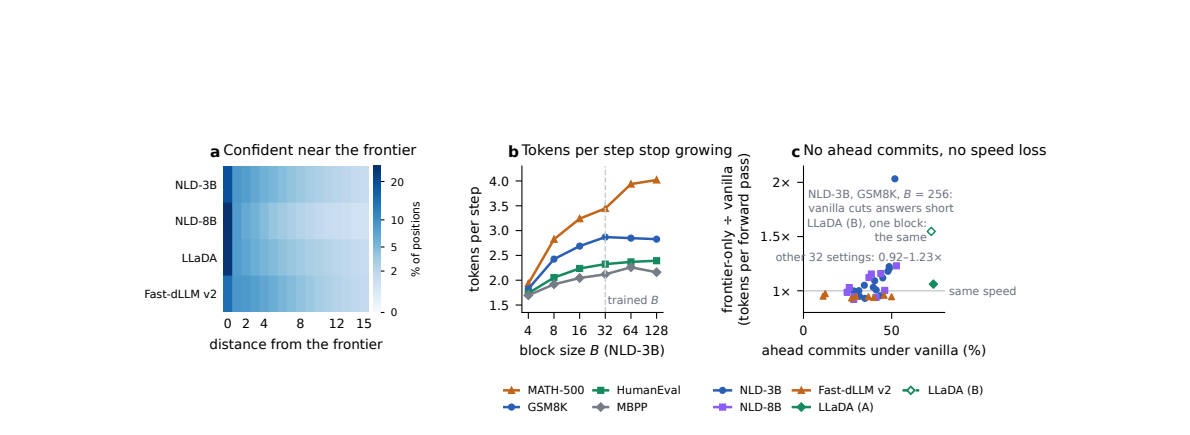
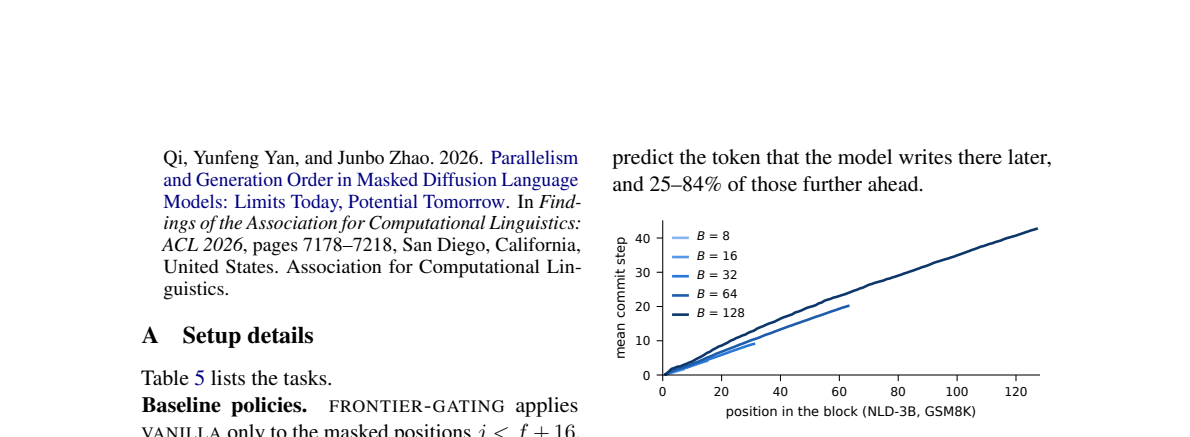
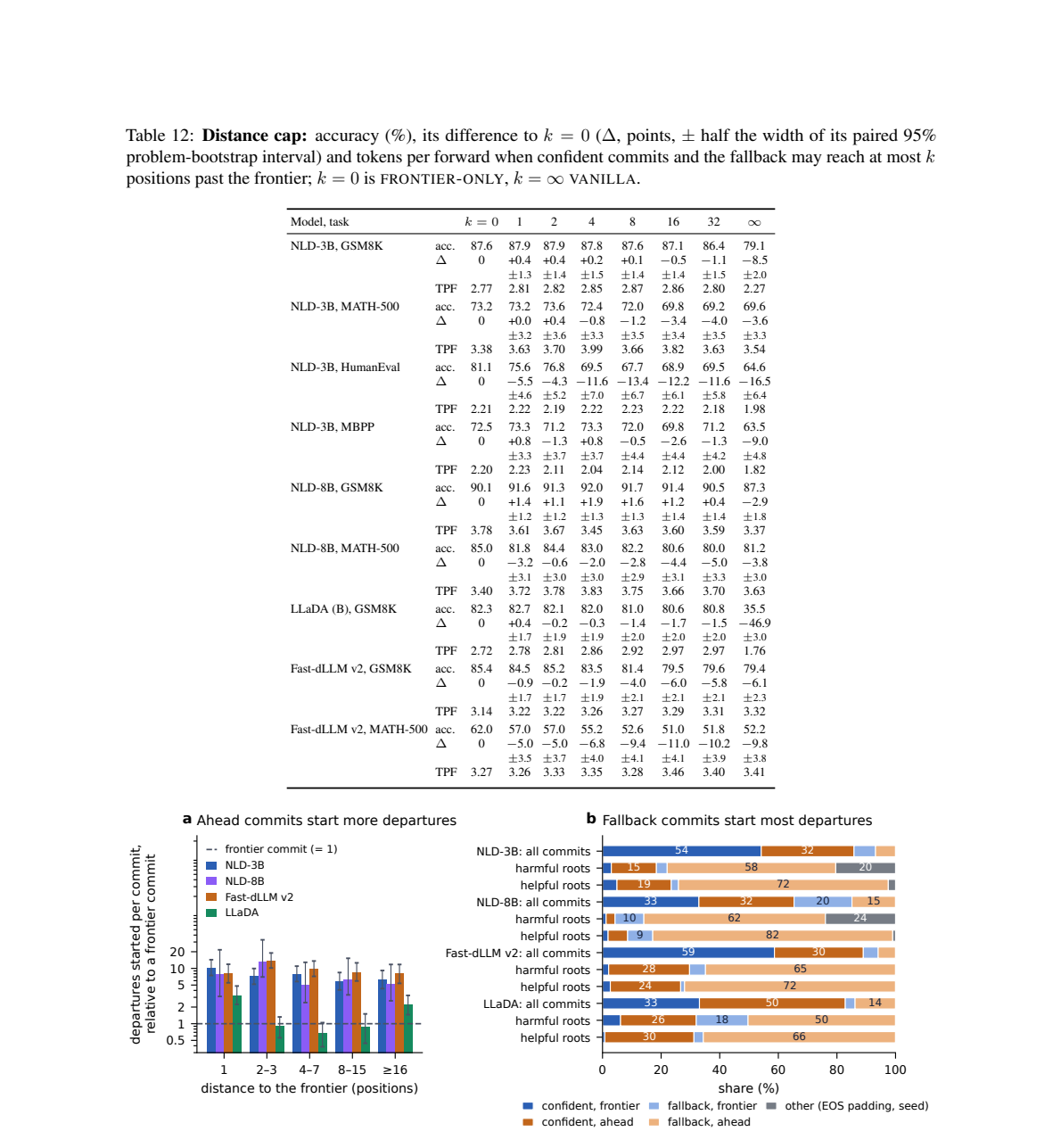
If none does, a fallback commits the most confident one, and the commits are never revised. Wide windows let the decoder commit far ahead of the text, which should speed up decoding but often costs accuracy. It is unclear where the model is confident and which commits cause errors. We trace every commit of four off-the-shelf DLMs on math, code, translation and summarization, and rerun failing answers with one step changed. Most tokens become confident only near the frontier, the leftmost masked position, so committing only there, still several tokens per step, is about as fast as committing anywhere. The accuracy loss comes from committing tokens before the text to their left, and committing one token per step does not reduce it. The worst case is an early end-of-sequence token that cuts the answer short. Fallback commits are 11-35% of commits but start 61-72% of the failures that left-to-right decoding avoids. Changing only the step where such a failure starts repairs it more often than changing a similar earlier step. Committing only at the frontier recovers most of the lost accuracy on all four models. Our code is available at https://github.com/rmakarovv/fast-at-the-frontier.
from the abstract
Pith says
Machine review · deepseek-v4-flash · 17 Nov 2026 · read the full text (115,811 characters) · not checked by a person
It can be wrong. Challenge this review or reply to it.
Holds up. A careful commit-level analysis shows that the accuracy loss in wide-window threshold decoding of diffusion language models comes from committing tokens ahead of the leftmost masked position, and that a simple frontier-only policy recovers most of the accuracy without slowing decoding. This line is wrong
no objections raised
How often objections from reviews like this one are right: not yet measured
The paper, first character to last
The reviewer was given the whole text, 115,811 characters. Not checked: figures, code, what the 76 references say.
What would settle it
If a diffusion language model were found where most tokens become confident far ahead of the frontier (e.g., >16 positions) and committing ahead of the frontier significantly increases speed without accuracy loss, the paper's central claim that ahead commits add little speed and cause accuracy loss would be contradicted. Alternatively, if a task were found where committing ahead of the frontier consistently improves accuracy over frontier-only decoding, the paper's recommendation to commit only at the frontier would be limited.
from Pith's summary of the paper
How the review went
5 passes by deepseek-v4-flash · 17 Nov 2026
- Reader holds up
- Skeptic concern withdrawn: Pith's reviewer misread the paper
- Referee no objections raised
- Check against the paper kept 0 of 1 objection
- Editor wrote the verdict above
Not run on this paper: the simulated authors' defence.
Pith's passes raised 1 objection. A check against the paper's text kept 0 and withdrew 1 (1 Pith's reviewer misread the paper).
The review in full
The review in brief, machine-written
This paper traces every commit of four open-weight diffusion language models to understand why wide decoding windows cost accuracy. The central finding is clear and well-supported: the accuracy loss comes from committing tokens ahead of the frontier (the leftmost masked position), not from committing several tokens per step. A policy that commits only at the frontier recovers most of the lost accuracy on all four models while keeping the same decoding speed.
The paper does several things well. The analysis is thorough: it uses paired McNemar tests with Holm correction, bootstrap intervals, and Poisson regression to separate the effects of distance and confidence. The replay experiments, where a single step of a failing decode is changed, provide direct evidence that the first departure from left-to-right decoding is often the cause of the failure. The paper also honestly acknowledges its limitations, including that the tasks studied (math, code, translation, summarization) have a natural left-to-right order, and that the root analysis is post-hoc.
The main soft spots are the ones the authors state. The frontier-only policy relies on left-to-right order being natural for the task; tasks like Sudoku or infilling are out of scope. The replay evidence is limited to two models (NLD-3B and Fast-dLLM v2). The paper does not ship verifiable code or data, though it provides a GitHub link. These are real but minor concerns that do not undermine the central claim.
This paper is for researchers working on decoding policies for diffusion language models. It deserves a serious referee. The analysis is careful, the claims are proportional to the evidence, and the practical recommendation (commit only at the frontier) is simple and well-motivated. I would accept this for peer review.
The stress test's concern
Withdrawn: Pith's reviewer misread the paper.
The paper says
“We pick roots after we know the outcome, and the control steps reduce this selection effect but do not remove it. Our Poisson model does not account for how hard each problem is, and we ran replays only on NLD-3B and Fast-dLLM v2. The roots therefore show where failures start, but the evidence that the root's step causes the failure is limited to these two models.”
The referee's report
If the findings hold, they provide a simple and actionable recipe for decoding DLMs: commit only at the frontier. This could improve the accuracy of existing models without retraining and guide future model training to increase confidence further ahead. The paper is thorough in its analysis and uses careful statistical methods. The scope is limited to tasks where left-to-right order is natural, but within that scope the results are robust across four models and multiple tasks.
Pith's reading of the paper (a machine's summary, not the authors')
The paper investigates why diffusion language models (DLMs) that can write several tokens per forward pass lose accuracy when decoding with wide windows. By tracing every commit of four open-weight DLMs on math, code, translation and summarization tasks, the authors find that most tokens become confident only near the frontier (the leftmost masked position), so committing ahead of the frontier adds little speed. The accuracy loss comes from committing tokens before the text to their left—especially early end-of-sequence tokens—and committing one token per step does not reduce it. Fallback commits (made when no position reaches the confidence threshold) are only 11–35% of all commits but start 61–72% of the failures that left-to-right decoding avoids. The authors propose a frontier-only policy that commits only at the frontier, which recovers most of the lost accuracy on all four models without slowing decoding.
What carries the argument. The central object is the frontier—the leftmost masked position in the decoding window. The paper defines ahead commits (commits made while a position to their left is still masked) and fallback commits (commits made when no position reaches the confidence threshold). The key mechanism is the replay experiment: taking a failing decode, changing only the step where it first departs from a left-to-right decode, and comparing repair rates against matched control steps. This isolates the causal role of individual commits.
Core claim. The central claim is that the accuracy loss in threshold decoding of diffusion language models with wide windows is caused by committing tokens ahead of the frontier (the leftmost masked position), and that a policy committing only at the frontier recovers most of this accuracy without slowing decoding. This is supported by the paper's three research questions: (RQ1) most tokens become confident only near the frontier, so ahead commits add little speed; (RQ2) the order of commits (not parallelism) causes accuracy loss, and frontier-only recovers it; (RQ3) most failures start at fallback commits ahead of the frontier.
The premise it rests on. The paper assumes that left-to-right order is the correct or optimal order for the tasks studied (math, code, translation, summarization), and that the confidence threshold (0.9) and the specific models studied are representative.
If the paper is right (Pith's inferences, not the authors')
Decoders should commit only at the frontier, and faster decoding should come from committing more tokens at the frontier in each step rather than from wider windows.
The frontier-only policy (fo) recovers most of the accuracy lost by vanilla threshold decoding on all four models tested, even with windows eight times the training block.
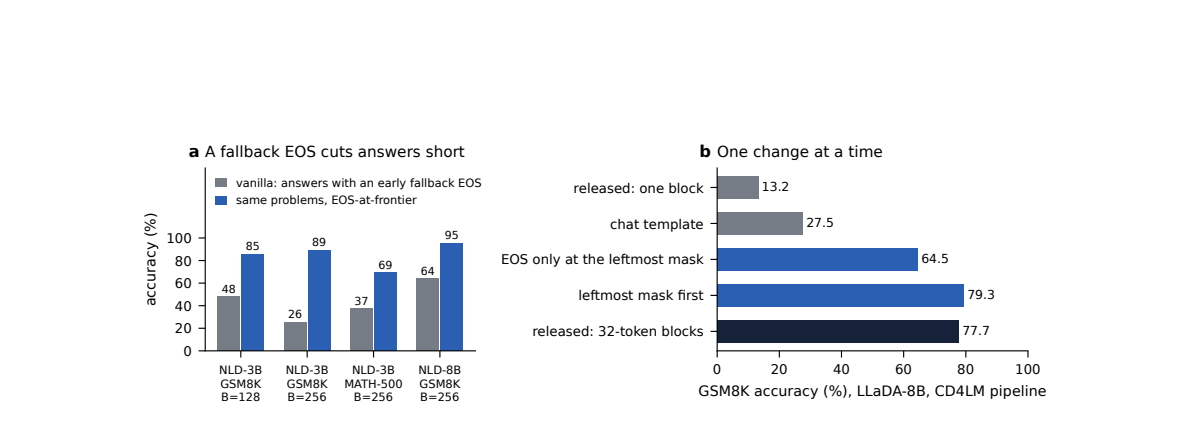
Early end-of-sequence tokens committed ahead of the frontier are the worst case, cutting answers short; allowing EOS only at the frontier fixes most of the collapse on NLD and LLaDA.
Fallback commits are disproportionately harmful: they are 11–35% of commits but start 61–72% of failures that left-to-right decoding avoids.
Confidence threshold alone cannot flag risky commits; distance from the frontier adds risk even at the same confidence, so decoding policies should use position as well.
The paper's findings suggest that training objectives for diffusion language models should encourage the model to become confident further ahead of the frontier, so that wider windows can actually increase speed without sacrificing accuracy.
The frontier-only policy is a simple, model-agnostic fix that could be applied to any threshold-decoding DLM without retraining, making it a practical default for deployment.
The analysis implies that the reported collapse of LLaDA with one 256-token block (from 77% to 13% on GSM8K) is mostly a decoding policy problem, not a model limitation, since frontier-only decoding restores most of the accuracy.
For tasks where left-to-right order is not natural (e.g., infilling, planning), the frontier-only policy may be suboptimal; the paper acknowledges this limitation explicitly.
Check this review
What was read
The passes were given all 115,811 characters of the paper's LaTeX source.
Fingerprint of that text (SHA-256): b5896f6d05046d17bc6d7b57fda4e37fa6a62b99ae8c070a20f6d70b1b784453
Pith does not keep that text. Rebuilt from the paper's source or PDF by the same code, it has this fingerprint if it is the same text. From a copy of Pith's code:
PYTHONPATH=. python scripts/review_input_check.py 2611.20693
The passes, in the order they ran
- Reader deepseek-v4-flash · medium effort · $0.012 · instructions of the Reader, fingerprint f9ead7300382…
- Skeptic deepseek-v4-flash · medium effort · $0.0040 · instructions of the Skeptic, fingerprint 8f88c0f61488…
- Referee deepseek-v4-flash · medium effort · $0.0040 · instructions of the Referee, fingerprint a852d99aea0d…
- Check against the paper deepseek-v4-flash · medium effort · $0.0041 · instructions of the Check against the paper, fingerprint 6c7a6883d551…
- Editor deepseek-v4-flash · medium effort · $0.0040 · instructions of the Editor, fingerprint e7211f6a3d27…
- Circularity check deepseek-v4-flash · medium effort · $0.0039 · instructions of the Circularity check, fingerprint e9946e39d67b…
- Summary for the page deepseek-v4-flash · medium effort · temperature 0.2 · $0.0043 · instructions of the Summary for the page, fingerprint e4f56bf568e7…
The passes cost $0.036 in model calls together.
Version stamped on this review: pith-pipeline@v1.4.1-daily-deepseek-or-medium+deepseek/deepseek-v4-flash+p.d60f54226f00
Each link opens a pass's instructions as plain text, the exact bytes its fingerprint was taken over. Every stored set of instructions.
curl -s https://pith.science/methodology/prompts/f9ead730038216984cfb56d7cb34332bdf691828296a1de4245f3d6667d4bf56 | sha256sum
prints the fingerprint of the reader's instructions. The same works for every pass.
The receipt
The review's fingerprint was taken on 17 Nov 2026. The review you are reading still matches it.
Fingerprint of the review (SHA-256): a2b594e5e5ed7579155ec0fa0dc7c2d163d284399ebeaafa81f17fbeaa107755
curl -s 'https://pith.science/api/v1/verdicts/2611.20693?form=canonical' | sha256sum
prints the fingerprint of the review as it stands now. The rule, in four steps.
A matching fingerprint shows the review has not changed since that date. It does not show that the review is right.
How often reviews like this one are right
Reviews like this one: written by deepseek-v4-flash, from the paper's LaTeX source.
How often objections from reviews like this one are right: not yet measured
Reviews by people
This review was written by a machine. No person has reviewed this paper on Pith yet. A scientist listed on Pith can review it for a fee, and their review is published here whatever it concludes.
The paper
Abstract
Diffusion language models (DLMs) can write several tokens per forward pass. Open-weight DLMs commit, in any order, every masked position whose confidence passes a threshold. If none does, a fallback commits the most confident one, and the commits are never revised. Wide windows let the decoder commit far ahead of the text, which should speed up decoding but often costs accuracy. It is unclear where the model is confident and which commits cause errors. We trace every commit of four off-the-shelf DLMs on math, code, translation and summarization, and rerun failing answers with one step changed. Most tokens become confident only near the frontier, the leftmost masked position, so committing only there, still several tokens per step, is about as fast as committing anywhere. The accuracy loss comes from committing tokens before the text to their left, and committing one token per step does not reduce it. The worst case is an early end-of-sequence token that cuts the answer short. Fallback commits are 11-35% of commits but start 61-72% of the failures that left-to-right decoding avoids. Changing only the step where such a failure starts repairs it more often than changing a similar earlier step. Committing only at the frontier recovers most of the lost accuracy on all four models. Our code is available at https://github.com/rmakarovv/fast-at-the-frontier.
The paper's own sentences, arranged, kept beside the review and separate from it. Each label is drawn from a closed vocabulary; the number beside it is the probability the classifier gave that label. No sentence in this record was written by a model.
abstract compiled · 2026-11-17
The authors' main claim, as the classifier picked it out 0.95
“Committing only at the frontier recovers most of the lost accuracy on all four models.”
How the main claim is stated: asserted 1.00
What the abstract itself states, as probabilities: claims first 0.05 · states limitation 0.28 · human participants 0.03 · controlled comparison 0.69 · randomized assignment 0.02 · states quantitative result 0.98 · compares with prior results 0.76 · mentions code or data availability 0.99
The abstract, sentence by sentence
This table labels the abstract only (arXiv listing abstract v1). The number is the probability the classifier gave the label.
| Sentence | Role | The authors' own work | States the main conclusion | Strength |
|---|---|---|---|---|
| Diffusion language models (DLMs) can write several tokens per forward pass. | background 1.00 | 0.10 | 0.02 | asserted 0.78 |
| Open-weight DLMs commit, in any order, every masked position whose confidence passes a threshold. | background 0.88 | 0.09 | 0.04 | asserted 1.00 |
| If none does, a fallback commits the most confident one, and the commits are never revised. | background 0.85 | 0.10 | 0.04 | asserted 1.00 |
| Wide windows let the decoder commit far ahead of the text, which should speed up decoding but often costs accuracy. | background 0.94 | 0.14 | 0.05 | asserted 0.61 |
| It is unclear where the model is confident and which commits cause errors. | gap 1.00 | 0.06 | 0.02 | asserted 0.73 |
| We trace every commit of four off-the-shelf DLMs on math, code, translation and summarization, and rerun failing answers with one step changed. | method 0.70 | 0.96 | 0.03 | asserted 0.98 |
| Most tokens become confident only near the frontier, the leftmost masked position, so committing only there, still several tokens per step, is about as fast as committing anywhere. | result 0.97 | 0.92 | 0.26 | asserted 0.97 |
| The accuracy loss comes from committing tokens before the text to their left, and committing one token per step does not reduce it. | result 0.95 | 0.89 | 0.34 | asserted 1.00 |
| The worst case is an early end-of-sequence token that cuts the answer short. | result 0.97 | 0.79 | 0.04 | asserted 1.00 |
| Fallback commits are 11-35% of commits but start 61-72% of the failures that left-to-right decoding avoids. | result 1.00 | 0.93 | 0.10 | asserted 1.00 |
| Changing only the step where such a failure starts repairs it more often than changing a similar earlier step. | result 0.95 | 0.94 | 0.08 | asserted 1.00 |
| Committing only at the frontier recovers most of the lost accuracy on all four models. | result 0.99 | 0.94 | 0.79 | asserted 1.00 |
| Our code is available at https://github.com/rmakarovv/fast-at-the-frontier. | contribution 0.82 | 0.47 | 0.01 | asserted 0.86 |
What kind of paper the classifier reports this is: empirical study 0.99 · evidence from observation or experiment 0.96
What was examined, and what was not
Sources read
- arXiv listing abstract v1
Not examined
- full text
- figures and tables
- references and citing sentences
- relations to other papers
Levels run
- P abstract
Not run
- S sections
- T body sentences
- C citations
- R cross-paper relations
How the labels were made
Compiled by classifier-1.13.0 via TypeSafe API, question bank abstract-p1-20260923, 2026-11-17: 1 request, 9,320 input tokens.
Every quoted sentence on this record is the authors'. Every label is from Pith's closed vocabulary, with the probability shown beside it. This record as JSON
Figures (5)
Figures are the authors', reproduced from the paper.
References (76)
- [1] Nan Yang and Tao Ge and Liang Wang and Binxing Jiao and Daxin Jiang and Linjun Yang and Rangan Majumder and Furu Wei , year =. 2304.04487 , archivePrefix = on PithPith's reviewarXiv
- [2] Chunyu Liu and Zhengyang Fan and Kaisen Yang and Alex Lamb , year =. 2606.17999 , archivePrefix = on PithPith's reviewarXiv
- [3] Metod Jazbec and Theo X. Olausson and Louis Béthune and Pierre Ablin and Michael Kirchhof and João Monteiro and Victor Turrisi and Jason Ramapuram and Marco Cuturi , booktitle =. 2026 , url = on Pith
- [4] Gagan Jain , year =. 2606.29275 , archivePrefix = on PithPith's reviewarXiv
- [5] Shansan Gong and Ruixiang Zhang and Huangjie Zheng and Jiatao Gu and Navdeep Jaitly and Lingpeng Kong and Yizhe Zhang , booktitle = on Pith
- [6] Jiacheng Ye and Zhihui Xie and Lin Zheng and Jiahui Gao and Zirui Wu and Xin Jiang and Zhenguo Li and Lingpeng Kong , year =. 2508.15487 , archivePrefix = on PithPith's reviewarXiv
- [7] Jewon Yeom and Jaewon Sok and Seonghyeon Park and Jeongjae Park and Hwiyeong Lee and Taesup Kim , year =. 2608.05687 , archivePrefix = on PithPith's reviewarXiv
- [8] Andy Catruna and Emilian Radoi , year =. 2607.15893 , archivePrefix = on PithPith's reviewarXiv
- [9] Kai Syun Hou and James Kwok , year =. 2607.24306 , archivePrefix = on PithPith's reviewarXiv
- [10] Stipe Frkovi. 2026 , eprint = on Pith
- [11] Mojtaba Nafez and James Henderson , year =. 2610.01275 , archivePrefix = on PithPith's reviewarXiv
- [12] Subham Sekhar Sahoo and Marianne Arriola and Yair Schiff and Aaron Gokaslan and Edgar Marroquin and Justin T Chiu and Alexander Rush and Volodymyr Kuleshov , booktitle = on Pith
- [13] Jinsong Li and Xiaoyi Dong and Yuhang Zang and Yuhang Cao and Jiaqi Wang and Dahua Lin , booktitle =. 2026 , url = on Pith
- [14] Yinjie Wang and Ling Yang and Bowen Li and Ye Tian and Ke Shen and Mengdi Wang , year =. 2509.06949 , archivePrefix = on PithPith's reviewarXiv
- [15] Yihao Liang and Ze Wang and Hao Chen and Ximeng Sun and Jialian Wu and Xiaodong Yu and Jiang Liu and Emad Barsoum and Zicheng Liu and Niraj K. Jha , year =. 2601.02236 , archivePrefix = on PithPith's reviewarXiv
- [16] Chengyue Wu and Hao Zhang and Shuchen Xue and Shizhe Diao and Yonggan Fu and Zhijian Liu and Pavlo Molchanov and Ping Luo and Song Han and Enze Xie , booktitle =. 2026 , url = on Pith
- [17] Siwei Chen and Yuxiang Wan and Yifan Yu and Fan Lai , year =. 2609.33390 , archivePrefix = on PithPith's reviewarXiv
- [18] Chengyue Wu and Hao Zhang and Shuchen Xue and Zhijian Liu and Shizhe Diao and Ligeng Zhu and Ping Luo and Song Han and Enze Xie , booktitle = on Pith
- [19] Ephrem Wu , year =. 2608.30427 , archivePrefix = on PithPith's reviewarXiv
- [20] Yonggan Fu and Lexington Whalen and Abhinav Garg and Chengyue Wu and Maksim Khadkevich and Nicolai Oswald and Enze Xie and Daniel Egert and Sharath Turuvekere Sreenivas and Shizhe Diao and Chenhan Yu and Ye Yu and others , year =. 2607.05722 , archivePrefix = on PithPith's reviewarXiv
show 56 more
- [21] Shuang Cheng and Yihan Bian and Dawei Liu and Linfeng Zhang and Qian Yao and Zhongbo Tian and Wenhai Wang and Qipeng Guo and Kai Chen and Biqing Qi and Bowen Zhou , year =. 2510.06303 , archivePrefix = on PitharXiv
- [22] Xingyou Fang and Jingxing Zhong and Xiaosong Yuan and Xiaofeng Zhang , year =. 2608.26641 , archivePrefix = on PithPith's reviewarXiv
- [23] Subham Sekhar Sahoo and Lingjie Chen and Khiem Pham and Jonathan Geuter and Chaitanya Dwivedi and Varad Pimpalkhute and Yash Akhauri and Alexander Moreno and Mikhail Yurochkin and Zhenting Wang and Mostafa Elhoushi and Nolan Dey and others , year =. 2609.04010 , archivePrefix = on PithPith's reviewarXiv
- [24] Linye Wei and Shutian Zheng and Haoyu Zeng and Meng Li , year =. 2609.34388 , archivePrefix = on PithPith's reviewarXiv
- [25] Jiawei Liu and Chunqiu Steven Xia and Yuyao Wang and Lingming Zhang , booktitle =. 2023 , url = on Pith
- [26] Siqi Kou and Lanxiang Hu and Zhezhi He and Zhijie Deng and Hao Zhang , booktitle =. 2024 , url = on Pith
- [27] Jingyi Yang and Guanxu Chen and Xuhao Hu and Jing Shao , year =. 2509.23924 , archivePrefix = on PitharXiv
- [28] Han Peng and Peiyu Liu and Zican Dong and Daixuan Cheng and Junyi Li and Yiru Tang and Shuo Wang and Wayne Xin Zhao , year =. 2510.18480 , archivePrefix = on PitharXiv
- [29] Bumjun Kim and Dongjae Jeon and Dueun Kim and Wonje Jeung and Albert No , booktitle =. 2026 , url = on Pith
- [30] Zanlin Ni and Shenzhi Wang and Yang Yue and Tianyu Yu and Weilin Zhao and Yeguo Hua and Tianyi Chen and Jun Song and Cheng Yu and Bo Zheng and Gao Huang , booktitle = on Pith
- [31] Mengyu Ye and Keito Kudo and Wataru Ikeda and Ryosuke Matsuda and Keisuke Sakaguchi and Jun Suzuki , year =. 2606.19005 , archivePrefix = on PithPith's reviewarXiv
- [32] Longxuan Yu and Shaorong Zhang and Yu Fu and Hui Liu and Yue Dong and Greg Ver Steeg , year =. 2606.01026 , archivePrefix = on PithPith's reviewarXiv
- [33] Jungwon Park and Jimyeong Kim and Jungmin Ko and Nojun Kwak and Wonjong Rhee , year =. 2605.28181 , archivePrefix = on PithPith's reviewarXiv
- [34] Zhenghao He and Bohan Liu and Guangzhi Xiong and Aidong Zhang , year =. 2609.36452 , archivePrefix = on PithPith's reviewarXiv
- [35] Fengqi Zhu and Rongzhen Wang and Shen Nie and Xiaolu Zhang and Chunwei Wu and Jun Hu and Jun Zhou and Jianfei Chen and Yankai Lin and Ji-Rong Wen and Chongxuan Li , year =. 2505.19223 , archivePrefix = on PithPith's reviewarXiv
- [36] Marianne Arriola and Aaron Gokaslan and Justin T. Chiu and Zhihan Yang and Zhixuan Qi and Jiaqi Han and Subham Sekhar Sahoo and Volodymyr Kuleshov , booktitle = on Pith
- [38] Ali Asaria and Tony Salomone and Deep Gandhi , year =. 2606.14620 , archivePrefix = on PitharXiv
- [39] Feng Hong and Geng Yu and Yushi Ye and Haicheng Huang and Huangjie Zheng and Ya Zhang and Yanfeng Wang and Jiangchao Yao , booktitle =. 2026 , url = on Pith
- [40] Jiyeon Kim and Sungik Choi and Yongrae Jo and Moontae Lee and Minjoon Seo , booktitle =. 2026 , url = on Pith
- [41] Mark Chen and Jerry Tworek and Heewoo Jun and Qiming Yuan and Henrique Ponde de Oliveira Pinto and Jared Kaplan and Harri Edwards and Yuri Burda and Nicholas Joseph and Greg Brockman and Alex Ray and Raul Puri and others , year =. 2107.03374 , archivePrefix = on PithPith's reviewarXiv
- [42] Hunter Lightman and Vineet Kosaraju and Yura Burda and Harri Edwards and Bowen Baker and Teddy Lee and Jan Leike and John Schulman and Ilya Sutskever and Karl Cobbe , booktitle = on Pith
- [43] Heli Ben-Hamu and Itai Gat and Daniel Severo and Niklas Nolte and Brian Karrer , booktitle =. 2025 , url = on Pith
- [44] Karl Cobbe and Vineet Kosaraju and Mohammad Bavarian and Mark Chen and Heewoo Jun and Lukasz Kaiser and Matthias Plappert and Jerry Tworek and Jacob Hilton and Reiichiro Nakano and Christopher Hesse and John Schulman , year =. 2110.14168 , archivePrefix = on PithPith's reviewarXiv
- [45] Jacob Austin and Augustus Odena and Maxwell Nye and Maarten Bosma and Henryk Michalewski and David Dohan and Ellen Jiang and Carrie Cai and Michael Terry and Quoc Le and Charles Sutton , year =. 2108.07732 , archivePrefix = on PithPith's reviewarXiv
- [46] Dan Hendrycks and Collin Burns and Saurav Kadavath and Akul Arora and Steven Basart and Eric Tang and Dawn Song and Jacob Steinhardt , booktitle =. 2021 , url = on Pith
- [47] Note on the sampling error of the difference between correlated proportions or percentages , author =. Psychometrika , volume = on Pith
- [48] A simple sequentially rejective multiple test procedure , author =. Scandinavian Journal of Statistics , volume = on Pith
- [49] On Excess Over the Boundary , author =. The Annals of Mathematical Statistics , volume = on Pith
- [50] Yangyang Zhong and Yanmei Gu and Zhengqing Zang and Xiaomeng Li and Yuqi Ding and Xibei Jia and Yuting Shen and Zhenzhong Lan and Liwang Zhu and Weiping Liu and Junlin Zhou and Haisheng Liu and Zhong Xin Yu and Pengxin Luo and Donglian Qi and Yunfeng Yan and Junbo Zhao , bookt... on Pith
- [51] Shaorong Zhang and Longxuan Yu and Rob Brekelmans and Luhan Tang and Salman Asif and Greg Ver Steeg , year =. 2602.00286 , archivePrefix = on PitharXiv
- [52] Chuling Wen and Weijie Liang and Jian Lu , year =. 2608.25505 , archivePrefix = on PithPith's reviewarXiv
- [53] Lin Yao , year =. 2607.04469 , archivePrefix = on PithPith's reviewarXiv
- [54] Chengcheng Wang and Tingzhang Luo and Wenhao Li and Jianyuan Guo and Chang Xu , year =. 2607.03236 , archivePrefix = on PithPith's reviewarXiv
- [55] Zhenhong Sun and Hanqing Zhao and Yatao Bian and Rongcheng Tu and Liuyue Xie and Xu Zhang and Jue Wang and Davide Modolo and Daoyi Dong and Dacheng Tao , year =. 2608.00605 , archivePrefix = on PithPith's reviewarXiv
- [56] Hengxiang Zhang and Jiaxi Ren and Renchunzi Xie and Hongxin Wei , year =. 2606.29228 , archivePrefix = on PithPith's reviewarXiv
- [57] Ivan Kobyzev and Abbas Ghaddar and Yufei Cui , year =. 2608.26374 , archivePrefix = on PithPith's reviewarXiv
- [58] Moongyu Jeon and Dongjae Jeon and Bumjun Kim and Mingyu Kim and Albert No , year =. 2609.34509 , archivePrefix = on PithPith's reviewarXiv
- [59] Marianne Arriola and Volodymyr Kuleshov , year =. 2607.01775 , archivePrefix = on PithPith's reviewarXiv
- [60] Siva Rajesh Kasa and Yasong Dai and Sumit Negi and Hongdong Li , year =. 2606.02955 , archivePrefix = on PithPith's reviewarXiv
- [61] Xinrui Song and Zhuoran Wang and Mingju Gao and Hao Tang , year =. 2606.04964 , archivePrefix = on PithPith's reviewarXiv
- [62] Yingxuan Ren and Yuxuan Lou and Yong Liu and Pengcheng Fang and Ziming Wang and Pengfei Zhou and Yang You , year =. 2606.08411 , archivePrefix = on PithPith's reviewarXiv
- [63] Pengcheng Huang and Shuhao Liu and Zhenghao Liu and Yukun Yan and Shuo Wang and Zulong Chen and Tong Xiao , year =. 2508.13021 , archivePrefix = on PithPith's reviewarXiv
- [64] Daniel Israel and Guy Van den Broeck and Aditya Grover , booktitle =. 2025 , url = on Pith
- [65] Jaeyeon Kim and Kulin Shah and Vasilis Kontonis and Sham Kakade and Sitan Chen , booktitle =. 2025 , eprint = on Pith
- [66] Jiacheng Ye and Jiahui Gao and Shansan Gong and Lin Zheng and Xin Jiang and Zhenguo Li and Lingpeng Kong , booktitle =. 2025 , eprint = on Pith
- [67] Marjan Ghazvininejad and Omer Levy and Yinhan Liu and Luke Zettlemoyer , booktitle =. 2019 , eprint = on Pith
- [68] Jiatao Gu and James Bradbury and Caiming Xiong and Victor O. K. Li and Richard Socher , booktitle =. 2018 , eprint = on Pith
- [69] Structured Denoising Diffusion Models in Discrete State-Spaces , author =. Advances in Neural Information Processing Systems , volume = on Pith
- [70] Simplified and Generalized Masked Diffusion for Discrete Data , author =. Advances in Neural Information Processing Systems , volume = on Pith
- [71] Large Language Diffusion Models , author =. Advances in Neural Information Processing Systems , volume = on Pith
- [72] Ond. Proceedings of the First Conference on Machine Translation: Volume 2, Shared Task Papers , pages =. 2016 , doi = on Pith
- [73] Maja Popovi. Proceedings of the Tenth Workshop on Statistical Machine Translation , pages =. 2015 , doi = on Pith
- [74] Karl Moritz Hermann and Tom. Advances in Neural Information Processing Systems , volume =. 2015 , url = on Pith
- [75] Abigail See and Peter J. Liu and Christopher D. Manning , booktitle =. 2017 , doi = on Pith
- [76] Chin-Yew Lin , booktitle =. 2004 , url = on Pith
- [77] Qwen2.5 Technical Report , author =. 2024 , eprint = on Pith
Challenges and discussion
Disagree with the review, or know something it missed? Leave a comment, or challenge this review formally: a challenge becomes a permanent entry in this paper's record, and its decision is published here.
Come back by email
A short list of the week's newly reviewed papers. Nothing is sent until you confirm from your inbox, and every email has a link that stops it. No account.
No comments yet.
Sign in to comment