Robotics · arXiv:2611.31002 v1 · submitted 23 Nov 2026 · 78 references
RoboUniverse-10K: Toward the Scaling Era of Agentic Robotics via Real-to-Sim Environments
The paper says
“Agentic Robotics, in which foundation models act as coding agents to control robots through executable programs, has emerged as a compelling paradigm for embodied intelligence.”
more of the abstract
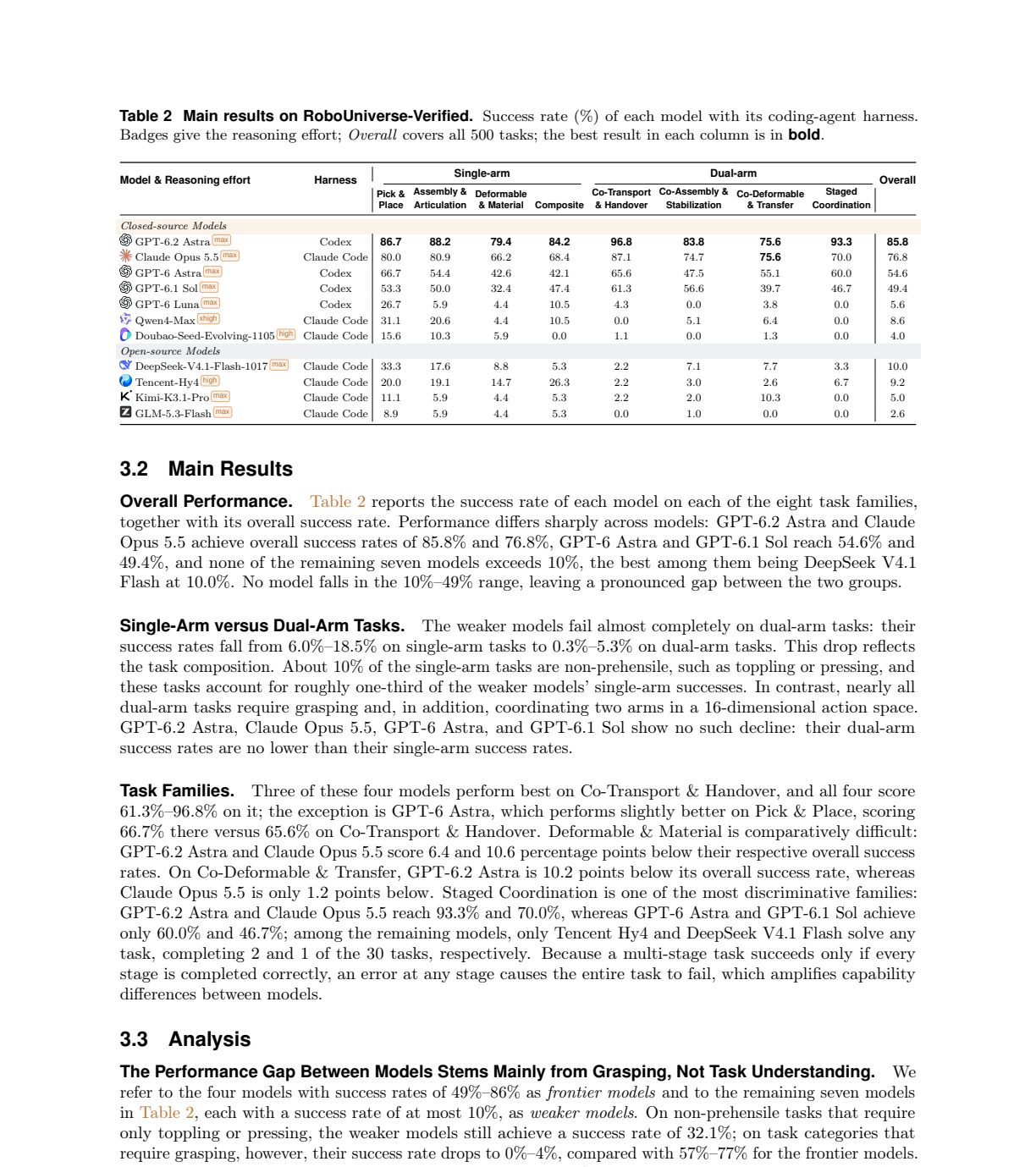
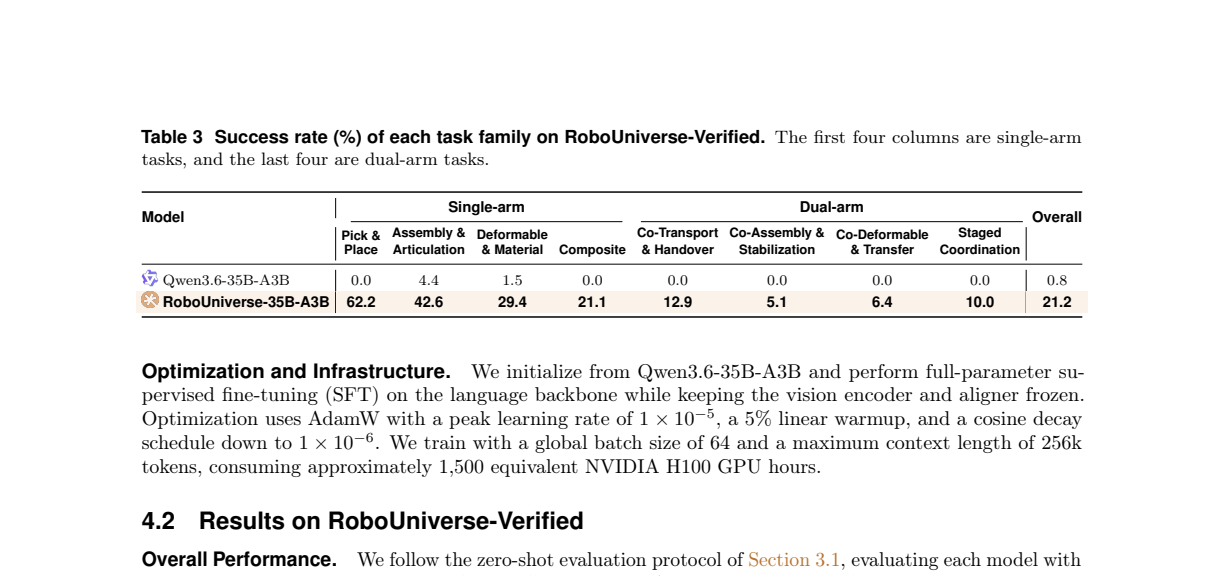
Yet unlike software engineering, where massive executable environments power post-training, robotics remains constrained by small, manual benchmarks and in-distribution evaluation. To bridge this gap, we introduce RoboUniverse-10K, 10,807 interactive, resettable, and verifiable physics environments built from real-world videos via an automated Real2Sim and quality assurance pipeline. Each runs in an isolated, Harbor-compatible harness that hides privileged states and grading logic to mirror real-world sensing. From the same pipeline, we hold out 500 unseen tasks to establish RoboUniverse-Verified, an expert-verified zero-shot benchmark. Evaluating 11 closed- and open-source models reveals a huge gap: frontier models reach 85.8% success, while open-source baselines lag at 2.6% to 10.0%, bottlenecked by low-level grasping, deformable-object manipulation, and post-contact physical control. Finally, we collect about 17K multi-turn trajectories totaling 0.79B tokens with GPT-6 Astra and perform full-parameter supervised fine-tuning on Qwen3.6-35B-A3B, yielding RoboUniverse-35B-A3B. Our model achieves substantial zero-shot gains on RoboUniverse-Verified, lifting the success rate from 0.8% to 21.2%, while achieving zero-shot task completions across LIBERO-MAX, RoboCasa, RoboTwin 2.0, and a real Franka arm. We open-source the RL-ready environments and model to lay the foundation for large-scale reinforcement learning in Agentic Robotics.
from the abstract
Pith says
Machine review · deepseek-v4-flash · 24 Nov 2026 · read the full text (107,604 characters) · not checked by a person
It can be wrong. Challenge this review or reply to it.
Holds up, with conditions. RoboUniverse-10K delivers 10,807 automated Real2Sim environments for agentic robotics—the largest such collection by an order of magnitude—and shows that supervised fine-tuning on them lifts zero-shot success from 0.8% to 21.2% on a held-out benchmark, though sim-to-real validation remains limited to one task. This line is wrong
2 minor · 1 open question
How often objections from reviews like this one are right: not yet measured
The paper, first character to last
The reviewer was given the whole text, 107,604 characters. Not checked: figures, code, what the 78 references say.
2 minor objections
The paper says, at 4.1 Training Setup
Pith says: minor objection 1 of 2
Section 4.1: 'Wecollectapproximately' is missing a space; should read 'We collect approximately'.
The paper says, at 2.2 Dataset Composition and Task Taxonomy
Pith says: minor objection 2 of 2
Section 2.2: The phrase 'Hierarchical Deduplication and Normalization' is clear, but the description of the five-level hierarchy (Embodiment → Taxonomy → Concrete Task → Layout → Trajectory) would benefit from a brief example to illustrate how a concrete task is defined and what counts as a duplicate.
Open questions (1)
Pith raised these and could not confirm them against the text of the paper it read. They are questions for the authors, not findings.
- 4.3 Generalization What are the per-benchmark success rates and number of tasks attempted for LIBERO-MAX, RoboCasa, and RoboTwin 2.0?
What would settle it
If a model trained on RoboUniverse-10K fails to achieve any zero-shot success on a set of 10 diverse real-world manipulation tasks (e.g., pick-and-place, assembly, cloth folding) on a Franka arm, then the claim that the environments enable transferable manipulation skills would be contradicted.
from Pith's summary of the paper
How the review went
5 passes by deepseek-v4-flash · 24 Nov 2026
- Reader holds up, with conditions
- Skeptic concern withdrawn: Pith's reviewer misread the paper
- Referee 2 minor
- Check against the paper kept 0 of 3 objections
- Editor wrote the verdict above
Not run on this paper: the simulated authors' defence.
Pith's passes raised 3 objections. A check against the paper's text kept 0, withdrew 2 (2 Pith's reviewer misread the paper) and left 1 as a question.
The review in full
The review in brief, machine-written
This paper does something that needed doing: it scales up the number of interactive, verifiable simulation environments for robot coding agents from the hundreds to over ten thousand. The automated Real2Sim pipeline, which turns real manipulation videos into Isaac Sim scenes with agent-based quality assurance, is the main engineering contribution. The resulting benchmark (RoboUniverse-Verified, 500 held-out tasks) is carefully constructed and reveals a clear capability gap: frontier models reach 85.8% success, while open-source models stall below 10%, bottlenecked by grasping, deformable-object manipulation, and post-contact control. The authors also show that full-parameter SFT on 17K GPT-6 Astra trajectories lifts a 3B-active-parameter model from 0.8% to 21.2% on the benchmark, and that the learned closed-loop control procedure transfers zero-shot to three external benchmarks and one real Franka arm task (drawing a logo). These are real results, and the open-source release of environments and model is a genuine service to the community. The soft spots are acknowledged in the paper. Sim-to-real validation is thin: one task on one robot arm. The training trajectories come from a closed-source model (GPT-6 Astra), which limits reproducibility. The automated pipeline produces simplified physics—dynamic interactions with articulated appliances are not well modeled, as the authors state. Dual-arm performance after SFT remains low (8.3%), and the analysis correctly attributes this to the base model's visual-spatial ceiling rather than to the training data. These are not fatal flaws; they are honest boundaries on what the current pipeline achieves. The paper is for researchers building post-training pipelines for robot coding agents and for anyone who wants a large-scale, verifiable benchmark for evaluating such agents. It deserves a serious referee. The evaluation is thorough, the failure analysis is insightful, and the limitations are stated plainly. I would send this to peer review.
The stress test's concern
Withdrawn: Pith's reviewer misread the paper.
The paper says
“Our model achieves substantial zero-shot gains on RoboUniverse-Verified, lifting the success rate from 0.8% to 21.2%, while achieving zero-shot task completions across LIBERO-MAX, RoboCasa, RoboTwin 2.0, and a real Franka arm.”
The referee's report
Not published. Pith's referee wrote this assessment before its objections were checked against the paper, and 2 of its 2 major objections did not survive that check.
Pith's reading of the paper (a machine's summary, not the authors')
The paper aims to establish that scaling the number of training environments for robot coding agents, via an automated pipeline that converts real-world videos into interactive simulations, can substantially improve the performance of open-source models. The authors introduce RoboUniverse-10K, a collection of 10,807 physics environments built from diverse manipulation datasets, along with a 500-task zero-shot benchmark (RoboUniverse-Verified). They show that supervised fine-tuning on trajectories from a frontier model (GPT-6 Astra) collected in these environments lifts the success rate of a 3B-parameter open-source model from 0.8% to 21.2% on the benchmark, and that the resulting model transfers zero-shot to external benchmarks and a real Franka arm. The benchmark evaluation of 11 models identifies low-level grasping, deformable-object manipulation, and post-contact physical control as the primary bottlenecks for current open-source coding agents.
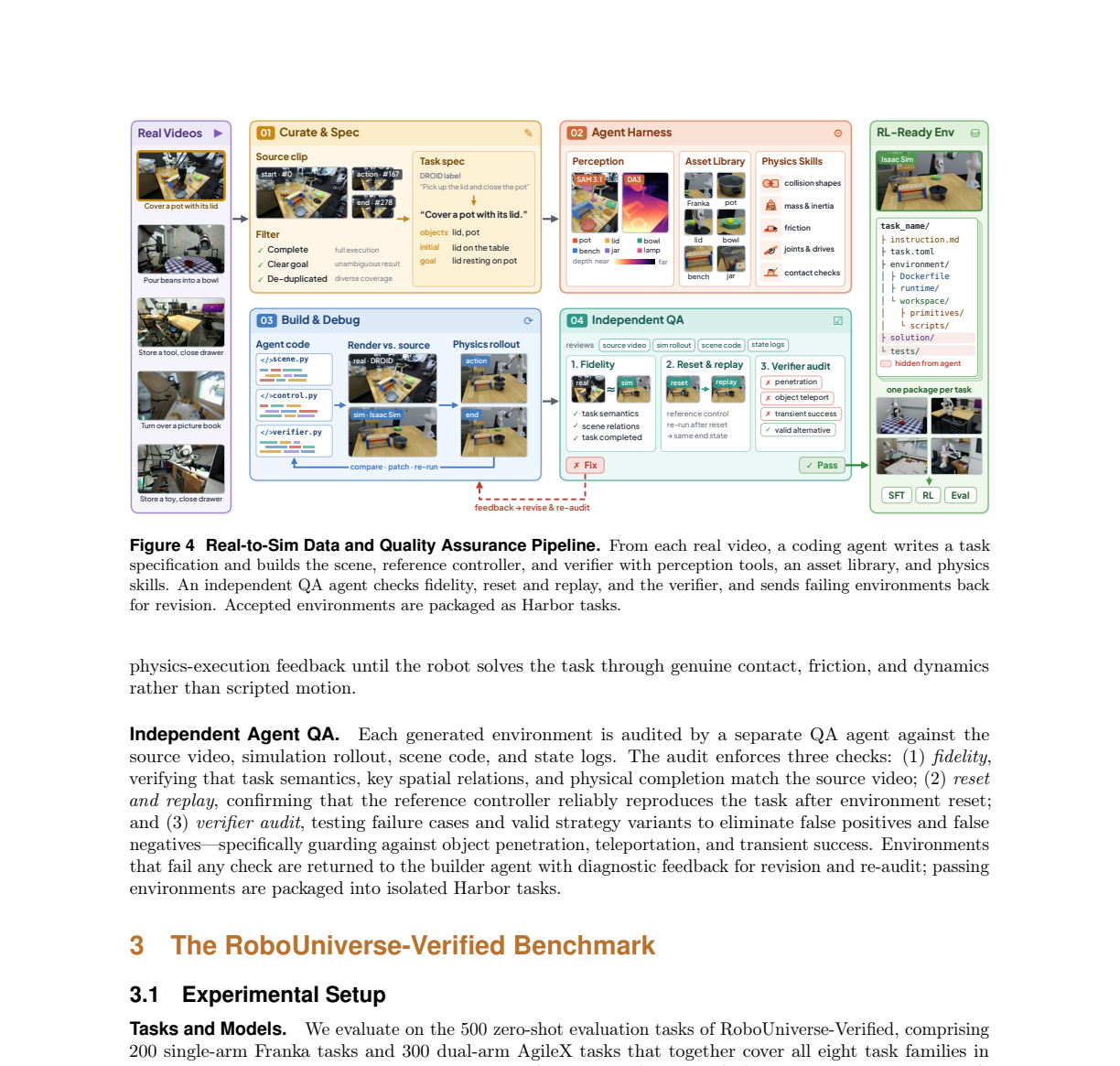
What carries the argument. The central machinery is an automated Real2Sim pipeline that uses a coding agent equipped with SAM 3.1 segmentation, DA3 depth estimation, a curated asset library, and physics-modeling skills to reconstruct scenes, author reference solutions, and write verifiers from real-world manipulation videos. An independent QA agent audits each environment for physical fidelity, reset consistency, and verifier robustness. The resulting environments are packaged in a Harbor-compatible harness that isolates the agent's code-execution sandbox from the simulator and verifier, hiding privileged states and grading logic. Supervised fine-tuning is performed on approximately 17K multi-turn trajectories (0.79B tokens) generated by GPT-6 Astra, using full-parameter SFT on the Qwen3.6-35B-A3B language backbone while freezing the vision encoder and aligner.
Core claim. The paper claims that an automated Real2Sim pipeline can convert real-world robot manipulation videos into 10,807 interactive, resettable, and verifiable physics simulation environments (RoboUniverse-10K), and that supervised fine-tuning (SFT) on GPT-6 Astra trajectories collected in these environments lifts the zero-shot success rate of the open-source Qwen3.6-35B-A3B model from 0.8% to 21.2% on a held-out 500-task benchmark (RoboUniverse-Verified). The fine-tuned model, RoboUniverse-35B-A3B, also achieves zero-shot task completions on three external benchmarks (LIBERO-MAX, RoboCasa, RoboTwin 2.0) and on a real Franka arm drawing a logo. The benchmark evaluation of 11 models reveals that the primary bottlenecks for open-source coding agents are low-level grasping, deformable-object manipulation, and fine-grained post-contact physical control.
The premise it rests on. The automated Real2Sim pipeline produces environments with sufficient physical fidelity and verifier correctness that training on them transfers to real-world robot manipulation, which is tested on only one real-robot task (drawing a logo). The paper acknowledges that dynamic interactions with articulated appliances are not well modeled (Section 6).
If the paper is right (Pith's inferences, not the authors')
Scaling the number of training environments via automated real-to-sim construction is a viable path for improving open-source robot coding agents, potentially reducing the gap to frontier closed-source models.
The RoboUniverse-Verified benchmark can serve as a standard zero-shot evaluation suite for embodied coding agents, with its 500 expert-verified tasks across eight families.
The identified bottlenecks (grasping, deformable objects, post-contact control) provide concrete targets for future research in perception, control, and model architecture.
The automated pipeline can be extended to generate environments for more complex, long-horizon tasks and for other robot embodiments, such as mobile manipulators.
The open-source release of RL-ready environments and the fine-tuned model enables large-scale reinforcement learning with verifiable rewards in robotics, analogous to the software engineering post-training pipeline.
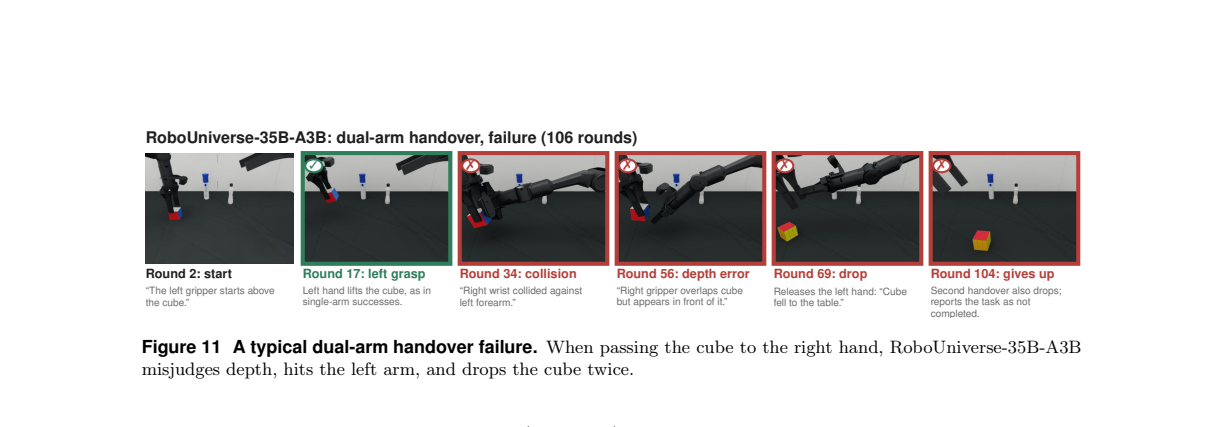
The sharp dual-arm performance gap (8.3% vs 40.5% single-arm) suggests that the vision-language base model's 3D spatial reasoning is the primary bottleneck for bimanual coordination, and that improving this capability (e.g., via depth estimation or camera calibration) may yield larger gains than additional SFT on single-arm tasks.
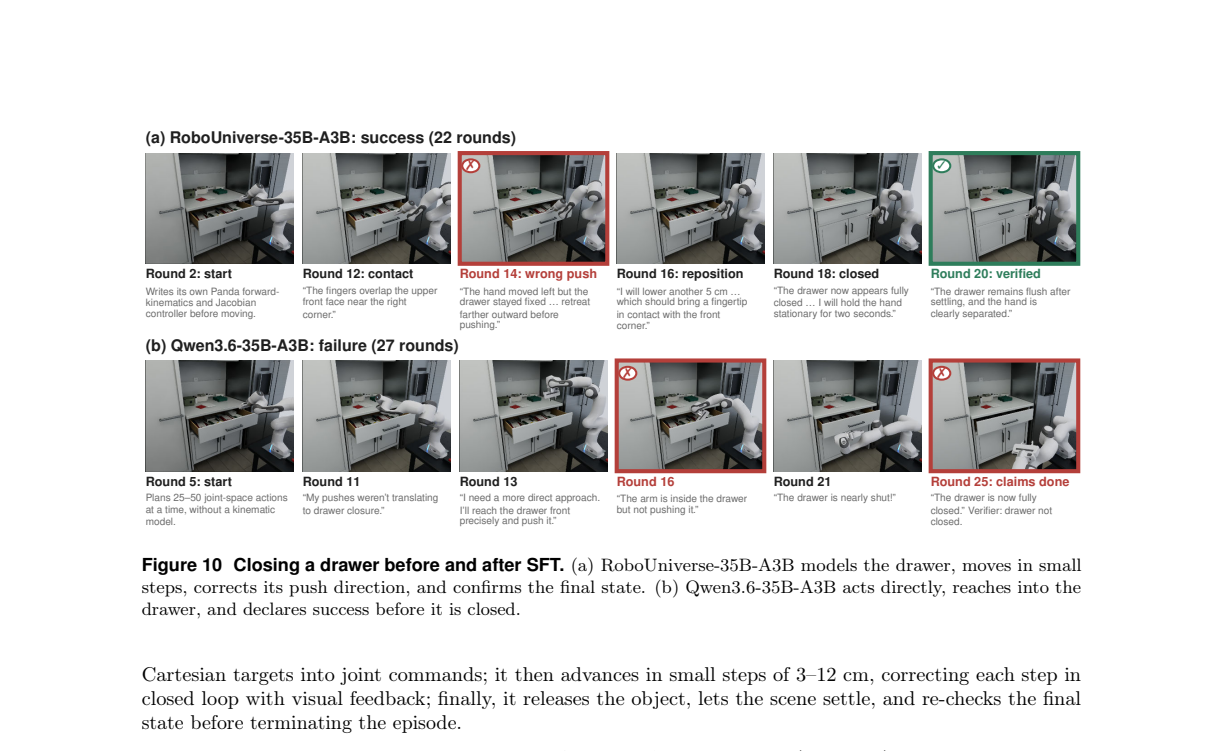
The fact that the fine-tuned model uses a closed-loop procedure (model, refine, verify) that is absent in the base model implies that SFT on diverse environments teaches a transferable control strategy rather than memorizing specific scenes, which could generalize to entirely new tasks and embodiments.
The automated pipeline's reliance on a frontier model (GPT-6 Astra) for trajectory generation means that the quality of the training data is tied to the capabilities of that model; weaker teacher models might produce lower-quality trajectories, limiting the gains from SFT.
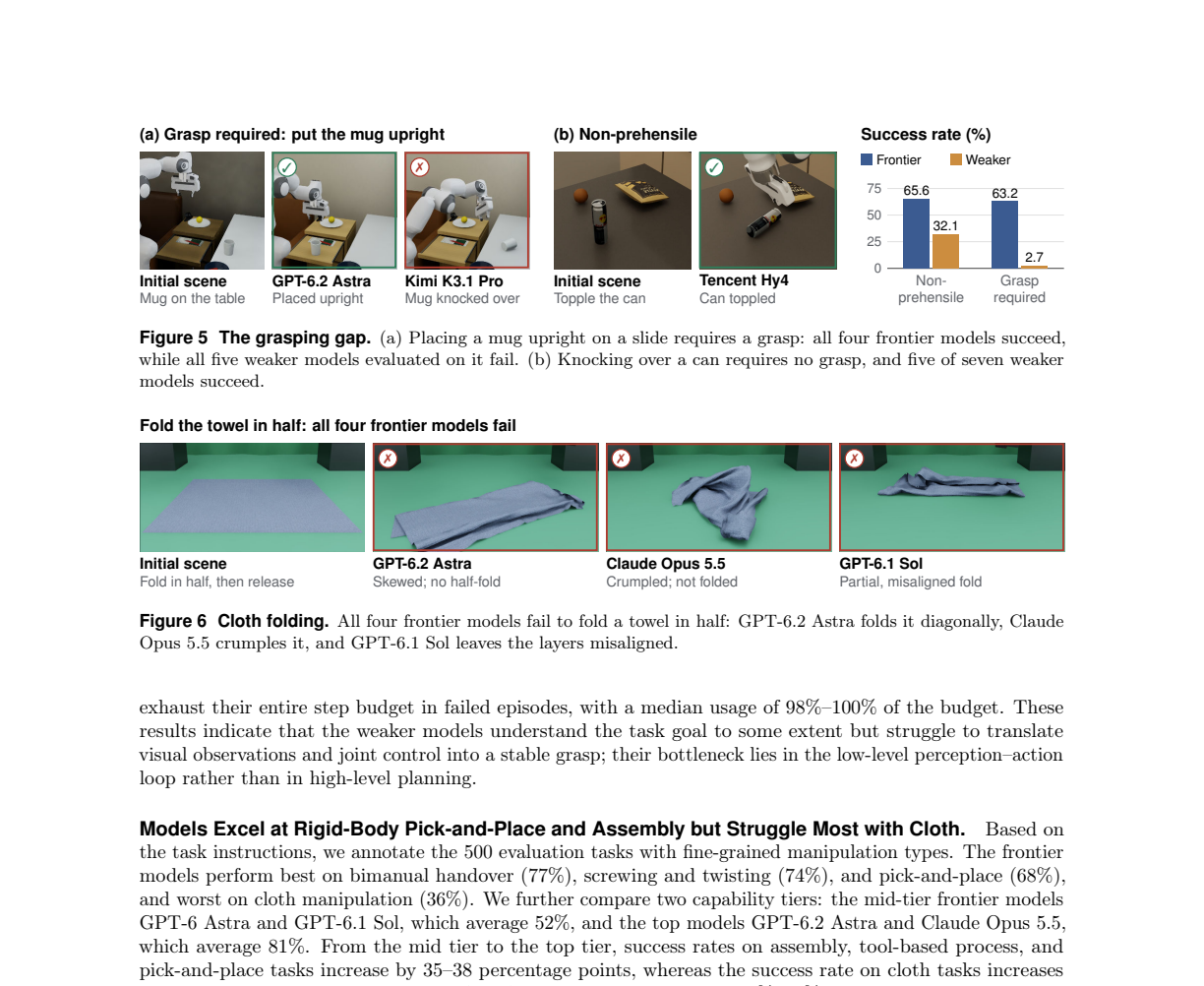
The benchmark's finding that frontier models also struggle with cloth manipulation (36% success) indicates a fundamental limitation of current vision-language models for deformable objects, which may require different sensing or control paradigms beyond the scope of the proposed pipeline.
Check this review
What was read
The passes were given all 107,604 characters of the text of the paper's PDF.
Fingerprint of that text (SHA-256): 58c60eef5e3e522881b94c8268085db2793755100206ef14e637c96e1d86a4c2
Pith does not keep that text. Rebuilt from the paper's source or PDF by the same code, it has this fingerprint if it is the same text. From a copy of Pith's code:
PYTHONPATH=. python scripts/review_input_check.py 2611.31002
The passes, in the order they ran
- Reader deepseek-v4-flash · medium effort · $0.0040 · instructions of the Reader, fingerprint f9ead7300382…
- Skeptic deepseek-v4-flash · medium effort · $0.0031 · instructions of the Skeptic, fingerprint 8f88c0f61488…
- Referee deepseek-v4-flash · medium effort · $0.0033 · instructions of the Referee, fingerprint a852d99aea0d…
- Check against the paper deepseek-v4-flash · medium effort · $0.0039 · instructions of the Check against the paper, fingerprint 6c7a6883d551…
- Editor deepseek-v4-flash · medium effort · $0.0030 · instructions of the Editor, fingerprint e7211f6a3d27…
- Circularity check deepseek-v4-flash · medium effort · $0.0028 · instructions of the Circularity check, fingerprint e9946e39d67b…
- Summary for the page deepseek-v4-flash · medium effort · temperature 0.2 · $0.0032 · instructions of the Summary for the page, fingerprint e4f56bf568e7…
The passes cost $0.023 in model calls together.
Version stamped on this review: pith-pipeline@v1.4.1-daily-deepseek-or-medium+deepseek/deepseek-v4-flash+p.d60f54226f00
Each link opens a pass's instructions as plain text, the exact bytes its fingerprint was taken over. Every stored set of instructions.
curl -s https://pith.science/methodology/prompts/f9ead730038216984cfb56d7cb34332bdf691828296a1de4245f3d6667d4bf56 | sha256sum
prints the fingerprint of the reader's instructions. The same works for every pass.
The receipt
The review's fingerprint was taken on 24 Nov 2026. The review you are reading still matches it.
Fingerprint of the review (SHA-256): fa0a7f30e5148995933704de31c035aa913428ae2100978c6b79de831ab273c0
curl -s 'https://pith.science/api/v1/verdicts/2611.31002?form=canonical' | sha256sum
prints the fingerprint of the review as it stands now. The rule, in four steps.
A matching fingerprint shows the review has not changed since that date. It does not show that the review is right.
How often reviews like this one are right
Reviews like this one: written by deepseek-v4-flash, from the text of the paper's PDF.
How often objections from reviews like this one are right: not yet measured
Reviews by people
This review was written by a machine. No person has reviewed this paper on Pith yet. A scientist listed on Pith can review it for a fee, and their review is published here whatever it concludes.
The paper
Abstract
Agentic Robotics, in which foundation models act as coding agents to control robots through executable programs, has emerged as a compelling paradigm for embodied intelligence. Yet unlike software engineering, where massive executable environments power post-training, robotics remains constrained by small, manual benchmarks and in-distribution evaluation. To bridge this gap, we introduce RoboUniverse-10K, 10,807 interactive, resettable, and verifiable physics environments built from real-world videos via an automated Real2Sim and quality assurance pipeline. Each runs in an isolated, Harbor-compatible harness that hides privileged states and grading logic to mirror real-world sensing. From the same pipeline, we hold out 500 unseen tasks to establish RoboUniverse-Verified, an expert-verified zero-shot benchmark. Evaluating 11 closed- and open-source models reveals a huge gap: frontier models reach 85.8% success, while open-source baselines lag at 2.6% to 10.0%, bottlenecked by low-level grasping, deformable-object manipulation, and post-contact physical control. Finally, we collect about 17K multi-turn trajectories totaling 0.79B tokens with GPT-6 Astra and perform full-parameter supervised fine-tuning on Qwen3.6-35B-A3B, yielding RoboUniverse-35B-A3B. Our model achieves substantial zero-shot gains on RoboUniverse-Verified, lifting the success rate from 0.8% to 21.2%, while achieving zero-shot task completions across LIBERO-MAX, RoboCasa, RoboTwin 2.0, and a real Franka arm. We open-source the RL-ready environments and model to lay the foundation for large-scale reinforcement learning in Agentic Robotics.
The paper's own sentences, arranged, kept beside the review and separate from it. Each label is drawn from a closed vocabulary; the number beside it is the probability the classifier gave that label. No sentence in this record was written by a model.
abstract compiled · 2026-11-24
The authors' main claim, as the classifier picked it out 0.95
“Our model achieves substantial zero-shot gains on RoboUniverse-Verified, lifting the success rate from 0.8\% to 21.2\%, while achieving zero-shot task completions across LIBERO-MAX, RoboCasa, RoboTwin 2.0, and a real Franka arm.”
How the main claim is stated: asserted 1.00
What the abstract itself states, as probabilities: claims first 0.10 · states limitation 0.29 · human participants 0.13 · controlled comparison 0.80 · randomized assignment 0.01 · states quantitative result 0.99 · compares with prior results 0.97 · mentions code or data availability 0.97
The abstract, sentence by sentence
This table labels the abstract only (arXiv listing abstract v1). The number is the probability the classifier gave the label.
| Sentence | Role | The authors' own work | States the main conclusion | Strength |
|---|---|---|---|---|
| Agentic Robotics, in which foundation models act as coding agents to control robots through executable programs, has emerged as a compelling paradigm for embodied intelligence. | background 1.00 | 0.05 | 0.03 | asserted 1.00 |
| Yet unlike software engineering, where massive executable environments power post-training, robotics remains constrained by small, manual benchmarks and in-distribution evaluation. | gap 0.94 | 0.07 | 0.02 | asserted 1.00 |
| To bridge this gap, we introduce RoboUniverse-10K, 10,807 interactive, resettable, and verifiable physics environments built from real-world videos via an automated Real2Sim and quality assurance pipeline. | contribution 0.92 | 0.96 | 0.07 | asserted 1.00 |
| Each runs in an isolated, Harbor-compatible harness that hides privileged states and grading logic to mirror real-world sensing. | method 0.98 | 0.87 | 0.02 | asserted 1.00 |
| From the same pipeline, we hold out 500 unseen tasks to establish RoboUniverse-Verified, an expert-verified zero-shot benchmark. | method 0.54 | 0.97 | 0.04 | asserted 0.99 |
| Evaluating 11 closed- and open-source models reveals a huge gap: frontier models reach 85.8\% success, while open-source baselines lag at 2.6\% to 10.0\%, bottlenecked by low-level grasping, deformable-object manipulation, and post-contact physical control. | result 1.00 | 0.95 | 0.22 | asserted 1.00 |
| Finally, we collect about 17K multi-turn trajectories totaling 0.79B tokens with GPT-6 Astra and perform full-parameter supervised fine-tuning on Qwen3.6-35B-A3B, yielding RoboUniverse-35B-A3B. | method 0.94 | 0.97 | 0.06 | asserted 1.00 |
| Our model achieves substantial zero-shot gains on RoboUniverse-Verified, lifting the success rate from 0.8\% to 21.2\%, while achieving zero-shot task completions across LIBERO-MAX, RoboCasa, RoboTwin 2.0, and a real Franka arm. | result 1.00 | 0.97 | 0.48 | asserted 1.00 |
| We open-source the RL-ready environments and model to lay the foundation for large-scale reinforcement learning in Agentic Robotics. | future work 0.53 | 0.93 | 0.17 | asserted 0.87 |
What kind of paper the classifier reports this is: dataset or benchmark 0.98 · evidence from observation or experiment 0.79
What was examined, and what was not
Sources read
- arXiv listing abstract v1
Not examined
- full text
- figures and tables
- references and citing sentences
- relations to other papers
Levels run
- P abstract
Not run
- S sections
- T body sentences
- C citations
- R cross-paper relations
How the labels were made
Compiled by classifier-1.13.0 via TypeSafe API, question bank abstract-p1-20260923, 2026-11-24: 1 request, 7,260 input tokens.
Every quoted sentence on this record is the authors'. Every label is from Pith's closed vocabulary, with the probability shown beside it. This record as JSON
Figures (13)
Showing 7 of the paper's 13 figures. Figures are the authors', reproduced from the paper.
References (78)
- [1] Jacky Liang, Wenlong Huang, Fei Xia, Peng Xu, Karol Hausman, Brian Ichter, Pete Florence, and Andy Zeng. Code as Policies: Language Model Programs for Embodied Control.arXiv preprint arXiv:2209.07753, 2022. URL https://arxiv.org/abs/2209.07753 on PithPith's reviewarXiv
- [2] Wenlong Huang, Chen Wang, Ruohan Zhang, Yunzhu Li, Jiajun Wu, and Li Fei-Fei. VoxPoser: Composable 3D Value Maps for Robotic Manipulation with Language Models.arXiv preprint arXiv:2307.05973, 2023. URL https://arxiv.org/abs/2307.05973 on PithPith's reviewarXiv
- [3] Letian Fu, Justin Yu, Karim El-Refai, Ethan Kou, Haoru Xue, Huang Huang, Wenli Xiao, Guanzhi Wang, Dantong Niu, Fei-Fei Li, Guanya Shi, Jiajun Wu, Shankar Sastry, Yuke Zhu, Ken Goldberg, and Linxi "Jim" Fan. CaP-X: A Framework for Benchmarking and Improving Coding Agents for R... on PithPith's reviewarXiv
- [4] Zhaoyang Chu, Earl T. Barr, Claire Le Goues, Peter O’Hearn, Mark Harman, Federica Sarro, and He Ye. OpenRUA: Robot-Use Agents Are Zero-Shot Visuomotor Policies.arXiv preprint arXiv:2610.02459, 2026. URL https://arxiv.org/abs/2610.02459 on PithPith's reviewarXiv
- [5] ORA Team. ORA: Open Robot-Use Agents. Hao AI Lab @ UCSD blog,https://haoailab.com/blogs/ora/, 2026. Published 2026-10-15 on Pith
- [6] Huan-ang Gao, Jiayi Geng, Wenyue Hua, Mengkang Hu, Xinzhe Juan, Hongzhang Liu, Shilong Liu, Jiahao Qiu, Xuan Qi, Yiran Wu, et al. A survey of self-evolving agents: What, when, how, and where to evolve on the path to artificial super intelligence.arXiv preprint arXiv:2507.21046, 2025 on PithPith's reviewarXiv
- [7] RoboDojo Team. RoboDojo Leaderboard. https://robodojo-benchmark.com/leaderboard, 2026. Agent track and simulation leaderboard, accessed 2026-11-17 on Pith
- [8] Kangrui Wang, Qineng Wang, Changhe Chen, Pingyue Zhang, Chi Gui, Feishi Wang, Canyu Chen, Wenli Xiao, Xiaoyu Huang, Tonghe Zhang, Linjie Li, Zihan Wang, Minyeong Kim, Yiyou Sun, Mingkai Deng, Jinyu Hou, Qi Zhu, Han Liu, Eric P. Xing, Huaxiu Yao, Zhiwen Fan, Yuejiang Liu, Dawn ... on PithPith's reviewarXiv
- [9] OpenRUA Team. Behind the RoboDojo Boom: Revisiting Embodied Evaluation of Robot-Use Agents.https: //openrua.ai/revisiting-rua, November 2026. Blog post, November 2, 2026 on Pith
- [10] Jiayi Pan, Xingyao Wang, Graham Neubig, Navdeep Jaitly, Heng Ji, Alane Suhr, and Yizhe Zhang. Training Software Engineering Agents and Verifiers with SWE-Gym.arXiv preprint arXiv:2412.21139, 2024. URL https://arxiv.org/abs/2412.21139 on PithPith's reviewarXiv
- [12] John Yang, Kilian Lieret, Carlos E. Jimenez, Alexander Wettig, Kabir Khandpur, Yanzhe Zhang, Binyuan Hui, Ofir Press, Ludwig Schmidt, and Diyi Yang. SWE-smith: Scaling Data for Software Engineering Agents.arXiv preprint arXiv:2504.21798, 2025. URLhttps://arxiv.org/abs/2504.21798 on PithPith's reviewarXiv
- [14] Jiale Zhao, Guoxin Chen, Fanzhe Meng, Minghao Li, Jie Chen, Hui Xu, Yongshuai Sun, Wayne Xin Zhao, Ruihua Song, Yuan Zhang, Peng Wang, Cheng Chen, Jirong Wen, and Kai Jia. Immersion in the GitHub Universe: Scaling Coding Agents to Mastery.arXiv preprint arXiv:2602.09892, 2026.... on PitharXiv
- [15] URLhttps://arxiv.org/abs/2505.20411 on PitharXiv
- [16] Yizhe Chi, Wenyi Li, Deyao Hong, Xiaoqiu Wang, Mingju Gao, Kaisen Yang, Bingxiang He, Youjie Zheng, Calvin Xiao, and Qinhuai Na. Ai4ai-bench: Benchmarking llm agents in algorithmic design for recursive self-improvement. arXiv preprint arXiv:2608.20318, 2026 on PithPith's reviewarXiv
- [17] Mouxiang Chen, Lei Zhang, Yunlong Feng, Xuwu Wang, Wenting Zhao, Ruisheng Cao, Jiaxi Yang, Jiawei Chen, Mingze Li, Zeyao Ma, Hao Ge, Zongmeng Zhang, Zeyu Cui, Dayiheng Liu, Jingren Zhou, Jianling Sun, Junyang Lin, Binyuan Hui, and Zhongxin Liu. SWE-Universe: Scale Real-World V... on PithPith's reviewarXiv
- [18] Michael Luo, Naman Jain, Jaskirat Singh, Sijun Tan, Ameen Patel, Qingyang Wu, Alpay Ariyak, Colin Cai, Tarun Venkat, Shang Zhu, Ben Athiwaratkun, Manan Roongta, Ce Zhang, Li Erran Li, Raluca Ada Popa, Koushik Sen, and Ion Stoica. DeepSWE: Training a Fully Open-sourced, State-o... on Pith
- [19] Yuxiang Wei, Olivier Duchenne, Jade Copet, Quentin Carbonneaux, Lingming Zhang, Daniel Fried, Gabriel Synnaeve, Rishabh Singh, and Sida I. Wang. SWE-RL: Advancing LLM Reasoning via Reinforcement Learning on Open Software Evolution.arXiv preprint arXiv:2502.18449, 2025. URLhttp... on PithPith's reviewarXiv
- [20] Carlos E. Jimenez, John Yang, Alexander Wettig, Shunyu Yao, Kexin Pei, Ofir Press, and Karthik Narasimhan. SWE-bench: Can Language Models Resolve Real-World GitHub Issues?arXiv preprint arXiv:2310.06770, 2023. URLhttps://arxiv.org/abs/2310.06770 on PithPith's reviewarXiv
- [21] Deyao Hong, Yizhe Chi, Wenyi Li, Xiaoqiu Wang, Mingju Gao, Kaisen Yang, Bingxiang He, Youjie Zheng, Calvin Xiao, and Qinhuai Na. Swe refactor bench: Can coding agents complete a long-horizon, whole-repository stack migration?arXiv preprint arXiv:2608.23564, 2026 on PithPith's reviewarXiv
- [22] Soroush Nasiriany, Abhiram Maddukuri, Lance Zhang, Adeet Parikh, Aaron Lo, Abhishek Joshi, Ajay Mandlekar, and Yuke Zhu. RoboCasa: Large-Scale Simulation of Everyday Tasks for Generalist Robots.arXiv preprint arXiv:2406.02523, 2024. URLhttps://arxiv.org/abs/2406.02523 on PithPith's reviewarXiv
show 58 more
- [23] Bo Liu, Yifeng Zhu, Chongkai Gao, Yihao Feng, Qiang Liu, Yuke Zhu, and Peter Stone. LIBERO: Benchmarking Knowledge Transfer for Lifelong Robot Learning.arXiv preprint arXiv:2306.03310, 2023. URLhttps://arxiv. org/abs/2306.03310 on PithPith's reviewarXiv
- [24] Tianxing Chen, Zanxin Chen, Baijun Chen, Zijian Cai, Yibin Liu, Zixuan Li, Qiwei Liang, Xianliang Lin, Yiheng Ge, Zhenyu Gu, Weiliang Deng, Yubin Guo, Tian Nian, Xuanbing Xie, Qiangyu Chen, Kailun Su, Tianling Xu, Guodong Liu, Mengkang Hu, Huan-ang Gao, Kaixuan Wang, Zhixuan L... on PithPith's reviewarXiv
- [25] Soroush Nasiriany, Sepehr Nasiriany, Abhiram Maddukuri, and Yuke Zhu. RoboCasa365: A Large-Scale Simulation Framework for Training and Benchmarking Generalist Robots.arXiv preprint arXiv:2603.04356, 2026. URL https://arxiv.org/abs/2603.04356 on PitharXiv
- [26] Lirui Wang, Yiyang Ling, Zhecheng Yuan, Mohit Shridhar, Chen Bao, Yuzhe Qin, Bailin Wang, Huazhe Xu, and Xiaolong Wang. GenSim: Generating Robotic Simulation Tasks via Large Language Models.arXiv preprint arXiv:2310.01361, 2023. URLhttps://arxiv.org/abs/2310.01361. Internation... on PithPith's reviewarXiv
- [27] Tianxing Chen, Yue Chen, Zixuan Li, Junyuan Tang, Kailun Su, Haoran Lu, Weijie Wan, Baijun Chen, Songling Liu, Haowen Yan, Honghao Su, Zhiyang Dou, Kaixuan Wang, Dandan Zhang, Yunze Liu, Yan Qin, Qiwei Liang, Qiwei Wu, Zijian Lin, Wenwei Lin, Yuran Wang, Minghua He, Tianshu Wu... on PithPith's reviewarXiv
- [28] Weirui Ye, Fangchen Liu, Zheng Ding, Yang Gao, Oleh Rybkin, and Pieter Abbeel. Video2Policy: Scaling up Manipulation Tasks in Simulation through Internet Videos.arXiv preprint arXiv:2502.09886, 2025. URL https://arxiv.org/abs/2502.09886 on PithPith's reviewarXiv
- [29] Yufei Wang, Zhou Xian, Feng Chen, Tsun-Hsuan Wang, Yian Wang, Katerina Fragkiadaki, Zackory Erickson, David Held, and Chuang Gan. RoboGen: Towards Unleashing Infinite Data for Automated Robot Learning via Generative Simulation.arXiv preprint arXiv:2311.01455, 2023. URLhttps://... on PithPith's reviewarXiv
- [30] Kerui Ren, Yingxiang Xu, Kaiwen Song, Linning Xu, Bo Dai, Mulin Yu, and Tao Lu. Real2Gym: Building Gyms from Videos, Bringing Skills to Robots.arXiv preprint arXiv:2609.37089, 2026. URLhttps://arxiv.org/abs/2609. 37089 on PithPith's reviewarXiv
- [31] Jinzhou Tang, Zijun Zhang, Jing Yang, Yuchen Yan, Kun Zhou, Lingjun Mao, Ruobing Han, Jinglin Cao, Wenpeng Xu, Lukun He, Minghao Fu, Fan Feng, and Biwei Huang. Video2World: Benchmarking Coding Agents for Interactive World Modeling from Embodied Videos.arXiv preprint arXiv:2610... on PithPith's reviewarXiv
- [32] Zeyu Shen, Haoxiang You, Yilang Liu, Zhicheng Zheng, Lihan Zha, Kashu Yamazaki, Mingtong Zhang, Suning Huang, Jiankai Sun, Qianzhong Chen, Lucy He, Kaiyuan Liu, Haoran Chang, Katerina Fragkiadaki, Dhruv Shah, Mac Schwager, Peter Henderson, Ian Abraham, and Canwen Xu. EmbodiedS... on PithPith's reviewarXiv
- [33] Pranjal Aggarwal and Sean Welleck. Gym-Anything for Robotics: Scaling physical simulations with digital agents. arXiv preprint arXiv:2610.40565, 2026. URLhttps://arxiv.org/abs/2610.40565 on PithPith's reviewarXiv
- [34] Yijia Fan, Xilin He, Yilei Jiang, Dongming Wu, Jiaxu Wang, and Xiangyu Yue. CaPtain: A Pipeline for Post-Training Code-as-Policy Robot Agents.arXiv preprint arXiv:2610.40799, 2026. URL https://arxiv.org/ abs/2610.40799 on PithPith's reviewarXiv
- [35] Kewei Zhang, Juncheng Ma, Guodong Lv, Duomin Wang, Feixiang Ruan, Ruiyang Si, Chuanrui Zhang, Yuxuan Chen, Hao Chen, Yichen Liu, Yintianrun Zhang, Yufan Deng, Enze Xie, and Daquan Zhou. PyRUA-DataFarm: LLM Agent as a Cost-Efficient Teleoperator for Real-Ready Robot Data.arXiv ... on PithPith's reviewarXiv
- [36] Jiaming Tang, Zhuoyang Zhang, Junxian Guo, Fangzhou Zhao, Yilong Zhao, Zekai Li, Xingyang Li, Yuyang Zhao, Song Bian, Zhijian Liu, and Song Han. Training Reasoning Models in Simulation to Natively Use Real Robots. arXiv preprint arXiv:2611.18562, 2026. URLhttps://arxiv.org/abs... on PithPith's reviewarXiv
- [37] Xinxin Liu, Bingxin Xu, Wenrui Bao, Ming Li, Wentao Bao, Chen Chen, and Yuzhang Shang. AgenticRoboRL: Bringing Coding-Agent Post-Training to Agentic Robotics.arXiv preprint arXiv:2610.28589, 2026. URL https://arxiv.org/abs/2610.28589 on PithPith's reviewarXiv
- [38] NVIDIA. Isaac Sim, 2026. URLhttps://developer.nvidia.com/isaac/sim on Pith
- [39] Wenbo Huang, Jianxin Bi, Shunyu Yang, Ruiyang Si, Rui Ni, Qiang Wang, Shulong Jiang, Yintianrun Zhang, Feixiang Ruan, Kewei Zhang, Ye Huang, Shukai Gong, and Daquan Zhou. Learning the Task or Learning the Verifier? Rethinking Criteria Exposure in Embodied Self-Improvement.arXi... on PithPith's reviewarXiv
- [40] Haotong Lin, Sili Chen, Junhao Liew, Donny Y. Chen, Zhenyu Li, Guang Shi, Jiashi Feng, and Bingyi Kang. Depth Anything 3: Recovering the Visual Space from Any Views.arXiv preprint arXiv:2511.10647, 2025. URL https://arxiv.org/abs/2511.10647 on PithPith's reviewarXiv
- [41] Nicolas Carion, Laura Gustafson, Yuan-Ting Hu, Shoubhik Debnath, Ronghang Hu, Didac Suris, Chaitanya Ryali, Kalyan Vasudev Alwala, Haitham Khedr, Andrew Huang, Jie Lei, Tengyu Ma, Baishan Guo, Arpit Kalla, Markus Marks, Joseph Greer, Meng Wang, Peize Sun, Roman Rädle, Triantaf... on PithPith's reviewarXiv
- [42] Harbor Framework Team. Harbor: A framework for evaluating and optimizing agents and models in container environments, 2026. URLhttps://github.com/harbor-framework/harbor. Concept DOI; resolves to the latest release on Pith
- [43] OpenAI. GPT-6 Astra.https://developers.openai.com/api/docs/models/gpt-6-astra, 2026. Accessed 2026-11-19 on Pith
- [44] Alexander Khazatsky, Karl Pertsch, Suraj Nair, Ashwin Balakrishna, Sudeep Dasari, Siddharth Karamcheti, Soroush Nasiriany, Mohan Kumar Srirama, Lawrence Yunliang Chen, Kirsty Ellis, Peter David Fagan, Joey Hejna, Masha Itkina, Marion Lepert, Yecheng Jason Ma, Patrick Tree Mill... on PithPith's reviewarXiv
- [45] Mike A. Merrill, Alexander G. Shaw, Nicholas Carlini, Boxuan Li, Harsh Raj, Ivan Bercovich, Lin Shi, Jeong Yeon Shin, Thomas Walshe, E. Kelly Buchanan, Junhong Shen, Guanghao Ye, Haowei Lin, Jason Poulos, Maoyu Wang, Marianna Nezhurina, Jenia Jitsev, Di Lu, Orfeas Menis Mastro... on PithPith's reviewarXiv
- [46] Eric Jang, Alex Irpan, Mohi Khansari, Daniel Kappler, Frederik Ebert, Corey Lynch, Sergey Levine, and Chelsea Finn. BC-Z: Zero-Shot Task Generalization with Robotic Imitation Learning. InConference on Robot Learning (CoRL), 2021 on Pith
- [47] Homer Rich Walke, Kevin Black, Tony Z. Zhao, Quan Vuong, Chongyi Zheng, Philippe Hansen-Estruch, Andre Wang He, Vivek Myers, Moo Jin Kim, Max Du, Abraham Lee, Kuan Fang, Chelsea Finn, and Sergey Levine. BridgeData V2: A Dataset for Robot Learning at Scale. InConference on Robo... on Pith
- [48] Xinghao Zhu, Ran Tian, Chenfeng Xu, Mingxiao Huo, Wei Zhan, Masayoshi Tomizuka, and Mingyu Ding. Fanuc Manipulation: A Dataset for Learning-based Manipulation with FANUC Mate 200iD Robot.https: //sites.google.com/berkeley.edu/fanuc-manipulation, 2023 on Pith
- [49] Anthony Brohan, Noah Brown, Justice Carbajal, Yevgen Chebotar, Joseph Dabis, Chelsea Finn, Keerthana Gopalakrishnan, Karol Hausman, Alex Herzog, Jasmine Hsu, et al. RT-1: Robotics Transformer for Real-World Control at Scale. InRobotics: Science and Systems (RSS), 2023 on Pith
- [50] Haochen Shi, Huazhe Xu, Samuel Clarke, Yunzhu Li, and Jiajun Wu. RoboCook: Long-Horizon Elasto-Plastic Object Manipulation with Diverse Tools. InConference on Robot Learning (CoRL), 2023 on Pith
- [51] Jianlan Luo, Charles Xu, Xinyang Liu, Liam Tan, Zipeng Lin, Jeffrey Wu, Pieter Abbeel, and Sergey Levine. Multi-Stage Cable Routing through Hierarchical Imitation Learning.IEEE Transactions on Robotics, 2024 on Pith
- [52] Cheng Chi, Siyuan Feng, Yilun Du, Zhenjia Xu, Eric Cousineau, Benjamin Burchfiel, and Shuran Song. Diffusion Policy: Visuomotor Policy Learning via Action Diffusion. InRobotics: Science and Systems (RSS), 2023 on Pith
- [53] Lawrence Yunliang Chen, Simeon Adebola, and Ken Goldberg. Berkeley UR5 Demonstration Dataset.https: //sites.google.com/view/berkeley-ur5/home, 2023 on Pith
- [54] Shikhar Bahl, Russell Mendonca, Lili Chen, Unnat Jain, and Deepak Pathak. Affordances from Human Videos as a Versatile Representation for Robotics. InIEEE/CVF Conference on Computer Vision and Pattern Recognition (CVPR), 2023 on Pith
- [55] Ajay Mandlekar, Jonathan Booher, Max Spero, Albert Tung, Anchit Gupta, Yuke Zhu, Animesh Garg, Silvio Savarese, and Li Fei-Fei. Scaling Robot Supervision to Hundreds of Hours with RoboTurk: Robotic Manipulation Dataset through Human Reasoning and Dexterity. InIEEE/RSJ Internat... on Pith
- [56] Shihan Wu, Xuecheng Liu, Shaoxuan Xie, Pengwei Wang, Xinghang Li, Bowen Yang, Zhe Li, Kai Zhu, Hongyu Wu, Yiheng Liu, Zhaoye Long, Runtian Xu, Yue Wang, Chong Liu, Dihan Wang, Ziqiang Ni, Xiang Yang, You Liu, Ruoxuan Feng, Lei Zhang, Denghang Huang, Chenghao Jin, Anlan Yin, Xi... on PithPith's reviewarXiv
- [57] Meituan Robotics Team. Meituan-Robotics-0: A Vision-Language-Action Foundation Model for Desktop Manip- ulation, 2026. URLhttps://arxiv.org/abs/2611.08577. Introduces the RoboDesk dataset,https://huggingface. co/datasets/MeituanRobotics/RoboDesk on PithPith's reviewarXiv
- [59] Ziyu Wang, Chenyuan Liu, Yushun Xiang, Runhao Zhang, Qingbo Hao, Hongliang Lu, Houyu Chen, Zhizhong Feng, Kaiyue Zheng, Dehao Ye, Xianchao Zeng, Xinyu Zhou, Boran Wen, Jiaxin Li, Mingyu Zhang, Kecheng Zheng, Qian Zhu, Ran Cheng, and Yong-Lu Li. The Great March 100: 100 Detail-... on PitharXiv
- [61] URLhttps://arxiv.org/abs/2512.02787 on PitharXiv
- [62] Qiwei Liang, Guangyu Chen, Shaolong Zhu, Zikuan Xiao, Jinxuan Lu, Yifan Xie, Renjing Xu, Wenbo Ding, and Tianxing Chen. MM-ABC: Towards Generalist Mobile Manipulation via Seeing, Coordinating and Imagining. arXiv preprint arXiv:2609.35652, 2026. URLhttps://arxiv.org/abs/2609.35652 on PithPith's reviewarXiv
- [63] Chengshu Li, Ruohan Zhang, Josiah Wong, Cem Gokmen, Sanjana Srivastava, Roberto Martín-Martín, Chen Wang, Gabrael Levine, Wensi Ai, Benjamin Martinez, Hang Yin, Michael Lingelbach, Minjune Hwang, Ayano Hiranaka, Sujay Garlanka, Arman Aydin, Sharon Lee, Jiankai Sun, Mona Anvari... on PithPith's reviewarXiv
- [64] URLhttps://arxiv.org/abs/2512.24653 on PitharXiv
- [65] Tianhe Yu, Deirdre Quillen, Zhanpeng He, Ryan Julian, Avnish Narayan, Hayden Shively, Adithya Bellathur, Karol Hausman, Chelsea Finn, and Sergey Levine. Meta-World: A Benchmark and Evaluation for Multi-Task and Meta Reinforcement Learning.arXiv preprint arXiv:1910.10897, 2019.... on PithPith's reviewarXiv
- [66] Stephen James, Zicong Ma, David Rovick Arrojo, and Andrew J. Davison. RLBench: The Robot Learning Benchmark & Learning Environment.arXiv preprint arXiv:1909.12271, 2019. URL https://arxiv.org/abs/1909. 12271 on PithPith's reviewarXiv
- [67] Guanxiong Chen, Qianjun Xia, Jiawei Peng, Heng Zhang, Pengyu Jing, Bole Ma, Justin Qian, Yixian Cheng, Ziyi Jiao, Bingyang Zhou, Yiduo Qu, Luoxin Ye, Kaifeng Zhang, Kunyi Wang, Weijia Zeng, Yunuo Chen, Pengzhi Yang, Ziqiu Zeng, Siyuan Luo, Huamin Wang, Chao Liu, Alan Yuille, F... on PithPith's reviewarXiv
- [68] BEHAVIOR Team. BEHAVIOR Challenge.https://behavior.stanford.edu/challenge/, 2026. Accessed 2026-11-18 on Pith
- [69] Xinjie Lin, Qingle Liu, Wenyi Li, John Lam, Xiaoqiu Wang, Deyao Hong, Mingju Gao, Zheng Jiang, Yizhe Chi, Youjie Zheng, et al. Frontier3dbench: Benchmarking coding agents for 3d creation across objects, scenes, and interactive open worlds.arXiv preprint arXiv:2611.09017, 2026 on PithPith's reviewarXiv
- [70] Yuanbo Lyu, Changjian Pan, Saining Zhang, Yi Yang, Peishuo Li, Zhiheng Li, Jialu Liu, Junhao Chen, Jiawei Weng, Yupeng Gao, et al. Rfw-a: Agentic procedural generation of 400k articulated assets over 500 categories. arXiv preprint arXiv:2610.40333, 2026 on PithPith's reviewarXiv
- [71] Matthew Chang, Gunjan Chhablani, Alexander Clegg, Mikael Dallaire Cote, Ruta Desai, Michal Hlavac, Vladimir Karashchuk, Jacob Krantz, Roozbeh Mottaghi, Priyam Parashar, Siddharth Patki, Ishita Prasad, Xavier Puig, Akshara Rai, Ram Ramrakhya, Daniel Tran, Joanne Truong, John M.... on PithPith's reviewarXiv
- [72] Weiqing Xiao, Hong Li, Xiuyu Yang, Houyuan Chen, Wenyi Li, Tianqi Liu, Shaocong Xu, Chongjie Ye, Hao Zhao, and Beibei Wang. Relit-live: Relight video by jointly learning environment video.arXiv preprint arXiv:2605.06658, 2026. 20 on PithPith's reviewarXiv
- [73] Mingju Gao, Kaisen Yang, Huan-ang Gao, Bohan Li, Ao Ding, Wenyi Li, Yangcheng Yu, Jinkun Liu, Shaocong Xu, Yike Niu, et al. Pam: A pose-appearance-motion engine for sim-to-real hoi video generation.arXiv preprint arXiv:2603.22193, 2026 on PitharXiv
- [74] Senyu Fei, Siyin Wang, Junhao Shi, Zihao Dai, Jikun Cai, Pengfang Qian, Li Ji, Xinzhe He, Shiduo Zhang, Zhaoye Fei, Jinlan Fu, Jingjing Gong, and Xipeng Qiu. LIBERO-Plus: In-depth Robustness Analysis of Vision-Language- Action Models.arXiv preprint arXiv:2510.13626, 2025. URLh... on PithPith's reviewarXiv
- [75] Meng-Hao Guo, Zhe-Han Mo, Jia-Jun Wang, Yi Zhang, Kejin Wang, Yi-Xuan Deng, Jia-Peng Zhang, Yongming Rao, and Shi-Min Hu. Transferring the intelligence of vlms to robotic control.arXiv preprint arXiv:2609.22966, 2026 on PithPith's reviewarXiv
- [76] Kabir Swain, Sijie Han, and Antonio Torralba. EnvDreamer: Large-Scale Multimodal-to-Environment Generation for Embodied AI.arXiv preprint arXiv:2610.04301, 2026. URLhttps://arxiv.org/abs/2610.04301 on PithPith's reviewarXiv
- [77] Runyu Lu, Yubo Wu, Ethan Kou, Haotian Lin, Letian Fu, Wenli Xiao, Ajay Mandlekar, Yinzhen Xu, Guanya Shi, Ken Goldberg, Ang Chen, Mosharaf Chowdhury, Jan Kautz, Yuke Zhu, Linxi "Jim" Fan, and Guanzhi Wang. ASPIRE: Agentic /Skills Discovery for Robotics.arXiv preprint arXiv:260... on PithPith's reviewarXiv
- [78] Yixian Zhang, Huanming Zhang, Feng Gao, Xiao Li, Zhihao Liu, Yi Nie, Chunyang Zhu, Jiaxing Qiu, Yuchen Yan, Jiyuan Liu, Wenhao Tang, Jiaji Rao, Zhengru Fang, Changxu Wei, Yu Wang, Wenbo Ding, and Chao Yu. Harness VLA: Steering Frozen VLAs into Reliable Manipulation Primitives ... on PithPith's reviewarXiv
- [80] Wenyi Li, Yizhe Chi, Youjie Zheng, Chunyu Liu, Xiaoqiu Wang, Mingju Gao, Zheng Jiang, Deyao Hong, Calvin Xiao, Kaisen Yang, and Qinhuai Na. EmbodiedEvo: Self-Evolving Coding Agent For Physical Intelligence.arXiv preprint arXiv:2610.18867, 2026. URLhttps://arxiv.org/abs/2610.18867 on PithPith's reviewarXiv
- [81] Meng-Hao Guo, Yi Zhang, Zhe-Han Mo, Han-Zheng Wang, Jia-Jun Wang, Xin-Sheng Chen, Jiaxi Song, Yi-Xuan Deng, Jia-Ning Li, Xuanyu Chu, Hengrui Zhang, Huan-ang Gao, Yongming Rao, and Shi-Min Hu. A glimpse of training vlms as foundation models for robotic manipulation.arXiv preprint, 2026 on Pith
- [82] Jiarui Yuan, Yuxin Zuo, Xiaoyu Huang, Wenbo Zhang, Kwanyoung Park, Junlin Yang, Tianxiang Zhang, Ruoqu Chen, Yutao Ouyang, Bingxiang He, Xingtai Lv, Hongjin Wu, Jiajun Liu, Jiahao Zhao, Tianwei Luo, Haozhan Li, Cheng Qian, Jiaxin Ge, Huan-ang Gao, Kaisen Yang, Jiaqi Deng, Qixi... on PithPith's reviewarXiv
- [2025] URLhttps://arxiv.org/abs/2504.07164 on PithPith's reviewarXiv
Challenges and discussion
Disagree with the review, or know something it missed? Leave a comment, or challenge this review formally: a challenge becomes a permanent entry in this paper's record, and its decision is published here.
Come back by email
A short list of the week's newly reviewed papers. Nothing is sent until you confirm from your inbox, and every email has a link that stops it. No account.
No comments yet.
Sign in to comment