Artificial Intelligence · arXiv:2611.31990 v1 · submitted 24 Nov 2026 · 34 references
How Much Dependency Can a Marginal Rule See? Total Correlation in Diffusion LM Parallel Decoding
The paper says
“A masked diffusion language model is fast because it commits several tokens per step.”
more of the abstract
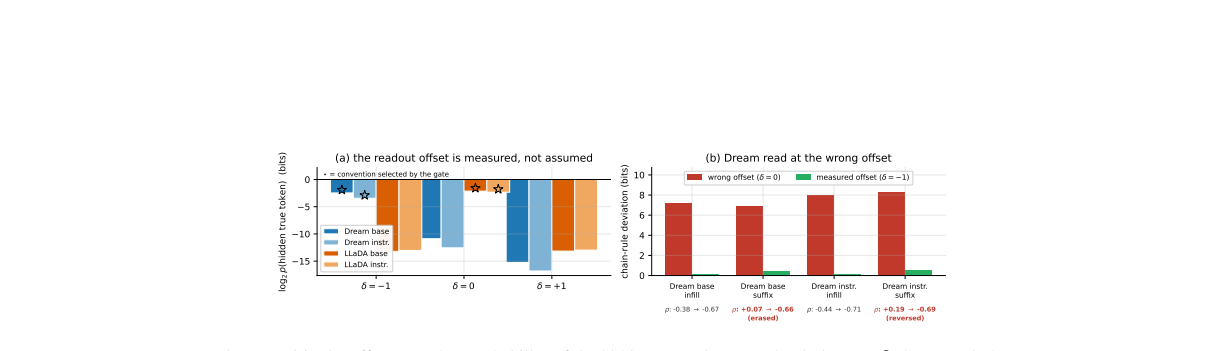
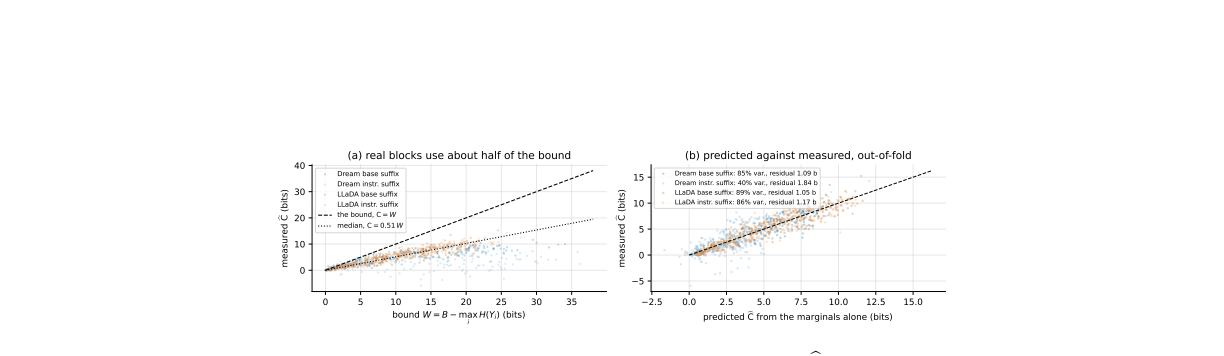
Each token is sampled from its own marginal, so the dependency between the tokens is lost, and the size of that loss is the conditional total correlation C of the committed set. Most decoders choose the set from per-position marginals, which can bound C but cannot determine it. We ask how well they predict it. We estimate C for fixed candidate sets on four masked diffusion LMs from two families. On three of the four, the best marginal-only predictor is off by about one bit (0.74 to 1.17), 1.8 to 3.7 times less than a baseline that knows only the bound, and most of this accuracy comes from the bound itself. On a subset, our estimate ranks sets like the exact KL cost of a parallel commit, but sits a median 0.4 to 1.1 bits below it on prose and when the rest of the text is still masked. Dream-instruct is the exception, mainly on prose, where its conditionals are least self-consistent. Among six common marginal rules, pooling over the set beats gating on its weakest position in all 24 paired comparisons. The measurement needs a validated readout: Dream and LLaDA place a position's prediction at different logit indices, and the wrong index inflates an inconsistency diagnostic 14 to 41 times. We give three checks that measure the convention. Our results concern predicting C for a fixed set, not what a dependency-aware decoder gains.
from the abstract
Pith says
Machine review · deepseek-v4-flash · 25 Nov 2026 · read the full text (60,959 characters) · not checked by a person
It can be wrong. Challenge this review or reply to it.
Holds up, with conditions. Marginal-only rules predict the conditional total correlation of a parallel commit to about one bit on three of four diffusion LMs, but most of that accuracy comes from the bound itself, and the estimate is not always the commit cost. This line is wrong
3 minor
How often objections from reviews like this one are right: not yet measured
The paper, first character to last
The reviewer was given the whole text, 60,959 characters. Not checked: figures, code, what the 34 references say.
3 minor objections
The paper says, at Abstract
Pith says: minor objection 1 of 3
The abstract states that the estimate 'sits a median 0.4 to 1.1 bits below it on prose and when the rest of the text is still masked.' The phrase 'when the rest of the text is still masked' is ambiguous on first reading; it refers to the suffix regime defined later. Consider rephrasing for clarity.
The paper says, at sec:worstcase
Pith says: minor objection 2 of 3
In Section 2, the bound $W$ is introduced as $B- max_i H(Y_i|c)$. The text says 'We call $W$ the bound.' but earlier defines $C_{max}$ as the largest $C$ over all joints with given marginals. It would be helpful to explicitly state that $W$ is an upper bound on $C_{max}$, not necessarily tight, to avoid confusion.
show 1 more
The paper says, at tab:domain
Pith says: minor objection 3 of 3
In Table 1, the column 'subst.' in the caption is not expanded; the table note defines it as 'those beyond $0.2$ bits'. Consider adding a footnote or clarifying in the caption.
What would settle it
Recompute the median fraction of W (C_hat / W) on a held-out set of blocks from a third model family (e.g., MDLM or a different checkpoint size) to verify that the 0.44–0.56 range is not specific to the two families studied. If the fraction shifts by more than 0.10, the claim that most accuracy comes from the bound itself would need qualification.
from the skeptic's reading
How the review went
5 passes by deepseek-v4-flash · 25 Nov 2026
- Reader holds up, with conditions
- Skeptic agrees
- Referee 3 minor
- Check against the paper
- Editor wrote the verdict above
Not run on this paper: the simulated authors' defence.
Pith checked this review's objections against the text of the paper it read.
The review in full
The review in brief, machine-written
This paper asks a concrete, well-scoped question: on a real diffusion LM, how much of the variation in conditional total correlation (C) can a decoder recover from per-position marginals alone? The answer, measured on four checkpoints from two families, is that the best marginal-only predictor is off by 0.74 to 1.17 bits outside Dream-instruct—about 1.8 to 3.7 times better than a baseline that knows only the upper bound W. Most of that accuracy comes from the bound itself, because real candidate sets sit at a stable 0.44 to 0.56 fraction of W. The paper also shows that pooling a rule over the set beats gating on its weakest position in all 24 paired comparisons, and that the advantage of the top-2 margin on synthetic tasks does not carry over to real checkpoints. The measurement protocol is unusually careful: readout gates validated on a second GPU, variance correction on residuals, out-of-fold prediction, and nested model selection quantifying a winner's curse of at most 0.035 bits. The authors repeatedly and honestly state the conditions under which their estimate equals the KL cost of a parallel commit, and they carve out Dream-instruct prose, where the gap reaches 4.4 to 5.6 bits. Two soft spots are worth noting. First, the headline residual is for the estimate C_hat, not for the commit cost itself; on prose and in the suffix regime C_hat sits a median 0.4 to 1.1 bits below the KL cost. Second, the residual is an upper bound—the predictor uses only per-position top-8 probabilities and entropies, and a better predictor could lower it. The paper is a solid, honest measurement that clarifies what marginal rules can and cannot do. It deserves a serious referee and will be useful to anyone designing decoders for masked diffusion LMs.
The strongest objection
The paper's central claim is that on three of four checkpoints, the best marginal-only predictor estimates C_hat to within about one bit, and that most of this accuracy comes from the bound W because real sets use a stable fraction of it. The paper repeatedly acknowledges that C_hat is not always a total correlation (Sec. 5, Limitations), that on Dream-instruct prose it does not measure the commit cost, and that the residual is against C_hat, not against the true KL cost. The reader's weakest_assumption—that the estimator is unbiased only when conditionals compose—is exactly the condition the paper states and tests. The paper provides evidence that on the three well-behaved checkpoints the conditionals are reasonably consistent (chain-rule deviation < 0.8 bits, order information < 1 bit), and that C_hat ranks blocks like the KL cost (Spearman 0.95 and 0.90). The one-bit residual is therefore a meaningful upper bound on how well marginals predict C_hat for those checkpoints. No hidden assumption or unaddressed flaw undermines the headline result within its stated scope.
The stress-test examined the paper's argument for the central claim: that marginals predict C_hat to about one bit on three of four checkpoints. The paper is transparent about the estimator's limitations (Sec. 5, Limitations), the carve-out for Dream-instruct prose, and the fact that the residual is against C_hat, not the true commit cost. The reader's weakest_assumption is already the paper's own stated condition. The paper provides robustness checks (M=256, k=8, nested model selection) and quantifies the gap between C_hat and KL cost on a probe subset. The claim about pooling beating min rules is supported by 24 paired comparisons with bootstrap intervals. No internal inconsistency or circularity was found. The only potential concern—that the residual might be larger against the true commit cost—is acknowledged by the paper, which states that C_hat understates the KL cost by 0.4–1.1 bits on prose and suffix regime. The paper does not claim otherwise. Therefore, no new load-bearing concern arises beyond what the reader already noted. The verdict should remain CONDITIONAL, as the reader's concerns about missing tables and the known failure modes are already addressed by the paper's own limitations and appendices.
The referee's report
This is the first empirical study to measure total correlation per candidate set on real diffusion LMs, and to quantify how much of it is recoverable from marginals. The results are practically relevant for decoder design, showing that the bound $W$ carries most of the information and that pooling rules are more faithful than min rules. The readout validation is a methodological contribution that prevents a subtle bug. The paper is thorough in its analysis, with careful variance correction, out-of-fold prediction, and robustness checks. The limitations are clearly stated.
Pith's reading of the paper (a machine's summary, not the authors')
The paper asks how much of the dependency (total correlation) lost in parallel commits of masked diffusion language models can be recovered from per-position marginals alone. This matters because most decoders use marginal rules to choose which tokens to commit together, but these rules can only bound the dependency, not determine it. On three of four real checkpoints, the best marginal-only predictor estimates the total correlation to within about one bit, and most of that accuracy comes from the bound itself because real sets use a stable fraction of it. The paper also finds that pooling a rule over the set (e.g., mean confidence) beats gating on its weakest position in all comparisons, and provides a validated readout protocol because different models use opposite logit conventions.
What carries the argument. The central object is the conditional total correlation $C(S|c) = sum_{i in S} H(Y_i|c) - H(Y_S|c)$, which measures the dependency lost when committing tokens in parallel. The estimator $C_hat$ uses the chain rule with random reveal orders to estimate the joint entropy $H(Y_S|c)$. The bound $W = B - max_i H(Y_i|c)$ is the maximum dependency the marginals allow. The paper uses these to quantify how well marginal rules (confidence, top-2 margin, entropy, pooled or min-aggregated) predict $C$.
Core claim. The paper establishes that on three of four real masked diffusion language model checkpoints (Dream-Coder 7B base, LLaDA 8B base and instruct), the best marginal-only predictor estimates the conditional total correlation $C(S|c)$ of a fixed committed set to within $0.74$ to $1.17$ bits, which is $1.8$ to $3.7$ times better than a baseline that knows only the upper bound $W = B - max_i H(Y_i|c)$. Most of this accuracy comes from the bound itself because real sets sit at a stable $0.44$ to $0.56$ fraction of $W$. Additionally, pooling a rule over the set (e.g., mean confidence) beats gating on its weakest position (e.g., minimum confidence) in all $24$ paired comparisons. The paper also shows that Dream-instruct is an exception on prose, where its conditionals are least self-consistent and the estimate $C_hat$ does not measure the KL cost of a parallel commit.
The premise it rests on. The chain-rule estimator $C_hat$ is an unbiased estimate of the true total correlation only when the model's conditionals compose into a single joint distribution; when they do not, $C_hat$ is not a total correlation and can be negative, and on Dream-instruct prose the gap to the true KL commit cost reaches 4.4 to 5.6 bits.
If the paper is right (Pith's inferences, not the authors')
Decoders that use marginal rules can estimate the dependency cost of a parallel commit to within about one bit without measuring the joint distribution.
Pooling over the set (e.g., mean confidence) is consistently better than gating on the weakest position, so decoder designs should prefer pooled rules over threshold rules.
The bound $W$ carries most of the information, so simple predictors like $f \cdot W$ are nearly as good as full marginal profiles on most checkpoints.
On Dream-instruct prose, marginal rules cannot reliably predict the commit cost because the model's conditionals are inconsistent; this regime requires a different approach.
The readout protocol (three gates) is essential for reproducible measurements, as the wrong logit convention inflates inconsistency diagnostics by $14$ to $41\times$ and erases correlations.
The finding that pooling beats gating suggests that decoder heuristics that threshold on minimum confidence may be suboptimal; a soft aggregation (e.g., mean confidence) could improve set selection without extra computation.
The stable fraction of $W$ ($0.44$ to $0.56$) across checkpoints hints at a universal property of trained diffusion LMs that could be exploited for calibration or for setting a default predictor.
The readout protocol (three gates) is a practical contribution that should be adopted by any work using Dream or LLaDA, as the wrong convention inflates inconsistency diagnostics and erases correlations, and the error is silent without decoding text.
The paper's results concern fixed sets; an end-to-end decoder study that uses these predictors to choose sets could test whether the one-bit residual translates into a generation quality gain.
Check this review
What was read
The passes were given all 60,959 characters of the paper's LaTeX source.
Fingerprint of that text (SHA-256): 23677ed771dddc0e3402ce3a7d4b6a490551d25ccf564c80d2db0f1894fef214
Pith does not keep that text. Rebuilt from the paper's source or PDF by the same code, it has this fingerprint if it is the same text. From a copy of Pith's code:
PYTHONPATH=. python scripts/review_input_check.py 2611.31990
The passes, in the order they ran
- Reader deepseek-v4-flash · medium effort · $0.0067 · instructions of the Reader, fingerprint f9ead7300382…
- Skeptic deepseek-v4-flash · medium effort · $0.0020 · instructions of the Skeptic, fingerprint 8f88c0f61488…
- Referee deepseek-v4-flash · medium effort · $0.0019 · instructions of the Referee, fingerprint a852d99aea0d…
- Editor deepseek-v4-flash · medium effort · $0.0017 · instructions of the Editor, fingerprint e7211f6a3d27…
- Circularity check deepseek-v4-flash · medium effort · $0.0017 · instructions of the Circularity check, fingerprint e9946e39d67b…
- Summary for the page deepseek-v4-flash · medium effort · temperature 0.2 · $0.0020 · instructions of the Summary for the page, fingerprint e4f56bf568e7…
The passes cost $0.016 in model calls together.
Version stamped on this review: pith-pipeline@v1.4.1-daily-deepseek-or-medium+deepseek/deepseek-v4-flash+p.505d180dcaef
Each link opens a pass's instructions as plain text, the exact bytes its fingerprint was taken over. Every stored set of instructions.
curl -s https://pith.science/methodology/prompts/f9ead730038216984cfb56d7cb34332bdf691828296a1de4245f3d6667d4bf56 | sha256sum
prints the fingerprint of the reader's instructions. The same works for every pass.
The receipt
The review's fingerprint was taken on 25 Nov 2026. The review you are reading still matches it.
Fingerprint of the review (SHA-256): c7a8109d0b31ed452c7b775fdc587c08c0b54604dfcc7e17443e4d16a9c7f03a
curl -s 'https://pith.science/api/v1/verdicts/2611.31990?form=canonical' | sha256sum
prints the fingerprint of the review as it stands now. The rule, in four steps.
A matching fingerprint shows the review has not changed since that date. It does not show that the review is right.
How often reviews like this one are right
Reviews like this one: written by deepseek-v4-flash, from the paper's LaTeX source.
How often objections from reviews like this one are right: not yet measured
Reviews by people
This review was written by a machine. No person has reviewed this paper on Pith yet. A scientist listed on Pith can review it for a fee, and their review is published here whatever it concludes.
The paper
Abstract
A masked diffusion language model is fast because it commits several tokens per step. Each token is sampled from its own marginal, so the dependency between the tokens is lost, and the size of that loss is the conditional total correlation C of the committed set. Most decoders choose the set from per-position marginals, which can bound C but cannot determine it. We ask how well they predict it. We estimate C for fixed candidate sets on four masked diffusion LMs from two families. On three of the four, the best marginal-only predictor is off by about one bit (0.74 to 1.17), 1.8 to 3.7 times less than a baseline that knows only the bound, and most of this accuracy comes from the bound itself. On a subset, our estimate ranks sets like the exact KL cost of a parallel commit, but sits a median 0.4 to 1.1 bits below it on prose and when the rest of the text is still masked. Dream-instruct is the exception, mainly on prose, where its conditionals are least self-consistent. Among six common marginal rules, pooling over the set beats gating on its weakest position in all 24 paired comparisons. The measurement needs a validated readout: Dream and LLaDA place a position's prediction at different logit indices, and the wrong index inflates an inconsistency diagnostic 14 to 41 times. We give three checks that measure the convention. Our results concern predicting C for a fixed set, not what a dependency-aware decoder gains.
The paper's own sentences, arranged, kept beside the review and separate from it. Each label is drawn from a closed vocabulary; the number beside it is the probability the classifier gave that label. No sentence in this record was written by a model.
abstract compiled · 2026-11-25
The authors' main claim, as the classifier picked it out 0.96
“On three of the four, the best marginal-only predictor is off by about one bit (0.74 to 1.17), 1.8 to 3.7 times less than a baseline that knows only the bound, and most of this accuracy comes from the bound itself.”
How the main claim is stated: asserted 1.00
What the abstract itself states, as probabilities: claims first 0.05 · states limitation 0.96 · human participants 0.04 · controlled comparison 0.89 · randomized assignment 0.02 · states quantitative result 0.99 · compares with prior results 0.94 · mentions code or data availability 0.03
The abstract, sentence by sentence
This table labels the abstract only (arXiv listing abstract v1). The number is the probability the classifier gave the label.
| Sentence | Role | The authors' own work | States the main conclusion | Strength |
|---|---|---|---|---|
| A masked diffusion language model is fast because it commits several tokens per step. | background 1.00 | 0.09 | 0.02 | asserted 1.00 |
| Each token is sampled from its own marginal, so the dependency between the tokens is lost, and the size of that loss is the conditional total correlation C of the committed set. | background 0.99 | 0.15 | 0.07 | asserted 1.00 |
| Most decoders choose the set from per-position marginals, which can bound C but cannot determine it. | background 0.83 | 0.09 | 0.05 | asserted 0.97 |
| We ask how well they predict it. | gap 0.55 | 0.18 | 0.02 | unclear 0.93 |
| We estimate C for fixed candidate sets on four masked diffusion LMs from two families. | method 0.83 | 0.95 | 0.04 | asserted 0.96 |
| On three of the four, the best marginal-only predictor is off by about one bit (0.74 to 1.17), 1.8 to 3.7 times less than a baseline that knows only the bound, and most of this accuracy comes from the bound itself. | result 1.00 | 0.93 | 0.43 | asserted 1.00 |
| On a subset, our estimate ranks sets like the exact KL cost of a parallel commit, but sits a median 0.4 to 1.1 bits below it on prose and when the rest of the text is still masked. | result 1.00 | 0.94 | 0.18 | asserted 1.00 |
| Dream-instruct is the exception, mainly on prose, where its conditionals are least self-consistent. | result 0.96 | 0.82 | 0.06 | asserted 1.00 |
| Among six common marginal rules, pooling over the set beats gating on its weakest position in all 24 paired comparisons. | result 1.00 | 0.91 | 0.14 | asserted 1.00 |
| The measurement needs a validated readout: Dream and LLaDA place a position's prediction at different logit indices, and the wrong index inflates an inconsistency diagnostic 14 to 41 times. | method 0.39 | 0.82 | 0.05 | asserted 1.00 |
| We give three checks that measure the convention. | method 0.73 | 0.89 | 0.04 | asserted 1.00 |
| Our results concern predicting C for a fixed set, not what a dependency-aware decoder gains. | limitation 0.99 | 0.43 | 0.15 | asserted 1.00 |
What kind of paper the classifier reports this is: empirical study 0.98 · evidence from observation or experiment 0.72
What was examined, and what was not
Sources read
- arXiv listing abstract v1
Not examined
- full text
- figures and tables
- references and citing sentences
- relations to other papers
Levels run
- P abstract
Not run
- S sections
- T body sentences
- C citations
- R cross-paper relations
How the labels were made
Compiled by classifier-1.13.0 via TypeSafe API, question bank abstract-p1-20260923, 2026-11-25: 1 request, 8,808 input tokens.
Every quoted sentence on this record is the authors'. Every label is from Pith's closed vocabulary, with the probability shown beside it. This record as JSON
Figures (2)
Figures are the authors', reproduced from the paper.
References (34)
- [1] Shen Nie, Fengqi Zhu, Zebin You, Xiaolu Zhang, et al. Large Language Diffusion Models. arXiv:2502.09992, 2025 on PithPith's reviewarXiv
- [2] Jiacheng Ye, Zhihui Xie, Lin Zheng, Jiahui Gao, et al. Dream 7B: Diffusion Large Language Models. arXiv:2508.15487, 2025 on PithPith's reviewarXiv
- [3] Zhihui Xie, Jiacheng Ye, Lin Zheng, Jiahui Gao, et al. Dream-Coder 7B: An Open Diffusion Language Model for Code. arXiv:2509.01142, 2025. (Checkpoints: Dream-Coder-v0 Base / Instruct 7B.) on PithPith's reviewarXiv
- [4] Chengyue Wu, Hao Zhang, Shuchen Xue, Zhijian Liu, et al. Fast-dLLM: Training-free Acceleration of Diffusion LLM by Enabling KV Cache and Parallel Decoding. arXiv:2505.22618, 2025 on PithPith's reviewarXiv
- [5] Tianyi Wu, Xiaoxi Sun, Yanhua Jiao, Yulin Li, et al. Dynamic-dLLM: Dynamic Cache-Budget and Adaptive Parallel Decoding for Training-Free Acceleration of Diffusion LLM. arXiv:2606.26120, 2026 on PithPith's reviewarXiv
- [6] Amr Mohamed, Guokan Shang, and Michalis Vazirgiannis. LESS Is More: Mutual-Stability Sampling for Diffusion Language Models. arXiv:2606.16908, 2026 on PitharXiv
- [7] Bumjun Kim, Dongjae Jeon, Moongyu Jeon, and Albert No. DAPD: Dependency-Aware Parallel Decoding via Attention for Diffusion LLMs. In ICML, 2026. arXiv:2603.12996 on PithPith's reviewarXiv
- [8] Lipeng Wan, Junjie Ma, Jianhui Gu, Zeyang Liu, et al. GeoBlock: Inferring Block Granularity from Dependency Geometry in Diffusion Language Models. arXiv:2603.26675, 2026 on PitharXiv
- [9] Wonjun Kang, Kevin Galim, Seunghyuk Oh, Minjae Lee, et al. ParallelBench: Understanding the Trade- offs of Parallel Decoding in Diffusion LLMs. In ICLR, 2026. arXiv:2510.04767 on PithPith's reviewarXiv
- [10] Anji Liu, Oliver Broadrick, Mathias Niepert, and Guy Van den Broeck. Discrete Copula Diffusion. arXiv:2410.01949, 2024 on PithPith's reviewarXiv
- [11] Shaorong Zhang, Longxuan Yu, Rob Brekelmans, Luhan Tang, et al. Generation Order and Parallel Decoding in Masked Diffusion Models: An Information-Theoretic Perspective. arXiv:2602.00286, 2026 on PitharXiv
- [12] Subham Sekhar Sahoo, Marianne Arriola, Yair Schiff, Aaron Gokaslan, et al. Simple and Effective Masked Diffusion Language Models. In NeurIPS, 2024. arXiv:2406.07524 on PithPith's reviewarXiv
- [13] Jiaxin Shi, Kehang Han, Zhe Wang, Arnaud Doucet, et al. Simplified and Generalized Masked Diffusion for Discrete Data. In NeurIPS, 2024. arXiv:2406.04329 on PithPith's reviewarXiv
- [14] Guhao Feng, Yihan Geng, Jian Guan, Wei Wu, et al. Theoretical Benefit and Limitation of Diffusion Language Model. arXiv:2502.09622, 2025 on PithPith's reviewarXiv
- [15] Sitan Chen, Kevin Cong, and Jerry Li. Optimal Inference Schedules for Masked Diffusion Models. arXiv:2511.04647, 2025 on PitharXiv
- [16] Fei Huang, Tianhua Tao, Hao Zhou, Lei Li, et al. On the Learning of Non-Autoregressive Transformers. In ICML, 2022. arXiv:2206.05975 on PithPith's reviewarXiv
- [17] Yue Wu and Jian Huang. Stability-Weighted Decoding for Diffusion Language Models. arXiv:2604.17068, 2026 on PithPith's reviewarXiv
- [18] Lin Yao. Don’t Commit Alone: Joint Token Commitment in Diffusion Language Models. arXiv:2607.04469, 2026 on PithPith's reviewarXiv
- [19] Jai Sharma, Yifan Wang, and Bryan Li. Neural Estimation of Pairwise Mutual Information in Masked Discrete Sequence Models. arXiv:2605.20187, 2026 on PithPith's reviewarXiv
- [20] Liran Ringel, Ameen Ali, and Yaniv Romano. Dependency-Guided Parallel Decoding in Discrete Diffusion Language Models. arXiv:2604.02560, 2026 on PithPith's reviewarXiv
show 14 more
- [21] Linjun Li. One-step lowest-variance selection in a Gaussian random-field model motivated by masked diffusion: Total correlation and a square root collision threshold. arXiv:2607.17522, 2026 on PithPith's reviewarXiv
- [22] Nazia Riasat. When Marginals Match but Structure Fails: Covariance Fidelity in Generative Models. Extended version of a paper in MathAI, 2026. arXiv:2603.17041 on PithPith's reviewarXiv
- [23] Yunxiao Zhao and Changxiao Cai. Adaptation to Intrinsic Dependence in Diffusion Language Models. arXiv:2602.20126, 2026 on PitharXiv
- [24] Lizhuo Luo, Zhuoran Shi, Jiajun Luo, Zhi Wang, et al. DAWN: Dependency-Aware Fast Inference for Diffusion LLMs. arXiv:2602.06953, 2026 on PithPith's reviewarXiv
- [25] Xueyu Zhou, Yangrong Hu, and Jian Huang. DOS: Dependency-Oriented Sampler for Masked Diffusion Language Models. arXiv:2603.15340, 2026 on PitharXiv
- [26] Heqiang Qi, Wei Huang, Mingyuan Bai, and Xiangming Meng. Cluster-Level Attention-Guided Parallel Decoding for Masked Diffusion Language Models. arXiv:2605.29607, 2026. 9 on PithPith's reviewarXiv
- [27] Tamim Zoabi, Ameen Ali, Liran Ringel, and Lior Wolf. Mean-Field Parallel Decoding for Discrete Diffusion Language Models. arXiv:2606.15805, 2026 on PitharXiv
- [28] Bohang Sun, Max Zhu, Francesco Caso, Jindong Gu, et al. The Path Matters: Learning a Token- Commitment Policy for Diffusion Language Models. arXiv:2605.24697, 2026 on PithPith's reviewarXiv
- [29] Lin Yao. Decoding in Order-Agnostic Language Models: Chain-Rule Deviation and Uniform Spreading. arXiv:2606.00997, 2026 on PithPith's reviewarXiv
- [30] Tom Young, Yunan Chen, and Yang You. Inconsistencies in Masked Language Models. arXiv:2301.00068, 2022 on PithPith's reviewarXiv
- [31] Suvadip Sana, Sami Wolf, Neer Mehta, Alina Shah, et al. Mixing Times of Glauber Dynamics on Masked Language Models. arXiv:2605.16378, 2026 on PithPith's reviewarXiv
- [32] Jeonseong Kim. Path-Dependent Denoising: A Non-Conservative Field Perspective on Order Collapse in Diffusion Language Models. arXiv:2605.09303, 2026 on PithPith's reviewarXiv
- [33] Iskander Azangulov, Teodora Pandeva, Niranjani Prasad, Javier Zazo, and Sushrut Karmalkar. Paral- lel Sampling from Masked Diffusion Models via Conditional Independence Testing. In ICLR, 2026. arXiv:2510.21961 on PitharXiv
- [34] Michael Hersche, Nicolas Menet, Ronan Tanios, and Abbas Rahimi. Locally Coherent Parallel Decoding in Diffusion Language Models. arXiv:2603.20216, 2026. 10 A Experimental details Corpus. 285 documents: for English prose, 121 WikiText-103 articles of at least 600 characters fro... on PithPith's reviewarXiv
Challenges and discussion
Disagree with the review, or know something it missed? Leave a comment, or challenge this review formally: a challenge becomes a permanent entry in this paper's record, and its decision is published here.
Come back by email
A short list of the week's newly reviewed papers. Nothing is sent until you confirm from your inbox, and every email has a link that stops it. No account.
No comments yet.
Sign in to comment