Long-time Freeness in the Kicked Top
Pith reviewed 2026-05-25 08:37 UTC · model grok-4.3
The pith
In the kicked top, fully chaotic dynamics reach long-time freeness exponentially fast.
A machine-rendered reading of the paper's core claim, the machinery that carries it, and where it could break.
Core claim
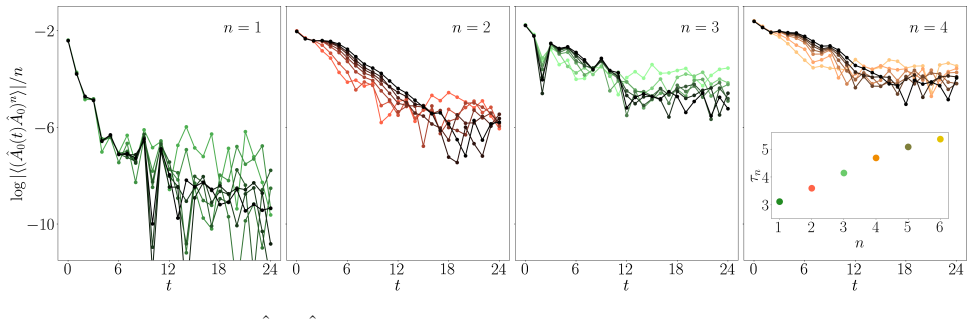
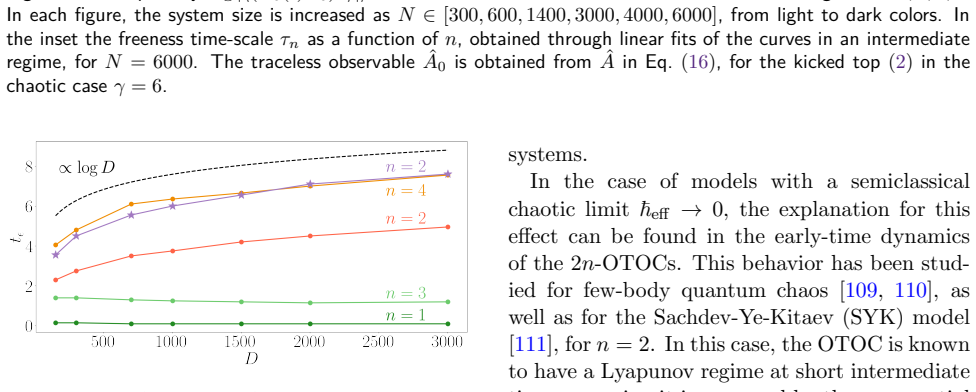
By numerically studying 2n-point out-of-time-order correlators in the kicked top, the work shows that in the fully chaotic regime, long-time freeness is reached exponentially fast. This prompts the introduction of a large deviation theory for freeness, which defines and analyzes the relevant time scale, with numerics confirming a hierarchy of different time scales and a multifractal approach to freeness.
What carries the argument
The 2n-point out-of-time-order correlators, which probe the higher-order correlations needed to establish free independence between observables under chaotic dynamics.
Load-bearing premise
The numerical extraction of 2n-point out-of-time-order correlators in the kicked top faithfully captures the long-time limit without significant finite-size or truncation artifacts that would alter the observed exponential decay or the hierarchy of time scales.
What would settle it
A calculation in larger system sizes showing that the decay of the out-of-time-order correlators is not exponential or that the hierarchy of time scales disappears would falsify the claim of exponential freeness with multifractal structure.
Figures



read the original abstract
Recent work highlighted the importance of higher-order correlations in quantum dynamics for a deeper understanding of quantum chaos and thermalization. The full Eigenstate Thermalization Hypothesis, the framework encompassing correlations, can be formalized using the language of Free Probability theory. In this context, chaotic dynamics at long times are proposed to lead to free independence or "freeness" of observables. In this work, we investigate these issues in a paradigmatic semiclassical model - the kicked top - which exhibits a transition from integrability to chaos. Despite its simplicity, we identify several non-trivial features. By numerically studying 2n-point out-of-time-order correlators, we show that in the fully chaotic regime, long-time freeness is reached exponentially fast. These considerations lead us to introduce a large deviation theory for freeness that enables us to define and analyze the associated time scale. The numerical results confirm the existence of a hierarchy of different time scales, indicating a multifractal approach to freeness in this model. Our findings provide novel insights into the long-time behavior of chaotic dynamics and may have broader implications for the study of many-body quantum dynamics.
Editorial analysis
A structured set of objections, weighed in public.
Referee Report
Summary. The paper studies the approach to freeness (free independence of observables) in the kicked top, a semiclassical model with an integrability-to-chaos transition. Using numerical computation of 2n-point out-of-time-order correlators, it claims that in the fully chaotic regime freeness is reached exponentially fast. The authors introduce a large-deviation theory for freeness to define associated time scales and report a hierarchy of scales, interpreted as a multifractal approach to freeness.
Significance. If the numerical results are free of truncation or recurrence artifacts, the work supplies a concrete large-deviation framework for quantifying the onset of freeness and demonstrates a separation of time scales in a paradigmatic chaotic map. This could inform studies of higher-order correlations and thermalization in quantum many-body systems. The explicit construction of the large-deviation rate function and the numerical extraction of multiple time scales are constructive contributions.
major comments (2)
- [Numerical results on OTOCs] Numerical OTOC analysis (section describing 2n-point correlators): the claimed exponential decay to freeness and the extracted time-scale hierarchy rest on finite-j data (dim=2j+1). The manuscript must demonstrate that the fitting window lies well before finite-size recurrences set in and that the decay rate is stable under increase of j; otherwise the exponential and the multifractal hierarchy could be artifacts of the accessible time interval.
- [Large deviation theory for freeness] Large-deviation theory section: the rate function and the associated time scales appear to be extracted from the same OTOC decay data used to claim exponential approach. The manuscript should show that the large-deviation function can be defined and computed independently of the numerical fit, or explicitly state the fitting procedure and its uncertainty, to avoid circularity in the reported hierarchy of scales.
minor comments (2)
- [Numerical methods] Clarify the precise definition of the 2n-point OTOC used (which operators, which ordering) and state the range of n and j values employed.
- [Discussion] Add a brief comparison of the observed time scales with known semiclassical or random-matrix predictions for the kicked top.
Simulated Author's Rebuttal
We thank the referee for the constructive report and the positive assessment of the potential significance of our work. We address the two major comments point by point below, indicating the revisions we will incorporate.
read point-by-point responses
-
Referee: Numerical OTOC analysis (section describing 2n-point correlators): the claimed exponential decay to freeness and the extracted time-scale hierarchy rest on finite-j data (dim=2j+1). The manuscript must demonstrate that the fitting window lies well before finite-size recurrences set in and that the decay rate is stable under increase of j; otherwise the exponential and the multifractal hierarchy could be artifacts of the accessible time interval.
Authors: We agree that finite-size effects must be carefully controlled. In the revised manuscript we will add a dedicated subsection with explicit checks: (i) recurrence times estimated from the dimension 2j+1 and shown to lie well beyond the fitting windows used; (ii) decay rates extracted for j=50,100,150,200, confirming stability of the exponential rates within statistical error; (iii) direct comparison of the OTOC traces for the two largest j values over the relevant time interval. These additions will be placed in the numerical-results section and will be accompanied by the corresponding figures. revision: yes
-
Referee: Large deviation theory for freeness: the rate function and the associated time scales appear to be extracted from the same OTOC decay data used to claim exponential approach. The manuscript should show that the large-deviation function can be defined and computed independently of the numerical fit, or explicitly state the fitting procedure and its uncertainty, to avoid circularity in the reported hierarchy of scales.
Authors: The large-deviation rate function is defined theoretically as the Legendre transform of the scaled cumulant-generating function of log|OTOC|, which is independent of any particular numerical fit. The time scales are then obtained as the derivatives of this rate function at the relevant points. In the revised manuscript we will (a) restate this theoretical construction explicitly, (b) provide the precise fitting protocol (least-squares window, weighting, and bootstrap uncertainty estimates) used to extract the cumulants from the OTOC data, and (c) show that the resulting hierarchy of time scales is robust under reasonable variations of the fitting window. This will eliminate any appearance of circularity while preserving the original numerical results. revision: yes
Circularity Check
No significant circularity; large-deviation theory introduced as independent analytical framework
full rationale
The paper numerically computes 2n-point OTOCs in the kicked top to observe exponential approach to freeness in the chaotic regime. It then introduces a large deviation theory for freeness to define and analyze associated time scales, with the same numerics used to confirm a hierarchy of scales. This introduction of theory does not reduce by construction to the numerical inputs (no self-definitional loop or fitted parameter renamed as prediction). No self-citation chains, uniqueness theorems, or ansatzes smuggled via prior work are load-bearing. The derivation remains self-contained against external benchmarks of free probability and chaotic dynamics.
Axiom & Free-Parameter Ledger
axioms (1)
- domain assumption Free probability theory provides the correct language for higher-order correlations in chaotic quantum dynamics.
invented entities (1)
-
Large deviation theory for freeness
no independent evidence
Forward citations
Cited by 6 Pith papers
-
Page Curve for Local-Operator Entanglement from Free Probability
LOE for Haar random dynamics asymptotically matches the Page curve for traceless operators and is independent of the initial operator at leading order.
-
Timescales for Deep and Full Thermalization
In a chaotic quantum system, higher-order correlations reach thermal equilibrium faster than state design moments, both relaxing exponentially.
-
Complexity of Quantum Trajectories
Intrinsic dimension of quantum trajectories serves as an unsupervised probe sensitive to chaos, integrability, and ergodicity breaking in dissipative quantum systems.
-
Scaling of free cumulants in closed system-bath setups
Microcanonical free cumulants of central-system observables scale universally with system-bath interaction strength in closed setups, connecting to thermalization dynamics.
-
Complexity of Quadratic Quantum Chaos
Hard-core boson two-body models with random interactions exhibit chaotic spectral statistics, operator growth, and eigenstate properties approaching those of random matrices and the SYK model.
-
Quantum analogues of exponential sensitivity: from Loschmidt echo to Krylov complexity
This review surveys the Loschmidt echo, OTOCs, and Krylov complexity as quantum proxies for classical Lyapunov exponents in chaotic systems.
Reference graph
Works this paper leans on
-
[1]
Philippe Delsarte, Jean-Marie Goethals, and Johan Jacob Seidel. “Spherical codes and designs”. In Geometry and Combinatorics. Pages 68–93. Else- vier (1991). url:https://doi.org/10. 1007/BF03187604
work page 1991
-
[2]
Efficient Simulation of Random Quantum States and Operators
Christoph Dankert. “Efficient simulation of random quantum states and opera- tors” (2005). url:https://doi.org/10. 48550/arXiv.quant-ph/0512217
work page internal anchor Pith review Pith/arXiv arXiv 2005
-
[3]
Exact and ap- proximate unitary 2-designs and their ap- plication to fidelity estimation
Christoph Dankert, Richard Cleve, Joseph Emerson, and Etera Livine. “Exact and ap- proximate unitary 2-designs and their ap- plication to fidelity estimation”. Phys. Rev. A80, 012304 (2009)
work page 2009
-
[4]
Emergent quan- tum state designs from individual many- body wave functions
Jordan S Cotler, Daniel K Mark, Hsin- Yuan Huang, Felipe Hernandez, Joonhee Choi, Adam L Shaw, Manuel Endres, and Soonwon Choi. “Emergent quan- tum state designs from individual many- body wave functions”. PRX Quantum4, 010311 (2023). url:10.1103/PRXQuantum. 4.010311
-
[5]
Preparing random states and bench- marking with many-body quantum chaos
Joonhee Choi, Adam L. Shaw, Ivaylo S. Madjarov, Xin Xie, Ran Finkelstein, Ja- cob P. Covey, Jordan S. Cotler, Daniel K. Mark, Hsin-Yuan Huang, Anant Kale, Hannes Pichler, Fernando G. S. L. Brand˜ ao, Soonwon Choi, and Manuel En- dres. “Preparing random states and bench- marking with many-body quantum chaos”. Nature613, 468–473 (2023)
work page 2023
-
[6]
Ex- act emergent quantum state designs from quantum chaotic dynamics
Wen Wei Ho and Soonwon Choi. “Ex- act emergent quantum state designs from quantum chaotic dynamics”. Phys. Rev. Lett.128, 060601 (2022)
work page 2022
-
[7]
Emergent quantum state designs and biu- nitarity in dual-unitary circuit dynamics
Pieter W Claeys and Austen Lamacraft. “Emergent quantum state designs and biu- nitarity in dual-unitary circuit dynamics”. Quantum6, 738 (2022)
work page 2022
-
[8]
Solv- able model of deep thermalization with distinct design times
Matteo Ippoliti and Wen Wei Ho. “Solv- able model of deep thermalization with distinct design times”. Quantum6, 886 (2022). url:https://doi.org/10. 22331/q-2022-12-29-886
work page 2022
-
[9]
General- ized deep thermalization for free fermions
Maxime Lucas, Lorenzo Piroli, Jacopo De Nardis, and Andrea De Luca. “General- ized deep thermalization for free fermions”. Phys. Rev. A107, 032215 (2023)
work page 2023
-
[10]
Deep thermalization in con- 16 strained quantum systems
Tanmay Bhore, Jean-Yves Desaules, and Zlatko Papi´ c. “Deep thermalization in con- 16 strained quantum systems”. Phys. Rev. B 108, 104317 (2023)
work page 2023
-
[11]
Shadow tomography from emergent state designs in analog quantum simulators
Max McGinley and Michele Fava. “Shadow tomography from emergent state designs in analog quantum simulators”. Phys. Rev. Lett.131, 160601 (2023)
work page 2023
-
[12]
Com- plete hilbert-space ergodicity in quantum dynamics of generalized fibonacci drives
Sa´ ul Pilatowsky-Cameo, Ceren B. Dag, Wen Wei Ho, and Soonwon Choi. “Com- plete hilbert-space ergodicity in quantum dynamics of generalized fibonacci drives”. Phys. Rev. Lett.131, 250401 (2023)
work page 2023
-
[13]
A maximum entropy principle in deep thermalization and in hilbert-space ergod- icity
Daniel K Mark, Federica Surace, Andreas Elben, Adam L Shaw, Joonhee Choi, Gil Refael, Manuel Endres, and Soonwon Choi. “A maximum entropy principle in deep thermalization and in hilbert-space ergod- icity” (2024). url:https://arxiv.org/ abs/2403.11970
-
[14]
Subsystem eigenstate ther- malization hypothesis
Anatoly Dymarsky, Nima Lashkari, and Hong Liu. “Subsystem eigenstate ther- malization hypothesis”. Phys. Rev. E97, 012140 (2018)
work page 2018
-
[15]
Universal eigenstate en- tanglement of chaotic local hamiltonians
Yichen Huang. “Universal eigenstate en- tanglement of chaotic local hamiltonians”. Nuclear Physics B938, 594–604 (2019)
work page 2019
-
[16]
Renyi entropy of chaotic eigenstates
Tsung-Cheng Lu and Tarun Grover. “Renyi entropy of chaotic eigenstates”. Phys. Rev. E99, 032111 (2019)
work page 2019
-
[17]
Structure of chaotic eigenstates and their entanglement entropy
Chaitanya Murthy and Mark Srednicki. “Structure of chaotic eigenstates and their entanglement entropy”. Physical Review E100, 022131 (2019). url:https://doi. org/10.1103/PhysRevE.100.022131
-
[18]
Local dynamics and the struc- ture of chaotic eigenstates
Zhengyan Darius Shi, Shreya Vardhan, and Hong Liu. “Local dynamics and the struc- ture of chaotic eigenstates”. Physical Re- view B108, 224305 (2023)
work page 2023
-
[19]
Dominik Hahn, David J. Luitz, and J. T. Chalker. “Eigenstate correlations, the eigenstate thermalization hypothesis, and quantum information dynamics in chaotic many-body quantum systems”. Phys. Rev. X14, 031029 (2024)
work page 2024
-
[20]
Gen- eralized free cumulants for quantum chaotic systems
Siddharth Jindal and Pavan Hosur. “Gen- eralized free cumulants for quantum chaotic systems” (2024). url:https:// doi.org/10.48550/arXiv.2401.13829
-
[21]
Fluc- tuations in ballistic transport from eu- ler hydrodynamics
Benjamin Doyon and Jason Myers. “Fluc- tuations in ballistic transport from eu- ler hydrodynamics”. In Annales Henri Poincar´ e. Volume 21, pages 255–302. Springer (2020)
work page 2020
-
[23]
Hydrodynamic nonlinear response of interacting inte- grable systems
Michele Fava, Sounak Biswas, Sarang Gopalakrishnan, Romain Vasseur, and SA Parameswaran. “Hydrodynamic nonlinear response of interacting inte- grable systems”. Proceedings of the National Academy of Sciences118, e2106945118 (2021)
work page 2021
-
[24]
Nonlinear response in diffusive systems
Luca V Delacr´ etaz and Ruchira Mishra. “Nonlinear response in diffusive systems”. SciPost Physics16, 047 (2024)
work page 2024
-
[25]
Taishi Kawamoto. “A strategy for prov- ing the strong eigenstate thermalization hypothesis: Chaotic systems and hologra- phy” (2024). url:https://doi.org/10. 48550/arXiv.2411.09746
-
[26]
Juan Maldacena, Stephen H. Shenker, and Douglas Stanford. “A bound on chaos”. Journal of High Energy Physics2016(2016). url:https://doi. org/10.1007/jhep08(2016)106
-
[27]
Pavan Hosur, Xiao-Liang Qi, Daniel A. Roberts, and Beni Yoshida. “Chaos in quantum channels”. Journal of High En- ergy Physics2016(2016). url:https:// doi.org/10.1007/jhep02(2016)004
-
[28]
Scram- bling dynamics and out-of-time ordered correlators in quantum many-body sys- tems: a tutorial
Shenglong Xu and Brian Swingle. “Scram- bling dynamics and out-of-time ordered correlators in quantum many-body sys- tems: a tutorial” (2022). url:https:// arxiv.org/pdf/2202.07060.pdf
-
[29]
Out- of-time-order correlators and quantum chaos
Ignacio Garc´ ıa-Mata, Rodolfo A. Jal- abert, and Diego A. Wisniacki. “Out- of-time-order correlators and quantum chaos”. Scholarpedia18, 55237 (2023). arXiv:2209.07965
-
[30]
Qua- siclassical method in the theory of super- conductivity
AI Larkin and Yu N Ovchinnikov. “Qua- siclassical method in the theory of super- conductivity”. Soviet Physics JETP28, 1200–1205 (1969). url:https://doi.org/ 10.1007/BF01090734
-
[31]
Talk given at the fundamen- tal physics prize symposium
A. Kitaev. “Talk given at the fundamen- tal physics prize symposium”. YouTube. 17 (20145). url:https://www.youtube.com/ watch?v=OQ9qN8j7EZI
-
[32]
Chaos and complexity by design
Daniel A Roberts and Beni Yoshida. “Chaos and complexity by design”. Jour- nal of High Energy Physics2017, 1– 64 (2017). url:https://doi.org/10. 1007/JHEP04%282017%29121
work page 2017
-
[33]
Chaos, complexity, and random matrices
Jordan Cotler, Nicholas Hunter-Jones, Junyu Liu, and Beni Yoshida. “Chaos, complexity, and random matrices”. Journal of High Energy Physics2017, 1–60 (2017)
work page 2017
-
[34]
Bound on the ex- ponential growth rate of out-of-time- ordered correlators
Naoto Tsuji, Tomohiro Shitara, and Masahito Ueda. “Bound on the ex- ponential growth rate of out-of-time- ordered correlators”. Physical Review E98, 012216 (2018). url:https: //journals.aps.org/pre/abstract/10. 1103/PhysRevE.98.012216
work page 2018
-
[35]
Spectral decoupling in many-body quan- tum chaos
Jordan Cotler and Nicholas Hunter-Jones. “Spectral decoupling in many-body quan- tum chaos”. Journal of High Energy Physics2020, 1–62 (2020)
work page 2020
-
[36]
Lorenzo Leone, Salvatore FE Oliviero, You Zhou, and Alioscia Hamma. “Quan- tum chaos is quantum”. Quantum5, 453 (2021). url:https://doi.org/10. 22331/q-2021-05-04-453
work page 2021
-
[37]
Quantum bounds on the generalized lya- punov exponents
Silvia Pappalardi and Jorge Kurchan. “Quantum bounds on the generalized lya- punov exponents”. Entropy25, 246 (2023)
work page 2023
-
[38]
Quantum chaos with- out false positives
Dmitrii A Trunin. “Quantum chaos with- out false positives”. Physical Review D 108, L101703 (2023)
work page 2023
-
[39]
Refined quantum lya- punov exponents from replica out-of-time- order correlators
Dmitrii A Trunin. “Refined quantum lya- punov exponents from replica out-of-time- order correlators”. Physical Review D108, 105023 (2023)
work page 2023
-
[40]
Chaos and quantum ther- malization
Mark Srednicki. “Chaos and quantum ther- malization”. Physical Review E50, 888– 901 (1994). url:https://doi.org/10. 1103/physreve.50.888
work page 1994
-
[41]
The approach to ther- mal equilibrium in quantized chaotic systems
Mark Srednicki. “The approach to ther- mal equilibrium in quantized chaotic systems”. Journal of Physics A: Mathematical and General32, 1163– 1175 (1999). url:https://doi.org/10. 1088/0305-4470/32/7/007
work page 1999
-
[42]
From quantum chaos and eigenstate thermaliza- tion to statistical mechanics and thermo- dynamics
Luca D’Alessio, Yariv Kafri, Anatoli Polkovnikov, and Marcos Rigol. “From quantum chaos and eigenstate thermaliza- tion to statistical mechanics and thermo- dynamics”. Advances in Physics65, 239– 362 (2016). url:https://doi.org/10. 1080/00018732.2016.1198134
-
[43]
Eigen- state thermalization hypothesis and out of time order correlators
Laura Foini and Jorge Kurchan. “Eigen- state thermalization hypothesis and out of time order correlators”. Phys. Rev. E99, 042139 (2019)
work page 2019
-
[44]
Ergodic properties of a generic nonintegrable quantum many-body system in the thermodynamic limit
Tomaz Prosen. “Ergodic properties of a generic nonintegrable quantum many-body system in the thermodynamic limit”. Phys. Rev. E60, 3949–3968 (1999)
work page 1999
-
[45]
Eigen- state thermalization in the sachdev-ye- model
Julian Sonner and Manuel Vielma. “Eigen- state thermalization in the sachdev-ye- model”. Journal of High Energy Physics 2017, 1–28 (2017)
work page 2017
-
[46]
Eigen- state thermalization and rotational invari- ance in ergodic quantum systems
Laura Foini and Jorge Kurchan. “Eigen- state thermalization and rotational invari- ance in ergodic quantum systems”. Phys. Rev. Lett.123, 260601 (2019)
work page 2019
-
[47]
Eigenstate correlations, thermal- ization, and the butterfly effect
Amos Chan, Andrea De Luca, and J. T. Chalker. “Eigenstate correlations, thermal- ization, and the butterfly effect”. Phys. Rev. Lett.122, 220601 (2019)
work page 2019
-
[48]
Bounds on chaos from the eigenstate ther- malization hypothesis
Chaitanya Murthy and Mark Srednicki. “Bounds on chaos from the eigenstate ther- malization hypothesis”. Physical Review Letters123(2019). url:https://doi.org/ 10.1103/physrevlett.123.230606
-
[49]
Jonas Richter, Anatoly Dymarsky, Robin Steinigeweg, and Jochen Gemmer. “Eigenstate thermalization hypothesis beyond standard indicators: Emer- gence of random-matrix behavior at small frequencies”. Physical Review E102(2020). url:https://doi.org/10. 1103/physreve.102.042127
work page 2020
-
[51]
Out-of-time-order correla- tions and the fine structure of eigen- state thermalization
Marlon Brenes, Silvia Pappalardi, Mark T. Mitchison, John Goold, and Alessan- dro Silva. “Out-of-time-order correla- tions and the fine structure of eigen- state thermalization”. Physical Review E104(2021). url:https://doi.org/10. 1103/physreve.104.034120. 18
work page 2021
-
[52]
Bound on eigenstate thermalization from transport
Anatoly Dymarsky. “Bound on eigenstate thermalization from transport”. Phys. Rev. Lett.128, 190601 (2022)
work page 2022
-
[53]
Exact universal chaos, speed limit, acceleration, planckian transport coeffi- cient,“collapse
Zohar Nussinov and Saurish Chakrabarty. “Exact universal chaos, speed limit, acceleration, planckian transport coeffi- cient,“collapse” to equilibrium, and other bounds in thermal quantum systems”. An- nals of Physics443, 168970 (2022)
work page 2022
-
[54]
Matrix models for eigenstate ther- malization
Daniel Louis Jafferis, David K Kolchmeyer, Baur Mukhametzhanov, and Julian Son- ner. “Matrix models for eigenstate ther- malization” (2022). url:https://arxiv. org/abs/2209.02130
-
[55]
Jt gravity with mat- ter, generalized eth, and random matri- ces
Daniel Louis Jafferis, David K Kolch- meyer, Baur Mukhametzhanov, and Ju- lian Sonner. “Jt gravity with mat- ter, generalized eth, and random matri- ces” (2022). url:https://arxiv.org/abs/ 2209.02131
-
[56]
Jiaozi Wang, Jonas Richter, Mats H Lamann, Robin Steinigeweg, Jochen Gem- mer, and Anatoly Dymarsky. “Emer- gence of unitary symmetry of microcanon- ically truncated operators in chaotic quan- tum systems”. Physical Review E110, L032203 (2024)
work page 2024
-
[57]
Designs via free probabil- ity
Michele Fava, Jorge Kurchan, and Silvia Pappalardi. “Designs via free probabil- ity” (2023)
work page 2023
-
[58]
Full eigenstate thermaliza- tion via free cumulants in quantum lattice systems
Silvia Pappalardi, Felix Fritzsch, and Tomaˇ z Prosen. “Full eigenstate thermaliza- tion via free cumulants in quantum lattice systems” (2023)
work page 2023
-
[59]
Microcanonical windows on quantum operators
Silvia Pappalardi, Laura Foini, and Jorge Kurchan. “Microcanonical windows on quantum operators”. Quantum8, 1227 (2024). url:https://doi.org/10. 22331/q-2024-01-11-1227
work page 2024
-
[60]
Microcanonical free cumulants in lattice systems
Felix Fritzsch, Tomaˇ z Prosen, and Sil- via Pappalardi. “Microcanonical free cumulants in lattice systems” (2024). arXiv:2409.01404
-
[61]
Eigenstate thermalization hy- pothesis and free probability
Silvia Pappalardi, Laura Foini, and Jorge Kurchan. “Eigenstate thermalization hy- pothesis and free probability”. Phys. Rev. Lett.129, 170603 (2022)
work page 2022
-
[62]
Limit laws for ran- dom matrices and free products
Dan Voiculescu. “Limit laws for ran- dom matrices and free products”. Inven- tiones Mathematicae104, 201–220 (1991). url:http://eudml.org/doc/143880
work page 1991
-
[63]
Dan V Voiculescu, Ken J Dykema, and Alexandru Nica. “Free random vari- ables”. American Mathematical Society. (1992). url:https://doi.org/10.1090/ crmm/001
work page 1992
-
[64]
Free probability theory and non-crossing partitions
Roland Speicher. “Free probability theory and non-crossing partitions.”. S´ eminaire Lotharingien de Combinatoire39, B39c– 38 (1997). url:https://citeseerx.ist. psu.edu/viewdoc/download?doi=10.1. 1.34.6530&rep=rep1&type=pdf
work page 1997
-
[65]
Edouard Br´ ezin, Claude Itzykson, Giorgio Parisi, and Jean-Bernard Zuber. “Planar diagrams”. Communications in Mathemat- ical Physics59, 35–51 (1978). url:https: //projecteuclid.org/journals/ communications-in-mathematical-physics/ volume-59/issue-1/Planar-diagrams/ cmp/1103901558.full
-
[66]
Planar perturba- tion expansion
Predrag Cvitanovi´ c. “Planar perturba- tion expansion”. Physics Letters B99, 49–52 (1981). url:https://doi.org/10. 1016/0370-2693(81)90801-7
work page 1981
-
[67]
The planar sector of field theories
Predrag Cvitanovi´ c, PG Lauwers, and PN Scharbach. “The planar sector of field theories”. Nuclear Physics B203, 385– 412 (1982). url:https://doi.org/10. 1016/0550-3213(82)90320-0
work page 1982
-
[68]
Ran- dom matrix techniques in quantum infor- mation theory
Benoˆ ıt Collins and Ion Nechita. “Ran- dom matrix techniques in quantum infor- mation theory”. Journal of Mathematical Physics57(2016). url:https://doi.org/ 10.1063/1.4936880
-
[69]
Ran- dom quantum channels i: Graphical calcu- lus and the bell state phenomenon
Benoˆ ıt Collins and Ion Nechita. “Ran- dom quantum channels i: Graphical calcu- lus and the bell state phenomenon”. Com- munications in Mathematical Physics297, 345–370 (2010). url:https://doi.org/ 10.1007/s00220-010-1012-0
-
[70]
Distinguishing ran- dom and black hole microstates
Jonah Kudler-Flam, Vladimir Narovlan- sky, and Shinsei Ryu. “Distinguishing ran- dom and black hole microstates”. PRX Quantum2, 040340 (2021)
work page 2021
-
[71]
Negativity spec- tra in random tensor networks and holog- raphy
Jonah Kudler-Flam, Vladimir Narovlan- sky, and Shinsei Ryu. “Negativity spec- tra in random tensor networks and holog- raphy”. Journal of High Energy Physics 2022, 1–74 (2022)
work page 2022
-
[72]
Random tensor networks with 19 non-trivial links
Newton Cheng, C´ ecilia Lancien, Geoff Pen- ington, Michael Walter, and Freek Wit- teveen. “Random tensor networks with 19 non-trivial links”. In Annales Henri Poincar´ e. Volume 25, pages 2107–2212. Springer (2024)
work page 2024
-
[73]
Ramis Movassagh and Alan Edel- man. “Isotropic entanglement” (2010). url:https://doi.org/10.48550/arXiv. 1012.5039
work page internal anchor Pith review Pith/arXiv arXiv doi:10.48550/arxiv 2010
-
[74]
Density of states of quantum spin systems from isotropic entanglement
Ramis Movassagh and Alan Edelman. “Density of states of quantum spin systems from isotropic entanglement”. Phys. Rev. Lett.107, 097205 (2011)
work page 2011
-
[75]
Error analysis of free probabil- ity approximations to the density of states of disordered systems
Jiahao Chen, Eric Hontz, Jeremy Moix, Matthew Welborn, Troy Van Voorhis, Al- berto Su´ arez, Ramis Movassagh, and Alan Edelman. “Error analysis of free probabil- ity approximations to the density of states of disordered systems”. Phys. Rev. Lett. 109, 036403 (2012)
work page 2012
-
[76]
Co- herent fluctuations in noisy mesoscopic sys- tems, the open quantum SSEP, and free probability
Ludwig Hruza and Denis Bernard. “Co- herent fluctuations in noisy mesoscopic sys- tems, the open quantum SSEP, and free probability”. Physical Review X13(2023)
work page 2023
-
[77]
Bernoulli vari- ables, classical exclusion processes and free probability
Michel Bauer, Denis Bernard, Philippe Biane, and Ludwig Hruza. “Bernoulli vari- ables, classical exclusion processes and free probability”. In Annales Henri Poincar´ e. Pages 1–48. Springer (2023). url:https:// doi.org/10.1007/s00023-023-01320-2
-
[78]
Exact entanglement in the driven quantum sym- metric simple exclusion process
Denis Bernard and Ludwig Hruza. “Exact entanglement in the driven quantum sym- metric simple exclusion process”. SciPost Physics15, 175 (2023)
work page 2023
-
[79]
Towards a full solution of the large n double-scaled syk model
Micha Berkooz, Mikhail Isachenkov, Vladimir Narovlansky, and Genis Tor- rents. “Towards a full solution of the large n double-scaled syk model”. Journal of High Energy Physics2019, 1–72 (2019). url:https://doi.org/10.1007/JHEP03% 282019%29079
-
[80]
Replica wormholes and the black hole interior
Geoff Penington, Stephen H Shenker, Dou- glas Stanford, and Zhenbin Yang. “Replica wormholes and the black hole interior”. Journal of High Energy Physics2022, 1–87 (2022). url:https://doi.org/10. 48550/arXiv.1911.11977
work page internal anchor Pith review Pith/arXiv arXiv 2022
-
[81]
Beyond islands: a free probabilistic approach
Jinzhao Wang. “Beyond islands: a free probabilistic approach”. Journal of High Energy Physics2023, 1–72 (2023)
work page 2023
-
[82]
Shuang Wu. “Non-commutative prob- ability insights into the double-scaling limit syk model with constant pertur- bations: moments, cumulants and q- independence”. Journal of Physics A: Mathematical and Theoretical57, 325203 (2024). url:https://doi.org/10. 48550/arXiv.2312.04297
discussion (0)
Sign in with ORCID, Apple, or X to comment. Anyone can read and Pith papers without signing in.