REVIEW 5 major objections 5 minor 23 cited by
Dual-Stream Diffusion for World-Model Augmented Vision-Language-Action Model
T0 review · 5 major / 5 minor · reviewed 2026-08-04 · deepseek-v4-flash
Pith's one-line read World-model-augmented robot policies improve when action and vision are diffused in separate streams that exchange information only through shared cross-modal attention, with independent noise schedules for each modality and asynchronous sa
desk verdict DUST is a credible dual-stream VLA/world-model hybrid with real gains in sim and real robots, but its test-time-scaling claim is undercut by an inconsistent pseudocode and should be treated as unverified. read the letter →
The pith
A machine-rendered reading of the paper's core claim, the machinery that carries it, and where it could break.
The reading
What carries the argument
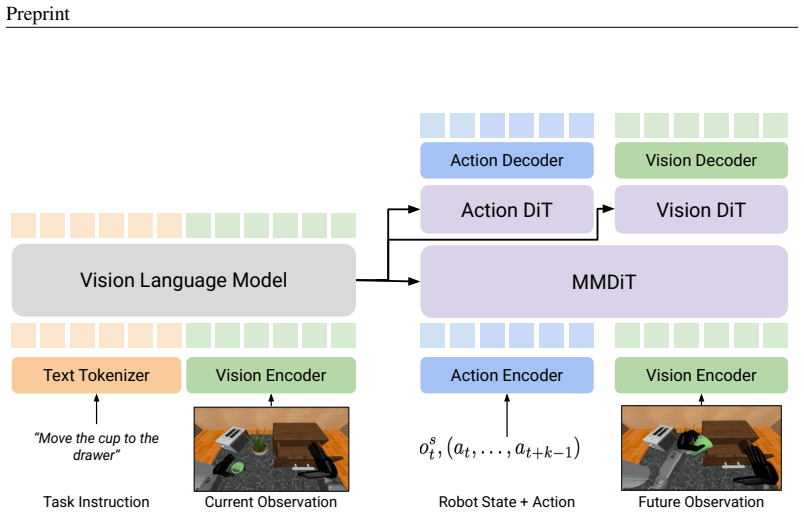
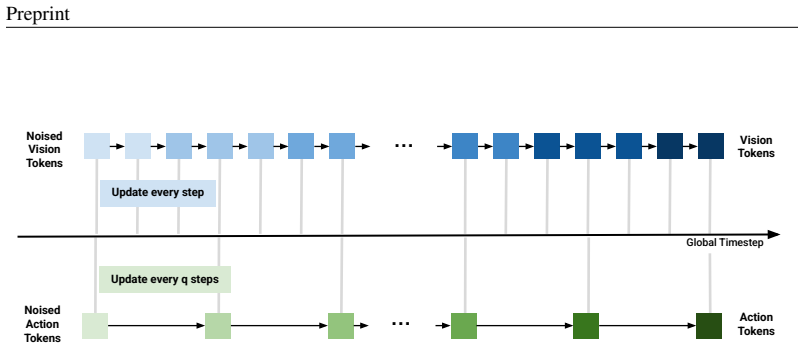
Multimodal diffusion transformer (MMDiT) with decoupled per-modality flow matching. The transformer keeps action and vision tokens in separate streams with independent timestep embeddings, merging them only for shared cross-modal attention and immediately re-splitting them into their own pathways. Independent noise perturbations for actions and future observations, with timesteps sampled separately, are combined into a decoupled loss that is the sum of the two unimodal flow-matching losses. Asynchronous Euler sampling, where vision tokens are updated every fine step and action tokens every q steps, turns the decoupling into a test-time scaling mechanism.
What would settle it
Test the causal pathway directly: train DUST, then run the policy with the predicted vision stream frozen to noise or with its gradient stopped during action generation. If success rates stay at the DUST level, the shared cross-modal attention is not doing the causal work the paper attributes to it; if success rates collapse, the mechanism is confirmed.
Extended reading notes
Core claim
DUST maintains separate token streams for action chunks and future observation embeddings inside a multimodal diffusion transformer. Each stream has its own timestep embedding and normalization, and the two are concatenated only inside shared attention layers before being split again. Training noises the two modalities with independent timesteps and optimizes the sum of two flow-matching losses, one per stream. The paper argues that this independent-noising decomposition trains the joint distribution so the shared attention learns bidirectional causal relations: what action produced this future state, and what future state this action will produce. At inference, vision tokens take more Euler
Load-bearing premise
DUST's training objective treats the joint action-vision distribution as trainable by the sum of two independent per-modality flow-matching losses; if that decomposition fails for an architecture with shared attention, the reported gains may come from a detached world-modeling auxiliary task rather than from the claimed bidirectional cross-modal learning.
Editorial extensions
If this is right
- Robot policies can model future observations without paying the cost of a unified latent space, reducing the modality-mismatch problem reported for joint-diffusion VLAs.
- Inference-time compute can be traded for accuracy by increasing only the vision denoising steps; scaling both streams uniformly degrades performance.
- World-modeling objectives can be pretrained on action-free video and then finetuned with few demonstrations, lowering the cost of policy data collection.
- The gains hold across simulation and real hardware and persist across multiple data scales, supporting the claim that the design improves data efficiency and scalability.
Reading between the lines
- The same decoupling principle could apply to other modality pairs with mismatched dimensionality or smoothness, such as audio-visual or sparse-LiDAR-plus-dense-image diffusion, where a unified latent space creates similar conflicts.
- If the claimed bidirectional causal mechanism is real, corrupting or freezing the predicted vision stream at inference should measurably degrade action quality; this intervention is testable and would separate a genuine cross-modal coupling from a detached auxiliary world-modeling task.
- The decomposition result that justifies the training objective comes from a setting without shared attention, so verifying the joint-distribution claim directly on DUST's architecture would clarify whether the gains come from the causal mechanism or from an auxiliary task.
- A practical extension would be to vary the vision-to-action step ratio q adaptively per task or per scene complexity, potentially extracting larger scaling gains than the fixed ratios reported.
Editorial analysis
A structured set of objections, weighed in public.
Referee Report
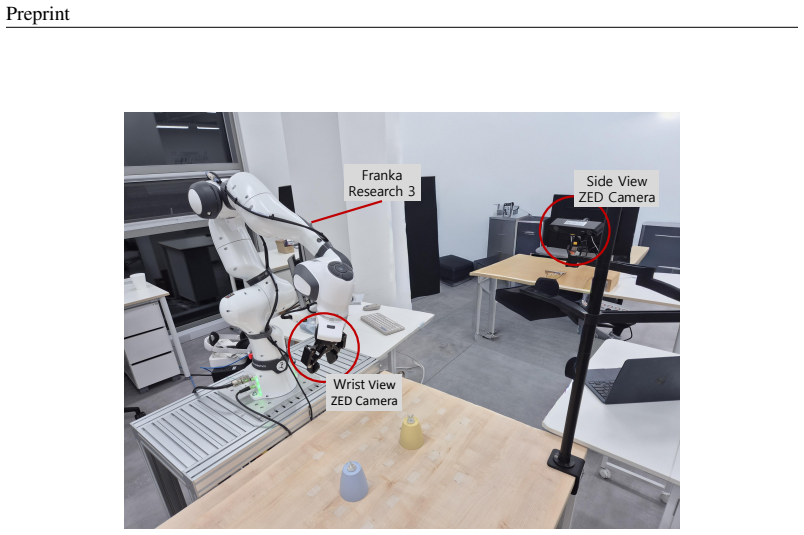
Summary. The paper introduces DUST, a vision-language-action (VLA) architecture in which action and future-observation embeddings are processed by separate diffusion streams in a multimodal diffusion transformer (MMDiT), with independent per-modality noise schedules and a sum of flow-matching losses. At inference, the paper proposes asynchronous Euler sampling in which vision tokens are updated more frequently than action tokens, controlled by a ratio q. Experiments on RoboCasa, GR-1, and a real Franka Research 3 arm report consistent success-rate gains over GR00T-N1.5 and a reimplemented FLARE baseline, and additional gains from pretraining on action-free BridgeV2 videos.
Significance. If the empirical results are robust, DUST's separation of modality streams with decoupled noising is a simple and likely useful addition to diffusion-based VLA training. The inference-time scaling idea is interesting, and the action-free video pretraining result is practically valuable. The paper also reports ablations showing that both the dual-stream structure and decoupled noise are needed, which supports the architectural contribution. However, reproducibility issues in the sampling pseudocode and a non-official FLARE baseline prevent the present version from supporting the paper's strongest claims.
major comments (5)
- [A.6, Algorithm 2 vs. Section 4.3, Eq. (5)] Algorithm 2's inner loop updates the action tokens with Delta_tau_A on every one of the q visual steps (line 9), while Eq. (5) updates actions only when the action time has advanced a full Delta_tau_A. Thus the pseudocode implements q action updates per action step, not one. If executed, the action stream is integrated q times with a step size meant for one step; if Algorithm 2 is a typo, the only implementation reference is still wrong. Since Table 5 is the evidence for the asynchronous test-time scaling claim, please correct the pseudocode or release code. The current inconsistency makes the scaling result unreproducible as written.
- [Section 5.1 / Appendix A.2, Tables 1-3] The FLARE baseline is described as reimplemented with DUST's own world-model target (SIGLIP-2 embeddings), an alignment MLP, and no official code or checkpoint. The reported gain over FLARE is therefore not a gain over the actual FLARE method on the original pipeline; it is a gain over a FLARE-like model built on DUST's components. This weakens the comparison against 'implicit world-modeling' claimed in the abstract. Please provide official FLARE results, a careful justification that the reimplementation is faithful, or explicitly reframe the claim as 'DUST vs. a FLARE-style loss on DUST's architecture.'
- [Tables 1-3 and Table 5] All success rates are reported as point estimates with no confidence intervals, repeated-seed statistics, or per-task variance. Several headline differences are small (e.g., RoboCasa 100-demo average 0.501 vs. 0.446 in Table 1; Table 3 per-task differences are often on the order of one success over 24 trials). Without CIs or seeds, the claimed gains--especially the 'additional 2-5%' from test-time scaling--cannot be distinguished from stochastic variation. Please add confidence intervals or repeated-seed results for the main comparisons and the scaling sweep.
- [Section 4.2, Eq. (4)] The text states that independent per-modality noise levels allow the model to 'learn causal relationships' and 'capture causal dependencies' between actions and future observations. The cited decomposition (Rojas et al., 2025) justifies the sum of flow-matching losses as a surrogate for a joint distribution, but it does not establish that the learned function is causal or that the model answers counterfactual queries. This is a load-bearing conceptual claim for the method. Please either provide a direct test of causal learning (e.g., an intervention-style experiment) or soften the claim to 'enables bidirectional conditioning between modalities at varied noise levels.'
- [Section 5.3, Table 5] The test-time scaling gains are obtained by sweeping q on the same RoboCasa/GR-1 evaluation benchmarks and then reporting the resulting best values. There is no separate validation set used to select q before evaluation. Thus the 'additional 2-5%' is a post-hoc selected result rather than a predictive, parameter-free claim. Please either fix q on a held-out validation split and report that number, or present the sweep as an analysis with the selection clearly acknowledged.
minor comments (5)
- [A.6, Algorithm 1 vs. Section 3] Algorithm 1 samples tau_A and tau_o from U(0,1), while Section 3 / Eq. (1) states that the action timestep is sampled from a Beta distribution. Please clarify which schedule is actually used for training.
- [Section 4.3, Eq. (5)] The condition '(tau_A N_o mod q = 0)' is mathematically ambiguous because tau_A is a continuous time variable. Express the update condition in terms of the discrete inner-step index or an integer action-step counter.
- [Appendix A.2] Figure 6 is used both for the ablation figure referenced in Section 5.4 and for the modified MMDiT diagram in Appendix A.2. These should be renumbered to avoid confusion.
- [Section 5.3] In Table 5, the GR-1 success at N_o=64 is lower than at N_o=32, so the text's statement 'mostly steady performance gains up to 64 steps' is somewhat misleading for GR-1. Please phrase the trend more accurately.
- [Abstract / Section 1] The paper alternates between percentage-point and relative improvements (e.g., '18% over GR00T-N1.5' vs. Table 1: 0.501 vs. 0.417). Please state explicitly which convention is used.
Circularity Check
No significant circularity: DUST's training objective and architecture are defined independently of its measured success rates; the joint-distribution justification cites external theory, and the only self-citation (REPA) is a non-load-bearing baseline detail.
full rationale
DUST's central derivation chain is self-contained against external evidence, so the paper sits at the 'no significant circularity' tier despite minor concerns. The joint training objective (Eq. 4) is a plain sum of two supervised flow-matching losses (Eq. 3) evaluated on real demonstration/video data; no reported success rate is used to define a loss term or a network output, so no quantity reduces to its own input by construction. The load-bearing theoretical step—that independent per-modality noising lets the sum of unimodal flow-matching losses train the joint distribution—is explicitly attributed to Rojas et al. (2025) and diffusion forcing (Chen et al. 2025), external works with no author overlap; this is independent support, not a self-citation chain. The only self-citation (REPA, Yu et al. 2025, Appendix A.2, used for the FLARE baseline's alignment MLP) is code-reproduced and non-load-bearing, so under the independent-evidence rule it does not raise the score. Benchmarks (RoboCasa, GR-1, real Franka Research 3) are external, and main results are held-out rollouts rather than refits. Flagged near-misses, which are correctness/statistics risks rather than circularity: (i) Table 5's 'additional 2-5%' gain is selected from a transparent q-grid on the same benchmarks—a tuned result presented as a scaling benefit, not a parameter-free prediction; (ii) Algorithm 2 (A.6) updates action tokens at every inner vision step with a full Delta-tau_A stride, contradicting Eq. 5's every-q-gate action update, which threatens reproducibility of the inference-time-scaling claim; (iii) the abstract's 'joint-training with heterogeneous robot and human datasets' claim lacks a matching experiment. None of these equates a claimed result to its input; hence the low score.
Assumptions & free parameters
free parameters (4)
- lambda_WM (world-model loss weight) =
1.0
- q (vision/action step ratio at inference) =
1 default, 4, 8, 16 explored
- Number of MMDiT layers =
12 of 16 total
- Number of vision tokens after pooling =
64
assumptions (5)
- domain assumption Sum of per-modality flow-matching losses with independent noise equals the joint diffusion objective (Rojas et al. 2025).
- standard math Flow matching objectives on actions and future observation embeddings faithfully model the desired conditional distributions.
- domain assumption Frozen Eagle-2/SIGLIP-2 future-image embeddings are a sufficient world-modeling target for improving downstream action selection.
- domain assumption The reimplemented FLARE baseline faithfully represents the original FLARE.
- domain assumption Pretraining on action-free BridgeV2 videos transfers to RoboCasa through the world-model branch.
Cite this review
Pith. "Pith review of Dual-Stream Diffusion for World-Model Augmented Vision-Language-Action Model." pith.science (2026). https://pith.science/paper/2IESB3WM
@misc{pith2026251027607,
  author       = {Pith},
  title        = {Pith review of: Dual-Stream Diffusion for World-Model Augmented Vision-Language-Action Model},
  year         = {2026},
  howpublished = {\url{https://pith.science/paper/2IESB3WM}},
  note         = {Machine review of arXiv:2510.27607}
}
read the original abstract
Augmenting vision-language-action models (VLAs) with world models is promising for robotic policy learning but faces challenges in jointly predicting states and actions due to the modality gap. To address this, we propose DUal-STream diffusion (DUST), a world-model augmented VLA framework featuring a multimodal diffusion transformer that maintains separate modality streams while enabling cross-modal knowledge sharing. In addition, DUST utilizes independent noise perturbations and a decoupled flow matching loss to learn cross-modal causal relationships. We further introduce an asynchronous sampling method for action and vision tokens that enhances performance through inference-time scaling. Experimental results on simulated benchmarks like RoboCasa and GR-1 show that DUST achieves up to 6% gains over state-of-the-art VLA and world-modeling baselines, with inference-time scaling providing an additional 2-5% improvement. In real-world tasks using the Franka Research 3, DUST outperforms baselines by 10% in success rate. Finally, we demonstrate that DUST enables effective transfer learning through both pretraining on action-free videos and joint-training with heterogeneous robot and human datasets.
Figures

Figures from the paper (4 more)


Forward citations
Cited by 23 Pith papers
-
Qantara: Bridge-Flow Training for Multi-Paradigm JEPA Control
A single ~21M JEPA checkpoint trained with Brownian-bridge state flow and edge-aligned action-state noise sampling serves planning, behaviour cloning, and inverse dynamics without retraining.
-
Point Tracking Improves World Action Models
JOPAT jointly models pixels, point tracks, and actions in a diffusion transformer and reports gains over pixel-only baselines on long-horizon robot tasks with occlusion and off-screen motion.
-
ViBES: A Conversational Agent with Behaviorally-Intelligent 3D Virtual Body
ViBES introduces a speech-language-behavior model using modality-specific transformer experts that jointly generates dialogue and 3D body actions, showing gains over separate co-speech and text-to-motion baselines on ...
-
DeVA: Decoupled Video-Action Model with physical guidance for robot policy learning
Decoupling video dynamics from action prediction with multi-level feature transfer and affordance/depth guidance yields more data-efficient robot policies than coupled video-action models.
-
MaskWAM: Unifying Mask Prompting and Prediction for World-Action Models
MaskWAM unifies mask prompting and prediction in world-action models via Mixture of Transformers to improve robotic policy generalization on language-ambiguous tasks.
-
Next Forcing: Causal World Modeling with Multi-Chunk Prediction
Next Forcing augments video generation models with auxiliary multi-chunk prediction modules to achieve faster training convergence, higher accuracy at high frame rates, and 2x faster inference on world modeling benchmarks.
-
HarmoWAM: Harmonizing Generalizable and Precise Manipulation via Adaptive World Action Models
HarmoWAM unifies predictive and reactive control in world action models via an adaptive gating mechanism to deliver improved zero-shot generalization and precision in robotic manipulation.
-
VAG: Dual-Stream Video-Action Generation for Embodied Data Synthesis
VAG is a synchronized dual-stream flow-matching framework that generates aligned video-action pairs for synthetic embodied data synthesis and policy pretraining.
-
Fast-WAM: Do World Action Models Need Test-time Future Imagination?
Fast-WAM shows that explicit future imagination at test time is not required for strong WAM performance; video modeling during training provides the main benefit.
-
World Action Models are Zero-shot Policies
DreamZero uses a 14B video diffusion model as a World Action Model to achieve over 2x better zero-shot generalization on real robots than state-of-the-art VLAs, real-time 7Hz closed-loop control, and cross-embodiment ...
-
Cosmos Policy: Fine-Tuning Video Models for Visuomotor Control and Planning
Single-stage fine-tuning of a video model to generate actions as latent frames plus future states and values yields state-of-the-art robot policy performance on LIBERO, RoboCasa, and bimanual tasks.
-
UNIVERSE: Unified Video Action Models for Autonomous Driving with Flexible Mask-Modulated Modality Generation
A single mask-modulated DiT that co-trains future video and trajectories yields stronger autonomous-driving action generalization and 4.3× faster trajectory-only inference than dual-DiT designs.
-
Kairos: A Regret-Aware Native World-Action Model Stack for Physical AI
Kairos is a native world model stack using cross-embodiment pretraining, hybrid linear temporal attention with theoretical error bounds, and deployment-aware co-design, reporting top performance on embodied benchmarks.
-
Kairos: A Regret-Aware Native World-Action Model Stack for Physical AI
Kairos learns and maintains control-sufficient world states via a cross-embodiment curriculum, hybrid linear temporal attention, and deployment-aware co-design for Physical AI.
-
World Pilot: Steering Vision-Language-Action Models with World-Action Priors
World Pilot augments VLA policies with world-action priors through latent and action steering pathways, reporting 84.7% success on LIBERO-Plus zero-shot OOD and top real-robot results across four tasks.
-
Making Foresight Actionable: Repurposing Representation Alignment in World Action Models
AGRA is an Action-Grounded Representation Alignment objective that aligns intermediate video diffusion features with semantic representations to make world action model hidden states more useful for low-level robot co...
-
World Models for Robotic Manipulation: A Survey
Survey organizing world models for robotic manipulation into representation families, a functional taxonomy, and infrastructure roles across pretraining, post-training, and inference, while reviewing 34 datasets and e...
-
X-Imitator: Spatial-Aware Imitation Learning via Bidirectional Action-Pose Interaction
X-Imitator is a bidirectional action-pose interaction framework for spatial-aware imitation learning that outperforms vanilla policies and explicit pose guidance on 24 simulated and 3 real-world robotic tasks.
-
WALL-WM: Carving World Action Modeling at the Event Joints
WALL-WM introduces event-grounded Vision-Language-Action pretraining that uses semantic events as the atomic unit to address granularity mismatch in world action models and reports state-of-the-art generalization.
-
World Action Models: The Next Frontier in Embodied AI
The paper introduces World Action Models as a new paradigm unifying predictive world modeling with action generation in embodied foundation models and provides a taxonomy of existing approaches.
-
RLDX-1 Technical Report
RLDX-1 outperforms frontier VLAs such as π0.5 and GR00T N1.6 on dexterous manipulation benchmarks, reaching 86.8% success on ALLEX humanoid tasks versus around 40% for the baselines.
-
RLDX-1 Technical Report
RLDX-1 achieves 86.8% success on complex ALLEX humanoid manipulation tasks where prior VLAs reach only around 40%.
-
World Action Models: A Survey
A survey that clarifies boundaries and organizes World Action Models by generation requirements and predictive substrates, identifying a trend toward generating less of the future.
Reference graph
Works this paper leans on
-
[2]
Chi-Lam Cheang, Guangzeng Chen, Ya Jing, Tao Kong, Hang Li, Yifeng Li, Yuxiao Liu, Hong- tao Wu, Jiafeng Xu, Yichu Yang, Hanbo Zhang, and Minzhao Zhu. Gr-2: A generative video-language-action model with web-scale knowledge for robot manipulation.arXiv preprint arXiv:2410.06158,
-
[3]
Siyuan Huang, Liliang Chen, Pengfei Zhou, Shengcong Chen, Zhengkai Jiang, Yue Hu, Yue Liao, Peng Gao, Hongsheng Li, Maoqing Yao, and Guanghui Ren. Enerverse: Envisioning embodied future space for robotics manipulation.arXiv preprint arXiv:2501.01895,
-
[4]
Openvla: An open-source vision-language-action model.arXiv preprint arXiv:2406.09246,
Moo Jin Kim, Karl Pertsch, Siddharth Karamcheti, Ted Xiao, Ashwin Balakrishna, Suraj Nair, Rafael Rafailov, Ethan Foster, Grace Lam, Pannag Sanketi, Quan Vuong, Thomas Kollar, Ben- jamin Burchfiel, Russ Tedrake, Dorsa Sadigh, Sergey Levine, Percy Liang, and Chelsea Finn. Openvla: An open-source vision-language-action model.arXiv preprint arXiv:2406.09246,
-
[6]
15 Preprint Baselines.The GR00T-N1.5 baseline is trained on the original released code, while the FLARE baseline does not release official code or checkpoints. Hence, for FLARE, we do not utilize the Q-Former architecture of the original paper, but re-implement the FLARE loss to utilize the same world modeling target as ours, which is the SIGLIP-2 embeddi...
2025
-
[7]
GR00T N1: An open foundation model for generalist humanoid robots.arXiv preprint arXiv:2503.14734,
NVIDIA, Johan Bjorck, Fernando Castañeda, Nikita Cherniadev, Xingye Da, Runyu Ding, Linxi "Jim" Fan, Yu Fang, Dieter Fox, Fengyuan Hu, Spencer Huang, Joel Jang, Zhenyu Jiang, Jan Kautz, Kaushil Kundalia, Lawrence Lao, Zhiqi Li, Zongyu Lin, Kevin Lin, Guilin Liu, Edith Llontop, Loic Magne, Ajay Mandlekar, Avnish Narayan, Soroush Nasiriany, Scott Reed, You ...
-
[8]
Maxime Oquab, Timothée Darcet, Theo Moutakanni, Huy V . V o, Marc Szafraniec, Vasil Khalidov, Pierre Fernandez, Daniel Haziza, Francisco Massa, Alaaeldin El-Nouby, Russell Howes, Po-Yao Huang, Hu Xu, Vasu Sharma, Shang-Wen Li, Wojciech Galuba, Mike Rabbat, Mido Assran, Nicolas Ballas, Gabriel Synnaeve, Ishan Misra, Herve Jegou, Julien Mairal, Patrick Laba...
-
[9]
Mustafa Shukor, Dana Aubakirova, Francesco Capuano, Pepijn Kooijmans, Steven Palma, Adil Zouitine, Michel Aractingi, Caroline Pascal, Martino Russi, Andres Marafioti, Simon Alibert, Matthieu Cord, Thomas Wolf, and Remi Cadene. Smolvla: A vision-language-action model for affordable and efficient robotics.arXiv preprint arXiv:2506.01844,
-
[10]
Chameleon: Mixed-modal early-fusion foundation models.arXiv preprint arXiv:2405.09818,
Chameleon Team. Chameleon: Mixed-modal early-fusion foundation models.arXiv preprint arXiv:2405.09818,
Show all 20 references
-
[13]
Genie centurion: Accelerating scalable real-world robot training with human rewind-and-refine guidance.arXiv preprint arXiv:2505.18793,
Wenhao Wang, Jianheng Song, Chiming Liu, Jiayao Ma, Siyuan Feng, Jingyuan Wang, Yuxin Jiang, Kylin Chen, Sikang Zhan, Yi Wang, et al. Genie centurion: Accelerating scalable real-world robot training with human rewind-and-refine guidance.arXiv preprint arXiv:2505.18793,
-
[14]
Robotic control via embodied chain-of-thought reasoning.arXiv preprint arXiv:2407.08693,
Michał Zawalski, William Chen, Karl Pertsch, Oier Mees, Chelsea Finn, and Sergey Levine. Robotic control via embodied chain-of-thought reasoning.arXiv preprint arXiv:2407.08693,
-
[15]
Learning fine-grained bimanual manipulation with low-cost hardware.arXiv preprint arXiv:2304.13705,
Tony Z Zhao, Vikash Kumar, Sergey Levine, and Chelsea Finn. Learning fine-grained bimanual manipulation with low-cost hardware.arXiv preprint arXiv:2304.13705,
-
[16]
Flare: Robot learning with implicit world modeling.arXiv preprint arXiv:2505.15659,
13 Preprint Ruijie Zheng, Jing Wang, Scott Reed, Johan Bjorck, Yu Fang, Fengyuan Hu, Joel Jang, Kaushil Kundalia, Zongyu Lin, Loic Magne, Avnish Narayan, You Liang Tan, Guanzhi Wang, Qi Wang, Jiannan Xiang, Yinzhen Xu, Seonghyeon Ye, Jan Kautz, Furong Huang, Yuke Zhu, and Linx...
-
[17]
Dino-wm: World models on pre-trained visual features enable zero-shot planning.arXiv preprint arXiv:2411.04983,
Gaoyue Zhou, Hengkai Pan, Yann LeCun, and Lerrel Pinto. Dino-wm: World models on pre-trained visual features enable zero-shot planning.arXiv preprint arXiv:2411.04983,
-
[19]
Image observations include 3 viewpoints from the left, right, and wrist
within the MuJoCo simulation environment (Todorov et al., 2012), with a Franka Emika Panda robot arm serving as the manipulator. Image observations include 3 viewpoints from the left, right, and wrist. The robot state/action space is parameterized with 7 degrees of freedom (Do...
2012
-
[20]
The simulated robot is a GR-1 humanoid robot with Fourier dexterous hands, enabling fine-grained grasping and manipulation
in the MuJoCo simulation environment (Todorov et al., 2012). The simulated robot is a GR-1 humanoid robot with Fourier dexterous hands, enabling fine-grained grasping and manipulation. Image observations are taken from a single egocentric view from the robot’s head. The state/...
2012
-
[2012]
Siglip 2: Multilingual vision-language encoders with improved semantic understanding, localization, and dense features.arXiv preprint arXiv:2502.14786,
Michael Tschannen, Alexey Gritsenko, Xiao Wang, Muhammad Ferjad Naeem, Ibrahim Alabdul- mohsin, Nikhil Parthasarathy, Talfan Evans, Lucas Beyer, Ye Xia, Basil Mustafa, Olivier Hénaff, Jeremiah Harmsen, Andreas Steiner, and Xiaohua Zhai. Siglip 2: Multilingual vision-language e...
-
[2019]
Being-h0: Vision-language-action pretraining from large- scale human videos.arXiv preprint arXiv:2507.15597,
Hao Luo, Yicheng Feng, Wanpeng Zhang, Sipeng Zheng, Ye Wang, Haoqi Yuan, Jiazheng Liu, Chaoyi Xu, Qin Jin, and Zongqing Lu. Being-h0: Vision-language-action pretraining from large- scale human videos.arXiv preprint arXiv:2507.15597,
-
[2023]
This&that: Language-gesture controlled video generation for robot planning
Boyang Wang, Nikhil Sridhar, Chao Feng, Mark Van der Merwe, Adam Fishman, Nima Fazeli, and Jeong Joon Park. This&that: Language-gesture controlled video generation for robot planning. arXiv preprint arXiv:2407.05530,
-
[2024]
BLIP-2: bootstrapping language-image pre-training with frozen image encoders and large language models
Junnan Li, Dongxu Li, Silvio Savarese, and Steven Hoi. BLIP-2: bootstrapping language-image pre-training with frozen image encoders and large language models. InInternational Conference on Machine Learning, 2023a. Shuang Li, Yihuai Gao, Dorsa Sadigh, and Shuran Song. Unified v...
-
[2025]
Rt- 2: Vision-language-action models transfer web knowledge to robotic control.arXiv preprint arXiv:2307.15818,
Anthony Brohan, Noah Brown, Justice Carbajal, Yevgen Chebotar, Xi Chen, Krzysztof Choro- manski, Tianli Ding, Danny Driess, Avinava Dubey, Chelsea Finn, Pete Florence, Chuyuan Fu, Montse Gonzalez Arenas, Keerthana Gopalakrishnan, Kehang Han, Karol Hausman, Alex Her- zog, Jasmi...
Reviewed August 4, 2026 · model on record in the stance chip above.
Discussion (0). Sign in to comment.