Nonlinear growth and amplification of phase-transition gravitational waves induced by cosmic expansion
Pith reviewed 2026-07-01 04:51 UTC · model grok-4.3
The pith
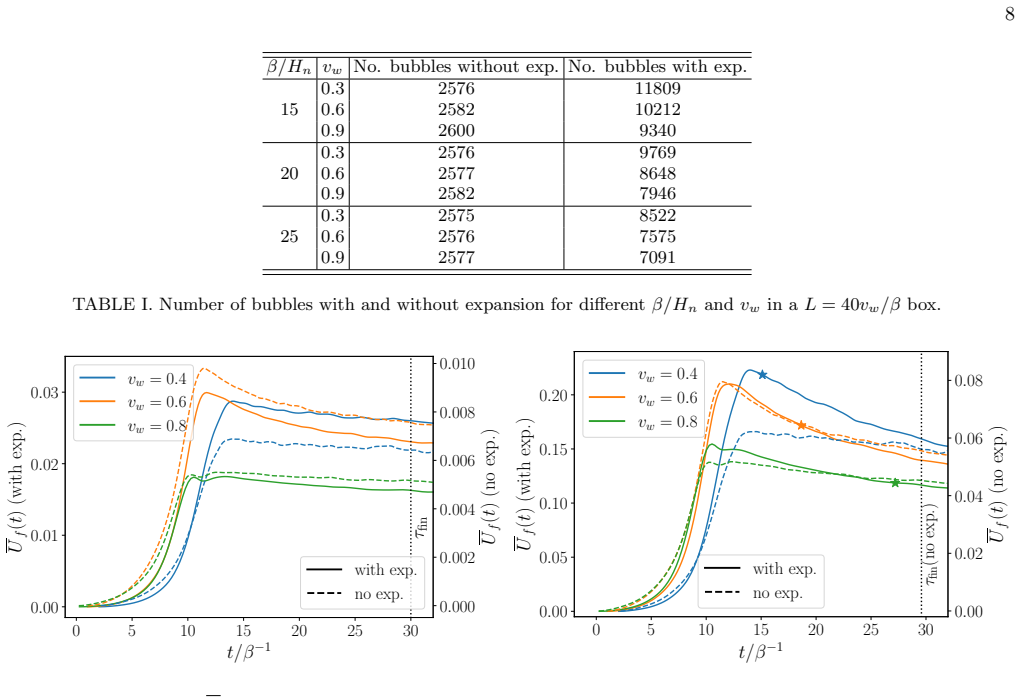
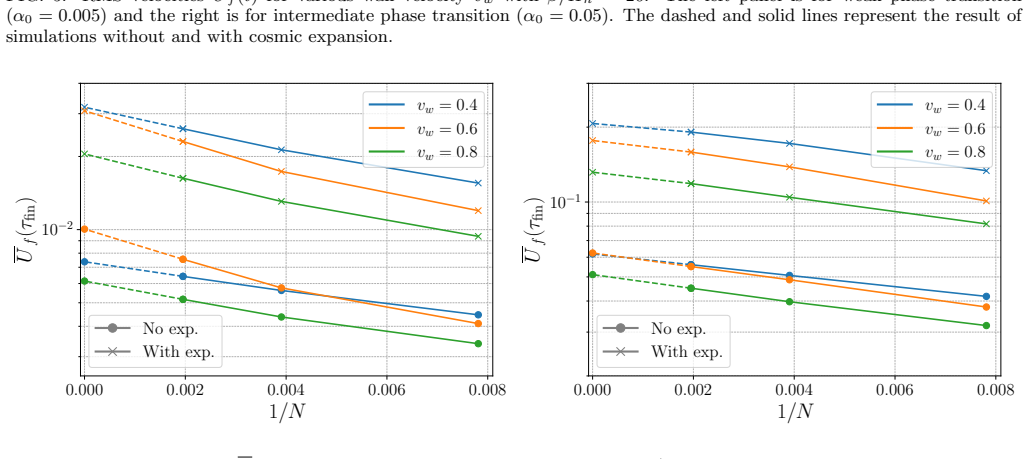
Cosmic expansion induces nonlinear growth that amplifies gravitational wave spectra from phase transitions by factors of 10 to 100.
A machine-rendered reading of the paper's core claim, the machinery that carries it, and where it could break.
Core claim
In three-dimensional hydrodynamical simulations of slow first-order phase transitions performed in an expanding cosmological background, cosmic expansion induces highly nonlinear growth in the gravitational wave energy fraction. This growth produces an O(10) to O(100) amplification of the gravitational wave spectra relative to non-expanding cases. The amplification is more pronounced for initially weak transitions than for those of initially intermediate strength. The simulations incorporate the effects of the evolving phase transition strength throughout the full nucleation process.
What carries the argument
Three-dimensional hydrodynamical simulations that incorporate the evolving phase transition strength and cosmic expansion throughout the full nucleation process of slow transitions.
If this is right
- Estimates of gravitational wave spectra from slow phase transitions that omit cosmic expansion underestimate the final amplitudes.
- The nonlinear amplification must be included when forecasting the detectability of phase-transition gravitational waves.
- Weak transitions, previously expected to yield weaker signals, can produce comparatively stronger gravitational wave spectra once expansion is accounted for.
- Accurate modeling of slow transitions now requires full inclusion of expansion effects on nucleation and sourcing.
Where Pith is reading between the lines
- Models that map phase-transition parameters to observable gravitational wave signals will need to incorporate this amplification to avoid underpredicting event rates at detectors.
- The result raises the question of whether the same nonlinear mechanism appears in transitions with additional ingredients such as magnetic fields or different equation-of-state assumptions.
- Analytic approximations used for rapid transitions may need systematic extension to slow transitions in expanding backgrounds to match the simulation outcomes.
Load-bearing premise
The three-dimensional hydrodynamical simulations accurately capture the coupled effects of cosmic expansion on bubble nucleation, wall dynamics, and gravitational-wave sourcing throughout the full slow transition without dominant numerical artifacts or missing physics.
What would settle it
A simulation run with cosmic expansion artificially disabled that still produces the same nonlinear growth and amplification, or a higher-resolution run that shows the growth remains linear rather than nonlinear, would falsify the claim that expansion drives the effect.
Figures
read the original abstract
We perform the first three-dimensional hydrodynamical simulations of cosmological first-order phase transitions in an expanding background. These simulations consistently incorporate the effects of the evolving phase transition strength throughout the full nucleation process of slow phase transitions. We find that, in addition to reducing mean bubble separations via an effectively enhanced nucleation rate, cosmic expansion unexpectedly induces highly nonlinear growth in the gravitational wave energy fraction, ultimately leading to a significant $\mathcal{O}(10)$ to $\mathcal{O}(100)$ amplification of the gravitational wave spectra. This amplification is more pronounced for initially weak transitions than for those of initially intermediate strength. Our results highlight the challenge and importance of accurately modelling slow phase transitions while accounting for cosmic expansion.
Editorial analysis
A structured set of objections, weighed in public.
Referee Report
Summary. The manuscript reports the first three-dimensional hydrodynamical simulations of cosmological first-order phase transitions performed in an expanding background. These simulations incorporate the evolving transition strength over the full nucleation process for slow transitions. The central result is that cosmic expansion induces highly nonlinear growth in the gravitational wave energy fraction, producing an O(10) to O(100) amplification of the GW spectra relative to non-expanding cases, with the effect stronger for initially weak transitions than for intermediate-strength ones.
Significance. If the reported amplification is physical, the result would substantially alter predictions for stochastic gravitational wave backgrounds from slow phase transitions, implying that prior calculations neglecting expansion have underestimated signal strengths by large factors. This would affect both theoretical forecasts and the interpretation of potential future detections, while underscoring the need for expansion-inclusive modeling in the field.
major comments (1)
- [Abstract] Abstract: The O(10)–O(100) amplification is extracted directly from the 3D hydrodynamical output, yet the abstract (and, by extension, the manuscript) supplies no convergence tests, resolution studies, box-size variations, or quantitative error budgets. Because the central claim rests entirely on these numerics, the absence of such validation leaves open whether the nonlinear growth arises from the physical coupling of expansion to bubble dynamics or from unresolved thin-wall or Hubble-friction effects.
Simulated Author's Rebuttal
We thank the referee for their careful reading and constructive comments. We address the single major comment below.
read point-by-point responses
-
Referee: [Abstract] Abstract: The O(10)–O(100) amplification is extracted directly from the 3D hydrodynamical output, yet the abstract (and, by extension, the manuscript) supplies no convergence tests, resolution studies, box-size variations, or quantitative error budgets. Because the central claim rests entirely on these numerics, the absence of such validation leaves open whether the nonlinear growth arises from the physical coupling of expansion to bubble dynamics or from unresolved thin-wall or Hubble-friction effects.
Authors: We agree that the submitted manuscript does not contain explicit convergence tests, resolution studies, box-size variations, or quantitative error budgets. In the revised version we will add a dedicated section (or appendix) presenting these numerical validation results, including resolution scans, box-size dependence, and error estimates, to confirm that the reported nonlinear growth and amplification factors are robust. revision: yes
Circularity Check
No circularity; results are direct outputs of 3D hydrodynamical simulations
full rationale
The paper reports outcomes from first-principles three-dimensional hydrodynamical simulations that incorporate cosmic expansion, bubble nucleation, and gravitational-wave sourcing over the full transition duration. The claimed O(10-100) amplification of GW spectra emerges as a numerical result rather than an analytic derivation that reduces to fitted parameters or self-citations by construction. No self-definitional equations, renamed empirical patterns, or load-bearing self-citations appear in the provided text; the central claim rests on simulation output that is independent of the target quantities by definition.
Axiom & Free-Parameter Ledger
Reference graph
Works this paper leans on
-
[1]
B. P. Abbottet al.(LIGO Scientific, Virgo), Observation of Gravitational Waves from a Binary Black Hole Merger, Phys. Rev. Lett.116, 061102 (2016), arXiv:1602.03837 [gr-qc]
work page internal anchor Pith review Pith/arXiv arXiv 2016
-
[2]
The NANOGrav 15-year Data Set: Evidence for a Gravitational-Wave Background
G. Agazieet al.(NANOGrav), The NANOGrav 15 yr Data Set: Evidence for a Gravitational-wave Background, Astrophys. J. Lett.951, L8 (2023), arXiv:2306.16213 [astro-ph.HE]
work page internal anchor Pith review Pith/arXiv arXiv 2023
-
[3]
H. Xuet al., Searching for the Nano-Hertz Stochastic Gravitational Wave Background with the Chinese Pulsar Timing Array Data Release I, Res. Astron. Astrophys. 23, 075024 (2023), arXiv:2306.16216 [astro-ph.HE]
work page internal anchor Pith review Pith/arXiv arXiv 2023
-
[4]
J. Antoniadiset al.(EPTA, InPTA:), The second data release from the European Pulsar Timing Array - III. Search for gravitational wave signals, Astron. Astrophys. 678, A50 (2023), arXiv:2306.16214 [astro-ph.HE]
work page internal anchor Pith review Pith/arXiv arXiv 2023
-
[5]
D. J. Reardonet al., Search for an Isotropic Gravitational-wave Background with the Parkes Pul- sar Timing Array, Astrophys. J. Lett.951, L6 (2023), arXiv:2306.16215 [astro-ph.HE]
work page internal anchor Pith review Pith/arXiv arXiv 2023
-
[6]
Laser Interferometer Space Antenna
P. Amaro-Seoaneet al.(LISA), Laser Interferometer Space Antenna (2017), arXiv:1702.00786 [astro-ph.IM]
work page internal anchor Pith review Pith/arXiv arXiv 2017
-
[7]
M. Colpiet al.(LISA), LISA Definition Study Report (2024), arXiv:2402.07571 [astro-ph.CO]
work page internal anchor Pith review Pith/arXiv arXiv 2024
-
[8]
Hu and Y.-L
W.-R. Hu and Y.-L. Wu, The Taiji Program in Space for gravitational wave physics and the nature of gravity, Natl. Sci. Rev.4, 685 (2017)
2017
-
[9]
TianQin: a space-borne gravitational wave detector
J. Luoet al.(TianQin), TianQin: a space-borne gravi- tational wave detector, Class. Quant. Grav.33, 035010 (2016), arXiv:1512.02076 [astro-ph.IM]
work page internal anchor Pith review Pith/arXiv arXiv 2016
-
[10]
Gravitational waves from the sound of a first order phase transition
M. Hindmarsh, S. J. Huber, K. Rummukainen, and D. J. Weir, Gravitational waves from the sound of a first order phase transition, Phys. Rev. Lett.112, 041301 (2014), arXiv:1304.2433 [hep-ph]
work page internal anchor Pith review Pith/arXiv arXiv 2014
-
[11]
M. Hindmarsh, S. J. Huber, K. Rummukainen, and D. J. Weir, Numerical simulations of acoustically generated gravitational waves at a first order phase transition, Phys. Rev. D92, 123009 (2015), arXiv:1504.03291 [astro- ph.CO]
work page internal anchor Pith review Pith/arXiv arXiv 2015
-
[12]
M. Hindmarsh, S. J. Huber, K. Rummukainen, and D. J. Weir, Shape of the acoustic gravitational wave power spectrum from a first order phase transition, Phys. Rev. D96, 103520 (2017), [Erratum: Phys.Rev.D 101, 089902 (2020)], arXiv:1704.05871 [astro-ph.CO]
-
[13]
D. Cutting, M. Hindmarsh, and D. J. Weir, Vorticity, ki- netic energy, and suppressed gravitational wave produc- tion in strong first order phase transitions, Phys. Rev. Lett.125, 021302 (2020), arXiv:1906.00480 [hep-ph]
- [14]
- [15]
-
[16]
R. Jinno and J. Kume, Gravitational effects on fluid dynamics in cosmological first-order phase transitions, JCAP02, 057, arXiv:2408.10770 [gr-qc]
- [17]
- [18]
-
[19]
C. Caprini, R. Jinno, T. Konstandin, A. Roper Pol, H. Rubira, and I. Stomberg, Gravitational waves from first-order phase transitions: from weak to strong, JHEP 07, 217, arXiv:2409.03651 [gr-qc]
-
[20]
M. Hindmarsh, Sound shell model for acoustic gravita- tional wave production at a first-order phase transition in the early Universe, Phys. Rev. Lett.120, 071301 (2018), arXiv:1608.04735 [astro-ph.CO]
work page internal anchor Pith review Pith/arXiv arXiv 2018
-
[21]
M. Hindmarsh and M. Hijazi, Gravitational waves from first order cosmological phase transitions in the Sound Shell Model, JCAP12, 062, arXiv:1909.10040 [astro- ph.CO]
- [22]
- [23]
- [24]
-
[25]
A. Roper Pol, S. Procacci, and C. Caprini, Character- ization of the gravitational wave spectrum from sound waves within the sound shell model, Phys. Rev. D109, 063531 (2024), arXiv:2308.12943 [gr-qc]
- [26]
- [27]
- [28]
-
[29]
Y. Xiao, H.-K. Guo, J.-H. Hu, J. M. Yang, and Y. Zhang, Growth of the gravitational wave spectrum from sound waves in a universe with a generic expansion rate, Phys. Rev. D112, L081302 (2025), arXiv:2410.23666 [gr-qc]
-
[30]
Gravitational wave energy budget in strongly supercooled phase transitions
J. Ellis, M. Lewicki, J. M. No, and V. Vaskonen, Gravita- tional wave energy budget in strongly supercooled phase transitions, JCAP06, 024, arXiv:1903.09642 [hep-ph]
work page internal anchor Pith review Pith/arXiv arXiv 1903
- [31]
- [32]
-
[33]
J. R. Espinosa, T. Konstandin, J. M. No, and G. Ser- vant, Energy Budget of Cosmological First-order Phase Transitions, JCAP06, 028, arXiv:1004.4187 [hep-ph]
work page internal anchor Pith review Pith/arXiv arXiv
- [34]
- [35]
- [36]
- [37]
-
[38]
Detecting gravitational waves from cosmological phase transitions with LISA: an update
C. Capriniet al., Detecting gravitational waves from cos- mological phase transitions with LISA: an update, JCAP 03, 024, arXiv:1910.13125 [astro-ph.CO]
work page internal anchor Pith review Pith/arXiv arXiv 1910
-
[39]
Kurganov and E
A. Kurganov and E. Tadmor, New High-Resolution Cen- tral Schemes for Nonlinear Conservation Laws and Con- vection–Diffusion Equations, J. Comput. Phys.160, 241 (2000)
2000
- [40]
-
[41]
From Boltzmann equations to steady wall velocities
T. Konstandin, G. Nardini, and I. Rues, From Boltz- mann equations to steady wall velocities, JCAP09, 028, arXiv:1407.3132 [hep-ph]
work page internal anchor Pith review Pith/arXiv arXiv
- [42]
- [43]
-
[44]
B. Laurent and J. M. Cline, First principles determina- tion of bubble wall velocity, Phys. Rev. D106, 023501 (2022), arXiv:2204.13120 [hep-ph]
- [45]
- [46]
- [47]
- [48]
-
[49]
T. Krajewski, M. Lewicki, M. Merchand, I. Ig- nacy Nalecz, and M. Zych, From friction scaling to an ef- ficient method for estimating bubble wall velocity (2026), arXiv:2603.24583 [astro-ph.CO]
-
[50]
M. Lewicki and V. Vaskonen, Impact of cosmic expansion on gravitational wave spectra from strongly supercooled first-order phase transitions (2025), arXiv:2511.15687 [astro-ph.CO]. 7 SUPPLEMENT AL MA TERIALS Simulations of Nucleation Histories in an Expanding Universe To derive the GW spectrum generated by sound waves in an expanding Universe, in addition...
discussion (0)
Sign in with ORCID, Apple, or X to comment. Anyone can read and Pith papers without signing in.