Correlated Quantum Sensing at the Seemingly Classical Limit
Pith reviewed 2026-06-28 14:27 UTC · model grok-4.3
The pith
Symmetric correlators from two or three resonant mass detectors can expose graviton quantum noise at the classical limit.
A machine-rendered reading of the paper's core claim, the machinery that carries it, and where it could break.
Core claim
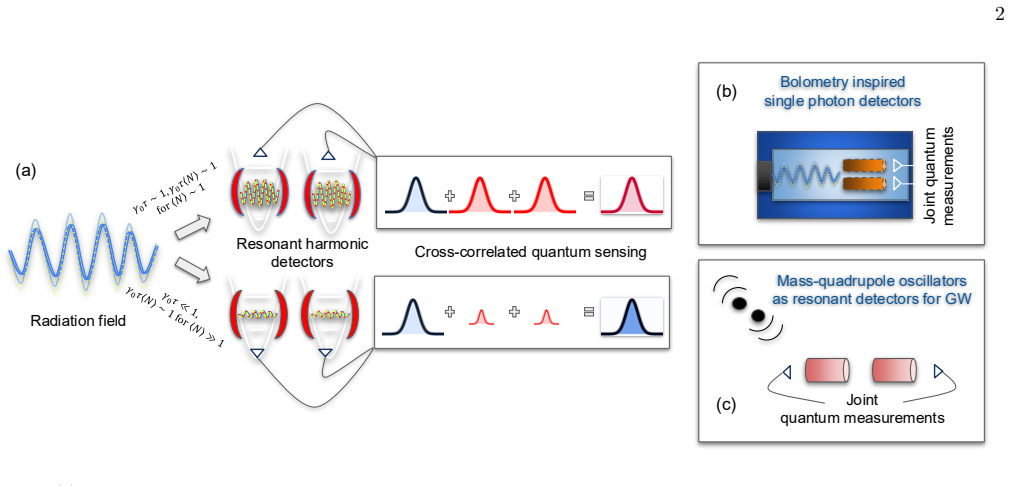
The central claim is that correlated counting, homodyne, and heterodyne detection strategies using high-quality resonant quantum harmonic detectors operating at the seemingly classical limit of a large number of quanta, initialized in bolometry-inspired zero-mean preparations such as thermal states, allow simple statistical tests with symmetric correlators for two and three barely functional resonant mass detectors to reveal the complementary quantum noise characteristics of gravitons.
What carries the argument
Symmetric correlators applied to signals from two and three resonant mass quadrupole oscillators in the bolometric regime.
If this is right
- Quantum effects in gravitons become testable with resonant mass detectors that need not reach single-quantum sensitivity.
- The bolometric regime of resonant detectors supplies statistical advantages for revealing quantum statistics of radiation fields.
- The same correlated strategies extend directly to other weakly interacting fields beyond gravity.
- Tabletop setups with two or three detectors suffice for the proposed tests without requiring large arrays.
Where Pith is reading between the lines
- The method could be adapted to test quantum statistics in other low-coupling fields such as certain dark-matter candidates.
- Numerical simulations of the proposed correlators on realistic detector noise models would provide a concrete next step before hardware implementation.
- If the correlator signatures appear, they would offer an independent check on whether gravitons obey bosonic statistics distinct from classical predictions.
Load-bearing premise
High-quality resonant detectors remain feasible and retain their statistical advantages even when operating at the seemingly classical limit for weakly interacting fields such as gravitons.
What would settle it
An experiment in which the measured symmetric correlators from two or three resonant mass detectors show no statistical distinction between the expected quantum noise of gravitons and the noise of a classical radiation field.
Figures
read the original abstract
It is a difficult task to detect the indivisible quanta of weakly interacting radiation fields, and even more challenging to probe their quantum statistics. Nevertheless, if barely functional high-quality resonant detectors are feasible for weakly interacting radiation fields, they do come with certain statistical advantages to probe quantum effects at the seemingly classical limit of a large number of quanta of the incoming radiation field. We present correlated counting, homodyne, and heterodyne detection strategies using high-quality resonant quantum harmonic detectors operating at this limit, initialized in bolometry-inspired zero-mean preparations such as thermal states. We compare the bolometric regime of good resonant harmonic detectors in quantum optics to the bolometric regime of barely functional resonant mass quadrupole oscillators as detectors for quantum gravity. Simple statistical tests are proposed using symmetric correlators for two and three such barely functional resonant mass detectors that could reveal the complementary quantum noise characteristics of gravitons in tabletop experiments.
Editorial analysis
A structured set of objections, weighed in public.
Referee Report
Summary. The paper proposes that barely functional high-quality resonant mass quadrupole oscillators, initialized in zero-mean states such as thermal states, can serve as detectors for gravitons in the bolometric regime at the seemingly classical limit of large mean occupation number. It draws an analogy to the quantum optics bolometric regime and presents correlated counting, homodyne, and heterodyne strategies using symmetric correlators on two or three detectors to reveal complementary quantum noise characteristics of gravitons via simple statistical tests in tabletop experiments.
Significance. If the feasibility assumptions hold and the proposed correlators can be implemented, the work would offer a conceptual route to probing quantum statistics of weakly coupled fields like gravitons without requiring high-sensitivity single-quantum detection, potentially enabling accessible tests of quantum gravity effects.
major comments (1)
- [Abstract] Abstract, paragraph on bolometric regime comparison: the central claim that resonant mass quadrupole oscillators retain statistical advantages (response linearity, noise statistics, correlator sensitivity) for gravitons when operating at the classical limit with large mean occupation number rests on an unverified assumption; no derivation, parameter estimate, or scaling analysis is supplied showing that the Planck-scale graviton coupling preserves these properties under the stated zero-mean preparations, which is load-bearing for applying the proposed statistical tests.
Simulated Author's Rebuttal
We thank the referee for their careful reading of the manuscript and for highlighting the need to substantiate the central analogy. We address the single major comment below.
read point-by-point responses
-
Referee: [Abstract] Abstract, paragraph on bolometric regime comparison: the central claim that resonant mass quadrupole oscillators retain statistical advantages (response linearity, noise statistics, correlator sensitivity) for gravitons when operating at the classical limit with large mean occupation number rests on an unverified assumption; no derivation, parameter estimate, or scaling analysis is supplied showing that the Planck-scale graviton coupling preserves these properties under the stated zero-mean preparations, which is load-bearing for applying the proposed statistical tests.
Authors: The manuscript explicitly frames the claim as conditional on the feasibility of high-quality resonant detectors and draws a direct analogy to the established bolometric regime of quantum-optics harmonic oscillators, where zero-mean preparations (thermal states, etc.) yield linear response and well-defined noise statistics that support symmetric correlators even at large mean occupation numbers. The graviton interaction is treated perturbatively in the same manner as conventional resonant-mass gravitational-wave detectors, so that the detector dynamics remain those of a quantum harmonic oscillator. We acknowledge, however, that the manuscript does not supply an explicit scaling derivation linking the Planck-scale coupling strength to the preservation of linearity and correlator sensitivity. We will revise the text to include a concise derivation (in the main body or an appendix) showing that, for weak bilinear coupling and small excitations, the zero-mean initial state and resonant character suffice to retain the stated statistical advantages independently of the precise value of the coupling constant. revision: yes
Circularity Check
No circularity: proposal rests on explicit assumptions and standard models
full rationale
The paper proposes statistical tests and detection strategies for gravitons using resonant mass detectors in the bolometric regime, drawing an explicit analogy to quantum optics without deriving any quantity from its own fitted parameters or self-citations. No equations reduce by construction to inputs (e.g., no parameter fitted to data then renamed as a prediction), no uniqueness theorems are imported from the authors' prior work, and no ansatz is smuggled via citation. The central claims are conditional on stated feasibility assumptions about detector behavior, which are presented as external requirements rather than internally derived results. The derivation chain is therefore self-contained against external benchmarks.
Axiom & Free-Parameter Ledger
axioms (2)
- domain assumption Resonant harmonic oscillators initialized in thermal states retain statistical advantages for probing quantum effects at large quanta numbers.
- domain assumption Symmetric correlators of detector outputs can isolate complementary quantum noise of gravitons.
Reference graph
Works this paper leans on
-
[1]
= cos2 θ0 2 Re(β1)−sin 2 θ0 2 Re(β2) + 1√ 2 sinθ 0Im(α),(D6) Re(β′
-
[2]
− x1 − √ 2x01Re(β′ 1) 2 x2 01 # exp
= cos2 θ0 2 Re(β2)−sin 2 θ0 2 Re(β1) + 1√ 2 sinθ 0Im(α).(D7) The resulting joint probability distribution is explicitly written as, P(x 1, x2) = 1 πx01x02 Z d2α d2β1 d2β2P(α)P(β 1)P(β 2) (D8) ×exp " − x1 − √ 2x01Re(β′ 1) 2 x2 01 # exp " − x2 − √ 2x02Re(β′ 2) 2 x2 02 # .(D9) 14 Once the joint probability distribution is known, the detector correlation can ...
-
[3]
Planck, ¨Uber das Gesetz der Energieverteilung im Normalspectrum, Annalen Phys.309, 553 (1901)
M. Planck, ¨Uber das Gesetz der Energieverteilung im Normalspectrum, Annalen Phys.309, 553 (1901)
1901
-
[4]
Einstein, Die plancksche theorie der strahlung und die theorie der spezifischen w˜A¤rme, Annalen der Physik 327, 180 (1907)
A. Einstein, Die plancksche theorie der strahlung und die theorie der spezifischen w˜A¤rme, Annalen der Physik 327, 180 (1907)
1907
-
[5]
Pais, Einstein and the quantum theory, Rev
A. Pais, Einstein and the quantum theory, Rev. Mod. Phys.51, 863 (1979)
1979
- [6]
-
[7]
F. Giazotto, T. T. Heikkila, A. Luukanen, A. M. Savin, and J. P. Pekola, Opportunities for mesoscop- 17 ics in thermometry and refrigeration: Physics and ap- plications, Rev. Mod. Phys.78, 217 (2006), [Erra- tum: Rev.Mod.Phys. 81, 1351–1351 (2009)], arXiv:cond- mat/0508093
-
[8]
J. Aasiet al.(LIGO Scientific), Enhancing the sensi- tivity of the LIGO gravitational wave detector by using squeezed states of light, Nature Photon.7, 613 (2013), arXiv:1310.0383 [quant-ph]
work page internal anchor Pith review Pith/arXiv arXiv 2013
-
[9]
J. Abadieet al.(LIGO Scientific), A Gravitational wave observatory operating beyond the quantum shot-noise limit: Squeezed light in application, Nature Phys.7, 962 (2011), arXiv:1109.2295 [quant-ph]
work page internal anchor Pith review Pith/arXiv arXiv 2011
- [10]
-
[11]
Advances in Photonic Quantum Sensing
S. Pirandola, B. R. Bardhan, T. Gehring, C. Weedbrook, and S. Lloyd, Advances in photonic quantum sensing, Nature Photon.12, 724 (2018), arXiv:1811.01969 [quant- ph]
work page internal anchor Pith review Pith/arXiv arXiv 2018
-
[12]
R. H. Hadfield, Single-photon detectors for optical quan- tum information applications, Nature Photon.3, 696 (2009)
2009
-
[13]
R. H. Hadfield, J. Leach, F. Fleming, D. J. Paul, C. H. Tan, J. S. Ng, R. K. Henderson, and G. S. Buller, Single- photon detection for long-range imaging and sensing, Op- tica10, 1124 (2023)
2023
-
[14]
M. Oxborrow and A. G. Sinclair, Single-photon sources, Contemporary Physics46, 173 (2005), https://doi.org/10.1080/00107510512331337936
-
[15]
S. P. Langley, The bolometer and radiant energy, inPro- ceedings of the American Academy of Arts and Sciences, Vol. 16 (JSTOR, 1880) pp. 342–358
-
[16]
S. P. Langley,The bolometer(American Metrological So- ciety, 1881)
-
[17]
Cabrera, L
B. Cabrera, L. M. Krauss, and F. Wilczek, Bolometric Detection of Neutrinos, Phys. Rev. Lett.55, 25 (1985)
1985
-
[18]
Drukier and L
A. Drukier and L. Stodolsky, Principles and Applications of a Neutral Current Detector for Neutrino Physics and Astronomy, Phys. Rev. D30, 2295 (1984)
1984
-
[19]
L. M. Krauss, M. Srednicki, and F. Wilczek, Solar System Constraints and Signatures for Dark Matter Candidates, Phys. Rev. D33, 2079 (1986)
2079
-
[20]
J. Sarkaret al., Kerr non-linearity enhances the response of a graphene Josephson bolometer, Nature Commun.16, 7043 (2025), arXiv:2502.04911 [cond-mat.mes-hall]
-
[21]
Catto,Ultrasensitive bolometers as detectors of single quanta, Ph.D
G. Catto,Ultrasensitive bolometers as detectors of single quanta, Ph.D. thesis, Aalto U., Aalto University (2023)
2023
-
[22]
R. Kokkoniemi, J. P. Girard, D. Hazra, A. Laitinen, J. Govenius, R. E. Lake, I. Sallinen, V. Vesterinen, P. Hakonen, and M. M¨ ott¨ onen, Bolometer operating at the threshold for circuit quantum electrodynamics, Na- ture586, 47 (2020), arXiv:2008.04628 [cond-mat.mes- hall]
- [23]
-
[24]
Charaevet al., Single-photon detection using large- scale high-temperature MgB 2 sensors at 20 K, Nature Commun.15, 3973 (2024)
I. Charaevet al., Single-photon detection using large- scale high-temperature MgB 2 sensors at 20 K, Nature Commun.15, 3973 (2024)
2024
-
[25]
X. Linpeng, L. Bresque, M. Maffei, A. N. Jordan, A. Auff` eves, and K. W. Murch, Energetic Cost of Measurements Using Quantum, Coherent, and Ther- mal Light, Phys. Rev. Lett.128, 220506 (2022), arXiv:2203.01329 [quant-ph]
-
[26]
Simbierowicz, M
S. Simbierowicz, M. Borrelli, V. Monarkha, V. Nuuti- nen, and R. E. Lake, Inherent Thermal-Noise Problem in Addressing Qubits, PRX Quantum5, 030302 (2024)
2024
- [27]
-
[28]
S. K. Manikandan and F. Wilczek, Testing the coherent- state description of radiation fields, Phys. Rev. A111, 033705 (2025)
2025
- [29]
- [30]
- [31]
- [32]
- [33]
-
[34]
D. Carney, Comments on Graviton Detection, inGravity, Strings and Fields: A Conference in Honour of Gordon Semenoff(2024) arXiv:2408.00094 [gr-qc]
- [35]
- [36]
- [37]
-
[38]
B. P. Abbottet al.(LIGO Scientific, Virgo), Observation of Gravitational Waves from a Binary Black Hole Merger, Phys. Rev. Lett.116, 061102 (2016), arXiv:1602.03837 [gr-qc]
work page internal anchor Pith review Pith/arXiv arXiv 2016
-
[39]
Dyson, Is a graviton detectable?, Int
F. Dyson, Is a graviton detectable?, Int. J. Mod. Phys. A28, 1330041 (2013)
2013
-
[40]
V. Shenderov, M. Kanex, T. Beitel, G. Tobar, S. K. Manikandan, and I. Pikovski, Stimulated absorption of single gravitons: First light on quantum gravity, Annals Phys.489, 170448 (2026), arXiv:2407.11929 [gr-qc]
-
[41]
K. Toccacelo, T. Beitel, U. L. Andersen, and I. Pikovski, Quantum state characterization of gravitational waves via graviton counting statistics, arXiv preprint arXiv:2602.09125 doi.org/10.48550/arXiv.2602.09125 (2026)
- [42]
- [43]
-
[44]
Weber, Detection and Generation of Gravitational Waves, Phys
J. Weber, Detection and Generation of Gravitational Waves, Phys. Rev.117, 306 (1960)
1960
-
[45]
Quantum Sensing with Joint Emitter-Fluorescence Measurements
Y. Bilinskaya and S. K. Manikandan, Quantum sens- ing with joint emitter-fluorescence measurements, arXiv 18 preprint arXiv:2604.11377 10.48550/arXiv.2604.11377 (2026)
work page internal anchor Pith review Pith/arXiv arXiv doi:10.48550/arxiv.2604.11377 2026
-
[46]
H. P. Yuen and V. W. S. Chan, Noise in homodyne and heterodyne detection, Opt. Lett.8, 177 (1983)
1983
-
[47]
G. L. Abbas, V. W. S. Chan, and T. K. Yee, Local- oscillator excess-noise suppression for homodyne and het- erodyne detection, Opt. Lett.8, 419 (1983)
1983
-
[48]
B. L. Schumaker, Noise in homodyne detection, Opt. Lett.9, 189 (1984)
1984
-
[49]
Vogel, Homodyne correlation measurements with weak local oscillators, Phys
W. Vogel, Homodyne correlation measurements with weak local oscillators, Phys. Rev. A51, 4160 (1995)
1995
-
[50]
Vogel, Squeezing and anomalous moments in reso- nance fluorescence, Phys
W. Vogel, Squeezing and anomalous moments in reso- nance fluorescence, Phys. Rev. Lett.67, 2450 (1991)
1991
-
[51]
S. D. Gupta and G. S. Agarwal, Two-photon quantum interference in plasmonics: theory and applications, Opt. Lett.39, 390 (2014)
2014
-
[52]
Weisskopf and E
V. Weisskopf and E. P. Wigner, Calculation of the nat- ural brightness of spectral lines on the basis of Dirac’s theory, Z. Phys.63, 54 (1930)
1930
-
[53]
E. C. G. Sudarshan, Equivalence of semiclassical and quantum mechanical descriptions of statistical light beams, Phys. Rev. Lett.10, 277 (1963)
1963
-
[54]
R. J. Glauber, Coherent and incoherent states of the ra- diation field, Phys. Rev.131, 2766 (1963)
1963
-
[55]
Gerry and P
C. Gerry and P. Knight,Introductory Quantum Optics (Cambridge University Press, 2004)
2004
-
[56]
H. M. Wiseman and G. J. Milburn, Interpretation of quantum jump and diffusion processes illustrated on the Bloch sphere, Physical Review A47, 1652 (1993), pub- lisher: American Physical Society
1993
-
[57]
H. M. Wiseman and G. J. Milburn, Quantum theory of field-quadrature measurements, Physical Review A47, 642 (1993), publisher: American Physical Society
1993
-
[58]
H. M. Wiseman, Quantum trajectories and quantum measurement theory, Quantum and Semiclassical Optics: Journal of the European Optical Society Part B8, 205 (1996)
1996
-
[59]
H. M. Wiseman and G. J. Milburn,Quantum Measure- ment and Control(Cambridge University Press, Cam- bridge, 2009)
2009
-
[60]
H. M. Wiseman, Stochastic quantum dynamics of a con- tinuously monitored laser, Physical Review A47, 5180 (1993), publisher: American Physical Society
1993
-
[61]
Lewalle, S
P. Lewalle, S. K. Manikandan, C. Elouard, and A. N. Jor- dan, Measuring fluorescence to track a quantum emitter’s state: a theory review, Contemporary Physics (2020), publisher: Taylor & Francis
2020
-
[62]
C. M. Caves and G. J. Milburn, Quantum-mechanical model for continuous position measurements, Physical Review A36, 5543 (1987), publisher: American Phys- ical Society
1987
-
[63]
E. Arthurs and J. L. Kelly, On the Simultaneous Measurement of a Pair of Conjugate Observables, Bell System Technical Journal44, 725 (1965), eprint: https://onlinelibrary.wiley.com/doi/pdf/10.1002/j.1538- 7305.1965.tb01684.x
-
[64]
T. Karmakar, P. Lewalle, and A. N. Jordan, Stochas- tic Path-Integral Analysis of the Continuously Monitored Quantum Harmonic Oscillator, PRX Quantum3, 010327 (2022), arXiv:2103.06111 [quant-ph]
-
[65]
C. Marletto and V. Vedral, Gravitationally-induced en- tanglement between two massive particles is sufficient ev- idence of quantum effects in gravity, Phys. Rev. Lett. 119, 240402 (2017), arXiv:1707.06036 [quant-ph]
work page internal anchor Pith review Pith/arXiv arXiv 2017
-
[66]
S. Bose, A. Mazumdar, G. W. Morley, H. Ulbricht, M. Toroˇ s, M. Paternostro, A. Geraci, P. Barker, M. S. Kim, and G. Milburn, Spin Entanglement Witness for Quantum Gravity, Phys. Rev. Lett.119, 240401 (2017), arXiv:1707.06050 [quant-ph]
work page internal anchor Pith review Pith/arXiv arXiv 2017
-
[67]
V. Fragkos, M. Kopp, and I. Pikovski, On inference of quantization from gravitationally induced entanglement, AVS Quantum Sci.4, 045601 (2022), arXiv:2206.00558 [quant-ph]
-
[68]
Relaxation Phenomena in a System of Two Harmonic Oscillators
A. Chimonidou and E. C. G. Sudarshan, Relaxation Phe- nomena in a System of Two Harmonic Oscillators, Phys. Rev. A77, 032121 (2008), arXiv:0705.2794 [quant-ph]
work page internal anchor Pith review Pith/arXiv arXiv 2008
discussion (0)
Sign in with ORCID, Apple, or X to comment. Anyone can read and Pith papers without signing in.