REVIEW 4 major objections 4 minor 16 cited by
Hadronic loops, not exotic particles, may explain the XYZ charmonium puzzles.
Reviewed by Pith at T0; open to challenge. T0 means a machine referee read the full paper against a public rubric. the ladder, T0–T4 →
T0 review · deepseek-v4-flash
2026-08-02 21:30 UTC pith:7TI5CCFV
load-bearing objection A comprehensive but self-referential review of the Lanzhou unquenched-charmonium program; the thesis that coupled-channel effects matter is plausible, but the quantitative evidence is softer than the abstract claims. the 4 major comments →
Unquenched Charmonium and Beyond
The pith
A machine-rendered reading of the paper's core claim, the machinery that carries it, and where it could break.
Core claim
The paper's central claim is that the unquenched picture—in which charmonium states couple to charmed-meson-pair channels through hadronic loops—is the essential ingredient for a unified description of the charmonium-like XYZ states and their decay anomalies. The review walks through the evidence: hadronic loops supply the long-distance amplitude that destructively interferes with the short-distance three-gluon amplitude in J/psi and psi(3686) decays, solving the rho-pi puzzle; the same loops generate the unexpectedly large non-D-Dbar branching fraction of psi(3770); coupled-channel mass shifts pull X(3872) down to the D-Dbar* threshold and explain the near-degeneracy and narrow width of X(3
What carries the argument
The load-bearing object is the hadronic loop: a charmonium state dissociates into a virtual D(*) Dbar(*) pair, which rescatters through exchange of a third charmed meson into the observed light final state. Its amplitude is regulated by a monopole or dipole form factor with cutoff Lambda = m_E + alpha Lambda_QCD, alpha being a free parameter fixed per channel. Around this core, the review assembles three auxiliary mechanisms: coupled-channel mass equations (quantum-mechanical mass-shift and field-theoretic once-subtracted dispersion relations) that shift bare quark-model masses; coherent interference between a direct e+e- annihilation amplitude and known charmonium-resonance amplitudes to bu
Load-bearing premise
All quantitative results rely on the empirical form-factor regularization with cutoff Lambda = m_E + alpha Lambda_QCD and on alpha being tuned separately for each channel; if this regularization is not a faithful stand-in for the true coupled-channel dynamics, the claimed solutions reduce to re-describing the fitted inputs.
What would settle it
A global fit of a single alpha (plus a minimal set of couplings) to all the reviewed channels—rho-pi, psi(3770) non-DDbar, X(3915) to J/psi omega, chi_c1 to omega phi, Y(4220) width, and the Z_c production line shapes—with no per-channel tuning. If the resulting predictions miss the measured branching ratios or line shapes by an order of magnitude (the chi_c1 to omega phi discrepancy cited in the review already hints at this), the unquenched-loop framework as formulated is ruled out. An independent lattice-QCD computation of the charmonium self-energy and its mass shifts would provide the same
If this is right
- Most XYZ states can be assigned to conventional charmonium or to loop/interference artifacts without needing compact tetraquarks or hybrids.
- The rho-pi puzzle and other 12%-rule violations follow from destructive interference between the short-distance three-gluon amplitude and long-distance charmed-meson loops.
- X(3915) and Z(3930) are both conventional 2P charmonia: the small mass gap comes from opposite-signed coupled-channel shifts, and the narrow width of X(3915) from node suppression in the radial wave function.
- Y(4260) is not a single resonance; its line shape is interference of psi(4160), psi(4415), and a direct amplitude, while Y(4220) is a genuine narrow state with a predicted partner near 4.38 GeV.
- Z_c(3900) and Z_b(10610) can be produced by initial single pion emission, and additional charged Z_cs states are predicted.
Where Pith is reading between the lines
- Editorial extension: if the hadronic-loop mechanism is the real underlying description, the tuned cutoff parameter alpha should become a single universal constant when all channels are fitted simultaneously; the spread of values quoted in the review is the most direct lever for testing the framework.
- Editorial extension: the same unquenched dynamics suggest that many other near-threshold enhancements in heavy-quark spectroscopy, beyond the XYZ set, may be loop artifacts; a systematic unquenched re-analysis of the known spectrum is a natural next step.
- Editorial extension: a sharp test would be the psi(3770) to gamma eta_c and chi_c2(2P) to D Dbar branching ratios, where the loop amplitude is not drowned by the short-distance term.
- Editorial extension: energy-dependent phase analysis of high-statistics e+e- scans could distinguish genuine poles from interference bumps; under the review's own scheme, Y(4320) and Y(4390) would dissolve as independent states.
Editorial analysis
A structured set of objections, weighed in public.
Referee Report
Summary. This review argues that the observed spectrum of charmonium-like XYZ states and the long-standing anomalies in charmonium decays require a departure from quenched potential models. Its central mechanism is the hadronic loop/coupled-channel effect, regulated by a monopole/dipole form factor, which is used to explain the rho-pi puzzle, the large non-DDbar width of psi(3770), helicity-selection-rule violations, the X(3872)/X(3915)/Z(3930) 2P spectroscopy, and the Y problem, and to predict charged Z_b/Z_c states through the initial single pion emission mechanism. The review extends the same picture to bottomonium and light vector mesons, and thus presents itself as a unified framework. It is a synthesis of a large body of work, much of it from the authors' own group.
Significance. If the quantitative hadronic-loop calculations are reliable, this is a significant synthesis with falsifiable predictions (e.g., psi(4380), Z_cs structures, chi_c2 -> K* Kbar, psi(3770) -> gamma eta_c) and with an honest disclosure of failures such as chi_c1 -> omega phi and the missing psi(3D) partner. The strengths are the breadth of the compilation, the explicit list of puzzles, and the clearly presented calculational scheme. However, the central claim that the unquenched picture gives 'compelling solutions' is not yet supported at the quantitative level: the form-factor cutoff parameter alpha is adjusted separately in most applications, and at least one flagship prediction misses data by two orders of magnitude. Without a global-alpha consistency test, the review's headline conclusion overstates the evidence.
major comments (4)
- [§2.2, Eq. (4); §2.2.1; §2.2.3.1; §3.3.3] The quantitative engine of the review is the hadronic-loop amplitude regulated by the form factor with cutoff Lambda = m_E + alpha Lambda_QCD. The parameter alpha is not universal: it is 0.13 in the rho-pi fit (§2.2.1), 1.14-1.28 for chi_c1 -> K*Kbar, 0.98±0.27 for M1 transitions (§2.2.3.2), and 1-4 for X(3915)->J/psi omega (§3.3.3). Predicted widths vary by more than an order of magnitude over the allowed ranges (e.g., 3.5×10^-3 to 0.15 MeV for X(3915)->J/psi omega). Since many observables are computed after alpha is adjusted in the same or a closely related channel, the abstract's claim of a unified, essential description is not established. The authors should perform and report a global-alpha cross-check: fix one alpha (or a physically motivated alpha extracted from one well-measured channel) and compare with all the rates in Tables 2-4 and the X(3915)/Y-sector results, or explicitly
- [§2.2.3.1, Table 3] Table 3 shows a two-order-of-magnitude failure: chi_c1 -> omega phi is predicted at (2.5-6.9)×10^-7 in Ref. [63] while the measured value is (2.2±0.6±0.2)×10^-5. The text acknowledges the discrepancy but still counts the hadronic-loop mechanism as providing a consistent description of the chi_c1 -> VV anomalies. This is load-bearing because chi_c1 -> omega phi is a double-OZI/helicity-suppressed channel central to the application. The authors should either supply an explicit mechanism (e.g., revised omega-phi mixing or an extra amplitude) that brings the prediction within a factor of a few, or list this channel as an unresolved failure and temper the corresponding conclusion.
- [§4.4.2-§4.4.3] The Y-problem solution is built on Y(4220) as a 'scaling point'. The mass spectrum is fitted with Y(4220) assigned as psi(4S), and the 4S-3D mixing angle theta is constrained by the Y(4220) mass to predict the psi(4380) partner. The paper itself states that 'there is no experimental evidence supporting the existence of its partner psi(3D) state' (§4.4.2). The later claim that a coupled-channel mechanism 'explains the origin of such a large mixing angle' is deferred to §4.5.1, but no quantitative derivation appears in the review. Thus the psi(4380) prediction is to a large extent a fit-informed assignment rather than an independent falsifiable outcome. The authors should present the coupled-channel computation of theta with uncertainties and state explicitly which e+e- datasets constrain psi(4380), including channels where it is not observed.
- [§4.4.1] The numerical evidence for Y(4220) as a genuine resonance rests on the 2R vs 3R fit comparison. The printed chi^2/n.d.f. values are internally inconsistent: for e+e- -> D0 D*- pi+ the 3R fit is quoted as 226/78 while the 2R fit is 69/74, i.e., the fit worsens when Y(4220) is added, contradicting the sentence that the fit quality 'dramatically improves'. If this is a typographical error, it must be corrected and the correct values checked; if not, the D0 D*- pi+ channel actually argues against the need for Y(4220) and the conclusion must be re-examined.
minor comments (4)
- [§2.1.1, Eq. (2) and Table 1] The branching ratios for K+ K*(892)- + c.c. are given with contradictory powers of ten in Eq. (2) and Table 1 (10^-5 vs 10^-3 for psi(3686), and 10^-3 vs 10^-1 for J/psi). Please reconcile with the PDG values.
- [§2.2, §3.3.2, §3.3.4] There are several typographical errors that should be corrected, including 'mechanim' in the §2.2 heading, 'bewteen' in §3.3.2, and 'disappeare' in §3.3.4.
- [Footnote 2 and §3.3.2] The main text uses the large width of X(3860) as a decisive argument against identifying it as chi_c0(2P), while the footnote notes that X(3860) is omitted from the PDG summary table and that the J^PC preference is only 2.5 sigma. Please frame this as a tentative argument rather than as established input.
- [Abstract and §1] The phrase 'compelling solutions' and the 'paradigm shift' framing are stronger than the quantitative evidence presented in the body. The abstract should echo the caveats about alpha-tuning and the chi_c1->omega phi failure that the body honestly contains.
Circularity Check
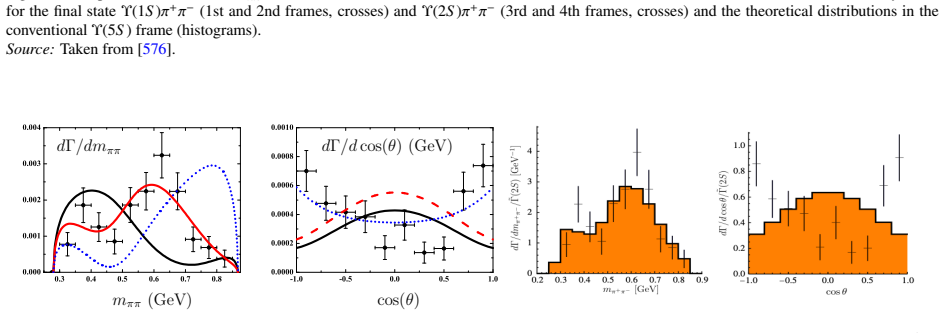
Several 'unquenched' solutions are parameterized to the very data they claim to explain: the ρπ puzzle, χ_c1→γV decays, and the Y(4220)-centered spectrum.
specific steps
-
fitted input called prediction
[Section 2.2.1, Decoding the ρπ puzzle through the hadronic loop mechanism]
"The model is constrained using the experimental branching ratios for two reference channels: J/ψ→ρ0π0 and J/ψ→K∗+K−+c.c.. A global fit yields the parameter values: α=0.13, |G_S^PV|=4.51×10^-3 GeV^-1. With these parameters fixed, predictions are made for all other J/ψ→PV channels. ... By fixing the relevant parameters with the experimental data for J/ψ, ψ′→ρπ and K∗K¯+c.c., they reached a similar conclusion: the destructive interference between the long-distance charmed-meson loops and the short-distance amplitudes in ψ′ decays leads to the observed deviations from the “12% rule”."
The ρπ and K*K branching ratios that define the puzzle are the fitting inputs. The 'destructive interference' that is claimed to explain the suppressed ρπ channel is therefore a property of the fit, not a prediction. The ψ′ suppression is likewise reproduced only after fixing parameters to the ψ′→ρπ and K*K data, so the 'solution' reduces to re-describing the input anomalies.
-
fitted input called prediction
[Section 2.2.3.2, Radiative decays (χ_c1→γV)]
"The corresponding α ranges for χ_c1→γρ0, γω, γϕ are 2.18<α<2.35, 2.06<α<2.28, and 1.16<α<2.77, respectively, all of which lie within a reasonable parameter space. Notably, a common α range of 2.18<α<2.28 is found for all three radiative decay channels. Thus, the hadronic loop mechanism can serve as the underlying source that reduces the discrepancy..."
α is not fixed a priori; for each channel the α interval is selected as the range where the theoretical curve overlaps the measured branching ratio. The 'common α range' is an intersection of three individually fitted intervals, so it is a post-fit consistency check rather than a parameter-free prediction. Presenting this as evidence that the hadronic loop mechanism is 'the underlying source' turns the fit into a purported explanation.
-
fitted input called prediction
[Section 4.4.2, Y(4220) as a scaling point to reconstruct J/ψ family within the unquenched picture; Section 4.4 intro]
"By fitting the masses of fourteen experimentally established charmonium states, including ... together with Y(4220) assigned as the ψ(4S) state, all model parameters can be constrained, which induced the mass of ψ(4S) as 4274 MeV. ... the identification of Y(4220)—a narrow structure near 4.2 GeV—as a scaling point for constructing the higher charmonium family within an unquenched framework, and the emergence of a distinctive mass spectrum for vector charmonia in the 4-4.5 GeV region, which aligns with all available experimental data..."
Y(4220) is an explicit fitting input: it is one of the states used to constrain the model parameters and is called the 'scaling point' for the higher charmonium spectrum. The later statement that the resulting 4–4.5 GeV mass spectrum 'aligns with all available experimental data' is therefore partly guaranteed by construction, since Y(4220) itself is in the fitted data set. The associated 'prediction' of the partner ψ(4380) is then 'confirmed' by adding a free resonance to a fit, further weakening the independence of the test.
full rationale
The review's central claim—that the unquenched picture is essential and provides compelling solutions—is supported largely by hadronic-loop calculations whose cutoff parameter α is tuned per process or per observable. Three explicit examples are flagged. In the ρπ puzzle, the same anomalous branching ratios used to fix α and the effective short-distance coupling are then said to be explained by destructive interference. In χ_c1→γV, α ranges are selected channel-by-channel by requiring overlap with experiment, and the existence of a common interval is offered as evidence. In the Y-problem sector, Y(4220) is explicitly used as a fitting input and 'scaling point'; its presence in the resulting spectrum cannot be counted as a prediction. These are not merely 'non-consensus' concerns but specific reductions of 'solutions' to the data they were fitted to. At the same time, the paper includes genuine external experimental data and some earlier parameter-free structural arguments (e.g., the 2014 mass-gap estimate of a narrow state near 4.26 GeV), so the circularity is partial rather than total. The score of 6 reflects that several central 'predictions' reduce by construction while the overall enterprise retains independent phenomenological content.
Axiom & Free-Parameter Ledger
free parameters (7)
- α (hadronic-loop form-factor cutoff) =
varies per channel: 0.13; 0.8–1.3; 1.14–1.28; 2.18–2.28; 1–4
- |G_S^PV| short-distance J/ψ→VP coupling =
4.51×10^-3 GeV^-1
- ω–ϕ mixing angle θ =
3.4° ± 0.2°
- 4S–3D mixing angle θ_4S−3D =
±(30°–36°)
- Subtraction point s0 in once-subtracted dispersion relation =
s0 = m_J/ψ²
- Screened-potential parameters (σ, μ, ε_i) =
σ = 0.26–0.32 GeV²; μ ≈ 0.14–0.16 GeV; ε_i per interaction type
- Fano-like interference background (normalization g, slope a, phases ϕ_k) =
g, a, ϕ_k (fit; no table in excerpt)
axioms (6)
- ad hoc to paper Loop amplitudes regularized by the empirical monopole/dipole form factor with cutoff Λ = m_E + αΛ_QCD dominate the long-distance physics
- domain assumption Two-body charmed-meson channels (D̄D, D̄D*, D*D̄*) dominate coupled-channel self-energies and rescattering amplitudes
- domain assumption Quenched quark-model (Cornell/GI) masses are legitimate 'bare' masses on which loop corrections act
- standard math The 12% rule and helicity selection rule give the correct quenched baseline
- ad hoc to paper Inference to best explanation: an anomaly reproduced by the hadronic-loop mechanism is caused by that mechanism
- ad hoc to paper Universality: unquenched effects apply equally to bottomonium and light-flavor sectors
invented entities (2)
-
ψ(4380) (4S–3D mixed partner of Y(4220))
independent evidence
-
Z_cs / isoscalar Z_c partner structures
independent evidence
read the original abstract
The year 2024 marked the 50th anniversary of the discovery of the $J/\psi$ particle, which unveiled the charm quark and the charmonium spectrum, instigating the "November Revolution" in particle physics. This discovery catalyzed the development of quenched potential models, most notably the Cornell model, which provided a foundational quantitative description of the hadronic spectrum. However, the landscape of hadron spectroscopy has been profoundly transformed since the turn of the 21st century with the observation of numerous charmonium-like states, such as $X(3872)$, which exhibit properties starkly at odds with quenched model predictions. These discrepancies, exemplified by the "$X(3872)$ low-mass puzzle" and the "$Y$ problem" associated with vector states like $Y(4260)$, underscore the critical limitations of the quenched approximation and signal the necessity for a new theoretical paradigm. This review synthesizes recent advances in hadronic spectroscopy, arguing that the unquenched picture, which incorporates coupled-channel effects such as hadronic loops, is essential for a unified description of these new states and associated anomalies. We demonstrate how unquenched effects provide compelling solutions to long-standing puzzles in charmonium decays (e.g., the "$\rho\pi$ puzzle" and anomalous dipion transitions), predict and explain the existence of exotic charged states like $Z_c(3900)$ and $Z_b(10610)$ via mechanisms such as Initial Single Pion Emission, and offer a framework for understanding interactions between charmonia and with nucleons. Furthermore, we emphasize the universality of unquenched effects, extending their application to bottomonium and light-flavor sectors. As experimental precision continues to improve, we advocate for the systematic development of unquenched hadronic spectroscopy.
Figures






















Forward citations
Cited by 16 Pith papers
-
Measurement of Born Cross Section for $e^+e^-\to K_S^0\bar{\Xi}^+\Sigma^-+\rm{c.c.}$ at $\sqrt{s} = 3.51-4.95$ GeV
First Born cross-section measurement for e+e−→K_S^0 \barΞ^+ Σ^- + c.c. at 3.51–4.95 GeV shows a smooth continuum with no charmonium-like resonance signals and a K_S^0-to-K^- ratio consistent with isospin conservation.
-
The supernumerary $K(1690)$ signal from COMPASS as a strange hybrid state
Among three pseudoscalar strange mesons seen at 1–2 GeV, the K(1690) is the one the quark model cannot accommodate, and its computed decay width as a 0⁻ strange hybrid matches experiment.
-
Possible hidden-bottom molecular pentaquarks from $P$-wave $\Lambda_bB^{(*)}/\Sigma_b^{(*)}B^{(*)}$ interactions
P-wave Lambda_b B(*)/Sigma_b(*) B(*) one-boson-exchange dynamics predicts a spectrum of positive-parity hidden-bottom molecular pentaquark candidates, including Sigma_b B* and Sigma_b* B* bound states and resonances.
-
Predictions for the scalar partner of the LHC tetraquark $X(6600)$
The paper predicts a scalar cc-ccbar tetraquark state (X(6400)) and identifies it as the partner to the recently observed tensor state X(6600).
-
Vector charmonium(-like) states in the energy range of 4.1-4.6 GeV
A coupled-channel framework is developed and fitted to BESIII data on vector charmonium-like states in the 4.1-4.6 GeV range, concluding that coupled-channel effects with dynamically generated poles explain the line shapes.
-
Proposed mixing between $2P$ and $1F$ wave charmonia
Unquenched coupled-channel calculations yield sizable 2P–1F mixing angles of 7.5° and 15.4° for the χ_c2 charmonia, with predicted two-photon and two-gluon widths as experimental tests.
-
Proposed mixing between $2P$ and $1F$ wave charmonia
Unquenched calculation finds sizable 2P-1F mixing in charmonium with angles 7.5° and 15.4°, yielding predictions for two-photon and two-gluon decay widths.
-
Unquenched Radially Excited $P$-wave Charmonia
Unquenched calculations of radially excited P-wave charmonia masses via Resonance-Spectrum Expansion with generalized 3P0 decay couplings produce a mass pattern matching PDG candidates around 3.85-3.95 GeV.
-
Five-flavor molecular pentaquarks in the $\Xi_b^{(\prime,\,*)} \bar D^{(*)}$ and $\Xi_c^{(\prime,\,*)} B^{(*)}$ systems
One-boson-exchange calculations predict multiple loosely bound five-flavor molecular pentaquarks in Ξb('*)D-bar(*) and Ξc('*)B(*) systems with I=0 and listed J^P quantum numbers.
-
Decay constants of the two-pole $D_0^*(2300)$
Molecular two-pole D0*(2300) decay constants are 65 and 81 MeV—much smaller than compact c¯q estimates—and imply Cabibbo-favored b-hadron branching fractions of order 10^{-5}.
-
$P_{c}(4312)$, $P_{c}(4440)$, and $P_{c}(4457)$ productions in $e^{+} e^{-}$ collisions
Pc(4312), Pc(4440), and Pc(4457) could be produced in e+e− collisions at tens-of-fb rates, with Pc(4457) dominating and a resolvable double peak near 4.45 GeV in the J/ψp mass spectrum.
-
Observation of $\psi(3770)\to p\bar p$ and Measurement of Electromagnetic Form Factors of Proton at $\sqrt{s} = 3.510-4.946$ GeV
BESIII observes ψ(3770)→p p-bar at 6.6σ and measures |G_E/G_M| and |G_M| from e+e- → p p-bar cross sections and angular distributions at 47 energies between 3.51 and 4.95 GeV.
-
Mass spectra and electromagnetic characteristics of the $K^{(*)}\bar D^{(*)}$ and $K^{(*)}{D}^{(*)}$ molecular tetraquarks from the coupled-channel dynamics
Using coupled-channel one-boson-exchange dynamics the authors predict several K(*) bar D(*) and K(*) D(*) molecular tetraquark candidates and their electromagnetic properties.
-
Prediction of doubly-charm hadronic molecules with double strange quarks
One-boson-exchange model predicts D_s1 bar D_s1, D_s1 bar D_s2* and D_s2* bar D_s2* states as hidden-charm hidden-strangeness molecular tetraquarks plus analogous doubly-charm candidates.
-
Five-flavor molecular pentaquarks in the $\Xi_b^{(\prime,\,*)} \bar D^{(*)}$ and $\Xi_c^{(\prime,\,*)} B^{(*)}$ systems
The study predicts several five-flavor molecular pentaquarks such as Ξ_b D̄ and Ξ_c B with I(J^P)=0(1/2^-) and related states, showing spin splittings from spin-dependent forces and channel couplings.
-
Production of high-orbital kaon excited states in the $K^{-}p$ reaction
An effective Lagrangian approach calibrated with one adjustable parameter from data reproduces cross sections for K3*(1780), K2(1820), K2(1770) and K4*(2045) and predicts sizable forward-peaked production for addition...
Reference graph
Works this paper leans on
-
[1]
20 2024)
SLAC National Accelerator Laboratory, SLAC celebrates 50 years of a nobel-winning discovery in particle physics (Nov. 20 2024). URLhttps://www6.slac.stanford.edu/news/2024-11-20-slac-celebrates-50-years-nobel-winning-discovery-particle-physics
2024
-
[2]
URLhttps://cds.cern.ch/record/2935663
IHEP–CERN Joint Symposium, 50 years of theJ/ψdiscovery: from the november revolution to the precision frontier. URLhttps://cds.cern.ch/record/2935663
-
[3]
J. J. Aubert, et al., Experimental Observation of a Heavy ParticleJ, Phys. Rev. Lett. 33 (1974) 1404–1406. doi:10.1103/PhysRevLett.33.1404
-
[4]
J. E. Augustin, et al., Discovery of a Narrow Resonance ine +e− Annihilation, Phys. Rev. Lett. 33 (1974) 1406–1408.doi:10.1103/PhysRevLett.33.1406. 141
-
[5]
S. L. Glashow, J. Iliopoulos, L. Maiani, Weak interactions with lepton-hadron symmetry, Phys. Rev. D 2 (1970) 1285–1292.doi:10.1103/PhysRevD.2.1285
-
[6]
Gell-Mann, The eightfold way: A theory of strong interaction symmetry (3 1961).doi:10.2172/4008239
M. Gell-Mann, The eightfold way: A theory of strong interaction symmetry (3 1961).doi:10.2172/4008239
doi:10.2172/4008239 1961
-
[7]
Ne’eman, Derivation of strong interactions from a gauge invariance, Nucl
Y . Ne’eman, Derivation of strong interactions from a gauge invariance, Nucl. Phys. 26 (1961) 222–229.doi: 10.1016/0029-5582(61)90134-1
-
[8]
Gell-Mann, A schematic model of baryons and mesons, Phys
M. Gell-Mann, A schematic model of baryons and mesons, Phys. Lett. 8 (1964) 214–215.doi:10.1016/ S0031-9163(64)92001-3
1964
-
[9]
Zweig, An SU(3) model for strong interaction symmetry and its breaking
G. Zweig, An SU(3) model for strong interaction symmetry and its breaking. Version 1 (1 1964).doi:10. 17181/CERN-TH-401
1964
-
[10]
E. Eichten, K. Gottfried, T. Kinoshita, J. B. Kogut, K. D. Lane, T.-M. Yan, The spectrum of charmonium, Phys. Rev. Lett. 34 (1975) 369–372, [Erratum: Phys.Rev.Lett. 36, 1276 (1976)].doi:10.1103/PhysRevLett.34. 369
-
[11]
E. Eichten, K. Gottfried, T. Kinoshita, K. D. Lane, T.-M. Yan, Charmonium: The model, Phys. Rev. D 17 (1978) 3090, [Erratum: Phys.Rev.D 21, 313 (1980)].doi:10.1103/PhysRevD.17.3090
-
[12]
E. Eichten, K. Gottfried, T. Kinoshita, K. D. Lane, T.-M. Yan, Charmonium: Comparison with experiment, Phys. Rev. D 21 (1980) 203.doi:10.1103/PhysRevD.21.203
-
[13]
S. Godfrey, N. Isgur, Mesons in a relativized quark model with chromodynamics, Phys. Rev. D 32 (1985) 189–231.doi:10.1103/PhysRevD.32.189
-
[14]
E. Klempt, A. Zaitsev, Glueballs, Hybrids, Multiquarks. Experimental facts versus QCD inspired concepts, Phys. Rept. 454 (2007) 1–202.arXiv:0708.4016,doi:10.1016/j.physrep.2007.07.006
Pith/arXiv arXiv 2007
-
[15]
Brambilla, et al., Heavy quarkonium: Progress, puzzles, and opportunities, Eur
N. Brambilla, et al., Heavy quarkonium: Progress, puzzles, and opportunities, Eur. Phys. J. C 71 (2011) 1534. arXiv:1010.5827,doi:10.1140/epjc/s10052-010-1534-9
Pith/arXiv arXiv 2011
-
[16]
Liu, An overview ofXYZnew particles, Chin
X. Liu, An overview ofXYZnew particles, Chin. Sci. Bull. 59 (2014) 3815–3830.arXiv:1312.7408,doi: 10.1007/s11434-014-0407-2
Pith/arXiv arXiv 2014
-
[17]
A. Hosaka, T. Iijima, K. Miyabayashi, Y . Sakai, S. Yasui, Exotic hadrons with heavy flavors:X,Y,Z, and related states, PTEP 2016 (6) (2016) 062C01.arXiv:1603.09229,doi:10.1093/ptep/ptw045
Pith/arXiv arXiv 2016
-
[18]
Richard, Exotic hadrons: review and perspectives, Few Body Syst
J.-M. Richard, Exotic hadrons: review and perspectives, Few Body Syst. 57 (12) (2016) 1185–1212.arXiv: 1606.08593,doi:10.1007/s00601-016-1159-0
Pith/arXiv arXiv 2016
-
[19]
H.-X. Chen, W. Chen, X. Liu, S.-L. Zhu, The hidden-charm pentaquark and tetraquark states, Phys. Rept. 639 (2016) 1–121.arXiv:1601.02092,doi:10.1016/j.physrep.2016.05.004
Pith/arXiv arXiv 2016
-
[20]
A. Esposito, A. Pilloni, A. D. Polosa, Multiquark resonances, Phys. Rept. 668 (2017) 1–97.arXiv:1611. 07920,doi:10.1016/j.physrep.2016.11.002
-
[21]
H.-X. Chen, W. Chen, X. Liu, Y .-R. Liu, S.-L. Zhu, A review of the open charm and open bottom systems, Rept. Prog. Phys. 80 (7) (2017) 076201.arXiv:1609.08928,doi:10.1088/1361-6633/aa6420
Pith/arXiv arXiv 2017
-
[22]
R. F. Lebed, R. E. Mitchell, E. S. Swanson, Heavy-quark QCD exotica, Prog. Part. Nucl. Phys. 93 (2017) 143–194.arXiv:1610.04528,doi:10.1016/j.ppnp.2016.11.003
Pith/arXiv arXiv 2017
-
[23]
F.-K. Guo, C. Hanhart, U.-G. Meißner, Q. Wang, Q. Zhao, B.-S. Zou, Hadronic molecules, Rev. Mod. Phys. 90 (1) (2018) 015004, [Erratum: Rev.Mod.Phys. 94, 029901 (2022)].arXiv:1705.00141,doi:10.1103/ RevModPhys.90.015004. 142
Pith/arXiv arXiv 2018
-
[24]
S. L. Olsen, T. Skwarnicki, D. Zieminska, Nonstandard heavy mesons and baryons: Experimental evidence, Rev. Mod. Phys. 90 (1) (2018) 015003.arXiv:1708.04012,doi:10.1103/RevModPhys.90.015003
Pith/arXiv arXiv 2018
-
[25]
A. Ali, J. S. Lange, S. Stone, Exotics: Heavy pentaquarks and tetraquarks, Prog. Part. Nucl. Phys. 97 (2017) 123–198.arXiv:1706.00610,doi:10.1016/j.ppnp.2017.08.003
Pith/arXiv arXiv 2017
-
[26]
Y .-R. Liu, H.-X. Chen, W. Chen, X. Liu, S.-L. Zhu, Pentaquark and tetraquark states, Prog. Part. Nucl. Phys. 107 (2019) 237–320.arXiv:1903.11976,doi:10.1016/j.ppnp.2019.04.003
Pith/arXiv arXiv 2019
-
[27]
N. Brambilla, S. Eidelman, C. Hanhart, A. Nefediev, C.-P. Shen, C. E. Thomas, A. Vairo, C.-Z. Yuan, The XYZstates: Experimental and theoretical status and perspectives, Phys. Rept. 873 (2020) 1–154.arXiv: 1907.07583,doi:10.1016/j.physrep.2020.05.001
Pith/arXiv arXiv 2020
-
[28]
H.-X. Chen, W. Chen, X. Liu, Y .-R. Liu, S.-L. Zhu, An updated review of the new hadron states, Rept. Prog. Phys. 86 (2) (2023) 026201.arXiv:2204.02649,doi:10.1088/1361-6633/aca3b6
Pith/arXiv arXiv 2023
-
[29]
L. Meng, B. Wang, G.-J. Wang, S.-L. Zhu, Chiral perturbation theory for heavy hadrons and chiral effective field theory for heavy hadronic molecules, Phys. Rept. 1019 (2023) 1–149.arXiv:2204.08716,doi:10. 1016/j.physrep.2023.04.003
Pith/arXiv arXiv 2023
-
[30]
F.-L. Wang, X.-D. Yang, R. Chen, X. Liu, Correlation of the hidden-charm molecular tetraquarks and the charmoniumlike structures existing in theB→XYZ+Kprocess, Phys. Rev. D 104 (9) (2021) 094010.arXiv: 2103.04698,doi:10.1103/PhysRevD.104.094010
Pith/arXiv arXiv 2021
-
[31]
X. Wang, X. Liu, Y . Gao, Colloquium: Hadron Production in Open-charm Meson Pair ate +e− Collider (2 2025).arXiv:2502.15117
Pith/arXiv arXiv 2025
-
[32]
S. K. Choi, et al., Observation of a narrow charmonium-like state in exclusiveB±→K ±π+π−J/ψdecays, Phys. Rev. Lett. 91 (2003) 262001.arXiv:hep-ex/0309032,doi:10.1103/PhysRevLett.91.262001
Pith/arXiv arXiv 2003
-
[33]
Aubert, et al., Observation of a narrow meson decaying toD + sπ0 at a mass of 2.32 GeV/c2, Phys
B. Aubert, et al., Observation of a narrow meson decaying toD + sπ0 at a mass of 2.32 GeV/c2, Phys. Rev. Lett. 90 (2003) 242001.arXiv:hep-ex/0304021,doi:10.1103/PhysRevLett.90.242001
Pith/arXiv arXiv 2003
-
[34]
D. Besson, et al., Observation of a narrow resonance of mass 2.46 GeV/c 2 decaying toD∗+ s π0 and confirmation of theD ∗ sJ(2317) state, Phys. Rev. D 68 (2003) 032002, [Erratum: Phys.Rev.D 75, 119908 (2007)].arXiv: hep-ex/0305100,doi:10.1103/PhysRevD.68.032002
Pith/arXiv arXiv 2003
-
[35]
Aubert, et al., Observation of a charmed baryon decaying toD 0pat a mass near 2.94 GeV/c 2, Phys
B. Aubert, et al., Observation of a charmed baryon decaying toD 0pat a mass near 2.94 GeV/c 2, Phys. Rev. Lett. 98 (2007) 012001.arXiv:hep-ex/0603052,doi:10.1103/PhysRevLett.98.012001
Pith/arXiv arXiv 2007
-
[36]
B. Silvestre-Brac, C. Gignoux, Unitary effects in spin orbit splitting ofP-wave baryons, Phys. Rev. D 43 (1991) 3699–3708.doi:10.1103/PhysRevD.43.3699
-
[37]
E. van Beveren, G. Rupp, ObservedD s(2317) and tentativeD(2100–2300) as the charmed cousins of the light scalar nonet, Phys. Rev. Lett. 91 (2003) 012003.arXiv:hep-ph/0305035,doi:10.1103/PhysRevLett. 91.012003
Pith/arXiv arXiv 2003
-
[38]
D. S. Hwang, D.-W. Kim, Mass ofD ∗ sJ(2317) and coupled channel effect, Phys. Lett. B 601 (2004) 137–143. arXiv:hep-ph/0408154,doi:10.1016/j.physletb.2004.09.040
Pith/arXiv arXiv 2004
-
[39]
Y . S. Kalashnikova, Coupled-channel model for charmonium levels and an option forX(3872), Phys. Rev. D 72 (2005) 034010.arXiv:hep-ph/0506270,doi:10.1103/PhysRevD.72.034010
Pith/arXiv arXiv 2005
-
[40]
B.-Q. Li, C. Meng, K.-T. Chao, Coupled-channel and screening effects in charmonium spectrum, Phys. Rev. D 80 (2009) 014012.arXiv:0904.4068,doi:10.1103/PhysRevD.80.014012
Pith/arXiv arXiv 2009
-
[41]
O. Zhang, C. Meng, H. Q. Zheng, Ambiversion ofX(3872), Phys. Lett. B 680 (2009) 453–458.arXiv: 0901.1553,doi:10.1016/j.physletb.2009.09.033. 143
Pith/arXiv arXiv 2009
-
[42]
P. G. Ortega, J. Segovia, D. R. Entem, F. Fernandez, Coupled channel approach to the structure of theX(3872), Phys. Rev. D 81 (2010) 054023.arXiv:0907.3997,doi:10.1103/PhysRevD.81.054023
Pith/arXiv arXiv 2010
-
[43]
I. V . Danilkin, Y . A. Simonov, Dynamical origin and the pole structure ofX(3872), Phys. Rev. Lett. 105 (2010) 102002.arXiv:1006.0211,doi:10.1103/PhysRevLett.105.102002
Pith/arXiv arXiv 2010
-
[44]
Q.-T. Song, D.-Y . Chen, X. Liu, T. Matsuki, Charmed-strange mesons revisited: mass spectra and strong decays, Phys. Rev. D 91 (2015) 054031.arXiv:1501.03575,doi:10.1103/PhysRevD.91.054031
Pith/arXiv arXiv 2015
-
[45]
S.-Q. Luo, B. Chen, Z.-W. Liu, X. Liu, Resolving the low mass puzzle ofΛ c(2940)+, Eur. Phys. J. C 80 (4) (2020) 301.arXiv:1910.14545,doi:10.1140/epjc/s10052-020-7874-1
Pith/arXiv arXiv 2020
-
[46]
S.-Q. Luo, B. Chen, X. Liu, T. Matsuki, Predicting a new resonance as charmed-strange baryonic analog ofD ∗ s0(2317), Phys. Rev. D 103 (7) (2021) 074027.arXiv:2102.00679,doi:10.1103/PhysRevD.103. 074027
Pith/arXiv arXiv 2021
-
[47]
Z.-L. Zhang, Z.-W. Liu, S.-Q. Luo, F.-L. Wang, B. Wang, H. Xu,Λ c(2910) andΛ c(2940) as conventional baryons dressed with theD ∗Nchannel, Phys. Rev. D 107 (3) (2023) 034036.arXiv:2210.17188,doi: 10.1103/PhysRevD.107.034036
Pith/arXiv arXiv 2023
-
[48]
Z.-L. Zhang, Z.-W. Liu, S.-Q. Luo, P. Chen, Z.-H. Guo, Masses and radiative decay widths ofD ∗ s0(2317) andD ′ s1(2460) and their bottom analogs, Phys. Rev. D 110 (9) (2024) 094037.arXiv:2409.05337,doi: 10.1103/PhysRevD.110.094037
Pith/arXiv arXiv 2024
-
[49]
Uehara, et al., Observation of a charmonium-like enhancement in theγγ→ωJ/ψprocess, Phys
S. Uehara, et al., Observation of a charmonium-like enhancement in theγγ→ωJ/ψprocess, Phys. Rev. Lett. 104 (2010) 092001.arXiv:0912.4451,doi:10.1103/PhysRevLett.104.092001
Pith/arXiv arXiv 2010
-
[50]
Uehara, et al., Observation of aχ ′ c2 candidate inγγ→D ¯Dproduction at Belle, Phys
S. Uehara, et al., Observation of aχ ′ c2 candidate inγγ→D ¯Dproduction at Belle, Phys. Rev. Lett. 96 (2006) 082003.arXiv:hep-ex/0512035,doi:10.1103/PhysRevLett.96.082003
Pith/arXiv arXiv 2006
-
[51]
B. Aubert, et al., Observation of a broad structure in theπ +π−J/ψmass spectrum around 4.26 GeV/c 2, Phys. Rev. Lett. 95 (2005) 142001.arXiv:hep-ex/0506081,doi:10.1103/PhysRevLett.95.142001
Pith/arXiv arXiv 2005
-
[52]
B. Aubert, et al., Evidence of a broad structure at an invariant mass of 4.32 GeV/c 2 in the reactione +e−→ π+π−ψ(2S) measured at BaBar, Phys. Rev. Lett. 98 (2007) 212001.arXiv:hep-ex/0610057,doi:10.1103/ PhysRevLett.98.212001
Pith/arXiv arXiv 2007
-
[53]
X. L. Wang, et al., Observation of two resonant structures ine +e−→π +π−ψ(2S) via initial state radiation at Belle, Phys. Rev. Lett. 99 (2007) 142002.arXiv:0707.3699,doi:10.1103/PhysRevLett.99.142002
Pith/arXiv arXiv 2007
-
[54]
G. Pakhlova, et al., Observation of a near-threshold enhancement in thee +e− →Λ + c Λ− c cross section using initial-state radiation, Phys. Rev. Lett. 101 (2008) 172001.arXiv:0807.4458,doi:10.1103/PhysRevLett. 101.172001
Pith/arXiv arXiv 2008
-
[55]
M. Ablikim, et al., Precise measurement of thee +e− →π +π−J/ψcross section at center-of-mass energies from 3.77 to 4.60 GeV, Phys. Rev. Lett. 118 (9) (2017) 092001.arXiv:1611.01317,doi:10.1103/ PhysRevLett.118.092001
Pith/arXiv arXiv 2017
-
[56]
Ablikim, et al., Evidence of two resonant structures ine +e−→π +π−hc, Phys
M. Ablikim, et al., Evidence of two resonant structures ine +e−→π +π−hc, Phys. Rev. Lett. 118 (9) (2017) 092002.arXiv:1610.07044,doi:10.1103/PhysRevLett.118.092002
Pith/arXiv arXiv 2017
-
[57]
Ablikim, et al., Future physics programme of BESIII, Chin
M. Ablikim, et al., Future physics programme of BESIII, Chin. Phys. C 44 (4) (2020) 040001.arXiv:1912. 05983,doi:10.1088/1674-1137/44/4/040001
-
[58]
F. A. Harris, Recent charmonium results from BES, in: American Physical Society (APS) Meeting of the Division of Particles and Fields (DPF 99), 1999.arXiv:hep-ex/9903036. 144
Pith/arXiv arXiv 1999
-
[59]
X. Liu, X.-Q. Zeng, X.-Q. Li, Study on contributions of hadronic loops to decays ofJ/ψ→vector+pseu- doscalar mesons, Phys. Rev. D 74 (2006) 074003.arXiv:hep-ph/0606191,doi:10.1103/PhysRevD.74. 074003
Pith/arXiv arXiv 2006
-
[60]
X. Liu, B. Zhang, X.-Q. Li, The puzzle of excessive non-D ¯Dcomponent of the inclusiveψ(3770) decay and the long-distant contribution, Phys. Lett. B 675 (2009) 441–445.arXiv:0902.0480,doi:10.1016/ j.physletb.2009.04.047
Pith/arXiv arXiv 2009
-
[61]
G. Li, X.-h. Liu, Q. Wang, Q. Zhao, Further understanding of the non-D ¯Ddecays ofψ(3770), Phys. Rev. D 88 (1) (2013) 014010.arXiv:1302.1745,doi:10.1103/PhysRevD.88.014010
Pith/arXiv arXiv 2013
-
[62]
Y .-J. Zhang, G. Li, Q. Zhao, Towards a dynamical understanding of the non-D ¯Ddecay ofψ(3770), Phys. Rev. Lett. 102 (2009) 172001.arXiv:0902.1300,doi:10.1103/PhysRevLett.102.172001
Pith/arXiv arXiv 2009
-
[63]
D.-Y . Chen, J. He, X.-Q. Li, X. Liu, Understanding the branching ratios ofχ c1→ϕϕ,ωω,ωϕobserved at BES-III, Phys. Rev. D 81 (2010) 074006.arXiv:0912.4860,doi:10.1103/PhysRevD.81.074006
Pith/arXiv arXiv 2010
-
[64]
X.-H. Liu, Q. Zhao, The Evasion of helicity selection rule inχc1→VVandχ c2→VPvia intermediate charmed meson loops, Phys. Rev. D 81 (2010) 014017.arXiv:0912.1508,doi:10.1103/PhysRevD.81.014017
Pith/arXiv arXiv 2010
-
[65]
D.-Y . Chen, Y .-B. Dong, X. Liu, Long-distant contribution andχc1 radiative decays to light vector meson, Eur. Phys. J. C 70 (2010) 177–182.arXiv:1005.0066,doi:10.1140/epjc/s10052-010-1449-5
Pith/arXiv arXiv 2010
-
[66]
Q. Huang, J.-Z. Wang, R.-G. Ping, X. Liu, Detecting the polarization inχcJ→ϕϕdecays to probe hadronic loop effect, Phys. Rev. D 103 (9) (2021) 096006.arXiv:2102.07104,doi:10.1103/PhysRevD.103.096006
Pith/arXiv arXiv 2021
-
[67]
Besson, et al., Measurement ofσ(e +e− →ψ(3770)→hadrons) atE c.m
D. Besson, et al., Measurement ofσ(e +e− →ψ(3770)→hadrons) atE c.m. =3773 MeV, Phys. Rev. Lett. 96 (2006) 092002, [Erratum: Phys.Rev.Lett. 104, 159901 (2010)].arXiv:1004.1358,doi:10.1103/ PhysRevLett.96.092002
Pith/arXiv arXiv 2006
-
[68]
M. Ablikim, et al., Measurements of the braching fractions forψ(3770)→D 0 ¯D0,D +D−,D ¯Dand the resonance parameters ofψ(3770) andψ(2S), Phys. Rev. Lett. 97 (2006) 121801.arXiv:hep-ex/0605107,doi:10. 1103/PhysRevLett.97.121801
Pith/arXiv arXiv 2006
-
[69]
M. Ablikim, et al., Measurements of the cross-sections fore +e−→hadrons at 3.650 GeV , 3.6648 GeV , 3.773 GeV and the branching fraction forψ(3770)→non−D ¯D, Phys. Lett. B 641 (2006) 145–155.arXiv: hep-ex/0605105,doi:10.1016/j.physletb.2006.08.049
Pith/arXiv arXiv 2006
-
[71]
M. Ablikim, et al., Direct measurements of the cross sections fore +e−→hadrons (non-D ¯D) in the range from 3.65 GeV to 3.87 GeV and the branching fraction forψ(3770)→non−D ¯D, Phys. Lett. B 659 (2008) 74–79. doi:10.1016/j.physletb.2007.11.078
-
[72]
J. V . Bennett, et al., Observation ofχ cJ radiative decays to light vector mesons, Phys. Rev. Lett. 101 (2008) 151801.arXiv:0807.3718,doi:10.1103/PhysRevLett.101.151801
Pith/arXiv arXiv 2008
-
[73]
Ablikim, et al., Study ofχ cJ radiative decays into a vector meson, Phys
M. Ablikim, et al., Study ofχ cJ radiative decays into a vector meson, Phys. Rev. D 83 (2011) 112005.arXiv: 1103.5564,doi:10.1103/PhysRevD.83.112005
Pith/arXiv arXiv 2011
-
[74]
Ablikim, et al., Observation ofK ∗(892)0 ¯K∗(892)0 inχ cJ decays, Phys
M. Ablikim, et al., Observation ofK ∗(892)0 ¯K∗(892)0 inχ cJ decays, Phys. Rev. D 70 (2004) 092003.arXiv: hep-ex/0408012,doi:10.1103/PhysRevD.70.092003
Pith/arXiv arXiv 2004
-
[75]
Ablikim, et al., Observation ofχ c1 decays into vector meson pairsϕϕ,ωω, andωϕ, Phys
M. Ablikim, et al., Observation ofχ c1 decays into vector meson pairsϕϕ,ωω, andωϕ, Phys. Rev. Lett. 107 (2011) 092001.arXiv:1104.5068,doi:10.1103/PhysRevLett.107.092001. 145
arXiv 2011
-
[76]
N. E. Adam, et al., Observation ofψ(3770)→ππJ/ψand measurement ofΓ ee[ψ(2S)], Phys. Rev. Lett. 96 (2006) 082004.arXiv:hep-ex/0508023,doi:10.1103/PhysRevLett.96.082004
Pith/arXiv arXiv 2006
-
[77]
Y .-P. Kuang, T.-M. Yan, Hadronic Transitions ofDWave Quarkonium andψ(3770)→J/ψππ, Phys. Rev. D 41 (1990) 155.doi:10.1103/PhysRevD.41.155
-
[78]
D.-Y . Chen, X. Liu, X.-Q. Li, Anomalous dipion invariant mass distribution of theΥ(4S) decays into Υ(1S)π +π− andΥ(2S)π +π−, Eur. Phys. J. C 71 (2011) 1808.arXiv:1109.1406,doi:10.1140/epjc/ s10052-011-1808-x
Pith/arXiv arXiv 2011
-
[79]
K. F. Chen, et al., Observation of anomalousΥ(1S)π +π− andΥ(2S)π +π− production near theΥ(5S) resonance, Phys. Rev. Lett. 100 (2008) 112001.arXiv:0710.2577,doi:10.1103/PhysRevLett.100.112001
Pith/arXiv arXiv 2008
-
[80]
Bondar, et al., Observation of two charged bottomonium-like resonances inΥ(5S) decays, Phys
A. Bondar, et al., Observation of two charged bottomonium-like resonances inΥ(5S) decays, Phys. Rev. Lett. 108 (2012) 122001.arXiv:1110.2251,doi:10.1103/PhysRevLett.108.122001
Pith/arXiv arXiv 2012
-
[81]
D.-Y . Chen, X. Liu,Z b(10610) andZ b(10650) structures produced by the initial single pion emission in the Υ(5S) decays, Phys. Rev. D 84 (2011) 094003.arXiv:1106.3798,doi:10.1103/PhysRevD.84.094003
Pith/arXiv arXiv 2011
discussion (0)
Sign in with ORCID, Apple, or X to comment. Anyone can read and Pith papers without signing in.