pith. sign in

arxiv: 1906.11241 · v1 · pith:AKZQLJP5new · submitted 2019-06-26 · 🌌 astro-ph.GA · astro-ph.IM· gr-qc

First M87 Event Horizon Telescope Results. IV. Imaging the Central Supermassive Black Hole

Pith reviewed 2026-05-25 15:22 UTC · model grok-4.3

classification 🌌 astro-ph.GA astro-ph.IMgr-qc
keywords M87Event Horizon Telescopeblack hole shadowsupermassive black holeradio interferometryphoton ringimaging reconstruction
0
0 comments X

The pith

The first Event Horizon Telescope images of M87 reveal a stable ring of roughly 40 microarcseconds that matches the expected lensed photon orbit around a supermassive black hole shadow.

A machine-rendered reading of the paper's core claim, the machinery that carries it, and where it could break.

The paper presents the initial 1.3 mm images of the M87 galaxy nucleus obtained by the Event Horizon Telescope in April 2017. These images display a prominent ring whose diameter and shape align with the lensed photon orbit that should encircle the shadow of a supermassive black hole. The ring feature remains consistent across four separate nights and shows brighter emission on the southern side. To guard against bias, four independent teams produced reconstructions with both traditional CLEAN and regularized maximum likelihood methods, then used a large survey of synthetic data to choose parameters objectively. The ring diameter and asymmetry stayed stable no matter which technique or parameter set was applied.

Core claim

The Event Horizon Telescope observations from April 2017 produce images of M87 that contain a prominent ring with a diameter of ~40 micro-as, consistent with the size and shape of the lensed photon orbit encircling the shadow of a supermassive black hole; this ring persists across four observing nights, exhibits enhanced southern brightness, and remains insensitive to the choice of imaging technique.

What carries the argument

A two-stage imaging procedure in which four teams independently reconstruct images using CLEAN and regularized maximum likelihood methods, followed by a survey of synthetic data to select parameters objectively without shared human bias.

If this is right

  • The measured ring diameter and asymmetry remain stable across independent teams and both CLEAN and regularized maximum likelihood reconstructions.
  • The ring structure and its southern brightness enhancement persist across all four observing nights.
  • These image features do not change when different imaging parameters are chosen within the range tested by the synthetic data survey.

Where Pith is reading between the lines

These are editorial extensions of the paper, not claims the author makes directly.

  • If the ring corresponds to the photon orbit, repeated observations could track changes in brightness or shape that would trace the accretion flow or black hole spin.
  • Application of the same two-stage procedure to other targets such as Sgr A* would test whether the ring feature appears in additional supermassive black holes.
  • Comparison of the observed ring diameter with predictions from general relativity could constrain the mass-to-distance ratio of the M87 black hole once the distance is fixed independently.

Load-bearing premise

The synthetic data survey used to select imaging parameters accurately reproduces the real instrumental and atmospheric effects present in the April 2017 observations.

What would settle it

A new observation at the same wavelength that yields a ring diameter differing by more than a few microarcseconds from 40 micro-as, or that shows no ring at all, would contradict the reported central feature.

Figures

Figures reproduced from arXiv: 1906.11241 by The Event Horizon Telescope Collaboration.

Figure 1
Figure 1. Figure 1: Top panels: aggregate baseline coverage for EHT observations of M87, combining observations on all four days. The left panel shows short-baseline coverage, comprised of ALMA interferometer baselines and intra-site EHT baselines (SMA–JCMT and ALMA–APEX). These short baselines probe angular scales larger than 0.1". The right panel shows long-baseline coverage, comprised of all inter-site EHT baselines. These… view at source ↗
Figure 2
Figure 2. Figure 2: Left panel: S/N as a function of projected baseline length for EHT observations of M87 on April 11. Each point denotes a visibility amplitude coherently averaged over a full scan (4–7 minutes). Points are colored by baseline. Right panel: visibility amplitudes (correlated flux density) as a function of projected baseline length after a priori and network calibration. The amplitudes are corrected for upward… view at source ↗
Figure 3
Figure 3. Figure 3: Selected closure phases from coherently averaged visibilities on three triangles as a function of Greenwich Mean Sidereal Time (GMST) using data from all four days. Error bars denote ±1σ uncertainties from thermal noise. The trivial ALMA–APEX–SMT triangle (left panel) has closure phases near zero on all days, as expected because this triangle includes an intra-site baseline. Deviations from zero arise from… view at source ↗
Figure 4
Figure 4. Figure 4: The first EHT images of M87, blindly reconstructed by four independent imaging teams using an early, engineering release of data from the April 11 observations. These images all used a single polarization (LCP) rather than Stokes I, which is used in the remainder of this Letter. Images from Teams 1 and 2 used RML methods (no restoring beam); images from Teams 3 and 4 used CLEAN (restored with a circular 20… view at source ↗
Figure 5
Figure 5. Figure 5: The four simple geometric models and synthetic data sets used in the parameter surveys (see Appendix C for details). Top: linear scale images, highlighting the compact structure of the models. Middle: logarithmic scale images, highlighting the larger-scale jet added to each model image. Bottom: one realization of simulated visibility amplitudes corresponding to the April 11 observations of M87. We indicate… view at source ↗
Figure 6
Figure 6. Figure 6: Selection of the DIFMAP (CLEAN) parameter survey results on real and synthetic data with April 11 EHT baseline coverage. A 2D slice of the 5D parameter space is displayed, corresponding to different diameters of the circular mask and the data weight on ALMA in self-calibration. All other parameters are kept constant (Compact Flux = 0.5 Jy, κ = −1, Stop Condition = Flux Reached). The left panel shows result… view at source ↗
Figure 7
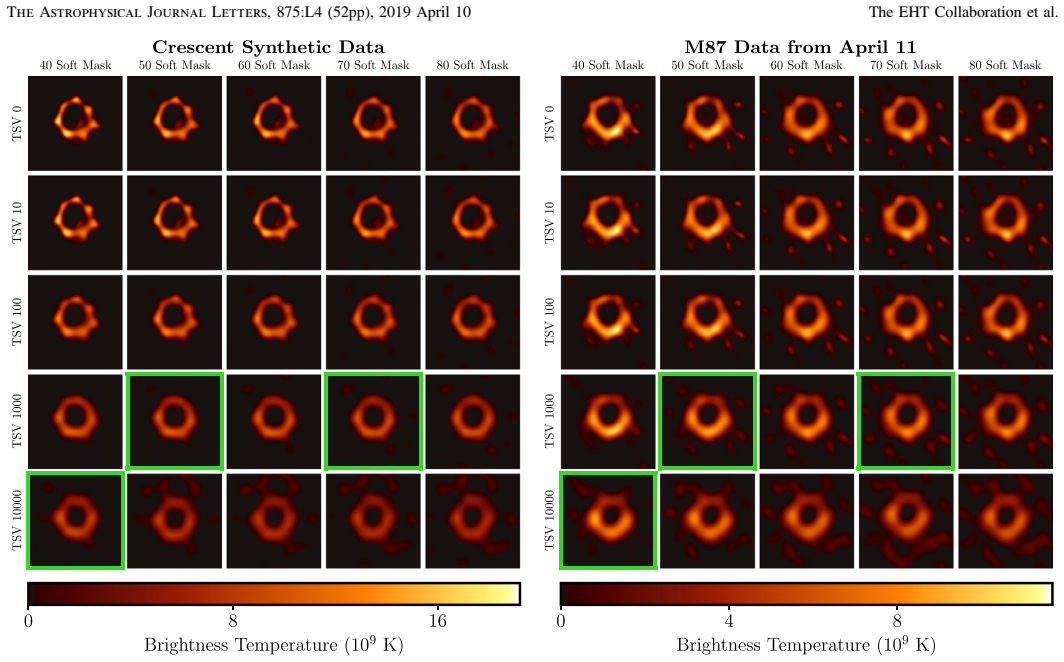
Figure 7. Figure 7: Selection of the eht-imaging (RML) parameter survey results on real and synthetic data with April 11 EHT baseline coverage. A 2D slice of the 7D parameter space is displayed, corresponding to different weights on the MEM and TV regularizers. All other parameters are kept constant (Compact Flux = 0.6 Jy, Initial/MEM FWHM = 40 μas, Systematic Error = 1%, TSV = 0, and ℓ1 = 0). The left panel shows results of … view at source ↗
Figure 8
Figure 8. Figure 8: Selection of the SMILI (RML) parameter survey results on real and synthetic data with April 11 EHT baseline coverage. A 2D slice of the 6D parameter space is displayed, corresponding to varying the diameter of the soft mask region and the weight on the TSV regularizer. All other parameters are kept constant (Compact Flux = 0.5 Jy, Systematic Error = 0%, TV = 0, ℓ1 1 W = ). The left panel shows results of t… view at source ↗
Figure 9
Figure 9. Figure 9: Normalized cross-correlation, ρNX, of the four simulated images compared before and after convolution with a circular Gaussian kernel with FWHM α. The vertical dashed line shows the nominal diffraction-limited resolution of the EHT (see [PITH_FULL_IMAGE:figures/full_fig_p015_9.png] view at source ↗
Figure 10
Figure 10. Figure 10: Cross-validation of the imaging parameter selection procedure. In each of the left four columns, we show reconstructed images for the simple geometric source models. These reconstructions do not use the fiducial imaging parameters identified by the full training set; instead, we selected the imaging parameters for each geometric source model after excluding that particular model from the parameter selecti… view at source ↗
Figure 11
Figure 11. Figure 11: shows the fiducial images from each day of EHT observations and each imaging method. These fiducial images are broadly consistent; all twelve images have a prominent, [PITH_FULL_IMAGE:figures/full_fig_p018_11.png] view at source ↗
Figure 12
Figure 12. Figure 12: Top: visibility amplitudes of self-calibrated data on April 11 as a function of baseline length compared with corresponding values for the three fiducial images. In each panel, visibilities are plotted after self-calibrating the data to the indicated fiducial image; thus, the visibility amplitudes differ across the three panels. For each image, we add an additional large-scale Gaussian component before se… view at source ↗
Figure 13
Figure 13. Figure 13: Closure phases plotted as function of GMST on three selected triangles from the April 11 observations. The solid lines indicate the corresponding closure phase curves from the fiducial images produced by the three pipelines. 20 The Astrophysical Journal Letters, 875:L4 (52pp), 2019 April 10 The EHT Collaboration et al [PITH_FULL_IMAGE:figures/full_fig_p020_13.png] view at source ↗
Figure 14
Figure 14. Figure 14: Fiducial images of M87 on April 11 from our three separate imaging pipelines after restoring each to an equivalent resolution. The eht-imaging and SMILI images have been restored with 17.1 and 18.6 μas FWHM Gaussian beams, respectively, to match the resolution of the DIFMAP reconstruction restored with a 20 μas beam [PITH_FULL_IMAGE:figures/full_fig_p021_14.png] view at source ↗
Figure 15
Figure 15. Figure 15: as a conservative representation of our final M87 imaging results. The fiducial images from each pipeline ( [PITH_FULL_IMAGE:figures/full_fig_p021_15.png] view at source ↗
Figure 16
Figure 16. Figure 16: Visibility-domain representation of the three fiducial pipeline images for April 11. The top panels show visibility amplitude as a function of vector baseline; the bottom panels show visibility phase as a function of vector baseline. Amplitude contours are spaced logarithmically, with three contours per decade. Thicker contours correspond to 10 and 100 mJy; the lowest contour is at 101/3 ≈ 2.2 mJy, althou… view at source ↗
Figure 17
Figure 17. Figure 17: Uncertainties related to imaging assumptions from the eht-imaging parameter search on April 11 data. The top row shows the mean image and associated uncertainties in the image domain, while the bottom row shows visibility amplitudes of the mean image and their uncertainties in the visibility domain. From left to right, panels correspond to the mean Top Set image, the standard deviation of the Top Set reco… view at source ↗
Figure 18
Figure 18. Figure 18: shows the aggregate baseline coverage for the interleaved EHT observations of 3C 279 in 2017 April. While the SPT could not observe M87, it participated in the observations of 3C 279, viewing it at an elevation of ∼6° (i.e., a relative air mass of ∼10). The addition of the SPT significantly improves the north–south resolution of the array [PITH_FULL_IMAGE:figures/full_fig_p023_18.png] view at source ↗
Figure 19
Figure 19. Figure 19: Visibility amplitudes of 3C 279 on April 11 as a function of projected baseline length after a priori and network calibration. The amplitudes are corrected for upward bias from thermal noise (Equation (6)). Points are colored by baseline as in [PITH_FULL_IMAGE:figures/full_fig_p024_19.png] view at source ↗
Figure 20
Figure 20. Figure 20: Representative images of 3C 279 from the April 11 EHT observations produced using DIFMAP, eht-imaging, and SMILI. To simplify visual comparisons and display the images at similar resolutions, the images are restored with circular Gaussian beams of 20, 17.1, and 18.6 μas FWHM, respectively [PITH_FULL_IMAGE:figures/full_fig_p025_20.png] view at source ↗
Figure 21
Figure 21. Figure 21: Multiplicative residual station gains for the SMT (left) and LMT (right) derived from the 3C 279 images ( [PITH_FULL_IMAGE:figures/full_fig_p025_21.png] view at source ↗
Figure 22
Figure 22. Figure 22: Example reconstructions of M87 on April 11 after omitting visibilities to each geographical site. The top row shows reconstructions that exclude all baselines to the indicated site (i.e., mimicking an observation without that site); the bottom row shows reconstructions that exclude all visibility amplitudes on baselines to the indicated site, while still including closure phases and closure amplitudes (i.… view at source ↗
Figure 23
Figure 23. Figure 23: Validating the observed variation in the reconstructed images between April 6 and 11. Top-left panels: fiducial eht-imaging image reconstructions from observations on April 6 and 11 (Section 7.1). Top-right panels: reconstructions using the same fiducial script and parameters, but using data only on the (u, v) points which overlap on April 6 and 11. The reconstructions using only the overlapping (u, v) co… view at source ↗
Figure 24
Figure 24. Figure 24: Measurements of ring features on fiducial reconstructions of a crescent model (top row) and a GRMHD simulation snapshot (bottom row) from images reconstructed with the fiducial parameters for three imaging pipelines. From left to right, panels show the measured ring diameter d, width w, and orientation angle η. The DIFMAP results are shown for images restored with both a 10 μas (cyan) and a 20 μas (blue) … view at source ↗
Figure 25
Figure 25. Figure 25: Measured ring properties on the fiducial images of M87 produced with all three imaging pipelines. From left to right, panels show the measured ring diameter d, width w, and orientation angle η. The DIFMAP results are shown for images restored with both a 10 μas (cyan) and a 20 μas (blue) Gaussian beam. The eht-imaging (red) and SMILI (green) are shown for the unblurred images. The three imaging pipelines … view at source ↗
Figure 26
Figure 26. Figure 26: Summary of the estimated ring properties overlaid on the April 11 fiducial images from each imaging pipeline. Our procedure estimates the ring diameter d, width w, orientation angle η, and fractional central brightness fC, as well as the asymmetry A (not shown). In each panel, the magenta cross indicates the location of peak ring brightness, and the dashed green circle shows the region used to define inte… view at source ↗
Figure 27
Figure 27. Figure 27: Unwrapped ring profiles of the fiducial images from April 5 to 11 (top to bottom) and for the three imaging pipelines (left to right). The columns are each scaled as in [PITH_FULL_IMAGE:figures/full_fig_p030_27.png] view at source ↗
Figure 28
Figure 28. Figure 28: shows the corrected SMT–LMT amplitudes for all points with a suitable crossing track correction, demonstrating that the corrected amplitudes are broadly consistent between points with large and small derived LMT correction factors. In summary, constraints 1–3 lead to the conclusion that 0.42 „ Fcpct „ 1.14 Jy on April 5 and 6, and that 0.56 „ Fcpct „ 1.21 Jy on April 10 and 11. We also estimate that the c… view at source ↗
Figure 30
Figure 30. Figure 30: summarizes the spectrum of M87 at lower frequencies and the expected flux densities at 230 GHz. We emphasize that this estimate for Fcpct,230 represents a characteristic value, and that the exact value may have varied slightly over the EHT observing window. We note that this value for Fcpct,230 is consistent with the constraints derived in Section B.1 using EHT measurements. Combining them, we obtain Fcpc… view at source ↗
Figure 31
Figure 31. Figure 31: shows a comparison between synthetic data generated from the same model image using eht-imaging and [PITH_FULL_IMAGE:figures/full_fig_p039_31.png] view at source ↗
Figure 32
Figure 32. Figure 32: Example reconstructions of M87 on April 11 after omitting visibilities to each geographical site for the DIFMAP and SMILI pipelines. Following [PITH_FULL_IMAGE:figures/full_fig_p041_32.png] view at source ↗
Figure 33
Figure 33. Figure 33: Variations seen in reconstructed images between days. Each row shows the beam-convolved difference of the aligned mean images from the Top Set of the corresponding parameter survey. All images are shown using the same color scale. Positive values (red) indicate an increase in brightness at the later date, and negative values (blue) indicate a decrease in brightness at the later date. 42 The Astrophysical … view at source ↗
Figure 34
Figure 34. Figure 34: Derived residual gains for the SMT (left) and LMT (right) using self-calibration to images of M87 (red) and 3C 279 (blue). The M87 images are the fiducial images from each pipeline; the 3C 279 images were reconstructed separately, using adapted imaging scripts. The particularly large excursions on the LMT M87 gains are often due to poor pointing. For instance, excursions at ≈6 UTC are from difficulties tr… view at source ↗
Figure 35
Figure 35. Figure 35 [PITH_FULL_IMAGE:figures/full_fig_p045_35.png] view at source ↗
Figure 36
Figure 36. Figure 36: Measured diameter d, width w, orientation angle η, and central brightness ratio fC of M87, measured from image reconstructions with varying total compact flux density, Fcpct. All other imaging parameters were set to the fiducial parameters of the corresponding pipeline. DIFMAP values were measured after restoring with a 10 μas FWHM Gaussian beam. The solid lines indicate the measured value, and the shaded… view at source ↗
Figure 37
Figure 37. Figure 37: 1D radial brightness profiles of the three fiducial M87 images on April 11. For each image, radial profiles in the semi-circle centered on η are plotted with negative values of r, and radial profiles through the opposing semi-circle centered on η + 180° are plotted with positive r. The solid curves show the median profile over the corresponding semi-circle, the darker band shows the 25th to 75th percentil… view at source ↗
Figure 38
Figure 38. Figure 38: 1D angular profiles of M87 on April 11 from the three imaging methods. For each method, the solid line shows the angular profile obtained from the fiducial image, the darker band shows the 25th to 75th percentile range across the Top Set, and the lighter band shows the full Top Set range. For the RML methods, the dashed line shows the angular profile from the fiducial image blurred to the resolution of th… view at source ↗
read the original abstract

We present the first Event Horizon Telescope (EHT) images of M87, using observations from April 2017 at 1.3 mm wavelength. These images show a prominent ring with a diameter of ~40 micro-as, consistent with the size and shape of the lensed photon orbit encircling the "shadow" of a supermassive black hole. The ring is persistent across four observing nights and shows enhanced brightness in the south. To assess the reliability of these results, we implemented a two-stage imaging procedure. In the first stage, four teams, each blind to the others' work, produced images of M87 using both an established method (CLEAN) and a newer technique (regularized maximum likelihood). This stage allowed us to avoid shared human bias and to assess common features among independent reconstructions. In the second stage, we reconstructed synthetic data from a large survey of imaging parameters and then compared the results with the corresponding ground truth images. This stage allowed us to select parameters objectively to use when reconstructing images of M87. Across all tests in both stages, the ring diameter and asymmetry remained stable, insensitive to the choice of imaging technique. We describe the EHT imaging procedures, the primary image features in M87, and the dependence of these features on imaging assumptions.

Editorial analysis

A structured set of objections, weighed in public.

Desk editor's note, referee report, simulated authors' rebuttal, and a circularity audit. Tearing a paper down is the easy half of reading it; the pith above is the substance, this is the friction.

Referee Report

1 major / 2 minor

Summary. The paper presents the first Event Horizon Telescope images of M87 at 1.3 mm from April 2017 observations. These show a prominent ring of diameter ~40 micro-as consistent with the lensed photon orbit around a supermassive black hole shadow; the ring persists across four nights with south-side brightness enhancement. A two-stage procedure is used: four independent blind teams produce images via CLEAN and regularized maximum likelihood, followed by a large synthetic-data survey to select imaging parameters objectively. Across tests the ring diameter and asymmetry remain stable.

Significance. If the central result holds, this is a landmark observational achievement providing the first direct image of a black-hole shadow, enabling strong-field tests of general relativity and constraints on M87 accretion/jet physics. The multi-team blind imaging plus synthetic validation constitute a strength, though the result's reliability remains conditional on the synthetic ensemble's fidelity to real systematics.

major comments (1)
  1. [Abstract / two-stage imaging procedure] Abstract (two-stage procedure): the parameter selection and stability claims rest on the synthetic data survey accurately reproducing the April 2017 instrumental, atmospheric, and calibration systematics (including baseline-dependent phase errors and refractive substructure). The manuscript should explicitly demonstrate or test that the chosen models span the relevant error distribution; otherwise the objective selection could systematically favor or suppress ring-like features when applied to the real visibilities.
minor comments (2)
  1. [Abstract] The abstract states the ring diameter remained stable but does not report quantitative uncertainties or error bars on the ~40 μas value; adding these would improve precision of the central claim.
  2. Notation for the imaging regularization parameters (listed as free parameters in the axiom ledger) should be defined consistently when first introduced to aid reproducibility.

Simulated Author's Rebuttal

1 responses · 0 unresolved

We thank the referee for the constructive review and the recommendation of minor revision. The concern about the fidelity of the synthetic data survey to real systematics is well-taken, and we address it directly below.

read point-by-point responses
  1. Referee: [Abstract / two-stage imaging procedure] Abstract (two-stage procedure): the parameter selection and stability claims rest on the synthetic data survey accurately reproducing the April 2017 instrumental, atmospheric, and calibration systematics (including baseline-dependent phase errors and refractive substructure). The manuscript should explicitly demonstrate or test that the chosen models span the relevant error distribution; otherwise the objective selection could systematically favor or suppress ring-like features when applied to the real visibilities.

    Authors: We agree that demonstrating the coverage of the synthetic ensemble is essential for the robustness of the parameter selection. The manuscript already describes the generation of synthetic visibilities using the actual April 2017 array configuration, measured thermal noise, and calibration solutions, with additional models for atmospheric phase errors and refractive scattering drawn from contemporaneous VLBI observations. However, to make this coverage explicit, we will revise the methods section (and add a supporting figure in the appendix) to include: (i) quantitative comparisons of the error distributions (phase closure, amplitude, and baseline-dependent scatter) between the synthetic ensemble and the real data, and (ii) a sensitivity test showing that the selected imaging parameters remain stable when the synthetic survey is augmented with an expanded range of refractive substructure strengths. These additions will directly address the possibility of systematic bias in ring recovery. revision: yes

Circularity Check

0 steps flagged

No significant circularity; central result is direct observational imaging from visibilities

full rationale

The paper reports images reconstructed from April 2017 EHT visibility data of M87 using independent CLEAN and regularized maximum likelihood pipelines applied by four blind teams, followed by objective parameter selection via a separate synthetic data survey. The ~40 μas ring diameter, persistence across nights, and south asymmetry are recovered features of the reconstructed images and remain stable under the tested imaging assumptions. This constitutes an empirical measurement from telescope data rather than a theoretical derivation, fitted parameter renamed as prediction, or self-referential equation. No load-bearing self-citation chains, ansatz smuggling, or uniqueness theorems imported from prior author work appear in the central claim. The result is self-contained against the external benchmark of the raw visibilities.

Axiom & Free-Parameter Ledger

1 free parameters · 1 axioms · 0 invented entities

The claim rests on the interpretation that the observed ring corresponds to the photon orbit under general relativity, plus the fidelity of the synthetic data used to tune imaging parameters. No new theoretical entities are introduced.

free parameters (1)
  • imaging regularization parameters
    Chosen via synthetic data survey in stage two; affect the final image but selected to avoid human bias.
axioms (1)
  • domain assumption The 1.3 mm emission originates from a region whose structure is dominated by gravitational lensing around a black hole rather than other astrophysical effects.
    Invoked when equating the observed ring diameter to the lensed photon orbit size.

pith-pipeline@v0.9.0 · 5766 in / 1275 out tokens · 24205 ms · 2026-05-25T15:22:26.430419+00:00 · methodology

discussion (0)

Sign in with ORCID, Apple, or X to comment. Anyone can read and Pith papers without signing in.

Lean theorems connected to this paper

Citations machine-checked in the Pith Canon. Every link opens the source theorem in the public Lean library.

What do these tags mean?
matches
The paper's claim is directly supported by a theorem in the formal canon.
supports
The theorem supports part of the paper's argument, but the paper may add assumptions or extra steps.
extends
The paper goes beyond the formal theorem; the theorem is a base layer rather than the whole result.
uses
The paper appears to rely on the theorem as machinery.
contradicts
The paper's claim conflicts with a theorem or certificate in the canon.
unclear
Pith found a possible connection, but the passage is too broad, indirect, or ambiguous to say the theorem truly supports the claim.

Forward citations

Cited by 14 Pith papers

Reviewed papers in the Pith corpus that reference this work. Sorted by Pith novelty score.

  1. Optical Appearance of Scalarized Kerr-Newman Black Holes with Multiple Light Rings

    gr-qc 2026-04 unverdicted novelty 7.0

    Scalarized Kerr-Newman black holes develop an inner photon shell that produces an additional critical curve and distinct crescent-like higher-order images unlike those in Kerr spacetime.

  2. Spin-Hair Induced Chaos of Spinning Test Particles in Rotating Hairy Black Holes

    gr-qc 2026-05 unverdicted novelty 6.0

    Spinning test particles around rotating hairy black holes show finite-time instability in localized regions of the (spin, hair-parameter) plane that reorganize the strong-field phase space compared to Kerr.

  3. Photon rings and shadows of black holes with non-minimal couplings between curvature and electromagnetic field

    gr-qc 2026-04 conditional novelty 6.0

    Three distinct non-minimal curvature-EM couplings produce different enlargements or reductions of black hole shadows and alter photon ring separations in characteristic ways.

  4. Superradiant Suppression of Non-minimally Coupled Scalar fields for a Rotating Charged dS Black Hole in Conformal Weyl Gravity

    hep-th 2026-04 unverdicted novelty 6.0

    Superradiant amplification of charged scalar fields around rotating charged de Sitter black holes is suppressed in conformal Weyl gravity relative to general relativity, with strong exponential suppression for massive...

  5. Critical phenomenon inside asymptotically flat black holes with spontaneous scalarization

    gr-qc 2025-12 unverdicted novelty 6.0

    Scalarized black holes in EMS theory lack smooth Cauchy horizons and form Kasner singularities, with a scaling relation between Kasner parameter and charge-to-mass ratio near criticality.

  6. Dimming of Photon Ring due to Photon-Axion Conversion around Kerr Black Holes

    gr-qc 2026-05 unverdicted novelty 5.0

    Photon-axion conversion near Kerr black holes produces dimming of photon spectral luminosity that increases with black hole spin, magnetic field strength, and photon-axion coupling, most efficiently at high frequencies.

  7. The properties and predictions of quasi-periodic oscillations around a black hole in nonlocal gravity

    gr-qc 2026-04 unverdicted novelty 5.0

    Nonlocal gravity shrinks the ISCO radius, boosts QPO frequencies, and constrains α/M ≤ 0.452 with M ≲ 43.6 M_⊙ for observed high-frequency QPOs under resonance models.

  8. Effective null geodesics and black hole images in Kruglov nonlinear electrodynamics

    gr-qc 2026-04 unverdicted novelty 5.0

    In Kruglov's Born-Infeld-type nonlinear electrodynamics, the effective photon geometry around a charged black hole produces q-dependent shifts in light deflection, shadow radius, and accretion disk images, including s...

  9. Effective null geodesics and black hole images in Kruglov nonlinear electrodynamics

    gr-qc 2026-04 unverdicted novelty 5.0

    In Kruglov nonlinear electrodynamics, small positive values of the parameter q produce stable photon orbits outside the event horizon and modify black hole shadows and relativistic images even when the spacetime metri...

  10. Thermodynamics and orbital structure of anti-de Sitter black holes in Palatini-inspired nonlinear electrodynamics

    gr-qc 2026-04 unverdicted novelty 4.0

    An exact AdS extension of the PINLED black hole is derived from the Einstein-Hilbert action plus nonlinear EM sector, preserving the original parametric form while adding the standard AdS lapse term, followed by full ...

  11. On Computational CUDA Studies of Black Hole Shadows

    physics.gen-ph 2026-04 unverdicted novelty 4.0

    CUDA-based ray tracing shows black hole shadows and emission rates vary with global monopole, charge, and rotation parameters but are insensitive to the Euler-Heisenberg nonlinearity, yielding observational bounds on ...

  12. Observational Signatures of Rotating Ay\'{o}n-Beato-Garc\'{i}a Black Holes: Shadows, Accretion Disks and Images

    gr-qc 2026-03 unverdicted novelty 4.0

    Rotating Ayón-Beato-García black holes produce smaller and sometimes D-shaped shadows whose size constrains the charge parameter ζ to the range 0.132811M–0.213607M when matched to EHT observations of M87* and Sgr A*.

  13. Bright ring features and polarization structures in Kerr-Sen black hole images illuminated by radiatively inefficient accretion flows

    gr-qc 2025-07 unverdicted novelty 4.0

    GRRT simulations show that raising the dilaton parameter shrinks the bright ring while increasing its width and brightness, disk thickness reduces diameter and width with weaker brightness impact, and both affect allo...

  14. On Thermodynamics of Charged Black Holes, Swampland, and Dark Matter

    hep-th 2026-05 unverdicted novelty 3.0

    Authors use black hole thermodynamics with dynamical cosmological constant to connect swampland conjectures and approach dark matter via scalar fields and Kaluza-Klein reduction.

Reference graph

Works this paper leans on

2 extracted references · 2 canonical work pages · cited by 13 Pith papers · 1 internal anchor

  1. [1]

    Abramowitz, M., & Stegun, I. A. 1972, Handbook of Mathematical Functions Akiyama, K., Ikeda, S., Pleau, M., et al. 2017a, AJ, 153, 159 Akiyama, K., Kuramochi, K., Ikeda, S., et al. 2017b, ApJ, 838, 1 Akiyama, K., Lu, R.-S., Fish, V. L., et al. 2015, ApJ, 807, 150 Akiyama, K., Tazaki, F., Moriyama, K., et al. 2019, SMILI: Sparse Modeling Imaging Library fo...

  2. [2]

    rPICARD: A CASA-based Calibration Pipeline for VLBI Data. Calibration and imaging of 7 mm VLBA observations of the AGN jet in M87

    5281/zenodo.2614016 Chael, A. A., Johnson, M. D., Bouman, K. L., et al. 2018, ApJ , 857, 23 Chael, A. A., Johnson, M. D., Narayan, R., et al. 2016, ApJ, 829, 11 Clark, B. G. 1980, A&A, 89, 377 Cornwell, T., Braun, R., & Briggs, D. S. 1999, in ASP Conf. Ser. 180, Synthesis Imaging in Radio Astronomy II, ed. G. B. Taylor, C. L. Carilli, & R. A. Perley (San ...