REVIEW 3 minor 45 references
Nonequilibrium coherent effects at finite chemical potential
T0 review · 0 major / 3 minor · reviewed 2026-06-29 · grok-4.3
Pith's one-line read Finite chemical potential splits particle and antiparticle phases to turn initial memory into a transient interference pattern that damps away.
desk verdict Finite mu splits particle and antiparticle phases in the homogeneous SK propagator, producing a transient interference that damps out in the probe limit. read the letter →
The pith
A machine-rendered reading of the paper's core claim, the machinery that carries it, and where it could break.
The reading
What carries the argument
The normalized interference contrast extracted from the mixed charge-sector terms of the homogeneous statistical propagator, which isolates the phase splitting induced by finite chemical potential.
What would settle it
A direct computation of the interference contrast at late times that shows no decay matching the plasmon damping rate of hot scalar phi^4 theory would contradict the claim that the pattern is erased as t approaches infinity.
Extended reading notes
Core claim
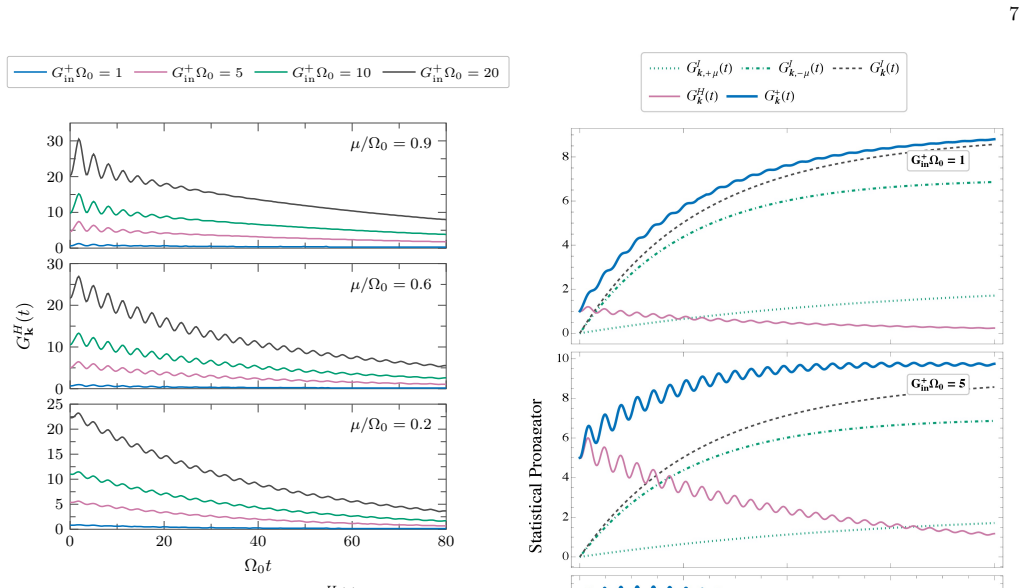
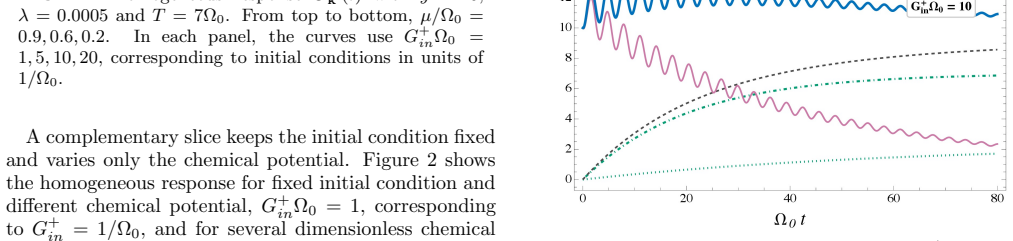
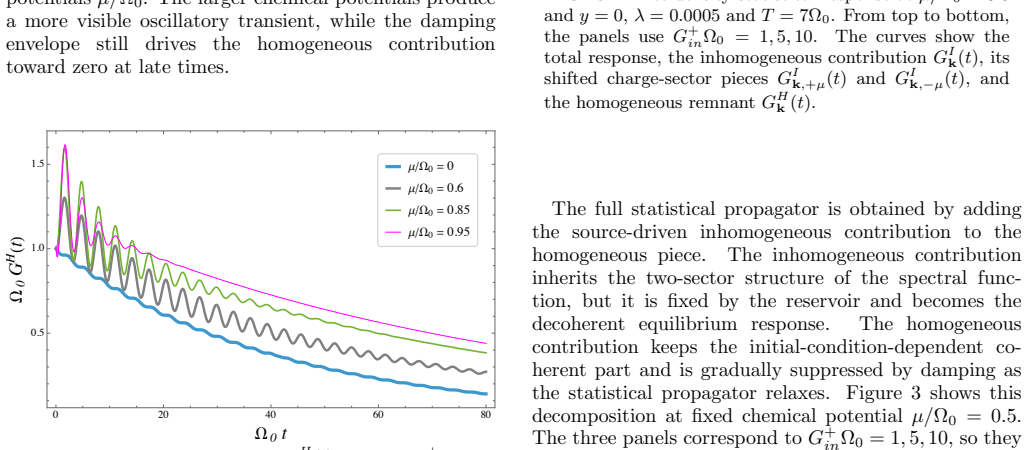
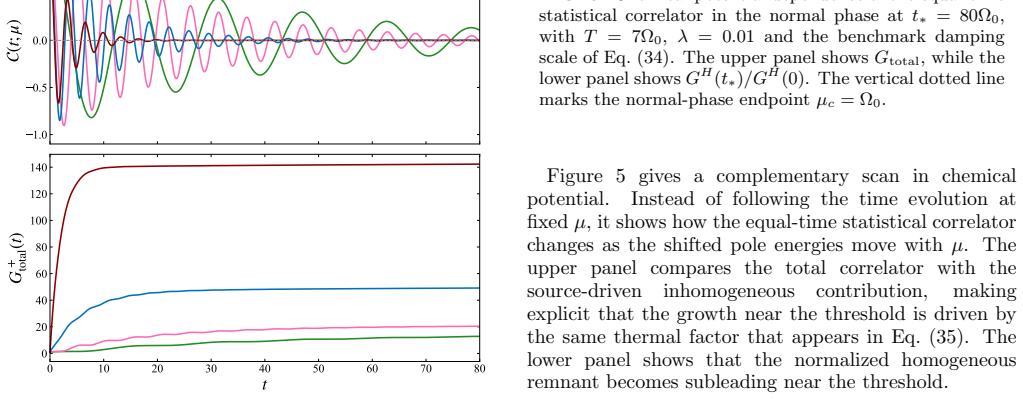
In the normal phase, the homogeneous solution of the Schwinger-Keldysh-Kadanoff-Baym equations carries initial-condition memory that finite chemical potential converts into a transient particle-antiparticle interference pattern by splitting the two charge-sector phases; this pattern is erased by damping as t to infinity, while the source-driven inhomogeneous solution relaxes to the usual decoherent equilibrium form.
Load-bearing premise
The scalar excitation is treated as a probe coupled to an equilibrium thermal reservoir so that the self-energy remains an equilibrium kernel with no backreaction on the bath.
Editorial extensions
If this is right
- The interference pattern is a transient remnant of initial data and vanishes under damping.
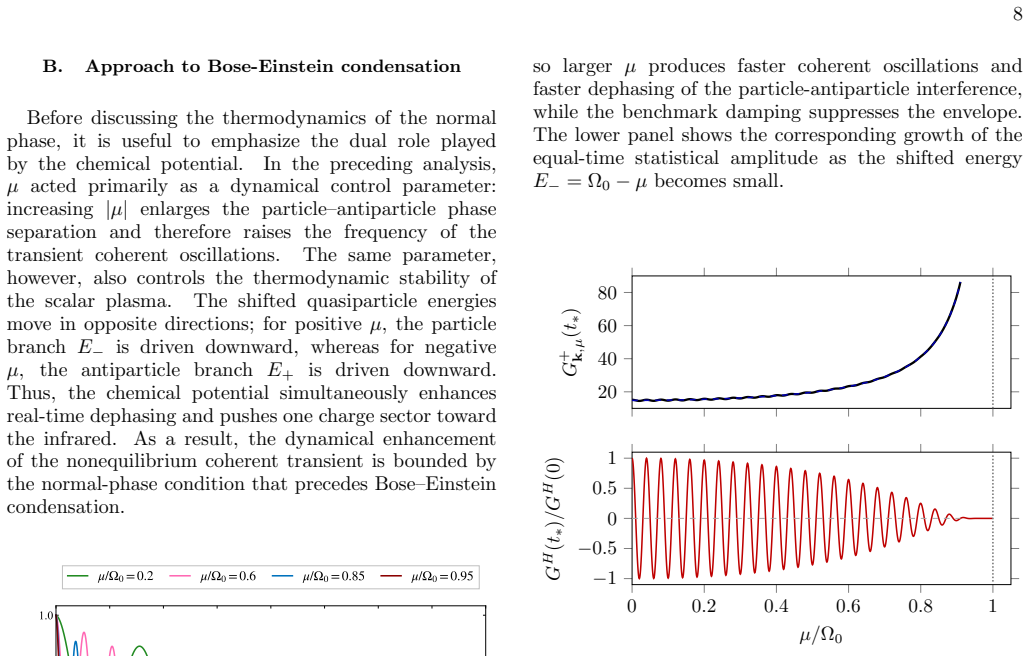
- The normal-phase solution exhibits infrared enhancement that precedes Bose-Einstein condensation.
- The effect is illustrated by the plasmon damping rate in hot scalar phi^4 theory.
- The inhomogeneous statistical propagator is fixed by the reservoir and always relaxes to the decoherent equilibrium form.
Reading between the lines
- The transient coherence could appear in systems with tunable chemical potentials, such as ultracold atomic gases or heavy-ion collisions, as a measurable signature before full damping.
- Extending the probe approximation to include backreaction on the bath would test whether the interference pattern influences the reservoir dynamics.
- The phase-sensitive memory suggests that conserved charges can preserve initial-condition effects at finite density even after apparent relaxation begins.
Signed reviews
Editorial analysis
A structured set of objections, weighed in public.
Referee Report
Summary. The manuscript studies nonequilibrium coherent effects in a complex scalar field with conserved U(1) charge at finite chemical potential. In the probe limit with an equilibrium thermal reservoir (no backreaction), the Schwinger-Keldysh-Kadanoff-Baym equations are solved in the normal phase (μ smaller than the dispersion). Particle and antiparticle quasiparticle poles are kept separate. The source-driven inhomogeneous statistical propagator relaxes to the standard decoherent equilibrium form fixed by the reservoir. The homogeneous solution retains initial-condition memory, which finite μ converts into a transient particle-antiparticle interference pattern via phase splitting; this damps to equilibrium as t→∞. A normalized interference contrast is defined from mixed charge-sector terms, relaxation is illustrated via the plasmon damping rate in hot scalar φ⁴ theory, and the normal-phase solution is shown to exhibit the infrared enhancement preceding Bose-Einstein condensation.
Significance. If the central derivation holds, the work isolates a concrete, phase-sensitive transient effect arising solely from finite μ acting on initial data, cleanly separated from equilibrium modes and from the reservoir-driven inhomogeneous part. The explicit construction in the normal phase, the definition of the interference contrast, and the use of the known plasmon rate to demonstrate damping provide a falsifiable, quantitative illustration. The additional observation of IR enhancement offers a bridge to condensation dynamics. These elements strengthen the literature on nonequilibrium QFT at finite density by supplying a controlled example where memory effects remain visible but ultimately erase.
minor comments (3)
- [§3] §3 (or wherever the SKKB equations are written): the separation into homogeneous and inhomogeneous solutions is stated clearly, but the explicit form of the retarded propagator used to construct the homogeneous solution should be written once with all μ-dependent phase factors visible, to make the origin of the interference term immediate.
- [Figure 2] Figure 2 (or the panel showing the contrast): the normalization of the interference contrast is defined in the text, but the caption should restate the precise combination of G^{12} and G^{21} components used, so the figure can be read without returning to the main text.
- [IR enhancement paragraph] The discussion of the infrared enhancement (near the end) would benefit from one additional sentence contrasting the μ=0 and μ>0 cases for the same initial condition, to quantify how the chemical potential modifies the approach to the would-be condensate regime.
Simulated Author's Rebuttal
We thank the referee for the careful reading and positive assessment of our manuscript. The summary accurately reflects the central results on the transient particle-antiparticle interference arising from finite chemical potential in the homogeneous solution. We are pleased that the work is viewed as providing a controlled, falsifiable example of memory effects at finite density. Since no major comments are listed, we have no points requiring rebuttal or revision at this stage.
Circularity Check
No significant circularity; derivation is self-contained
full rationale
The manuscript explicitly limits itself to the probe approximation with an equilibrium self-energy kernel and no backreaction, solves the SKKB equations while separating particle and antiparticle poles for μ below the dispersion, and tracks the distinction between the reservoir-fixed inhomogeneous statistical propagator and the initial-condition-dependent homogeneous solution. The transient interference pattern is obtained directly from the phase splitting in the homogeneous part and is shown to damp via the plasmon rate; the normalized contrast is defined from the mixed charge-sector terms of that solution. No parameter fitting, no self-citation chains invoked as uniqueness theorems, and no renaming of known results occur. The long-time limit recovers the equilibrium form by construction of the damping, without reducing the central claim to its inputs.
Assumptions & free parameters
assumptions (1)
- domain assumption The scalar excitation is treated as a probe coupled to an equilibrium thermal reservoir, so the self-energy is an equilibrium kernel and there is no backreaction on the bath.
Cite this review
Pith. "Pith review of Nonequilibrium coherent effects at finite chemical potential." pith.science (2026). https://pith.science/paper/BB3X3B27
@misc{pith2026260528724,
  author       = {Pith},
  title        = {Pith review of: Nonequilibrium coherent effects at finite chemical potential},
  year         = {2026},
  howpublished = {\url{https://pith.science/paper/BB3X3B27}},
  note         = {Machine review of arXiv:2605.28724}
}
abstract
We study a nonequilibrium coherent effect generated by a finite chemical potential in a complex scalar field with a conserved $U(1)$ charge. The scalar excitation is treated as a probe coupled to an equilibrium thermal reservoir, so the self-energy is an equilibrium kernel and there is no backreaction on the bath. Solving the Schwinger-Keldysh-Kadanoff-Baym equations in the normal phase, when the chemical potential is smaller than the dispersion relation, we keep the particle and antiparticle quasiparticle poles separate. The source-driven inhomogeneous statistical propagator is fixed by the reservoir and relaxes to the usual decoherent equilibrium form. By contrast, the homogeneous solution carries initial-condition memory; finite chemical potential turns this memory into a transient particle-antiparticle interference pattern by splitting the two charge-sector phases. The effect is not a new equilibrium mode, but a phase-sensitive remnant of the initial data that is erased by damping as $t\to\infty$. We define a normalized interference contrast extracted from the mixed charge-sector terms, illustrate the relaxation using the plasmon damping rate of hot scalar $\phi^4$ theory, and show that the same normal-phase solution displays the infrared enhancement that precedes Bose-Einstein condensation.
Figures
Figures from the paper (2 more)
Reference graph
Works this paper leans on
-
[1]
Heavy Ion Collisions: The Big Picture, and the Big Questions
W. Busza, K. Rajagopal, and W. van der Schee, Heavy Ion Collisions: The Big Picture, and the Big Questions, Ann. Rev. Nucl. Part. Sci.68, 339 (2018), arXiv:1802.04801 [hep-ph]
work page Pith review arXiv 2018
-
[2]
Mapping the Phases of Quantum Chromodynamics with Beam Energy Scan
A. Bzdak, S. Esumi, V. Koch, J. Liao, M. Stephanov, and N. Xu, Mapping the Phases of Quantum Chromo- dynamics with Beam Energy Scan, Phys. Rept.853, 1 (2020), arXiv:1906.00936 [nucl-th]
work page Pith review arXiv 2020
- [3]
-
[4]
M. G. Alford, A. Schmitt, K. Rajagopal, and T. Sch¨ afer, Color superconductivity in dense quark matter, Rev. Mod. Phys.80, 1455 (2008), arXiv:0709.4635 [hep-ph]
work page Pith review arXiv 2008
-
[5]
A. D. Sakharov, Violation of CP Invariance, C Asymme- try, and Baryon Asymmetry of the Universe, JETP Lett. 5, 24 (1967)
1967
-
[6]
A. G. Cohen, D. B. Kaplan, and A. E. Nelson, Progress in electroweak baryogenesis, Ann. Rev. Nucl. Part. Sci. 43, 27 (1993), arXiv:hep-ph/9302210
work page Pith review arXiv 1993
-
[7]
Baryogenesis from the weak scale to the grand unification scale
D. B¨ odeker and W. Buchm¨ uller, Baryogenesis from the weak scale to the grand unification scale, Rev. Mod. Phys.93, 035004 (2021), arXiv:2009.07294 [hep-ph]
work page Pith review arXiv 2021
-
[8]
Background field method at finite temperature and density
M. Loewe, S. Mendizabal, and J. C. Rojas, Background field method at finite temperature and density, Phys. Lett. B635, 213 (2006), arXiv:hep-ph/0512042
work page Pith review arXiv 2006
Show all 45 references
-
[9]
Loewe, S
M. Loewe, S. Mendizabal, and J. C. Rojas, Weinberg- Salam model at finite temperature and density, Phys. Lett. B617, 87 (2005), arXiv:hep-ph/0412392
2005 arXiv
-
[10]
Mallik and S
S. Mallik and S. Sarkar, Real-time propagators at finite temperature and chemical potential, Eur. Phys. J. C61, 489 (2009), arXiv:0901.1045 [hep-ph]
2009 arXiv
-
[11]
Sasagawa and H
S. Sasagawa and H. Tanaka, The effect of an imagi- nary part of the Schwinger-Dyson equation at finite tem- perature and density, Phys. Rev. C85, 045201 (2012), arXiv:1106.4379 [hep-ph]
2012 arXiv
-
[12]
N. P. Landsman and C. G. van Weert, Real- and imaginary-time field theory at finite temperature and density, Phys. Rept.145, 141 (1987)
1987
-
[13]
Chou, Z.-b
K.-c. Chou, Z.-b. Su, B.-l. Hao, and L. Yu, Equilibrium and nonequilibrium formalisms made unified, Phys. Rept. 118, 1 (1985)
1985
-
[14]
H. A. Weldon, Chemical potentials in real-time thermal field theory, Phys. Rev. D76, 125029 (2007)
2007
-
[15]
Anisimov, W
A. Anisimov, W. Buchmuller, M. Drewes, and S. Men- dizabal, Nonequilibrium Dynamics of Scalar Fields in a Thermal Bath, Annals Phys.324, 1234 (2009), arXiv:0812.1934 [hep-th]
2009 arXiv
-
[16]
J. I. Kapusta, Bose-Einstein Condensation, Spontaneous Symmetry Breaking, and Gauge Theories, Phys. Rev. D 24, 426 (1981)
1981
-
[17]
H. E. Haber and H. A. Weldon, Thermodynamics of an Ultrarelativistic Bose Gas, Phys. Rev. Lett.46, 1497 (1981)
1981
-
[18]
H. E. Haber and H. A. Weldon, Finite Temperature Sym- metry Breaking as Bose-Einstein Condensation, Phys. Rev. D25, 502 (1982)
1982
-
[19]
Bernstein and S
J. Bernstein and S. Dodelson, Relativistic Bose gas, Phys. Rev. Lett.66, 683 (1991)
1991
-
[20]
K. M. Benson, J. Bernstein, and S. Dodelson, Phase structure and the effective potential at fixed charge, Phys. Rev. D44, 2480 (1991)
1991
-
[21]
Marko, U
G. Marko, U. Reinosa, and Z. Szep, Bose-Einstein con- densation and Silver Blaze property from the two-loop Φ-derivable approximation, Phys. Rev. D90, 125021 (2014), arXiv:1410.6998 [hep-ph]
2014 arXiv
-
[22]
L. Hui, J. P. Ostriker, S. Tremaine, and E. Witten, Ul- tralight scalars as cosmological dark matter, Phys. Rev. D95, 043541 (2017), arXiv:1610.08297 [astro-ph.CO]
2017 arXiv
-
[23]
Berges and D
J. Berges and D. Sexty, Bose-Einstein condensation in relativistic field theories far from equilibrium, Phys. Rev. Lett.108, 161601 (2012), arXiv:1201.0687 [hep-ph]
2012 arXiv
-
[24]
Berges and J
J. Berges and J. Jaeckel, Far from equilibrium dynam- ics of Bose-Einstein condensation for axion dark matter, Phys. Rev. D91, 025020 (2015), arXiv:1402.4776 [hep- ph]
2015 arXiv
-
[25]
D. G. Levkov, A. G. Panin, and I. I. Tkachev, Gravita- tional Bose-Einstein condensation in the kinetic regime, 11 Phys. Rev. Lett.121, 151301 (2018), arXiv:1804.05857 [astro-ph.CO]
2018 arXiv
-
[26]
S. L. Liebling and C. Palenzuela, Dynamical boson stars, Living Rev. Rel.15, 6 (2012), arXiv:1202.5809 [gr-qc]
2012 arXiv
-
[27]
Matsubara, A new approach to quantum-statistical mechanics, Progress of Theoretical Physics14, 351 (1955)
T. Matsubara, A new approach to quantum-statistical mechanics, Progress of Theoretical Physics14, 351 (1955)
1955
-
[28]
Le Bellac,Thermal Field Theory(Cambridge Univer- sity Press, 2008)
M. Le Bellac,Thermal Field Theory(Cambridge Univer- sity Press, 2008)
2008
-
[29]
J. S. Schwinger, Brownian motion of a quantum oscilla- tor, J. Math. Phys.2, 407 (1961)
1961
-
[30]
L. V. Keldysh, Diagram technique for nonequilibrium processes, Zh. Eksp. Teor. Fiz.47, 1515 (1964)
1964
-
[31]
P. M. Bakshi and K. T. Mahanthappa, Expectation value formalism in quantum field theory. 1., J. Math. Phys.4, 1 (1963)
1963
-
[32]
P. M. Bakshi and K. T. Mahanthappa, Expectation value formalism in quantum field theory. 2., J. Math. Phys.4, 12 (1963)
1963
-
[33]
Kadanoff and G
L. Kadanoff and G. Baym,Quantum Statistical Mechan- ics(W. A. Benjamin, 1962)
1962
-
[34]
Danielewicz, Quantum theory of nonequilibrium pro- cesses, I, Annals Phys.152, 239 (1984)
P. Danielewicz, Quantum theory of nonequilibrium pro- cesses, I, Annals Phys.152, 239 (1984)
1984
-
[35]
Rammer and H
J. Rammer and H. Smith, Quantum field-theoretical methods in transport theory of metals, Rev. Mod. Phys. 58, 323 (1986)
1986
-
[36]
Berges, Introduction to nonequilibrium quantum field theory, AIP Conf
J. Berges, Introduction to nonequilibrium quantum field theory, AIP Conf. Proc.739, 3 (2004)
2004
-
[37]
J. F. Nieves and S. Sahu, Model for the propagation of fermions in a Bose-Einstein condensate, Phys. Rev. D 107, 116012 (2023), arXiv:2302.14285 [hep-ph]
2023
-
[38]
J. F. Nieves and S. Sahu, Photon propagation in a charged Bose–Einstein condensate model, Eur. Phys. J. C84, 830 (2024), arXiv:2401.13896 [hep-ph]
2024
-
[39]
J. F. Nieves and S. Sahu, Plasmon damping in a charged Bose-Einstein condensate model, Phys. Rev. D112, 095013 (2025), arXiv:2509.19738 [hep-ph]
2025
-
[40]
Mendizabal and J
S. Mendizabal and J. C. Rojas, Backreaction Effects on Nonequilibrium Spectral Function, Int. J. Mod. Phys. A 32, 1750126 (2017), arXiv:1603.01118 [hep-ph]
2017 arXiv
-
[41]
Boyanovsky, K
D. Boyanovsky, K. Davey, and C. M. Ho, Particle abundance in a thermal plasma: Quantum kinetics vs. Boltzmann equation, Phys. Rev. D71, 023523 (2005), arXiv:hep-ph/0411042
2005 arXiv
-
[42]
Mendizabal, Non-equilibrium scalar fields at finite temperature and density, Annals Phys.484, 170290 (2026), arXiv:2505.09104 [hep-th]
S. Mendizabal, Non-equilibrium scalar fields at finite temperature and density, Annals Phys.484, 170290 (2026), arXiv:2505.09104 [hep-th]
2026
-
[43]
Kubo, Statistical mechanical theory of irreversible processes
R. Kubo, Statistical mechanical theory of irreversible processes. 1. General theory and simple applications in magnetic and conduction problems, J. Phys. Soc. Jap. 12, 570 (1957)
1957
-
[44]
P. C. Martin and J. S. Schwinger, Theory of many par- ticle systems. 1., Phys. Rev.115, 1342 (1959)
1959
-
[45]
Aarts and J
G. Aarts and J. Smit, Finiteness of hot classical scalar field theory and the plasmon damping rate, Phys. Lett. B393, 395 (1997), arXiv:hep-ph/9610415
1997 arXiv
Reviewed June 29, 2026 · model on record in the stance chip above.
Discussion (0). Continue with ORCID to comment.