Λ hyperons in core-collapse supernovae: Equilibration and neutrino opacities
Pith reviewed 2026-07-03 10:03 UTC · model grok-4.3
The pith
Lambda hyperons reach chemical equilibrium in proto-neutron stars on timescales of 10^{-11} to 10^{-10} seconds.
A machine-rendered reading of the paper's core claim, the machinery that carries it, and where it could break.
Core claim
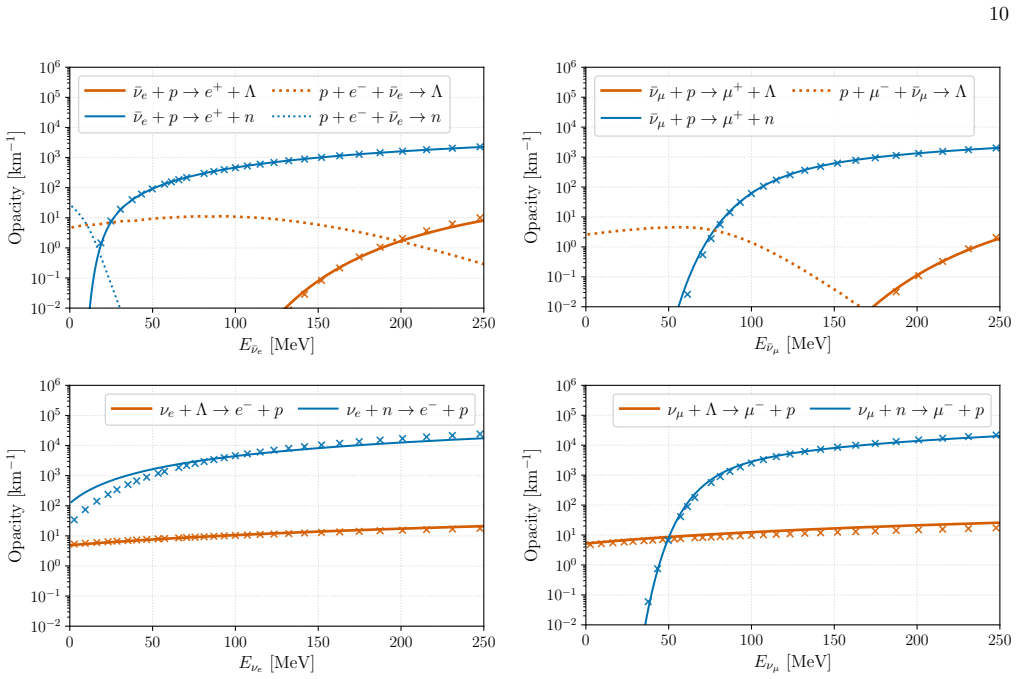
Local chemical equilibration of Lambda hyperons is driven by nonleptonic strangeness-changing reactions, especially NN↔NΛ scattering, on timescales of order 10^{-11}-10^{-10} s. These timescales are many orders of magnitude shorter than macroscopic proto-neutron-star evolution timescales. Short-range contact interactions dominate the nonleptonic rates beyond a pure one-meson-exchange description. Semileptonic channels open additional absorption channels for low-energy muon neutrinos and antineutrinos such as ν_μ + Λ → μ^- + p, and at low energies these opacities exceed the nucleonic contributions.
What carries the argument
Nonleptonic strangeness-changing reactions NN↔NΛ that set the chemical equilibration timescale for Λ hyperons.
If this is right
- Local chemical equilibrium for Λ hyperons can be assumed in dense-matter equation-of-state models for core-collapse supernovae.
- Semileptonic reactions provide new absorption channels for muon neutrinos that may exceed nucleonic opacities at low energies.
- These processes can influence the evolution of the muon lepton number during proto-neutron-star deleptonization.
- Effective-field-theory calculations constrained by hypernuclear data are needed to capture the dominant short-range contributions to the rates.
Where Pith is reading between the lines
- The results imply that time-dependent nonequilibrium effects for Λ hyperons can be neglected in supernova simulations.
- Similar equilibration timescales may apply to other hyperons under comparable conditions.
- Neutrino transport codes should incorporate these Λ-induced opacities to accurately model flavor evolution.
- Ab initio nuclear calculations at finite temperature could test the dominance of contact interactions in these rates.
Load-bearing premise
The effective-field-theory framework constrained by hypernuclear weak-decay data accurately describes the short-range contact interactions that dominate the nonleptonic rates under the hot, dense, isospin-asymmetric conditions of post-collapse proto-neutron stars.
What would settle it
An observation or calculation showing that the NN to NΛ reaction rate under proto-neutron-star conditions leads to equilibration timescales exceeding 10^{-9} seconds would falsify the central claim of rapid local equilibration.
Figures
read the original abstract
Strange hadrons are commonly included in dense-matter equation-of-state models by imposing chemical equilibrium, but the weak-interaction timescales required to establish it in core-collapse supernovae have not been systematically assessed. In this paper we compute the $\Lambda$-hyperon production rates in the hot, dense, and isospin-asymmetric conditions characteristic of post-collapse proto-neutron stars. We find that local $\Lambda$ chemical equilibration is driven by nonleptonic strangeness-changing reactions, especially $NN\leftrightarrow N\Lambda$ scattering, on timescales of order $10^{-11}$-$10^{-10}$ s, many orders of magnitude shorter than macroscopic proto-neutron-star evolution timescales. Using an effective-field-theory framework constrained by hypernuclear weak-decay data, we find that short-range contact interactions dominate the nonleptonic rates, beyond a pure one-meson-exchange description. Semileptonic channels are too slow to set the equilibrium $\Lambda$ abundance, but they open additional absorption channels for low-energy muon neutrinos and antineutrinos, such as $\nu_\mu+\Lambda\to\mu^-+p$ and $p+\mu^-+\bar\nu_\mu\to\Lambda$. At low energies, these $\Lambda$-induced neutrino opacities exceed the corresponding nucleonic contributions for muon (anti)neutrinos, possibly influencing the evolution of the muon lepton number during proto-neutron-star deleptonization. These results support local chemical equilibrium for $\Lambda$ hyperons under the conditions studied and provide new weak-interaction input for flavor-dependent neutrino transport, muonization, and proto-neutron-star evolution.
Editorial analysis
A structured set of objections, weighed in public.
Referee Report
Summary. The manuscript computes Λ-hyperon production rates in the hot, dense, isospin-asymmetric conditions of post-collapse proto-neutron stars using an effective-field-theory framework whose parameters are fixed by hypernuclear weak-decay data. It concludes that nonleptonic strangeness-changing reactions, especially NN↔NΛ scattering, drive local chemical equilibration on timescales of 10^{-11}–10^{-10} s—many orders of magnitude shorter than macroscopic PNS evolution—while semileptonic channels, though too slow to set equilibrium abundances, open additional absorption channels that make Λ-induced opacities for low-energy muon neutrinos and antineutrinos exceed the corresponding nucleonic contributions.
Significance. If the central results hold, the work supplies concrete weak-interaction rates needed for supernova simulations that include hyperons in the equation of state and for flavor-dependent neutrino transport during deleptonization. The constraint of the EFT by independent hypernuclear data is a clear methodological strength, as is the explicit separation of nonleptonic versus semileptonic channels and the focus on muon-neutrino opacities.
major comments (2)
- [§3 (EFT framework and nonleptonic rates)] §3 (EFT framework and nonleptonic rates): the contact couplings are determined exclusively from hypernuclear weak-decay data at ρ ≲ ρ0 and T=0; the manuscript provides no quantitative assessment or sensitivity study of how these short-range terms behave at the PNS densities (up to 3–5ρ0), temperatures (10–50 MeV), and large isospin asymmetries relevant to the claimed 10^{-11}–10^{-10} s equilibration timescales.
- [Results on equilibration timescales (near Eq. for NN↔NΛ rate)] Results on equilibration timescales (near Eq. for NN↔NΛ rate): the reported timescales are presented without error bands, variation under changes to the EFT cutoff, or comparison to a nucleonic baseline, so the claim that these processes are “many orders of magnitude shorter” than macroscopic evolution cannot be verified from the available validation.
minor comments (2)
- [Figure captions] Figure captions should explicitly state the density, temperature, and isospin-asymmetry ranges plotted so that the opacity comparisons can be directly compared to the PNS conditions discussed in the text.
- [Notation] The notation for the isospin asymmetry parameter δ and the definition of the effective chemical potentials should be collected in one place with an explicit equation reference.
Simulated Author's Rebuttal
We thank the referee for the careful reading of our manuscript and the constructive comments. We address each major comment below.
read point-by-point responses
-
Referee: [§3 (EFT framework and nonleptonic rates)] §3 (EFT framework and nonleptonic rates): the contact couplings are determined exclusively from hypernuclear weak-decay data at ρ ≲ ρ0 and T=0; the manuscript provides no quantitative assessment or sensitivity study of how these short-range terms behave at the PNS densities (up to 3–5ρ0), temperatures (10–50 MeV), and large isospin asymmetries relevant to the claimed 10^{-11}–10^{-10} s equilibration timescales.
Authors: We acknowledge that the contact couplings in our EFT are fixed using hypernuclear weak-decay data at densities ρ ≲ ρ0 and T=0. The manuscript does not include a dedicated quantitative sensitivity study for the higher densities, temperatures, and isospin asymmetries in proto-neutron stars. We agree that such an analysis would strengthen the robustness of our results. In the revised manuscript, we will add a discussion of the cutoff dependence of the rates and an estimate of the theoretical uncertainties associated with the extrapolation to PNS conditions. revision: yes
-
Referee: [Results on equilibration timescales (near Eq. for NN↔NΛ rate)] Results on equilibration timescales (near Eq. for NN↔NΛ rate): the reported timescales are presented without error bands, variation under changes to the EFT cutoff, or comparison to a nucleonic baseline, so the claim that these processes are “many orders of magnitude shorter” than macroscopic evolution cannot be verified from the available validation.
Authors: The equilibration timescales in the manuscript are indeed presented as central values without accompanying error bands or explicit variations with the EFT cutoff. We also note that a direct comparison to a nucleonic baseline is not provided. To address these points, we will include in the revised version error estimates derived from variations in the EFT cutoff scale, as well as a comparison of the nonleptonic rates to the corresponding nucleonic processes to better contextualize the 'many orders of magnitude' claim. revision: yes
Circularity Check
No significant circularity; rates derived from externally constrained EFT
full rationale
The paper derives Λ equilibration timescales and neutrino opacities from nonleptonic rates computed in an EFT whose short-range contact interactions are fixed by independent hypernuclear weak-decay data. These inputs are external experimental constraints, not fitted to the PNS conditions or target timescales themselves. No self-definitional steps, fitted-input predictions, or load-bearing self-citation chains appear in the derivation; the central claims remain independent of the quantities being reported.
Axiom & Free-Parameter Ledger
axioms (1)
- domain assumption Effective-field-theory framework constrained by hypernuclear weak-decay data accurately captures short-range contact interactions dominating nonleptonic rates
Reference graph
Works this paper leans on
-
[1]
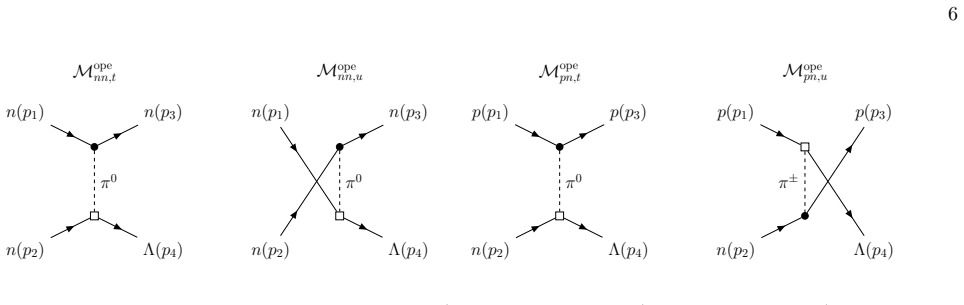
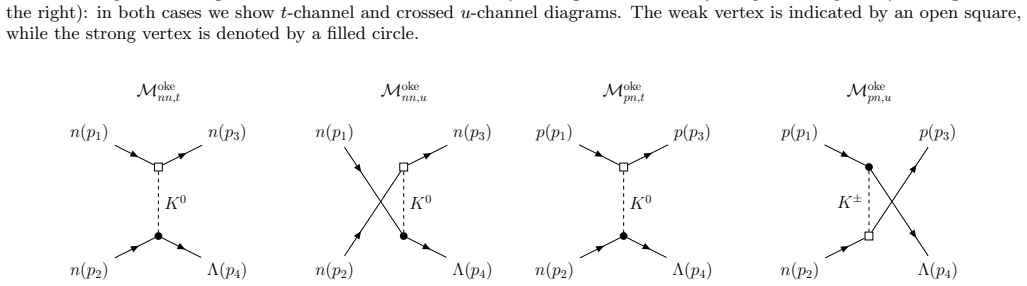
One meson exchange The one-meson-exchange contributions arise from di- agrams in which a pion or kaon is exchanged between two baryon lines, with one weak vertex inducing the ∆S= 1 transition and one strong vertex, see Figs. 1 and 2. The relevant nonleptonic weak vertices, describ- ingBB ′ϕ-interactions, whereϕdenotes a pion or kaon, are written in the ch...
-
[2]
It is therefore useful to first write the corresponding operators in a nonrelativistic heavy-baryon language
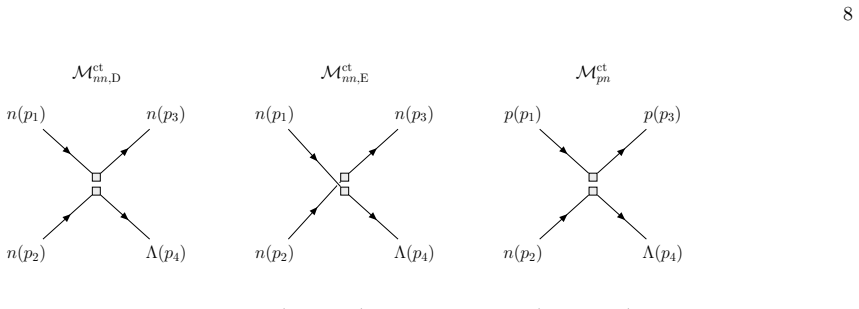
Contact interactions The contact interactions in the EFT are parametrized in terms of the non-relativistic Λ +N− →N+Npoten- tial. It is therefore useful to first write the corresponding operators in a nonrelativistic heavy-baryon language. For thep+n− →p+ Λ channel, after performing a Fierz re- arrangement (for details, see App. B 3), the LO contact opera...
-
[3]
UNDARK” of the Widening participation and spreading excellence pro- gramme (project number 101159929). RZ and JMC also acknowledge the MICINN through the grant “Dark- Maps
Calculation of the nonleptonic scattering rates Our goal is to compute the scattering rates entering the collision operators for these two processes. To this end, we now introduce the approximations used in the rate calculation for these scattering channels. •We approximate the contribution of the Pauli blocking factors (1±f ω) in the integrand of Eq. (2)...
2023
-
[4]
Partial widths and asymmetry parameters In theBrest frame, the final baryon momentum and energy are respectively |⃗ p|= λ1/2 K (M2, M ′2 , m2 ϕ) 2M , E= M ′2 +M 2 −m 2 ϕ 2M .(A2) Using Eq. (A1), the corresponding two-body decay width is Γ = G2 F m4 π+ 4πM |⃗ p|(E+M′) |AϕB′B|2 + E−M ′ E+M ′ |BϕB′B|2 ,(A3) which has to be matched with its experimental value...
-
[5]
(A4) andris obtained from Eq
Extraction ofAandB Defining K= G2 F m4 π+ 4πM |⃗ p|(E+M′),(A9) the corresponding weak hadronic couplings for the decayB− →B ′ +ϕare then given by AϕB′B =± r Γ/K 1 +r 2 ,B ϕB′B = E+M ′ |⃗ p| rA ϕB′B,(A10) where Γ is taken from Eq. (A4) andris obtained from Eq. (A8) using the measured value ofα. Since the decay width and asymmetry parameter leave an overall...
-
[6]
Semileptonic processes For the semileptonic scattering channel ℓ− +B− →ν ℓ +B ′ (B1) whereBandB ′ denote octet baryons connected by a strangeness-changing ∆S=−1 weak charged current. With the approximation at leading order in SU(3)-flavor breaking andq 2/M2 explained in the main text, the spin-averaged squared matrix element reads |M|2 ℓ−B→νℓB′ = 8G 2 F |...
-
[7]
As discussed in the main text, both OPE and OKE amplitudes are built from one strong and one weak baryon–baryon–meson vertex
Nonleptonic processes Let us now consider the one-meson-exchange (OME) contributions. As discussed in the main text, both OPE and OKE amplitudes are built from one strong and one weak baryon–baryon–meson vertex. For the nonleptonic scattering channelsn+n− →n+ Λ andp+n− →p+ Λ, each exchanged meson gives rise to two topologies (see Figs. 1 and 2). Thus, eac...
-
[8]
Contact terms We start with the nonrelativistic Λ +N− →N+Npotential at LO presented in [49, 50], V LO =G F C0 0 +C 1 0 ⃗ σ1 ·⃗ σ2 (CIS +C IV (⃗ τ1 h)·⃗ τ2), h= 0 1 ,(B18) where we have labeled the line in which Λ← →Noccurs as 1 (withhan isospin spurion), and as 2 thespectator line. This can be matched to a nonrelativistic Hamiltonian, Hct =G F Iab;d h C0 ...
-
[9]
H. A. Bethe and J. R. Wilson, Astrophys. J.295, 14 (1985)
1985
-
[10]
G. S. Bisnovatyi-Kogan, Astronomiceskij Zhurnal47, 813 (1970)
1970
-
[11]
J. M. LeBlanc and J. R. Wilson, ApJ161, 541 (1970)
1970
-
[12]
Takahara and K
M. Takahara and K. Sato, Progress of Theoretical Physics80, 861 (1988)
1988
-
[13]
Signals of the QCD phase transition in core-collapse supernovae
I. Sagert, T. Fischer, M. Hempel, G. Pagliara, J. Schaffner-Bielich, A. Mezzacappa, F. K. Thielemann, and M. Liebend¨ orfer, Phys. Rev. Lett.102, 081101 (2009), arXiv:0809.4225 [astro-ph]
work page internal anchor Pith review Pith/arXiv arXiv 2009
-
[14]
Quark deconfinement as supernova explosion engine for massive blue-supergiant stars
T. Fischer, N.-U. F. Bastian, M.-R. Wu, P. Bak- lanov, E. Sorokina, S. Blinnikov, S. Typel, T. Kl¨ ahn, and D. B. Blaschke, Nature Astronomy2, 980 (2018), arXiv:1712.08788 [astro-ph.HE]
work page internal anchor Pith review Pith/arXiv arXiv 2018
-
[15]
Theory of Core-Collapse Supernovae
H.-T. Janka, K. Langanke, A. Marek, G. Martinez- Pinedo, and B. Mueller, Phys. Rept.442, 38 (2007), arXiv:astro-ph/0612072
work page internal anchor Pith review Pith/arXiv arXiv 2007
-
[16]
Supernova Neutrinos: Production, Oscillations and Detection
A. Mirizzi, I. Tamborra, H.-T. Janka, N. Sa- viano, K. Scholberg, R. Bollig, L. Hudepohl, and S. Chakraborty, Riv. Nuovo Cim.39, 1 (2016), arXiv:1508.00785 [astro-ph.HE]
work page internal anchor Pith review Pith/arXiv arXiv 2016
-
[17]
The Status of Multi-Dimensional Core-Collapse Supernova Models
B. M¨ uller, Publ. Astron. Soc. Austral.33, e048 (2016), arXiv:1608.03274 [astro-ph.SR]
work page internal anchor Pith review Pith/arXiv arXiv 2016
-
[18]
Janka, Annual Review of Nuclear and Particle Sci- ence75, 425 (2025), arXiv:2502.14836 [astro-ph.HE]
H.-T. Janka, Annual Review of Nuclear and Particle Sci- ence75, 425 (2025), arXiv:2502.14836 [astro-ph.HE]
-
[19]
A. Rusakov, A. S. Burrows, T. Wang, and D. Var- tanyan, arXiv e-prints , arXiv:2602.09025 (2026), arXiv:2602.09025 [astro-ph.HE]
work page internal anchor Pith review Pith/arXiv arXiv 2026
-
[20]
T. Fischer, N.-U. Bastian, D. Blaschke, M. Cierniak, M. Hempel, T. Kl¨ ahn, G. Mart´ ınez-Pinedo, W. G. New- ton, G. R¨ opke, and S. Typel, Publ. Astron. Soc. Austral. 34, 67 (2017), arXiv:1711.07411 [astro-ph.HE]
work page internal anchor Pith review Pith/arXiv arXiv 2017
-
[21]
Equations of state for supernovae and compact stars
M. Oertel, M. Hempel, T. Kl¨ ahn, and S. Typel, Rev. Mod. Phys.89, 015007 (2017), arXiv:1610.03361 [astro- ph.HE]
work page internal anchor Pith review Pith/arXiv arXiv 2017
-
[22]
Hyperons in hot dense matter: what do the constraints tell us for equation of state?
M. Fortin, M. Oertel, and C. Providˆ encia, Publ. Astron. Soc. Austral.35, 44 (2018), arXiv:1711.09427 [astro- ph.HE]
work page internal anchor Pith review Pith/arXiv arXiv 2018
- [23]
-
[24]
H. Kochankovski, A. Ramos, and L. Tolos, Mon. Not. Roy. Astron. Soc.528, 2629 (2024), arXiv:2309.14879 [astro-ph.HE]
-
[25]
T. Fischer, J. Martin Camalich, H. Kochankovski, and L. Tolos, JCAP01, 061 (2025), arXiv:2408.01406 [astro- ph.HE]
-
[26]
Muon Creation in Supernova Matter Facilitates Neutrino-driven Explosions
R. Bollig, H. T. Janka, A. Lohs, G. Martinez-Pinedo, C. J. Horowitz, and T. Melson, Phys. Rev. Lett.119, 242702 (2017), arXiv:1706.04630 [astro-ph.HE]
work page internal anchor Pith review Pith/arXiv arXiv 2017
- [27]
- [28]
-
[29]
T. Fischer, G. Guo, G. Mart´ ınez-Pinedo, M. Liebend¨ orfer, and A. Mezzacappa, Phys. Rev. D102, 123001 (2020), arXiv:2008.13628 [astro-ph.HE]
-
[30]
F. Capozzi, S. Abbar, R. Bollig, and H. T. Janka, Phys. Rev. D103, 063013 (2021), arXiv:2012.08525 [astro- ph.HE]
-
[31]
T. Fischer, P. Carenza, B. Fore, M. Giannotti, A. Mi- rizzi, and S. Reddy, Phys. Rev. D104, 103012 (2021), arXiv:2108.13726 [hep-ph]
-
[32]
V. A. Ambartsumyan and G. S. Saakyan, Soviet Astron- omy4, 187 (1960)
1960
-
[33]
A Massive Pulsar in a Compact Relativistic Binary
J. Antoniadis, P. C. C. Freire, N. Wex, T. M. Tauris, R. S. Lynch, M. H. van Kerkwijk, M. Kramer, C. Bassa, V. S. Dhillon, T. Driebe, J. W. T. Hessels, V. M. Kaspi, V. I. Kondratiev, N. Langer, T. R. Marsh, M. A. McLaugh- lin, T. T. Pennucci, S. M. Ransom, I. H. Stairs, J. van Leeuwen, J. P. W. Verbiest, and D. G. Whelan, Science 340, 448 (2013), arXiv:13...
work page internal anchor Pith review Pith/arXiv arXiv 2013
-
[34]
H. T. Cromartie, E. Fonseca, S. M. Ransom, P. B. De- morest, Z. Arzoumanian, H. Blumer, P. R. Brook, M. E. DeCesar, T. Dolch, J. A. Ellis, R. D. Ferdman, E. C. Ferrara, N. Garver-Daniels, P. A. Gentile, M. L. Jones, M. T. Lam, D. R. Lorimer, R. S. Lynch, M. A. McLaugh- lin, C. Ng, D. J. Nice, T. T. Pennucci, R. Spiewak, I. H. Stairs, K. Stovall, J. K. Swi...
-
[35]
M. C. Miller, F. K. Lamb, A. J. Dittmann, S. Bog- danov, Z. Arzoumanian, K. C. Gendreau, S. Guillot, A. K. Harding, W. C. G. Ho, J. M. Lattimer, R. M. Lud- lam, S. Mahmoodifar, S. M. Morsink, P. S. Ray, T. E. Strohmayer, K. S. Wood, T. Enoto, R. Foster, T. Oka- jima, G. Prigozhin, and Y. Soong, ApJ887, L24 (2019), arXiv:1912.05705 [astro-ph.HE]
work page internal anchor Pith review Pith/arXiv arXiv 2019
- [36]
-
[37]
T. E. Riley, A. L. Watts, P. S. Ray, S. Bogdanov, S. Guillot, S. M. Morsink, A. V. Bilous, Z. Arzouma- nian, D. Choudhury, J. S. Deneva, K. C. Gendreau, A. K. Harding, W. C. G. Ho, J. M. Lattimer, M. Loewen- stein, R. M. Ludlam, C. B. Markwardt, T. Okajima, C. Prescod-Weinstein, R. A. Remillard, M. T. Wolff, E. Fonseca, H. T. Cromartie, M. Kerr, T. T. Pen...
-
[38]
M. C. Miller, F. K. Lamb, A. J. Dittmann, S. Bogdanov, Z. Arzoumanian, K. C. Gendreau, S. Guillot, W. C. G. Ho, J. M. Lattimer, M. Loewenstein, S. M. Morsink, P. S. Ray, M. T. Wolff, C. L. Baker, T. Cazeau, S. Man- thripragada, C. B. Markwardt, T. Okajima, S. Pollard, I. Cognard, H. T. Cromartie, E. Fonseca, L. Guillemot, M. Kerr, A. Parthasarathy, T. T. ...
work page internal anchor Pith review Pith/arXiv arXiv 2021
-
[39]
N. K. Glendenning, Physics Letters B114, 392 (1982)
1982
-
[40]
N. K. Glendenning, The Astrophysical Journal293, 470 (1985)
1985
-
[41]
Hyperons: the strange ingredients of the nuclear equation of state
I. Vida˜ na, Proc. Roy. Soc. Lond. A474, 0145 (2018), arXiv:1803.00504 [nucl-th]
work page internal anchor Pith review Pith/arXiv arXiv 2018
-
[42]
L. Tolos and L. Fabbietti, Prog. Part. Nucl. Phys.112, 103770 (2020), arXiv:2002.09223 [nucl-ex]. 20
- [43]
-
[44]
J. Martin Camalich and R. Ziegler, (2025), 10.1146/annurev-nucl-121423-100931, arXiv:2503.17323 [hep-ph]
-
[45]
M. Cavan-Piton, D. Guadagnoli, M. Oertel, H. Seong, and L. Vittorio, (2024), arXiv:2401.10979 [hep-ph]
-
[46]
Neutrino spectra evolution during proto-neutron star deleptonization
T. Fischer, G. Mart´ ınez-Pinedo, M. Hempel, and M. Liebend¨ orfer, Phys. Rev. D85, 083003 (2012), arXiv:1112.3842 [astro-ph.HE]
work page internal anchor Pith review Pith/arXiv arXiv 2012
-
[47]
J. M. Lattimer and F. Swesty, Nuclear Physics A535, 331 (1991)
1991
-
[48]
H. Shen, H. Toki, K. Oyamatsu, and K. Sumiyoshi, Nu- clear Physics A637, 435 (1998), arXiv:nucl-th/9805035
work page internal anchor Pith review Pith/arXiv arXiv 1998
-
[49]
G. Shen, C. J. Horowitz, and E. O’Connor, Phys. Rev. C 83, 065808 (2011), arXiv:1103.5174 [astro-ph.SR]
work page internal anchor Pith review Pith/arXiv arXiv 2011
-
[50]
Statistical Model for a Complete Supernova Equation of State
M. Hempel and J. Schaffner-Bielich, Nuclear Physics A 837, 210 (2010), arXiv:0911.4073 [nucl-th]
work page internal anchor Pith review Pith/arXiv arXiv 2010
-
[51]
A. W. Steiner, M. Hempel, and T. Fischer, ApJ774, 17 (2013), arXiv:1207.2184 [astro-ph.SR]
work page internal anchor Pith review Pith/arXiv arXiv 2013
-
[52]
Simultaneous chiral symmetry restoration and deconfinement - Consequences for the QCD phase diagram
T. Kl¨ ahn, T. Fischer, and M. Hempel, ApJ836, 89 (2017), arXiv:1603.03679 [nucl-th]
work page internal anchor Pith review Pith/arXiv arXiv 2017
- [53]
-
[54]
R. F. Sawyer, Phys. Rev. Lett.29, 382 (1972)
1972
-
[55]
Baym, Phys
G. Baym, Phys. Rev. Lett.30, 1340 (1973)
1973
-
[56]
B. Fore and S. Reddy, Phys. Rev. C101, 035809 (2020), arXiv:1911.02632 [astro-ph.HE]
-
[57]
$\Lambda N \to NN$ weak interaction in effective field theory
A. Parreno, C. Bennhold, and B. R. Holstein, Phys. Rev. C70, 051601 (2004), arXiv:nucl-th/0308074
work page internal anchor Pith review Pith/arXiv arXiv 2004
-
[58]
An EFT for the weak $\Lambda N$ interaction
A. Parreno, C. Bennhold, and B. R. Holstein, Nucl. Phys. A754, 127 (2005), arXiv:nucl-th/0312047
work page internal anchor Pith review Pith/arXiv arXiv 2005
-
[59]
One-loop contributions in the EFT for the $\Lambda N \to NN$ transition
A. P´ erez-Obiol, D. R. Entem, B. Juli´ a-D´ ıaz, and A. Parre˜ no, Phys. Rev. C87, 044614 (2013), arXiv:1302.6955 [nucl-th]
work page internal anchor Pith review Pith/arXiv arXiv 2013
-
[60]
Navaset al.(Particle Data Group), Phys
S. Navaset al.(Particle Data Group), Phys. Rev. D110, 030001 (2024)
2024
- [61]
-
[62]
N. Cabibbo, E. C. Swallow, and R. Winston, Ann. Rev. Nucl. Part. Sci.53, 39 (2003), arXiv:hep-ph/0307298
work page internal anchor Pith review Pith/arXiv arXiv 2003
-
[63]
Scherer and M
S. Scherer and M. R. Schindler,A Primer for Chiral Per- turbation Theory, Vol. 830 (2012)
2012
-
[64]
Burrows and J
A. Burrows and J. M. Lattimer, ApJ307, 178 (1986)
1986
-
[65]
Nagakura, A
H. Nagakura, A. Burrows, D. Radice, and D. Vartanyan, Monthly Notices of the Royal Astronomical Society492, 5764 (2020), https://academic.oup.com/mnras/article- pdf/492/4/5764/32432608/staa261.pdf
2020
-
[66]
A. Mezzacappa, A. C. Calder, S. W. Bruenn, J. M. Blondin, M. W. Guidry, M. R. Strayer, and A. S. Umar, ApJ493, 848 (1998), arXiv:astro-ph/9709184 [astro-ph]
work page internal anchor Pith review Pith/arXiv arXiv 1998
-
[67]
Multi-Dimensional Radiation/Hydrodynamic Simulations of Protoneutron Star Convection
L. Dessart, A. Burrows, E. Livne, and C. D. Ott, ApJ 645, 534 (2006), arXiv:astro-ph/0510229 [astro-ph]
work page internal anchor Pith review Pith/arXiv arXiv 2006
-
[68]
T. Fischer, G. Guo, K. Langanke, G. Mart´ ınez-Pinedo, Y.-Z. Qian, and M.-R. Wu, Progress in Particle and Nuclear Physics137, 104107 (2024), arXiv:2308.03962 [astro-ph.HE]
-
[69]
Weinberg, Phys
S. Weinberg, Phys. Rev.112, 1375 (1958)
1958
-
[70]
Ademollo and R
M. Ademollo and R. Gatto, Phys. Rev. Lett.13, 264 (1964)
1964
-
[71]
C. J. Horowitz, G. Shen, E. O’Connor, and C. D. Ott, Phys. Rev. C86, 065806 (2012), arXiv:1209.3173 [astro- ph.HE]
work page internal anchor Pith review Pith/arXiv arXiv 2012
-
[72]
L. F. Roberts and S. Reddy, Phys. Rev. C95, 045807 (2017), arXiv:1612.02764 [astro-ph.HE]
work page internal anchor Pith review Pith/arXiv arXiv 2017
-
[73]
K. Soko lowski, A. Kumar, and T. Fischer, arXiv e-prints , arXiv:2605.17563 (2026), arXiv:2605.17563 [astro-ph.HE]
work page internal anchor Pith review Pith/arXiv arXiv 2026
-
[74]
Effects of Strong and Electromagnetic Correlations on Neutrino Interactions in Dense Matter
S. Reddy, M. Prakash, J. M. Lattimer, and J. A. Pons, Phys. Rev. C59, 2888 (1999), arXiv:astro-ph/9811294 [astro-ph]
work page internal anchor Pith review Pith/arXiv arXiv 1999
- [75]
-
[76]
E. N. E. van Dalen and A. E. L. Dieperink, Phys. Rev. C69, 025802 (2004), arXiv:nucl-th/0311103
work page internal anchor Pith review Pith/arXiv arXiv 2004
-
[77]
Shtabovenko, R
V. Shtabovenko, R. Mertig, and F. Orellana, Computer Physics Communications306, 109357 (2025)
2025
-
[78]
Mertig, M
R. Mertig, M. B¨ ohm, and A. Denner, Computer Physics Communications64, 345 (1991)
1991
-
[79]
T. D. Lee and C.-N. Yang, Phys. Rev.108, 1645 (1957)
1957
-
[80]
E. E. Jenkins, Nucl. Phys. B375, 561 (1992)
1992
discussion (0)
Sign in with ORCID, Apple, or X to comment. Anyone can read and Pith papers without signing in.