Finite-Density Dynamics of Chemically Equilibrating QGP in Conformal Gubser Flow and Hard Thermal Photon Production
Pith reviewed 2026-07-01 04:33 UTC · model grok-4.3
The pith
Finite baryon density and transverse flow delay chemical equilibration in the quark-gluon plasma, suppressing total thermal photon yield while enhancing early high-p_T contributions.
A machine-rendered reading of the paper's core claim, the machinery that carries it, and where it could break.
Core claim
In conformal Gubser flow at finite baryon density, chemical non-equilibrium is incorporated through fugacity parameters whose evolution is governed by master rate equations coupled to the hydrodynamic expansion; both finite density and transverse expansion delay chemical equilibration and produce a chemically undersaturated medium in which quarks lag behind gluons; the overall thermal photon yield is suppressed while an enhanced early-time contribution appears at high transverse momentum, and the instantaneous rates display a distinct temporal structure arising from the interplay of rapid cooling and evolving fugacities.
What carries the argument
Fugacity parameters in the parton phase-space distribution functions, evolved through master rate equations coupled to conformal Gubser hydrodynamic expansion.
If this is right
- The medium remains chemically undersaturated with quarks lagging behind gluons throughout the evolution.
- The total thermal photon yield integrated over the expanding system is reduced relative to equilibrium expectations.
- High-p_T photon production receives an enhanced contribution from the early-time non-equilibrium stage.
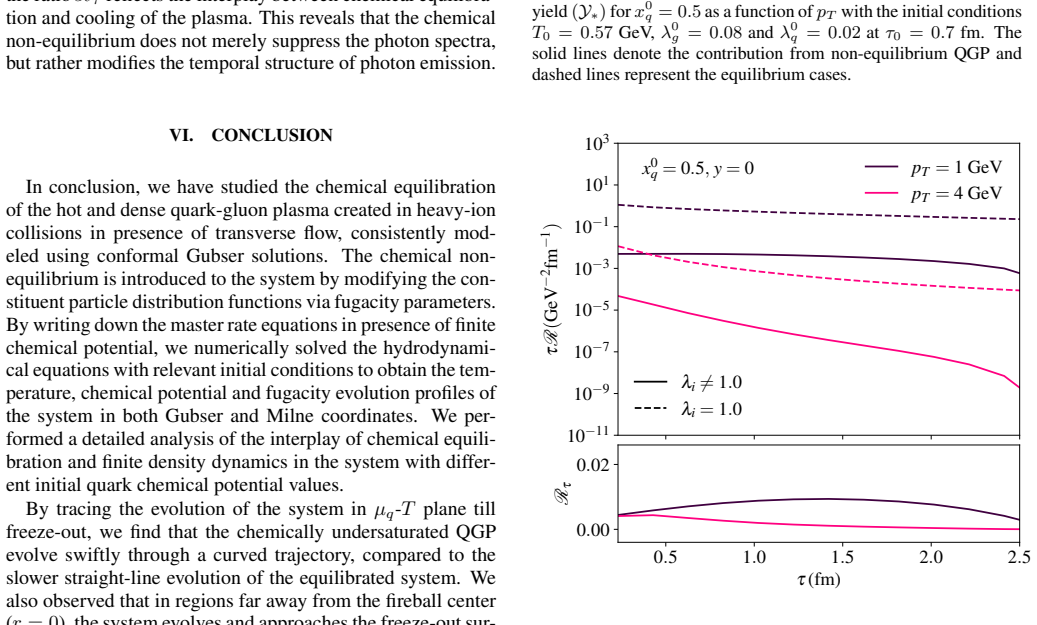
- Instantaneous photon emission rates develop a distinct temporal profile set by the competition between cooling and fugacity changes.
Where Pith is reading between the lines
- Photon spectra measured at different collision energies could encode information on the timing of chemical equilibration.
- The same non-equilibrium framework may affect other early-time observables such as dilepton production.
- Hydrodynamic models that assume instant chemical equilibrium may need adjustment when applied to finite-density regimes.
Load-bearing premise
The master rate equations coupled to the conformal Gubser hydrodynamic expansion, together with the fugacity parameterization of the parton distributions, sufficiently capture the chemical evolution at finite baryon density without requiring additional viscous corrections or non-conformal effects.
What would settle it
A measurement of thermal photon yields in heavy-ion collisions at finite baryon density that shows no overall suppression and no early-time enhancement at high p_T would falsify the predicted effects of delayed chemical equilibration.
Figures

read the original abstract
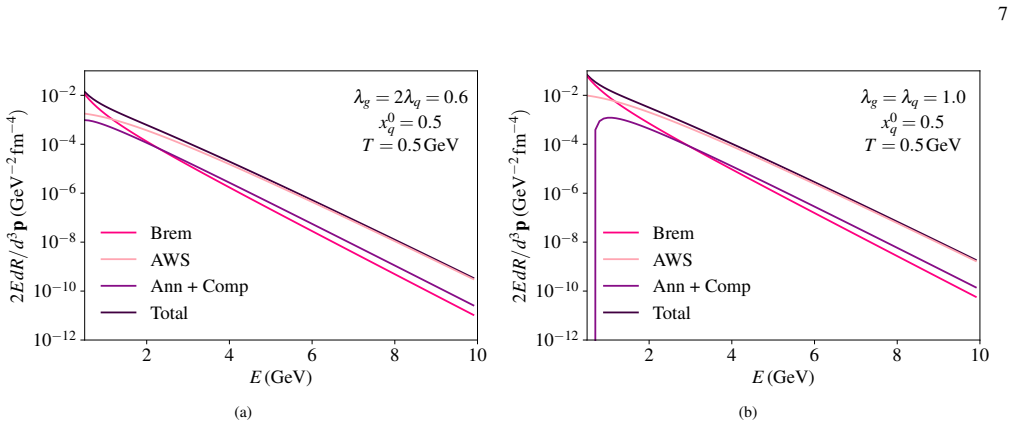
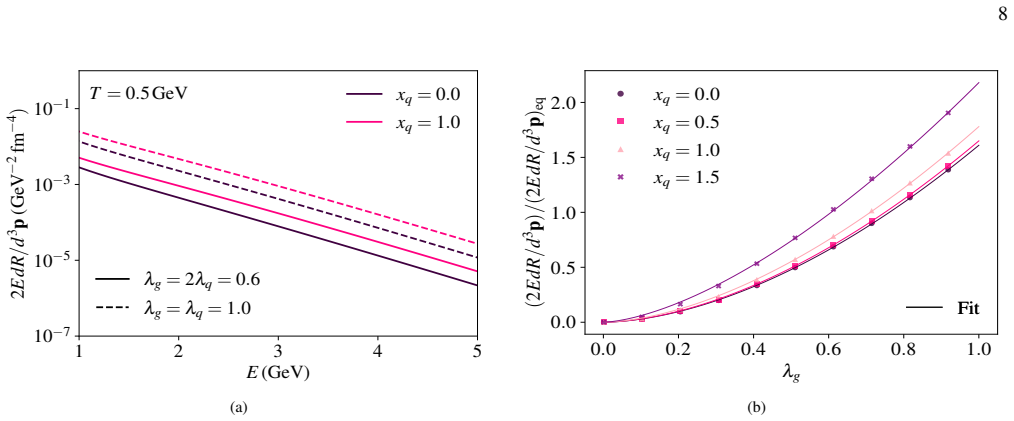
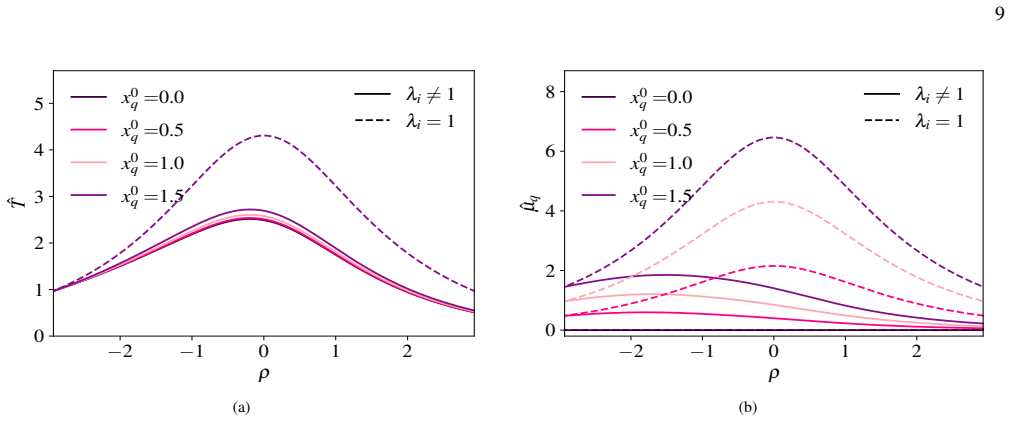
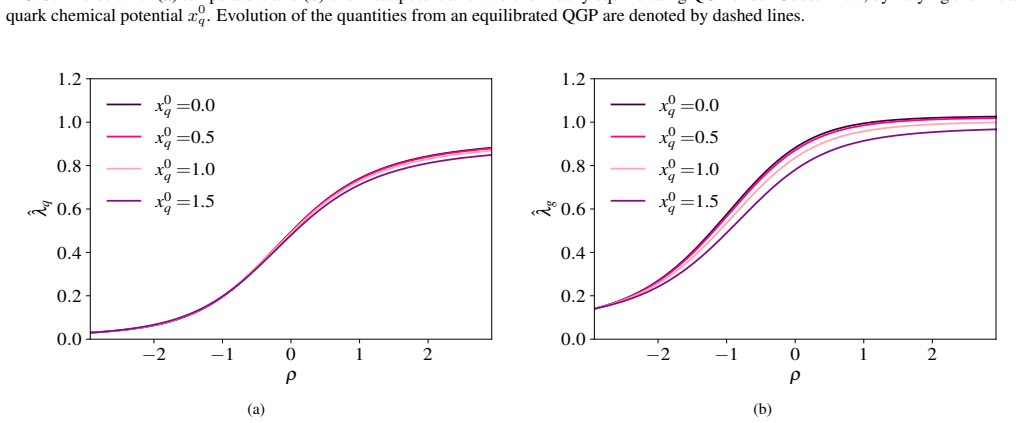
We study the chemical equilibration of a hot and dense quark-gluon plasma (QGP) at finite baryon density produced in relativistic heavy-ion collisions within conformal Gubser flow. Chemical non-equilibrium is incorporated through fugacity parameters in the parton phase-space distribution functions, whose evolution is governed by master rate equations coupled to the hydrodynamic expansion with transverse flow. We analyse the interplay between chemical equilibration and finite-density dynamics, and investigate its impact on hard thermal photon production. We observe that both finite density and transverse expansion delay chemical equilibration, leading to a chemically undersaturated medium with quarks lagging behind gluons. While the overall thermal photon yield from the expanding system is suppressed in the non-equilibrium scenario, we find an enhanced early-time contribution to high $p_T$ photon production. By analyzing the instantaneous photon emission in presence of chemical non-equilibrium, we demonstrate that the rates exhibit a distinct temporal structure arising from the interplay of rapid cooling and evolving fugacities. These features may provide potential observable signatures of chemical equilibration dynamics in the QGP.
Editorial analysis
A structured set of objections, weighed in public.
Referee Report
Summary. The manuscript studies chemical equilibration of a hot and dense QGP at finite baryon density in conformal Gubser flow. Non-equilibrium effects are incorporated via fugacity parameters in parton distributions whose evolution is governed by master rate equations coupled to the hydrodynamic expansion. The work analyzes the interplay of finite density, transverse flow, and chemical equilibration, and its consequences for hard thermal photon production. Key findings are that finite density and expansion delay equilibration, producing an undersaturated medium with quarks lagging gluons; overall photon yield is suppressed but early-time high-p_T emission is enhanced; and instantaneous rates show distinct temporal structure from the competition between rapid cooling and evolving fugacities.
Significance. If the modeling holds, the results provide a controlled analytic framework for non-equilibrium dynamics at finite density, identifying potential photon observables that could signal chemical equilibration timescales in heavy-ion collisions. The use of conformal Gubser flow combined with rate equations allows clean isolation of expansion versus density effects on fugacity evolution, and the reported temporal structure in emission rates offers a falsifiable prediction for photon spectra.
major comments (1)
- [modeling setup and rate equations] The central claims on delayed equilibration, quark-gluon lag, and the resulting photon yield modifications rest on the fugacity parameterization and master rate equations coupled to conformal Gubser hydro. At finite baryon density the collision integrals must incorporate mu_B dependence and, typically, separate fugacities for quarks and antiquarks; the manuscript does not demonstrate that these are included, nor does it address possible baryon diffusion or small non-conformal corrections to the EOS that would modify the cooling trajectory. A concrete test is whether the reported undersaturation and early-time photon enhancement survive when distinct lambda_q and lambda_barq are evolved with mu_B-dependent rates.
minor comments (2)
- [Abstract] The abstract states that 'quarks lagging behind gluons' but does not specify whether a single quark fugacity or separate quark/antiquark fugacities are employed; this notation should be clarified in the text and figures.
- [figures] Figure captions for the time-dependent photon rates should explicitly label the equilibrium versus non-equilibrium curves and the chosen initial fugacity and mu_B values to allow direct comparison with the rate-equation solutions.
Simulated Author's Rebuttal
We thank the referee for the careful and constructive review of our manuscript. The comments raise important points regarding the modeling of finite-density effects, which we address below. We believe these clarifications will strengthen the paper.
read point-by-point responses
-
Referee: [modeling setup and rate equations] The central claims on delayed equilibration, quark-gluon lag, and the resulting photon yield modifications rest on the fugacity parameterization and master rate equations coupled to conformal Gubser hydro. At finite baryon density the collision integrals must incorporate mu_B dependence and, typically, separate fugacities for quarks and antiquarks; the manuscript does not demonstrate that these are included, nor does it address possible baryon diffusion or small non-conformal corrections to the EOS that would modify the cooling trajectory. A concrete test is whether the reported undersaturation and early-time photon enhancement survive when distinct lambda_q and lambda_barq are evolved with mu_B-dependent rates.
Authors: We thank the referee for highlighting these aspects of our modeling setup. Our approach incorporates finite baryon density through the chemical potential μ_B appearing in the parton distribution functions and in the collision integrals of the master rate equations. The fugacity parameters are evolved self-consistently with the Gubser hydrodynamic flow. However, we employ a single fugacity for the quark sector (λ_q = λ_{\bar q}) rather than evolving them separately. This choice is made to focus on the essential physics of chemical non-equilibrium in the conformal limit while keeping the system analytically tractable. We agree that a more complete treatment with distinct λ_q and λ_{\bar q} and explicit μ_B dependence in the rates would be desirable for quantitative precision at high densities. We will revise the manuscript to clearly state this approximation in the methods section and add a discussion of its validity and potential effects on the results. Regarding baryon diffusion and non-conformal corrections to the equation of state, these are neglected within the assumptions of conformal Gubser flow; we will include a brief remark on these limitations in the revised version. We expect the qualitative features, including the delayed equilibration and the temporal structure in photon emission, to persist under these extensions. revision: yes
Circularity Check
No circularity: results follow from solving coupled rate equations and hydrodynamics
full rationale
The derivation proceeds by writing master rate equations for the time evolution of fugacities (governed by collision integrals and the conformal Gubser expansion), integrating them numerically along the hydrodynamic trajectory, and then computing photon emission rates from the resulting non-equilibrium distributions. These steps are differential and depend on stated initial conditions, rate coefficients, and the flow profile; none reduce by construction to a fitted parameter renamed as a prediction, a self-definitional closure, or a load-bearing self-citation chain. The reported delays, undersaturation, and photon temporal structure are outputs of the integration, not inputs, so the chain is self-contained.
Axiom & Free-Parameter Ledger
free parameters (2)
- initial fugacity values
- baryon chemical potential or density parameter
axioms (2)
- domain assumption Conformal Gubser flow provides an accurate description of the hydrodynamic expansion including transverse flow
- domain assumption Master rate equations with fugacity parameters capture the dominant chemical processes
Reference graph
Works this paper leans on
-
[1]
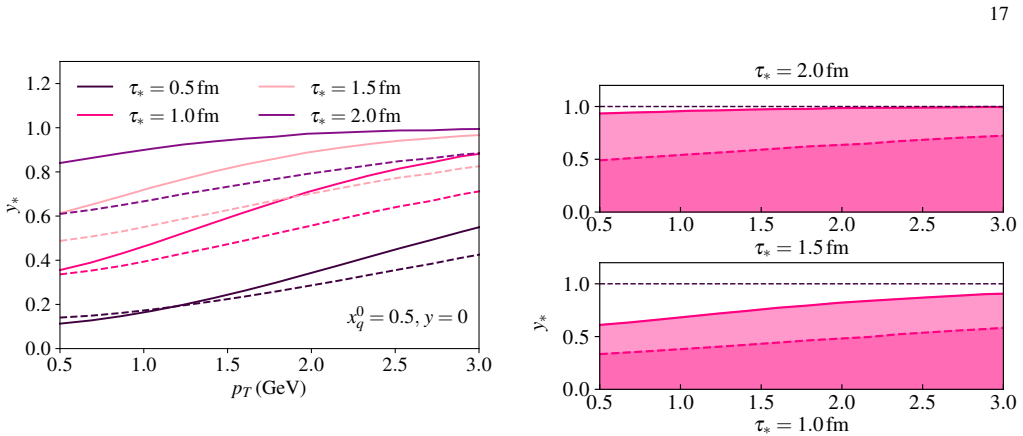
WithT 0 = 0.57GeV ,λ 0 g = 0.08,λ 0 q = 0.02 atτ 0 = 0.7fm, the cumulative early time fraction is calcu- lated and displayed in Fig
as well. WithT 0 = 0.57GeV ,λ 0 g = 0.08,λ 0 q = 0.02 atτ 0 = 0.7fm, the cumulative early time fraction is calcu- lated and displayed in Fig. 18. One can see that,Y ∗ at large pT remains distinctly high for non-equilibrium case for all the τ∗ values, as seen before. This exceptionally large early time fraction of the highp T photons, we believe, is the ch...
-
[2]
Perfect Fluidity of the Quark Gluon Plasma Core as Seen through its Dissipative Hadronic Corona
T. Hirano and M. Gyulassy, Perfect fluidity of the quark gluon plasma core as seen through its dissipative hadronic corona, Nucl. Phys. A769, 71 (2006), arXiv:nucl-th/0506049
work page internal anchor Pith review Pith/arXiv arXiv 2006
-
[3]
S. A. V oloshin, A. M. Poskanzer, and R. Snellings, Collec- tive phenomena in non-central nuclear collisions, Landolt- Bornstein23, 293 (2010), arXiv:0809.2949 [nucl-ex]
work page internal anchor Pith review Pith/arXiv arXiv 2010
-
[4]
Challenges in QCD matter physics - The Compressed Baryonic Matter experiment at FAIR
T. Ablyazimovet al.(CBM), Challenges in QCD matter physics –The scientific programme of the Compressed Bary- onic Matter experiment at FAIR, Eur. Phys. J. A53, 60 (2017), arXiv:1607.01487 [nucl-ex]
work page internal anchor Pith review Pith/arXiv arXiv 2017
-
[5]
L. Adamczyket al.(STAR), Bulk Properties of the Medium Produced in Relativistic Heavy-Ion Collisions from the Beam Energy Scan Program, Phys. Rev. C96, 044904 (2017), arXiv:1701.07065 [nucl-ex]
work page internal anchor Pith review Pith/arXiv arXiv 2017
-
[6]
Senger, Heavy-Ion Collisions at FAIR-NICA Energies, Par- ticles4, 214 (2021)
P. Senger, Heavy-Ion Collisions at FAIR-NICA Energies, Par- ticles4, 214 (2021)
2021
-
[7]
P. Romatschke and U. Romatschke,Relativistic Fluid Dy- namics In and Out of Equilibrium, Cambridge Monographs on Mathematical Physics (Cambridge University Press, 2019) arXiv:1712.05815 [nucl-th]
work page internal anchor Pith review Pith/arXiv arXiv 2019
-
[8]
Flow at the SPS and RHIC as a Quark Gluon Plasma Signature
D. Teaney, J. Lauret, and E. V . Shuryak, Flow at the SPS and RHIC as a quark gluon plasma signature, Phys. Rev. Lett.86, 4783 (2001), arXiv:nucl-th/0011058
work page internal anchor Pith review Pith/arXiv arXiv 2001
-
[9]
Causal Theories of Dissipative Relativistic Fluid Dynamics for Nuclear Collisions
A. Muronga, Causal theories of dissipative relativistic fluid dynamics for nuclear collisions, Phys. Rev. C69, 034903 (2004), arXiv:nucl-th/0309055
work page internal anchor Pith review Pith/arXiv arXiv 2004
-
[10]
P. Romatschke and U. Romatschke, Viscosity Information from Relativistic Nuclear Collisions: How Perfect is the Fluid Observed at RHIC?, Phys. Rev. Lett.99, 172301 (2007), arXiv:0706.1522 [nucl-th]
work page internal anchor Pith review Pith/arXiv arXiv 2007
-
[11]
Causal viscous hydrodynamics in 2+1 dimensions for relativistic heavy-ion collisions
H. Song and U. W. Heinz, Causal viscous hydrodynamics in 2+1 dimensions for relativistic heavy-ion collisions, Phys. Rev. C77, 064901 (2008), arXiv:0712.3715 [nucl-th]
work page internal anchor Pith review Pith/arXiv arXiv 2008
-
[12]
C. Gale, S. Jeon, and B. Schenke, Hydrodynamic Modeling of Heavy-Ion Collisions, Int. J. Mod. Phys. A28, 1340011 (2013), arXiv:1301.5893 [nucl-th]
work page internal anchor Pith review Pith/arXiv arXiv 2013
-
[13]
E. V . Shuryak, Two stage equilibration in high-energy heavy ion collisions, Phys. Rev. Lett.68, 3270 (1992)
1992
-
[14]
Geiger, Thermalization in ultrarelativistic nuclear colli- sions
K. Geiger, Thermalization in ultrarelativistic nuclear colli- sions. 1. Parton kinetics and quark gluon plasma formation, Phys. Rev. D46, 4965 (1992)
1992
-
[15]
T. S. Biro, E. van Doorn, B. Muller, M. H. Thoma, and X. N. Wang, Parton equilibration in relativistic heavy ion collisions, Phys. Rev. C48, 1275 (1993), arXiv:nucl-th/9303004
work page internal anchor Pith review Pith/arXiv arXiv 1993
-
[16]
Open Charm Production in an Equilibrating Parton Plasma
P. Levai, B. Muller, and X.-N. Wang, Open charm produc- tion in an equilibrating parton plasma, Phys. Rev. C51, 3326 (1995), arXiv:hep-ph/9412352
work page internal anchor Pith review Pith/arXiv arXiv 1995
-
[17]
S. M. H. Wong, Thermal and chemical equilibration in rel- ativistic heavy ion collisions, Phys. Rev. C54, 2588 (1996), arXiv:hep-ph/9609287
work page internal anchor Pith review Pith/arXiv arXiv 1996
-
[18]
Bottom-up thermalization in heavy ion collisions
R. Baier, A. H. Mueller, D. Schiff, and D. T. Son, ’Bottom up’ thermalization in heavy ion collisions, Phys. Lett. B502, 51 (2001), arXiv:hep-ph/0009237
work page internal anchor Pith review Pith/arXiv arXiv 2001
-
[19]
Turbulent thermalization process in heavy-ion collisions at ultrarelativistic energies
J. Berges, K. Boguslavski, S. Schlichting, and R. Venu- gopalan, Turbulent thermalization process in heavy-ion col- lisions at ultrarelativistic energies, Phys. Rev. D89, 074011 (2014), arXiv:1303.5650 [hep-ph]. 19
work page internal anchor Pith review Pith/arXiv arXiv 2014
-
[20]
Pressure isotropization in high energy heavy ion collisions
T. Epelbaum and F. Gelis, Pressure isotropization in high en- ergy heavy ion collisions, Phys. Rev. Lett.111, 232301 (2013), arXiv:1307.2214 [hep-ph]
work page internal anchor Pith review Pith/arXiv arXiv 2013
-
[21]
Isotropization and hydrodynamization in weakly coupled heavy-ion collisions
A. Kurkela and Y . Zhu, Isotropization and hydrodynamization in weakly coupled heavy-ion collisions, Phys. Rev. Lett.115, 182301 (2015), arXiv:1506.06647 [hep-ph]
work page internal anchor Pith review Pith/arXiv arXiv 2015
-
[22]
Initial conditions for hydrodynamics from weakly coupled pre-equilibrium evolution
L. Keegan, A. Kurkela, A. Mazeliauskas, and D. Teaney, Ini- tial conditions for hydrodynamics from weakly coupled pre- equilibrium evolution, JHEP08, 171, arXiv:1605.04287 [hep- ph]
work page internal anchor Pith review Pith/arXiv arXiv
-
[23]
A. Kurkela, A. Mazeliauskas, J.-F. Paquet, S. Schlichting, and D. Teaney, Effective kinetic description of event-by-event pre-equilibrium dynamics in high-energy heavy-ion collisions, Phys. Rev. C99, 034910 (2019), arXiv:1805.00961 [hep-ph]
work page internal anchor Pith review Pith/arXiv arXiv 2019
-
[24]
Chemical Equilibration in Weakly Coupled QCD
A. Kurkela and A. Mazeliauskas, Chemical equilibration in weakly coupled QCD, Phys. Rev. D99, 054018 (2019), arXiv:1811.03068 [hep-ph]
work page internal anchor Pith review Pith/arXiv arXiv 2019
-
[25]
Chemical Equilibration in Hadronic Collisions
A. Kurkela and A. Mazeliauskas, Chemical Equilibration in Hadronic Collisions, Phys. Rev. Lett.122, 142301 (2019), arXiv:1811.03040 [hep-ph]
work page internal anchor Pith review Pith/arXiv arXiv 2019
- [26]
- [27]
-
[28]
J. R. Bhatt and V . Sreekanth, Photon emission from out of equilibrium dissipative parton plasma, Int. J. Mod. Phys. E19, 299 (2010), arXiv:0901.1363 [hep-ph]
work page internal anchor Pith review Pith/arXiv arXiv 2010
-
[29]
D. M. Elliott and D. H. Rischke, Chemical equilibration of quarks and gluons at RHIC and LHC energies, Nucl. Phys. A 671, 583 (2000), arXiv:nucl-th/9908004
work page internal anchor Pith review Pith/arXiv arXiv 2000
-
[30]
A. El, A. Muronga, Z. Xu, and C. Greiner, A Relativistic dissipative hydrodynamic description for systems including particle number changing processes, Nucl. Phys. A848, 428 (2010), arXiv:1007.0705 [nucl-th]
work page internal anchor Pith review Pith/arXiv arXiv 2010
-
[31]
V . V ovchenko, M. I. Gorenstein, L. M. Satarov, I. N. Mishus- tin, L. P. Csernai, I. Kisel, and H. St¨ocker, Entropy production in chemically nonequilibrium quark-gluon plasma created in central Pb+Pb collisions at energies available at the CERN Large Hadron Collider, Phys. Rev. C93, 014906 (2016), arXiv:1510.01235 [hep-ph]
work page internal anchor Pith review Pith/arXiv arXiv 2016
-
[32]
D. Dutta, K. Kumar, A. K. Mohanty, and R. K. Choudhury, Chemical equilibration and thermal dilepton production from the quark gluon plasma at finite baryon density, Phys. Rev. C 60, 014905 (1999), arXiv:hep-ph/9905245
work page internal anchor Pith review Pith/arXiv arXiv 1999
-
[33]
Kampfer, O
B. Kampfer, O. P. Pavlenko, A. Peshier, and G. Soff, Dilep- ton production in a chemically equilibrating, expanding, and hadronizing quark - gluon plasma, Phys. Rev. C52, 2704 (1995)
1995
-
[34]
D. K. Srivastava, M. G. Mustafa, and B. Muller, Expanding quark - gluon plasmas: Transverse flow, chemical equilibra- tion and electromagnetic radiation, Phys. Rev. C56, 1064 (1997), arXiv:nucl-th/9611041
work page internal anchor Pith review Pith/arXiv arXiv 1997
-
[35]
Photon production from non-equilibrium QGP in heavy ion collisions
F. Gelis, H. Niemi, P. V . Ruuskanen, and S. S. Rasanen, Photon production from nonequilibrium QGP in heavy ion collisions, J. Phys. G30, S1031 (2004), arXiv:nucl-th/0403040
work page internal anchor Pith review Pith/arXiv arXiv 2004
-
[36]
V . V ovchenko, I. A. Karpenko, M. I. Gorenstein, L. M. Sa- tarov, I. N. Mishustin, B. K ¨ampfer, and H. Stoecker, Electro- magnetic probes of a pure-glue initial state in nucleus-nucleus collisions at energies available at the CERN Large Hadron Collider, Phys. Rev. C94, 024906 (2016), arXiv:1604.06346 [nucl-th]
work page internal anchor Pith review Pith/arXiv arXiv 2016
-
[37]
L. D. Landau, On the multiparticle production in high-energy collisions, Izv. Akad. Nauk Ser. Fiz.17, 51 (1953)
1953
-
[38]
J. D. Bjorken, Highly Relativistic Nucleus-Nucleus Colli- sions: The Central Rapidity Region, Phys. Rev. D27, 140 (1983)
1983
-
[39]
A New Family of Simple Solutions of Perfect Fluid Hydrodynamics
T. Csorgo, M. I. Nagy, and M. Csanad, A New family of sim- ple solutions of perfect fluid hydrodynamics, Phys. Lett. B 663, 306 (2008), arXiv:nucl-th/0605070
work page internal anchor Pith review Pith/arXiv arXiv 2008
-
[40]
Unified description of Bjorken and Landau 1+1 hydrodynamics
A. Bialas, R. A. Janik, and R. B. Peschanski, Unified descrip- tion of Bjorken and Landau 1+1 hydrodynamics, Phys. Rev. C 76, 054901 (2007), arXiv:0706.2108 [nucl-th]
work page internal anchor Pith review Pith/arXiv arXiv 2007
-
[41]
S. S. Gubser and A. Yarom, Conformal hydrodynamics in Minkowski and de Sitter spacetimes, Nucl. Phys. B846, 469 (2011), arXiv:1012.1314 [hep-th]
work page internal anchor Pith review Pith/arXiv arXiv 2011
-
[42]
S. S. Gubser, Symmetry constraints on generalizations of Bjorken flow, Phys. Rev. D82, 085027 (2010), arXiv:1006.0006 [hep-th]
work page internal anchor Pith review Pith/arXiv arXiv 2010
- [43]
-
[44]
Solutions of Conformal Israel-Stewart Relativistic Viscous Fluid Dynamics
H. Marrochio, J. Noronha, G. S. Denicol, M. Luzum, S. Jeon, and C. Gale, Solutions of Conformal Israel-Stewart Relativis- tic Viscous Fluid Dynamics, Phys. Rev. C91, 014903 (2015), arXiv:1307.6130 [nucl-th]
work page internal anchor Pith review Pith/arXiv arXiv 2015
-
[45]
G. S. Denicol, U. W. Heinz, M. Martinez, J. Noronha, and M. Strickland, Studying the validity of relativistic hydrody- namics with a new exact solution of the Boltzmann equation, Phys. Rev. D90, 125026 (2014), arXiv:1408.7048 [hep-ph]
work page internal anchor Pith review Pith/arXiv arXiv 2014
-
[46]
G. S. Denicol, U. W. Heinz, M. Martinez, J. Noronha, and M. Strickland, New Exact Solution of the Relativistic Boltz- mann Equation and its Hydrodynamic Limit, Phys. Rev. Lett. 113, 202301 (2014), arXiv:1408.5646 [hep-ph]
work page internal anchor Pith review Pith/arXiv arXiv 2014
-
[47]
Anisotropic hydrodynamics for conformal Gubser flow
M. Nopoush, R. Ryblewski, and M. Strickland, Anisotropic hydrodynamics for conformal Gubser flow, Phys. Rev. D91, 045007 (2015), arXiv:1410.6790 [nucl-th]
work page internal anchor Pith review Pith/arXiv arXiv 2015
-
[48]
Anisotropic fluid dynamics for Gubser flow
M. Martinez, M. McNelis, and U. Heinz, Anisotropic fluid dynamics for Gubser flow, Phys. Rev. C95, 054907 (2017), arXiv:1703.10955 [nucl-th]
work page internal anchor Pith review Pith/arXiv arXiv 2017
-
[49]
On higher order and anisotropic hydrodynamics for Bjorken and Gubser flows
C. Chattopadhyay, U. Heinz, S. Pal, and G. Vujanovic, Higher order and anisotropic hydrodynamics for Bjorken and Gub- ser flows, Phys. Rev. C97, 064909 (2018), arXiv:1801.07755 [nucl-th]
work page internal anchor Pith review Pith/arXiv arXiv 2018
-
[50]
M. Shokri and N. Sadooghi, Evolution of magnetic fields from the 3 + 1 dimensional self-similar and Gubser flows in ideal relativistic magnetohydrodynamics, JHEP11, 181, arXiv:1807.09487 [nucl-th]
work page internal anchor Pith review Pith/arXiv arXiv
-
[51]
D.-L. Wang, X.-Q. Xie, S. Fang, and S. Pu, Analytic solu- tions of relativistic dissipative spin hydrodynamics with radial expansion in Gubser flow, Phys. Rev. D105, 114050 (2022), arXiv:2112.15535 [hep-ph]
-
[52]
Far-from-equilibrium attractors and nonlinear dynamical systems approach to the Gubser flow
A. Behtash, C. N. Cruz-Camacho, and M. Martinez, Far-from- equilibrium attractors and nonlinear dynamical systems ap- proach to the Gubser flow, Phys. Rev. D97, 044041 (2018), arXiv:1711.01745 [hep-th]
work page internal anchor Pith review Pith/arXiv arXiv 2018
-
[53]
G. S. Denicol and J. Noronha, Hydrodynamic attractor and the fate of perturbative expansions in Gubser flow, Phys. Rev. D 99, 116004 (2019), arXiv:1804.04771 [nucl-th]
work page internal anchor Pith review Pith/arXiv arXiv 2019
- [54]
- [55]
-
[56]
Building up the elliptic flow: analytical insights
Y . Hatta and B.-W. Xiao, Building up the elliptic flow: analyt- ical insights, Phys. Lett. B736, 180 (2014), arXiv:1405.1984 [nucl-th]
work page internal anchor Pith review Pith/arXiv arXiv 2014
-
[57]
Magnetohydrodynamics, charged currents and directed flow in heavy ion collisions
U. Gursoy, D. Kharzeev, and K. Rajagopal, Magnetohydrody- namics, charged currents and directed flow in heavy ion colli- sions, Phys. Rev. C89, 054905 (2014), arXiv:1401.3805 [hep- ph]
work page internal anchor Pith review Pith/arXiv arXiv 2014
-
[58]
Flow harmonics $v_n$ at finite density
Y . Hatta, A. Monnai, and B.-W. Xiao, Flow harmonics vn at finite density, Phys. Rev. D92, 114010 (2015), arXiv:1505.04226 [hep-ph]
work page internal anchor Pith review Pith/arXiv arXiv 2015
- [59]
- [60]
-
[61]
Paquet, Thermal photon production in Gubser inviscid relativistic fluid dynamics, Phys
J.-F. Paquet, Thermal photon production in Gubser inviscid relativistic fluid dynamics, Phys. Rev. C108, 064912 (2023), arXiv:2305.10669 [nucl-th]
- [62]
-
[63]
A. Dwibedi, A. K. Panda, S. Ghosh, and V . Roy, Probing Dy- namical Electrical Conductivity via Dilepton Emission: A Ki- netic theory approach, (2025), arXiv:2508.16988 [nucl-th]
-
[64]
E. L. Feinberg, Direct Production of Photons and Dileptons in Thermodynamical Models of Multiple Hadron Production, Nuovo Cim. A34, 391 (1976)
1976
-
[65]
E. V . Shuryak, Quark-Gluon Plasma and Hadronic Production of Leptons, Photons and Psions, Phys. Lett. B78, 150 (1978)
1978
-
[66]
J. I. Kapusta, P. Lichard, and D. Seibert, High-energy photons from quark - gluon plasma versus hot hadronic gas, Phys. Rev. D44, 2774 (1991), [Erratum: Phys.Rev.D 47, 4171 (1993)]
1991
-
[67]
Direct Photons from Relativistic Heavy-Ion Collisions
T. Peitzmann and M. H. Thoma, Direct photons from rel- ativistic heavy ion collisions, Phys. Rept.364, 175 (2002), arXiv:hep-ph/0111114
work page internal anchor Pith review Pith/arXiv arXiv 2002
-
[68]
Thermal Electromagnetic Radiation in Heavy-Ion Collisions
R. Rapp and H. van Hees, Thermal Electromagnetic Radia- tion in Heavy-Ion Collisions, Eur. Phys. J. A52, 257 (2016), arXiv:1608.05279 [hep-ph]
work page internal anchor Pith review Pith/arXiv arXiv 2016
-
[69]
David, Direct real photons in relativistic heavy ion colli- sions, Rept
G. David, Direct real photons in relativistic heavy ion colli- sions, Rept. Prog. Phys.83, 046301 (2020), arXiv:1907.08893 [nucl-ex]
-
[70]
F. Geurts and R.-A. Tripolt, Electromagnetic probes: Theory and experiment, Prog. Part. Nucl. Phys.128, 104004 (2023), arXiv:2210.01622 [hep-ph]
-
[71]
J. R. Bhatt, H. Mishra, and V . Sreekanth, Cavitation and ther- mal dilepton production in QGP, Nucl. Phys. A875, 181 (2012), arXiv:1101.5597 [hep-ph]
work page internal anchor Pith review Pith/arXiv arXiv 2012
-
[72]
Photon elliptic flow in relativistic heavy-ion collisions: hadronic versus partonic sources
O. Linnyk, V . P. Konchakovski, W. Cassing, and E. L. Bratkovskaya, Photon elliptic flow in relativistic heavy-ion collisions: hadronic versus partonic sources, Phys. Rev. C88, 034904 (2013), arXiv:1304.7030 [nucl-th]
work page internal anchor Pith review Pith/arXiv arXiv 2013
-
[73]
V . Chandra and V . Sreekanth, Quark and gluon distribution functions in a viscous quark-gluon plasma medium and dilep- ton production viaq¯qannihilation, Phys. Rev. D92, 094027 (2015), arXiv:1511.01208 [nucl-th]
work page internal anchor Pith review Pith/arXiv arXiv 2015
-
[74]
G. Vujanovic, J.-F. Paquet, G. S. Denicol, M. Luzum, S. Jeon, and C. Gale, Electromagnetic radiation as a probe of the initial state and of viscous dynamics in relativistic nuclear collisions, Phys. Rev. C94, 014904 (2016), arXiv:1602.01455 [nucl-th]
work page internal anchor Pith review Pith/arXiv arXiv 2016
- [75]
-
[76]
N. G ¨otz, A. Sch ¨afer, O. Garcia-Montero, J.-F. Paquet, H. Elfner, and C. Gale (SMASH), Out-of-equilibrium pho- ton production in the late stages of relativistic heavy-ion collisions, Phys. Rev. C105, 044910 (2022), [Erratum: Phys.Rev.C 109, 049901 (2024)], arXiv:2111.13603 [hep-ph]
- [77]
-
[78]
O. Garcia-Montero, A. Mazeliauskas, P. Plaschke, and S. Schlichting, Pre-equilibrium photons from the early stages of heavy-ion collisions, JHEP03, 053, arXiv:2308.09747 [hep-ph]
-
[79]
Dilepton production at next-to-leading order and intermediate invariant- mass observables,
J. Churchill, L. Du, C. Gale, G. Jackson, and S. Jeon, Dilepton production at next-to-leading order and intermediate invariant-mass observables, Phys. Rev. C109, 044915 (2024), arXiv:2311.06675 [nucl-th]
-
[80]
Bremsstrahlung and photon production in thermal QCD
P. Aurenche, F. Gelis, R. Kobes, and H. Zaraket, Bremsstrahlung and photon production in thermal QCD, Phys. Rev. D58, 085003 (1998), arXiv:hep-ph/9804224
work page internal anchor Pith review Pith/arXiv arXiv 1998
discussion (0)
Sign in with ORCID, Apple, or X to comment. Anyone can read and Pith papers without signing in.