Constraints on Horndeski Gravity with Phantom Crossing
Pith reviewed 2026-06-26 15:52 UTC · model grok-4.3
The pith
Asymptotic Cubic Galileon models within Horndeski gravity reproduce the phantom-crossing expansion history favored by Planck, DESI and DES data.
A machine-rendered reading of the paper's core claim, the machinery that carries it, and where it could break.
Core claim
ACG models provide a concrete Lagrangian realization of the w0waCDM phenomenology that simultaneously satisfies current expansion-history data and is further bounded by perturbative observables, thereby confining viable Horndeski realizations to a well-defined and testable region while remaining minimally coupled to matter.
What carries the argument
The Asymptotic Cubic Galileon (ACG) subclass of Horndeski theories, which generates phantom crossing through its specific cubic Galileon term while preserving minimal matter coupling.
If this is right
- ACG models jointly reproduce the expansion history from Planck CMB, DESI BAO and DES supernovae.
- Galaxy-ISW cross-correlation and void force profile data confine viable ACG models to a bounded region of Horndeski parameter space.
- Both chi-squared and Bayesian evidence favor ACG realizations over LambdaCDM at a level comparable to w0waCDM.
- The Lagrangian formulation supplies a theoretical foundation for the w0waCDM behavior and motivates tests on nonlinear scales.
Where Pith is reading between the lines
- The bounded ACG region yields concrete predictions for the growth of structure that upcoming large-scale surveys can target directly.
- Relaxing the minimal-coupling assumption while retaining the cubic Galileon structure could enlarge the testable space without losing phantom-crossing capability.
- Because the models are derived from an action, higher-order statistics such as bispectrum signals become calculable and distinguishable from pure w0waCDM phenomenology.
Load-bearing premise
That the ACG subclass can sustain phantom crossing while remaining minimally coupled to matter and that the chosen galaxy-ISW and void observables supply independent constraints without hidden modeling assumptions.
What would settle it
A future measurement of the galaxy-ISW cross-correlation or void force profile lying outside the narrow ACG parameter region allowed by current data would rule out the viable models identified in the paper.
Figures
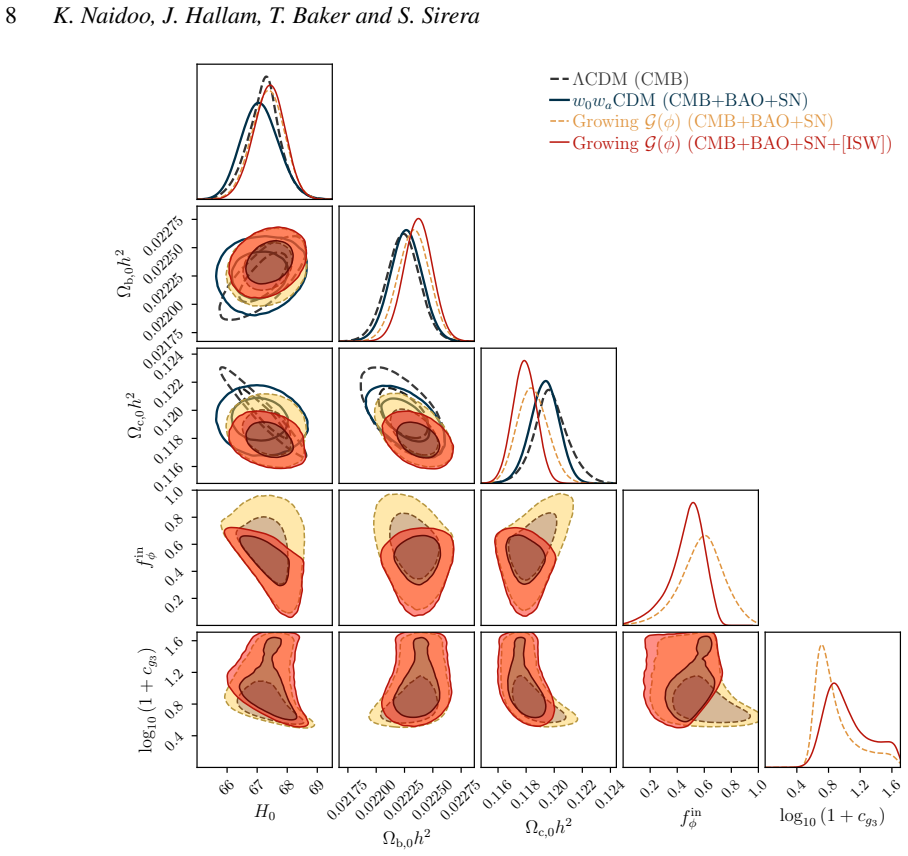
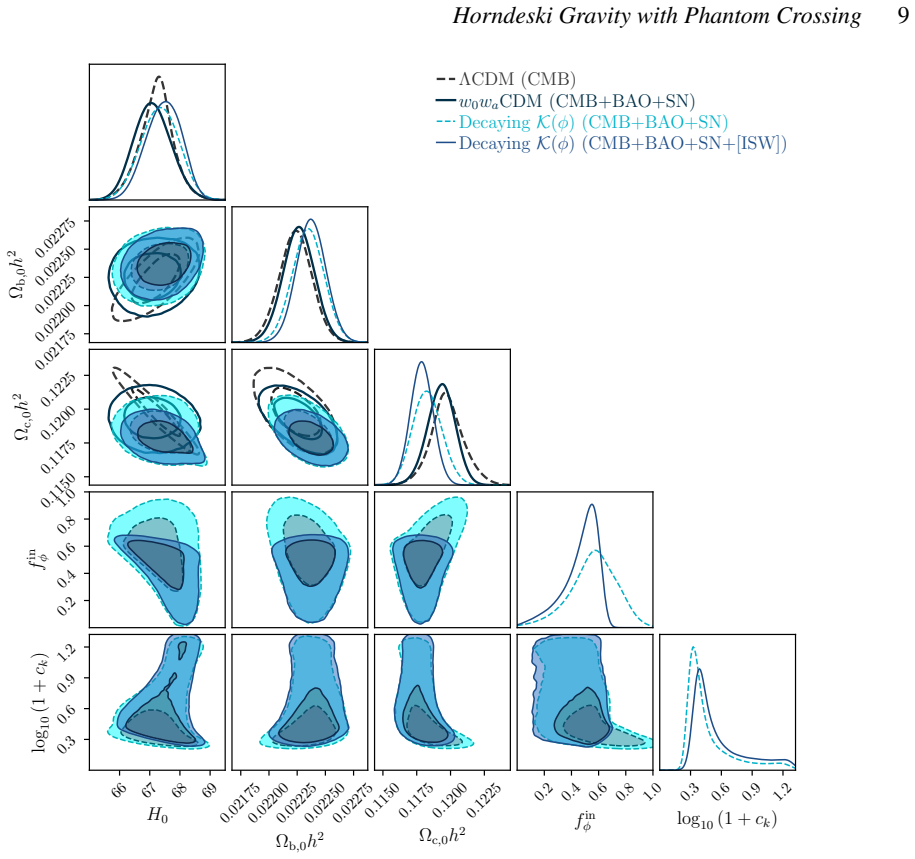
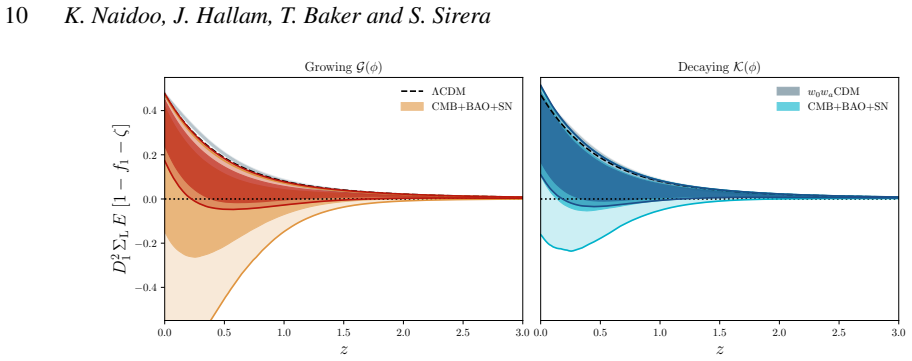
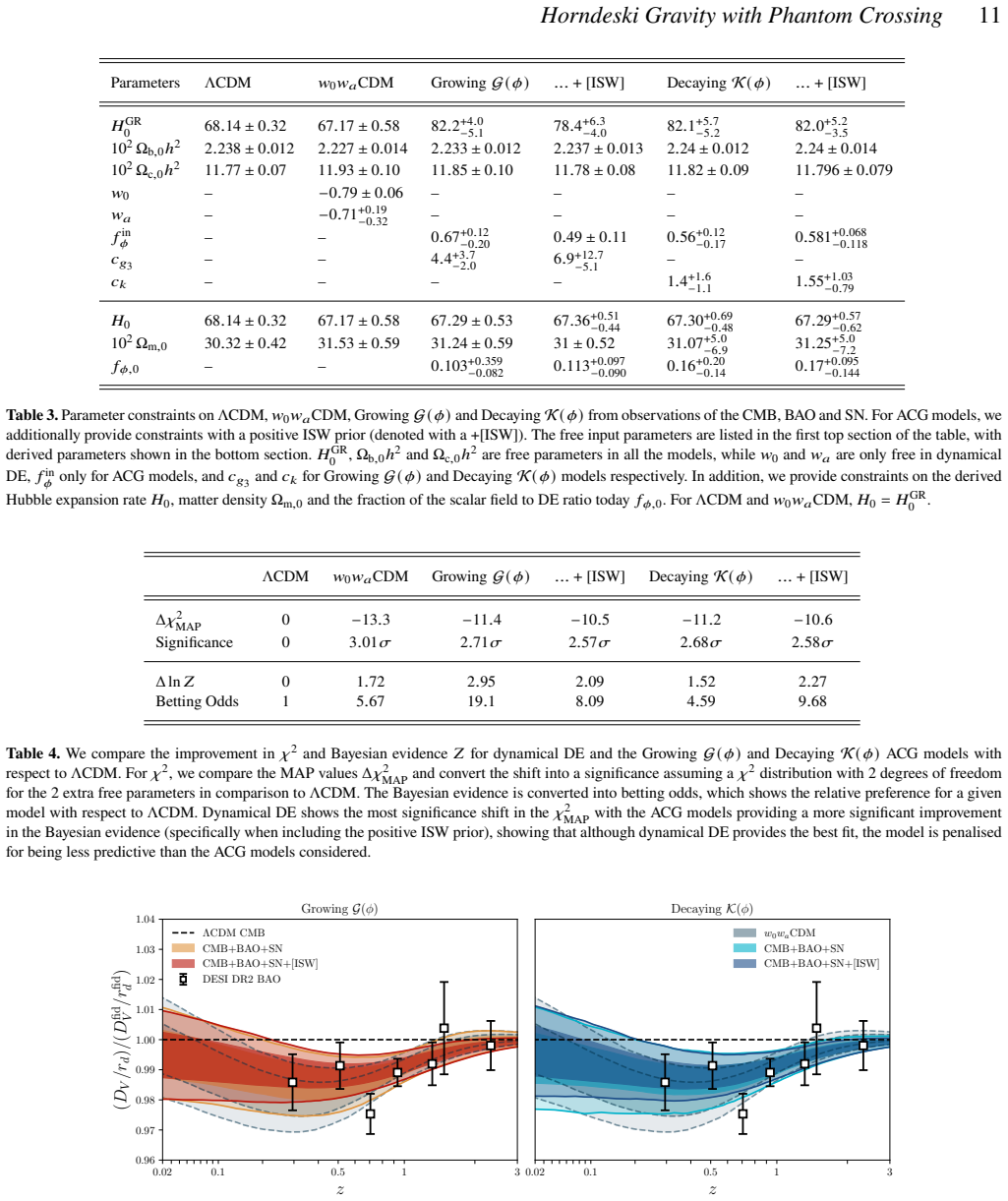
read the original abstract
Gravity models in which the dark energy equation of state crosses $w=-1$, also known as the phantom divide, have received extensive interest due to recent analyses favouring this behaviour. We introduce a new subclass of Horndeski scalar-tensor models capable of generating phantom crossing, whilst remaining minimally coupled to matter: the Asymptotic Cubic Galileon (ACG) models. We show that ACG models can jointly fit the expansion history inferred from observations of the Planck cosmic microwave background, baryon acoustic oscillation measurements from the Dark Energy Spectroscopic Instrument, and distance-ladder supernovae measurements from the Dark Energy Survey. We then demonstrate that perturbative observables, including the galaxy-ISW cross-correlation and void force profile, provide powerful constraints that confine viable and testable ACG models to a well-defined region of the broader Horndeski landscape. Model comparison metrics, including $\chi^{2}$ and Bayesian evidence, favour both ACG and $w_{0}w_{a}$CDM models over $\Lambda$CDM, with ACG providing a fit of comparable quality to $w_{0}w_{a}$CDM. Crucially, ACG models ground the observationally preferred $w_{0}w_{a}$CDM behaviour in a robust Lagrangian formulation. This enables interpretation beyond mere phenomenological fits, and motivates further tests of these models on nonlinear scales.
Editorial analysis
A structured set of objections, weighed in public.
Referee Report
Summary. The manuscript introduces Asymptotic Cubic Galileon (ACG) models, a subclass of Horndeski scalar-tensor theories that permit phantom crossing of the dark-energy equation of state while remaining minimally coupled to matter. It claims that ACG models jointly reproduce the expansion history inferred from Planck CMB, DESI BAO and DES supernovae data, that galaxy-ISW cross-correlations and void force profiles supply independent perturbative constraints that restrict viable ACG parameter space to a well-defined region, and that model-comparison metrics (χ2 and Bayesian evidence) favor both ACG and w0waCDM over ΛCDM at comparable quality, thereby grounding the phenomenological behavior in a Lagrangian formulation.
Significance. If the central claims are substantiated with explicit derivations, error budgets and robustness tests, the work would supply a concrete, minimally coupled Horndeski realization of the observationally preferred phantom-crossing dynamics, together with falsifiable predictions on perturbative scales that distinguish it from both ΛCDM and generic w0waCDM parametrizations.
major comments (3)
- [§4.3] §4.3 (galaxy-ISW likelihood): the analysis adopts a fixed linear bias model and a single void-identification algorithm without marginalization; if these choices are not varied, the reported confinement of ACG parameters may be driven by modeling assumptions rather than the data, undermining the claim that perturbative observables independently carve out a viable region.
- [§5.1, Eq. (27)] §5.1, Eq. (27): the mapping from linear to observed void force profile is stated to be parameter-free, yet the conversion involves an assumed growth-rate normalization that is itself constrained by the same background data; this introduces a potential circularity that must be quantified by showing the posterior shift when the normalization is left free.
- [Table 4] Table 4 (Bayesian evidence): the reported ln B values for ACG versus w0waCDM are within 1 unit, yet the paper asserts comparable quality; the prior volume on the ACG parameters is not stated, so it is unclear whether the evidence ratio is robust to reasonable changes in the prior range.
minor comments (2)
- [Abstract] The abstract states that ACG models 'ground' the w0waCDM behavior, but the manuscript does not quantify how much of the w0waCDM posterior lies inside the ACG subspace; a direct overlap plot would strengthen the interpretation.
- [§2] Notation for the ACG functions f(ϕ), G3(ϕ,X) is introduced in §2 but the asymptotic limit is only described qualitatively; explicit functional forms and the precise definition of the 'asymptotic' regime should be given in an equation.
Simulated Author's Rebuttal
We thank the referee for their constructive and detailed report. The comments highlight important points on robustness and transparency that we address below. We have revised the manuscript accordingly to strengthen the claims.
read point-by-point responses
-
Referee: [§4.3] §4.3 (galaxy-ISW likelihood): the analysis adopts a fixed linear bias model and a single void-identification algorithm without marginalization; if these choices are not varied, the reported confinement of ACG parameters may be driven by modeling assumptions rather than the data, undermining the claim that perturbative observables independently carve out a viable region.
Authors: We agree that the original analysis would benefit from explicit robustness checks against these modeling choices. In the revised manuscript we have added tests that vary the linear bias within current observational uncertainties (±20%) and repeat the void analysis with a second identification algorithm. The resulting ACG parameter constraints remain consistent to within 1σ of the fiducial results, indicating that the confinement is not driven by the specific choices. These tests are now reported in an expanded §4.3 together with a new supplementary figure. revision: yes
-
Referee: [§5.1, Eq. (27)] §5.1, Eq. (27): the mapping from linear to observed void force profile is stated to be parameter-free, yet the conversion involves an assumed growth-rate normalization that is itself constrained by the same background data; this introduces a potential circularity that must be quantified by showing the posterior shift when the normalization is left free.
Authors: The referee correctly identifies a potential circularity. We have re-run the void-force likelihood leaving the growth-rate normalization as a free parameter with a broad uniform prior. The posterior on the ACG parameters shifts by less than 0.5σ relative to the fiducial case. This test and the updated discussion of Eq. (27) have been added to §5.1. revision: yes
-
Referee: [Table 4] Table 4 (Bayesian evidence): the reported ln B values for ACG versus w0waCDM are within 1 unit, yet the paper asserts comparable quality; the prior volume on the ACG parameters is not stated, so it is unclear whether the evidence ratio is robust to reasonable changes in the prior range.
Authors: We accept that the prior ranges were not stated explicitly. The ACG parameters were assigned uniform priors over theoretically motivated intervals (e.g., the cubic Galileon coefficient between −5 and +5). We have now added a prior-sensitivity test in which the ranges are widened by factors of two and five; the ln-evidence ratios change by at most 0.7 and remain consistent with the statement of comparable quality. The prior ranges and the sensitivity results are reported in the revised Table 4 caption and accompanying text. revision: yes
Circularity Check
No significant circularity; derivation chain is self-contained against external data.
full rationale
The paper defines a new ACG subclass of Horndeski models by construction to allow phantom crossing with minimal matter coupling, then fits the resulting background expansion to independent datasets (Planck CMB, DESI BAO, DES supernovae) and applies separate perturbative observables (galaxy-ISW cross-correlation, void force profiles) for additional constraints. Model comparison metrics are computed against the same external data. No quoted step reduces a claimed prediction or uniqueness result to a fitted parameter or self-citation by construction; the Lagrangian formulation supplies independent content beyond the phenomenological w0waCDM fit. This is the normal case of a model being tested on data rather than a circular re-derivation.
Axiom & Free-Parameter Ledger
free parameters (1)
- ACG model parameters
axioms (2)
- standard math Horndeski scalar-tensor gravity framework
- domain assumption Minimal coupling to matter
invented entities (1)
-
Asymptotic Cubic Galileon models
no independent evidence
Forward citations
Cited by 1 Pith paper
-
Quintom Model Perturbations
A two-field quintom model reproduces w0waCDM perturbation features and is mildly favored over it in Bayesian fits to BAO, CMB, and SNIa data.
Reference graph
Works this paper leans on
-
[1]
Measurement of the Rate of _ e + d --> p + p + e ^ - Interactions Produced by ^ 8 B Solar Neutrinos at the Sudbury Neutrino Observatory. , keywords =. doi:10.1103/PhysRevLett.87.071301 , archivePrefix =. nucl-ex/0106015 , primaryClass =
work page internal anchor Pith review Pith/arXiv arXiv doi:10.1103/physrevlett.87.071301
-
[2]
The clustering of galaxies in the completed SDSS-III Baryon Oscillation Spectroscopic Survey: cosmological analysis of the DR12 galaxy sample. , keywords =. doi:10.1093/mnras/stx721 , archivePrefix =. 1607.03155 , primaryClass =
work page internal anchor Pith review Pith/arXiv arXiv doi:10.1093/mnras/stx721
-
[3]
New Gravitational Scales in Cosmological Surveys
New gravitational scales in cosmological surveys. , keywords =. doi:10.1103/PhysRevD.90.124030 , archivePrefix =. 1409.8284 , primaryClass =
work page internal anchor Pith review Pith/arXiv arXiv doi:10.1103/physrevd.90.124030
-
[4]
Strong constraints on cosmological gravity from GW170817 and GRB 170817A
Strong Constraints on Cosmological Gravity from GW170817 and GRB 170817A. , keywords =. doi:10.1103/PhysRevLett.119.251301 , archivePrefix =. 1710.06394 , primaryClass =
work page internal anchor Pith review Pith/arXiv arXiv doi:10.1103/physrevlett.119.251301
-
[5]
Void lensing as a test of gravity. , keywords =. doi:10.1103/PhysRevD.98.023511 , archivePrefix =. 1803.07533 , primaryClass =
-
[6]
The observational status of Galileon gravity after Planck
The observational status of Galileon gravity after Planck. , keywords =. doi:10.1088/1475-7516/2014/08/059 , archivePrefix =. 1406.0485 , primaryClass =
work page internal anchor Pith review Pith/arXiv arXiv doi:10.1088/1475-7516/2014/08/059 2014
-
[7]
Maximal freedom at minimum cost: linear large-scale structure in general modifications of gravity
Maximal freedom at minimum cost: linear large-scale structure in general modifications of gravity. , keywords =. doi:10.1088/1475-7516/2014/07/050 , archivePrefix =. 1404.3713 , primaryClass =
work page internal anchor Pith review Pith/arXiv arXiv doi:10.1088/1475-7516/2014/07/050 2014
-
[8]
Charging Across the Phantom Divide with Modified Gravity
Charging Across the Phantom Divide with Modified Gravity. arXiv e-prints , keywords =. doi:10.48550/arXiv.2605.26259 , archivePrefix =. 2605.26259 , primaryClass =
work page internal anchor Pith review Pith/arXiv arXiv doi:10.48550/arxiv.2605.26259
-
[9]
Accelerating Universes with Scaling Dark Matter
Accelerating Universes with Scaling Dark Matter. International Journal of Modern Physics D , keywords =. doi:10.1142/S0218271801000822 , archivePrefix =. gr-qc/0009008 , primaryClass =
work page internal anchor Pith review Pith/arXiv arXiv doi:10.1142/s0218271801000822
-
[10]
Journal of High Energy Physics , keywords =
No s is Good News. Journal of High Energy Physics , keywords =. doi:10.1007/JHEP09(2024)097 , archivePrefix =. 2405.00836 , primaryClass =
-
[11]
Dark Energy Survey Year 6 Results: Cosmological Constraints from Galaxy Clustering and Weak Lensing. arXiv e-prints , keywords =. doi:10.48550/arXiv.2601.14559 , archivePrefix =. 2601.14559 , primaryClass =
-
[12]
The Dark Energy Survey: Cosmology Results with 1500 New High-redshift Type Ia Supernovae Using the Full 5 yr Data Set. , keywords =. doi:10.3847/2041-8213/ad6f9f , archivePrefix =. 2401.02929 , primaryClass =
work page internal anchor Pith review Pith/arXiv arXiv doi:10.3847/2041-8213/ad6f9f 2041
-
[13]
DESI DR2 results. II. Measurements of baryon acoustic oscillations and cosmological constraints. , keywords =. doi:10.1103/tr6y-kpc6 , archivePrefix =. 2503.14738 , primaryClass =
work page internal anchor Pith review Pith/arXiv arXiv doi:10.1103/tr6y-kpc6
-
[14]
4D Gravity on a Brane in 5D Minkowski Space
4D gravity on a brane in 5D Minkowski space. Physics Letters B , keywords =. doi:10.1016/S0370-2693(00)00669-9 , archivePrefix =. hep-th/0005016 , primaryClass =
work page internal anchor Pith review Pith/arXiv arXiv doi:10.1016/s0370-2693(00)00669-9
-
[15]
Overview of the Euclid mission
Euclid: I. Overview of the Euclid mission. , keywords =. doi:10.1051/0004-6361/202450810 , archivePrefix =. 2405.13491 , primaryClass =
-
[16]
Negative neutrino masses as a mirage of dark energy. , keywords =. doi:10.1103/PhysRevD.111.063534 , archivePrefix =. 2407.10965 , primaryClass =
-
[17]
Constraints on Neutrino Physics from DESI DR2 BAO and DR1 Full Shape
Constraints on neutrino physics from DESI DR2 BAO and DR1 full shape. , keywords =. doi:10.1103/w9pk-xsk7 , archivePrefix =. 2503.14744 , primaryClass =
work page internal anchor Pith review Pith/arXiv arXiv doi:10.1103/w9pk-xsk7
-
[18]
emcee: The MCMC Hammer. , keywords =. doi:10.1086/670067 , archivePrefix =. 1202.3665 , primaryClass =
work page internal anchor Pith review Pith/arXiv arXiv doi:10.1086/670067
-
[19]
Evidence for oscillation of atmospheric neutrinos
Evidence for Oscillation of Atmospheric Neutrinos. , keywords =. doi:10.1103/PhysRevLett.81.1562 , archivePrefix =. hep-ex/9807003 , primaryClass =
work page internal anchor Pith review Pith/arXiv arXiv doi:10.1103/physrevlett.81.1562
-
[20]
GW170817: Observation of Gravitational Waves from a Binary Neutron Star Inspiral
GW170817: Observation of Gravitational Waves from a Binary Neutron Star Inspiral. , keywords =. doi:10.1103/PhysRevLett.119.161101 , archivePrefix =. 1710.05832 , primaryClass =
work page internal anchor Pith review Pith/arXiv arXiv doi:10.1103/physrevlett.119.161101
-
[21]
Multi-messenger Observations of a Binary Neutron Star Merger
Multi-messenger Observations of a Binary Neutron Star Merger. , keywords =. doi:10.3847/2041-8213/aa91c9 , archivePrefix =. 1710.05833 , primaryClass =
work page internal anchor Pith review Pith/arXiv arXiv doi:10.3847/2041-8213/aa91c9 2041
-
[22]
Cosmological Viability of Asymptotically Cubic Galileon Gravity. in-prep
-
[23]
Consistency of standard cosmologies using Bayesian model comparison and tension quantification. arXiv e-prints , keywords =. doi:10.48550/arXiv.2602.06115 , archivePrefix =. 2602.06115 , primaryClass =
-
[24]
International Journal of Theoretical Physics , keywords =
Second-order scalar-tensor field equations in a four-dimensional space. International Journal of Theoretical Physics , keywords =. doi:10.1007/BF01807638 , adsurl =
-
[25]
hi_class: Horndeski in the Cosmic Linear Anisotropy Solving System
hi\_class: Horndeski in the Cosmic Linear Anisotropy Solving System. , keywords =. doi:10.1088/1475-7516/2017/08/019 , archivePrefix =. 1605.06102 , primaryClass =
work page internal anchor Pith review Pith/arXiv arXiv doi:10.1088/1475-7516/2017/08/019 2017
-
[26]
Models of f(R) Cosmic Acceleration that Evade Solar-System Tests
Models of f(R) cosmic acceleration that evade solar system tests. , keywords =. doi:10.1103/PhysRevD.76.064004 , archivePrefix =. 0705.1158 , primaryClass =
work page internal anchor Pith review Pith/arXiv arXiv doi:10.1103/physrevd.76.064004
-
[27]
Effective Field Theory of Cosmic Acceleration: an implementation in CAMB
Effective field theory of cosmic acceleration: An implementation in CAMB. , keywords =. doi:10.1103/PhysRevD.89.103530 , archivePrefix =. 1312.5742 , primaryClass =
work page internal anchor Pith review Pith/arXiv arXiv doi:10.1103/physrevd.89.103530
-
[28]
Anisotropies in the Cosmic Microwave Background: An Analytic Approach
Anisotropies in the Cosmic Microwave Background: an Analytic Approach. , keywords =. doi:10.1086/175624 , archivePrefix =. astro-ph/9407093 , primaryClass =
work page internal anchor Pith review Pith/arXiv arXiv doi:10.1086/175624
-
[29]
Modified gravity constraints from the full shape modeling of clustering measurements from DESI 2024. , keywords =. doi:10.1088/1475-7516/2025/09/053 , archivePrefix =. 2411.12026 , primaryClass =
-
[30]
Vainshtein screening in a cosmological background in the most general second-order scalar-tensor theory. , keywords =. doi:10.1103/PhysRevD.85.024023 , archivePrefix =. 1111.6749 , primaryClass =
work page internal anchor Pith review Pith/arXiv arXiv doi:10.1103/physrevd.85.024023
-
[31]
CMB constraints on the early Universe independent of late-time cosmology. , keywords =. doi:10.1103/PhysRevD.107.103505 , archivePrefix =. 2302.12911 , primaryClass =
-
[32]
The Cosmic Linear Anisotropy Solving System (CLASS) I: Overview
The Cosmic Linear Anisotropy Solving System (CLASS) I: Overview. arXiv e-prints , keywords =. doi:10.48550/arXiv.1104.2932 , archivePrefix =. 1104.2932 , primaryClass =
work page internal anchor Pith review Pith/arXiv arXiv doi:10.48550/arxiv.1104.2932
-
[33]
CAMB: Code for Anisotropies in the Microwave Background
-
[34]
Extended Dark Energy analysis using DESI DR2 BAO measurements
Extended dark energy analysis using DESI DR2 BAO measurements. , keywords =. doi:10.1103/w4c6-1r5j , archivePrefix =. 2503.14743 , primaryClass =
work page internal anchor Pith review Pith/arXiv arXiv doi:10.1103/w4c6-1r5j
-
[35]
Extended Limber approximation. , keywords =. doi:10.1103/PhysRevD.78.123506 , archivePrefix =. 0809.5112 , primaryClass =
work page internal anchor Pith review Pith/arXiv arXiv doi:10.1103/physrevd.78.123506
-
[36]
Cosmology after Phantom Crossing by Horndeski Gravity. arXiv e-prints , keywords =. doi:10.48550/arXiv.2512.03139 , archivePrefix =. 2512.03139 , primaryClass =
-
[37]
Exploring the Expansion History of the Universe
Exploring the Expansion History of the Universe. , keywords =. doi:10.1103/PhysRevLett.90.091301 , archivePrefix =. astro-ph/0208512 , primaryClass =
work page internal anchor Pith review Pith/arXiv arXiv doi:10.1103/physrevlett.90.091301
-
[38]
The galileon as a local modification of gravity
Galileon as a local modification of gravity. , keywords =. doi:10.1103/PhysRevD.79.064036 , archivePrefix =. 0811.2197 , primaryClass =
work page internal anchor Pith review Pith/arXiv arXiv doi:10.1103/physrevd.79.064036
-
[39]
How deep can a cosmic void be? Voids-informed theoretical bounds in Galileon gravity , author =. Phys. Rev. D , pages =. 2026 , month =. doi:10.1103/nk9f-dw1z , url =
-
[40]
Planck 2018 results. VI. Cosmological parameters. , keywords =. doi:10.1051/0004-6361/201833910 , archivePrefix =. 1807.06209 , primaryClass =
work page internal anchor Pith review Pith/arXiv arXiv doi:10.1051/0004-6361/201833910 2018
-
[41]
The Dark Energy Survey Supernova Program: A Reanalysis Of Cosmology Results And Evidence For Evolving Dark Energy With An Updated Type Ia Supernova Calibration. arXiv e-prints , keywords =. doi:10.48550/arXiv.2511.07517 , archivePrefix =. 2511.07517 , primaryClass =
work page internal anchor Pith review Pith/arXiv arXiv doi:10.48550/arxiv.2511.07517
-
[42]
What can Cosmology tell us about Gravity? Constraining Horndeski with Sigma and Mu
What can cosmology tell us about gravity? Constraining Horndeski gravity with and. , keywords =. doi:10.1103/PhysRevD.94.104014 , archivePrefix =. 1606.05339 , primaryClass =
work page internal anchor Pith review Pith/arXiv arXiv doi:10.1103/physrevd.94.104014
-
[43]
Galileon Gravity in Light of ISW, CMB, BAO and $H_0$ data
Galileon gravity in light of ISW, CMB, BAO and H _ 0 data. , keywords =. doi:10.1088/1475-7516/2017/10/020 , archivePrefix =. 1707.02263 , primaryClass =
work page internal anchor Pith review Pith/arXiv arXiv doi:10.1088/1475-7516/2017/10/020 2017
-
[44]
A Comprehensive Measurement of the Local Value of the Hubble Constant with 1 km s ^ -1 Mpc ^ -1 Uncertainty from the Hubble Space Telescope and the SH0ES Team. , keywords =. doi:10.3847/2041-8213/ac5c5b , archivePrefix =. 2112.04510 , primaryClass =
work page internal anchor Pith review Pith/arXiv arXiv doi:10.3847/2041-8213/ac5c5b 2041
-
[45]
, year = 1967, month = jan, volume =
Perturbations of a Cosmological Model and Angular Variations of the Microwave Background. , year = 1967, month = jan, volume =. doi:10.1086/148982 , adsurl =
-
[46]
Constraining dark energy with the integrated Sachs-Wolfe effect. , keywords =. doi:10.1103/PhysRevD.110.123525 , archivePrefix =. 2401.06221 , primaryClass =
-
[47]
arXiv e-prints , keywords =
A Master Equation for Screening in Luminal Horndeski Gravity. arXiv e-prints , keywords =
-
[48]
dynesty: A Dynamic Nested Sampling Package for Estimating Bayesian Posteriors and Evidences
DYNESTY: a dynamic nested sampling package for estimating Bayesian posteriors and evidences. , keywords =. doi:10.1093/mnras/staa278 , archivePrefix =. 1904.02180 , primaryClass =
work page internal anchor Pith review Pith/arXiv arXiv doi:10.1093/mnras/staa278 1904
-
[49]
PeerJ Computer Science , issn =
SymPy: symbolic computing in Python , author =. PeerJ Computer Science , issn =
-
[50]
Solving Large Scale Structure in Ten Easy Steps with COLA
Solving large scale structure in ten easy steps with COLA. , keywords =. doi:10.1088/1475-7516/2013/06/036 , archivePrefix =. 1301.0322 , primaryClass =
work page internal anchor Pith review Pith/arXiv arXiv doi:10.1088/1475-7516/2013/06/036 2013
-
[51]
Cobaya: Bayesian analysis in cosmology
-
[52]
Crossing the phantom divide in scalar-tensor and vector-tensor theories. arXiv e-prints , keywords =. doi:10.48550/arXiv.2508.17231 , archivePrefix =. 2508.17231 , primaryClass =
-
[53]
Union Through UNITY: Cosmology with 2,000 SNe Using a Unified Bayesian Framework
Union through UNITY: Cosmology with 2000 SNe Using a Unified Bayesian Framework. , keywords =. doi:10.3847/1538-4357/adc0a5 , archivePrefix =. 2311.12098 , primaryClass =
work page internal anchor Pith review Pith/arXiv arXiv doi:10.3847/1538-4357/adc0a5 2000
-
[54]
COLASolver: Particle-Mesh N-body code
-
[55]
Cosmological constraints on Galileon dark energy with broken shift symmetry
Cosmological constraints on Galileon dark energy with broken shift symmetry. , keywords =. doi:10.1103/bxvj-bsv1 , archivePrefix =. 2509.17586 , primaryClass =
work page internal anchor Pith review Pith/arXiv arXiv doi:10.1103/bxvj-bsv1
-
[56]
Assessing Cosmological Evidence for Nonminimal Coupling. , keywords =. doi:10.1103/jysf-k72m , archivePrefix =. 2504.07679 , primaryClass =
-
[57]
Matching current observational constraints with nonminimally coupled dark energy. , keywords =. doi:10.1103/PhysRevD.111.L041303 , archivePrefix =. 2409.17019 , primaryClass =
-
[58]
Hi-COLA: fast, approximate simulations of structure formation in Horndeski gravity. , keywords =. doi:10.1088/1475-7516/2023/03/040 , archivePrefix =. 2209.01666 , primaryClass =
-
[59]
When One-Parameter Dark Energy Makes Neutrinos Physical Again. arXiv e-prints , keywords =. doi:10.48550/arXiv.2603.15422 , archivePrefix =. 2603.15422 , primaryClass =
-
[60]
Hints of Nonminimally Coupled Gravity in DESI 2024 Baryon Acoustic Oscillation Measurements. , keywords =. doi:10.1103/PhysRevLett.134.181002 , archivePrefix =. 2407.15832 , primaryClass =
-
[61]
Dynamical dark energy in light of the DESI DR2 baryonic acoustic oscillations measurements
Gu, Gan and others. Dynamical dark energy in light of the DESI DR2 baryonic acoustic oscillations measurements. Nature Astron. 2025. doi:10.1038/s41550-025-02669-6. arXiv:2504.06118
-
[62]
doi:10.1103/PhysRevLett.119.251304 , eprint =
Ezquiaga, Jose María and Zumalac\'arregui, Miguel , year = 2017, journal =. doi:10.1103/PhysRevLett.119.251304 , eprint =
-
[63]
doi:10.1103/PhysRevLett.119.251302 , eprint =
Creminelli, Paolo and Vernizzi, Filippo , year = 2017, journal =. doi:10.1103/PhysRevLett.119.251302 , eprint =
-
[64]
doi:10.1103/PhysRevLett.121.221101 , eprint =
de Rham, Claudia and Melville, Scott , year = 2018, journal =. doi:10.1103/PhysRevLett.121.221101 , eprint =
-
[65]
Probing the speed of gravity with LVK, LISA, and joint observations
Harry, Ian and Noller, Johannes. Probing the speed of gravity with LVK, LISA, and joint observations. Gen. Rel. Grav. 2022. doi:10.1007/s10714-022-03016-0. arXiv:2207.10096
-
[66]
Measuring the propagation speed of gravitational waves with LISA. , keywords =. doi:10.1088/1475-7516/2022/08/031 , archivePrefix =. 2203.00566 , primaryClass =
-
[67]
doi:10.1088/1475-7516/2021/01/068 , eprint =
Baker, Tessa and Harrison, Ian , year = 2021, journal =. doi:10.1088/1475-7516/2021/01/068 , eprint =
-
[68]
doi:10.1103/PhysRevD.107.124054 , eprint =
Sirera, Sergi and Noller, Johannes , year = 2023, journal =. doi:10.1103/PhysRevD.107.124054 , eprint =
-
[69]
doi:10.1103/PhysRevD.110.124018 , eprint =
Atkins, Bill and Malhotra, Ameek and Tasinato, Gianmassimo , year = 2024, journal =. doi:10.1103/PhysRevD.110.124018 , eprint =
-
[70]
doi:10.1088/1475-7516/2023/03/044 , eprint =
Baker, Tessa and Barausse, Enrico and Chen, Anson and de Rham, Claudia and Pieroni, Mauro and Tasinato, Gianmassimo , year = 2022, journal =. doi:10.1088/1475-7516/2023/03/044 , eprint =
-
[71]
Deffayet, C. and Esposito-Farese, Gilles and Vikman, A. Covariant Galileon. Phys. Rev. D. 2009. doi:10.1103/PhysRevD.79.084003. arXiv:0901.1314
work page internal anchor Pith review Pith/arXiv arXiv doi:10.1103/physrevd.79.084003 2009
-
[72]
Imperfect dark energy from kinetic gravity braiding , volume=
Cédric Deffayet and Oriol Pujolàs and Ignacy Sawicki and Alexander Vikman , year=. Imperfect dark energy from kinetic gravity braiding , volume=. Journal of Cosmology and Astroparticle Physics , publisher=. doi:10.1088/1475-7516/2010/10/026 , number=
-
[73]
and García-García, Carlos and Noller, Johannes and Zumalacárregui, Miguel , year=
Traykova, Dina and Bellini, Emilio and Ferreira, Pedro G. and García-García, Carlos and Noller, Johannes and Zumalacárregui, Miguel , year=. Theoretical priors in scalar-tensor cosmologies: Shift-symmetric Horndeski models , volume=. Physical Review D , publisher=. doi:10.1103/physrevd.104.083502 , number=
-
[74]
Can dark energy evolve to the Phantom?
Vikman, Alexander. Can dark energy evolve to the phantom?. Phys. Rev. D. 2005. doi:10.1103/PhysRevD.71.023515. arXiv:astro-ph/0407107
work page internal anchor Pith review Pith/arXiv arXiv doi:10.1103/physrevd.71.023515 2005
-
[75]
The Vainshtein mechanism beyond the quasi-static approximation
Winther, Hans A. and Ferreira, Pedro G. , year = 2015, journal =. doi:10.1103/PhysRevD.92.064005 , archiveprefix =. 1505.03539 , primaryclass =
work page internal anchor Pith review Pith/arXiv arXiv doi:10.1103/physrevd.92.064005 2015
discussion (0)
Sign in with ORCID, Apple, or X to comment. Anyone can read and Pith papers without signing in.