Cosmological searches for the neutrino mass scale and mass ordering
Pith reviewed 2026-05-24 19:40 UTC · model grok-4.3
The pith
Cosmological data from large-scale structure yields an upper limit of 0.12 eV on the sum of neutrino masses and a weak preference for normal ordering driven by volume effects.
A machine-rendered reading of the paper's core claim, the machinery that carries it, and where it could break.
Core claim
Large-scale structure data constrain the sum of neutrino masses to less than 0.12 eV. The same data display a weak preference for the normal mass ordering that originates in the larger available parameter volume rather than in any direct observational signature. The standard galaxy-bias definition becomes scale-dependent on large scales when neutrinos carry mass, an effect that must be removed by a new recipe if future surveys are to extract reliable neutrino information. In non-phantom dynamical dark energy models the neutrino-mass upper bound tightens relative to the Lambda-CDM case, strengthening the volume-driven ordering preference. Constraints on inflationary parameters remain stable,
What carries the argument
Scale-dependent galaxy bias in the presence of massive neutrinos, calibrated through CMB lensing-galaxy cross-correlations and corrected by a new bias recipe that removes spurious large-scale dependence.
If this is right
- Non-phantom dynamical dark energy models produce a tighter upper limit on the neutrino mass sum than Lambda-CDM and therefore a stronger volume-driven preference for normal ordering.
- If the corrected bias recipe is not used, future large-scale structure surveys will suffer systematic errors in neutrino-mass constraints.
- Inflationary parameter determinations stay unchanged when assumptions about the neutrino sector are varied.
- The volume effect that generates the mild ordering preference can be quantified with a simple statistical measure proposed in the analysis.
Where Pith is reading between the lines
- Adopting the new bias definition across analyses would reduce tension between cosmological and laboratory neutrino-mass bounds.
- The volume-driven nature of the ordering preference implies that oscillation experiments, rather than cosmology alone, will ultimately decide the mass hierarchy.
- Correlations between neutrino mass and dark energy parameters could serve as a consistency test once laboratory ordering results become available.
Load-bearing premise
The conventional definition of galaxy bias fails to remain scale-independent once neutrinos have non-zero mass.
What would settle it
A laboratory determination that the neutrino mass ordering is inverted would exclude or strongly disfavor the non-phantom dynamical dark energy models examined in the thesis.
Figures



read the original abstract
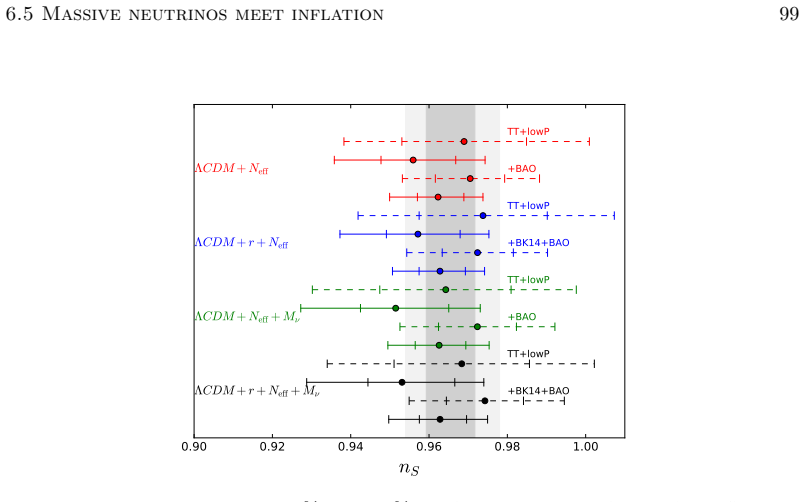
In this thesis, I describe a number of recent important developments in neutrino cosmology on three fronts. Firstly, focusing on Large-Scale Structure (LSS) data, I will show that current cosmological probes contain a wealth of information on the sum of the neutrino masses. I report on the analysis leading to the currently best upper limit on the sum of the neutrino masses of $0.12\,{\rm eV}$. I show how cosmological data exhibits a weak preference for the normal neutrino mass ordering because of parameter space volume effects, and propose a simple method to quantify this preference. Secondly, I will discuss how galaxy bias represents a severe limitation towards fully capitalizing on the neutrino information hidden in LSS data. I propose a method for calibrating the scale-dependent galaxy bias using CMB lensing-galaxy cross-correlations. Moreover, in the presence of massive neutrinos, the usual definition of bias becomes inadequate, as it leads to a scale-dependence on large scales which has never been accounted for. I show that failure to define the bias appropriately will be a problem for future LSS surveys, and propose a simple recipe to account for the effect of massive neutrinos on galaxy bias. Finally, I discuss implications of correlations between neutrino parameters and other cosmological parameters. In non-phantom dynamical dark energy models, the upper limit on the sum of the neutrino masses becomes tighter than the $\Lambda$CDM limit. Therefore, such models exhibit an even stronger preference for the normal ordering, and their viability could be jeopardized should near-future laboratory experiments determine that the mass ordering is inverted. I then discuss correlations between neutrino and inflationary parameters. I find that our determination of inflationary parameters is stable against assumptions about the neutrino sector. (abridged)
Editorial analysis
A structured set of objections, weighed in public.
Referee Report
Summary. This thesis summarizes developments in neutrino cosmology from LSS and CMB data. It reports that current probes yield a best upper limit of 0.12 eV on the sum of neutrino masses, with cosmological data showing a weak preference for normal mass ordering driven by parameter-space volume effects. It identifies galaxy bias as a key limitation, noting that the standard bias definition produces unaccounted scale dependence on large scales when neutrinos are massive, and proposes calibration via CMB lensing-galaxy cross-correlations plus a recipe to correct for neutrino effects on bias. Additional sections examine how non-phantom dynamical dark energy tightens the mass-sum limit (strengthening the normal-ordering preference) and how neutrino assumptions leave inflationary parameters stable.
Significance. If the central results hold, the work demonstrates the constraining power of existing LSS+CMB datasets on neutrino masses and supplies a concrete methodological explanation (volume effects) for the observed ordering preference. The identification of a previously unaccounted scale-dependent bias effect, together with proposed calibration and correction recipes, directly addresses a systematic that will become load-bearing for next-generation surveys. The parameter-correlation analyses provide useful context on degeneracies with dark energy and inflation.
major comments (2)
- [Abstract / introduction (limit and ordering preference)] The 0.12 eV upper limit is presented as the best current constraint derived from LSS analyses, yet the manuscript later states that the usual galaxy-bias definition produces an unaccounted scale dependence on large scales in the presence of massive neutrinos. It is therefore necessary to clarify whether the analyses underlying the quoted limit employed the standard bias definition or the proposed correction; if the former, the posterior on Σmν (and the volume-effect ordering preference) could shift. This directly affects the load-bearing claim in the abstract and introduction.
- [Section on galaxy bias and neutrino effects] The statement that the usual bias definition 'leads to a scale-dependence on large scales which has never been accounted for' and 'will be a problem for future LSS surveys' is presented without a quantitative estimate of the induced bias on Σmν or on the ordering preference. A concrete forecast or re-analysis showing the magnitude of the shift would be required to substantiate that the effect is severe enough to warrant the proposed recipe.
minor comments (2)
- [Abstract] The abstract refers to 'the analysis leading to' the 0.12 eV limit but supplies no dataset list, likelihood details, or reference to the specific publication; adding these would improve traceability.
- [Throughout] Notation for the neutrino mass sum (Σmν vs. mν) and for the ordering preference metric should be defined at first use and used consistently.
Simulated Author's Rebuttal
We thank the referee for their thoughtful comments on our thesis. We provide point-by-point responses to the major comments below.
read point-by-point responses
-
Referee: [Abstract / introduction (limit and ordering preference)] The 0.12 eV upper limit is presented as the best current constraint derived from LSS analyses, yet the manuscript later states that the usual galaxy-bias definition produces an unaccounted scale dependence on large scales in the presence of massive neutrinos. It is therefore necessary to clarify whether the analyses underlying the quoted limit employed the standard bias definition or the proposed correction; if the former, the posterior on Σmν (and the volume-effect ordering preference) could shift. This directly affects the load-bearing claim in the abstract and introduction.
Authors: The 0.12 eV upper limit is derived from previously published LSS analyses that used the standard definition of galaxy bias. The thesis summarizes these results and separately identifies the scale-dependent bias issue as a limitation for future analyses, proposing a correction recipe. We will revise the manuscript to explicitly state that the quoted limit comes from standard-bias analyses and that the proposed correction is intended for improved future constraints. This clarification will address the potential for shifts in the posterior. revision: yes
-
Referee: [Section on galaxy bias and neutrino effects] The statement that the usual bias definition 'leads to a scale-dependence on large scales which has never been accounted for' and 'will be a problem for future LSS surveys' is presented without a quantitative estimate of the induced bias on Σmν or on the ordering preference. A concrete forecast or re-analysis showing the magnitude of the shift would be required to substantiate that the effect is severe enough to warrant the proposed recipe.
Authors: We acknowledge that a quantitative forecast would provide stronger substantiation. However, the primary contribution of this section is the identification of the unaccounted scale dependence and the proposal of a calibration method using CMB lensing cross-correlations along with a correction recipe. The severity is argued qualitatively based on the fact that the effect appears on large scales where neutrino mass effects are most prominent. A full quantitative assessment would require dedicated simulations or re-analyses not included in the current thesis scope, but we can add a brief discussion noting the expected impact for next-generation surveys. revision: partial
Circularity Check
No significant circularity detected; results drawn from external data analyses
full rationale
The reported 0.12 eV upper limit and ordering preference are presented as outcomes of existing LSS+CMB data analyses rather than internal derivations that loop back to fitted parameters or self-citations. The volume-effect explanation for the ordering preference is explicitly identified as a modeling feature, not a self-referential prediction. Proposed bias corrections are forward-looking recipes and do not redefine or force the prior limits. No load-bearing step reduces by construction to the paper's own inputs.
Axiom & Free-Parameter Ledger
Lean theorems connected to this paper
-
IndisputableMonolith/Foundation/RealityFromDistinction.leanreality_from_one_distinction unclear?
unclearRelation between the paper passage and the cited Recognition theorem.
analysis leading to the currently best upper limit on the sum of the neutrino masses of 0.12 eV... usual definition of bias becomes inadequate... scale-dependence on large scales
-
IndisputableMonolith/Cost/FunctionalEquation.leanwashburn_uniqueness_aczel unclear?
unclearRelation between the paper passage and the cited Recognition theorem.
weak preference for the normal neutrino mass ordering because of parameter space volume effects
What do these tags mean?
- matches
- The paper's claim is directly supported by a theorem in the formal canon.
- supports
- The theorem supports part of the paper's argument, but the paper may add assumptions or extra steps.
- extends
- The paper goes beyond the formal theorem; the theorem is a base layer rather than the whole result.
- uses
- The paper appears to rely on the theorem as machinery.
- contradicts
- The paper's claim conflicts with a theorem or certificate in the canon.
- unclear
- Pith found a possible connection, but the passage is too broad, indirect, or ambiguous to say the theorem truly supports the claim.
Forward citations
Cited by 1 Pith paper
-
Joint Constraints on Neutrinos and Dynamical Dark Energy in Minimally Modified Gravity
The w†VCDM model shows a statistically significant preference for late-time quintessence-phantom crossing dark energy, raises the Hubble constant, and satisfies neutrino mass and Neff constraints from current cosmolog...
Reference graph
Works this paper leans on
-
[1]
Tanabashi et al.,Review of Particle Physics, Phys
Particle Data Group collaboration, M. Tanabashi et al.,Review of Particle Physics, Phys. Rev. D98 (2018) 030001
work page 2018
-
[2]
M. C. González-García, M. Maltoni, J. Salvadó and T. Schwetz,Global fit to three neutrino mixing: critical look at present precision, JHEP 12 (2012) 123, [1209.3023]
work page internal anchor Pith review Pith/arXiv arXiv 2012
-
[3]
M. C. González-García, M. Maltoni and T. Schwetz,Updated fit to three neutrino mixing: status of leptonic CP violation, JHEP 11 (2014) 052, [1409.5439]
work page internal anchor Pith review Pith/arXiv arXiv 2014
-
[4]
M. C. González-García, M. Maltoni and T. Schwetz,Global Analyses of Neutrino Oscillation Experiments, Nucl. Phys. B908 (2016) 199–217, [1512.06856]
work page internal anchor Pith review Pith/arXiv arXiv 2016
-
[5]
Updated fit to three neutrino mixing: exploring the accelerator-reactor complementarity
I. Esteban, M. C. González-García, M. Maltoni, I. Martínez-Soler and T. Schwetz,Updated fit to three neutrino mixing: exploring the accelerator-reactor complementarity, JHEP 01 (2017) 087, [1611.01514]
work page internal anchor Pith review Pith/arXiv arXiv 2017
-
[6]
P. F. de Salas, D. V. Forero, C. A. Ternes, M. Tórtola and J. W. F. Valle,Status of neutrino oscillations 2018: 3σ hint for normal mass ordering and improved CP sensitivity, Phys. Lett. B782 (2018) 633–640, [1708.01186]
work page internal anchor Pith review Pith/arXiv arXiv 2018
-
[7]
P. F. de Salas, S. Gariazzo, O. Mena, C. A. Ternes and M. Tórtola,Neutrino Mass Ordering from Oscillations and Beyond: 2018 Status and Future Prospects, Front. Astron. Space Sci.5 (2018) 36, [1806.11051]
work page internal anchor Pith review Pith/arXiv arXiv 2018
-
[8]
Can cosmology detect hierarchical neutrino masses?
S. Hannestad,Can cosmology detect hierarchical neutrino masses?, Phys. Rev. D67 (2003) 085017, [astro-ph/0211106]
work page internal anchor Pith review Pith/arXiv arXiv 2003
-
[9]
S. Joudaki and M. Kaplinghat,Dark Energy and Neutrino Masses from Future Measurements of the Expansion History and Growth of Structure, Phys. Rev. D86 (2012) 023526, [1106.0299]
work page internal anchor Pith review Pith/arXiv arXiv 2012
-
[10]
Measuring the neutrino mass from future wide galaxy cluster catalogues
C. Carbone, C. Fedeli, L. Moscardini and A. Cimatti,Measuring the neutrino mass from future wide galaxy cluster catalogues, JCAP 1203 (2012) 023, [1112.4810]
work page internal anchor Pith review Pith/arXiv arXiv 2012
-
[11]
Measuring neutrino masses with a future galaxy survey
J. Hamann, S. Hannestad and Y. Y. Y. Wong,Measuring neutrino masses with a future galaxy survey, JCAP 1211 (2012) 052, [1209.1043]
work page internal anchor Pith review Pith/arXiv arXiv 2012
-
[12]
Towards a cosmological neutrino mass detection
R. Allison, P. Caucal, E. Calabrese, J. Dunkley and T. Louis,Towards a cosmological neutrino mass detection, Phys. Rev. D92 (2015) 123535, [1509.07471]
work page internal anchor Pith review Pith/arXiv arXiv 2015
-
[13]
Physical effects involved in the measurements of neutrino masses with future cosmological data
M. Archidiacono, T. Brinckmann, J. Lesgourgues and V. Poulin,Physical effects involved in the measurements of neutrino masses with future cosmological data, JCAP 1702 (2017) 052, [1610.09852]
work page internal anchor Pith review Pith/arXiv arXiv 2017
-
[14]
A. Boyle and E. Komatsu,Deconstructing the neutrino mass constraint from galaxy redshift surveys, JCAP 1803 (2018) 035, [1712.01857]
-
[15]
Cosmology in the era of Euclid and the Square Kilometre Array
T. Sprenger, M. Archidiacono, T. Brinckmann, S. Clesse and J. Lesgourgues,Cosmology in the era of Euclid and the Square Kilometre Array, JCAP 1902 (2019) 047, [1801.08331]
work page internal anchor Pith review Pith/arXiv arXiv 1902
-
[16]
Neutrino masses and beyond-$\Lambda$CDM cosmology with LSST and future CMB experiments
S. Mishra-Sharma, D. Alonso and J. Dunkley,Neutrino masses and beyond-ΛCDM cosmology with LSST and future CMB experiments, Phys. Rev. D97 (2018) 123544, [1803.07561]
work page internal anchor Pith review Pith/arXiv arXiv 2018
-
[17]
The promising future of a robust cosmological neutrino mass measurement
T. Brinckmann, D. C. Hooper, M. Archidiacono, J. Lesgourgues and T. Sprenger,The promising future of a robust cosmological neutrino mass measurement, JCAP 1901 (2019) 059, [1808.05955]
work page internal anchor Pith review Pith/arXiv arXiv 1901
-
[18]
C. D. Kreisch, A. Pisani, C. Carbone, J. Liu, A. J. Hawken, E. Massara et al.,Massive Neutrinos Leave Fingerprints on Cosmic Voids, 1808.07464
work page internal anchor Pith review Pith/arXiv arXiv
-
[19]
The Simons Observatory: Science goals and forecasts
Simons Observatorycollaboration, P. Ade et al.,The Simons Observatory: Science goals and forecasts, JCAP 1902 (2019) 056, [1808.07445]. 106 References
work page internal anchor Pith review Pith/arXiv arXiv 1902
-
[20]
B. Yu, R. Z. Knight, B. D. Sherwin, S. Ferraro, L. Knox and M. Schmittfull,Towards Neutrino Mass from Cosmology without Optical Depth Information, 1809.02120
work page internal anchor Pith review Pith/arXiv arXiv
-
[21]
A. Boyle,Understanding the neutrino mass constraints achievable by combining CMB lensing and spectroscopic galaxy surveys, 1811.07636
-
[22]
PICO: Probe of Inflation and Cosmic Origins
NASA PICO collaboration, S. Hanany et al.,PICO: Probe of Inflation and Cosmic Origins, 1902.10541
work page internal anchor Pith review Pith/arXiv arXiv 1902
-
[23]
Electroweak Symmetry Breaking and BSM Physics (A Review)
G. Bhattacharyya,Electroweak Symmetry Breaking and BSM Physics (A Review), Pramana 72 (2009) 37–54, [0807.3883]
work page internal anchor Pith review Pith/arXiv arXiv 2009
-
[24]
J. D. Lykken,Beyond the Standard Model, inCERN Yellow Report CERN-2010-002, 101-109, 2010, 1005.1676
work page internal anchor Pith review Pith/arXiv arXiv 2010
-
[25]
B. C. Allanach,Beyond the Standard Model Lectures for the 2016 European School of High-Energy Physics, inProceedings, 2016 European School of High-Energy Physics (ESHEP2016): Skeikampen, Norway, June 15-28 2016, pp. 123–152, 2017,1609.02015
work page internal anchor Pith review Pith/arXiv arXiv 2016
-
[26]
Physics Beyond the Standard Model
R. Rosenfeld,Physics Beyond the Standard Model, inProceedings, 8th CERN–Latin-American School of High-Energy Physics (CLASHEP2015): Ibarra, Ecuador, March 05-17, 2015, pp. 159–164, 2016,1708.00800
work page internal anchor Pith review Pith/arXiv arXiv 2015
-
[27]
ATLAS, CMS, LHCb collaboration, E. Graverini,Flavour anomalies: a review, J. Phys. Conf. Ser. 1137 (2019) 012025, [1807.11373]
work page internal anchor Pith review Pith/arXiv arXiv 2019
-
[28]
Beyond the Cosmological Standard Model
A. Joyce, B. Jain, J. Khoury and M. Trodden,Beyond the Cosmological Standard Model, Phys. Rept. 568 (2015) 1–98, [1407.0059]
work page internal anchor Pith review Pith/arXiv arXiv 2015
-
[29]
Beyond $\Lambda$CDM: Problems, solutions, and the road ahead
P. Bull et al.,Beyond ΛCDM: Problems, solutions, and the road ahead, Phys. Dark Univ.12 (2016) 56–99, [1512.05356]
work page internal anchor Pith review Pith/arXiv arXiv 2016
-
[30]
W. L. Freedman,Cosmology at a Crossroads, Nat. Astron.1 (2017) 0121, [1706.02739]
work page internal anchor Pith review Pith/arXiv arXiv 2017
-
[31]
Crack in the cosmological paradigm
E. Di Valentino,Crack in the cosmological paradigm, Nat. Astron.1 (2017) 569–570, [1709.04046]
work page internal anchor Pith review Pith/arXiv arXiv 2017
-
[32]
On the tension between Large Scale Structures and Cosmic Microwave Background
M. Douspis, L. Salvati and N. Aghanim,On the Tension between Large Scale Structures and Cosmic Microwave Background, PoS EDSU2018 (2018) 037, [1901.05289]
work page internal anchor Pith review Pith/arXiv arXiv 2018
- [33]
-
[34]
T. P. Cheng and L. F. Li,Gauge Theory of Elementary particle physics. 1984
work page 1984
-
[35]
G. L. Kane,Modern Elementary Particle Physics. Cambridge University Press, 2017
work page 2017
-
[36]
I. J. R. Aitchison and A. J. G. Hey,Gauge Theories in Particle Physics: A Practical Introduction. 1989
work page 1989
-
[37]
P. D. B. Collins, A. D. Martin and E. J. Squires,Particle Physics and Cosmology. 1989
work page 1989
-
[38]
J. F. Donoghue, E. Golowich and B. R. Holstein,Dynamics of the standard model, Camb. Monogr. Part. Phys. Nucl. Phys. Cosmol.2 (1992) 1–540
work page 1992
-
[39]
W. N. Cottingham and D. A. Greenwood,An introduction to the standard model of particle physics. Cambridge University Press, 2007
work page 2007
-
[40]
Griffiths,Introduction to elementary particles
D. Griffiths,Introduction to elementary particles. 2008
work page 2008
-
[41]
Langacker,The standard model and beyond
P. Langacker,The standard model and beyond. 2010
work page 2010
-
[42]
M. D. Schwartz,Quantum Field Theory and the Standard Model. Cambridge University Press, 2014
work page 2014
-
[43]
Evidence for oscillation of atmospheric neutrinos
Super-Kamiokande collaboration, Y. Fukuda et al.,Evidence for oscillation of atmospheric neutrinos, Phys. Rev. Lett.81 (1998) 1562–1567, [hep-ex/9807003]
work page internal anchor Pith review Pith/arXiv arXiv 1998
-
[44]
Minkowski,µ→ eγ at a Rate of One Out of109 Muon Decays?, Phys
P. Minkowski,µ→ eγ at a Rate of One Out of109 Muon Decays?, Phys. Lett.67B (1977) 421–428
work page 1977
-
[45]
Yanagida,Horizontal gauge symmetry and masses of neutrinos, Conf
T. Yanagida,Horizontal gauge symmetry and masses of neutrinos, Conf. Proc.C7902131 (1979) 95–99
work page 1979
-
[46]
Complex Spinors and Unified Theories
M. Gell-Mann, P. Ramond and R. Slansky,Complex Spinors and Unified Theories, Conf. Proc. C790927 (1979) 315–321, [1306.4669]
work page internal anchor Pith review Pith/arXiv arXiv 1979
-
[47]
R. N. Mohapatra and G. Senjanović,Neutrino Mass and Spontaneous Parity Nonconservation, Phys. Rev. Lett.44 (1980) 912
work page 1980
-
[48]
J. Schechter and J. W. F. Valle,Neutrino Masses in SU(2) x U(1) Theories, Phys. Rev. D22 (1980) 2227. References 107
work page 1980
-
[49]
M. Magg and C. Wetterich,Neutrino Mass Problem and Gauge Hierarchy, Phys. Lett. 94B (1980) 61–64
work page 1980
-
[50]
G. Lazarides, Q. Shafi and C. Wetterich,Proton Lifetime and Fermion Masses in an SO(10) Model, Nucl. Phys. B181 (1981) 287–300
work page 1981
-
[51]
R. N. Mohapatra and G. Senjanović,Neutrino Masses and Mixings in Gauge Models with Spontaneous Parity Violation, Phys. Rev. D23 (1981) 165
work page 1981
-
[52]
Wetterich,Neutrino Masses and the Scale of B-L Violation, Nucl
C. Wetterich,Neutrino Masses and the Scale of B-L Violation, Nucl. Phys. B187 (1981) 343–375
work page 1981
-
[53]
R. Foot, H. Lew, X. G. He and G. C. Joshi,Seesaw Neutrino Masses Induced by a Triplet of Leptons, Z. Phys. C44 (1989) 441
work page 1989
-
[54]
Pathways to Naturally Small Neutrino Masses
E. Ma,Pathways to naturally small neutrino masses, Phys. Rev. Lett.81 (1998) 1171–1174, [hep-ph/9805219]
work page internal anchor Pith review Pith/arXiv arXiv 1998
-
[55]
Heavy Triplet Leptons and New Gauge Boson
E. Ma and D. P. Roy,Heavy triplet leptons and new gauge boson, Nucl. Phys. B644 (2002) 290–302, [hep-ph/0206150]
work page internal anchor Pith review Pith/arXiv arXiv 2002
-
[56]
Zee,Charged Scalar Field and Quantum Number Violations, Phys
A. Zee,Charged Scalar Field and Quantum Number Violations, Phys. Lett. 161B (1985) 141–145
work page 1985
-
[57]
Zee,Quantum Numbers of Majorana Neutrino Masses, Nucl
A. Zee,Quantum Numbers of Majorana Neutrino Masses, Nucl. Phys. B264 (1986) 99–110
work page 1986
-
[58]
K. S. Babu,Model of ’Calculable’ Majorana Neutrino Masses, Phys. Lett. B203 (1988) 132–136
work page 1988
-
[59]
The $\nu$MSM, Dark Matter and Neutrino Masses
T. Asaka, S. Blanchet and M. Shaposhnikov,The nuMSM, dark matter and neutrino masses, Phys. Lett. B631 (2005) 151–156, [hep-ph/0503065]
work page internal anchor Pith review Pith/arXiv arXiv 2005
-
[60]
The $\nu$MSM, Dark Matter and Baryon Asymmetry of the Universe
T. Asaka and M. Shaposhnikov,The nuMSM, dark matter and baryon asymmetry of the universe, Phys. Lett. B620 (2005) 17–26, [hep-ph/0505013]
work page internal anchor Pith review Pith/arXiv arXiv 2005
-
[61]
The role of sterile neutrinos in cosmology and astrophysics
A. Boyarsky, O. Ruchayskiy and M. Shaposhnikov,The Role of sterile neutrinos in cosmology and astrophysics, Ann. Rev. Nucl. Part. Sci.59 (2009) 191–214, [0901.0011]
work page internal anchor Pith review Pith/arXiv arXiv 2009
-
[62]
S. M. Boucenna, S. Morisi and J. W. F. Valle,The low-scale approach to neutrino masses, Adv. High Energy Phys.2014 (2014) 831598, [1404.3751]
work page internal anchor Pith review Pith/arXiv arXiv 2014
-
[63]
S. F. King,Models of Neutrino Mass, Mixing and CP Violation, J. Phys. G42 (2015) 123001, [1510.02091]
work page internal anchor Pith review Pith/arXiv arXiv 2015
-
[64]
S. F. King,Neutrino mass models, Rept. Prog. Phys.67 (2004) 107–158, [hep-ph/0310204]
work page internal anchor Pith review Pith/arXiv arXiv 2004
-
[65]
Y. Cai, J. Herrero-García, M. A. Schmidt, A. Vicente and R. R. Volkas,From the trees to the forest: a review of radiative neutrino mass models, Front.in Phys.5 (2017) 63, [1706.08524]
work page internal anchor Pith review Pith/arXiv arXiv 2017
-
[66]
R. N. Mohapatra and A. Y. Smirnov,Neutrino Mass and New Physics, Ann. Rev. Nucl. Part. Sci. 56 (2006) 569–628, [hep-ph/0603118]
work page internal anchor Pith review Pith/arXiv arXiv 2006
-
[67]
Discrete Flavor Symmetries and Models of Neutrino Mixing
G. Altarelli and F. Feruglio,Discrete Flavor Symmetries and Models of Neutrino Mixing, Rev. Mod. Phys. 82 (2010) 2701–2729, [1002.0211]
work page internal anchor Pith review Pith/arXiv arXiv 2010
-
[68]
GUT and flavor models for neutrino masses and mixing
D. Meloni,GUT and flavor models for neutrino masses and mixing, Front.in Phys.5 (2017) 43, [1709.02662]
work page internal anchor Pith review Pith/arXiv arXiv 2017
-
[69]
Current unknowns in the three neutrino framework
F. Capozzi, E. Lisi, A. Marrone and A. Palazzo,Current unknowns in the three neutrino framework, Prog. Part. Nucl. Phys.102 (2018) 48–72, [1804.09678]
work page internal anchor Pith review Pith/arXiv arXiv 2018
-
[70]
Hubble,A relation between distance and radial velocity among extra-galactic nebulae, Proc
E. Hubble,A relation between distance and radial velocity among extra-galactic nebulae, Proc. Nat. Acad. Sci.15 (1929) 168–173
work page 1929
-
[71]
G. Lemaître,A Homogeneous Universe of Constant Mass and Growing Radius Accounting for the Radial Velocity of Extragalactic Nebulae, Annales Soc. Sci. Bruxelles A47 (1927) 49–59
work page 1927
-
[72]
Zwicky,Die Rotverschiebung von extragalaktischen Nebeln, Helv
F. Zwicky,Die Rotverschiebung von extragalaktischen Nebeln, Helv. Phys. Acta6 (1933) 110–127
work page 1933
-
[73]
R. A. Alpher, H. Bethe and G. Gamow,The origin of chemical elements, Phys. Rev. 73 (1948) 803–804
work page 1948
-
[74]
R. A. Alpher and R. C. Herman,On the Relative Abundance of the Elements, Phys. Rev. 74 (1948) 1737–1742
work page 1948
-
[75]
A. A. Penzias and R. W. Wilson,A Measurement of excess antenna temperature at 4080-Mc/s, Astrophys. J.142 (1965) 419–421
work page 1965
-
[76]
R. H. Dicke, P. J. E. Peebles, P. G. Roll and D. T. Wilkinson,Cosmic Black-Body Radiation, Astrophys. J.142 (1965) 414–419
work page 1965
-
[77]
D. J. Fixsen, E. S. Cheng, J. M. Gales, J. C. Mather, R. A. Shafer and E. L. Wright,The Cosmic Microwave Background spectrum from the full COBE FIRAS data set, Astrophys. J.473 (1996) 576, [astro-ph/9605054]. 108 References
work page internal anchor Pith review Pith/arXiv arXiv 1996
-
[78]
COBE collaboration, G. F. Smoot et al.,Structure in the COBE differential microwave radiometer first year maps, Astrophys. J.396 (1992) L1–L5
work page 1992
-
[79]
WMAP collaboration, C. L. Bennett et al.,The Microwave Anisotropy Probe (MAP) mission, Astrophys. J.583 (2003) 1–23, [astro-ph/0301158]
work page internal anchor Pith review Pith/arXiv arXiv 2003
-
[80]
WMAP collaboration, D. N. Spergel et al.,Wilkinson Microwave Anisotropy Probe (WMAP) three year results: implications for cosmology, Astrophys. J. Suppl.170 (2007) 377, [astro-ph/0603449]
work page internal anchor Pith review Pith/arXiv arXiv 2007
discussion (0)
Sign in with ORCID, Apple, or X to comment. Anyone can read and Pith papers without signing in.