REVIEW 1 major objections 1 cited by
New quantum transport developments relax electron EDM constraints on electroweak baryogenesis.
Reviewed by Pith at T0; open to challenge. T0 means a machine referee read the full paper against a public rubric. the ladder, T0–T4 →
T0 review · grok-4.3
2026-05-25 08:14 UTC pith:HHFC56BH
load-bearing objection The paper shows first-order gradient CP sources relax EDM constraints on EWBG in their model, but lacks checks that the expansion holds. the 1 major comments →
Does the Electron EDM Preclude Electroweak Baryogenesis ?
The pith
A machine-rendered reading of the paper's core claim, the machinery that carries it, and where it could break.
Core claim
In a specific model, new developments in EWBG quantum transport theory that include CP-violating sources first order in gradients imply more relaxed EDM constraints and thereby greater EWBG viability than implied by previous approximation formulations. These developments also enable a more realistic treatment of CP-conserving interactions that can have a decisive impact on the predicted BAU.
What carries the argument
CP-violating sources first order in gradients inside the quantum transport equations during the electroweak phase transition.
Load-bearing premise
The first-order gradient expansion for CP-violating sources remains accurate and dominant in the chosen model during the electroweak phase transition.
What would settle it
A full numerical solution of the transport equations that includes higher-order gradient terms and shows they reverse the relaxation of the EDM bound would falsify the claim of greater viability.
If this is right
- Successful EWBG becomes possible in a larger region of parameter space that respects current electron EDM limits.
- CP-conserving interactions can shift the predicted baryon asymmetry by an amount large enough to decide success or failure.
- Earlier transport approximations systematically overestimated the tension between EDM data and viable baryogenesis.
Where Pith is reading between the lines
- The same first-order sources could loosen constraints from other EDMs such as the neutron in related models.
- Future collider or gravitational-wave searches for the phase transition might be prioritized over further EDM tightening.
- Testing the gradient expansion in additional benchmark models would map where the relaxation holds.
Editorial analysis
A structured set of objections, weighed in public.
Referee Report
Summary. The manuscript argues that recent advances in quantum transport theory for electroweak baryogenesis (EWBG), specifically the inclusion of CP-violating sources at first order in gradients, lead to substantially relaxed constraints from the electron electric dipole moment (EDM) compared to earlier approximations. This is illustrated with a specific beyond-Standard-Model example, and the work also emphasizes the decisive role of a more realistic treatment of CP-conserving interactions in determining the predicted baryon asymmetry of the universe (BAU).
Significance. If the central claim holds, the result would meaningfully reopen parameter space for CP-violating extensions that can generate the observed BAU via EWBG, reducing the apparent tension with current and future EDM bounds. The emphasis on first-order gradient sources and improved CP-conserving transport constitutes a concrete technical advance that could alter quantitative assessments of EWBG viability in the literature.
major comments (1)
- [model illustration (abstract)] Abstract and model illustration: The headline claim that first-order gradient CP-violating sources relax the electron EDM bound rests on these sources dominating the BAU calculation. No explicit check is provided that the gradient expansion parameter (set by wall thickness, velocity, and mass gradients) remains ≪1 throughout the relevant bubble-wall profile and parameter region, nor is a comparison to O(gradient²) contributions reported. Without this, the quantitative relaxation of the EDM constraint cannot be established.
Simulated Author's Rebuttal
We thank the referee for their careful reading of the manuscript and for highlighting an important point regarding the validity of the gradient expansion. We address the major comment below.
read point-by-point responses
-
Referee: Abstract and model illustration: The headline claim that first-order gradient CP-violating sources relax the electron EDM bound rests on these sources dominating the BAU calculation. No explicit check is provided that the gradient expansion parameter (set by wall thickness, velocity, and mass gradients) remains ≪1 throughout the relevant bubble-wall profile and parameter region, nor is a comparison to O(gradient²) contributions reported. Without this, the quantitative relaxation of the EDM constraint cannot be established.
Authors: We agree that an explicit verification of the gradient expansion validity would strengthen the manuscript. In the revised version we will add a dedicated paragraph (with supporting figure or table) evaluating the gradient expansion parameter for the benchmark points in our model illustration, confirming that it remains ≪1 across the bubble-wall profiles considered. A direct numerical comparison to O(gradient²) terms lies outside the present scope, as it would require a separate computational framework; however, the first-order sources constitute the leading CP-violating contribution within the gradient expansion employed by the transport equations, and our results are presented under the standard assumptions of that framework. We believe these additions will substantiate the reported relaxation of the EDM bounds. revision: partial
Circularity Check
No significant circularity; derivation relies on independent transport calculation
full rationale
The paper's central result is obtained by applying an updated quantum transport formalism (first-order gradient CP-violating sources) to a concrete model and recomputing the baryon asymmetry and EDM bounds. No step reduces a claimed prediction to a fitted parameter, self-defined quantity, or load-bearing self-citation whose validity is presupposed by the present work. The argument is self-contained once the transport equations are accepted; the model illustration does not rename or tautologically reproduce its inputs.
Axiom & Free-Parameter Ledger
axioms (1)
- domain assumption The first-order gradient expansion accurately captures the dominant CP-violating sources during the electroweak phase transition
read the original abstract
Electroweak baryogenesis (EWBG) constitutes a theoretically compelling and experimentally testable mechanism for explaining the origin of the baryon asymmetry of the universe (BAU). New results for the electric dipole moment (EDM) of the electron place significant constraints on the beyond Standard Model CP-violation needed for successful EWBG. Using a specific model illustration, we show how new developments in EWBG quantum transport theory that include CP-violating sources first order in gradients imply more relaxed EDM constraints -- and thereby greater EWBG viability -- than implied by previous approximation formulations. We also illustrate how these developments enable a more realistic treatment of CP-conserving interactions that can also have a decisive impact on the predicted BAU.
Figures


Lean theorems connected to this paper
-
IndisputableMonolith/Cost/FunctionalEquation.leanwashburn_uniqueness_aczel unclear?
unclearRelation between the paper passage and the cited Recognition theorem.
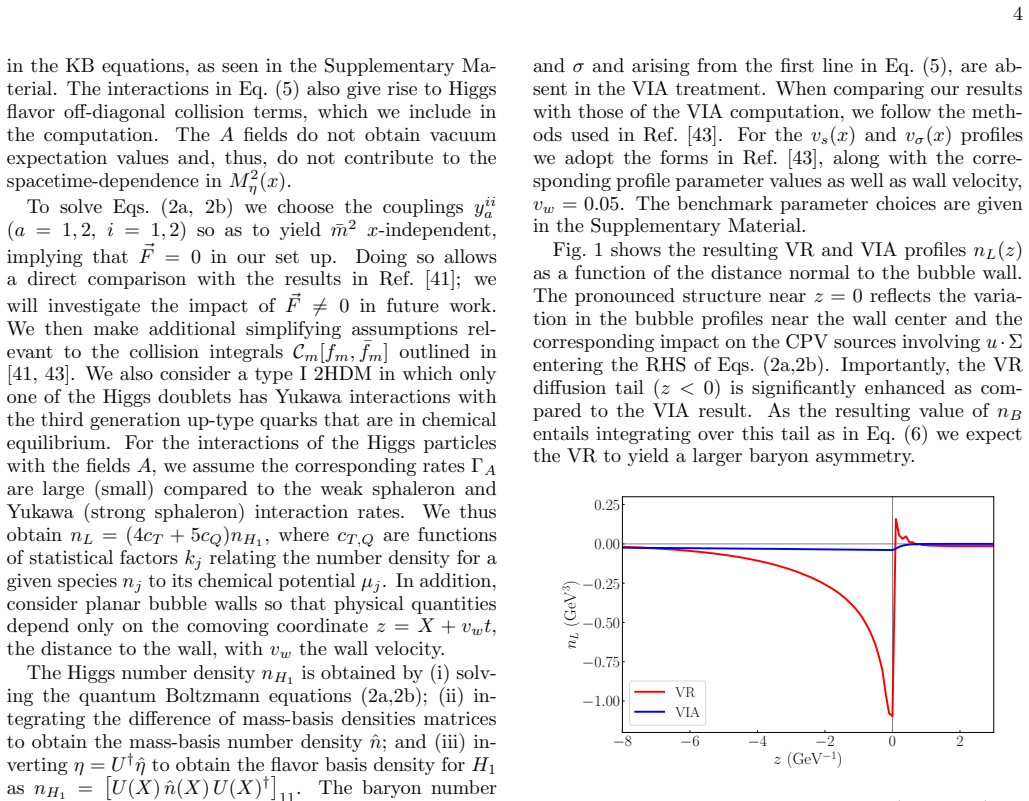
We solve the Kadanoff-Baym transport equations using the vev resummation (VR) framework... CPV sources first arise at second order in gradients... commutators [u·Σ,fm] encode the CP-violating sources... linear in the spacetime gradients
-
IndisputableMonolith/Foundation/RealityFromDistinction.leanreality_from_one_distinction unclear?
unclearRelation between the paper passage and the cited Recognition theorem.
The resulting BAU predictions... nB = −3 Γws/vw ∫ dz nL(z) exp(...)
What do these tags mean?
- matches
- The paper's claim is directly supported by a theorem in the formal canon.
- supports
- The theorem supports part of the paper's argument, but the paper may add assumptions or extra steps.
- extends
- The paper goes beyond the formal theorem; the theorem is a base layer rather than the whole result.
- uses
- The paper appears to rely on the theorem as machinery.
- contradicts
- The paper's claim conflicts with a theorem or certificate in the canon.
- unclear
- Pith found a possible connection, but the passage is too broad, indirect, or ambiguous to say the theorem truly supports the claim.
Forward citations
Cited by 1 Pith paper
-
Lepton sourced baryon asymmetry in the fourth generation model
A fourth-generation model is claimed to yield the observed baryon asymmetry η_B ≈ 10^-10, but the derivation sets the matching scale equal to the t' quark mass while also adopting a value about nine times smaller.
Reference graph
Works this paper leans on
-
[1]
A combination of these CPV phases and the (S,Σ) vevs induce theM 2 i (x) as well as theα(x) in Eq
andδ Σ = arg(a ∗ 2v1v∗ 2). A combination of these CPV phases and the (S,Σ) vevs induce theM 2 i (x) as well as theα(x) in Eq. (9) and, thus, the CPV sources 4 in the KB equations, as seen in the Supplementary Ma- terial. The interactions in Eq. (5) also give rise to Higgs flavor off-diagonal collision terms, which we include in the computation. TheAfields...
-
[2]
The baryon number density is then given by nB =−3 Γws vw Z 0 −∞ dz nL(z) exp 15 4 Γws vw z ,(6) where we have integrated over the region of unbroken EW symmetry in which Γ ws is unsuppressed. To obtain a numerical solution to Eqs. (2a,2b), which comprise a system of eight coupled integro-differential equations (thef m and ¯fm are 2×2 matrices in the mass ...
work page 2018
-
[3]
V. A. Kuzmin, V. A. Rubakov, and M. E. Shaposhnikov, Phys. Lett. B155, 36 (1985)
work page 1985
-
[4]
M. E. Shaposhnikov, Nucl. Phys. B299, 797 (1988)
work page 1988
-
[5]
M. E. Shaposhnikov, Nucl. Phys. B287, 757 (1987)
work page 1987
-
[6]
M. Trodden, Rev. Mod. Phys.71, 1463 (1999), arXiv:hep-ph/9803479
work page internal anchor Pith review Pith/arXiv arXiv 1999
-
[7]
J. M. Cline (2006) arXiv:hep-ph/0609145
work page internal anchor Pith review Pith/arXiv arXiv 2006
-
[8]
D. E. Morrissey and M. J. Ramsey-Musolf, New J. Phys. 14, 125003 (2012), arXiv:1206.2942 [hep-ph]
work page internal anchor Pith review Pith/arXiv arXiv 2012
-
[9]
A. D. Sakharov, Pisma Zh. Eksp. Teor. Fiz.5, 32 (1967)
work page 1967
-
[10]
A. I. Bochkarev and M. E. Shaposhnikov, Mod. Phys. Lett. A2, 417 (1987)
work page 1987
-
[11]
K. Kajantie, M. Laine, K. Rummukainen, and M. E. Shaposhnikov, Nucl. Phys. B466, 189 (1996), arXiv:hep- lat/9510020
-
[12]
Lattice study of an electroweak phase transition at m_h ~ 126 GeV
M. Laine, G. Nardini, and K. Rummukainen, JCAP01, 011 (2013), arXiv:1211.7344 [hep-ph]
work page internal anchor Pith review Pith/arXiv arXiv 2013
-
[13]
M. B. Gavela, P. Hern´ andez, J. Orloff, and O. P` ene, Mod. Phys. Lett. A9, 795 (1994), arXiv:hep-ph/9312215
work page internal anchor Pith review Pith/arXiv arXiv 1994
-
[14]
Electroweak Baryogenesis and Standard Model CP Violation
P. Huet and E. Sather, Phys. Rev. D51, 379 (1995), arXiv:hep-ph/9404302
work page internal anchor Pith review Pith/arXiv arXiv 1995
- [15]
- [16]
-
[17]
C. Caprini et al., JCAP04, 001 (2016), arXiv:1512.06239 [astro-ph.CO]
work page internal anchor Pith review Pith/arXiv arXiv 2016
-
[18]
Detecting gravitational waves from cosmological phase transitions with LISA: an update
C. Caprini et al., JCAP03, 024 (2020), arXiv:1910.13125 [astro-ph.CO]
work page internal anchor Pith review arXiv 2020
-
[19]
Beyond LISA: Exploring Future Gravitational Wave Missions
J. Crowder and N. J. Cornish, Phys. Rev. D72, 083005 (2005), arXiv:gr-qc/0506015
work page internal anchor Pith review Pith/arXiv arXiv 2005
-
[20]
Electric Dipole Moments: A Global Analysis
T. Chupp and M. Ramsey-Musolf, Phys. Rev. C91, 035502 (2015), arXiv:1407.1064 [hep-ph]
work page internal anchor Pith review Pith/arXiv arXiv 2015
-
[21]
Electric Dipole Moments of Nucleons, Nuclei, and Atoms: The Standard Model and Beyond
J. Engel, M. J. Ramsey-Musolf, and U. van Kolck, Prog. Part. Nucl. Phys.71, 21 (2013), arXiv:1303.2371 [nucl- th]
work page internal anchor Pith review Pith/arXiv arXiv 2013
-
[22]
Electric dipole moments as probes of new physics
M. Pospelov and A. Ritz, Annals Phys.318, 119 (2005), arXiv:hep-ph/0504231
work page internal anchor Pith review Pith/arXiv arXiv 2005
-
[23]
J. M. Cline, M. Joyce, and K. Kainulainen, Phys. Lett. B417, 79 (1998), [Erratum: Phys.Lett.B 448, 321–321 (1999)], arXiv:hep-ph/9708393
work page internal anchor Pith review Pith/arXiv arXiv 1998
-
[24]
Quantum Transport and Electroweak Baryogenesis
T. Konstandin, Phys. Usp.56, 747 (2013), arXiv:1302.6713 [hep-ph]
work page internal anchor Pith review Pith/arXiv arXiv 2013
-
[25]
B. Garbrecht, Prog. Part. Nucl. Phys.110, 103727 (2020), arXiv:1812.02651 [hep-ph]
- [26]
-
[27]
Electroweak baryogenesis in the CP-violating two-Higgs doublet model,
P. Basler, L. Biermann, M. M¨ uhlleitner, and J. M¨ uller, Eur. Phys. J. C83, 57 (2023), arXiv:2108.03580 [hep-ph]
-
[28]
K. Kainulainen, JCAP11, 042 (2021), arXiv:2108.08336 [hep-ph]
- [29]
- [30]
-
[31]
Electroweak Baryogenesis From Dark CP Violation
M. Carena, M. Quir´ os, and Y. Zhang, Phys. Rev. Lett. 122, 201802 (2019), arXiv:1811.09719 [hep-ph]
work page internal anchor Pith review Pith/arXiv arXiv 2019
- [32]
-
[33]
Anatomy of the electroweak phase transition for dark sector induced baryogenesis,
M. Carena, Y.-Y. Li, T. Ou, and Y. Wang, JHEP02, 139 (2023), arXiv:2210.14352 [hep-ph]
-
[34]
K. Enomoto, S. Kanemura, and Y. Mura, JHEP01, 104 (2022), arXiv:2111.13079 [hep-ph]
- [35]
- [36]
-
[37]
C. Lee, V. Cirigliano, and M. J. Ramsey-Musolf, Phys. Rev. D71, 075010 (2005), arXiv:hep-ph/0412354
work page internal anchor Pith review Pith/arXiv arXiv 2005
-
[38]
V. Cirigliano, M. J. Ramsey-Musolf, S. Tulin, and C. Lee, Phys. Rev. D73, 115009 (2006), arXiv:hep- ph/0603058
-
[39]
M. Postma and J. van de Vis, JHEP02, 090 (2020), arXiv:1910.11794 [hep-ph]
- [40]
- [41]
-
[42]
Flavored Quantum Boltzmann Equations
V. Cirigliano, C. Lee, M. J. Ramsey-Musolf, and S. Tulin, Phys. Rev. D81, 103503 (2010), arXiv:0912.3523 [hep-ph]
work page internal anchor Pith review Pith/arXiv arXiv 2010
-
[43]
Resonant Flavor Oscillations in Electroweak Baryogenesis
V. Cirigliano, C. Lee, and S. Tulin, Phys. Rev. D84, 056006 (2011), arXiv:1106.0747 [hep-ph]
work page internal anchor Pith review Pith/arXiv arXiv 2011
-
[44]
H. H. Patel and M. J. Ramsey-Musolf, Phys. Rev. D88, 035013 (2013), arXiv:1212.5652 [hep-ph]
work page internal anchor Pith review Pith/arXiv arXiv 2013
-
[45]
Two-Step Electroweak Baryogenesis
S. Inoue, G. Ovanesyan, and M. J. Ramsey-Musolf, Phys. Rev. D93, 015013 (2016), arXiv:1508.05404 [hep- ph]
work page internal anchor Pith review Pith/arXiv arXiv 2016
-
[46]
J. S. Schwinger, J. Math. Phys.2, 407 (1961)
work page 1961
-
[47]
K. T. Mahanthappa, Phys. Rev.126, 329 (1962)
work page 1962
-
[48]
P. M. Bakshi and K. T. Mahanthappa, J. Math. Phys.4, 1 (1963)
work page 1963
-
[49]
P. M. Bakshi and K. T. Mahanthappa, J. Math. Phys.4, 12 (1963)
work page 1963
-
[50]
L. V. Keldysh, Zh. Eksp. Teor. Fiz.47, 1515 (1964)
work page 1964
- [51]
- [52]
- [53]
-
[54]
J. R. Espinosa, T. Konstandin, J. M. No, and G. Servant, JCAP06, 028 (2010), arXiv:1004.4187 [hep-ph]
work page internal anchor Pith review Pith/arXiv arXiv 2010
-
[55]
Electroweak Bubble Wall Speed Limit
D. Bodeker and G. D. Moore, JCAP05, 025 (2017), arXiv:1703.08215 [hep-ph]
work page internal anchor Pith review Pith/arXiv arXiv 2017
- [56]
-
[57]
Bubble wall dynamics at the 8 electroweak phase transition,
S. De Curtis, L. D. Rose, A. Guiggiani, A. G. Muyor, and G. Panico, JHEP03, 163 (2022), arXiv:2201.08220 [hep-ph]
-
[58]
First principles determination of bubble wall velocity,
B. Laurent and J. M. Cline, Phys. Rev. D106, 023501 (2022), arXiv:2204.13120 [hep-ph]
-
[59]
P. Bandyopadhyay, C. Coriano, and A. Costantini, JHEP12, 127 (2015), arXiv:1510.06309 [hep-ph]
work page internal anchor Pith review Pith/arXiv arXiv 2015
-
[60]
P. Bandyopadhyay, C. Coriano, and A. Costantini, JHEP09, 045 (2015), arXiv:1506.03634 [hep-ph]
work page internal anchor Pith review Pith/arXiv arXiv 2015
-
[61]
H. H. Patel and M. J. Ramsey-Musolf, JHEP07, 029 7 (2011), arXiv:1101.4665 [hep-ph]
work page internal anchor Pith review Pith/arXiv arXiv 2011
-
[62]
L. Niemi, M. J. Ramsey-Musolf, T. V. I. Tenkanen, and D. J. Weir, Phys. Rev. Lett.126, 171802 (2021), arXiv:2005.11332 [hep-ph]
-
[63]
J. F. Gunion and H. E. Haber, Phys. Rev. D67, 075019 (2003), arXiv:hep-ph/0207010
work page internal anchor Pith review Pith/arXiv arXiv 2003
-
[64]
G. C. Branco, P. M. Ferreira, L. Lavoura, M. N. Rebelo, M. Sher, and J. P. Silva, Phys. Rept.516, 1 (2012), arXiv:1106.0034 [hep-ph]
work page internal anchor Pith review Pith/arXiv arXiv 2012
-
[65]
CPV Phenomenology of Flavor Conserving Two Higgs Doublet Models
S. Inoue, M. J. Ramsey-Musolf, and Y. Zhang, Phys. Rev. D89, 115023 (2014), arXiv:1403.4257 [hep-ph]
work page internal anchor Pith review Pith/arXiv arXiv 2014
-
[66]
W. H. Press, S. A. Teukolsky, W. T. Vetterling, and B. P. Flannery, (1992)
work page 1992
-
[67]
Electric dipole moments and the search for new physics
R. Alarcon et al., in Snowmass 2021 (2022) arXiv:2203.08103 [hep-ph]
-
[68]
V. Andreev et al. (ACME), Nature562, 355 (2018). 8 Supplemental Material for Does the Electron EDM Preclude Electroweak Baryogenesis ? Yuan-Zhen Li, Jiang-Hao Yu, Michael J. Ramsey-Musolf In this Supplemental Material, we provide some relevant details of our work, including the form of the mass matrix with the contributions from the vevs and thermal mass ...
work page 2018
-
[69]
andy S, yΣ, yA are the corresponding coupling matrices. Whiley A is diagonal,y S andy Σ contain off-diagonal elements given by the couplingsa 1 anda 2, respectively. During the first step of EWSB the mass-squared matrix for the doublet fields,M 2 η , depends on the spacetime variation of theSand Σ vevs,v s andv σ, respectively, and the couplings in Eq. (7...
-
[70]
log 1 +n B(t−) 1 +n B(t+) (26) (Rϕ)scat,out abcd (k,k ′) = T(1 +n B(t0)) 64πt ωab k ωcd k′ θ(t2 −t 2
-
[71]
log 1 +n B(t−) 1 +n B(t+) (27) and the annihilation kernels are Rann,in abcd (k,k ′) = T n B(s0) 128πs ωab k ωcd k′ θ(s2 0 −s 2 −4m 2 A) log nB(s−)nB(−s−) nB(s+)nB(−s+) (28) Rann,out abcd (k,k ′) = T(1 +n B(s0)) 128πs ωab k ωcd k′ θ(s2 0 −s 2 −4m 2 A) log nB(s−)nB(−s−) nB(s+)nB(−s+) (29) where t≡ |k−k ′|, t 0 ≡ω ab k −ω cd k′ , t ± ≡ ± t0 2 + t 2 q 1 + 4m...
discussion (0)
Sign in with ORCID, Apple, or X to comment. Anyone can read and Pith papers without signing in.