Establishing Compactness as a Population Observable in Gravitational-Wave Astronomy
Pith reviewed 2026-07-01 04:19 UTC · model grok-4.3
The pith
Gravitational wave signals from all high-significance events match black hole compactness.
A machine-rendered reading of the paper's core claim, the machinery that carries it, and where it could break.
Core claim
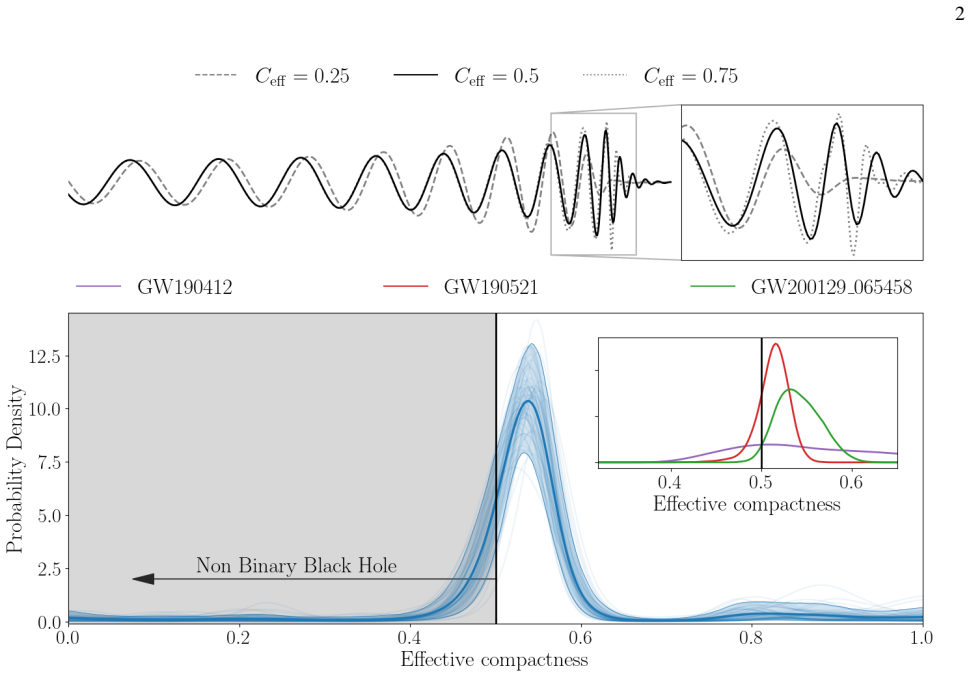
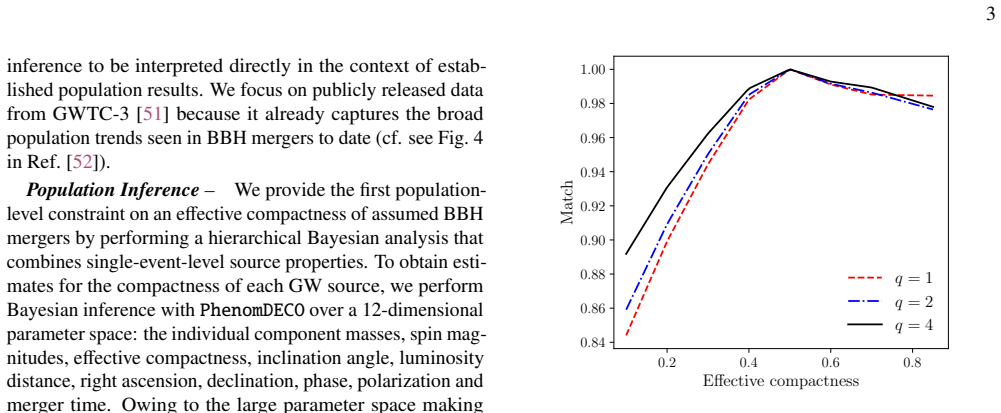
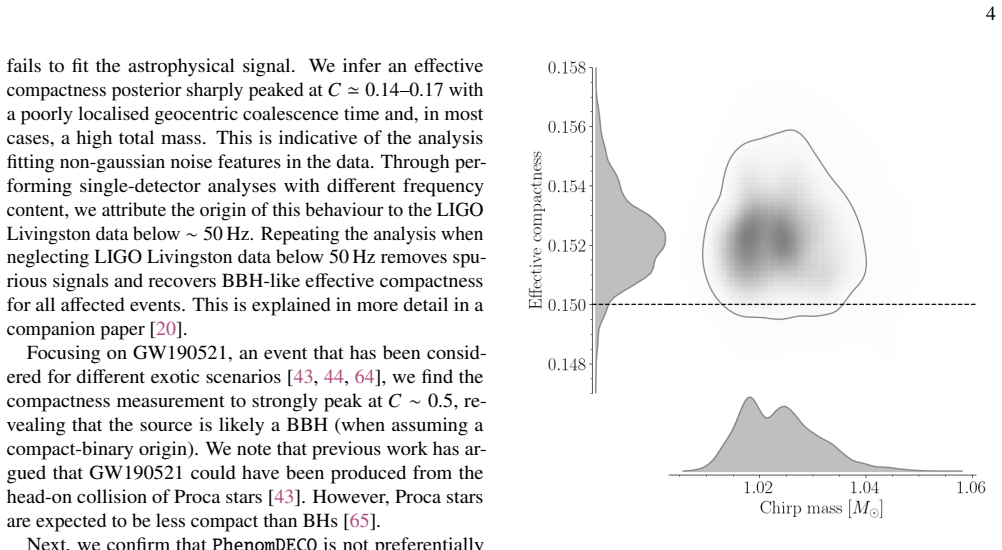
We introduce an effective compactness parameter C_eff that probes the closest approach in binary systems from their gravitational wave signals. A hierarchical analysis of high-significance signals in GWTC-3 yields C_eff = 0.5^{+0.3}_{-0.1}, consistent with the black hole value, while limiting the rate of low-compactness exotic binaries to less than 0.7 Gpc^{-3} yr^{-1}. This work shows that compactness can be established as a population observable in gravitational wave astronomy.
What carries the argument
The effective compactness parameter C_eff extracted from gravitational wave signals to reflect the binary's closest approach distance.
If this is right
- All high-significance gravitational wave events in GWTC-3 are consistent with black hole mergers.
- The merger rate of low-compactness exotic binaries is constrained to less than 0.7 Gpc^{-3} yr^{-1}.
- Compactness becomes a measurable population property rather than a fixed assumption in gravitational wave studies.
- Future gravitational wave catalogs can provide tighter constraints on the presence of exotic compact objects.
Where Pith is reading between the lines
- This approach could allow distinguishing black holes from other compact objects in larger datasets without prior assumptions on their nature.
- Extending the method to lower significance events or future detectors might reveal new populations of objects.
- The rate limit could inform models of compact object formation if exotic objects are predicted in certain scenarios.
Load-bearing premise
The extracted effective compactness accurately represents the closest approach distance and the population model accounts for all relevant selection effects without bias.
What would settle it
A single high-significance gravitational wave event with an inferred effective compactness clearly inconsistent with 0.5 would challenge the consistency claim.
Figures
read the original abstract
Classically, black holes (BHs) are the most compact objects predicted in nature with C=0.5 in the Schwarzschild limit; C is defined as the mass-to-radius ratio in geometric units. In this work we perform a novel measurement on the nature of putative BH mergers in the gravitational wave (GW) data by directly probing the binary's closest approach through an effective compactness parameter. We confidently show all such high-significance signals in GWTC-3 are consistent with the BH hypothesis for the first time. Our hierarchical analysis yields $C_{\rm eff} = 0.5^{+0.3}_{-0.1}$, and we further limit the merger rate of low-compactness exotic binaries to $< 0.7\,{\rm Gpc}^{-3}\,{\rm yr}^{-1}$. This work establishes compactness as a key observable in GW astronomy.
Editorial analysis
A structured set of objections, weighed in public.
Referee Report
Summary. The manuscript introduces an effective compactness parameter C_eff to probe the closest approach distance in binary mergers observed in GWTC-3 gravitational-wave data. A hierarchical population analysis is used to infer C_eff = 0.5^{+0.3}_{-0.1}, which is reported as consistent with the Schwarzschild black-hole value, while placing an upper limit of <0.7 Gpc^{-3} yr^{-1} on the merger rate of low-compactness exotic binaries. The work positions compactness as a new population-level observable in gravitational-wave astronomy.
Significance. If the hierarchical inference and selection-effect modeling are robust and free of bias, the result would provide a direct, data-driven test of the black-hole hypothesis at the population level and a new constraint on exotic compact-object scenarios, extending beyond existing mass and spin population studies.
major comments (2)
- [Abstract] Abstract: the central claim that all high-significance GWTC-3 signals are 'consistent with the BH hypothesis for the first time' rests on the posterior for C_eff; however, the quoted uncertainties (+0.3/-0.1) are broad enough that the measurement does not tightly exclude values away from 0.5, and no independent cross-check (e.g., injection recovery or external prior) is described to confirm that the hierarchical model recovers the input C_eff without bias from waveform assumptions or selection effects.
- [Abstract] The definition and extraction of C_eff from individual events is not provided; without an explicit mapping from the GW signal (e.g., via a specific equation relating closest approach to the waveform) it is impossible to verify that C_eff accurately reflects the binary's closest approach distance as asserted in the weakest assumption.
minor comments (1)
- [Abstract] The abstract states a numerical result and rate limit but supplies no information on the number of events used, the waveform family, the form of the hierarchical likelihood, or how selection effects are incorporated; these details are required for reproducibility.
Simulated Author's Rebuttal
We thank the referee for their review and comments. We respond point-by-point below, focusing on the major comments.
read point-by-point responses
-
Referee: [Abstract] Abstract: the central claim that all high-significance GWTC-3 signals are 'consistent with the BH hypothesis for the first time' rests on the posterior for C_eff; however, the quoted uncertainties (+0.3/-0.1) are broad enough that the measurement does not tightly exclude values away from 0.5, and no independent cross-check (e.g., injection recovery or external prior) is described to confirm that the hierarchical model recovers the input C_eff without bias from waveform assumptions or selection effects.
Authors: The quoted uncertainties are indeed broad, as expected for this new population observable with the current catalog size; the posterior mode at 0.5 supports consistency with the black-hole value rather than a tight exclusion of other values. The phrase 'for the first time' refers to the first direct population-level compactness measurement. The manuscript contains basic consistency checks on the hierarchical model, but we acknowledge the value of explicit validation and will add a dedicated subsection on injection-recovery tests to confirm unbiased recovery of C_eff under waveform and selection effects. revision: partial
-
Referee: [Abstract] The definition and extraction of C_eff from individual events is not provided; without an explicit mapping from the GW signal (e.g., via a specific equation relating closest approach to the waveform) it is impossible to verify that C_eff accurately reflects the binary's closest approach distance as asserted in the weakest assumption.
Authors: The definition of C_eff and its extraction from individual-event posteriors (via reweighting to the closest-approach parameter) are provided in Section II of the full manuscript, including the explicit relation to the waveform. The abstract serves as a summary and does not repeat these details. We will revise the abstract to include a one-sentence definition and reference to the relevant section for improved clarity. revision: yes
Circularity Check
No significant circularity identified
full rationale
The paper reports a hierarchical Bayesian analysis applied to GWTC-3 events that extracts a posterior on the effective compactness parameter C_eff directly from the gravitational-wave data. The central result is therefore a data-driven measurement whose numerical value is not forced by any self-referential definition, prior self-citation, or renaming of an input quantity. No equations or steps are exhibited in the provided text that reduce the reported C_eff posterior or rate limit to the analysis inputs by algebraic construction. The derivation chain remains self-contained against external benchmarks.
Axiom & Free-Parameter Ledger
free parameters (1)
- C_eff =
0.5^{+0.3}_{-0.1}
axioms (1)
- domain assumption GWTC-3 events are produced by binary compact-object mergers whose waveforms allow extraction of closest-approach information
Reference graph
Works this paper leans on
-
[1]
J. R. Oppenheimer and H. Snyder, On continued gravitational contraction, Phys. Rev.56, 455 (1939)
1939
-
[2]
D. J. Kaup, Klein-gordon geon, Phys. Rev.172, 1331 (1968). 7
1968
-
[3]
Ruffini and S
R. Ruffini and S. Bonazzola, Systems of self-gravitating par- ticles in general relativity and the concept of an equation of state, Phys. Rev.187, 1767 (1969)
1969
-
[4]
M. S. Morris and K. S. Thorne, Wormholes in spacetime and their use for interstellar travel: A tool for teaching general relativity, Am. J. Phys.56, 395 (1988)
1988
-
[5]
S. D. Mathur, The fuzzball proposal for black holes: An ele- mentary review, Fortschr. Phys.53, 793 (2005)
2005
-
[6]
P. O. Mazur and E. Mottola, Gravitational vacuum condensate stars, Proc. Natl. Acad. Sci. U.S.A.101, 9545 (2004)
2004
-
[7]
R. Narayan, Black holes in astrophysics, New J. Phys.7, 199 (2005), arXiv:gr-qc/0506078
work page internal anchor Pith review Pith/arXiv arXiv 2005
-
[8]
Monitoring stellar orbits around the Massive Black Hole in the Galactic Center
S. Gillessen, F. Eisenhauer, S. Trippe, T. Alexander, R. Genzel, F. Martins, and T. Ott, Monitoring stellar orbits around the Massive Black Hole in the Galactic Center, Astrophys. J.692, 1075 (2009), arXiv:0810.4674 [astro-ph]
work page internal anchor Pith review Pith/arXiv arXiv 2009
-
[9]
R. Abuteret al.(GRA VITY), Detection of the Schwarzschild precession in the orbit of the star S2 near the Galactic cen- tre massive black hole, Astron. Astrophys.636, L5 (2020), arXiv:2004.07187 [astro-ph.GA]
-
[10]
First M87 Event Horizon Telescope Results. VI. The Shadow and Mass of the Central Black Hole
K. Akiyamaet al.(Event Horizon Telescope), First M87 Event Horizon Telescope Results. VI. The Shadow and Mass of the Central Black Hole, Astrophys. J. Lett.875, L6 (2019), arXiv:1906.11243 [astro-ph.GA]
work page internal anchor Pith review Pith/arXiv arXiv 2019
-
[11]
K. Akiyamaet al.(Event Horizon Telescope), First Sagittarius A* Event Horizon Telescope Results. I. The Shadow of the Supermassive Black Hole in the Center of the Milky Way, Astrophys. J. Lett.930, L12 (2022), arXiv:2311.08680 [astro- ph.HE]
work page internal anchor Pith review Pith/arXiv arXiv 2022
-
[12]
J. E. McClintock and R. A. Remillard, Black hole binaries, (2003), arXiv:astro-ph/0306213
work page internal anchor Pith review Pith/arXiv arXiv 2003
-
[13]
J. E. McClintock, R. Narayan, and G. B. Rybicki, On the lack of thermal emission from the quiescent black hole XTE J1118+480: Evidence for the event horizon, Astrophys. J.615, 402 (2004), arXiv:astro-ph/0403251
work page internal anchor Pith review Pith/arXiv arXiv 2004
-
[14]
GWTC-5.0: An Introduction to Version 5.0 of the Gravitational-Wave Transient Catalog
N. Abacet al.(LIGO Scientific, VIRGO, KAGRA), GWTC- 5.0: An Introduction to Version 5.0 of the Gravitational-Wave Transient Catalog, (2026), arXiv:2605.27223 [gr-qc]
work page internal anchor Pith review Pith/arXiv arXiv 2026
-
[15]
R. Abbottet al.(LIGO Scientific, Virgo), GW190412: Obser- vation of a Binary-Black-Hole Coalescence with Asymmetric Masses, Phys. Rev. D102, 043015 (2020), arXiv:2004.08342 [astro-ph.HE]
-
[16]
R. Abbottet al.(LIGO Scientific, Virgo), GW190521: A Binary Black Hole Merger with a Total Mass of 150M⊙, Phys. Rev. Lett.125, 101102 (2020), arXiv:2009.01075 [gr-qc]
-
[17]
R. Abbottet al.(LIGO Scientific, Virgo), Properties and As- trophysical Implications of the 150 M ⊙ Binary Black Hole Merger GW190521, Astrophys. J. Lett.900, L13 (2020), arXiv:2009.01190 [astro-ph.HE]
-
[18]
B. P. Abbottet al.(LIGO Scientific Collaboration, Virgo Col- laboration, and KAGRA Collaboration), Gwtc-3: Compact binary coalescences observed by ligo and virgo during the sec- ond part of the third observing run, Phys. Rev. X13, 041039 (2023)
2023
-
[19]
S. Ghosh and M. Hannam, Identification of exotic compact binaries with gravitational waves: A phenomenological ap- proach, Phys. Rev. D112, 104017 (2025), arXiv:2505.16380 [gr-qc]
-
[20]
Ghosh, C
S. Ghosh, C. Hoy, M. Hannam, and F. Ohme, Companion paper (2026), in preparation
2026
-
[21]
R. Abbottet al.(LIGO Scientific, Virgo), Tests of general relativity with binary black holes from the second LIGO-Virgo gravitational-wave transient catalog, Phys. Rev. D103, 122002 (2021), arXiv:2010.14529 [gr-qc]
work page internal anchor Pith review Pith/arXiv arXiv 2021
-
[22]
Tests of General Relativity with GWTC-3
R. Abbottet al.(LIGO Scientific, VIRGO, KAGRA), Tests of General Relativity with GWTC-3, Phys. Rev. D112, 084080 (2025), arXiv:2112.06861 [gr-qc]
work page internal anchor Pith review Pith/arXiv arXiv 2025
- [23]
-
[24]
N. Sennett, T. Hinderer, J. Steinhoff, A. Buonanno, and S. Os- sokine, Distinguishing Boson Stars from Black Holes and Neutron Stars from Tidal Interactions in Inspiraling Binary Systems, Phys. Rev. D96, 024002 (2017), arXiv:1704.08651 [gr-qc]
work page internal anchor Pith review Pith/arXiv arXiv 2017
-
[25]
N. V . Krishnendu, K. G. Arun, and C. K. Mishra, Testing the binary black hole nature of a compact binary coalescence, Phys. Rev. Lett.119, 091101 (2017), arXiv:1701.06318 [gr-qc]
work page internal anchor Pith review Pith/arXiv arXiv 2017
-
[26]
N. K. Johnson-McDaniel, A. Mukherjee, R. Kashyap, P. Ajith, W. Del Pozzo, and S. Vitale, Constraining black hole mimick- ers with gravitational wave observations, Phys. Rev. D102, 123010 (2020)
2020
- [27]
-
[28]
Head-on collisions of boson stars
C. Palenzuela, I. Olabarrieta, L. Lehner, and S. L. Liebling, Head-on collisions of boson stars, Phys. Rev. D75, 064005 (2007), arXiv:gr-qc/0612067
work page internal anchor Pith review Pith/arXiv arXiv 2007
-
[29]
Orbital Dynamics of Binary Boson Star Systems
C. Palenzuela, L. Lehner, and S. L. Liebling, Orbital Dynam- ics of Binary Boson Star Systems, Phys. Rev. D77, 044036 (2008), arXiv:0706.2435 [gr-qc]
work page internal anchor Pith review Pith/arXiv arXiv 2008
-
[30]
Full 3D Numerical Relativity Simulations of Neutron Star -- Boson Star Collisions with BAM
T. Dietrich, S. Ossokine, and K. Clough, Full 3D numer- ical relativity simulations of neutron star–boson star colli- sions with BAM, Class. Quant. Grav.36, 025002 (2019), arXiv:1807.06959 [gr-qc]
work page internal anchor Pith review Pith/arXiv arXiv 2019
-
[31]
Axion star collisions with black holes and neutron stars in full 3D numerical relativity
K. Clough, T. Dietrich, and J. C. Niemeyer, Axion star colli- sions with black holes and neutron stars in full 3D numerical relativity, Phys. Rev. D98, 083020 (2018), arXiv:1808.04668 [gr-qc]
work page internal anchor Pith review Pith/arXiv arXiv 2018
-
[32]
T. Evstafyeva, U. Sperhake, I. Romero-Shaw, and M. Agathos, Gravitational-wave data analysis with high-precision numer- ical relativity simulations of boson star mergers, (2024), arXiv:2406.02715 [gr-qc]
-
[33]
J. Aasiet al.(LIGO Scientific), Advanced LIGO, Class. Quant. Grav.32, 074001 (2015), arXiv:1411.4547 [gr-qc]
work page internal anchor Pith review Pith/arXiv arXiv 2015
-
[34]
A. Buikemaet al.(aLIGO), Sensitivity and performance of the Advanced LIGO detectors in the third observing run, Phys. Rev. D102, 062003 (2020), arXiv:2008.01301 [astro-ph.IM]
-
[35]
Tseet al., Quantum-Enhanced Advanced LIGO Detectors in the Era of Gravitational-Wave Astronomy, Phys
M. Tseet al., Quantum-Enhanced Advanced LIGO Detectors in the Era of Gravitational-Wave Astronomy, Phys. Rev. Lett. 123, 231107 (2019)
2019
-
[36]
Advanced Virgo: a 2nd generation interferometric gravitational wave detector
F. Acerneseet al.(VIRGO), Advanced Virgo: a second- generation interferometric gravitational wave detector, Class. Quant. Grav.32, 024001 (2015), arXiv:1408.3978 [gr-qc]
work page internal anchor Pith review Pith/arXiv arXiv 2015
-
[37]
Acerneseet al.(Virgo), Increasing the Astrophysical Reach of the Advanced Virgo Detector via the Application of Squeezed Vacuum States of Light, Phys
F. Acerneseet al.(Virgo), Increasing the Astrophysical Reach of the Advanced Virgo Detector via the Application of Squeezed Vacuum States of Light, Phys. Rev. Lett.123, 231108 (2019)
2019
-
[38]
F. Acerneseet al.(Virgo), Virgo detector characterization and data quality: results from the O3 run, Class. Quant. Grav.40, 185006 (2023), arXiv:2210.15633 [gr-qc]
-
[39]
K. Somiya (KAGRA), Detector configuration of KAGRA: The Japanese cryogenic gravitational-wave detector, Class. Quant. Grav.29, 124007 (2012), arXiv:1111.7185 [gr-qc]
-
[40]
Y . Aso, Y . Michimura, K. Somiya, M. Ando, O. Miyakawa, T. Sekiguchi, D. Tatsumi, and H. Yamamoto (The KAGRA Collaboration), Interferometer design of the kagra gravitational wave detector, Phys. Rev. D88, 043007 (2013)
2013
-
[41]
T. Akutsuet al.(KAGRA), Overview of KAGRA: Detector design and construction history, PTEP2021, 05A101 (2021), arXiv:2005.05574 [physics.ins-det]
- [42]
-
[43]
J. C. Bustillo, N. Sanchis-Gual, A. Torres-Forné, J. A. Font, A. Vajpeyi, R. Smith, C. Herdeiro, E. Radu, and S. H. W. Leong, Gw190521 as a merger of proca stars: A potential new vector boson of 8.7 ×10 −13 eV, Phys. Rev. Lett.126, 081101 (2021)
2021
-
[44]
Sakstein, D
J. Sakstein, D. Croon, S. D. McDermott, M. C. Straight, and E. J. Baxter, Beyond the standard model explanations of gw190521, Phys. Rev. Lett.125, 261105 (2020)
2020
-
[45]
T. Narikawa, N. Uchikata, and T. Tanaka, Gravitational-wave constraints on the GWTC-2 events by measuring the tidal de- formability and the spin-induced quadrupole moment, Phys. Rev. D104, 084056 (2021), [Erratum: Phys.Rev.D 111, 089903 (2025)], arXiv:2106.09193 [gr-qc]
- [46]
- [47]
- [48]
- [49]
-
[50]
S. Khan, S. Husa, M. Hannam, F. Ohme, M. Pürrer, X. Jiménez Forteza, and A. Bohé, Frequency-domain grav- itational waves from nonprecessing black-hole binaries. II. A phenomenological model for the advanced detector era, Phys. Rev. D93, 044007 (2016), arXiv:1508.07253 [gr-qc]
work page internal anchor Pith review Pith/arXiv arXiv 2016
-
[51]
Gravitational Wave Open Science Center, Gravitational- wave Transient Catalog (GWTC), https://gwosc.org/ eventapi/html/GWTC/
-
[52]
A. G. Abacet al.(LIGO Scientific, VIRGO, KAGRA), GWTC- 4.0: Population Properties of Merging Compact Binaries, (2025), arXiv:2508.18083 [astro-ph.HE]
work page internal anchor Pith review Pith/arXiv arXiv 2025
-
[53]
J. S. Speagle, dynesty: a dynamic nested sampling package for estimating Bayesian posteriors and evidences, Mon. Not. Roy. Astron. Soc.493, 3132 (2020), arXiv:1904.02180 [astro- ph.IM]
work page internal anchor Pith review Pith/arXiv arXiv 2020
-
[54]
Bilby: A user-friendly Bayesian inference library for gravitational-wave astronomy
G. Ashtonet al., BILBY: A user-friendly Bayesian inference library for gravitational-wave astronomy, Astrophys. J. Suppl. 241, 27 (2019), arXiv:1811.02042 [astro-ph.IM]
work page internal anchor Pith review Pith/arXiv arXiv 2019
-
[55]
I. M. Romero-Shawet al., Bayesian inference for compact bi- nary coalescences with bilby: validation and application to the first LIGO–Virgo gravitational-wave transient catalogue, Mon. Not. Roy. Astron. Soc.499, 3295 (2020), arXiv:2006.00714 [astro-ph.IM]
work page internal anchor Pith review Pith/arXiv arXiv 2020
- [56]
- [57]
-
[58]
J. Golomb and C. Talbot, Searching for structure in the binary black hole spin distribution, Phys. Rev. D108, 103009 (2023), arXiv:2210.12287 [astro-ph.HE]
-
[59]
B. J. Owen, Search templates for gravitational waves from inspiraling binaries: Choice of template spacing, Phys. Rev. D 53, 6749 (1996), arXiv:gr-qc/9511032
work page internal anchor Pith review Pith/arXiv arXiv 1996
-
[60]
LSC, LIGO Document T1800044-v5
-
[61]
M. Hannamet al., General-relativistic precession in a black- hole binary, Nature610, 652 (2022), arXiv:2112.11300 [gr- qc]
- [62]
-
[63]
Gravitational-wave astronomy requires population-informed parameter estimation
M. Mould, R. Tenorio, and D. Gerosa, Gravitational-wave astronomy requires population-informed parameter estimation, (2026), arXiv:2604.15885 [gr-qc]
work page internal anchor Pith review Pith/arXiv arXiv 2026
- [64]
-
[65]
Kerr black holes with Proca hair
C. Herdeiro, E. Radu, and H. Rúnarsson, Kerr black holes with Proca hair, Class. Quant. Grav.33, 154001 (2016), arXiv:1603.02687 [gr-qc]
work page internal anchor Pith review Pith/arXiv arXiv 2016
-
[66]
CoRe database of binary neutron star merger waveforms and its application in waveform development
T. Dietrich, D. Radice, S. Bernuzzi, F. Zappa, A. Perego, B. Brügmann, S. V . Chaurasia, R. Dudi, W. Tichy, and M. Uje- vic, CoRe database of binary neutron star merger waveforms, Class. Quant. Grav.35, 24LT01 (2018), arXiv:1806.01625 [gr-qc]
work page internal anchor Pith review Pith/arXiv arXiv 2018
-
[67]
K. Ackleyet al., Neutron Star Extreme Matter Observa- tory: A kilohertz-band gravitational-wave detector in the global network, Publ. Astron. Soc. Austral.37, e047 (2020), arXiv:2007.03128 [astro-ph.HE]
-
[68]
Relativistic Mean-Field Theory and the High-Density Nuclear Equation of State
H. Mueller and B. D. Serot, Relativistic mean field theory and the high density nuclear equation of state, Nucl. Phys. A606, 508 (1996), arXiv:nucl-th/9603037
work page internal anchor Pith review Pith/arXiv arXiv 1996
-
[69]
J. S. Read, B. D. Lackey, B. J. Owen, and J. L. Fried- man, Constraints on a phenomenologically parameterized neutron-star equation of state, Phys. Rev. D79, 124032 (2009), arXiv:0812.2163 [astro-ph]
work page internal anchor Pith review Pith/arXiv arXiv 2009
-
[70]
R. Dudi, F. Pannarale, T. Dietrich, M. Hannam, S. Bernuzzi, F. Ohme, and B. Brügmann, Relevance of tidal effects and post- merger dynamics for binary neutron star parameter estimation, Phys. Rev. D98, 084061 (2018), arXiv:1808.09749 [gr-qc]
work page internal anchor Pith review Pith/arXiv arXiv 2018
-
[71]
Extracting distribution parameters from multiple uncertain observations with selection biases
I. Mandel, W. M. Farr, and J. R. Gair, Extracting distribution parameters from multiple uncertain observations with selec- tion biases, Mon. Not. Roy. Astron. Soc.486, 1086 (2019), arXiv:1809.02063 [physics.data-an]
work page internal anchor Pith review Pith/arXiv arXiv 2019
-
[72]
B. P. Abbottet al.(LIGO Scientific, Virgo), The Rate of Binary Black Hole Mergers Inferred from Advanced LIGO Observa- tions Surrounding GW150914, Astrophys. J. Lett.833, L1 (2016), arXiv:1602.03842 [astro-ph.HE]
work page internal anchor Pith review Pith/arXiv arXiv 2016
-
[73]
J. Veitchet al., Parameter estimation for compact binaries with ground-based gravitational-wave observations using the LAL- Inference software library, Phys. Rev. D91, 042003 (2015), arXiv:1409.7215 [gr-qc]
work page internal anchor Pith review Pith/arXiv arXiv 2015
-
[74]
Metropolis and S
N. Metropolis and S. Ulam, The monte carlo method, Journal of the American statistical association44, 335 (1949)
1949
-
[75]
Skilling, Nested sampling, inAIP Conference Proceedings (AIP, 2004)
J. Skilling, Nested sampling, inAIP Conference Proceedings (AIP, 2004)
2004
-
[76]
Skilling, Nested sampling for general Bayesian computation, Bayesian Analysis1, 833 (2006)
J. Skilling, Nested sampling for general Bayesian computation, Bayesian Analysis1, 833 (2006)
2006
-
[77]
C. M. Biwer, C. D. Capano, S. De, M. Cabero, D. A. Brown, A. H. Nitz, and V . Raymond, PyCBC Inference: A Python- based parameter estimation toolkit for compact binary coa- lescence signals, Publ. Astron. Soc. Pac.131, 024503 (2019), arXiv:1807.10312 [astro-ph.IM]
work page internal anchor Pith review Pith/arXiv arXiv 2019
-
[78]
Rapid and accurate parameter inference for coalescing, precessing compact binaries
J. Lange, R. O’Shaughnessy, and M. Rizzo, Rapid and accu- rate parameter inference for coalescing, precessing compact binaries, (2018), arXiv:1805.10457 [gr-qc]
work page internal anchor Pith review Pith/arXiv arXiv 2018
- [79]
- [80]
discussion (0)
Sign in with ORCID, Apple, or X to comment. Anyone can read and Pith papers without signing in.