The Effect of Adiabatic Index on Radius Evolution and the Mass Loss
Pith reviewed 2026-06-27 02:40 UTC · model grok-4.3
The pith
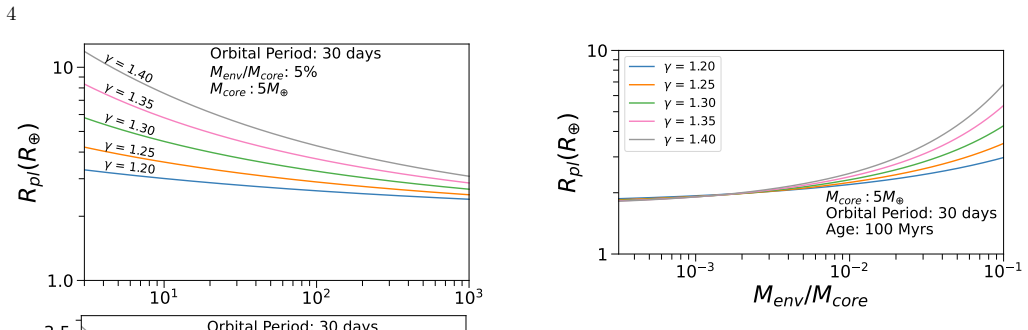
Assuming a high adiabatic index overestimates the impact of mass loss on young exoplanet radii.
A machine-rendered reading of the paper's core claim, the machinery that carries it, and where it could break.
Core claim
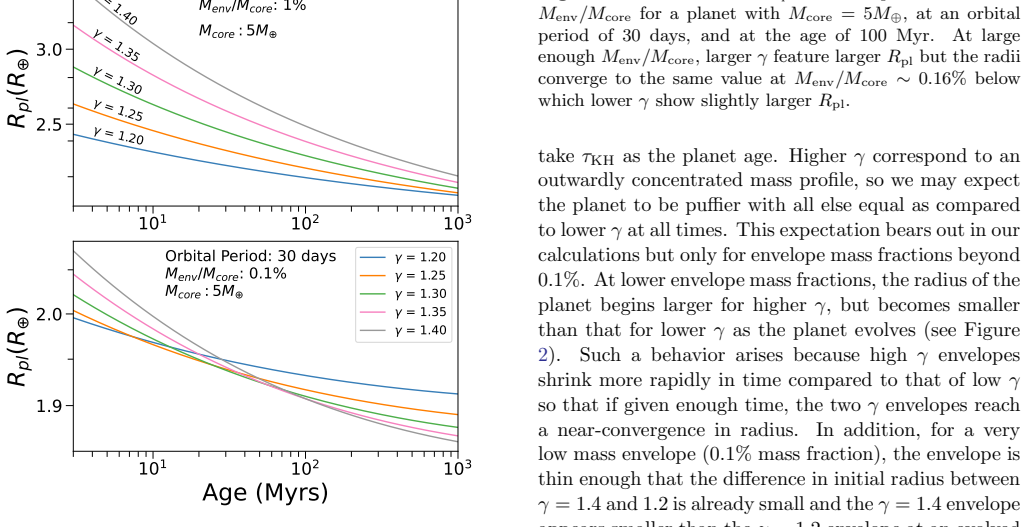
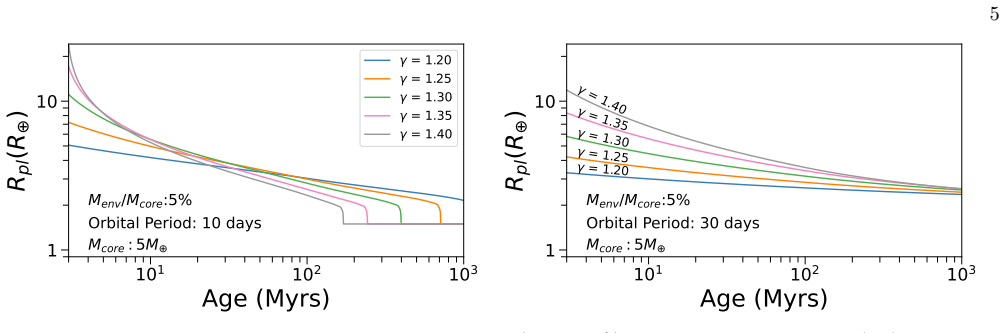
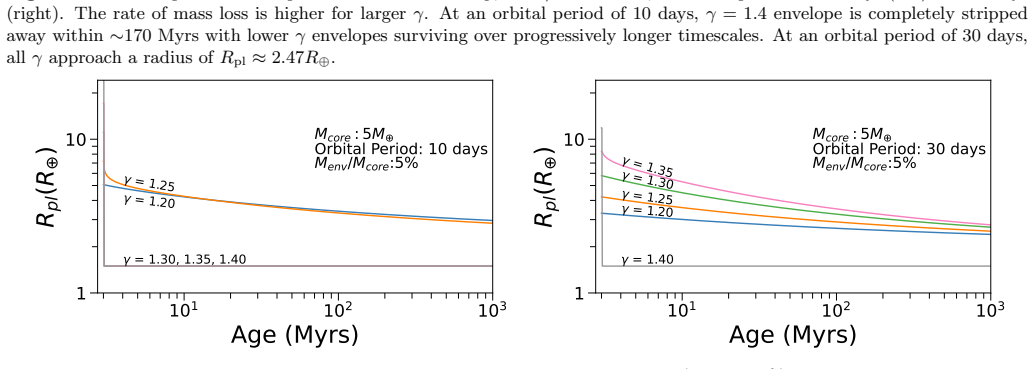
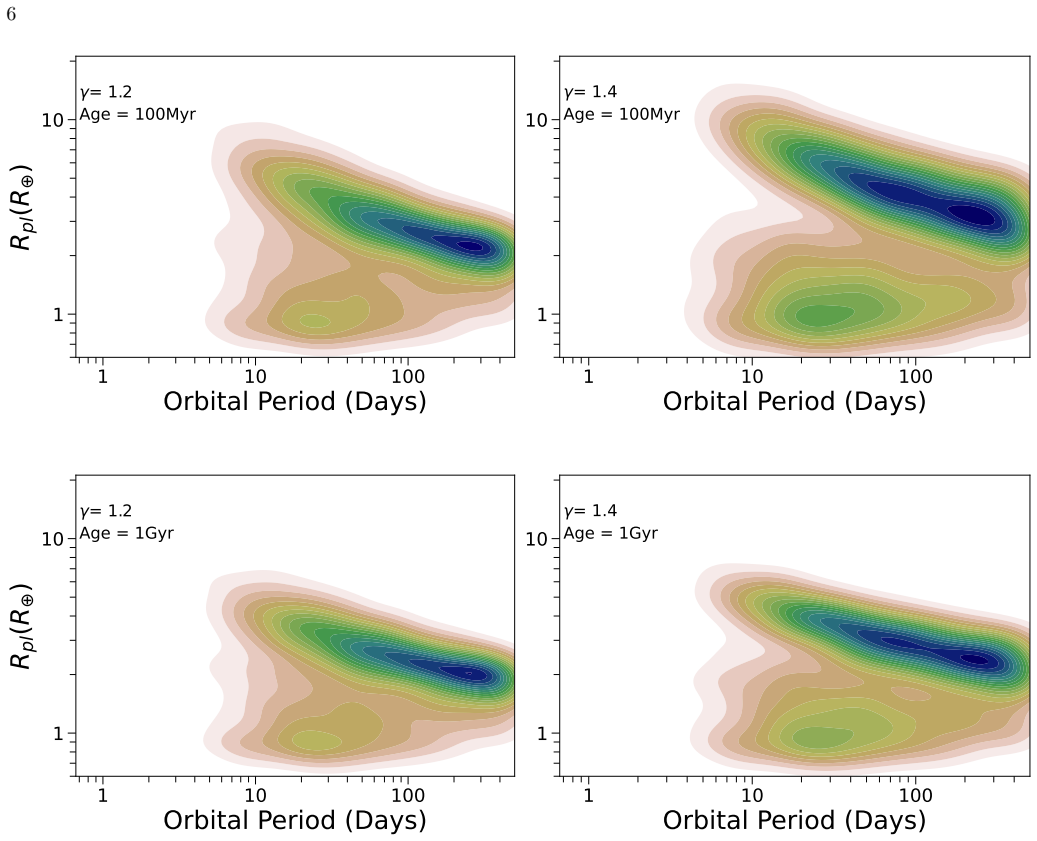
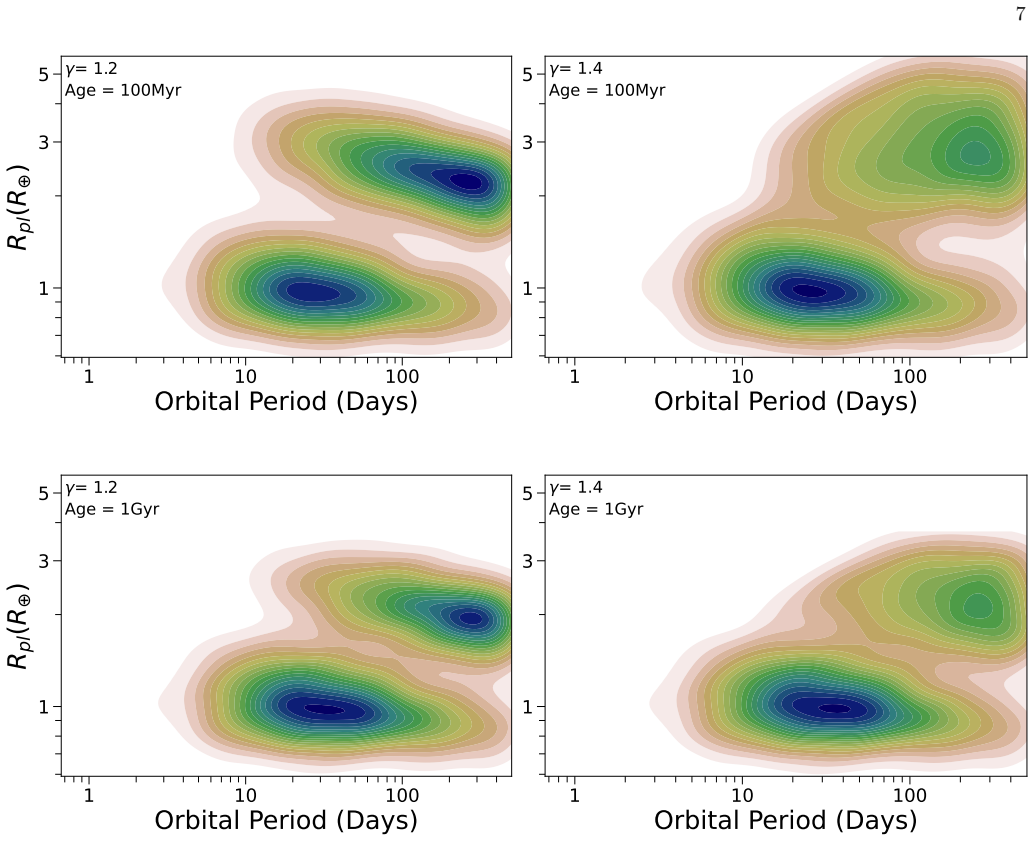
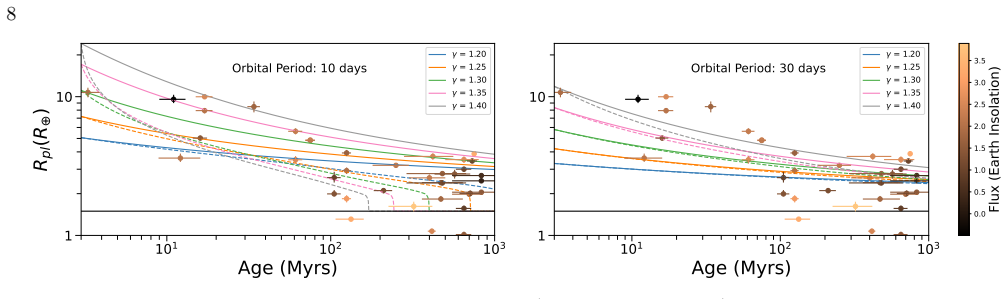
The central claim is that envelopes with larger adiabatic indices start puffier and undergo faster radius contraction with accelerated mass loss. Therefore, assuming gamma ~1.4 overestimates the effect of mass loss in shaping the exoplanetary population, especially when young planets are considered. This arises because the lower gamma of ~1.2 for young planets changes how interior mass is distributed.
What carries the argument
The adiabatic index gamma in the planetary interior structure equations, which controls mass distribution and thereby sets the pace of radius contraction and mass loss.
If this is right
- Envelopes with gamma equal to 1.4 begin with larger radii than those with gamma equal to 1.2 when all other parameters are held fixed.
- Higher gamma produces faster radius contraction over time.
- Mass loss proceeds at an accelerated rate when gamma is higher.
- The overestimation of mass loss's role grows larger for planets younger than roughly one gigayear.
- Evolutionary models must incorporate age-dependent initial thermal conditions to match measured radii accurately.
Where Pith is reading between the lines
- Current radius-valley interpretations that rely on high-gamma tracks may need revision once lower values are adopted for the first 100 million years.
- Radius measurements from young clusters could directly constrain the effective gamma by showing whether contraction is slower than high-gamma models predict.
- Coupling time-variable gamma with different equations of state might change the predicted timing of atmospheric escape in formation models.
- This effect could alter estimates of how long certain planets retain thick envelopes before photoevaporation dominates.
Load-bearing premise
The claim that young planets have an adiabatic index of approximately 1.2 that applies directly within the evolutionary structure equations.
What would settle it
Direct comparison of observed radii for planets in star clusters younger than 100 million years against model tracks run with gamma fixed at 1.2 versus 1.4.
Figures
read the original abstract
Models that track the size evolution of exoplanets often assume a prescribed initial thermal state or a single adiabatic index to describe the planetary interior structure, the latter of which is taken to be $\gamma \sim1.4$ which is likely appropriate for evolved planets ($\gtrsim$1 Gyr). Extrapolating this high $\gamma$ to earlier ages (down to $\sim$million years old) is problematic since, according to thermodynamics, the adiabatic index of young planets is $\sim$1.2, which is low enough to drastically change how interior mass is distributed. We quantify the effect of varying the adiabatic index from 1.2 to 1.4 on the expected radius of the exoplanet over time. We find that envelopes of larger adiabatic indices start puffier with all else equal and undergo faster radius contraction with accelerated mass loss. Assumption of high $\gamma$ can therefore overestimate the effect of mass loss in shaping the exoplanetary population, especially when young planets are considered. We highlight the need for a more careful consideration of the initial thermal condition of planets in evolutionary models to properly interpret the radii measurements of exoplanets.
Editorial analysis
A structured set of objections, weighed in public.
Referee Report
Summary. The manuscript examines the effect of the adiabatic index γ on exoplanet radius evolution and mass loss. It argues that γ ≈ 1.4 is appropriate only for evolved planets (≳1 Gyr) while young planets have γ ≈ 1.2 according to thermodynamics; envelopes with higher γ are initially puffier, contract faster, and lose mass more rapidly. Consequently, assuming high γ overestimates the imprint of mass loss on the young exoplanet population, and the work calls for more careful treatment of initial thermal conditions in evolutionary models.
Significance. If substantiated, the result would demonstrate that planetary radius tracks and inferred mass-loss efficiencies are sensitive to the choice of γ at early ages, with direct consequences for population-level interpretations of observed radii and the relative importance of photoevaporation versus other processes in young systems.
major comments (2)
- [Abstract] Abstract: The central claim that 'according to thermodynamics, the adiabatic index of young planets is ∼1.2' is stated without derivation, explicit calculation (e.g., from Cp/Cv including ionization or dissociation), reference to a specific equation of state, or mapping from the thermodynamic value to the polytropic/adiabatic assumption actually solved in the evolutionary code's hydrostatic structure equations. This mapping is load-bearing for the reported radius and mass-loss differences.
- [Abstract] Abstract: No methods, equations, code description, numerical setup, or error analysis are provided, so it is impossible to verify whether the claimed radius-contraction and mass-loss differences between γ = 1.2 and 1.4 are robust to choices of initial conditions, grid resolution, or data selection.
Simulated Author's Rebuttal
We thank the referee for their constructive comments, which highlight areas where the manuscript requires additional detail to support its claims. We agree that both the thermodynamic justification and the methods description are currently insufficient in the abstract and will revise the manuscript to address these issues directly.
read point-by-point responses
-
Referee: [Abstract] Abstract: The central claim that 'according to thermodynamics, the adiabatic index of young planets is ∼1.2' is stated without derivation, explicit calculation (e.g., from Cp/Cv including ionization or dissociation), reference to a specific equation of state, or mapping from the thermodynamic value to the polytropic/adiabatic assumption actually solved in the evolutionary code's hydrostatic structure equations. This mapping is load-bearing for the reported radius and mass-loss differences.
Authors: We acknowledge that the thermodynamic basis requires explicit support. In the revised manuscript we will add a dedicated paragraph deriving the effective adiabatic index from the ideal-gas relation γ = Cp/Cv, incorporating the reduction due to H2 dissociation and ionization in young, warm envelopes, citing a standard equation of state (e.g., Saumon-Chabrier or similar), and clarifying how this thermodynamic γ is adopted as the polytropic index in the hydrostatic structure solver. This addition will make the mapping transparent and substantiate the reported differences. revision: yes
-
Referee: [Abstract] Abstract: No methods, equations, code description, numerical setup, or error analysis are provided, so it is impossible to verify whether the claimed radius-contraction and mass-loss differences between γ = 1.2 and 1.4 are robust to choices of initial conditions, grid resolution, or data selection.
Authors: We agree the present concise format omits these elements. The revised manuscript will include a Methods section that specifies the evolutionary code, the form of the hydrostatic and energy equations solved, the adopted initial conditions (entropy, core mass, envelope mass), grid resolution and convergence criteria, and any sensitivity tests performed on initial conditions or numerical parameters. This will allow readers to assess robustness. revision: yes
Circularity Check
No significant circularity; central result is direct numerical comparison of fixed-γ models
full rationale
The paper asserts γ≈1.2 for young planets 'according to thermodynamics' and quantifies radius evolution by running models with γ varied from 1.2 to 1.4. No load-bearing step reduces the reported radius difference or mass-loss imprint to a fitted parameter, self-citation chain, or definitional equivalence (e.g., no prediction that is the input by construction). The derivation is therefore self-contained as a set of forward evolutionary calculations.
Axiom & Free-Parameter Ledger
free parameters (1)
- adiabatic index gamma
axioms (1)
- domain assumption Adiabatic index of young planets is approximately 1.2 according to thermodynamics
Reference graph
Works this paper leans on
-
[1]
Is the total mass density profile of the NFW form or even steeper?
Agol, E., Steffen, J., Sari, R., & Clarkson, W. 2005, MNRAS, 359, 567, doi: 10.1111/j.1365-2966.2005.08922.x Astropy Collaboration, Robitaille, T. P., Tollerud, E. J., et al. 2013, A&A, 558, A33, doi: 10.1051/0004-6361/201322068 Astropy Collaboration, Price-Whelan, A. M., Sip˝ ocz, B. M., et al. 2018, AJ, 156, 123, doi: 10.3847/1538-3881/aabc4f
-
[2]
2024, arXiv e-prints, arXiv:2403.03325, doi: 10.48550/arXiv.2403.03325
Benneke, B., Roy, P.-A., Coulombe, L.-P., et al. 2024, arXiv e-prints, arXiv:2403.03325, doi: 10.48550/arXiv.2403.03325
-
[3]
Dainese, S., & Albrecht, S. H. 2025, A&A, 695, A253, doi: 10.1051/0004-6361/202452904
-
[4]
Fulton, B. J., & Petigura, E. A. 2018, AJ, 156, 264, doi: 10.3847/1538-3881/aae828
-
[5]
Fulton, B. J., Petigura, E. A., Howard, A. W., et al. 2017, AJ, 154, 109, doi: 10.3847/1538-3881/aa80eb
-
[6]
Ginzburg, S., Schlichting, H. E., & Sari, R. 2018, MNRAS, 476, 759, doi: 10.1093/mnras/sty290
-
[7]
Gupta, A., & Schlichting, H. E. 2019, MNRAS, 487, 24, doi: 10.1093/mnras/stz1230
-
[8]
Gupta, A., & Schlichting, H. E. 2020, MNRAS, 493, 792, doi: 10.1093/mnras/staa315
-
[9]
Harris, C. R., Millman, K. J., van der Walt, S. J., et al. 2020, Nature, 585, 357, doi: 10.1038/s41586-020-2649-2
-
[10]
Holman, M. J., & Murray, N. W. 2005, Science, 307, 1288, doi: 10.1126/science.1107822
-
[11]
Hunter, J. D. 2007, Computing in Science & Engineering, 9, 90, doi: 10.1109/MCSE.2007.55
-
[12]
2012, ApJ, 753, 66, doi: 10.1088/0004-637X/753/1/66
Ikoma, M., & Hori, Y. 2012, ApJ, 753, 66, doi: 10.1088/0004-637X/753/1/66
-
[13]
Jackson, A. P., Davis, T. A., & Wheatley, P. J. 2012, Monthly Notices of the Royal Astronomical Society, 422, 2024, doi: 10.1111/j.1365-2966.2012.20657.x
-
[14]
Karalis, A., Lee, E. J., & Thorngren, D. P. 2025, ApJ, 978, 46, doi: 10.3847/1538-4357/ad946c
-
[15]
King, G. W., & Wheatley, P. J. 2021, Monthly Notices of the Royal Astronomical Society: Letters, 501, L28, doi: 10.1093/mnrasl/slaa186
-
[16]
Lee, E. J., & Chiang, E. 2015, ApJ, 811, 41, doi: 10.1088/0004-637X/811/1/41
-
[17]
Lee, E. J., & Chiang, E. 2016, ApJ, 817, 90, doi: 10.3847/0004-637X/817/2/90
-
[18]
Lee, E. J., Chiang, E., & Ferguson, J. W. 2018, MNRAS, 476, 2199, doi: 10.1093/mnras/sty389
-
[19]
Lee, E. J., Chiang, E., & Ormel, C. W. 2014, ApJ, 797, 95, doi: 10.1088/0004-637X/797/2/95
-
[20]
Lee, E. J., & Connors, N. J. 2021, ApJ, 908, 32, doi: 10.3847/1538-4357/abd6c7 10
-
[21]
J., Karalis, A., & Thorngren, D
Lee, E. J., Karalis, A., & Thorngren, D. P. 2022, ApJ, 941, 186, doi: 10.3847/1538-4357/ac9c66
-
[22]
Lopez, E. D., & Fortney, J. J. 2013, The Astrophysical Journal, 776, 2, doi: 10.1088/0004-637X/776/1/2
-
[23]
Lopez, E. D., & Fortney, J. J. 2014, ApJ, 792, 1, doi: 10.1088/0004-637X/792/1/1
-
[24]
Luque, R., & Pall´ e, E. 2022, Science, 377, 1211, doi: 10.1126/science.abl7164
-
[25]
Misener, W., Schulik, M., Schlichting, H. E., & Owen, J. E. 2026, arXiv e-prints, arXiv:2605.02766, doi: 10.48550/arXiv.2605.02766 NASA Exoplanet Archive. 2026, Planetary Systems, Version: 2026-05-28 11:28 NExScI-Caltech/IPAC, doi: 10.26133/NEA12
work page internal anchor Pith review Pith/arXiv arXiv doi:10.48550/arxiv.2605.02766 2026
-
[26]
Owen, J. E., & Schlichting, H. E. 2024, MNRAS, 528, 1615, doi: 10.1093/mnras/stad3972
-
[27]
Owen, J. E., & Wu, Y. 2013, ApJ, 775, 105, doi: 10.1088/0004-637X/775/2/105
work page internal anchor Pith review doi:10.1088/0004-637x/775/2/105 2013
-
[28]
Owen, J. E., & Wu, Y. 2016, ApJ, 817, 107, doi: 10.3847/0004-637X/817/2/107
-
[29]
Owen, J. E., & Wu, Y. 2017, ApJ, 847, 29, doi: 10.3847/1538-4357/aa890a pandas development team, T. 2020, pandas-dev/pandas: Pandas, latest Zenodo, doi: 10.5281/zenodo.3509134
-
[30]
Parc, L., Bouchy, F., Venturini, J., Dorn, C., & Helled, R. 2024, A&A, 688, A59, doi: 10.1051/0004-6361/202449911
-
[31]
Petigura, E. A., Marcy, G. W., Winn, J. N., et al. 2018, AJ, 155, 89, doi: 10.3847/1538-3881/aaa54c
-
[32]
2024, ApJL, 974, L10, doi: 10.3847/2041-8213/ad6f00
Piaulet-Ghorayeb, C., Benneke, B., Radica, M., et al. 2024, ApJL, 974, L10, doi: 10.3847/2041-8213/ad6f00
-
[33]
Ribas, I., Guinan, E. F., G¨ udel, M., & Audard, M. 2005, ApJ, 622, 680, doi: 10.1086/427977
-
[34]
Rogers, J. G. 2025, MNRAS, 539, 2230, doi: 10.1093/mnras/staf628
-
[35]
Rogers, J. G., Owen, J. E., & Schlichting, H. E. 2024, MNRAS, 529, 2716, doi: 10.1093/mnras/stae563
-
[36]
Rogers, L. A., & Seager, S. 2010, ApJ, 712, 974, doi: 10.1088/0004-637X/712/2/974
-
[37]
Savignac, V., & Lee, E. J. 2024, ApJ, 973, 85, doi: 10.3847/1538-4357/ad6317
-
[38]
Talens, G. J. J., Albrecht, S., Spronck, J. F. P., et al. 2017, A&A, 606, A73, doi: 10.1051/0004-6361/201731282
-
[39]
Tang, Y., Fortney, J. J., & Murray-Clay, R. 2024, ApJ, 976, 221, doi: 10.3847/1538-4357/ad8567
-
[40]
Valencia, D., O’Connell, R. J., & Sasselov, D. 2006, Icarus, 181, 545, doi: 10.1016/j.icarus.2005.11.021 Van Eylen, V., Agentoft, C., Lundkvist, M. S., et al. 2018, MNRAS, 479, 4786, doi: 10.1093/mnras/sty1783
-
[41]
Hints from formation and evolution models
Venturini, J., Guilera, O. M., Haldemann, J., Ronco, M. P., & Mordasini, C. 2020, A&A, 643, L1, doi: 10.1051/0004-6361/202039141
-
[42]
Virtanen, P., Gommers, R., Oliphant, T. E., et al. 2020, Nature Methods, 17, 261, doi: 10.1038/s41592-019-0686-2
-
[43]
Zeng, L., Jacobsen, S. B., Sasselov, D. D., et al. 2019, Proceedings of the National Academy of Science, 116, 9723, doi: 10.1073/pnas.1812905116
-
[44]
2021, ARA&A, 59, 291, doi: 10.1146/annurev-astro-112420-020055
Zhu, W., & Dong, S. 2021, ARA&A, 59, 291, doi: 10.1146/annurev-astro-112420-020055
discussion (0)
Sign in with ORCID, Apple, or X to comment. Anyone can read and Pith papers without signing in.