REVIEW 3 major objections 7 minor 72 references
Full four-quark interaction basis shifts QCD critical endpoint
Reviewed by Pith at T0; open to challenge. T0 means a machine referee read the full paper against a public rubric. the ladder, T0–T4 →
T0 review · glm-5.2
2026-07-09 13:14 UTC pith:LAT7XXHA
load-bearing objection Fierz-complete four-quark channels in fRG-QCD: useful systematic study, but CEP shift is confounded by simultaneous parameter retuning the 3 major comments →
Fierz-complete four-quark interactions and the QCD phase diagram
The pith
A machine-rendered reading of the paper's core claim, the machinery that carries it, and where it could break.
Core claim
The paper's core result is a quantitative accounting of how much the predicted QCD critical endpoint and phase boundary curvature change when the four-quark interaction sector is upgraded from one channel to the full Fierz-complete set of ten. The sigma and pion channels dominate everywhere except near the critical endpoint, where subleading channels (eta, a, vector, axial-vector, adjoint scalar-pseudoscalar) rise to about ten percent of the dominant couplings. The net effect moves the critical endpoint to slightly lower temperature and higher baryon chemical potential, and makes the phase boundary marginally more curved. The authors also find that distinguishing the sigma and pion Yukawacou
What carries the argument
The Fierz-complete four-quark basis of ten tensor channels for light quarks, evolved under the functional renormalization group flow with dynamical hadronization of the sigma and pion channels into meson exchanges. The flow equations couple the four-quark vertices to the quark-gluon vertex, Yukawa couplings, and meson propagators across all ten channels simultaneously. A phenomenological infrared enhancement function compensates for retaining only the classical tensor structure of the quark-gluon vertex.
Load-bearing premise
The calculation retains only the classical tensor structure of the quark-gluon vertex, compensating with a phenomenological infrared enhancement tuned to reproduce dynamical chiral symmetry breaking, and approximates the strange quark sector with a two-flavor potential rather than a full 2+1-flavor one. These approximations matter most precisely at the large baryon chemical potential where the CEP sits and where the paper claims the new four-quark channels become relevant.
What would settle it
If including non-classical quark-gluon vertex structures or a full 2+1-flavor strange quark potential shifts the CEP location by more than the ~5 MeV in T and ~12 MeV in mu_B reported here, then the Fierz-completeness correction documented in this paper is subdominant to other truncation effects and the quantitative CEP prediction remains provisional.
If this is right
- The result that subleading four-quark channels reach ~10% of the dominant ones near the CEP suggests that further truncation improvements — such as including non-classical quark-gluon vertex structures — could shift the CEP by comparable or larger amounts, since the CEP sits at mu_B/T ~ 6.3 where the authors acknowledge truncation errors grow substantially.
- The phase boundary curvature kappa_2 = 0.0151 can be directly compared to lattice QCD extrapolations and to chemical freeze-out data from heavy-ion collisions, providing a consistency check on whether the functional approach tracks the true QCD phase boundary at low baryon density.
- The growth of vector and diquark channels near the CEP points toward possible additional phase transitions or instabilities at higher baryon density (such as color superconductivity) that would require extending the truncation further.
- The framework provides a systematic error budget for functional QCD predictions of the CEP location: the Fierz-completeness correction is quantified here, but the quark-gluon vertex truncation and the approximate strange-quark potential remain as known sources of systematic uncertainty.
Editorial analysis
A structured set of objections, weighed in public.
Referee Report
Summary. This manuscript investigates the impact of Fierz-complete four-quark interactions (ten tensor channels) on the QCD phase diagram within the functional renormalization group (fRG) framework. Building on prior work (Ref. [22]) that retained only the scalar-pseudoscalar channel, the authors extend the truncation to include all ten Fierz-complete channels for light quarks, with dynamical hadronization applied to the sigma and pion channels. The flow equations for all ten four-quark couplings, the distinct sigma and pion Yukawa couplings, and the quark-gluon vertex are derived and solved. The main results are: (i) in the vacuum, the sigma and pion channels dominate overwhelmingly while other channels are negligible; (ii) near the critical endpoint (CEP), non-dominant channels grow to approximately 10% of the dominant ones; (iii) the phase boundary curvature increases slightly from kappa_2 = 0.0142 to 0.0151; and (iv) the CEP shifts from (107, 635) MeV to (102, 647) MeV. The vacuum observables (m_pi, m_sigma, m_l, m_s) are reproduced and the chiral condensate is compared favorably with lattice data at mu_B = 0.
Significance. The paper provides a systematic and technically demanding extension of the fRG approach to QCD at finite temperature and density, moving from a single four-quark channel to the full Fierz-complete basis. The explicit flow equations for all ten channels (Appendix G), the Yukawa couplings (Appendix F), and the dynamical hadronization framework represent a substantial technical contribution. The finding that non-dominant channels reach ~10% near the CEP is a useful quantitative result for assessing truncation systematics. The curvature result kappa_2 = 0.0151 is consistent with prior fRG, DSE, and lattice estimates. The work is a meaningful step toward quantifying the reliability of functional QCD predictions for the CEP location.
major comments (3)
- §IV, Eq. (23) and surrounding text: The CEP shift from (107, 635) MeV to (102, 647) MeV is attributed to the inclusion of Fierz-complete four-quark channels. However, as discussed in Appendix D (Eq. D2-D3), the infrared enhancement parameter 'a' is simultaneously changed from 0.034 to 0.013, and the Yukawa couplings h_sigma and h_pi are now distinguished (previously set equal in Ref. [22]). The paper states the reduction in 'a' is 'compensated by the Fierz-complete four-quark interactions' but does not quantify this compensation. Without a sensitivity analysis that isolates the channel-extension effect from the parameter retuning, the specific CEP numbers (102, 647) MeV cannot be cleanly attributed to the Fierz-complete dynamics. The authors should either provide such an analysis (e.g., showing the CEP location with the old 'a' value and the new channels, or vice versa) or explicitly re-
- §IV, Eq. (22): The curvature kappa_2 = 0.0151(1) is fitted in the range mu_B/T in [0,3] and [0,4]. The text states both ranges yield the same result, but the individual fit results for each range are not reported separately. Given that the CEP sits at mu_B/T ~ 6.3, the choice of fit range could affect kappa_2. Please report the fit results for each range separately, including the chi-squared or goodness of fit, to support the claim that the curvature is robust.
- Appendix D, Eq. (D1): The strange quark sector uses an approximate 2-flavor potential V_k(rho, rho_s) ~ V_k(rho) + (1/2)V_k(2*rho_s) rather than a full 2+1-flavor potential. This approximation is inherited from Ref. [22]. Since the CEP region is precisely where the paper claims new channels become relevant, the authors should comment on whether this approximation in the strange sector could systematically bias the CEP location, and whether the direction of such a bias can be estimated.
minor comments (7)
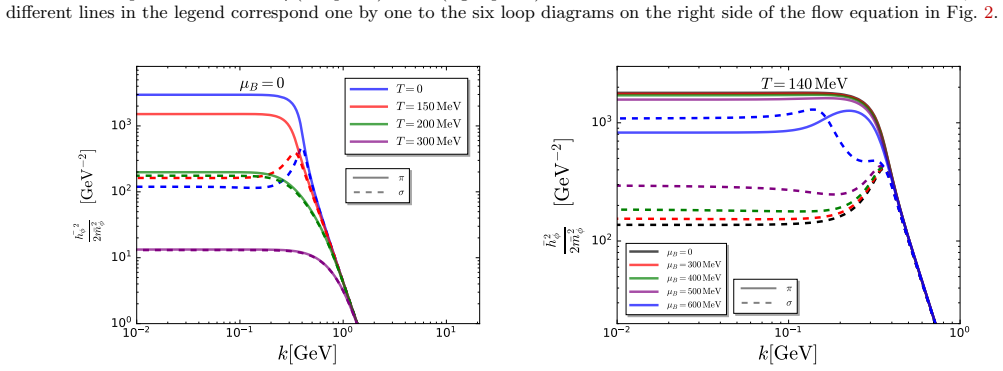
- §III.A, Fig. 8: The y-axis label in the top-left panel reads 'lambda [GeV^{-2}]' with values up to ~3000, while the top-right panel (T=130, mu_B=300) has the same label but values up to ~100. Please verify the units and scale are consistent across panels, or clarify if different normalizations are used.
- §IV, Fig. 19: The phase boundary line from this work (black dashed) appears to deviate from the fRG result of Ref. [22] (red) at higher mu_B. It would help to quantify the maximum deviation in T_c(mu_B) between the two calculations in the crossover region.
- Appendix D, Table I: The parameter 'a = 0.013' is described as providing 'only 1.3% larger quark-gluon coupling.' However, Eq. (D3) shows the enhancement factor approaches 1+a in the infrared, so the enhancement is 1.3% relative to the unenhanced coupling. This phrasing could be slightly misleading; consider rephrasing to 'an infrared enhancement of 1.3%.'
- §III.C, Fig. 16: The strong couplings alpha_{l l A}, alpha_{s s A}, and alpha_{A3} are shown for T = 0, 150, 300 MeV. The text mentions they 'decrease with the increasing temperature,' but the figure shows this only for the light quark coupling. Please verify the strange quark and three-gluon couplings show the same trend, or clarify.
- References: Several references to future work are cited as 'arXiv:2603.xxxxx' (e.g., Refs. [6], [20], [33], [34]) with 2026 dates. Please verify these are publicly available or update with published references where applicable.
- §V (Conclusions): The sentence 'We have studies the four-quark couplings' should read 'We have studied the four-quark couplings.'
- Appendix G: The fish diagram contributions (Eqs. G30-G39) involve very lengthy expressions. While their inclusion is appreciated for reproducibility, a brief comment on whether these expressions have been cross-checked (e.g., against symmetry relations or limiting cases) would strengthen confidence in their correctness.
Simulated Author's Rebuttal
We thank the referee for a careful and constructive report. The comments are well-taken and we address each one below. We agree that the simultaneous change of the infrared enhancement parameter and the channel extension complicates the attribution of the CEP shift, and we will add a sensitivity analysis to disentangle these effects. We will also report the individual fit results for each fit range. Regarding the strange-sector approximation, we will add an expanded discussion of its potential systematic impact.
read point-by-point responses
-
Referee: §IV, Eq. (23): CEP shift attributed to Fierz-complete channels, but parameter 'a' simultaneously changed from 0.034 to 0.013, and h_sigma/h_pi now distinguished. No sensitivity analysis isolating channel-extension from parameter retuning. Request either such analysis or explicit qualification.
Authors: The referee raises a valid and important point. We agree that the simultaneous change of the infrared enhancement parameter a (from 0.034 to 0.013) and the distinction of h_sigma and h_pi, alongside the inclusion of Fierz-complete channels, means that the CEP shift cannot be cleanly attributed to the channel extension alone based solely on the comparison as currently presented. We will address this by performing and reporting a sensitivity analysis in the revised manuscript. Specifically, we will compute the CEP location with the new Fierz-complete channels but using the old value a = 0.034 (and h_sigma = h_pi), and conversely, to isolate the effect of the channel extension from the parameter retuning. This will allow us to quantify the individual contributions. We will also revise the text in §IV to explicitly state that the CEP shift reflects the combined effect of channel extension and parameter retuning, rather than attributing it solely to the Fierz-complete dynamics. We note that the physical logic for the reduced 'a' is sound: the additional four-quark channels provide extra channels for chiral symmetry breaking dynamics, so less phenomenological infrared enhancement of the quark-gluon coupling is needed. However, we agree this should be demonstrated quantitatively rather than merely stated. revision: yes
-
Referee: §IV, Eq. (22): kappa_2 = 0.0151(1) fitted in ranges mu_B/T in [0,3] and [0,4]. Individual fit results for each range not reported separately. Request separate results including chi-squared or goodness of fit.
Authors: This is a reasonable request. We will report the individual fit results for each range (mu_B/T in [0,3] and [0,4]) separately in the revised manuscript, including the corresponding chi-squared or goodness-of-fit measures. In our current analysis, both ranges yield kappa_2 = 0.0151 and kappa_4 = 0.00023 within the quoted errors, and the chi-squared values are comparable. We will present these numbers explicitly in a table or in the text to support the robustness claim. We note that the CEP location at mu_B/T ~ 6.3 is well outside both fit ranges, so the curvature extraction is not contaminated by critical fluctuations near the CEP, which is part of the reason the result is stable across the two ranges. revision: yes
-
Referee: Appendix D, Eq. (D1): Strange quark sector uses approximate 2-flavor potential V_k(rho, rho_s) ~ V_k(rho) + (1/2)V_k(2*rho_s) rather than full 2+1-flavor potential. Request comment on whether this could systematically bias the CEP location, and whether direction of bias can be estimated.
Authors: We agree that this approximation warrants discussion, particularly given that the CEP region is where new channels become relevant. We will add a dedicated paragraph in Appendix D addressing the potential systematic bias. To summarize the content of this addition: The approximation V_k(rho, rho_s) ~ V_k(rho) + (1/2)V_k(2*rho_s) treats the strange quark sector as a spectator to the light-quark dynamics in the mesonic potential, while still determining the strange quark mass dynamically. Since the strange quark is considerably heavier than the light quarks and the chiral transition is primarily driven by the light-quark sector, the impact on the phase boundary and CEP location is expected to be moderate. However, near the CEP, where critical fluctuations in the sigma channel are large, the feedback from strange-quark dynamics could introduce a systematic shift. The direction of the bias is difficult to estimate without a full 2+1-flavor calculation, but we expect it to be subdominant compared to the truncation effects already quantified (e.g., the ~10% non-dominant channel contributions). We note that a comprehensive 2+1-flavor effective potential with scalar and pseudoscalar mesonic nonets is being implemented in the companion work [Ref. 33], which will allow a direct assessment of this systematic. We will reference this ongoing improvement and add a cautionary note that the strange-sector approximation is an inherited limitation whose quantitative impact on the CEP location remains to be fully assessed. revision: partial
Circularity Check
No significant circularity. The CEP location and phase boundary curvature are outputs of integrated flow equations, not fitted inputs. Self-citations provide the framework but the flow equations are explicitly derived.
full rationale
The paper's central results — the CEP location (102, 647) MeV and curvature κ₂ = 0.0151 — are obtained by integrating the explicitly written flow equations (Appendices F, G) from an ultraviolet cutoff Λ = 20 GeV down to k = 0. The input parameters (Table I: c_σ, c_σs, α_{s,Λ}) are fitted to reproduce known vacuum observables (m_π, m_σ, m_l, m_s), which is standard practice and not circular: the fitted quantities (hadron masses at T = μ = 0) are distinct from the predicted quantities (CEP location, phase boundary curvature at finite T, μ_B). The infrared enhancement parameter a = 0.013 is tuned to ensure dynamical chiral symmetry breaking — a physical requirement, not a fit to the CEP. The paper builds on prior work by overlapping authors (Refs [22], [41–43]) for the fRG framework, dynamical hadronization technique, and four-quark flow equations. However, these self-citations provide the truncation scheme and flow equation structure, which are then explicitly written out in the present paper (Appendices C, F, G). The hadronization condition (Eq. C9: λ̃_φ = 0) is a standard truncation choice from [66–68], not a self-citation. The four-quark couplings in the eight non-hadronized channels are computed from their flow equations, not set by hand. The comparison with lattice data at μ_B = 0 (Figs. 17, 18) and with independent DSE/lattice results for the CEP (Fig. 19) provides external benchmarks. The skeptic's concern about simultaneous retuning of parameter a alongside the channel extension is a valid methodology concern about confounding variables, but it is not circularity: the parameter a is not fitted to reproduce the CEP location, and the CEP shift is a genuine output of the calculation, not an input by construction. The minor self-citations raise the score to 2, but the central derivation chain is self-contained against external benchmarks.
Axiom & Free-Parameter Ledger
free parameters (8)
- c_σ =
3.6 GeV³
- c_σs =
97.2 GeV³
- α_{s,Λ} =
0.235
- a (IR enhancement) =
0.013
- b (IR enhancement scale) =
2 GeV
- δ (IR enhancement exponent) =
2
- α (Polyakov rescaling) =
0.57
- T_c^glue =
225 MeV
axioms (6)
- domain assumption Landau gauge (ξ = 0) is adopted for all computations (Sec. A, Eq. A1).
- domain assumption Only the classical tensor structure of the quark-gluon vertex is retained; non-classical channels are neglected (Sec. III C, App. C).
- domain assumption The strange quark effective potential is approximated from the 2-flavor potential via V_k(ρ,ρ_s) ≈ V_k(ρ) + ½V_k(2ρ_s) (Eq. D1).
- domain assumption Dynamical hadronization condition: λ̃_φ = 0 for all k (Eq. C9), transferring four-quark dynamics in σ and π channels to meson exchanges.
- domain assumption External momenta are neglected (p = 0) and only the lowest fermionic Matsubara mode is kept for external propagators (Eq. F9).
- domain assumption The Polyakov loop potential is parameterized with temperature-dependent coefficients from pure-gauge lattice data (Eqs. D4-D7, Ref [69]).
read the original abstract
The dynamics of Fierz-complete four-quark interactions and its influence on the QCD phase diagram have been investigated within the functional renormalization group approach to QCD at finite temperature and densities. It is found that in the vacuum the pion and sigma channels play the overwhelmingly dominant role, and all the other channels are negligible. However, when it is near the critical end point (CEP), the magnitude of four-quark couplings in other channels increases sizably and they become more and more important. In comparison to the single scalar-pseudoscalar channel of four-quark interactions, the dynamics of Fierz-complete four-quark interactions increases a bit the curvature of the phase boundary, and moves the CEP to location of larger baryon chemical potential and smaller temperature.
Figures




Reference graph
Works this paper leans on
-
[1]
20 we show the four-quark flows for theηand achannels in the vacuum
Four-quark couplings and flows In Fig. 20 we show the four-quark flows for theηand achannels in the vacuum. In comparison to the four- quark flows for the pion and sigma channels in Fig. 4, the triangle-gluon diagram here contributes a sizable mi- nus value. The magnitude of box-meson diagram in the ηandachannels is smaller than its magnitude in the pion ...
-
[2]
Yukawa couplings and flows The Yukawa flows for the pion and sigma as functions of the RG scale at the three representative points in the QCD phase diagram as shown in Fig. 3 are investigated in Fig. 24, Fig. 25, and Fig. 26, respectively. Appendix F: Flow equations of the Yukawa couplings In this section, we provide the computational details of the flow ...
-
[3]
M. A. Stephanov, QCD phase diagram: An Overview, Proceedings, 24th International Symposium on Lattice Field Theory (Lattice 2006): Tucson, USA, July 23-28, 2006, PoSLAT2006, 024 (2006), arXiv:hep-lat/0701002 [hep-lat]
work page internal anchor Pith review Pith/arXiv arXiv 2006
-
[4]
X. Luo and N. Xu, Search for the QCD Critical Point with Fluctuations of Conserved Quantities in Relativistic Heavy-Ion Collisions at RHIC : An Overview, Nucl. Sci. Tech.28, 112 (2017), arXiv:1701.02105 [nucl-ex]
work page internal anchor Pith review Pith/arXiv arXiv 2017
-
[5]
Mapping the Phases of Quantum Chromodynamics with Beam Energy Scan
A. Bzdak, S. Esumi, V. Koch, J. Liao, M. Stephanov, and N. Xu, Mapping the Phases of Quantum Chromo- dynamics with Beam Energy Scan, Phys. Rept.853, 1 (2020), arXiv:1906.00936 [nucl-th]
work page internal anchor Pith review Pith/arXiv arXiv 2020
-
[6]
QCD at finite temperature and density within the fRG approach: An overview
W.-j. Fu, QCD at finite temperature and density within the fRG approach: an overview, Commun. Theor. Phys. 74, 097304 (2022), arXiv:2205.00468 [hep-ph]
work page internal anchor Pith review Pith/arXiv arXiv 2022
-
[7]
QCD Phase Diagram and Astrophysical Implications
K. Fukushima, QCD phase diagram and astrophysi- cal implications, J. Subatomic Part. Cosmol.3, 100066 (2025), arXiv:2501.01907 [hep-ph]
work page internal anchor Pith review Pith/arXiv arXiv 2025
- [8]
-
[10]
The QCD crossover at finite chemical potential from lattice simulations
S. Borsanyi, Z. Fodor, J. N. Guenther, R. Kara, S. D. Katz, P. Parotto, A. Pasztor, C. Ratti, and K. K. Szabo, QCD Crossover at Finite Chemical Potential from Lat- tice Simulations, Phys. Rev. Lett.125, 052001 (2020), arXiv:2002.02821 [hep-lat]
work page internal anchor Pith review Pith/arXiv arXiv 2020
-
[11]
B. E. Aboonaet al.(STAR), Precision Measurement of Net-Proton-Number Fluctuations in Au+Au Colli- sions at RHIC, Phys. Rev. Lett.135, 142301 (2025), arXiv:2504.00817 [nucl-ex]
work page internal anchor Pith review Pith/arXiv arXiv 2025
-
[12]
Adamet al.(STAR), Nonmonotonic Energy Depen- dence of Net-Proton Number Fluctuations, Phys
J. Adamet al.(STAR), Nonmonotonic Energy Depen- dence of Net-Proton Number Fluctuations, Phys. Rev. Lett.126, 092301 (2021), arXiv:2001.02852 [nucl-ex]
- [13]
-
[14]
B. Aboonaet al.(STAR), Beam Energy Dependence of Fifth and Sixth-Order Net-proton Number Fluctuations in Au+Au Collisions at RHIC, Phys. Rev. Lett.130, 082301 (2023), arXiv:2207.09837 [nucl-ex]. 31
-
[15]
M. Abdallahet al.(STAR), Higher-order cumulants and correlation functions of proton multiplicity distri- butions in sNN=3 GeV Au+Au collisions at the RHIC STAR experiment, Phys. Rev. C107, 024908 (2023), arXiv:2209.11940 [nucl-ex]
-
[16]
Non-Monotonicity of Transverse Momentum Correla- tions in Au + Au Collisions at RHIC, (2026), arXiv:2604.06434 [nucl-ex]
work page internal anchor Pith review Pith/arXiv arXiv 2026
-
[17]
M. A. Stephanov, Non-Gaussian fluctuations near the QCD critical point, Phys. Rev. Lett.102, 032301 (2009), arXiv:0809.3450 [hep-ph]
work page internal anchor Pith review Pith/arXiv arXiv 2009
-
[18]
M. A. Stephanov, On the sign of kurtosis near the QCD critical point, Phys. Rev. Lett.107, 052301 (2011), arXiv:1104.1627 [hep-ph]
work page internal anchor Pith review Pith/arXiv arXiv 2011
-
[19]
W.-j. Fu, J. M. Pawlowski, F. Rennecke, and B.-J. Schaefer, Baryon number fluctuations at finite temper- ature and density, Phys. Rev. D94, 116020 (2016), arXiv:1608.04302 [hep-ph]
work page internal anchor Pith review Pith/arXiv arXiv 2016
-
[20]
W.-j. Fu, X. Luo, J. M. Pawlowski, F. Rennecke, R. Wen, and S. Yin, Hyper-order baryon number fluctuations at finite temperature and density, Phys. Rev. D104, 094047 (2021), arXiv:2101.06035 [hep-ph]
work page internal anchor Pith review Pith/arXiv arXiv 2021
-
[21]
W.-j. Fu, X. Luo, J. M. Pawlowski, F. Rennecke, and S. Yin, Ripples of the QCD critical point, Phys. Rev. D 111, L031502 (2025), arXiv:2308.15508 [hep-ph]
work page internal anchor Pith review Pith/arXiv arXiv 2025
- [22]
-
[23]
High-order fluctuations of temperature in hot QCD matter
J. Chen, W.-j. Fu, S. Yin, and C. Zhang, High-order fluctuations of temperature in hot QCD matter, (2025), arXiv:2504.06886 [hep-ph]
work page internal anchor Pith review Pith/arXiv arXiv 2025
-
[24]
W.-j. Fu, J. M. Pawlowski, and F. Rennecke, QCD phase structure at finite temperature and density, Phys. Rev. D101, 054032 (2020), arXiv:1909.02991 [hep-ph]
work page internal anchor Pith review Pith/arXiv arXiv 2020
-
[25]
Chiral phase structure and critical end point in QCD
F. Gao and J. M. Pawlowski, Chiral phase structure and critical end point in QCD, Phys. Lett. B820, 136584 (2021), arXiv:2010.13705 [hep-ph]
work page internal anchor Pith review Pith/arXiv arXiv 2021
-
[26]
P. J. Gunkel and C. S. Fischer, Locating the critical end- point of QCD: Mesonic backcoupling effects, Phys. Rev. D104, 054022 (2021), arXiv:2106.08356 [hep-ph]
work page internal anchor Pith review Pith/arXiv arXiv 2021
-
[27]
On the QCD critical point, Lee-Yang edge singularities and Pade resummations
G. Basar, QCD critical point, Lee-Yang edge singulari- ties, and Pad´ e resummations, Phys. Rev. C110, 015203 (2024), arXiv:2312.06952 [hep-th]
work page internal anchor Pith review Pith/arXiv arXiv 2024
-
[28]
D. A. Clarke, P. Dimopoulos, F. Di Renzo, J. Goswami, C. Schmidt, S. Singh, and K. Zambello, Searching for the QCD critical end point using multipoint Pad´ e approximations, Phys. Rev. D112, L091504 (2025), arXiv:2405.10196 [hep-lat]
work page internal anchor Pith review Pith/arXiv arXiv 2025
-
[29]
A. Adam, S. Bors´ anyi, Z. Fodor, J. N. Guenther, P. Ku- mar, P. Parotto, A. P´ asztor, and C. H. Wong, High- precision baryon number cumulants from lattice QCD in a finite box: Cumulant ratios, Lee-Yang zeros, and critical endpoint predictions, Phys. Rev. D113, 074525 (2026), arXiv:2507.13254 [hep-lat]
work page internal anchor Pith review Pith/arXiv arXiv 2026
- [30]
-
[31]
Lattice QCD constraints on the critical point from an improved precision equation of state
S. Borsanyi, Z. Fodor, J. N. Guenther, P. Parotto, A. Pasztor, C. Ratti, V. Vovchenko, and C. H. Wong, Lattice QCD constraints on the critical point from an improved precision equation of state, Phys. Rev. D112, L111505 (2025), arXiv:2502.10267 [hep-lat]
work page internal anchor Pith review Pith/arXiv arXiv 2025
-
[32]
J. Braunet al., Soft modes in hot QCD matter, Phys. Rev. D111, 094010 (2025), arXiv:2310.19853 [hep-ph]
work page internal anchor Pith review Pith/arXiv arXiv 2025
-
[33]
W.-j. Fu, J. M. Pawlowski, R. D. Pisarski, F. Ren- necke, R. Wen, and S. Yin, QCD moat regime and its real-time properties, Phys. Rev. D111, 094026 (2025), arXiv:2412.15949 [hep-ph]
work page internal anchor Pith review Pith/arXiv arXiv 2025
- [34]
- [35]
-
[36]
Y. Lu, F. Gao, Y.-x. Liu, and J. M. Pawlowski, Fi- nite density signatures of confining and chiral dynam- ics in QCD thermodynamics and fluctuations of con- served charges, Phys. Rev. D113, 054019 (2026), arXiv:2504.05099 [hep-ph]
work page internal anchor Pith review Pith/arXiv arXiv 2026
-
[37]
R.-G. Cai, S. He, L. Li, and Y.-X. Wang, Probing QCD critical point and induced gravitational wave by black hole physics, Phys. Rev. D106, L121902 (2022), arXiv:2201.02004 [hep-th]
work page internal anchor Pith review Pith/arXiv arXiv 2022
-
[38]
Bayesian location of the QCD critical point from a holographic perspective
M. Hippert, J. Grefa, T. A. Manning, J. Noronha, J. Noronha-Hostler, I. Portillo Vazquez, C. Ratti, R. Rougemont, and M. Trujillo, Bayesian location of the QCD critical point from a holographic perspective, Phys. Rev. D110, 094006 (2024), arXiv:2309.00579 [nucl-th]
work page internal anchor Pith review Pith/arXiv arXiv 2024
-
[39]
L. Zhu, X. Chen, K. Zhou, H. Zhang, and M. Huang, Bayesian inference of the critical end point in a (2+1)- flavor system from holographic QCD, Phys. Rev. D112, 026019 (2025), arXiv:2501.17763 [hep-ph]
work page internal anchor Pith review Pith/arXiv arXiv 2025
-
[40]
Fierz-complete NJL model study: fixed points and phase structure at finite temperature and density
J. Braun, M. Leonhardt, and M. Pospiech, Fierz- complete NJL model study: Fixed points and phase structure at finite temperature and density, Phys. Rev. D96, 076003 (2017), arXiv:1705.00074 [hep-ph]
work page internal anchor Pith review Pith/arXiv arXiv 2017
-
[41]
J. Braun, M. Leonhardt, and M. Pospiech, Fierz- complete NJL model study. II. Toward the fixed-point and phase structure of hot and dense two-flavor QCD, Phys. Rev. D97, 076010 (2018), arXiv:1801.08338 [hep- ph]
work page internal anchor Pith review Pith/arXiv arXiv 2018
-
[42]
Fierz-complete NJL model study III: Emergence from quark-gluon dynamics
J. Braun, M. Leonhardt, and M. Pospiech, Fierz- complete NJL model study III: Emergence from quark- gluon dynamics, Phys. Rev. D101, 036004 (2020), arXiv:1909.06298 [hep-ph]
work page internal anchor Pith review Pith/arXiv arXiv 2020
-
[43]
W.-j. Fu, C. Huang, J. M. Pawlowski, and Y.-y. Tan, Four-quark scatterings in QCD I, SciPost Phys.14, 069 (2023), arXiv:2209.13120 [hep-ph]
work page internal anchor Pith review Pith/arXiv arXiv 2023
-
[44]
W.-j. Fu, C. Huang, J. M. Pawlowski, and Y.-y. Tan, Four-quark scatterings in QCD II, SciPost Phys.17, 148 (2024), arXiv:2401.07638 [hep-ph]
work page internal anchor Pith review Pith/arXiv arXiv 2024
-
[45]
W.-j. Fu, C. Huang, J. M. Pawlowski, Y.-y. Tan, and L.-j. Zhou, Four-quark scatterings in QCD III, Phys. Rev. D 112, 054047 (2025), arXiv:2502.14388 [hep-ph]
work page internal anchor Pith review Pith/arXiv arXiv 2025
-
[46]
Quasi parton distributions of pions at large longitudinal momentum
D.-y. Zhang, C. Huang, and W.-j. Fu, Quasiparton distri- butions of pions at large longitudinal momentum, Phys. Rev. D112, 074001 (2025), arXiv:2502.15384 [hep-ph]
work page internal anchor Pith review Pith/arXiv arXiv 2025
-
[47]
Kaon Distribution Amplitudes from Euclidean Functional QCD
W. Cui, D.-y. Zhang, C. Huang, and W.-j. Fu, Kaon Dis- tribution Amplitudes from Euclidean Functional QCD, (2026), arXiv:2604.23739 [hep-ph]
work page internal anchor Pith review Pith/arXiv arXiv 2026
-
[48]
L. von Smekal, R. Alkofer, and A. Hauck, The In- frared behavior of gluon and ghost propagators in Landau gauge QCD, Phys. Rev. Lett.79, 3591 (1997), arXiv:hep- ph/9705242
-
[49]
L. von Smekal, A. Hauck, and R. Alkofer, A Solution to Coupled Dyson–Schwinger Equations for Gluons and 32 Ghosts in Landau Gauge, Annals Phys.267, 1 (1998), [Erratum: Annals Phys. 269, 182 (1998)], arXiv:hep- ph/9707327
-
[50]
C. S. Fischer, A. Maas, and J. M. Pawlowski, On the in- frared behavior of Landau gauge Yang-Mills theory, An- nals Phys.324, 2408 (2009), arXiv:0810.1987 [hep-ph]
work page internal anchor Pith review Pith/arXiv arXiv 2009
-
[51]
A. K. Cyrol, L. Fister, M. Mitter, J. M. Pawlowski, and N. Strodthoff, Landau gauge Yang-Mills correlation func- tions, Phys. Rev. D94, 054005 (2016), arXiv:1605.01856 [hep-ph]
work page internal anchor Pith review Pith/arXiv arXiv 2016
-
[52]
Chiral symmetry breaking in continuum QCD
M. Mitter, J. M. Pawlowski, and N. Strodthoff, Chiral symmetry breaking in continuum QCD, Phys. Rev. D 91, 054035 (2015), arXiv:1411.7978 [hep-ph]
work page internal anchor Pith review Pith/arXiv arXiv 2015
-
[53]
From Quarks and Gluons to Hadrons: Chiral Symmetry Breaking in Dynamical QCD
J. Braun, L. Fister, J. M. Pawlowski, and F. Rennecke, From Quarks and Gluons to Hadrons: Chiral Symmetry Breaking in Dynamical QCD, Phys. Rev. D94, 034016 (2016), arXiv:1412.1045 [hep-ph]
work page internal anchor Pith review Pith/arXiv arXiv 2016
-
[54]
A. K. Cyrol, M. Mitter, J. M. Pawlowski, and N. Strodthoff, Nonperturbative quark, gluon, and me- son correlators of unquenched QCD, Phys. Rev. D97, 054006 (2018), arXiv:1706.06326 [hep-ph]
work page internal anchor Pith review Pith/arXiv arXiv 2018
-
[55]
Correlation functions of three-dimensional Yang-Mills theory from the FRG
L. Corell, A. K. Cyrol, M. Mitter, J. M. Pawlowski, and N. Strodthoff, Correlation functions of three-dimensional Yang-Mills theory from the FRG, SciPost Phys.5, 066 (2018), arXiv:1803.10092 [hep-ph]
work page internal anchor Pith review Pith/arXiv arXiv 2018
- [56]
-
[57]
Towards quantitative precision in functional QCD I
F. Ihssen, J. M. Pawlowski, F. R. Sattler, and N. Wink, Toward quantitative precision in functional QCD, Phys. Rev. D113, 094038 (2026), arXiv:2408.08413 [hep-ph]
work page internal anchor Pith review Pith/arXiv arXiv 2026
-
[58]
S. Borsanyi, Z. Fodor, C. Hoelbling, S. D. Katz, S. Krieg, C. Ratti, and K. K. Szabo (Wuppertal-Budapest), Is there still anyT c mystery in lattice QCD? Results with physical masses in the continuum limit III, JHEP09, 073, arXiv:1005.3508 [hep-lat]
work page internal anchor Pith review Pith/arXiv arXiv
-
[59]
Chiral crossover in QCD at zero and non-zero chemical potentials
A. Bazavovet al.(HotQCD), Chiral crossover in QCD at zero and non-zero chemical potentials, Phys. Lett. B 795, 15 (2019), arXiv:1812.08235 [hep-lat]
work page internal anchor Pith review Pith/arXiv arXiv 2019
-
[60]
L. Adamczyket al.(STAR), Bulk Properties of the Medium Produced in Relativistic Heavy-Ion Collisions from the Beam Energy Scan Program, Phys. Rev. C96, 044904 (2017), arXiv:1701.07065 [nucl-ex]
work page internal anchor Pith review Pith/arXiv arXiv 2017
-
[61]
P. Alba, W. Alberico, R. Bellwied, M. Bluhm, V. Man- tovani Sarti, M. Nahrgang, and C. Ratti, Freeze-out con- ditions from net-proton and net-charge fluctuations at RHIC, Phys. Lett. B738, 305 (2014), arXiv:1403.4903 [hep-ph]
work page internal anchor Pith review Pith/arXiv arXiv 2014
-
[62]
Decoding the phase structure of QCD via particle production at high energy
A. Andronic, P. Braun-Munzinger, K. Redlich, and J. Stachel, Decoding the phase structure of QCD via par- ticle production at high energy, Nature561, 321 (2018), arXiv:1710.09425 [nucl-th]
work page internal anchor Pith review Pith/arXiv arXiv 2018
-
[63]
Hadronization conditions in relativistic nuclear collisions and the QCD pseudo-critical line
F. Becattini, J. Steinheimer, R. Stock, and M. Bleicher, Hadronization conditions in relativistic nuclear collisions and the QCD pseudo-critical line, Phys. Lett. B764, 241 (2017), arXiv:1605.09694 [nucl-th]
work page internal anchor Pith review Pith/arXiv arXiv 2017
-
[64]
V. Vovchenko, V. V. Begun, and M. I. Gorenstein, Hadron multiplicities and chemical freeze-out conditions in proton-proton and nucleus-nucleus collisions, Phys. Rev.C93, 064906 (2016), arXiv:1512.08025 [nucl-th]
work page internal anchor Pith review Pith/arXiv arXiv 2016
-
[65]
V. V. Sagun, K. A. Bugaev, A. I. Ivanytskyi, I. P. Yaki- menko, E. G. Nikonov, A. V. Taranenko, C. Greiner, D. B. Blaschke, and G. M. Zinovjev, Hadron Resonance Gas Model with Induced Surface Tension, Eur. Phys. J. A54, 100 (2018), arXiv:1703.00049 [hep-ph]
work page internal anchor Pith review Pith/arXiv arXiv 2018
-
[66]
H. T. Ding, O. Kaczmarek, F. Karsch, P. Petreczky, M. Sarkar, C. Schmidt, and S. Sharma, Curvature of the chiral phase transition line from the magnetic equation of state of (2+1)-flavor QCD, Phys. Rev. D109, 114516 (2024), arXiv:2403.09390 [hep-lat]
work page internal anchor Pith review Pith/arXiv arXiv 2024
-
[67]
fQCD collaboration, https://fqcd-collaboration.github.io
-
[68]
H. Gies and C. Wetterich, Renormalization flow of bound states, Phys. Rev. D65, 065001 (2002), arXiv:hep- th/0107221
-
[69]
Universality of spontaneous chiral symmetry breaking in gauge theories
H. Gies and C. Wetterich, Universality of spontaneous chiral symmetry breaking in gauge theories, Phys. Rev. D69, 025001 (2004), arXiv:hep-th/0209183 [hep-th]
work page internal anchor Pith review Pith/arXiv arXiv 2004
- [70]
-
[71]
P. M. Lo, B. Friman, O. Kaczmarek, K. Redlich, and C. Sasaki, Polyakov loop fluctuations in SU(3) lattice gauge theory and an effective gluon potential, Phys. Rev. D88, 074502 (2013), arXiv:1307.5958 [hep-lat]
work page internal anchor Pith review Pith/arXiv arXiv 2013
-
[72]
L. M. Haas, R. Stiele, J. Braun, J. M. Pawlowski, and J. Schaffner-Bielich, Improved Polyakov-loop potential for effective models from functional calculations, Phys. Rev.D87, 076004 (2013), arXiv:1302.1993 [hep-ph]
work page internal anchor Pith review Pith/arXiv arXiv 2013
-
[73]
T. K. Herbst, M. Mitter, J. M. Pawlowski, B.-J. Schae- fer, and R. Stiele, Thermodynamics of QCD at vanishing density, Phys. Lett. B731, 248 (2014), arXiv:1308.3621 [hep-ph]
work page internal anchor Pith review Pith/arXiv arXiv 2014
discussion (0)
Sign in with ORCID, Apple, or X to comment. Anyone can read and Pith papers without signing in.