Untangling QLDPC Codes with Biased Noise Ancilla
Pith reviewed 2026-06-30 05:53 UTC · model grok-4.3
The pith
Biased noise on ancilla qubits can raise the effective fault distance of QLDPC syndrome extraction and lower logical error rates by nearly an order of magnitude.
A machine-rendered reading of the paper's core claim, the machinery that carries it, and where it could break.
Core claim
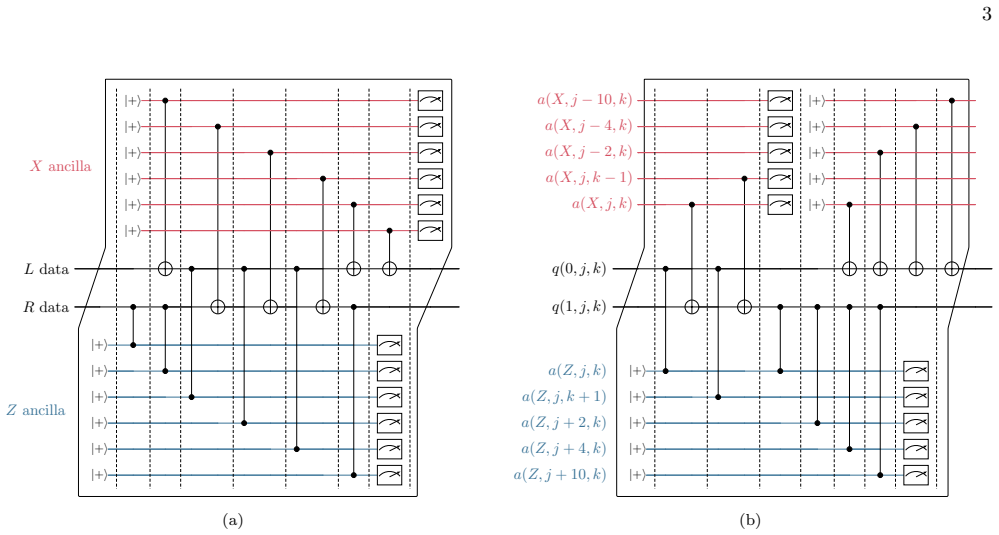
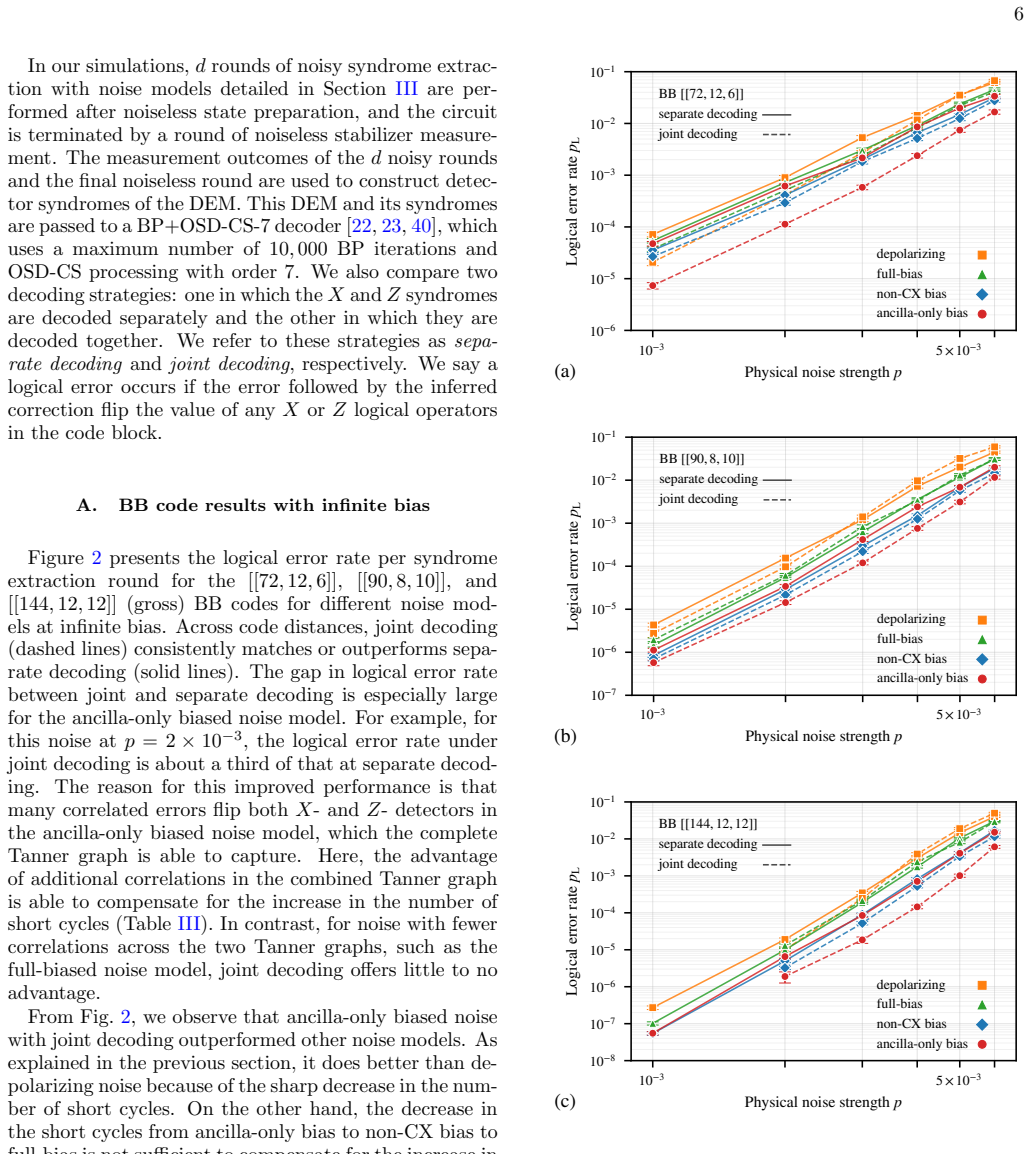
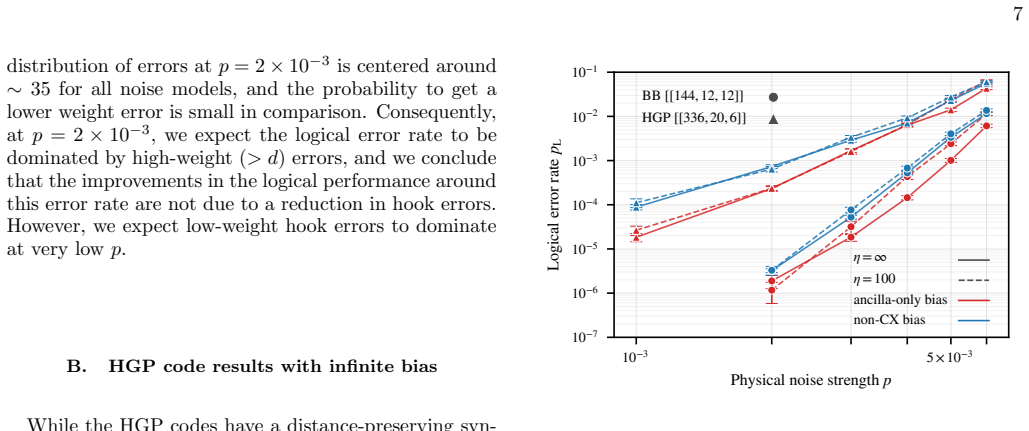
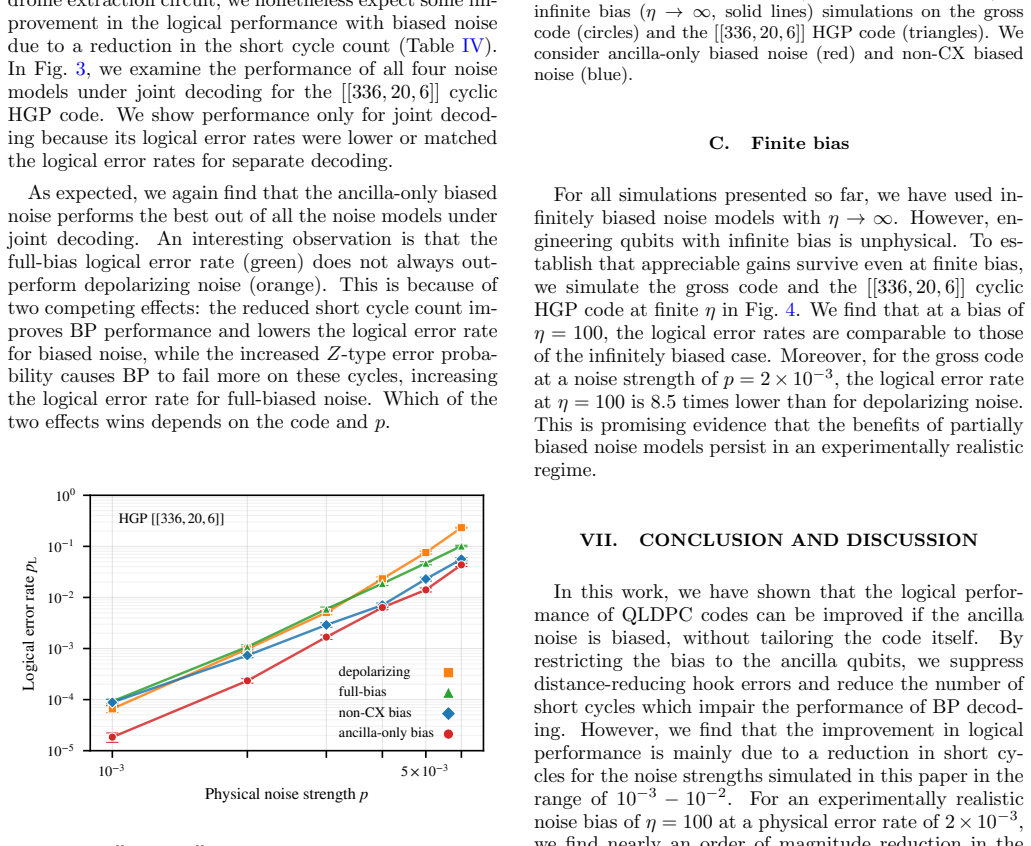
When ancillas are subject to phase-flip errors only, the effective fault-distance of the conventional syndrome extraction circuit is significantly higher and the number of short loops is significantly lower compared to when they are also subject to bit-flip errors, resulting in almost an order of magnitude improvement in the logical error rate at circuit noise of 2×10^{-3} when bit-flip errors in the ancilla are 50 times less likely than phase-flip errors.
What carries the argument
Biased noise ancillas limited to phase-flip errors in the syndrome extraction circuit for QLDPC codes.
If this is right
- The effective fault-distance increases for bicycle bivariate codes and cyclic hypergraph product codes.
- The number of short loops in the Tanner graph decreases.
- Logical error rates improve by nearly an order of magnitude under the specified noise conditions.
- This provides a practical advantage without changing the circuit structure.
Where Pith is reading between the lines
- Hardware implementations that can bias ancilla noise toward phase flips while keeping data qubits depolarizing could enable better QLDPC performance.
- Similar bias techniques might apply to other quantum codes beyond the examples studied.
- Decoders could be optimized further if short loops are reduced this way.
Load-bearing premise
Ancilla qubits can be realized with phase-flip errors only, specifically with bit-flip rates 50 times lower than phase-flip rates, while the rest of the circuit has standard depolarizing noise.
What would settle it
A simulation or experiment showing that the logical error rate does not improve by nearly an order of magnitude when ancilla bit-flip errors are suppressed by a factor of 50 at 2e-3 circuit noise would falsify the claim.
Figures
read the original abstract
Remarkable technical progress has made high-rate, high-distance, quantum low-density parity-check codes (QLDPC) promising candidates for scalable quantum computing. However, it is hard to design low-depth syndrome extraction circuits that do not spread errors from ancilla qubits to multiple data qubits, also known as hook errors, for general QLDPC codes. Additionally, widely used decoders for these codes based on belief propagation are impaired due to short loops in the Tanner graph. Here, we investigate a hardware-aware approach to avoid these hooks and loops using biased noise ancillas. Using examples of bicycle bivariate codes and a cyclic hypergraph product code, which have been widely considered for practical application, we show that the effective fault-distance of the conventional syndrome extraction circuit can be significantly higher and the number of short loops can be significantly lower when the ancillas are subject to phase-flip errors only, compared to when they are also subject to bit-flip errors. This can result in almost an order of magnitude improvement in the logical error rate at circuit noise of $2\times 10^{-3}$ and when bit-flip errors in the ancilla are 50 times less likely than phase-flip errors. Our work demonstrates a significant and practical quantum error correction advantage with biased noise qubits in which full-bias cannot be maintained.
Editorial analysis
A structured set of objections, weighed in public.
Referee Report
Summary. The manuscript investigates a hardware-aware approach to mitigating hook errors and short Tanner-graph loops in syndrome extraction circuits for QLDPC codes by restricting ancilla noise to phase flips only (with bit-flip rate 50× lower than phase-flip rate). Using bicycle bivariate codes and a cyclic hypergraph product code, it reports that this bias raises the effective fault distance of conventional circuits, reduces short loops, and yields nearly an order-of-magnitude improvement in logical error rate at circuit-level noise p=2×10^{-3} under depolarizing noise on data qubits.
Significance. If the ancilla-only bias model holds, the work supplies a practical route to better performance for existing high-rate, high-distance QLDPC constructions without new code designs or decoders. The concrete numerical gains at realistic noise levels and the focus on codes already considered for implementation are strengths.
major comments (2)
- [Abstract and noise-model description] The central performance claims (higher effective fault distance, fewer short loops, ~10× logical-error-rate improvement) are obtained exclusively under the circuit-level noise model in which ancillas experience phase-flip errors only while data qubits see full depolarizing noise. No section provides an independent hardware argument, calibration data, or analysis showing that a 50× bit-flip suppression can be maintained on ancillas alone without side effects from two-qubit gates or readout that would couple the bias to data qubits.
- [Results on bicycle and hypergraph-product codes] The reported distance and loop-count advantages are presented as numerical observations from simulation; the manuscript does not derive or bound how the bias alters the effective distance or loop structure analytically (e.g., via modified error propagation in the syndrome-extraction circuit).
minor comments (1)
- Notation for the biased noise model (e.g., the precise definition of the 50× ratio and how it is applied to each gate type) should be stated explicitly in the methods section rather than only in the abstract.
Simulated Author's Rebuttal
We thank the referee for their careful reading of the manuscript and for recognizing the practical relevance of biased-noise ancillas for existing QLDPC constructions. We address each major comment below.
read point-by-point responses
-
Referee: [Abstract and noise-model description] The central performance claims (higher effective fault distance, fewer short loops, ~10× logical-error-rate improvement) are obtained exclusively under the circuit-level noise model in which ancillas experience phase-flip errors only while data qubits see full depolarizing noise. No section provides an independent hardware argument, calibration data, or analysis showing that a 50× bit-flip suppression can be maintained on ancillas alone without side effects from two-qubit gates or readout that would couple the bias to data qubits.
Authors: We acknowledge that the reported gains rely on the assumed biased-noise model for ancillas (phase flips only, with bit-flip rate 50× lower). The manuscript frames this as a hardware-aware model motivated by prior work on biased-noise qubits, but does not supply new hardware calibration data or analysis of potential side effects from gates or readout that could couple bias to data qubits. This limitation is inherent to the scope of the present numerical study. We will revise the abstract and introduction to state more explicitly that the 50× suppression is an input assumption of the noise model rather than a demonstrated hardware property. revision: partial
-
Referee: [Results on bicycle and hypergraph-product codes] The reported distance and loop-count advantages are presented as numerical observations from simulation; the manuscript does not derive or bound how the bias alters the effective distance or loop structure analytically (e.g., via modified error propagation in the syndrome-extraction circuit).
Authors: The improvements in effective fault distance and the reduction in short Tanner-graph loops are obtained from direct simulation of the syndrome-extraction circuits under the biased ancilla model. We supply circuit-level explanations of the underlying mechanisms (elimination of bit-flip-induced hooks that would otherwise produce uncorrectable weight-2 errors), but we do not provide analytical bounds on the modified distance or loop spectrum. Deriving such bounds for general QLDPC codes under circuit noise remains an open theoretical challenge. We will expand the discussion section with additional detail on the observed error-propagation patterns that underlie the numerical results. revision: partial
- Independent hardware argument, calibration data, or analysis demonstrating that a 50× bit-flip suppression can be maintained on ancillas without side effects from two-qubit gates or readout.
Circularity Check
No circularity; central claims are direct numerical observations from simulations under an explicit noise model
full rationale
The paper reports simulation results on effective fault distance, Tanner-graph loop counts, and logical error rates for specific QLDPC codes under two noise models (depolarizing vs. ancilla phase-flip only). These quantities are computed directly from circuit-level Monte Carlo or similar methods; no equations, fitted parameters, or self-citations are invoked to derive the reported improvements. The modeling choice of 50× bit-flip suppression on ancillas is stated as an input assumption rather than derived, and the performance numbers are presented as empirical outcomes rather than self-referential predictions. No load-bearing self-citation chain or renaming of known results appears in the derivation.
Axiom & Free-Parameter Ledger
Reference graph
Works this paper leans on
-
[1]
Panteleev and G
P. Panteleev and G. Kalachev, Asymptotically good quantum and locally testable classical LDPC codes, in Proceedings of the 54th annual ACM SIGACT sympo- sium on theory of computing(2022) pp. 375–388
2022
-
[2]
Leverrier and G
A. Leverrier and G. Z´ emor, Quantum tanner codes, in 2022 IEEE 63rd Annual Symposium on Foundations of Computer Science (FOCS)(IEEE, 2022) pp. 872–883
2022
-
[3]
Dinur, M.-H
I. Dinur, M.-H. Hsieh, T.-C. Lin, and T. Vidick, Good quantum LDPC codes with linear time decoders, inPro- ceedings of the 55th annual ACM symposium on theory of computing(2023) pp. 905–918
2023
-
[4]
A. Y. Kitaev, Fault-tolerant quantum computation by anyons, Annals of physics303, 2 (2003)
2003
-
[5]
S. B. Bravyi and A. Y. Kitaev, Quantum codes on a lattice with boundary, arXiv preprint quant-ph/9811052 (1998)
work page internal anchor Pith review Pith/arXiv arXiv 1998
-
[6]
Dennis, A
E. Dennis, A. Kitaev, A. Landahl, and J. Preskill, Topological quantum memory, Journal of Mathematical Physics43, 4452 (2002)
2002
-
[7]
N. P. Breuckmann and J. N. Eberhardt, Quantum low- density parity-check codes, PRX quantum2, 040101 (2021)
2021
-
[8]
Bluvstein, S
D. Bluvstein, S. J. Evered, A. A. Geim, S. H. Li, H. Zhou, T. Manovitz, S. Ebadi, M. Cain, M. Kalinowski, D. Hangleiter,et al., Logical quantum processor based on reconfigurable atom arrays, Nature626, 58 (2024)
2024
-
[9]
S. J. Evered, M. Xu, S. H. Li, A. A. Geim, J. Ataides, M. Kalinowski, D. Bluvstein, N. Maskara, C. Kokail, M. Greiner,et al., High-fidelity entangling gates and nonlocal circuits with neutral atoms, arXiv preprint arXiv:2604.25987 (2026)
work page internal anchor Pith review Pith/arXiv arXiv 2026
-
[10]
S. A. Moses, C. H. Baldwin, M. S. Allman, R. Ancona, L. Ascarrunz, C. Barnes, J. Bartolotta, B. Bjork, P. Blan- chard, M. Bohn,et al., A race-track trapped-ion quantum processor, Physical Review X13, 041052 (2023)
2023
-
[11]
K. Heya, T. Phung, M. Malekakhlagh, R. Steiner, M. Turchetti, W. Shanks, J. Mamin, W.-S. Lu, Y. P. Kandel, N. Sundaresan,et al., Randomized benchmark- ing of a remote cnot gate via a meter-scale microwave link, Physical Review Letters135, 200801 (2025)
2025
-
[12]
Cross, A modular quantum computer based on bi- variate bicycle codes, in7th International Conference on Quantum Error Correction(2025)
A. Cross, A modular quantum computer based on bi- variate bicycle codes, in7th International Conference on Quantum Error Correction(2025)
2025
-
[13]
K. Wang, Z. Lu, C. Zhang, G. Liu, J. Chen, Y. Wang, Y. Wu, S. Xu, X. Zhu, F. Jin,et al., Demonstration of low-overhead quantum error correction codes, Nature Physics , 1 (2026)
2026
-
[14]
Bravyi, A
S. Bravyi, A. W. Cross, J. M. Gambetta, D. Maslov, P. Rall, and T. J. Yoder, High-threshold and low- overhead fault-tolerant quantum memory, Nature627, 778 (2024)
2024
-
[15]
Tillich and G
J.-P. Tillich and G. Z´ emor, Quantum LDPC codes with positive rate and minimum distance proportional to the square root of the blocklength, IEEE Transactions on Information Theory60, 1193 (2013)
2013
-
[16]
T. J. Yoder, E. Schoute, P. Rall, E. Pritchett, J. M. Gam- betta, A. W. Cross, M. Carroll, and M. E. Beverland, Tour de gross: A modular quantum computer based on bivariate bicycle codes, arXiv preprint arXiv:2506.03094 (2025)
work page internal anchor Pith review Pith/arXiv arXiv 2025
-
[17]
Q. Xu, H. Zhou, G. Zheng, D. Bluvstein, J. P. B. Ataides, M. D. Lukin, and L. Jiang, Fast and parallelizable logical computation with homological product codes, Physical Review X15, 021065 (2025)
2025
- [18]
-
[19]
Fault-Tolerant Quantum Computing with Trapped Ions: The Walking Cat Architecture
F. Tripier, W. C. Chung, J. Young, S. Alam, B. Bjork, A. Brodutch, F. L. Buessen, N. J. Coble, T. Dellaert, D. Maslov,et al., Fault-tolerant quantum computing with trapped ions: The walking cat architecture, arXiv preprint arXiv:2604.19481 (2026)
work page internal anchor Pith review Pith/arXiv arXiv 2026
-
[20]
Tomita and K
Y. Tomita and K. M. Svore, Low-distance surface codes under realistic quantum noise, Physical Review A90, 062320 (2014)
2014
-
[21]
A. G. Manes and J. Claes, Distance-preserving stabilizer measurements in hypergraph product codes, Quantum9, 1618 (2025)
2025
-
[22]
Panteleev and G
P. Panteleev and G. Kalachev, Degenerate quantum 9 LDPC codes with good finite length performance, Quan- tum5, 585 (2021)
2021
-
[23]
Roffe, D
J. Roffe, D. R. White, S. Burton, and E. Campbell, De- coding across the quantum low-density parity-check code landscape, Physical Review Research2, 043423 (2020)
2020
-
[24]
On the iterative decoding of sparse quantum codes
D. Poulin and Y. Chung, On the iterative decoding of sparse quantum codes, arXiv preprint arXiv:0801.1241 (2008)
work page internal anchor Pith review Pith/arXiv arXiv 2008
-
[25]
Raveendran and B
N. Raveendran and B. Vasi´ c, Trapping sets of quantum LDPC codes, Quantum5, 562 (2021)
2021
-
[26]
Roffe, L
J. Roffe, L. Z. Cohen, A. O. Quintavalle, D. Chandra, and E. T. Campbell, Bias-tailored quantum LDPC codes, Quantum7, 1005 (2023)
2023
-
[27]
J. Das, S. Dhara, P. Medina, A. Pesah, and A. Dua, Clifford-deformed zero-rate LDPC codes with 50% bi- ased noise thresholds, arXiv preprint arXiv:2605.15348 (2026)
work page internal anchor Pith review Pith/arXiv arXiv 2026
-
[28]
Aliferis and J
P. Aliferis and J. Preskill, Fault-tolerant quantum computation against biased noise, Physical Review A—Atomic, Molecular, and Optical Physics78, 052331 (2008)
2008
-
[29]
S. Puri, L. St-Jean, J. A. Gross, A. Grimm, N. E. Frat- tini, P. S. Iyer, A. Krishna, S. Touzard, L. Jiang, A. Blais, et al., Bias-preserving gates with stabilized cat qubits, Science advances6(2020)
2020
-
[30]
Guillaud and M
J. Guillaud and M. Mirrahimi, Repetition Cat Qubits for Fault-Tolerant Quantum Computation, Physical Review X9(2019)
2019
- [31]
-
[32]
Poole, T
C. Poole, T. M. Graham, M. A. Perlin, M. Otten, and M. Saffman, Architecture for fast implementation of quantum low-density parity-check codes with optimized Rydberg gates, Physical Review A111(2025)
2025
-
[33]
Viszlai, W
J. Viszlai, W. Yang, S. Lin, J. Liu, N. Nottingham, J. Baker, and F. Chong, qSIEVE: Efficient qLDPC Mem- ory via Systolic Movement in Atom Arrays, ACM Trans- actions on Quantum Computing7, 1–26 (2026)
2026
-
[34]
I. M. Pop, K. Geerlings, G. Catelani, R. J. Schoelkopf, L. I. Glazman, and M. H. Devoret, Coherent suppres- sion of electromagnetic dissipation due to superconduct- ing quasiparticles, Nature508, 369 (2014)
2014
-
[35]
M. D. Shulman, O. E. Dial, S. P. Harvey, H. Bluhm, V. Umansky, and A. Yacoby, Demonstration of entan- glement of electrostatically coupled singlet-triplet qubits, science336, 202 (2012)
2012
-
[36]
Watson, S
T. Watson, S. Philips, E. Kawakami, D. Ward, P. Scar- lino, M. Veldhorst, D. Savage, M. Lagally, M. Friesen, S. Coppersmith,et al., A programmable two-qubit quan- tum processor in silicon, nature555, 633 (2018)
2018
-
[37]
Waldherr, Y
G. Waldherr, Y. Wang, S. Zaiser, M. Jamali, T. Schulte- Herbr¨ uggen, H. Abe, T. Ohshima, J. Isoya, J. Du, P. Neu- mann,et al., Quantum error correction in a solid-state hybrid spin register, Nature506, 204 (2014)
2014
-
[38]
A. S. Darmawan, B. J. Brown, A. L. Grimsmo, D. K. Tuckett, and S. Puri, Practical quantum error correction with the XZZX code and Kerr-cat qubits, PRX Quantum 2, 030345 (2021)
2021
-
[39]
Gidney, Stim: a fast stabilizer circuit simulator, Quan- tum5, 497 (2021)
C. Gidney, Stim: a fast stabilizer circuit simulator, Quan- tum5, 497 (2021)
2021
-
[40]
Roffe, LDPC: Python tools for low density parity check codes (2022)
J. Roffe, LDPC: Python tools for low density parity check codes (2022)
2022
-
[41]
Improved belief propagation is sufficient for real-time decoding of quantum memory,
T. M¨ uller, T. Alexander, M. E. Beverland, M. B¨ uhler, B. R. Johnson, T. Maurer, and D. Vandeth, Improved belief propagation is sufficient for real-time decoding of quantum memory, arXiv preprint arXiv:2506.01779 (2025)
- [42]
- [43]
-
[44]
Approximating optimal decoding of quantum LDPC codes with narrow frontiers
A. Leverrier and R. Urbanke, Approximating optimal de- coding of quantum LDPC codes with narrow frontiers, arXiv preprint arXiv:2606.20513 (2026)
work page internal anchor Pith review Pith/arXiv arXiv 2026
-
[45]
J. Blue, H. Avlani, Z. He, L. Ziyin, and I. L. Chuang, Ma- chine learning decoding of circuit-level noise for bivariate bicycle codes, arXiv preprint arXiv:2504.13043 (2025)
work page internal anchor Pith review Pith/arXiv arXiv 2025
-
[46]
A. Gu, J. Ataides, M. D. Lukin, and S. F. Yelin, Scal- able neural decoders for practical fault-tolerant quantum computation, arXiv preprint arXiv:2604.08358 (2026)
work page internal anchor Pith review Pith/arXiv arXiv 2026
discussion (0)
Sign in with ORCID, Apple, or X to comment. Anyone can read and Pith papers without signing in.