Peas and USPs: Can Stellar Spindown and Peas in a Pod Replicate Ultra-Short-Period Planet Characteristics?
Pith reviewed 2026-06-27 23:26 UTC · model grok-4.3
The pith
Strictly regular peas-in-a-pod systems cannot decouple their inner planet through stellar spindown resonance crossings.
A machine-rendered reading of the paper's core claim, the machinery that carries it, and where it could break.
Core claim
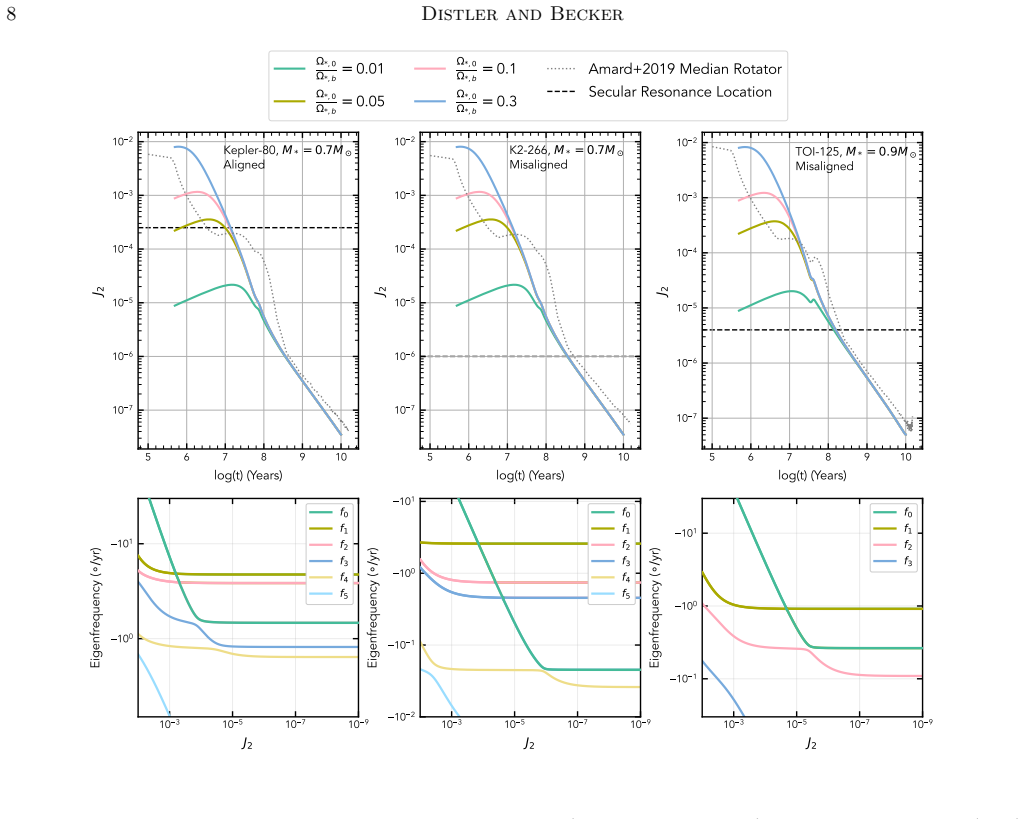
Strictly PIAP systems with regular spacings cannot undergo secular resonance crossings for the expected stellar J2 evolution, and that we instead require the inner planet to migrate inward to undergo this resonance crossing. As a result, there is no inner edge to PIAP systems where systems will always cross a secular resonance and decouple the inner planet. Using expected J2 evolution tracks from stellar evolution models, we find a diversity of expected resonance crossing times, highlighting the ability to test migration pathways and initial stellar obliquities using this framework.
What carries the argument
Laplace-Lagrange secular theory that tracks how changing stellar J2 alters planet precession rates and drives resonance crossings.
If this is right
- Inner-planet migration is required before secular resonance crossing can occur in regular peas-in-a-pod systems.
- Resonance crossing times depend on the star's J2 track and initial obliquity.
- No universal inner boundary exists that forces all peas-in-a-pod systems to decouple their innermost planet.
Where Pith is reading between the lines
- Observed ultra-short-period planets may arise from initial configurations that are not strictly regular or from processes beyond secular resonance.
- Age and inclination measurements in young multi-planet systems could distinguish migration pathways.
Load-bearing premise
Stellar J2 follows the tracks from standard stellar evolution models and initial planet spacings remain strictly regular with no extra perturbations.
What would settle it
Detection of a regularly spaced peas-in-a-pod system whose age exceeds the calculated resonance-crossing time yet shows no inner-planet decoupling or migration.
Figures
read the original abstract
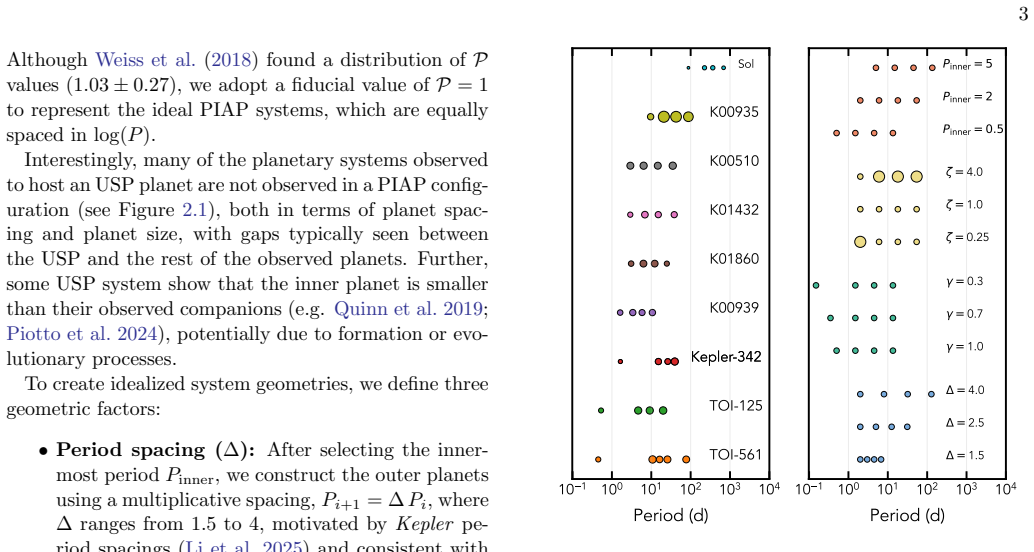
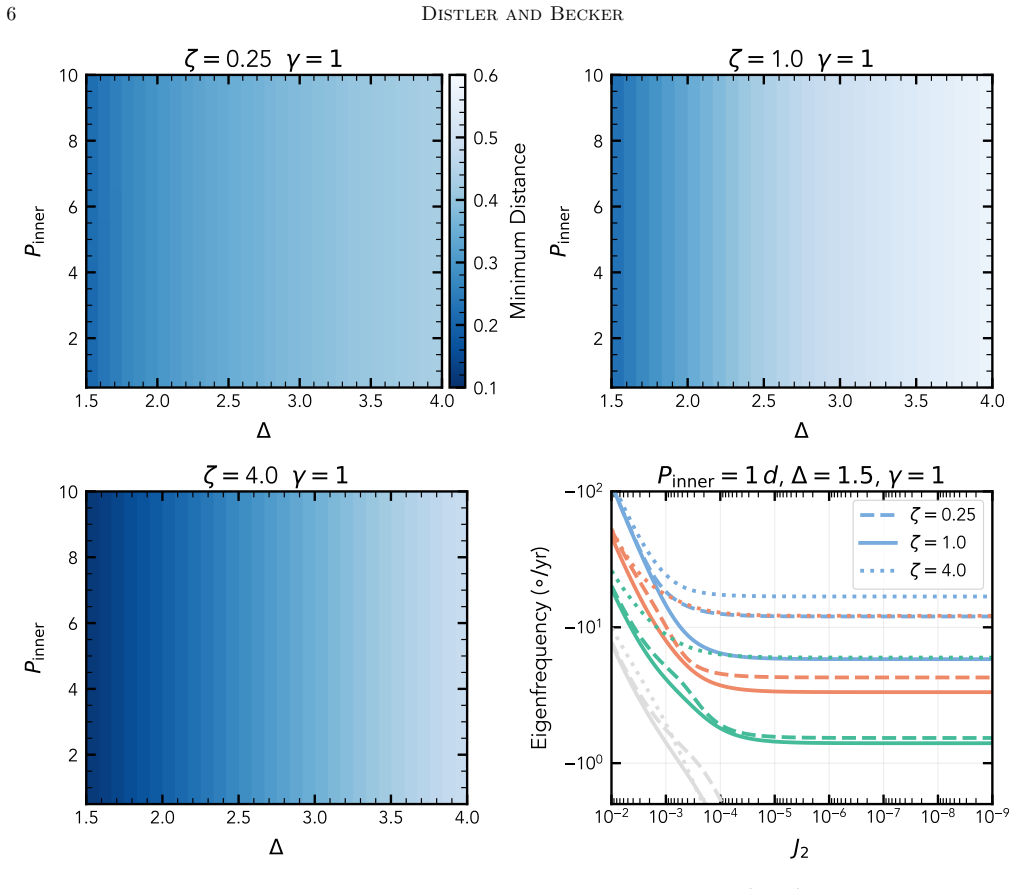
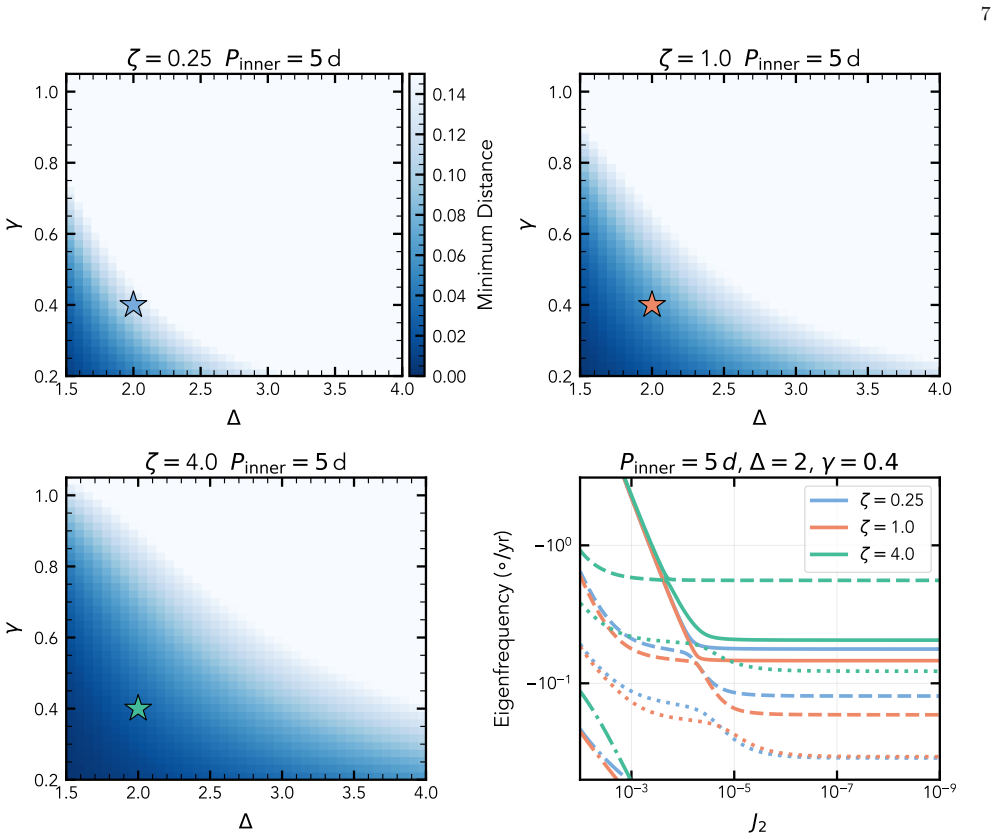
Peas-in-a-Pod (PIAP) systems have been shown to be common across exoplanet systems, with regular planet spacings and similar planet sizes. In contrast, ultra-short-period planets have displayed distinct differences from PIAP systems, including higher mutual inclinations, ages, and planet sizes. Using Laplace-Lagrange secular theory, we investigate the ability of stellar spindown to decouple PIAP systems. We find that strictly PIAP systems with regular spacings cannot undergo secular resonance crossings for the expected stellar $J_2$ evolution, and that we instead require the inner planet to migrate inward to undergo this resonance crossing. As a result, there is no inner edge to PIAP systems where systems will always cross a secular resonance and decouple the inner planet. Using expected $J_2$ evolution tracks from stellar evolution models, we find a diversity of expected resonance crossing times, highlighting the ability to test migration pathways and initial stellar obliquities using this framework.
Editorial analysis
A structured set of objections, weighed in public.
Referee Report
Summary. The paper applies Laplace-Lagrange secular theory to Peas-in-a-Pod (PIAP) systems and concludes that strictly regular planet spacings cannot produce secular resonance crossings under the J2(t) evolution tracks predicted by standard stellar-evolution models. Consequently, an inner planet must migrate inward to experience a resonance crossing, implying that no universal inner edge exists at which all PIAP systems decouple. The work also reports a range of resonance-crossing times that could be used to test migration pathways and initial stellar obliquities.
Significance. If the central claim is robust, the result supplies a dynamical mechanism that can help account for the observed differences in mutual inclination, age, and size between PIAP systems and ultra-short-period planets. The framework is built on standard secular theory and published stellar J2 tracks, which is a methodological strength; the diversity of crossing times offers a concrete, observationally testable prediction.
major comments (2)
- [Abstract and stellar-evolution section] The central claim that regular spacings preclude resonance crossings rests on the specific functional form and timescale of the adopted J2(t) tracks. No sensitivity tests to alternative initial rotation rates, magnetic-braking prescriptions, or non-standard spindown laws are reported; a modest change in the J2 decay rate could move the resonance condition into the regular-spacing regime.
- [Secular-theory methods] The manuscript states that the secular frequencies are computed from Laplace-Lagrange theory with time-dependent J2, yet neither the explicit matrix elements nor the numerical criterion used to identify a resonance crossing are provided. Without these details the assertion that regular spacings never satisfy the crossing condition cannot be independently verified.
minor comments (1)
- Notation for the stellar quadrupole moment should be defined at first use (J2 versus J_2) and kept consistent throughout.
Simulated Author's Rebuttal
We thank the referee for their constructive comments, which help clarify the presentation of our results. We address each major comment below. Revisions will be made to improve reproducibility and to discuss the dependence on stellar models.
read point-by-point responses
-
Referee: [Abstract and stellar-evolution section] The central claim that regular spacings preclude resonance crossings rests on the specific functional form and timescale of the adopted J2(t) tracks. No sensitivity tests to alternative initial rotation rates, magnetic-braking prescriptions, or non-standard spindown laws are reported; a modest change in the J2 decay rate could move the resonance condition into the regular-spacing regime.
Authors: Our central result is that, for the J2(t) evolution predicted by standard stellar models, strictly regular PIAP spacings do not produce secular resonance crossings. We agree that the outcome depends on the adopted spindown law. In revision we will add a short discussion in the stellar-evolution section noting the sensitivity to initial rotation rate and braking prescriptions, with references to alternative models in the literature. Full parameter sweeps lie outside the scope of the present work, but the added text will make the dependence explicit. revision: partial
-
Referee: [Secular-theory methods] The manuscript states that the secular frequencies are computed from Laplace-Lagrange theory with time-dependent J2, yet neither the explicit matrix elements nor the numerical criterion used to identify a resonance crossing are provided. Without these details the assertion that regular spacings never satisfy the crossing condition cannot be independently verified.
Authors: We agree that the explicit matrix and crossing criterion should be provided. In the revised manuscript we will include, in a new appendix, the Laplace-Lagrange secular matrix with the time-dependent J2 contribution and state the numerical criterion used to flag a crossing (a secular eigenfrequency passing through the stellar spin-axis precession rate). These additions will allow independent reproduction of the result that regular spacings do not satisfy the crossing condition. revision: yes
Circularity Check
No significant circularity; derivation uses external J2 tracks and standard secular theory
full rationale
The central claim follows from applying Laplace-Lagrange secular theory to J2 evolution tracks taken from standard stellar evolution models (external inputs). The conclusion that strictly regular PIAP systems do not cross secular resonances is a direct computational outcome of those inputs rather than a redefinition, fitted parameter renamed as prediction, or self-citation chain. No load-bearing steps reduce by construction to the paper's own definitions or prior self-citations.
Axiom & Free-Parameter Ledger
free parameters (1)
- stellar J2 evolution tracks
axioms (1)
- domain assumption Laplace-Lagrange secular theory applies to these multi-planet systems
Reference graph
Works this paper leans on
-
[1]
R., Jackson, B., Johnson, S., et al
Adams, E. R., Jackson, B., Johnson, S., et al. 2021, PSJ, 2, 152, doi: 10.3847/PSJ/ac0ea0
-
[2]
Adams, F. C. 2019, MNRAS, 488, 1446, doi: 10.1093/mnras/stz1832
-
[3]
Adams, F. C., Batygin, K., Bloch, A. M., & Laughlin, G. 2020, MNRAS, 493, 5520, doi: 10.1093/mnras/staa624
-
[4]
Albrecht, S., Winn, J. N., Johnson, J. A., et al. 2012, ApJ, 757, 18, doi: 10.1088/0004-637X/757/1/18
-
[5]
2019, A&A, 631, A77, doi: 10.1051/0004-6361/201935160
Amard, L., Palacios, A., Charbonnel, C., et al. 2019, A&A, 631, A77, doi: 10.1051/0004-6361/201935160
-
[6]
Ballard, S., & Johnson, J. A. 2016, ApJ, 816, 66, doi: 10.3847/0004-637X/816/2/66
-
[7]
Baraffe, I., Homeier, D., Allard, F., & Chabrier, G. 2015, A&A, 577, A42, doi: 10.1051/0004-6361/201425481
work page internal anchor Pith review doi:10.1051/0004-6361/201425481 2015
-
[8]
Batygin, K., Adams, F. C., & Becker, J. 2023, ApJL, 951, L19, doi: 10.3847/2041-8213/acdb5d
-
[9]
Batygin, K., Bodenheimer, P. H., & Laughlin, G. P. 2016, ApJ, 829, 114, doi: 10.3847/0004-637X/829/2/114
-
[10]
2020, AJ, 160, 254, doi: 10.3847/1538-3881/abbad3
Becker, J., Batygin, K., Fabrycky, D., et al. 2020, AJ, 160, 254, doi: 10.3847/1538-3881/abbad3
-
[11]
2025, Nature, 644, 356, doi: 10.1038/s41586-025-09324-0
Wu, Y.-L. 2025, Nature, 644, 356, doi: 10.1038/s41586-025-09324-0
-
[12]
Blandford, R. D., & Payne, D. G. 1982, MNRAS, 199, 883, doi: 10.1093/mnras/199.4.883
-
[13]
Borucki, W. J., Koch, D., Basri, G., et al. 2010, Science, 327, 977, doi: 10.1126/science.1185402
-
[14]
Brefka, L., & Becker, J. C. 2021, AJ, 162, 242, doi: 10.3847/1538-3881/ac2a32
-
[15]
Charbonneau, D., Brown, T. M., Latham, D. W., & Mayor, M. 2000, ApJL, 529, L45, doi: 10.1086/312457
-
[16]
2022, ApJ, 930, 58, doi: 10.3847/1538-4357/ac6024
Chen, C., Li, G., & Petrovich, C. 2022, ApJ, 930, 58, doi: 10.3847/1538-4357/ac6024
-
[17]
2017, ApJ, 834, 17, doi: 10.3847/1538-4357/834/1/17
Chen, J., & Kipping, D. 2017, ApJ, 834, 17, doi: 10.3847/1538-4357/834/1/17
-
[18]
2023, A&A, 674, A67, doi: 10.1051/0004-6361/202346250
Claret, A. 2023, A&A, 674, A67, doi: 10.1051/0004-6361/202346250
-
[19]
Cranmer, S. R., & Saar, S. H. 2011, ApJ, 741, 54, doi: 10.1088/0004-637X/741/1/54
-
[20]
Dai, F., Masuda, K., & Winn, J. N. 2018, ApJL, 864, L38, doi: 10.3847/2041-8213/aadd4f D’Alessio, P., Cant¨ o, J., Calvet, N., & Lizano, S. 1998, ApJ, 500, 411, doi: 10.1086/305702
-
[21]
H., Naoz, S., Li, G., & Inzunza, N
Faridani, T. H., Naoz, S., Li, G., & Inzunza, N. 2023, ApJ, 956, 90, doi: 10.3847/1538-4357/acf378
-
[22]
H., Naoz, S., Li, G., Rice, M., & Inzunza, N
Faridani, T. H., Naoz, S., Li, G., Rice, M., & Inzunza, N. 2025a, ApJ, 978, 18, doi: 10.3847/1538-4357/ad8ebf
-
[23]
H., Naoz, S., Li, G., Rice, M., & Lubin, J
Faridani, T. H., Naoz, S., Li, G., Rice, M., & Lubin, J. 2025b, ApJL, 990, L21, doi: 10.3847/2041-8213/adfa8a
-
[24]
2023, Nature, 614, 670, doi: 10.1038/s41586-022-05674-1
Feinstein, A. D., Radica, M., Welbanks, L., et al. 2023, Nature, 614, 670, doi: 10.1038/s41586-022-05674-1
-
[25]
Fulton, B. J., Petigura, E. A., Howard, A. W., et al. 2017, AJ, 154, 109, doi: 10.3847/1538-3881/aa80eb 12Distler and Becker
-
[26]
Ghosh, P., & Lamb, F. K. 1979, ApJ, 234, 296, doi: 10.1086/157498
-
[27]
Ginzburg, S., Schlichting, H. E., & Sari, R. 2018, MNRAS, 476, 759, doi: 10.1093/mnras/sty290
-
[28]
1966, Icarus, 5, 375, doi: 10.1016/0019-1035(66)90051-0
Goldreich, P., & Soter, S. 1966, Icarus, 5, 375, doi: 10.1016/0019-1035(66)90051-0
-
[29]
Goyal, A. V., & Wang, S. 2025, AJ, 169, 191, doi: 10.3847/1538-3881/adb487
-
[30]
Harris, C. R., Millman, K. J., van der Walt, S. J., et al. 2020, Nature, 585, 357, doi: 10.1038/s41586-020-2649-2
-
[31]
2025, ApJL, 984, L3, doi: 10.3847/2041-8213/adbf21
Hon, M., Rappaport, S., Shporer, A., et al. 2025, ApJL, 984, L3, doi: 10.3847/2041-8213/adbf21
-
[32]
Howe, A. R., Becker, J. C., & Adams, F. C. 2026, AJ, 171, 148, doi: 10.3847/1538-3881/ae3aa6
-
[33]
Howe, A. R., Becker, J. C., Stark, C. C., & Adams, F. C. 2025, AJ, 169, 149, doi: 10.3847/1538-3881/adabdb
-
[34]
Hunter, J. D. 2007, Computing in Science & Engineering, 9, 90, doi: 10.1109/MCSE.2007.55
-
[35]
2008, ApJ, 678, 1396, doi: 10.1086/529187
Jackson, B., Greenberg, R., & Barnes, R. 2008, ApJ, 678, 1396, doi: 10.1086/529187
-
[36]
2024, AJ, 167, 254, doi: 10.3847/1538-3881/ad3804
Lam, C., & Ballard, S. 2024, AJ, 167, 254, doi: 10.3847/1538-3881/ad3804
-
[37]
Lee, E. J., & Chiang, E. 2017, ApJ, 842, 40, doi: 10.3847/1538-4357/aa6fb3
-
[38]
2020, ApJL, 890, L31, doi: 10.3847/2041-8213/ab72f4
Li, G., Dai, F., & Becker, J. 2020, ApJL, 890, L31, doi: 10.3847/2041-8213/ab72f4
-
[39]
2025, AJ, 169, 323, doi: 10.3847/1538-3881/adce0c
Li, R., Chiang, E., Choksi, N., & Dai, F. 2025, AJ, 169, 323, doi: 10.3847/1538-3881/adce0c
-
[40]
R., Deming, D., Albert, L., et al
Louie, D. R., Deming, D., Albert, L., et al. 2018, PASP, 130, 044401, doi: 10.1088/1538-3873/aaa87b
-
[41]
MacDonald, M. G., Shakespeare, C. J., & Ragozzine, D. 2021, AJ, 162, 114, doi: 10.3847/1538-3881/ac12d5
-
[42]
G., Ragozzine, D., Fabrycky, D
MacDonald, M. G., Ragozzine, D., Fabrycky, D. C., et al. 2016, AJ, 152, 105, doi: 10.3847/0004-6256/152/4/105
-
[43]
2025, ApJ, 987, 30, doi: 10.3847/1538-4357/add884
MacLean, T., & Becker, J. 2025, ApJ, 987, 30, doi: 10.3847/1538-4357/add884
-
[44]
2015, ApJL, 799, L23, doi: 10.1088/2041-8205/799/2/L23 —
Chabrier, G. 2015, ApJL, 799, L23, doi: 10.1088/2041-8205/799/2/L23 —. 2019, ApJL, 870, L27, doi: 10.3847/2041-8213/aafa1b
-
[45]
Millholland, S. C., & Spalding, C. 2020, ApJ, 905, 71, doi: 10.3847/1538-4357/abc4e5
-
[46]
2016, ApJ, 832, 34, doi: 10.3847/0004-637X/832/1/34
Moriarty, J., & Ballard, S. 2016, ApJ, 832, 34, doi: 10.3847/0004-637X/832/1/34
-
[47]
Morton, T. D., Bryson, S. T., Coughlin, J. L., et al. 2016, ApJ, 822, 86, doi: 10.3847/0004-637X/822/2/86
-
[48]
Murray, C. D., & Dermott, S. F. 1999, Solar System Dynamics, doi: 10.1017/CBO9781139174817
-
[49]
D., Gandolfi, D., Armstrong, D
Nielsen, L. D., Gandolfi, D., Armstrong, D. J., et al. 2020, MNRAS, 492, 5399, doi: 10.1093/mnras/staa197
-
[50]
2025, AJ, 169, 90, doi: 10.3847/1538-3881/ad91a7
Ofir, A., Yoffe, G., & Aharonson, O. 2025, AJ, 169, 90, doi: 10.3847/1538-3881/ad91a7
-
[51]
Owen, J. E., & Wu, Y. 2017, ApJ, 847, 29, doi: 10.3847/1538-4357/aa890a pandas development team, T. 2020, pandas-dev/pandas: Pandas, latest, Zenodo, doi: 10.5281/zenodo.3509134
-
[52]
Petigura, E. A., Howard, A. W., Marcy, G. W., et al. 2017, AJ, 154, 107, doi: 10.3847/1538-3881/aa80de
-
[53]
2019, AJ, 157, 180, doi: 10.3847/1538-3881/ab0e0a
Petrovich, C., Deibert, E., & Wu, Y. 2019, AJ, 157, 180, doi: 10.3847/1538-3881/ab0e0a
-
[54]
2024, MNRAS, 535, 2763, doi: 10.1093/mnras/stae2440
Piotto, G., Zingales, T., Borsato, L., et al. 2024, MNRAS, 535, 2763, doi: 10.1093/mnras/stae2440
-
[55]
2019, MNRAS, 488, 3568, doi: 10.1093/mnras/stz1817
Pu, B., & Lai, D. 2019, MNRAS, 488, 3568, doi: 10.1093/mnras/stz1817
-
[56]
Quinn, S. N., Becker, J. C., Rodriguez, J. E., et al. 2019, AJ, 158, 177, doi: 10.3847/1538-3881/ab3f2b
-
[57]
Journal of Astronomical Telescopes, Instruments, and Systems , year = 2015, month = jan, volume =
Ricker, G. R., Winn, J. N., Vanderspek, R., et al. 2015, Journal of Astronomical Telescopes, Instruments, and Systems, 1, 014003, doi: 10.1117/1.JATIS.1.1.014003
work page internal anchor Pith review doi:10.1117/1.jatis.1.1.014003 2015
-
[58]
Rodriguez, J. E., Becker, J. C., Eastman, J. D., et al. 2018, AJ, 156, 245, doi: 10.3847/1538-3881/aae530
-
[59]
Sahu, K. C., Casertano, S., Bond, H. E., et al. 2006, Nature, 443, 534, doi: 10.1038/nature05158
-
[60]
Sanchis-Ojeda, R., Rappaport, S., Winn, J. N., et al. 2014, ApJ, 787, 47, doi: 10.1088/0004-637X/787/1/47 —. 2013, ApJ, 774, 54, doi: 10.1088/0004-637X/774/1/54
-
[61]
Schlaufman, K. C., Lin, D. N. C., & Ida, S. 2010, ApJL, 724, L53, doi: 10.1088/2041-8205/724/1/L53
-
[62]
Schmidt, S. P., Schlaufman, K. C., & Hamer, J. H. 2024, AJ, 168, 109, doi: 10.3847/1538-3881/ad5d76
-
[63]
Seager, S., & Sasselov, D. D. 2000, ApJ, 537, 916, doi: 10.1086/309088
-
[64]
Shallue, C. J., & Vanderburg, A. 2018, AJ, 155, 94, doi: 10.3847/1538-3881/aa9e09
-
[65]
2016, ApJ, 830, 5, doi: 10.3847/0004-637X/830/1/5
Spalding, C., & Batygin, K. 2016, ApJ, 830, 5, doi: 10.3847/0004-637X/830/1/5
-
[66]
2025, Nature Astronomy, 9, 995, doi: 10.1038/s41550-025-02539-1
Tu, P.-W., Xie, J.-W., Chen, D.-C., & Zhou, J.-L. 2025, Nature Astronomy, 9, 995, doi: 10.1038/s41550-025-02539-1
-
[67]
Virtanen, P., Gommers, R., Oliphant, T. E., et al. 2020, Nature Methods, 17, 261, doi: 10.1038/s41592-019-0686-2
-
[68]
2022, ApJL, 941, L31, doi: 10.3847/2041-8213/aca47e
Vissapragada, S., Chontos, A., Greklek-McKeon, M., et al. 2022, ApJL, 941, L31, doi: 10.3847/2041-8213/aca47e
-
[69]
R., Colombo, G., & Franklin, F
Ward, W. R., Colombo, G., & Franklin, F. A. 1976, Icarus, 28, 441, doi: 10.1016/0019-1035(76)90117-2
-
[70]
M., Millholland, S
Weiss, L. M., Millholland, S. C., Petigura, E. A., et al. 2023, in Astronomical Society of the Pacific Conference
2023
-
[71]
534, Protostars and Planets VII, ed
Series, Vol. 534, Protostars and Planets VII, ed. S. Inutsuka, Y. Aikawa, T. Muto, K. Tomida, & M. Tamura, 863, doi: 10.48550/arXiv.2203.10076 13
-
[72]
Weiss, L. M., Marcy, G. W., Petigura, E. A., et al. 2018, AJ, 155, 48, doi: 10.3847/1538-3881/aa9ff6
-
[73]
Weisserman, D., Becker, J. C., & Vanderburg, A. 2023, AJ, 165, 89, doi: 10.3847/1538-3881/acac80
-
[74]
N., Sanchis-Ojeda, R., & Rappaport, S
Winn, J. N., Sanchis-Ojeda, R., & Rappaport, S. 2018, NewAR, 83, 37, doi: 10.1016/j.newar.2019.03.006
discussion (0)
Sign in with ORCID, Apple, or X to comment. Anyone can read and Pith papers without signing in.