REVIEW 5 major objections 5 minor 28 cited by
TWIST: Teleoperated Whole-Body Imitation System
T0 review · 5 major / 5 minor · reviewed 2026-08-16 · deepseek-v4-flash
Pith's one-line read A single neural network controller can teleoperate a humanoid robot through whole-body skills by tracking live human motion.
desk verdict A credible integrated teleoperation system with impressive demos, but the real-time claim rests on ablations that never inject the measured 0.9s latency. read the letter →
The pith
A machine-rendered reading of the paper's core claim, the machinery that carries it, and where it could break.
The reading
What carries the argument
The load-bearing mechanism is a teacher–student distillation pair. The teacher policy is trained with proximal policy optimization (PPO) on a tracking reward that includes future reference motion frames spanning two seconds, which lets it plan smooth motions; the deployable student policy observes only the current retargeted frame plus proprioception and is optimized with a hybrid loss $L(\pi_{\mathrm{stu}}) = L_{\mathrm{RL}}(\pi_{\mathrm{stu}}) + \lambda D_{\mathrm{KL}}(\pi_{\mathrm{stu}} \| \pi_{\mathrm{tea}})$, with $\lambda$ annealed during training. Around this sits an online retargeter that converts 120 Hz motion-capture data into 50 Hz robot joint-position and root-velocity targets, optimized to jointly fit 3D positions and orientations, and a dataset mixture of offline retargeted public motion clips and small in-house clips captured under realistic teleoperation noise.
What would settle it
Add an extra 0.5 seconds of latency to the retargeted reference stream during a live teleoperation session and measure the robot's tracking error; if the robot cannot keep balance or the error grows well beyond the tracking reward's acceptable margin, the zero-shot robustness claim fails.
Extended reading notes
Core claim
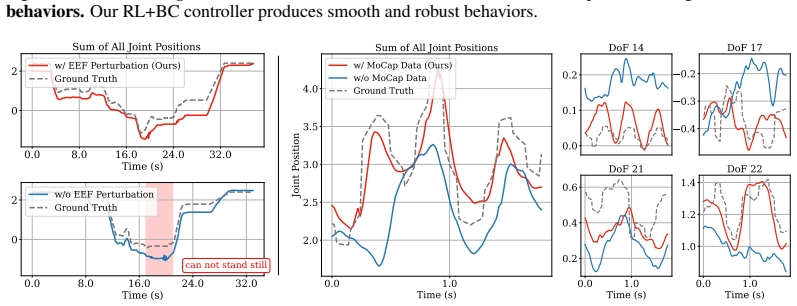
On its own terms, the paper establishes that a single unified whole-body controller can drive a 29-degree-of-freedom humanoid robot to track retargeted human motion in real time, producing coordinated whole-body skills that earlier teleoperation systems split into separate locomotion and manipulation controllers. The core result is the two-stage training recipe: a privileged reinforcement-learning teacher trained with access to future reference frames is distilled into a deployable student via an RL plus behavior-cloning objective, and the student, using only proprioception and one current reference frame, tracks unseen motions well enough for real-world use. The paper further reports that mixing roughly 150 in-house motion-capture clips recorded under online retargeting conditions into a large offline dataset markedly improves tracking, and that forcing contact during training via end-effector perturbations is needed for tasks that involve lifting or pushing objects.
Load-bearing premise
The whole system rests on the assumption that the online retargeter can convert noisy 120 Hz motion-capture frames into smooth, physically feasible 50 Hz robot joint targets, and that the single-frame student policy can track those live targets without any additional real-world training despite the measured end-to-end delay of about 0.9 seconds.
Editorial extensions
If this is right
- A single controller, rather than task-specific modules, can serve as the low-level tracking layer for many humanoid skills; task variation enters through the human's motion rather than through controller switching.
- Whole-body teleoperation data collected this way is a candidate training source for higher-level visuomotor or language-conditioned policies.
- Adding a small amount of noisy, domain-matched motion data yields large tracking gains, suggesting data-quality matching can matter more than dataset size.
- The same training pipeline transfers to a second humanoid platform in simulation, indicating the method is not tied to one robot model.
- Contact-rich tasks require explicit training-time perturbations; without them the policy drifts during stationary poses.
Reading between the lines
- Because the student tracks only a single current reference frame, the same controller could likely be driven by a predictive model of future human motion, which would attack the measured 0.9 second delay without changing the policy.
- The retargeting step is the dominant latency component; a faster or learned retargeter could cut end-to-end lag substantially and is a concrete, testable improvement.
- Replacing the motion-capture suit with monocular RGB pose estimation would directly test whether the controller is robust to added pose noise, while addressing the paper's stated portability limitation.
- The reported failure mode of motor overheating during crouching suggests that thermal limits, not control policy limits, may be the near-term bottleneck for whole-body data collection.
Signed reviews
Editorial analysis
A structured set of objections, weighed in public.
Referee Report
Summary. The paper presents TWIST, a teleoperation system that streams human motion-capture data at 120 Hz, retargets it to humanoid joint targets at 50 Hz, and controls a 29-DoF Unitree G1 humanoid with a single neural network policy trained in simulation using a two-stage teacher-student RL+BC pipeline. The system is claimed to achieve whole-body manipulation, legged manipulation, locomotion, and expressive motions in real time. The paper also reports ablations on the RL+BC objective, in-house MoCap data, end-effector perturbations, and online retargeting, together with a sim-to-sim transfer to the Booster T1 robot.
Significance. If the real-world capabilities hold, TWIST would be a notable system contribution: a single unified controller covering diverse whole-body skills, with a plausible and well-structured training recipe. The paper's strengths include the systematic ablation organization, the sim-to-sim generalization check on a second robot, and the concrete design techniques (future-frame teacher, RL+BC distillation, in-house online MoCap data, end-effector perturbations). However, the central real-time teleoperation claim currently rests on qualitative video demonstrations and on quantitative evaluations that omit the measured 0.9 s system latency. The scientific value is therefore conditional on additional closed-loop and statistical evidence.
major comments (5)
- [Section 3.2, Section 4.3] The student policy is trained to track the current (undelayed) retargeted reference frame, with the KL term in Eq. (1) pushing it toward a teacher that sees future frames, while live teleoperation is reported to have an end-to-end delay of roughly 0.9 s (0.7 s retargeting + 0.2 s inference). The quantitative evaluations in Figures 6-8 use recorded references without injecting this delay, so the paper never verifies that the single-frame student policy remains stable and accurate when its input is a 0.7-0.9 s stale pose. Since the videos cannot separate the controller's tracking ability from the human operator's compensatory behavior, the central 'real-time teleoperation' claim is not yet supported. Please add a latency-injection evaluation, for example shifting the reference stream by the measured delays during simulated rollouts or replaying delayed references, and report closed-loop teleoperation metrics.
- [Section 4.2, Figures 6 and 8] The ablation plots report single trajectories or single summary values without error bars, standard deviations, or the number of seeds and rollouts. Statements such as 'significantly outperforms' (Key Finding 1) and 'substantially reduces tracking errors' (Key Finding 2) therefore lack statistical support. Report mean +/- standard deviation over at least three training seeds and specify the number of test clips and rollouts per condition.
- [Section 4.2, Key Finding 2] The test set used to demonstrate the benefit of in-house MoCap data is collected with the same online MoCap and retargeting setup that motivated adding these data in the first place. This confound makes it unclear whether the improvement reflects better generalization or simply a better match to the test-time data distribution. Please add evaluation on independently collected held-out sessions, for example different operators or different days, or explicitly quantify the distribution shift.
- [Section 4.1 and Figure 2] The main real-world results are presented only as qualitative video demonstrations. For a system whose headline contribution is real-world teleoperation, quantitative evaluation is needed: per-task success rates with task definitions and number of trials, measured tracking error during closed-loop teleoperation, and ideally a comparison against a latency-compensated baseline. Without these, the claim that the controller, rather than the human operator's real-time compensation, is responsible for the demonstrated skills is not quantitatively assessed.
- [Reference [11]] The online retargeter improvement (Section 3.1 and Figure 8, left) is attributed to [11], cited as 'A. Authors ... Anonymous submission, under review'. This citation is not verifiable by readers, and the manuscript does not describe the optimization objective in enough detail to reproduce the improvement. Please either include the full retargeting formulation in the paper or replace the anonymous citation with a public, citable version.
minor comments (5)
- [Figure 6 caption] The caption contains the typo 'unsessen motions'; it should read 'unseen motions'.
- [Figure 7 (left)] The axes of the real-world rollout curves are not labeled; please add axis labels, units, and a legend so the curves can be interpreted.
- [Table 1] The 'Feet Air Time 5.0' entry is listed under 'Penalty Terms' but has a positive weight and appears to be a reward term; please relocate or relabel it.
- [Section 4.2, Key Finding 1] The heading 'RL+BC >> RL >> BC (DAgger)' conflates behavior cloning with DAgger, which is an online interactive imitation algorithm; please clarify the exact baselines compared.
- [Section 3.3] The phrase 'on an Nvidia RTX 4090 GPU' should be 'on an Nvidia RTX 4090 GPU'; also note that policy inference is reported at 50 Hz, so stating the GPU used is helpful only if the measurement method is given.
Circularity Check
No significant circularity: TWIST's claims rest on held-out ablations and real-robot deployment; the latency mismatch is a robustness risk, not circularity.
full rationale
TWIST's derivation chain is empirical: stage 1 curates humanoid motion data by retargeting, stage 2 trains a teacher-student whole-body controller with RL+BC, and stage 3 deploys the student policy zero-shot on a real humanoid. Each claimed improvement—privileged future frames, in-house MoCap data, end-effector perturbations, and the improved online retargeter—is supported by quantitative ablations on a held-out 50-clip MoCap test set not used in training, with additional sim-to-sim transfer to MuJoCo and real-robot demonstrations. None of these evaluations reduces to its input by construction: the student policy's tracking error is measured against retargeted references that are not identical to the training targets, and the in-house-data ablation compares controllers trained with and without that data on the same held-out test set. The measured 0.9 s teleoperation delay is a genuine correctness/robustness risk, because training uses synchronous reference frames while live deployment observes delayed frames, but that is an unverified transfer assumption rather than a circular derivation. Reference [11] is an anonymous under-review citation used for the online retargeter baseline; even if it overlaps with the authors, it is not the load-bearing step of the central argument, so it does not raise the circularity score.
Assumptions & free parameters
free parameters (5)
- Reward weights (Table 1) =
hand-chosen
- Domain randomization ranges (Table 2) =
hand-chosen ranges
- Teacher future horizon =
2 seconds
- KL weight lambda schedule =
gradually reduced
- End-effector perturbation range =
[0, 20] N
assumptions (4)
- domain assumption Human motion capture data can be retargeted to feasible humanoid joint trajectories by the offline and online retargeters.
- domain assumption A policy trained in simulation with the domain randomization ranges in Table 2 transfers zero-shot to the real Unitree G1.
- domain assumption The tracking reward in Table 1 is a sufficient objective for producing contact-rich whole-body behaviors without explicitly modeling contact forces.
- domain assumption Distilling the privileged teacher into a single-frame student policy via PPO plus KL divergence (Equation 1) preserves enough information for zero-shot deployment.
Cite this review
Pith. "Pith review of TWIST: Teleoperated Whole-Body Imitation System." pith.science (2026). https://pith.science/paper/NKZNQTGU
@misc{pith2026250502833,
  author       = {Pith},
  title        = {Pith review of: TWIST: Teleoperated Whole-Body Imitation System},
  year         = {2026},
  howpublished = {\url{https://pith.science/paper/NKZNQTGU}},
  note         = {Machine review of arXiv:2505.02833}
}
read the original abstract
Teleoperating humanoid robots in a whole-body manner marks a fundamental step toward developing general-purpose robotic intelligence, with human motion providing an ideal interface for controlling all degrees of freedom. Yet, most current humanoid teleoperation systems fall short of enabling coordinated whole-body behavior, typically limiting themselves to isolated locomotion or manipulation tasks. We present the Teleoperated Whole-Body Imitation System (TWIST), a system for humanoid teleoperation through whole-body motion imitation. We first generate reference motion clips by retargeting human motion capture data to the humanoid robot. We then develop a robust, adaptive, and responsive whole-body controller using a combination of reinforcement learning and behavior cloning (RL+BC). Through systematic analysis, we demonstrate how incorporating privileged future motion frames and real-world motion capture (MoCap) data improves tracking accuracy. TWIST enables real-world humanoid robots to achieve unprecedented, versatile, and coordinated whole-body motor skills--spanning whole-body manipulation, legged manipulation, locomotion, and expressive movement--using a single unified neural network controller. Our project website: https://humanoid-teleop.github.io
Figures


Figures from the paper (5 more)




Forward citations
Cited by 28 Pith papers
-
RoboReact: Agentic Skill Distillation from Generated Egocentric Videos for Generalizable Whole-Body Manipulation
From a single egocentric RGB-D frame and a language instruction, RoboReact generates a human manipulation video, distills it into object-relative keyframe skills, refines them through a vision-language-model trial loo...
-
RynnWorld-Teleop: An Action-Conditioned World Model for Digital Teleoperation
A real-time robot-centric video world model driven by depth-aware hand skeletons generates imitation-learning trajectories that support zero-shot real-robot transfer and improve policies when mixed with real data.
-
HumanTracker: Towards Comprehensive and Human-Aligned Motion Tracking Benchmark
HumanTracker introduces a 153-hour categorized humanoid tracking benchmark and a preference-trained metric, HumanScore, that agrees with human judgments better than kinematic error metrics.
-
Learning Panorama-Aware VLA for Mobile Manipulation with Whole-Body Teleoperation
Adding a panoramic camera feed to a vision-language-action policy raises end-to-end success on four real-world mobile two-arm tasks from 30% to 73%.
-
Teleopit: A Full-Embodiment Humanoid Teleoperation System
Teleopit combines VR body, hand, and head tracking with a learned whole-body tracker and a cross-hand retargeter, and teleop-collected demos train ACT and GR00T policies to around 90 to 95 percent success on a humanoi...
-
A Change of Frame Makes Balance Observable: Distillation-Free Humanoid Single-Leg Stance
A support-relative dynamic capture-point observation, reconstructible without base linear velocity, lets a humanoid policy hold clean single-leg balance at 86/90 in simulation and deploy on a Unitree G1 without distillation.
-
What Matters in Humanoid General Motion Tracking? An Empirical Study
A controlled ablation of humanoid motion-tracking pipelines shows that explicit reference joint velocities and a short observation history improve tracking, while residual actions and teacher-student training yield on...
-
Scaling Behavior Foundation Model for Humanoid Robots
A scaling recipe for humanoid behavior foundation models—global-frame motion tracking, on-policy data quantity plus reference diversity, and a transformer with hyperspherical latents—cuts global tracking error by roug...
-
EgoHTR: Egocentric 4D Demonstrations of Human Terrain Traversal
EgoHTR is a 55-sequence, 150k-frame egocentric 4D human-terrain dataset with a reconstruction pipeline, MoCap-validated benchmark, and perceptive locomotion policies deployed on a Unitree G1.
-
ContactMimic: Humanoid Object Interaction via Contact Control
A humanoid tracking policy is trained with contact-following rewards and trajectory augmentation to decouple physical contact from keypoint geometry, enabling runtime contact control.
-
ThorArena: Benchmarking Humanoid Physical Interaction with Human Motion-Force Demonstrations
A force-aware humanoid benchmark pairs synchronized human motion-force data with simulation-based force replay to evaluate whole-body control policies under realistic physical disturbances.
-
Kinodynamic Motion Retargeting for Humanoid Locomotion via Multi-Contact Whole-Body Trajectory Optimization
A physics-aware motion-retargeting pipeline that uses ground-reaction-force-derived heel-toe contacts produces dynamically feasible humanoid references and improves downstream imitation learning.
-
Distinguishing Imitation Error from Intrinsic Motion Learning Difficulty
A physics-based score (MDS) predicts how hard a motion is for a humanoid to imitate by measuring how much joint torques must change under small pose perturbations.
-
Thor: Towards Human-Level Whole-Body Reactions for Intense Contact-Rich Environments
A decoupled whole-body RL policy with a force-based lean reward enables a Unitree G1 humanoid to pull with up to 167.7 N, beating prior controllers by 69–75%.
-
PHUMA: Physically Reliable Humanoid Locomotion Dataset
PHUMA is a curated 73-hour humanoid locomotion corpus whose physical-reliability metrics are partly defined by the same losses used to optimize it, and whose imitation success claims are confounded by in-distribution ...
-
A Scalable Whole-body Motion Transfer via Implicit Kinodynamic Motion Retargeting
A neural retargeting pipeline maps human motion to humanoid robot motion at 5000+ frames per second using a shared latent space and physics-based fine-tuning, filtering noise and producing physically feasible trajectories.
-
HITTER: A HumanoId Table TEnnis Robot via Hierarchical Planning and Learning
A humanoid robot with a model-based planner and a reinforcement-learning controller returns table tennis balls and sustained a 106-shot rally against a human.
-
KungfuBot: Physics-Based Humanoid Whole-Body Control for Learning Highly-Dynamic Skills
A robot control method that adaptively tightens motion-tracking reward tolerances achieves lower tracking errors on dynamic skills and transfers zero-shot to a real humanoid.
-
SkillBlender: Towards Versatile Humanoid Whole-Body Loco-Manipulation via Skill Blending
SkillBlender pretrains reusable goal-conditioned skills and blends them with softmax per-joint weights to solve simulated humanoid loco-manipulation tasks with one or two reward terms.
-
Event-Based Upper-Body Humanoid Teleoperation Under Challenging Illumination
An event-camera-based pipeline for upper-body human-to-humanoid teleoperation achieves 23–34 ms end-to-end latency and more robust tracking than RGB under low light, backlight, and fast motion.
-
Semantic Audio-driven Understanding for Dynamic Humanoid Whole Body Control
A multi-modal audio router maps streaming music and speech to imitation-learned whole-body policies for a Unitree G1 humanoid, achieving 84.8% chunk-level retrieval accuracy in simulation.
-
The Latent Color Subspace: Emergent Order in High-Dimensional Chaos
FLUX.1’s VAE latent space contains an interpretable Hue–Saturation–Lightness structure that enables training-free color prediction and control via closed-form latent edits.
-
RobotDancing: Residual-Action Reinforcement Learning Enables Robust Long-Horizon Humanoid Motion Tracking
Residual-action reinforcement learning, with selective corrections on hip and knee pitch joints, enables zero-shot long-horizon dance tracking on real humanoid robots.
-
HERMES: Human-to-Robot Embodied Learning from Multi-Source Motion Data for Mobile Dexterous Manipulation
HERMES converts a single human motion demonstration into a deployable mobile bimanual dexterous manipulation policy, using RL, depth-image distillation, and closed-loop PnP pose refinement.
-
Switch4EAI: Leveraging Console Game Platform for Benchmarking Robotic Athletics
Switch4EAI uses Just Dance on a Nintendo Switch as a benchmark: a Unitree G1 robot scored 5,707 versus a human's 9,361 on three routines.
-
GBC: Generalized Behavior-Cloning Framework for Whole-Body Humanoid Imitation
GBC unifies MoCap retargeting and imitation learning into one framework that trains whole-body humanoid policies across multiple robot morphologies in simulation.
-
Beyond Topology: A Morphological Symmetry Graph Representation for Locomotion Policy Learning
Encoding the robot's left-right symmetry and joint connectivity directly into a policy network enforces mirror symmetry by construction, improving out-of-distribution command tracking on quadruped robots.
-
Feature-Based vs. GAN-Based Learning from Demonstrations: When and Why
Feature-based and GAN-based imitation learning should be selected by task priorities (fidelity, diversity, interpretability, adaptability), not by paradigm loyalty.
Reference graph
Works this paper leans on
-
[11]
A. Authors. Mind the mapping: How motion retargeting choices impact sim2real success. Anonymous submission, 2025. Under review
work page 2025
- [1]
-
[2]
Dafarra, U
S. Dafarra, U. Pattacini, G. Romualdi, L. Rapetti, R. Grieco, K. Darvish, G. Milani, E. Valli, I. Sorrentino, P. M. Viceconte, et al. icub3 avatar system: Enabling remote fully immersive embodiment of humanoid robots. Science Robotics, 9(86):eadh3834, 2024
2024
-
[3]
L. Penco, B. Cl ´ement, V . Modugno, E. M. Hoffman, G. Nava, D. Pucci, N. G. Tsagarakis, J.-B. Mouret, and S. Ivaldi. Robust real-time whole-body motion retargeting from human to humanoid. In 2018 IEEE-RAS 18th International Conference on Humanoid Robots (Hu- manoids), pages 425–432. IEEE, 2018
work page 2018
-
[4]
Darvish, L
K. Darvish, L. Penco, J. Ramos, R. Cisneros, J. Pratt, E. Yoshida, S. Ivaldi, and D. Pucci. Teleoperation of humanoid robots: A survey. IEEE Transactions on Robotics , 39(3):1706– 1727, 2023
2023
-
[5]
K. Darvish, Y . Tirupachuri, G. Romualdi, L. Rapetti, D. Ferigo, F. J. A. Chavez, and D. Pucci. Whole-body geometric retargeting for humanoid robots. In2019 IEEE-RAS 19th International Conference on Humanoid Robots (Humanoids), pages 679–686. IEEE, 2019
work page 2019
-
[6]
Z. He, K. Lei, Y . Ze, K. Sreenath, Z. Li, and H. Xu. Learning visual quadrupedal loco- manipulation from demonstrations. arXiv preprint arXiv:2403.20328, 2024
arXiv 2024
-
[7]
Z. Fu, Q. Zhao, Q. Wu, G. Wetzstein, and C. Finn. Humanplus: Humanoid shadowing and imitation from humans. In Conference on Robot Learning (CoRL), 2024
2024
Show all 49 references
-
[8]
T. He, Z. Luo, X. He, W. Xiao, C. Zhang, W. Zhang, K. Kitani, C. Liu, and G. Shi. Omnih2o: Universal and dexterous human-to-humanoid whole-body teleoperation and learning. arXiv preprint arXiv:2406.08858, 2024
2024 arXiv
-
[9]
T. He, W. Xiao, T. Lin, Z. Luo, Z. Xu, Z. Jiang, J. Kautz, C. Liu, G. Shi, X. Wang, et al. Hover: Versatile neural whole-body controller for humanoid robots.arXiv preprint arXiv:2410.21229, 2024
2024 arXiv
-
[10]
Koenemann, F
J. Koenemann, F. Burget, and M. Bennewitz. Real-time imitation of human whole-body mo- tions by humanoids. In 2014 IEEE International Conference on Robotics and Automation (ICRA), pages 2806–2812. IEEE, 2014
2014
-
[12]
Z. Chen, X. He, Y .-J. Wang, Q. Liao, Y . Ze, Z. Li, S. S. Sastry, J. Wu, K. Sreenath, S. Gupta, et al. Learning smooth humanoid locomotion through lipschitz-constrained policies. arXiv preprint arXiv:2410.11825, 2024
2024 arXiv
-
[13]
Gu, Y .-J
X. Gu, Y .-J. Wang, X. Zhu, C. Shi, Y . Guo, Y . Liu, and J. Chen. Advancing humanoid loco- motion: Mastering challenging terrains with denoising world model learning. arXiv preprint arXiv:2408.14472, 2024
2024 arXiv
-
[14]
Radosavovic, S
I. Radosavovic, S. Kamat, T. Darrell, and J. Malik. Learning humanoid locomotion over chal- lenging terrain. arXiv preprint arXiv:2410.03654, 2024
2024 arXiv
-
[15]
Radosavovic, T
I. Radosavovic, T. Xiao, B. Zhang, T. Darrell, J. Malik, and K. Sreenath. Real-world humanoid locomotion with reinforcement learning. Science Robotics, 9(89):eadi9579, 2024
2024
-
[16]
J. Long, W. Yu, Q. Li, Z. Wang, D. Lin, and J. Pang. Learning h-infinity locomotion control. In ArXiv, 2024
2024
-
[17]
Zhang, W
C. Zhang, W. Xiao, T. He, and G. Shi. Wococo: Learning whole-body humanoid control with sequential contacts, 2024
2024
-
[18]
Zhuang, S
Z. Zhuang, S. Yao, and H. Zhao. Humanoid parkour learning. arXiv preprint arXiv:2406.10759, 2024. 10
2024 arXiv
-
[19]
Cheng, Y
X. Cheng, Y . Ji, J. Chen, R. Yang, G. Yang, and X. Wang. Expressive whole-body control for humanoid robots. arXiv preprint arXiv:2402.16796, 2024
2024 arXiv
-
[20]
M. Ji, X. Peng, F. Liu, J. Li, G. Yang, X. Cheng, and X. Wang. Exbody2: Advanced expressive humanoid whole-body control. arXiv preprint arXiv:2412.13196, 2024
2024 arXiv
-
[21]
Y . Xue, W. Dong, M. Liu, W. Zhang, and J. Pang. A unified and general humanoid whole-body controller for fine-grained locomotion. arXiv preprint arXiv:2502.03206, 2025
2025 arXiv
-
[22]
Huang, J
T. Huang, J. Ren, H. Wang, Z. Wang, Q. Ben, M. Wen, X. Chen, J. Li, and J. Pang. Learning humanoid standing-up control across diverse postures.arXiv preprint arXiv:2502.08378, 2025
2025 arXiv
-
[23]
Zhuang and H
Z. Zhuang and H. Zhao. Embrace collisions: Humanoid shadowing for deployable contact- agnostics motions. arXiv preprint arXiv:2502.01465, 2025
2025 arXiv
-
[24]
X. He, R. Dong, Z. Chen, and S. Gupta. Learning getting-up policies for real-world humanoid robots. arXiv preprint arXiv:2502.12152, 2025
2025 arXiv
-
[25]
Y . Ze, Z. Chen, W. Wang, T. Chen, X. He, Y . Yuan, X. B. Peng, and J. Wu. Generalizable humanoid manipulation with 3d diffusion policies. arXiv preprint arXiv:2410.10803, 2024
2024 arXiv
-
[26]
Cheng, J
X. Cheng, J. Li, S. Yang, G. Yang, and X. Wang. Open-television: Teleoperation with immer- sive active visual feedback. arXiv preprint arXiv:2407.01512, 2024
2024 arXiv
-
[27]
C. Lu, X. Cheng, J. Li, S. Yang, M. Ji, C. Yuan, G. Yang, S. Yi, and X. Wang. Mobile- television: Predictive motion priors for humanoid whole-body control. arXiv preprint arXiv:2412.07773, 2024
2024 arXiv
-
[28]
Q. Ben, F. Jia, J. Zeng, J. Dong, D. Lin, and J. Pang. Homie: Humanoid loco-manipulation with isomorphic exoskeleton cockpit. arXiv preprint arXiv:2502.13013, 2025
2025 arXiv
-
[29]
S. Yang, M. Liu, Y . Qin, D. Runyu, L. Jialong, X. Cheng, R. Yang, S. Yi, and X. Wang. Ace: A cross-platfrom visual-exoskeletons for low-cost dexterous teleoperation.arXiv preprint arXiv:240, 2024
2024
-
[30]
Jiang, R
Y . Jiang, R. Zhang, J. Wong, C. Wang, Y . Ze, H. Yin, C. Gokmen, S. Song, J. Wu, and L. Fei- Fei. Behavior robot suite: Streamlining real-world whole-body manipulation for everyday household activities. arXiv preprint arXiv:2503.05652, 2025
2025 arXiv
-
[31]
K. Shaw, Y . Li, J. Yang, M. K. Srirama, R. Liu, H. Xiong, R. Mendonca, and D. Pathak. Bimanual dexterity for complex tasks. In 8th Annual Conference on Robot Learning, 2024
2024
-
[32]
A. D. Dragan, K. C. Lee, and S. S. Srinivasa. Legibility and predictability of robot motion. In 2013 8th ACM/IEEE International Conference on Human-Robot Interaction (HRI) , pages 301–308. IEEE, 2013
2013
-
[33]
T. He, Z. Luo, W. Xiao, C. Zhang, K. Kitani, C. Liu, and G. Shi. Learning human-to-humanoid real-time whole-body teleoperation. arXiv preprint arXiv:2403.04436, 2024
2024 arXiv
-
[34]
S. Shin, J. Kim, E. Halilaj, and M. J. Black. Wham: Reconstructing world-grounded humans with accurate 3d motion. In Computer Vision and Pattern Recognition (CVPR), 2024
2024
-
[35]
X. B. Peng, P. Abbeel, S. Levine, and M. Van de Panne. Deepmimic: Example-guided deep re- inforcement learning of physics-based character skills.ACM Transactions On Graphics (TOG), 37(4):1–14, 2018
2018
-
[36]
Z. Luo, J. Cao, K. Kitani, W. Xu, et al. Perpetual humanoid control for real-time simulated avatars. In Proceedings of the IEEE/CVF International Conference on Computer Vision, pages 10895–10904, 2023. 11
2023
-
[37]
Mahmood, N
N. Mahmood, N. Ghorbani, N. F. Troje, G. Pons-Moll, and M. J. Black. Amass: Archive of motion capture as surface shapes. In Proceedings of the IEEE/CVF international conference on computer vision, pages 5442–5451, 2019
2019
-
[38]
J. Li, J. Wu, and C. K. Liu. Object motion guided human motion synthesis. ACM Transactions on Graphics (TOG), 42(6):1–11, 2023
2023
-
[39]
K. Zakka. Mink: Python inverse kinematics based on MuJoCo, July 2024. URL https: //github.com/kevinzakka/mink
2024
-
[40]
Makoviychuk, L
V . Makoviychuk, L. Wawrzyniak, Y . Guo, M. Lu, K. Storey, M. Macklin, D. Hoeller, N. Rudin, A. Allshire, A. Handa, et al. Isaac gym: High performance gpu-based physics simulation for robot learning. arXiv preprint arXiv:2108.10470, 2021
2021 arXiv
-
[41]
Schulman, F
J. Schulman, F. Wolski, P. Dhariwal, A. Radford, and O. Klimov. Proximal policy optimization algorithms. arXiv preprint arXiv:1707.06347, 2017
2017 arXiv
-
[42]
Rudin, D
N. Rudin, D. Hoeller, P. Reist, and M. Hutter. Learning to walk in minutes using massively parallel deep reinforcement learning. InConference on Robot Learning, pages 91–100. PMLR, 2022
2022
-
[43]
S. Ross, G. Gordon, and D. Bagnell. A reduction of imitation learning and structured predic- tion to no-regret online learning. In Proceedings of the fourteenth international conference on artificial intelligence and statistics, pages 627–635. JMLR Workshop and Conference Pro-...
2011
-
[44]
Optitrack - motion capture systems, 2025
NaturalPoint, Inc. Optitrack - motion capture systems, 2025. URL https://www. optitrack.com/. Accessed: 2025-04-22
2025
-
[45]
Todorov, T
E. Todorov, T. Erez, and Y . Tassa. Mujoco: A physics engine for model-based control. In2012 IEEE/RSJ international conference on intelligent robots and systems, pages 5026–5033. IEEE, 2012
2012
-
[46]
Unitree G1 Humanoid Robot
Unitree Robotics. Unitree G1 Humanoid Robot. https://www.unitree.com/cn/g1/,
-
[47]
Booster t1 humanoid robot
Booster Robotics. Booster t1 humanoid robot. https://www.boosterobotics.com/, 2025
2025
-
[48]
T. Chu, Y . Zhai, J. Yang, S. Tong, S. Xie, D. Schuurmans, Q. V . Le, S. Levine, and Y . Ma. Sft memorizes, rl generalizes: A comparative study of foundation model post-training. arXiv preprint arXiv:2501.17161, 2025. 12
2025 arXiv
-
[2024]
Accessed: 2025-04-26
2025
Reviewed August 16, 2026 · model on record in the stance chip above.
Discussion (0). Continue with ORCID to comment.