Distance duality relation in symmetric teleparallel gravity
Pith reviewed 2026-07-01 04:37 UTC · model grok-4.3
The pith
The distance duality relation holds under minimal electromagnetic coupling in symmetric teleparallel gravity but is violated dynamically by nonminimal coupling to the nonmetricity scalar.
A machine-rendered reading of the paper's core claim, the machinery that carries it, and where it could break.
Core claim
In symmetric teleparallel gravity the standard Etherington reciprocity relation remains valid when electromagnetism is minimally coupled and the photon number is conserved. In a class of f(Q) theories a nonminimal coupling between the electromagnetic field and the nonmetricity scalar modifies the conservation of the photon number current and thereby induces a dynamical violation of the distance duality relation. On a homogeneous isotropic background in the coincident gauge this yields an explicit generalized formula relating the two distance measures to the Hubble rate, with deviations also tied to changes in the effective fine-structure constant.
What carries the argument
The nonminimal coupling function between the electromagnetic field and the nonmetricity scalar Q, which alters the photon number current conservation.
If this is right
- Deviations from the standard distance duality can be attributed to dynamical effects of the nonminimal coupling rather than to geometry alone.
- The generalized formula allows direct use of distance data to constrain the Hubble expansion in these theories.
- Phenomenologically viable coupling functions produce only small deviations from the standard relation.
- Observed variations in the effective fine-structure constant can be cross-checked against distance-duality violations.
Where Pith is reading between the lines
- High-redshift supernova and baryon acoustic oscillation data could be reanalyzed to bound the strength of any nonminimal coupling.
- Independent laboratory or astrophysical bounds on fine-structure constant drift would provide a separate test of the same coupling function.
- The same nonminimal-coupling mechanism might be examined in other metric-affine theories to predict analogous violations.
Load-bearing premise
The geometrical optics approximation together with the assumption of a homogeneous and isotropic spacetime background in the coincident gauge.
What would settle it
Precise simultaneous measurements of luminosity distance and angular diameter distance at the same redshift that either match or deviate from the generalized formula in a manner inconsistent with the predicted effect of a specific nonminimal coupling function.
Figures
read the original abstract
In this work, we investigate the distance duality relation (DDR) in symmetric teleparallel theories, where gravity is mediated by nonmetricity. Starting from the general metric-affine formulation and adopting the geometrical optics approximation, we show that the standard Etherington reciprocity relation remains valid in the presence of nonmetricity when electromagnetism is minimally coupled and the photon number is conserved. We then extend the analysis to a class of $f(Q)$ theories with a nonminimal coupling between the electromagnetic field and the nonmetricity scalar. We demonstrate that such an interaction modifies the conservation of the photon number current, leading to a dynamical violation of the DDR. Focusing on a homogeneous and isotropic spacetime background in the coincident gauge, we derive a generalized DDR formula that directly relates observational distance measures to the Hubble expansion rate. Furthermore, we discuss the link between the deviations from Etherington's relation and variations of the effective fine-structure constant. Specific illustrative examples of the coupling function are also analyzed, showing that phenomenologically viable models predict only small deviations from the standard DDR. Our results provide a unified framework to distinguish between the geometric and dynamical origins of DDR violations, opening new avenues for testing non-Riemannian gravity with future high-precision astrophysical and cosmological observations.
Editorial analysis
A structured set of objections, weighed in public.
Referee Report
Summary. The paper claims that the standard Etherington distance duality relation (DDR) holds in symmetric teleparallel gravity for minimal electromagnetic coupling (due to photon number conservation), but is dynamically violated in f(Q) theories with nonminimal EM-nonmetricity coupling because the latter modifies the divergence of the photon number current. Starting from the metric-affine formulation and geometrical optics, the authors derive a generalized DDR formula in homogeneous isotropic backgrounds (coincident gauge) that relates distance measures to the Hubble rate, link deviations to variations in the effective fine-structure constant, and analyze specific coupling functions that yield only small deviations.
Significance. If the central derivations hold, the work supplies a concrete distinction between geometric (nonmetricity alone) and dynamical (modified current conservation) origins of DDR violations, which could be tested with future precision cosmology and astrophysics data. The approach of beginning from the general metric-affine action and applying the geometrical optics limit is a strength, as is the explicit reduction to an FLRW-like coincident-gauge background that produces an observationally usable formula.
major comments (2)
- [analysis of nonminimal EM-nonmetricity coupling and photon number current] The load-bearing step is the explicit demonstration that the nonminimal coupling term produces a non-vanishing divergence of the photon number current (proportional to the derivative of the coupling function) while the minimal-coupling case yields exact conservation. The manuscript must show all intermediate steps in the metric-affine Maxwell equations, including any contributions from the affine connection to the Hodge star and covariant derivatives, to rule out hidden connection-dependent terms that could affect the continuity equation even when the coupling function is constant.
- [derivation of generalized DDR formula] The generalized DDR formula is obtained after adopting the geometrical optics approximation in the general metric-affine formulation together with a homogeneous isotropic background in the coincident gauge. The manuscript should state the precise conditions under which this approximation remains valid when nonmetricity is present and verify that no additional terms arise from the nonmetricity tensor in the ray-tracing or eikonal equation.
minor comments (1)
- Notation for the nonminimal coupling function should be introduced once and used consistently; its explicit functional form in the illustrative examples should be stated in the main text rather than only in figures or appendices.
Simulated Author's Rebuttal
We thank the referee for the careful reading and constructive comments on our manuscript. We address each major comment below, agreeing that additional explicit steps will strengthen the presentation while maintaining that the central derivations are correct as stated.
read point-by-point responses
-
Referee: The load-bearing step is the explicit demonstration that the nonminimal coupling term produces a non-vanishing divergence of the photon number current (proportional to the derivative of the coupling function) while the minimal-coupling case yields exact conservation. The manuscript must show all intermediate steps in the metric-affine Maxwell equations, including any contributions from the affine connection to the Hodge star and covariant derivatives, to rule out hidden connection-dependent terms that could affect the continuity equation even when the coupling function is constant.
Authors: We agree that a fully expanded derivation of the metric-affine Maxwell equations will improve transparency. In the revised manuscript we will insert all intermediate steps, explicitly displaying the action of the affine connection on the Hodge star and on the covariant derivatives. This will confirm that the photon-number current is conserved when the coupling function is constant and acquires a divergence proportional to its derivative in the nonminimal case, with no residual connection-dependent contributions. revision: yes
-
Referee: The generalized DDR formula is obtained after adopting the geometrical optics approximation in the general metric-affine formulation together with a homogeneous isotropic background in the coincident gauge. The manuscript should state the precise conditions under which this approximation remains valid when nonmetricity is present and verify that no additional terms arise from the nonmetricity tensor in the ray-tracing or eikonal equation.
Authors: We will add a dedicated paragraph stating the precise validity conditions of the geometrical-optics limit in the presence of nonmetricity. Starting from the metric-affine Maxwell equations we will derive the eikonal equation and demonstrate that, under the coincident-gauge and homogeneous-isotropic assumptions already employed, the nonmetricity tensor does not generate extra terms in the ray-tracing or eikonal equations beyond those already included in the generalized DDR formula. revision: yes
Circularity Check
No significant circularity; derivation is self-contained
full rationale
The paper starts from the general metric-affine formulation, adopts the geometrical optics approximation, and derives the standard Etherington relation under minimal EM coupling (via photon number conservation) versus dynamical violation under nonminimal f(Q)-EM coupling (via modified current divergence). The generalized DDR formula is then obtained explicitly for homogeneous isotropic spacetime in the coincident gauge, relating distances to the Hubble rate without any reduction to fitted inputs, self-definitions, or load-bearing self-citations. All steps are presented as explicit calculations from the action and conservation laws.
Axiom & Free-Parameter Ledger
free parameters (1)
- nonminimal coupling function
axioms (2)
- domain assumption geometrical optics approximation
- domain assumption homogeneous and isotropic spacetime in coincident gauge
Reference graph
Works this paper leans on
-
[1]
In the coincident gauge, Eq
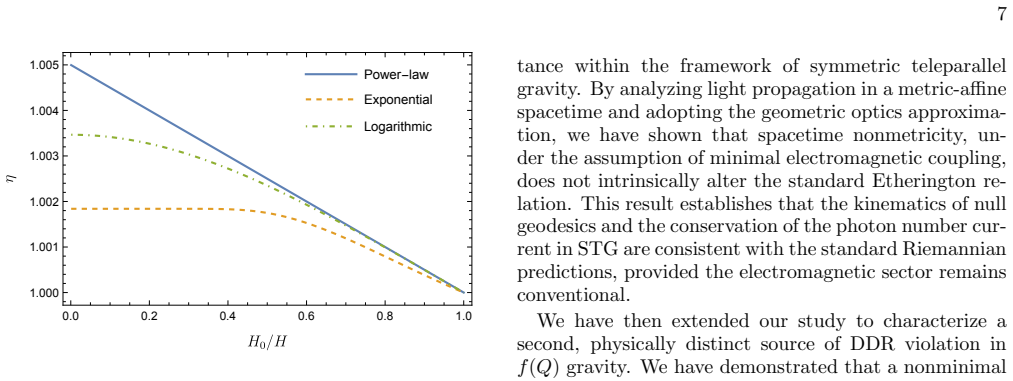
Power-law coupling Let us first consider the following coupling: I(Q) = 1 +ϵ Q Q0 −n , n >0.(49) Here,ϵ≪1 is a small dimensionless coupling constant, andQ 0 is the current value of the nonmetricity scalar. In the coincident gauge, Eq. (49) translates to I(H 2) = 1 +ϵ H 2 0 H 2 n ,(50) which yieldsI(H 2
-
[2]
From the definition of the DDR violation parameter, it follows thatη(0) = 1 holds identically, meaning that the stan- dard Etherington relation is exactly restored at present
= 1 +ϵat the current epoch. From the definition of the DDR violation parameter, it follows thatη(0) = 1 holds identically, meaning that the stan- dard Etherington relation is exactly restored at present. Then, to evaluate the behaviour atz >0, we substitute the above expressions into Eq. (46), and perform a first- order expansion inϵ: η(z)≃1 + ϵ 2 " 1− H0...
-
[3]
Under the coincident gauge condition, this parametrization reads I(H 2) = 1 +ϵ e −(H/H0)2 ,(53) which impliesI(H 2
Exponential coupling Alternatively, we can consider an exponential coupling function of the form I(Q) = 1 +ϵ e −Q/Q0 ,(52) withϵ≪1. Under the coincident gauge condition, this parametrization reads I(H 2) = 1 +ϵ e −(H/H0)2 ,(53) which impliesI(H 2
-
[4]
Similarly to the previous case, using Eq
= 1 +ϵ e −1 at the present era. Similarly to the previous case, using Eq. (46) and per- forming a first-order expansion inϵ, we find η(z)≃1 + ϵ 2e 1−exp 1− H 2(z) H 2 0 .(54) In this scenario, forH≫H 0 in the early epoch, the exponential term strongly suppresses the nonminimal coupling, leading toη(z)≃1 +ϵ/(2e). This devia- tion smoothly decreases up to t...
-
[5]
In the coincident gauge, this becomes I(H 2) = 1 +ϵln 1 + H 2 0 H 2 ,(56) which impliesI(H 2
Logarithmic coupling Finally, we can explore a logarithmic coupling function parameterized as I(Q) = 1 +ϵln 1 + Q0 Q ,(55) whereϵ≪1. In the coincident gauge, this becomes I(H 2) = 1 +ϵln 1 + H 2 0 H 2 ,(56) which impliesI(H 2
-
[6]
As in the previous cases, the standard DDR is exactly preserved today, sinceη(0) = 1 holds identically
= 1 +ϵln 2 at the present epoch. As in the previous cases, the standard DDR is exactly preserved today, sinceη(0) = 1 holds identically. To describe the evolutionary behaviour at higher red- shifts, we expand Eq. (46) to the first order inϵ, obtaining η(z)≃1 + ϵ 2 ln 2H 2(z) H 2(z) +H 2 0 .(57) At very high redshifts (H≫H 0), the logarithmic term approach...
-
[7]
Also in this case, the functionη(z) remains always very close to unity, as indicated by observations. In Fig. 1, we display the cosmic evolution of the DDR parameterη(z) from the early Universe to the present epoch, arising from the different parametrizations of the electromagnetic coupling function considered above. In all cases,η(z) remains very close t...
-
[8]
Testing General Relativity with Present and Future Astrophysical Observations
E. Bertiet al., Class. Quant. Grav.32, 243001 (2015), arXiv:1501.07274 [gr-qc]
work page internal anchor Pith review Pith/arXiv arXiv 2015
-
[9]
General Relativity and Cosmology: Unsolved Questions and Future Directions
I. Debono and G. F. Smoot, Universe2, 23 (2016), arXiv:1609.09781 [gr-qc]
work page internal anchor Pith review Pith/arXiv arXiv 2016
-
[10]
M. Ishak, Living Rev. Rel.22, 1 (2019), arXiv:1806.10122 [astro-ph.CO]
-
[11]
Weinberg, Rev
S. Weinberg, Rev. Mod. Phys.61, 1 (1989)
1989
-
[12]
Cosmological Constant - the Weight of the Vacuum
T. Padmanabhan, Phys. Rept.380, 235 (2003), arXiv:hep-th/0212290
work page internal anchor Pith review Pith/arXiv arXiv 2003
-
[13]
P. J. E. Peebles and B. Ratra, Rev. Mod. Phys.75, 559 (2003), arXiv:astro-ph/0207347
work page internal anchor Pith review Pith/arXiv arXiv 2003
-
[14]
Dark energy two decades after: Observables, probes, consistency tests
D. Huterer and D. L. Shafer, Rept. Prog. Phys.81, 016901 (2018), arXiv:1709.01091 [astro-ph.CO]
work page internal anchor Pith review Pith/arXiv arXiv 2018
-
[15]
R. D’Agostino, Phys. Rev. D99, 103524 (2019), arXiv:1903.03836 [gr-qc]
work page internal anchor Pith review Pith/arXiv arXiv 2019
-
[16]
A. Arbey and F. Mahmoudi, Prog. Part. Nucl. Phys.119, 103865 (2021), arXiv:2104.11488 [hep-ph]
-
[17]
R. D’Agostino, O. Luongo, and M. Muccino, Class. Quant. Grav.39, 195014 (2022), arXiv:2204.02190 [gr- qc]
-
[18]
A. G. Riess, S. Casertano, W. Yuan, L. M. Macri, and D. Scolnic, Astrophys. J.876, 85 (2019), arXiv:1903.07603 [astro-ph.CO]
work page internal anchor Pith review Pith/arXiv arXiv 2019
-
[19]
R. D’Agostino and R. C. Nunes, Phys. Rev. D108, 023523 (2023), arXiv:2307.13464 [astro-ph.CO]
-
[20]
E. Di Valentinoet al.(CosmoVerse Network), Phys. Dark Univ.49, 101965 (2025), arXiv:2504.01669 [astro- ph.CO]
work page internal anchor Pith review Pith/arXiv arXiv 2025
-
[21]
DESI DR2 Results II: Measurements of Baryon Acoustic Oscillations and Cosmological Constraints
M. Abdul Karimet al.(DESI), Phys. Rev. D112, 083515 (2025), arXiv:2503.14738 [astro-ph.CO]
work page internal anchor Pith review Pith/arXiv arXiv 2025
-
[22]
Beyond the Cosmological Standard Model
A. Joyce, B. Jain, J. Khoury, and M. Trodden, Phys. Rept.568, 1 (2015), arXiv:1407.0059 [astro-ph.CO]
work page internal anchor Pith review Pith/arXiv arXiv 2015
-
[23]
Challenges for $\Lambda$CDM: An update
L. Perivolaropoulos and F. Skara, New Astron. Rev.95, 101659 (2022), arXiv:2105.05208 [astro-ph.CO]
work page internal anchor Pith review Pith/arXiv arXiv 2022
-
[24]
R. D’Agostino, M. Califano, N. Menadeo, and D. Vernieri, Phys. Rev. D108, 043538 (2023), arXiv:2305.14238 [astro-ph.CO]
-
[25]
M. Califano, R. D’Agostino, and D. Vernieri, Phys. Rev. D109, 083520 (2024), arXiv:2403.15373 [astro-ph.CO]
-
[26]
Modified Gravity and Cosmology
T. Clifton, P. G. Ferreira, A. Padilla, and C. Sko- rdis, Phys. Rept.513, 1 (2012), arXiv:1106.2476 [astro- ph.CO]
work page internal anchor Pith review Pith/arXiv arXiv 2012
-
[27]
Cosmological Tests of Modified Gravity
K. Koyama, Rept. Prog. Phys.79, 046902 (2016), arXiv:1504.04623 [astro-ph.CO]
work page internal anchor Pith review Pith/arXiv arXiv 2016
-
[28]
Modified Gravity Theories on a Nutshell: Inflation, Bounce and Late-time Evolution
S. Nojiri, S. D. Odintsov, and V. K. Oikonomou, Phys. Rept.692, 1 (2017), arXiv:1705.11098 [gr-qc]
work page internal anchor Pith review Pith/arXiv arXiv 2017
-
[29]
S. Capozziello, R. D’Agostino, and O. Luongo, Int. J. Mod. Phys. D28, 1930016 (2019), arXiv:1904.01427 [gr- qc]
work page internal anchor Pith review Pith/arXiv arXiv 2019
-
[30]
R. D’Agostino and R. C. Nunes, Phys. Rev. D101, 103505 (2020), arXiv:2002.06381 [astro-ph.CO]
- [31]
-
[32]
T. P. Sotiriou and V. Faraoni, Rev. Mod. Phys.82, 451 (2010), arXiv:0805.1726 [gr-qc]
work page internal anchor Pith review Pith/arXiv arXiv 2010
-
[33]
Unified cosmic history in modified gravity: from F(R) theory to Lorentz non-invariant models
S. Nojiri and S. D. Odintsov, Phys. Rept.505, 59 (2011), arXiv:1011.0544 [gr-qc]
work page internal anchor Pith review Pith/arXiv arXiv 2011
-
[34]
A. De Felice and S. Tsujikawa, Living Rev. Rel.13, 3 (2010), arXiv:1002.4928 [gr-qc]
work page internal anchor Pith review Pith/arXiv arXiv 2010
-
[35]
R. D’Agostino and G. G. Luciano, Phys. Lett. B857, 138987 (2024), arXiv:2408.13638 [gr-qc]
-
[36]
From minimal-length quantum theory to modified gravity
R. D’Agostino, P. Bosso, and G. G. Luciano, Phys. Lett. B878, 140519 (2026), arXiv:2511.14869 [gr-qc]
work page internal anchor Pith review Pith/arXiv arXiv 2026
-
[37]
Brans and R
C. Brans and R. H. Dicke, Phys. Rev.124, 925 (1961)
1961
-
[38]
G. W. Horndeski, Int. J. Theor. Phys.10, 363 (1974)
1974
-
[39]
Late-time cosmology in (phantom) scalar-tensor theory: dark energy and the cosmic speed-up
E. Elizalde, S. Nojiri, and S. D. Odintsov, Phys. Rev. D 70, 043539 (2004), arXiv:hep-th/0405034
work page internal anchor Pith review Pith/arXiv arXiv 2004
-
[40]
J. M. Ezquiaga and M. Zumalac´ arregui, Phys. Rev. Lett. 119, 251304 (2017), arXiv:1710.05901 [astro-ph.CO]
work page internal anchor Pith review Pith/arXiv arXiv 2017
-
[41]
R. D’Agostino and R. C. Nunes, Phys. Rev. D100, 044041 (2019), arXiv:1907.05516 [gr-qc]
-
[42]
M. Califano, R. D’Agostino, and D. Vernieri, Phys. Rev. D109, 104062 (2024), arXiv:2311.02161 [gr-qc]
-
[43]
S. Deser and R. P. Woodard, Phys. Rev. Lett.99, 111301 (2007), arXiv:0706.2151 [astro-ph]
work page internal anchor Pith review Pith/arXiv arXiv 2007
-
[44]
G. Calcagni, M. Montobbio, and G. Nardelli, Phys. Rev. D76, 126001 (2007), arXiv:0705.3043 [hep-th]
work page internal anchor Pith review Pith/arXiv arXiv 2007
-
[45]
F. W. Hehl and B. Mashhoon, Phys. Lett. B673, 279 (2009), arXiv:0812.1059 [gr-qc]
work page internal anchor Pith review Pith/arXiv arXiv 2009
-
[46]
Towards singularity and ghost free theories of gravity
T. Biswas, E. Gerwick, T. Koivisto, and A. Mazumdar, Phys. Rev. Lett.108, 031101 (2012), arXiv:1110.5249 [gr-qc]
work page internal anchor Pith review Pith/arXiv arXiv 2012
-
[47]
Non-local gravity and dark energy
M. Maggiore and M. Mancarella, Phys. Rev. D90, 023005 (2014), arXiv:1402.0448 [hep-th]
work page internal anchor Pith review Pith/arXiv arXiv 2014
-
[48]
S. Capozziello, R. D’Agostino, and O. Luongo, Phys. Lett. B834, 137475 (2022), arXiv:2207.01276 [gr-qc]
-
[49]
R. D’Agostino and V. De Falco, JCAP07, 046 (2025), arXiv:2502.15460 [gr-qc]
-
[50]
R. D’Agostino and V. De Falco, JCAP05, 069 (2025), arXiv:2501.18007 [gr-qc]
-
[51]
R. D’Agostino and V. De Falco, Phys. Rev. D113, 044029 (2026), arXiv:2601.11101 [gr-qc]. 9
-
[52]
Observational constraints on nonlocal black holes via gravitational lensing
R. D’Agostino and V. De Falco, Phys. Rev. D113, 104018 (2026), arXiv:2604.13223 [gr-qc]
work page internal anchor Pith review Pith/arXiv arXiv 2026
-
[53]
F. W. Hehl, P. Von Der Heyde, G. D. Kerlick, and J. M. Nester, Rev. Mod. Phys.48, 393 (1976)
1976
-
[54]
G. R. Bengochea and R. Ferraro, Phys. Rev. D79, 124019 (2009), arXiv:0812.1205 [astro-ph]
work page internal anchor Pith review Pith/arXiv arXiv 2009
-
[55]
E. V. Linder, Phys. Rev. D81, 127301 (2010), [Erratum: Phys.Rev.D 82, 109902 (2010)], arXiv:1005.3039 [astro- ph.CO]
work page internal anchor Pith review Pith/arXiv arXiv 2010
-
[56]
C.-Q. Geng, C.-C. Lee, E. N. Saridakis, and Y.-P. Wu, Phys. Lett. B704, 384 (2011), arXiv:1109.1092 [hep-th]
work page internal anchor Pith review Pith/arXiv arXiv 2011
-
[57]
Y.-F. Cai, S. Capozziello, M. De Laurentis, and E. N. Saridakis, Rept. Prog. Phys.79, 106901 (2016), arXiv:1511.07586 [gr-qc]
work page internal anchor Pith review Pith/arXiv arXiv 2016
-
[58]
Effective gravitational coupling in modified teleparallel theories
H. Abedi, S. Capozziello, R. D’Agostino, and O. Luongo, Phys. Rev. D97, 084008 (2018), arXiv:1803.07171 [gr- qc]
work page internal anchor Pith review Pith/arXiv arXiv 2018
-
[59]
Growth of matter perturbations in non-minimal teleparallel dark energy
R. D’Agostino and O. Luongo, Phys. Rev. D98, 124013 (2018), arXiv:1807.10167 [gr-qc]
work page internal anchor Pith review Pith/arXiv arXiv 2018
-
[60]
R. D’Agostino and F. Bajardi, Phys. Rev. D111, 104076 (2025), arXiv:2505.21359 [gr-qc]
-
[61]
J. Beltr´ an Jim´ enez, L. Heisenberg, and T. Koivisto, Phys. Rev. D98, 044048 (2018), arXiv:1710.03116 [gr- qc]
work page internal anchor Pith review Pith/arXiv arXiv 2018
-
[62]
Nonmetricity formulation of general relativity and its scalar-tensor extension
L. J¨ arv, M. R¨ unkla, M. Saal, and O. Vilson, Phys. Rev. D97, 124025 (2018), arXiv:1802.00492 [gr-qc]
work page internal anchor Pith review Pith/arXiv arXiv 2018
-
[63]
J. Beltr´ an Jim´ enez, L. Heisenberg, T. S. Koivisto, and S. Pekar, Phys. Rev. D101, 103507 (2020), arXiv:1906.10027 [gr-qc]
-
[64]
M. Hohmann, Phys. Rev. D104, 124077 (2021), arXiv:2109.01525 [gr-qc]
-
[65]
F. D’Ambrosio, L. Heisenberg, and S. Kuhn, Class. Quant. Grav.39, 025013 (2022), arXiv:2109.04209 [gr- qc]
-
[66]
S. Capozziello and R. D’Agostino, Phys. Lett. B832, 137229 (2022), arXiv:2204.01015 [gr-qc]
-
[67]
R. D’Agostino and R. C. Nunes, Phys. Rev. D106, 124053 (2022), arXiv:2210.11935 [gr-qc]
-
[68]
I. M. H. Etherington, (1933), 10.1080/14786443309462220
-
[69]
B. A. Bassett and M. Kunz, Phys. Rev. D69, 101305 (2004), arXiv:astro-ph/0312443
work page internal anchor Pith review Pith/arXiv arXiv 2004
-
[70]
A. Avgoustidis, C. Burrage, J. Redondo, L. Verde, and R. Jimenez, JCAP10, 024 (2010), arXiv:1004.2053 [astro-ph.CO]
work page internal anchor Pith review Pith/arXiv arXiv 2010
-
[71]
A. Hees, O. Minazzoli, and J. Larena, Phys. Rev. D90, 124064 (2014), arXiv:1406.6187 [astro-ph.CO]
work page internal anchor Pith review Pith/arXiv arXiv 2014
- [72]
-
[73]
Martinelliet al.(Euclid), Astron
M. Martinelliet al.(Euclid), Astron. Astrophys.644, A80 (2020), arXiv:2007.16153 [astro-ph.CO]
- [74]
- [75]
- [76]
-
[77]
L. Heisenberg, Phys. Rept.1066, 1 (2024), arXiv:2309.15958 [gr-qc]
-
[78]
I. T. Drummond and S. J. Hathrell, Phys. Rev. D22, 343 (1980)
1980
-
[79]
S. M. Carroll, Phys. Rev. Lett.81, 3067 (1998), arXiv:astro-ph/9806099
work page internal anchor Pith review Pith/arXiv arXiv 1998
-
[80]
M. S. Turner and L. M. Widrow, Phys. Rev. D37, 2743 (1988)
1988
discussion (0)
Sign in with ORCID, Apple, or X to comment. Anyone can read and Pith papers without signing in.