REVIEW 2 major objections 5 minor 106 references
Dirac right-handed neutrinos turn ΔN_eff into a decisive filter on Z' portal dark matter, excluding resonance WIMPs below ~400 GeV and leaving secluded and FIMP regions that future CMB can still test.
Reviewed by Pith at T0; open to challenge. T0 means a machine referee read the full paper against a public rubric. the ladder, T0–T4 →
T0 review · grok-4.5
2026-07-10 13:23 UTC pith:OQM2ULGB
load-bearing objection Solid, incremental B-L portal scan that correctly folds the ν_R–χ channel and latest ΔN_eff bounds into concrete (m_χ, Q_χ) windows for resonance, secluded, and FIMP cases. the 2 major comments →
Z^prime Portal Dark Matter with Observable Delta N_(rm eff)
The pith
A machine-rendered reading of the paper's core claim, the machinery that carries it, and where it could break.
Core claim
When right-handed neutrinos are Dirac particles charged under the same U(1)_{B-L} that mediates dark-matter interactions, the requirement that the observed relic density be produced through the Z' portal forces a lower bound ΔN_eff ≥ 0.14 in the resonant WIMP case and permits smaller, still-testable values only for secluded WIMPs and FIMPs; the combined cosmological, direct-detection, indirect-detection and collider constraints therefore carve out sharply defined, experimentally accessible regions in the (m_χ, Q_χ) plane.
What carries the argument
The shared Z' portal: both the dark-matter annihilation (or freeze-in) rate and the ν_R ν_R o f f̄ / χ χ̄ scattering rates are controlled by the same product g' Q, so the temperature at which the Dirac neutrinos decouple—and hence the value of ΔN_eff—is locked to the dark-matter abundance.
Load-bearing premise
The B-L symmetry that keeps the right-handed neutrinos Dirac and generates a light Z' via the Stueckelberg mechanism must remain unbroken; any spontaneous breaking that gives the neutrinos Majorana masses or removes the light Z' collapses the whole ΔN_eff prediction.
What would settle it
A future CMB measurement that sets ΔN_eff < 0.14 with no residual excess would completely exclude the resonant WIMP branch of the model while leaving only the secluded and FIMP windows still open.
If this is right
- Resonant WIMP dark matter is forced into a narrow high-mass window (roughly 400 GeV to 10^5 GeV) with charges between ~1 and a few thousand, all of which will be covered by CMB-S4/HD.
- Secluded and freeze-in candidates can produce ΔN_eff well below 0.14, so a null CMB result does not kill the entire Z' portal scenario.
- The same parameter space that survives cosmology is already within reach of next-generation direct-detection experiments for TeV-scale masses and of MeV-scale gamma-ray telescopes for the secluded annihilation channel.
- Collider searches for a light Z' become secondary once ΔN_eff is measured; the cosmological bound is stronger than present LHC and B-factory limits over most of the interesting range.
Where Pith is reading between the lines
- If Dirac neutrinos are the only light species charged under B-L, a precision ΔN_eff measurement effectively becomes a dark-matter mass and charge spectrometer for any Z' portal model.
- The same logic can be ported to other anomaly-free U(1) extensions (e.g., L_μ-L_τ) that keep right-handed neutrinos Dirac, potentially turning every future CMB stage into a simultaneous probe of neutrino nature and dark-matter production.
- A confirmed ΔN_eff excess near 0.14 would favour thermal production of both ν_R and χ, while a value significantly below that floor would point toward freeze-in or secluded dynamics.
Editorial analysis
A structured set of objections, weighed in public.
Referee Report
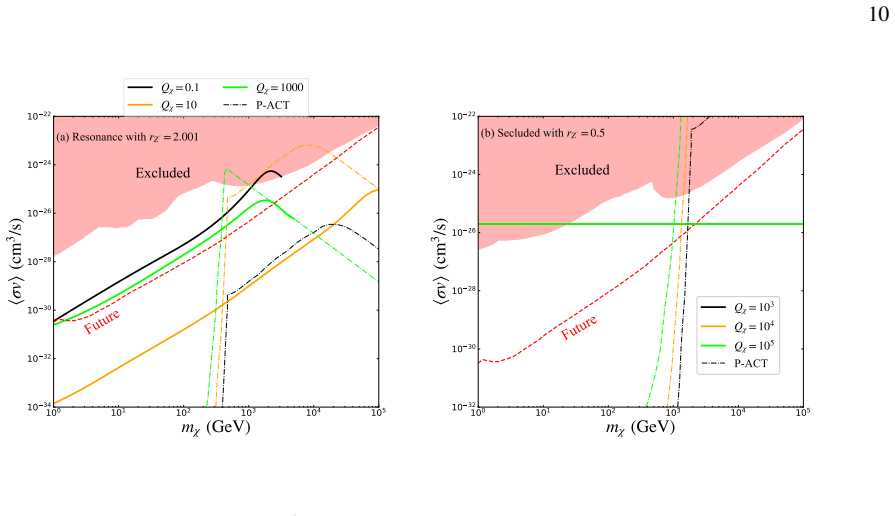
Summary. The paper studies a minimal U(1)_{B-L} extension with Dirac right-handed neutrinos u_R (Q_ u R = −1) and a vector-like Dirac dark-matter fermion u_R-protected by unbroken B−L and a Z_2 parity, with the Z′ mass generated by the Stueckelberg mechanism. Free parameters are {m_ u, m_Z′, g′, Q_ u}. Both WIMP (resonant u ū o f f̄ and secluded u ū o Z′Z′) and FIMP production via the Z′ portal are analyzed. The central claim is that thermal and non-thermal u_R contributions to u N_eff, together with perturbativity, direct/indirect detection, and Z′ collider bounds, carve out concrete viable windows: resonant WIMP survives only for roughly 400 GeV ≲ m_ u ≲ 1.54 imes10^5 GeV and 0.7 ≲ Q_ u ≲ 3400 (with u N_eff less 0.14), while secluded and FIMP regions can yield u N_eff < 0.14 and remain testable by CMB-S4/HD. A future null result u N_eff < 0.14 would exclude the resonant case.
Significance. If the results hold, the work supplies a clean, falsifiable link between Z′ portal dark matter and upcoming precision u N_eff measurements. The multi-constraint scans (Figs. 4, 5, 7) and the explicit statement that a null u N_eff < 0.14 kills the resonant WIMP window are concrete predictions that can be tested by CMB-S4/HD, future direct/indirect detection, and colliders. The treatment of the additional u_R ū_R o u ū channel, the piecewise reaction rates, and the consistent use of micrOMEGAs for thermal averages are standard and reproducible within the stated model assumptions. The paper therefore adds a useful, observationally sharp corner to the Z′ portal literature.
major comments (2)
- Section II (after Eq. (1) and the Stueckelberg paragraph): the unbroken U(1)_{B-L} that both forbids Majorana masses for u_R and generates the light Z′ is a model-building premise, not an inconsistency. The paper should, however, state more explicitly that any spontaneous breaking that generates Majorana masses or removes the light Z′ collapses the entire u N_eff calculation and the portal structure; a short paragraph quantifying the scale at which this occurs would strengthen the claim’s robustness.
- Section III.A, Eqs. (10)–(12) and the discussion of T_ u R^dec vs T_ u^dec: the claim that u_R ū_R o u ū dominates the resonant decoupling for large Q_ u is load-bearing for the floor u N_eff less 0.14. The paper should quantify more carefully the extreme-resonance regime (where phase-space suppression of u Z′ o u ū makes the channel negligible) and show that the quoted mass window 400 GeV ≲ m_ u remains intact when that regime is included.
minor comments (5)
- Figure 1 caption and panels: the Unicode/encoding artifacts (e.g. “/uni0000000b”) make the legends hard to read; clean PDF fonts would improve clarity.
- Eq. (13) and the surrounding text: the nucleon mass is written m_n less 0.939 GeV; a brief note that the reduced-mass factor is already included would avoid ambiguity.
- Section IV.A, freeze-in Boltzmann equations (15)–(16): the neglect of t-channel Z′Z′ and of u ū o u_R ū_R is stated but not quantified; a short numerical check (or reference to the verification mentioned in the text) would be helpful.
- Throughout: the notation r_Z′ = m_Z′/m_ u is introduced early but occasionally written inconsistently (r_Z vs r_Z′); unify for readability.
- References: a few recent related works on Dirac u_R and u N_eff (e.g. those already cited in the introduction) could be cross-linked more explicitly when the non-thermal results of Ref. [18] are adopted.
Circularity Check
No significant circularity: relic-density contours and ΔN_eff floors are computed from free parameters against external experimental bounds.
full rationale
The paper constructs a minimal U(1)_{B-L} model with Dirac ν_R and vector-like DM χ, then solves the Boltzmann equations for freeze-out (WIMP resonance/secluded) and freeze-in (FIMP) production of both χ and ν_R. Relic-density contours (black lines in Figs. 4, 5, 7) are obtained by requiring Ω_χ h^{2} = 0.12 for free parameters {m_χ, m_Z', g', Q_χ}; they are not forced by a normalization chosen to match the target. The thermal ΔN_eff floor of 0.14 follows directly from Eq. (10) once g_*(T_dec) o 106.75, an external SM input. All exclusion regions (DESI, P-ACT, CMB-S4/HD, LZ/XENONnT, AMS/Fermi/HESS, BaBar/LHCb/LEP/CMS/ATLAS) are taken from independent experimental literature. Self-citations (e.g., [53], [54]) supply only prior related calculations and do not close a logical loop that defines the quoted mass/charge windows. The unbroken B-L + Stueckelberg premise is a model-building assumption, not an internal circular construction. The derivation chain is therefore self-contained against external benchmarks.
Axiom & Free-Parameter Ledger
free parameters (4)
- m_χ
- m_Z'
- g'
- Q_χ
axioms (4)
- domain assumption Standard cosmological Boltzmann equations for freeze-out and freeze-in with entropy and Hubble rates that include three Dirac
u_R degrees of freedom when thermally populated.
- ad hoc to paper Unbroken U(1)_{B-L} that both forbids Majorana masses for
u_R and generates the Z' mass via the Stueckelberg mechanism.
- domain assumption Yukawa coupling y ≲ 10^{-11} that generates sub-eV Dirac neutrino masses contributes negligibly to ΔN_eff (≈ 7.5 imes10^{-12}).
- domain assumption Current experimental upper limits on ΔN_eff (DESI ≲ 0.4, P-ACT ≲ 0.17), σ_SI, ⟨σv⟩ and Z' production can be treated as hard exclusion boundaries.
invented entities (2)
-
Vector-like Dirac fermion χ with arbitrary U(1)_{B-L} charge Q_χ and Z_2-odd parity
no independent evidence
-
Massive Z' boson generated by the Stueckelberg mechanism under unbroken B-L
no independent evidence
read the original abstract
In the conventional $Z^\prime$ portal dark matter scenario, the prediction of detectable dark matter $\chi$ typically relies on the collider sensitivities of $Z^\prime$ and direct detection, where the Majorana type right-handed neutrinos are usually assumed. However, if the right-handed neutrinos $\nu_R$ are Dirac type, they will contribute to the additional effective number of relativistic species $\Delta N_{\rm eff}$, which brings different detectable predictions for $Z^\prime$ portal dark matter. In light of the great improvement of $\Delta N_{\rm eff}$ for the upcoming experiments, we investigate the $Z^\prime$ portal dark matter with Dirac type $\nu_R$. Under the $U(1)_{B-L}$ symmetry, this model includes $\nu_R$ with $U(1)_{B-L}$ charge $Q_{\nu_R}=-1$ and $\chi$ with arbitrary $Q_\chi$ beyond the SM. Based on the relation in the production of $\chi$ and $\nu_R$, both the WIMP and FIMP dark matter through the $Z^\prime$ portal scenario are considered. We perform a comprehensive exploration of the viable parameter space under the constraints from $\Delta N_{\rm eff}$ induced by thermal and non-thermal $\nu_R$, perturbative limit, dark matter direct and indirect detection, and collider searches of $Z^\prime$.
Figures




Reference graph
Works this paper leans on
-
[1]
The upcoming results are depicted as a blue dashed line in Figure 2
will achieve significantly improved sensitivity onσSI, extending the reach downward by approximately one order of magnitude compared to current limits. The upcoming results are depicted as a blue dashed line in Figure 2. In this model, the DM-nucleon scattering process is mediated byZ ′, which can be calculated as σSI = m2 χQ2 χg′4 πm4 Z′(mχ +m n)2 ,(13) ...
- [2]
-
[3]
M. Cirelli, A. Strumia and J. Zupan, [arXiv:2406.01705 [hep-ph]]
work page internal anchor Pith review Pith/arXiv arXiv
-
[4]
Evidence for oscillation of atmospheric neutrinos
Y . Fukudaet al.[Super-Kamiokande], Phys. Rev. Lett.81, 1562-1567 (1998) [arXiv:hep-ex/9807003 [hep-ex]]
work page internal anchor Pith review Pith/arXiv arXiv 1998
-
[5]
Q. R. Ahmadet al.[SNO], Phys. Rev. Lett.89, 011301 (2002) [arXiv:nucl-ex/0204008 [nucl-ex]]
work page internal anchor Pith review Pith/arXiv arXiv 2002
-
[6]
F. P. Anet al.[Daya Bay], Phys. Rev. Lett.108, 171803 (2012) [arXiv:1203.1669 [hep-ex]]
work page internal anchor Pith review Pith/arXiv arXiv 2012
-
[7]
J. K. Ahnet al.[RENO], Phys. Rev. Lett.108, 191802 (2012) [arXiv:1204.0626 [hep-ex]]
work page internal anchor Pith review Pith/arXiv arXiv 2012
-
[8]
Particle Dark Matter: Evidence, Candidates and Constraints
G. Bertone, D. Hooper and J. Silk, Phys. Rept.405, 279-390 (2005) [arXiv:hep-ph/0404175 [hep-ph]]
work page internal anchor Pith review Pith/arXiv arXiv 2005
- [9]
-
[10]
The Waning of the WIMP? A Review of Models, Searches, and Constraints
G. Arcadi, M. Dutra, P. Ghosh, M. Lindner, Y . Mambrini, M. Pierre, S. Profumo and F. S. Queiroz, Eur. Phys. J. C78, no.3, 203 (2018) [arXiv:1703.07364 [hep-ph]]
work page internal anchor Pith review Pith/arXiv arXiv 2018
-
[11]
L. J. Hall, K. Jedamzik, J. March-Russell and S. M. West, JHEP03, 080 (2010) [arXiv:0911.1120 [hep-ph]]. 22
work page internal anchor Pith review Pith/arXiv arXiv 2010
-
[12]
The Dawn of FIMP Dark Matter: A Review of Models and Constraints
N. Bernal, M. Heikinheimo, T. Tenkanen, K. Tuominen and V . Vaskonen, Int. J. Mod. Phys. A32, no.27, 1730023 (2017) [arXiv:1706.07442 [hep-ph]]
work page internal anchor Pith review Pith/arXiv arXiv 2017
-
[13]
M. J. Dolinski, A. W. P. Poon and W. Rodejohann, Ann. Rev. Nucl. Part. Sci.69, 219-251 (2019) [arXiv:1902.04097 [nucl-ex]]
work page internal anchor Pith review Pith/arXiv arXiv 2019
-
[14]
J. Heeck, Phys. Lett. B739, 256-262 (2014) [arXiv:1408.6845 [hep-ph]]
work page internal anchor Pith review Pith/arXiv arXiv 2014
-
[15]
K. N. Abazajian and J. Heeck, Phys. Rev. D100, 075027 (2019) [arXiv:1908.03286 [hep-ph]]
work page internal anchor Pith review Pith/arXiv arXiv 2019
-
[16]
M. Escudero Abenza, JCAP05, 048 (2020) [arXiv:2001.04466 [hep-ph]]
work page internal anchor Pith review Pith/arXiv arXiv 2020
-
[17]
X. Luo, W. Rodejohann and X. J. Xu, JCAP06, 058 (2020) [arXiv:2005.01629 [hep-ph]]
work page internal anchor Pith review Pith/arXiv arXiv 2020
-
[18]
X. Luo, W. Rodejohann and X. J. Xu, JCAP03, 082 (2021) [arXiv:2011.13059 [hep-ph]]
work page internal anchor Pith review Pith/arXiv arXiv 2021
-
[19]
Dark radiation constraints on portal interactions with hidden sectors
P. Adshead, P. Ralegankar and J. Shelton, JCAP09, 056 (2022) [arXiv:2206.13530 [hep-ph]]
work page internal anchor Pith review Pith/arXiv arXiv 2022
-
[20]
K. S. Babu, X. G. He, M. Su and A. Thapa, JHEP08, 140 (2022) [arXiv:2205.09127 [hep-ph]]
work page internal anchor Pith review Pith/arXiv arXiv 2022
-
[21]
Cosmological Implications of Gauged $U(1)_{B-L}$ on $\Delta N_{\rm eff}$ in the CMB and BBN
H. Esseili and G. D. Kribs, JCAP05, 110 (2024) [arXiv:2308.07955 [hep-ph]]
work page internal anchor Pith review Pith/arXiv arXiv 2024
-
[22]
Light Dirac neutrino portal dark matter with observable $\Delta{N_{\rm eff}}$
A. Biswas, D. Borah and D. Nanda, JCAP10, 002 (2021) [arXiv:2103.05648 [hep-ph]]
work page internal anchor Pith review Pith/arXiv arXiv 2021
-
[23]
Type II Dirac Seesaw with Observable $\Delta N_{\rm eff}$ in the light of W-mass Anomaly
D. Borah, S. Mahapatra, D. Nanda and N. Sahu, Phys. Lett. B833, 137297 (2022) [arXiv:2204.08266 [hep- ph]]
work page internal anchor Pith review Pith/arXiv arXiv 2022
-
[24]
Observable ${\rm \Delta{N_{eff}}}$ in Dirac Scotogenic Model
D. Borah, P. Das and D. Nanda, Eur. Phys. J. C84, no.2, 140 (2024) [arXiv:2211.13168 [hep-ph]]
work page internal anchor Pith review Pith/arXiv arXiv 2024
-
[25]
Freeze-in Dark Matter via Light Dirac Neutrino Portal
A. Biswas, D. Borah, N. Das and D. Nanda, Phys. Rev. D107, no.1, 015015 (2023) [arXiv:2205.01144 [hep- ph]]
work page internal anchor Pith review Pith/arXiv arXiv 2023
-
[26]
Singlet-doublet fermion dark matter with Dirac neutrino mass, $(g-2)_\mu$ and $\Delta N_{\rm eff}$
D. Borah, S. Mahapatra, D. Nanda, S. K. Sahoo and N. Sahu, JHEP05, 096 (2024) [arXiv:2310.03721 [hep- ph]]
work page internal anchor Pith review Pith/arXiv arXiv 2024
-
[27]
Self Interacting Dark Matter and Dirac neutrinos via Lepton Quarticity
S. Mahapatra, S. K. Sahoo, N. Sahu and V . S. Thounaojam, Phys. Rev. D109, no.5, 055036 (2024) [arXiv:2312.12322 [hep-ph]]
work page internal anchor Pith review Pith/arXiv arXiv 2024
-
[28]
Discrete dark matter with light Dirac neutrinos
D. Borah, P. Das, B. Karmakar and S. Mahapatra, Phys. Rev. D111, no.3, 035032 (2025) [arXiv:2406.17861 [hep-ph]]
work page internal anchor Pith review Pith/arXiv arXiv 2025
- [29]
-
[30]
Z. A. Borboruah, D. Borah, L. Malhotra and U. Patel, Phys. Rev. D112, no.1, 015022 (2025) [arXiv:2412.12267 [hep-ph]]
work page internal anchor Pith review Pith/arXiv arXiv 2025
-
[31]
V . Oliveira, P. Escalona, L. Angel, C. A. de S. Pires and F. S. Queiroz, JHEP07, 197 (2025) [arXiv:2502.01760 [hep-ph]]
work page internal anchor Pith review Pith/arXiv arXiv 2025
-
[32]
A. E. B. Abdelrahim, B. Batell, J. Berger, D. McKeen and B. Shams Es Haghi, JCAP02, 073 (2026) [arXiv:2506.09137 [hep-ph]]
work page internal anchor Pith review Pith/arXiv arXiv 2026
- [33]
- [34]
-
[35]
J. Adhikary, A. Batra, K. Deka and F. R. Joaquim, [arXiv:2603.20145 [hep-ph]]
- [36]
-
[37]
R. N. Mohapatra and R. E. Marshak, Phys. Rev. Lett.44, 1316-1319 (1980) [erratum: Phys. Rev. Lett.44, 1643 (1980)] 23
work page 1980
-
[38]
R. E. Marshak and R. N. Mohapatra, Phys. Lett. B91, 222-224 (1980)
work page 1980
- [39]
-
[40]
R. N. Mohapatra and G. Senjanovic, Phys. Rev. D27, 254 (1983)
work page 1983
-
[41]
W. Buchmuller, C. Greub and P. Minkowski, Phys. Lett. B267, 395-399 (1991)
work page 1991
- [42]
-
[43]
R. N. Mohapatra and G. Senjanovic, Phys. Rev. Lett.44, 912 (1980)
work page 1980
- [44]
- [45]
-
[46]
Z. L. Han and W. Wang, Eur. Phys. J. C78, no.10, 839 (2018) [arXiv:1805.02025 [hep-ph]]
work page internal anchor Pith review Pith/arXiv arXiv 2018
-
[47]
Low scale Dirac leptogenesis and dark matter with observable $\Delta N_{\rm eff}$
D. Mahanta and D. Borah, Eur. Phys. J. C82, no.5, 495 (2022) [arXiv:2101.02092 [hep-ph]]
work page internal anchor Pith review Pith/arXiv arXiv 2022
-
[48]
Freeze-In of radiative keV-scale neutrino dark matter from a new $\text{U}(1)_\text{B-L}$
M. Berbig, JHEP09, 101 (2022) [arXiv:2203.04276 [hep-ph]]
work page internal anchor Pith review Pith/arXiv arXiv 2022
-
[49]
Light Dirac neutrino portal dark matter with gauged $U(1)_{B-L}$ symmetry
N. Das and D. Borah, Phys. Rev. D109, no.7, 075045 (2024) [arXiv:2312.06777 [hep-ph]]
work page internal anchor Pith review Pith/arXiv arXiv 2024
-
[50]
Effective theory of light Dirac neutrino portal dark matter with observable ${\Delta N_{\rm eff}}$
D. Borah, S. Mahapatra, D. Nanda, S. K. Sahoo and N. Sahu, Phys. Rev. D112, no.5, 055010 (2025) [arXiv:2502.10318 [hep-ph]]
work page internal anchor Pith review Pith/arXiv arXiv 2025
-
[51]
Improved cosmological limits on $Z^\prime$ models with light right-handed neutrinos
T. Herbermann and M. Lindner, JCAP09, 078 (2025) [arXiv:2505.04695 [hep-ph]]
work page internal anchor Pith review Pith/arXiv arXiv 2025
- [52]
-
[53]
C. Han, M. L. L ´opez-Ib´a˜nez, B. Peng and J. M. Yang, Nucl. Phys. B959, 115154 (2020) [arXiv:2001.04078 [hep-ph]]
work page internal anchor Pith review Pith/arXiv arXiv 2020
-
[54]
A. Liu, F. L. Shao, Z. L. Han, Y . Jin and H. Li, JHEP10, 019 (2024) [arXiv:2407.19730 [hep-ph]]
work page internal anchor Pith review Pith/arXiv arXiv 2024
-
[55]
R. N. Mohapatra and N. Okada, Phys. Rev. D102, no.3, 035028 (2020) [arXiv:1908.11325 [hep-ph]]
work page internal anchor Pith review Pith/arXiv arXiv 2020
-
[56]
Planck 2018 results. VI. Cosmological parameters
N. Aghanimet al.[Planck], Astron. Astrophys.641, A6 (2020) [erratum: Astron. Astrophys.652, C4 (2021)] [arXiv:1807.06209 [astro-ph.CO]]
work page internal anchor Pith review Pith/arXiv arXiv 2020
-
[57]
Relic neutrino decoupling including flavour oscillations
G. Mangano, G. Miele, S. Pastor, T. Pinto, O. Pisanti and P. D. Serpico, Nucl. Phys. B729, 221-234 (2005) [arXiv:hep-ph/0506164 [hep-ph]]
work page internal anchor Pith review Pith/arXiv arXiv 2005
-
[58]
Neutrino energy transport in weak decoupling and big bang nucleosynthesis
E. Grohs, G. M. Fuller, C. T. Kishimoto, M. W. Paris and A. Vlasenko, Phys. Rev. D93, no.8, 083522 (2016) [arXiv:1512.02205 [astro-ph.CO]]
work page internal anchor Pith review Pith/arXiv arXiv 2016
-
[59]
P. F. de Salas and S. Pastor, JCAP07, 051 (2016) [arXiv:1606.06986 [hep-ph]]
work page internal anchor Pith review Pith/arXiv arXiv 2016
-
[60]
A. G. Adameet al.[DESI], JCAP02, 021 (2025) [arXiv:2404.03002 [astro-ph.CO]]
work page internal anchor Pith review Pith/arXiv arXiv 2025
-
[61]
The Atacama Cosmology Telescope: DR6 Power Spectra, Likelihoods and $\Lambda$CDM Parameters
T. Louiset al.[Atacama Cosmology Telescope], JCAP11, 062 (2025) [arXiv:2503.14452 [astro-ph.CO]]
work page internal anchor Pith review Pith/arXiv arXiv 2025
-
[62]
The Atacama Cosmology Telescope: DR6 Constraints on Extended Cosmological Models
E. Calabreseet al.[Atacama Cosmology Telescope], JCAP11, 063 (2025) [arXiv:2503.14454 [astro-ph.CO]]
work page internal anchor Pith review Pith/arXiv arXiv 2025
-
[63]
CMB-S4 Science Case, Reference Design, and Project Plan
K. Abazajian, G. Addison, P. Adshead, Z. Ahmed, S. W. Allen, D. Alonso, M. Alvarez, A. Anderson, K. S. Arnold and C. Baccigalupi,et al.[arXiv:1907.04473 [astro-ph.IM]]
work page internal anchor Pith review Pith/arXiv arXiv 1907
-
[64]
Snowmass2021 CMB-HD White Paper
S. Aiolaet al.[CMB-HD], [arXiv:2203.05728 [astro-ph.CO]]
work page internal anchor Pith review Pith/arXiv arXiv
-
[65]
J. C. Montero and V . Pleitez, Phys. Lett. B675, 64-68 (2009) [arXiv:0706.0473 [hep-ph]]
work page internal anchor Pith review Pith/arXiv arXiv 2009
-
[66]
The Stueckelberg Z Prime at the LHC: Discovery Potential, Signature Spaces and Model Discrimination
D. Feldman, Z. Liu and P. Nath, JHEP11, 007 (2006) [arXiv:hep-ph/0606294 [hep-ph]]
work page internal anchor Pith review Pith/arXiv arXiv 2006
-
[67]
micrOMEGAs3.1 : a program for calculating dark matter observables
G. Belanger, F. Boudjema, A. Pukhov and A. Semenov, Comput. Phys. Commun.185, 960-985 (2014) [arXiv:1305.0237 [hep-ph]]. 24
work page internal anchor Pith review Pith/arXiv arXiv 2014
-
[68]
micrOMEGAs 6.0: N-component dark matter
G. Alguero, G. Belanger, F. Boudjema, S. Chakraborti, A. Goudelis, S. Kraml, A. Mjallal and A. Pukhov, Comput. Phys. Commun.299, 109133 (2024) [arXiv:2312.14894 [hep-ph]]
work page internal anchor Pith review Pith/arXiv arXiv 2024
-
[69]
N. Nath, N. Okada, S. Okada, D. Raut and Q. Shafi, Eur. Phys. J. C82, no.10, 864 (2022) [arXiv:2112.08960 [hep-ph]]
work page internal anchor Pith review Pith/arXiv arXiv 2022
-
[70]
Light $Z^\prime$ and Dark Matter from U(1)$_X$ Gauge Symmetry
N. Okada, S. Okada and Q. Shafi, Phys. Lett. B810, 135845 (2020) [arXiv:2003.02667 [hep-ph]]
work page internal anchor Pith review Pith/arXiv arXiv 2020
-
[71]
Search for low mass dark matter in DarkSide-50: the bayesian network approach
P. Agneset al.[DarkSide-50], Eur. Phys. J. C83, 322 (2023) [arXiv:2302.01830 [hep-ex]]
work page internal anchor Pith review Pith/arXiv arXiv 2023
-
[72]
E. Aprileet al.[XENON], Phys. Rev. Lett.135, no.22, 221003 (2025) [arXiv:2502.18005 [hep-ex]]
-
[73]
Dark Matter Search Results from 1.54 Tonne$\cdot$Year Exposure of PandaX-4T
Z. Boet al.[PandaX], Phys. Rev. Lett.134, no.1, 011805 (2025) [arXiv:2408.00664 [hep-ex]]
work page internal anchor Pith review Pith/arXiv arXiv 2025
-
[74]
Dark Matter Search Results from 4.2 Tonne-Years of Exposure of the LUX-ZEPLIN (LZ) Experiment
J. Aalberset al.[LZ], Phys. Rev. Lett.135, no.1, 011802 (2025) [arXiv:2410.17036 [hep-ex]]
work page internal anchor Pith review Pith/arXiv arXiv 2025
-
[75]
P. Agneset al.[Global Argon Dark Matter], Phys. Rev. D107, no.11, 112006 (2023) [arXiv:2209.01177 [physics.ins-det]]
work page internal anchor Pith review Pith/arXiv arXiv 2023
-
[76]
Projected Sensitivity of the SuperCDMS SNOLAB experiment
R. Agneseet al.[SuperCDMS], Phys. Rev. D95, no.8, 082002 (2017) [arXiv:1610.00006 [physics.ins-det]]
work page internal anchor Pith review Pith/arXiv arXiv 2017
-
[77]
D. S. Akeribet al.[LZ], [arXiv:1509.02910 [physics.ins-det]]
work page internal anchor Pith review Pith/arXiv arXiv
-
[78]
Putting all the X in one basket: Updated X-ray constraints on sub-GeV Dark Matter
M. Cirelli, N. Fornengo, J. Koechler, E. Pinetti and B. M. Roach, JCAP07, 026 (2023) [erratum: JCAP08, E02 (2025)] [arXiv:2303.08854 [hep-ph]]
work page internal anchor Pith review Pith/arXiv arXiv 2023
-
[79]
Constraints on dark matter annihilation from CMB observations before Planck
L. Lopez-Honorez, O. Mena, S. Palomares-Ruiz and A. C. Vincent, JCAP07, 046 (2013) [arXiv:1303.5094 [astro-ph.CO]]
work page internal anchor Pith review Pith/arXiv arXiv 2013
-
[80]
T. R. Slatyer, Phys. Rev. D93, no.2, 023527 (2016) [arXiv:1506.03811 [hep-ph]]
work page internal anchor Pith review Pith/arXiv arXiv 2016
discussion (0)
Sign in with ORCID, Apple, or X to comment. Anyone can read and Pith papers without signing in.