OzSSy1: The Australian Southern Seyfert-1 Spectroscopic Atlas and Catalogue at z < 0.1
Pith reviewed 2026-06-29 04:23 UTC · model grok-4.3
The pith
A new atlas assembles spectra and line fits for 887 southern broad-line AGNs at z below 0.1.
A machine-rendered reading of the paper's core claim, the machinery that carries it, and where it could break.
Core claim
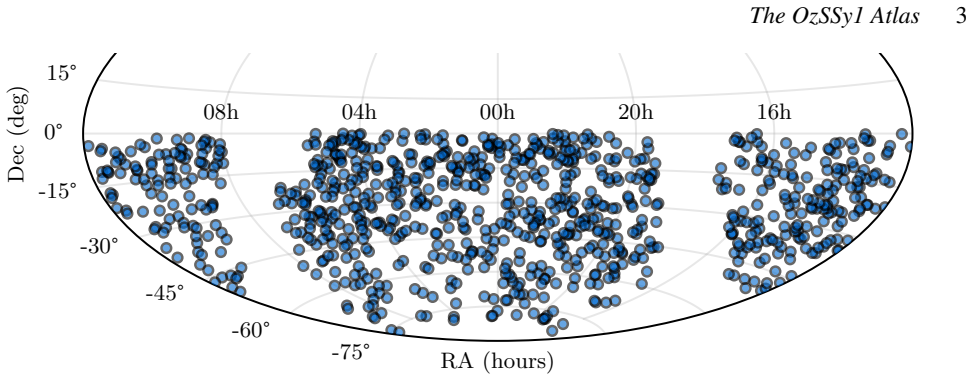
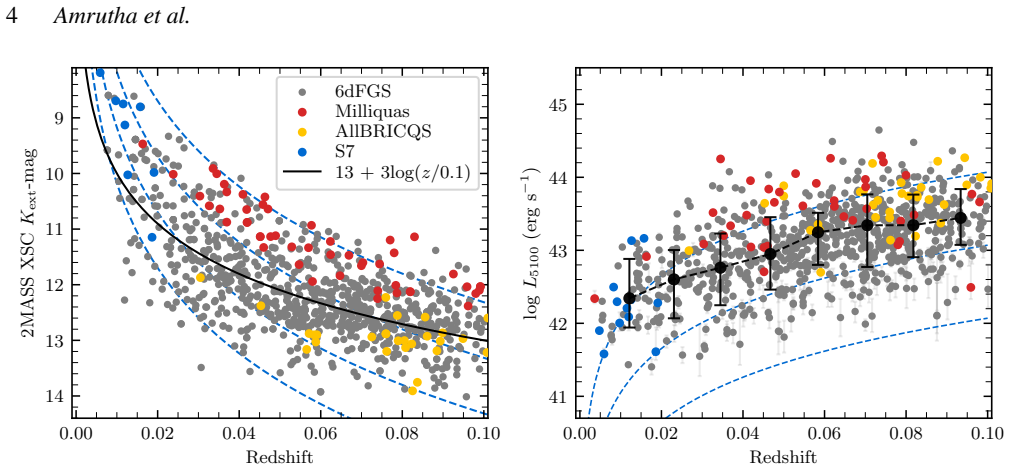
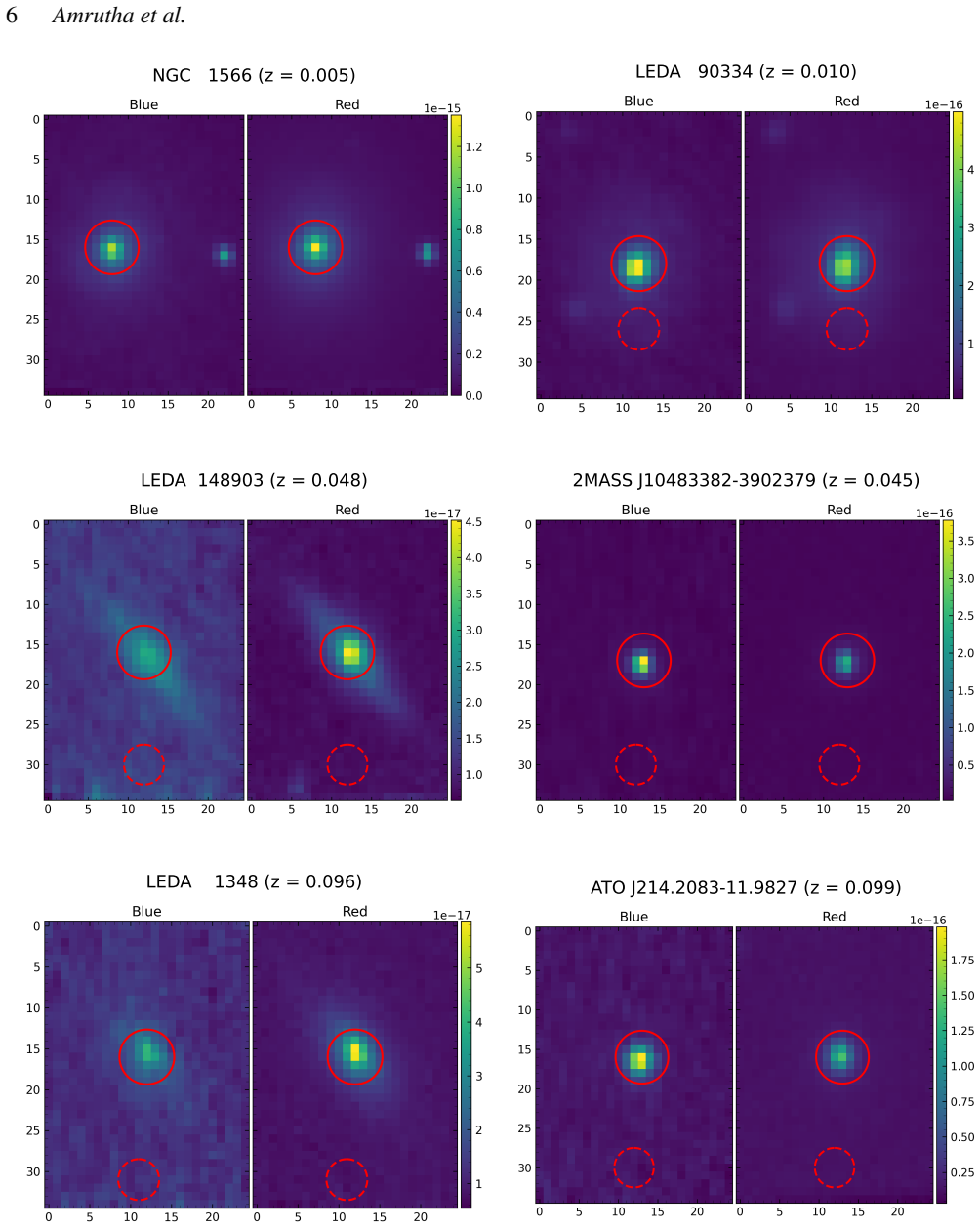
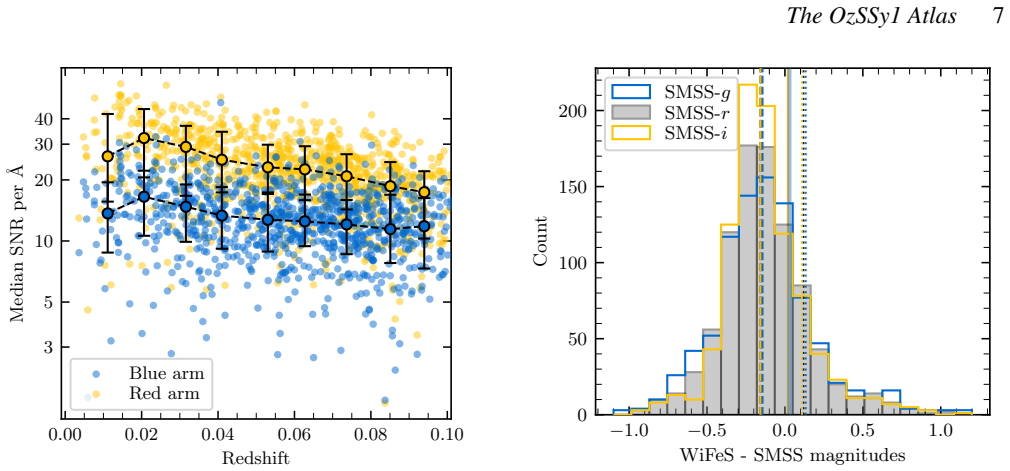
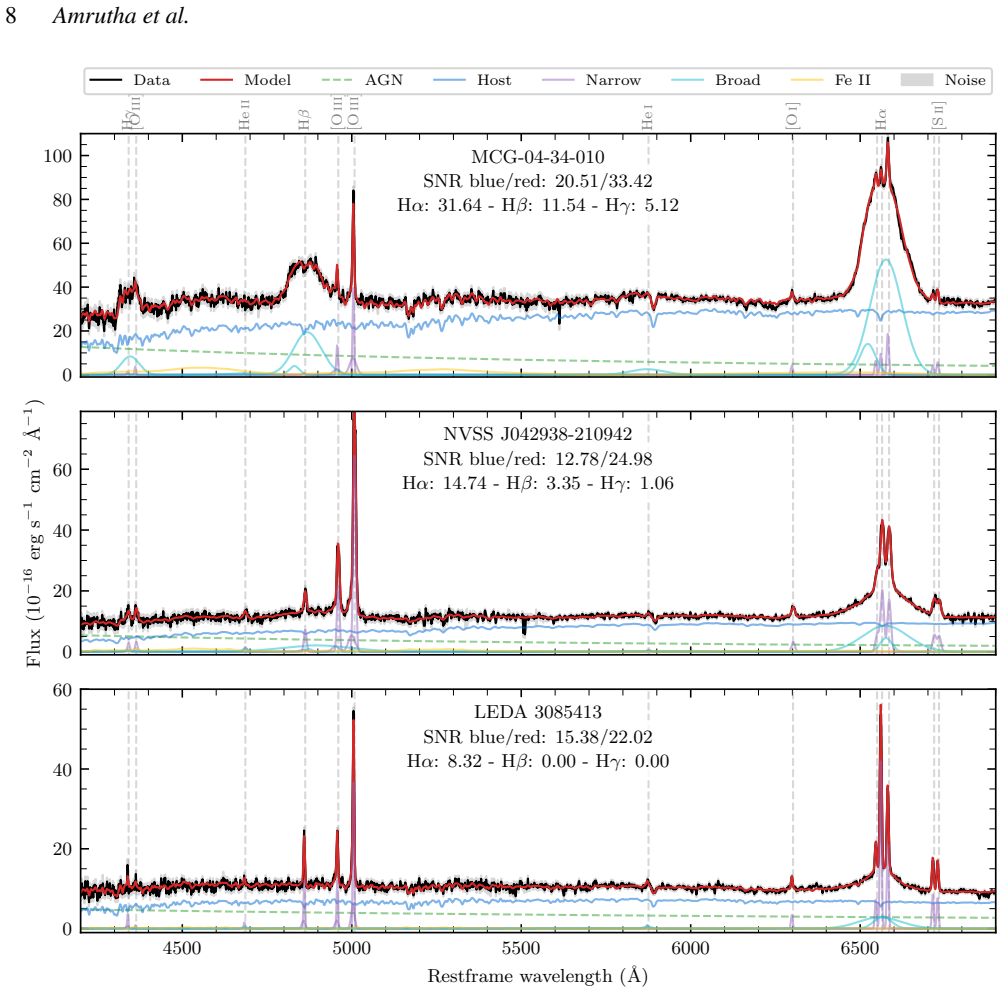
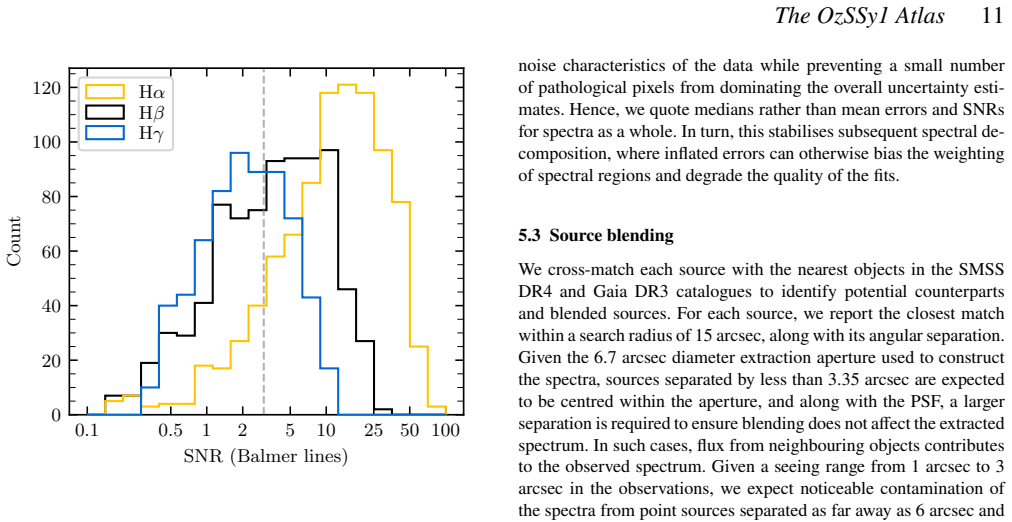
We present a spectroscopic atlas of 887 broad-line active galactic nuclei (AGNs) in the Southern sky, spanning redshifts z < 0.1, declinations δ < 0 deg and Galactic latitudes |b| > 10 deg. The sample aims at being a largely complete census of nearby broad-line AGN. The atlas is constructed from observations with R∼3000 using the integral-field Wide Field Spectrograph at the Australian National University 2.3 m telescope. Spectra are extracted in a 6.7 arcsec aperture and have a median signal-to-noise ratio of 13 and 23 per Angstrom in the blue and red arms, respectively. Each spectrum is accompanied by a spectral decomposition that models the AGN continuum and host galaxy, along with fits t
What carries the argument
The atlas of 887 objects with 6.7-arcsec aperture spectra, continuum-plus-host decompositions, and multi-line fits including broad components.
If this is right
- The released spectra and fits enable direct statistical studies of emission-line properties across a large nearby AGN sample.
- Combined with future time-domain data the atlas supports variability analyses for the same objects.
- Public availability allows cross-matching with multi-wavelength surveys for demographic work.
- The southern coverage complements existing northern samples for all-sky population studies.
Where Pith is reading between the lines
- Cross-matching the catalogue against X-ray or infrared selections could quantify how many broad-line AGNs are missed by optical criteria.
- The line fits could be re-used to derive black-hole mass estimates or Eddington ratios for the full sample in a uniform way.
- If aperture effects prove small, the same extraction method could be applied to larger integral-field surveys for consistency.
Load-bearing premise
The sample selection function is complete enough, and the fixed aperture plus moderate-resolution spectra capture representative broad-line properties without major bias from host light or aperture mismatch.
What would settle it
A count of all previously catalogued broad-line AGNs in the same sky area, redshift range, and latitude cut that differs substantially from 887 after applying the same selection criteria.
Figures
read the original abstract
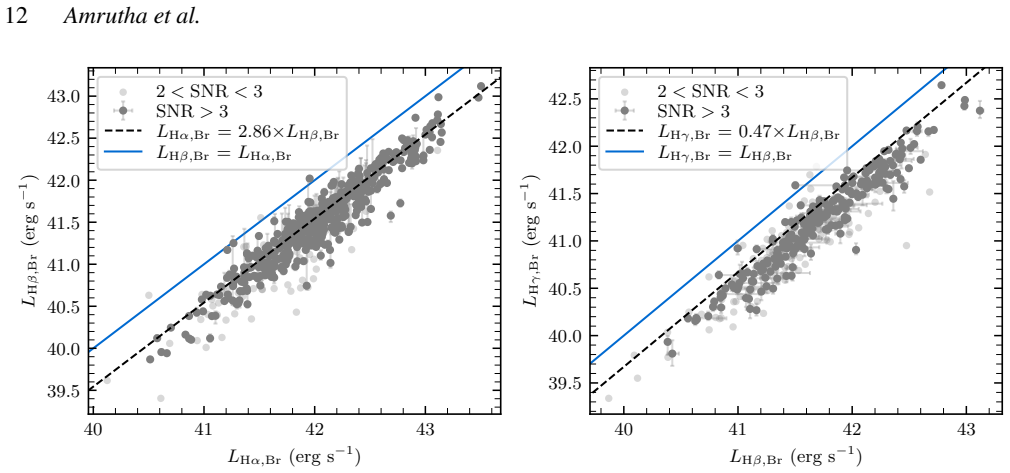
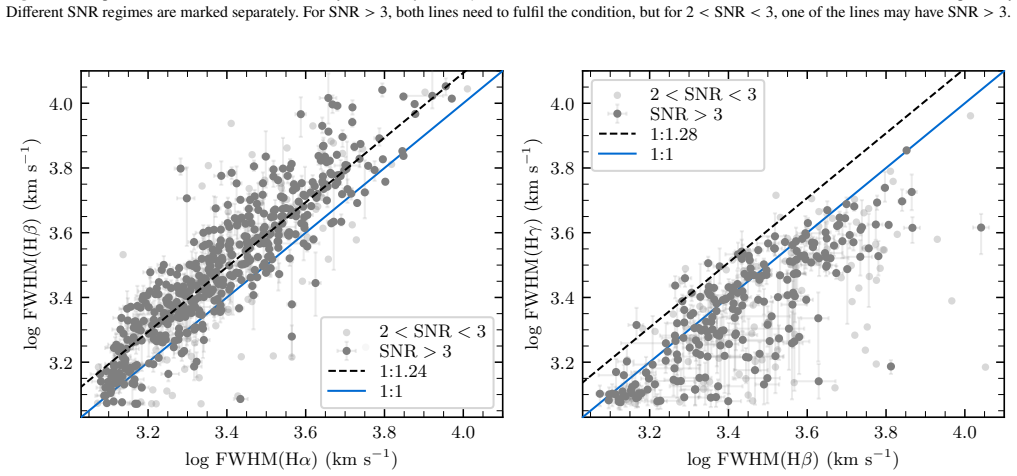
We present a spectroscopic atlas of 887 broad-line active galactic nuclei (AGNs) in the Southern sky, spanning redshifts $z < 0.1$, declinations $\delta < 0$ deg and Galactic latitudes $|b| > 10$ deg. The sample aims at being a largely complete census of nearby broad-line AGN. The atlas is constructed from observations with $R\sim3000$ using the integral-field Wide Field Spectrograph at the Australian National University 2.3 m telescope. Spectra are extracted in a 6.7 arcsec aperture and have a median signal-to-noise ratio of 13 and 23 per Angstrom in the blue and red arms, respectively. Each spectrum is accompanied by a spectral decomposition that models the AGN continuum and host galaxy, along with fits to the emission lines H$\gamma$, H$\beta$, H$\alpha$, He II, He I, [O III], [O I], [N II] and [S II], including broad Balmer and Helium components. The data products are publicly available and designed to support studies of population demographics and AGN variability in conjunction with future time-domain surveys.
Editorial analysis
A structured set of objections, weighed in public.
Referee Report
Summary. The manuscript presents OzSSy1, a spectroscopic atlas and catalogue of 887 broad-line AGNs in the Southern sky (z < 0.1, δ < 0°, |b| > 10°). Data were obtained with the WiFeS integral-field spectrograph (R ~ 3000) on the ANU 2.3 m telescope; spectra are extracted through a fixed 6.7 arcsec aperture, have median S/N of 13 (blue) and 23 (red) per Å, and are accompanied by AGN+host continuum decompositions plus Gaussian fits to Hγ, Hβ, Hα, He II, He I, [O III], [O I], [N II] and [S II] (including broad components). The data products are released publicly to support demographic and variability studies with future time-domain surveys.
Significance. If the sample selection can be shown to be largely complete, the public release of 887 uniformly reduced and modeled spectra would constitute a useful resource for statistical studies of nearby broad-line AGN populations and for cross-matching with time-domain surveys. The provision of both raw and decomposed spectra plus the integral-field origin are practical strengths for community use.
major comments (2)
- [Abstract] Abstract: The headline framing that the sample 'aims at being a largely complete census of nearby broad-line AGN' is load-bearing for the paper's motivation and utility claims, yet no parent catalog, magnitude or emission-line pre-selection criteria, or completeness estimate is supplied. Without these, the 'largely complete' qualifier cannot be evaluated against independent number densities or other surveys.
- [Abstract] The manuscript provides no quantitative assessment of how the fixed 6.7 arcsec aperture extraction affects broad-line measurements (e.g., host contamination for low-luminosity objects or aperture losses), which directly impacts the reliability of the emission-line catalog for demographic studies.
minor comments (2)
- The median S/N values are stated but no distribution, wavelength dependence, or definition of the S/N measurement (e.g., per pixel vs. per resolution element) is given.
- No information is provided on how redshifts were measured or on any quality flags for the line fits (e.g., χ², parameter uncertainties).
Simulated Author's Rebuttal
We thank the referee for their constructive comments, which highlight important areas for clarifying the sample selection and data characterization. We address each major comment below and will make revisions to improve the manuscript.
read point-by-point responses
-
Referee: [Abstract] Abstract: The headline framing that the sample 'aims at being a largely complete census of nearby broad-line AGN' is load-bearing for the paper's motivation and utility claims, yet no parent catalog, magnitude or emission-line pre-selection criteria, or completeness estimate is supplied. Without these, the 'largely complete' qualifier cannot be evaluated against independent number densities or other surveys.
Authors: We agree that the abstract claim requires explicit supporting details to be defensible. The current manuscript does not supply a parent catalog, magnitude or emission-line pre-selection criteria, or a completeness estimate. We will add a new subsection in the methods section that describes the sample construction, including the parent catalogs, selection criteria, and a quantitative completeness assessment via comparison to independent AGN number densities from other surveys. We will also revise the abstract wording to align with the added details. revision: yes
-
Referee: [Abstract] The manuscript provides no quantitative assessment of how the fixed 6.7 arcsec aperture extraction affects broad-line measurements (e.g., host contamination for low-luminosity objects or aperture losses), which directly impacts the reliability of the emission-line catalog for demographic studies.
Authors: We acknowledge that the manuscript lacks a quantitative assessment of aperture effects on the broad-line measurements. We will add this analysis to the revised manuscript, including estimates of host contamination for low-luminosity objects and aperture losses, using the integral-field data properties and any available comparisons or simulations. revision: yes
Circularity Check
No circularity: pure observational data release with no derivations or fitted predictions
full rationale
The paper is an observational catalog presenting spectra, decompositions, and line fits for 887 AGNs selected by redshift, declination, and latitude cuts. No equations, models, or predictions are derived that reduce to inputs by construction; there are no self-definitional steps, fitted parameters renamed as predictions, or load-bearing self-citations. The 'largely complete census' phrasing is an unquantified selection assertion, not a mathematical result. The work is self-contained as a data product release.
Axiom & Free-Parameter Ledger
Reference graph
Works this paper leans on
-
[1]
Slow blue nuclear hypervariables in PanSTARRS-1
Slow-blue nuclear hypervariables in PanSTARRS-1. , keywords =. doi:10.1093/mnras/stw1963 , archivePrefix =. 1605.07842 , primaryClass =
work page internal anchor Pith review Pith/arXiv arXiv doi:10.1093/mnras/stw1963
-
[2]
The NumPy array: a structure for efficient numerical computation
The NumPy Array: A Structure for Efficient Numerical Computation. Computing in Science and Engineering , keywords =. doi:10.1109/MCSE.2011.37 , archivePrefix =. 1102.1523 , primaryClass =
work page internal anchor Pith review Pith/arXiv arXiv doi:10.1109/mcse.2011.37 2011
-
[3]
Computing in Science and Engineering , keywords =
Matplotlib: A 2D Graphics Environment. Computing in Science and Engineering , keywords =. doi:10.1109/MCSE.2007.55 , adsurl =
-
[4]
The 6dF Galaxy Survey: samples, observational techniques and the first data release. , keywords =. doi:10.1111/j.1365-2966.2004.08353.x , archivePrefix =. astro-ph/0403501 , primaryClass =
-
[5]
The 6dF Galaxy Survey: final redshift release (DR3) and southern large-scale structures. , keywords =. doi:10.1111/j.1365-2966.2009.15338.x , archivePrefix =. 0903.5451 , primaryClass =
-
[6]
ATLAS: A High-cadence All-sky Survey System. , keywords =. doi:10.1088/1538-3873/aabadf , archivePrefix =. 1802.00879 , primaryClass =
work page internal anchor Pith review Pith/arXiv arXiv doi:10.1088/1538-3873/aabadf
-
[7]
SkyMapper Southern Survey: First Data Release (DR1)
SkyMapper Southern Survey: First Data Release (DR1). , keywords =. doi:10.1017/pasa.2018.5 , archivePrefix =. 1801.07834 , primaryClass =
work page internal anchor Pith review Pith/arXiv arXiv doi:10.1017/pasa.2018.5 2018
-
[8]
Unified models for active galactic nuclei and quasars. , keywords =. doi:10.1146/annurev.aa.31.090193.002353 , adsurl =
-
[9]
Unified Schemes for Radio-Loud Active Galactic Nuclei
Unified Schemes for Radio-Loud Active Galactic Nuclei. , keywords =. doi:10.1086/133630 , archivePrefix =. astro-ph/9506063 , primaryClass =
work page internal anchor Pith review Pith/arXiv arXiv doi:10.1086/133630
-
[10]
Broad-line active galactic nuclei in the 6dF Galaxy Survey. , keywords =. doi:10.1093/mnras/stae2815 , archivePrefix =. 2410.08536 , primaryClass =
-
[11]
The Wide Field Spectrograph (WiFeS). , keywords =. doi:10.1007/s10509-007-9510-z , archivePrefix =. 0705.0287 , primaryClass =
-
[12]
The Wide Field Spectrograph (WiFeS): Performance and Data Reduction
The Wide Field Spectrograph (WiFeS): performance and data reduction. , keywords =. doi:10.1007/s10509-010-0335-9 , archivePrefix =. 1002.4472 , primaryClass =
work page internal anchor Pith review Pith/arXiv arXiv doi:10.1007/s10509-010-0335-9
-
[13]
PyWiFeS: A Rapid Data Reduction Pipeline for the Wide Field Spectrograph (WiFeS)
PyWiFeS: a rapid data reduction pipeline for the Wide Field Spectrograph (WiFeS). , keywords =. doi:10.1007/s10509-013-1682-0 , archivePrefix =. 1311.2666 , primaryClass =
work page internal anchor Pith review Pith/arXiv arXiv doi:10.1007/s10509-013-1682-0
-
[14]
Newly discovered changing-look AGN
SkyMapper colours of Seyfert galaxies and changing-look AGN - II. Newly discovered changing-look AGN. , keywords =. doi:10.1093/mnras/stab3694 , adsurl =
-
[15]
Changing-look active galactic nuclei. Nature Astronomy , keywords =. doi:10.1038/s41550-023-02108-4 , archivePrefix =. 2211.05132 , primaryClass =
-
[16]
BAT AGN Spectroscopic Survey. I. Spectral Measurements, Derived Quantities, and AGN Demographics. , keywords =. doi:10.3847/1538-4357/aa8ec9 , archivePrefix =. 1707.08123 , primaryClass =
work page internal anchor Pith review Pith/arXiv arXiv doi:10.3847/1538-4357/aa8ec9
-
[17]
BAT AGN Spectroscopic Survey. V. X-Ray Properties of the Swift/BAT 70-month AGN Catalog. , keywords =. doi:10.3847/1538-4365/aa96ad , archivePrefix =. 1709.03989 , primaryClass =
work page internal anchor Pith review Pith/arXiv arXiv doi:10.3847/1538-4365/aa96ad
-
[18]
, year = 1976, month = dec, volume =
Variation of the spectrum of the Seyfert galaxy NGC 7603. , year = 1976, month = dec, volume =. doi:10.1086/182317 , adsurl =
-
[19]
The Man behind the Curtain: X-Rays Drive the UV through NIR Variability in the 2013 Active Galactic Nucleus Outburst in NGC 2617. , keywords =. doi:10.1088/0004-637X/788/1/48 , archivePrefix =. 1310.2241 , primaryClass =
work page internal anchor Pith review Pith/arXiv arXiv doi:10.1088/0004-637x/788/1/48 2013
-
[20]
AGN Type-casting: Mrk 590 No Longer Fits the Role
The Typecasting of Active Galactic Nuclei: Mrk 590 no Longer Fits the Role. , keywords =. doi:10.1088/0004-637X/796/2/134 , archivePrefix =. 1404.4879 , primaryClass =
work page internal anchor Pith review Pith/arXiv arXiv doi:10.1088/0004-637x/796/2/134
-
[21]
Changing-look Quasar Candidates: First Results from Follow-up Spectroscopy of Highly Optically Variable Quasars. , keywords =. doi:10.3847/1538-4357/ab05e2 , archivePrefix =. 1810.00087 , primaryClass =
work page internal anchor Pith review Pith/arXiv arXiv doi:10.3847/1538-4357/ab05e2
-
[22]
A Systematic Search for Changing-Look Quasars in SDSS
A systematic search for changing-look quasars in SDSS. , keywords =. doi:10.1093/mnras/stv2997 , archivePrefix =. 1509.08393 , primaryClass =
work page internal anchor Pith review Pith/arXiv arXiv doi:10.1093/mnras/stv2997
-
[23]
SkyMapper colours of Seyfert galaxies and Changing-Look AGN. , keywords =. doi:10.1093/mnras/staa2794 , archivePrefix =. 2009.04688 , primaryClass =
-
[24]
The Time Domain Spectroscopic Survey: Changing-look Quasar Candidates from Multi-epoch Spectroscopy in SDSS-IV. , keywords =. doi:10.3847/1538-4357/ac743f , archivePrefix =. 2201.09123 , primaryClass =
-
[25]
The Discovery of the First Changing Look Quasar: New Insights Into the Physics and Phenomenology of Active Galactic Nucleus. , keywords =. doi:10.1088/0004-637X/800/2/144 , archivePrefix =. 1412.2136 , primaryClass =
work page internal anchor Pith review Pith/arXiv arXiv doi:10.1088/0004-637x/800/2/144
-
[26]
Discovery of 21 New Changing-look AGNs in Northern Sky
Discovery of 21 New Changing-look AGNs in the Northern Sky. , keywords =. doi:10.3847/1538-4357/aaca3a , archivePrefix =. 1711.08122 , primaryClass =
work page internal anchor Pith review Pith/arXiv arXiv doi:10.3847/1538-4357/aaca3a
-
[27]
Understanding extreme quasar optical variability with CRTS - II. Changing-state quasars. , keywords =. doi:10.1093/mnras/stz3244 , archivePrefix =. 1905.02262 , primaryClass =
-
[28]
BASS XXXIX: Swift-BAT AGN with changing-look optical spectra. , keywords =. doi:10.1093/mnras/stac3279 , archivePrefix =. 2211.04478 , primaryClass =
-
[29]
A Transient ``Changing-look'' Active Galactic Nucleus Resolved on Month Timescales from First-year Sloan Digital Sky Survey V Data. , keywords =. doi:10.3847/2041-8213/ac9a47 , archivePrefix =. 2210.07258 , primaryClass =
-
[30]
Changing-look Active Galactic Nuclei from the Dark Energy Spectroscopic Instrument. I. Sample from the Early Data. , keywords =. doi:10.3847/1538-4365/ad118a , archivePrefix =. 2307.08289 , primaryClass =
-
[31]
Changing-look Active Galactic Nuclei from the Dark Energy Spectroscopic Instrument. II. Statistical Properties from the First Data Release. arXiv e-prints , keywords =. doi:10.48550/arXiv.2408.00402 , archivePrefix =. 2408.00402 , primaryClass =
-
[32]
Confirming new changing-look AGNs discovered through optical variability using a random forest-based light-curve classifier. , keywords =. doi:10.1093/mnrasl/slac033 , archivePrefix =. 2203.15040 , primaryClass =
-
[33]
Polarization of the changing-look quasar J1011+5442
Polarization of the changing-look quasar J1011+5442. , keywords =. doi:10.1051/0004-6361/201731397 , archivePrefix =. 1707.05540 , primaryClass =
work page internal anchor Pith review Pith/arXiv arXiv doi:10.1051/0004-6361/201731397
-
[34]
Mid-infrared variability of changing-look AGN
Mid-infrared Variability of Changing-look AGNs. , keywords =. doi:10.3847/2041-8213/aa85de , archivePrefix =. 1707.02686 , primaryClass =
work page internal anchor Pith review Pith/arXiv arXiv doi:10.3847/2041-8213/aa85de 2041
-
[35]
Seyfert galaxies with weak broad H alpha emission lines. , keywords =. doi:10.1086/159306 , adsurl =
-
[36]
Variability studies of Seyfert galaxies - II. Spectroscopy. , keywords =. doi:10.1093/mnras/257.4.677 , adsurl =
-
[37]
SpectRes: A Fast Spectral Resampling Tool in Python
SpectRes: A Fast Spectral Resampling Tool in Python. arXiv e-prints , keywords =. doi:10.48550/arXiv.1705.05165 , archivePrefix =. 1705.05165 , primaryClass =
work page internal anchor Pith review Pith/arXiv arXiv doi:10.48550/arxiv.1705.05165
-
[38]
Bayesian AGN Decomposition Analysis for SDSS spectra: a correlation analysis of [O III] 5007 outflow kinematics with AGN and host galaxy properties. , keywords =. doi:10.1093/mnras/staa3278 , archivePrefix =. 2010.09748 , primaryClass =
-
[39]
Evidence for Large Temperature Fluctuations in Quasar Accretion Disks From Spectral Variability
Evidence for Large Temperature Fluctuations in Quasar Accretion Disks from Spectral Variability. , keywords =. doi:10.1088/0004-637X/783/2/105 , archivePrefix =. 1401.1211 , primaryClass =
work page internal anchor Pith review Pith/arXiv arXiv doi:10.1088/0004-637x/783/2/105
-
[40]
The Ensemble Photometric Variability of ~25000 Quasars in the Sloan Digital Sky Survey
The Ensemble Photometric Variability of -0.5ex 25,000 Quasars in the Sloan Digital Sky Survey. , keywords =. doi:10.1086/380563 , archivePrefix =. astro-ph/0310336 , primaryClass =
work page internal anchor Pith review Pith/arXiv arXiv doi:10.1086/380563
-
[41]
On the variability of quasars: a link between the Eddington ratio and optical variability?. , keywords =. doi:10.1111/j.1365-2966.2007.12655.x , archivePrefix =. 0711.4844 , primaryClass =
-
[42]
Extreme AGN variability: evidence of magnetically elevated accretion?
Extreme AGN variability: evidence of magnetically elevated accretion?. , keywords =. doi:10.1093/mnrasl/sly213 , archivePrefix =. 1807.03314 , primaryClass =
work page internal anchor Pith review Pith/arXiv arXiv doi:10.1093/mnrasl/sly213
-
[43]
1999, MNRAS, 309, 447, doi: 10.1046/j.1365-8711.1999.02853.x
Long-term optical variability properties of the Palomar-Green quasars. , keywords =. doi:10.1046/j.1365-8711.1999.02556.x , archivePrefix =. astro-ph/9902254 , primaryClass =
-
[44]
Observational appearance
Black holes in binary systems. Observational appearance. , year = 1973, month = jan, volume =
1973
-
[45]
Hidden Broad Line Seyfert 2 Galaxies in the CfA and 12micron Samples
Hidden Broad-Line Seyfert 2 Galaxies in the CFA and 12 M Samples. , keywords =. doi:10.1086/320926 , archivePrefix =. astro-ph/0105462 , primaryClass =
work page internal anchor Pith review Pith/arXiv arXiv doi:10.1086/320926
-
[46]
The Unified Model & Evolution of Active Galaxies: Implications from a Spectropolarimetric Study
The Unified Model and Evolution of Active Galaxies: Implications from a Spectropolarimetric Study. , keywords =. doi:10.1086/345473 , archivePrefix =. astro-ph/0210262 , primaryClass =
work page internal anchor Pith review Pith/arXiv arXiv doi:10.1086/345473
-
[47]
M., Tremonti, C., et al.\ 2003, , 346, 1055, doi:10.1111/j.1365-2966.2003.07154.x
The host galaxies of active galactic nuclei. , keywords =. doi:10.1111/j.1365-2966.2003.07154.x , archivePrefix =. astro-ph/0304239 , primaryClass =
-
[48]
Space density of optically-selected type 2 quasars
Space Density of Optically Selected Type 2 Quasars. , keywords =. doi:10.1088/0004-6256/136/6/2373 , archivePrefix =. 0801.1115 , primaryClass =
work page internal anchor Pith review Pith/arXiv arXiv doi:10.1088/0004-6256/136/6/2373
-
[49]
Broad Hbeta Emission-Line Variability in a Sample of 102 Local Active Galaxies
Broad H Emission-line Variability in a Sample of 102 Local Active Galaxies. , keywords =. doi:10.3847/0004-637X/821/1/33 , archivePrefix =. 1603.00035 , primaryClass =
work page internal anchor Pith review Pith/arXiv arXiv doi:10.3847/0004-637x/821/1/33
-
[50]
The Destruction and Recreation of the X-Ray Corona in a Changing-look Active Galactic Nucleus. , keywords =. doi:10.3847/2041-8213/ab91a1 , archivePrefix =. 2007.07275 , primaryClass =
-
[51]
A tidal disruption flare in a massive galaxy? Implications for the fuelling mechanisms of nuclear black holes. , keywords =. doi:10.1093/mnras/stv1095 , archivePrefix =. 1503.04870 , primaryClass =
work page internal anchor Pith review Pith/arXiv arXiv doi:10.1093/mnras/stv1095
-
[52]
Now You See It, Now You Don't: The Disappearing Central Engine of the Quasar J1011+5442
Now you see it, now you don't: the disappearing central engine of the quasar J1011+5442. , keywords =. doi:10.1093/mnras/stv2385 , archivePrefix =. 1509.03640 , primaryClass =
work page internal anchor Pith review Pith/arXiv arXiv doi:10.1093/mnras/stv2385
-
[53]
On the Bardeen-Petterson Effect in black hole accretion discs
On the Bardeen-Petterson effect in black hole accretion discs. , keywords =. doi:10.1093/mnras/stv014 , archivePrefix =. 1501.01687 , primaryClass =
work page internal anchor Pith review Pith/arXiv arXiv doi:10.1093/mnras/stv014
-
[54]
Nozzle Shocks, Disk Tearing, and Streamers Drive Rapid Accretion in 3D GRMHD Simulations of Warped Thin Disks. , keywords =. doi:10.3847/1538-4357/ace051 , archivePrefix =. 2210.10053 , primaryClass =
-
[55]
SDSS-V: Pioneering Panoptic Spectroscopy
SDSS-V: Pioneering Panoptic Spectroscopy. arXiv e-prints , keywords =. doi:10.48550/arXiv.1711.03234 , archivePrefix =. 1711.03234 , primaryClass =
work page internal anchor Pith review Pith/arXiv arXiv doi:10.48550/arxiv.1711.03234
-
[56]
LSST: from Science Drivers to Reference Design and Anticipated Data Products
LSST: From Science Drivers to Reference Design and Anticipated Data Products. , keywords =. doi:10.3847/1538-4357/ab042c , archivePrefix =. 0805.2366 , primaryClass =
work page internal anchor Pith review Pith/arXiv arXiv doi:10.3847/1538-4357/ab042c
-
[57]
Insights from the VVDS and VIPERS surveys
The Type II AGN-host galaxy connection. Insights from the VVDS and VIPERS surveys. , keywords =. doi:10.1051/0004-6361/202141072 , archivePrefix =. 2111.08730 , primaryClass =
-
[58]
The incidence of obscuration in active galactic nuclei
The incidence of obscuration in active galactic nuclei. , keywords =. doi:10.1093/mnras/stt2149 , archivePrefix =. 1311.1305 , primaryClass =
work page internal anchor Pith review Pith/arXiv arXiv doi:10.1093/mnras/stt2149
-
[59]
Changing look: from Compton-thick to Compton-thin, or the rebirth of fossil active galactic nuclei. , keywords =. doi:10.1046/j.1365-8711.2003.06539.x , archivePrefix =. astro-ph/0302328 , primaryClass =
-
[60]
Transient Name Server Discovery Report , keywords =
GaiaAlerts Transient Discovery Report for 2019-06-18. Transient Name Server Discovery Report , keywords =
2019
-
[61]
The Host Galaxy and Rapidly Evolving Broad-line Region in the Changing-look Active Galactic Nucleus 1ES 1927+654. , keywords =. doi:10.3847/1538-4357/ac714a , archivePrefix =. 2208.01797 , primaryClass =
-
[62]
Tidal Disruption Events in Active Galactic Nuclei. , keywords =. doi:10.3847/1538-4357/ab2b40 , archivePrefix =. 1904.12261 , primaryClass =
-
[63]
A new class of flares from accreting supermassive black holes
A new class of flares from accreting supermassive black holes. Nature Astronomy , keywords =. doi:10.1038/s41550-018-0661-3 , archivePrefix =. 1901.03731 , primaryClass =
work page internal anchor Pith review Pith/arXiv arXiv doi:10.1038/s41550-018-0661-3 1901
-
[64]
Comparison of the X-ray emission from Tidal Disruption Events with those of Active Galactic Nuclei
A Comparison of the X-Ray Emission from Tidal Disruption Events with those of Active Galactic Nuclei. , keywords =. doi:10.3847/1538-4357/aa9b7c , archivePrefix =. 1703.06141 , primaryClass =
work page internal anchor Pith review Pith/arXiv arXiv doi:10.3847/1538-4357/aa9b7c
-
[65]
2021, ARA&A, 59, 21, doi: 10.1146/annurev-astro-111720-030029
Tidal Disruption Events. , keywords =. doi:10.1146/annurev-astro-111720-030029 , archivePrefix =. 2104.14580 , primaryClass =
-
[66]
Estimating Black Hole Masses in Active Galaxies Using the H Emission Line. , keywords =. doi:10.1086/431897 , archivePrefix =. astro-ph/0508335 , primaryClass =
work page internal anchor Pith review Pith/arXiv arXiv doi:10.1086/431897
-
[67]
A Catalog of Quasar Properties from SDSS DR7
A Catalog of Quasar Properties from Sloan Digital Sky Survey Data Release 7. , keywords =. doi:10.1088/0067-0049/194/2/45 , archivePrefix =. 1006.5178 , primaryClass =
work page internal anchor Pith review Pith/arXiv arXiv doi:10.1088/0067-0049/194/2/45
-
[68]
Spectral Properties of Quasars from Sloan Digital Sky Survey Data Release 14: The Catalog. , keywords =. doi:10.3847/1538-4365/ab99c5 , archivePrefix =. 1910.10395 , primaryClass =
-
[69]
Dissecting galaxies: spatial and spectral separation of emission excited by star formation and AGN activity. , keywords =. doi:10.1093/mnras/stw1754 , archivePrefix =. 1607.05731 , primaryClass =
work page internal anchor Pith review Pith/arXiv arXiv doi:10.1093/mnras/stw1754
-
[70]
SkyMapper Southern Survey: Second data release (DR2). , keywords =. doi:10.1017/pasa.2019.27 , archivePrefix =. 2008.10359 , primaryClass =
-
[71]
An Algorithm for the Relative Scaling of Spectra. , keywords =. doi:10.1086/133039 , adsurl =
-
[72]
The Type 1 and Type 2 AGN dichotomy according to their ZTF optical variability. , keywords =. doi:10.1093/mnras/stac3174 , archivePrefix =. 2211.00770 , primaryClass =
-
[73]
X-ray spectra reveal the reawakening of the repeat changing-look AGN NGC 1566
X-ray spectra reveal the reawakening of the repeat changing-look AGN NGC 1566. , keywords =. doi:10.1093/mnrasl/sly224 , archivePrefix =. 1811.10289 , primaryClass =
work page internal anchor Pith review Pith/arXiv arXiv doi:10.1093/mnrasl/sly224
-
[74]
Explaining changing-look AGN with state transition triggered by rapid mass accretion rate drop
Explaining changing-look AGN with state transition triggered by rapid mass accretion rate drop. , keywords =. doi:10.1093/mnras/sty2032 , archivePrefix =. 1805.07873 , primaryClass =
work page internal anchor Pith review Pith/arXiv arXiv doi:10.1093/mnras/sty2032
-
[75]
Improving the selection of changing-look AGNs through multiwavelength photometric variability. , keywords =. doi:10.1093/mnras/stad1893 , archivePrefix =. 2306.13808 , primaryClass =
-
[76]
Optical Continuum and Emission-Line Variability of Seyfert 1 Galaxies
Optical Continuum and Emission-Line Variability of Seyfert 1 Galaxies. , keywords =. doi:10.1086/305813 , archivePrefix =. astro-ph/9802104 , primaryClass =
work page internal anchor Pith review Pith/arXiv arXiv doi:10.1086/305813
-
[77]
Summary of the content and survey properties
Gaia Data Release 3. Summary of the content and survey properties. , keywords =. doi:10.1051/0004-6361/202243940 , archivePrefix =. 2208.00211 , primaryClass =
-
[78]
Theoretical Modeling of Starburst Galaxies. , keywords =. doi:10.1086/321545 , archivePrefix =. astro-ph/0106324 , primaryClass =
work page internal anchor Pith review Pith/arXiv arXiv doi:10.1086/321545
-
[79]
Semi-empirical analysis of Sloan Digital Sky Survey galaxies - III. How to distinguish AGN hosts. , keywords =. doi:10.1111/j.1365-2966.2006.10732.x , archivePrefix =. astro-ph/0606724 , primaryClass =
-
[80]
Obscured Active Galactic Nuclei
Obscured Active Galactic Nuclei. , keywords =. doi:10.1146/annurev-astro-081817-051803 , archivePrefix =. 1806.04680 , primaryClass =
work page internal anchor Pith review Pith/arXiv arXiv doi:10.1146/annurev-astro-081817-051803
discussion (0)
Sign in with ORCID, Apple, or X to comment. Anyone can read and Pith papers without signing in.