Spin Femtoscopy: A Framework for Revealing Genuine Spin Correlations
Pith reviewed 2026-07-02 04:56 UTC · model grok-4.3
The pith
Spin femtoscopy separates genuine two-particle spin correlations from quantum-statistical and interaction-induced mixing using spin-resolved correlation functions in heavy-ion collisions.
A machine-rendered reading of the paper's core claim, the machinery that carries it, and where it could break.
Core claim
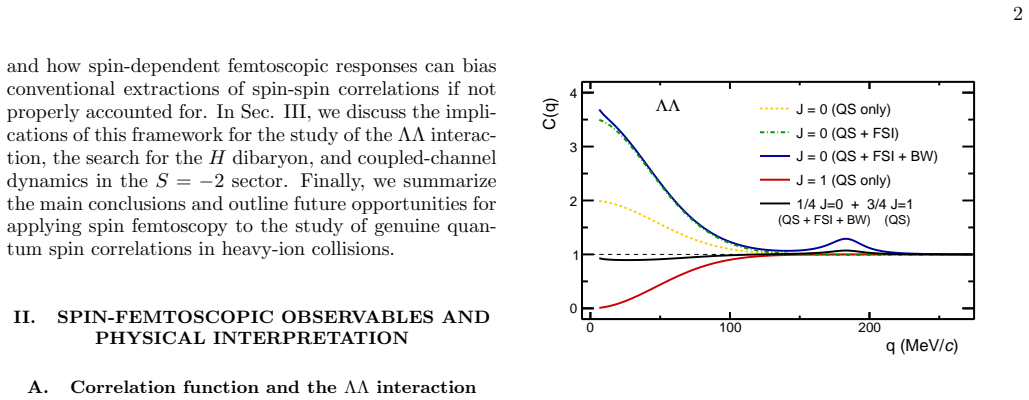
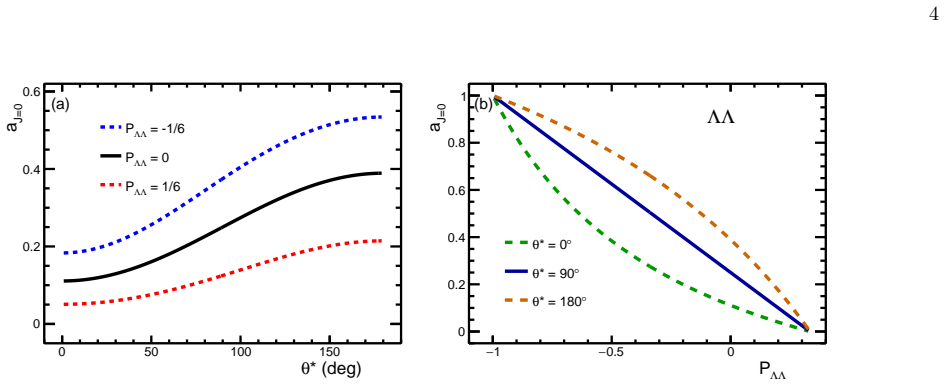
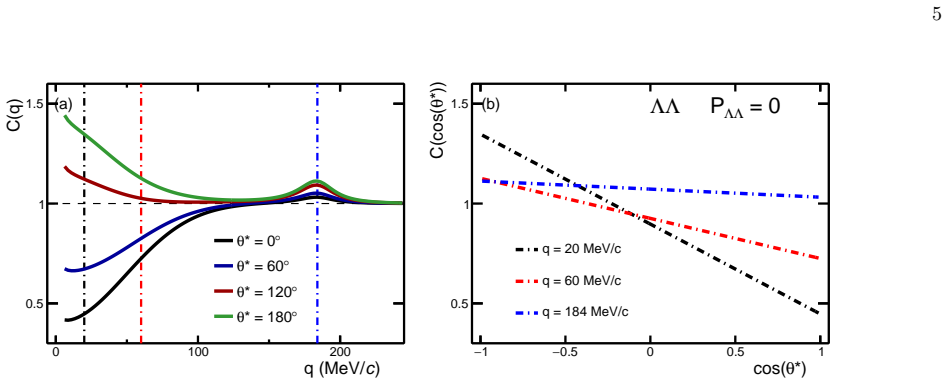
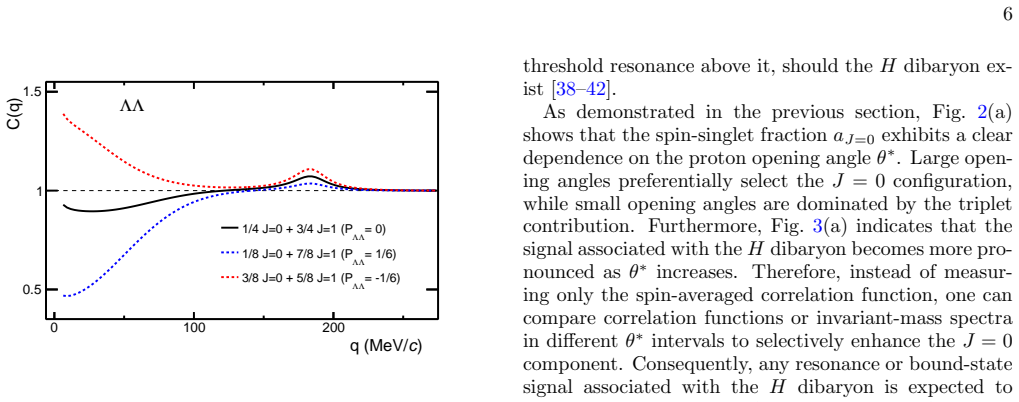
Spin femtoscopy exploits the fact that different two-particle spin configurations give rise to different femtoscopic correlation functions because of quantum statistics and spin-dependent final-state interactions. Using Lambda-Lambda pairs as a proof of principle and the self-analyzing weak decay of Lambda hyperons, the framework constructs spin-sensitive correlation functions with controlled singlet and triplet admixtures. These observables provide experimental access to the spin-state populations of the pair and allow genuine spin correlations to be separated from spin-dependent femtoscopic mixing caused by quantum statistics and final-state interactions.
What carries the argument
Spin-resolved femtoscopic correlation functions constructed from Lambda-Lambda pairs with varying singlet-triplet admixtures, enabled by the self-analyzing weak decays.
If this is right
- Genuine two-particle spin correlations become measurable in relativistic heavy-ion collisions.
- The spin-state populations of produced particle pairs can be extracted experimentally.
- Femtoscopy extends from a probe of source geometry to a probe of quantum spin structure.
- Spin-dependent final-state interactions can be isolated from genuine spin correlations in the data.
Where Pith is reading between the lines
- The approach could be tested on other pairs whose decays allow spin analysis, such as certain vector-meson combinations.
- It supplies a new observable that could be compared against hydrodynamic or transport models of spin production in QCD matter.
- Successful application would link femtoscopic source sizes directly to measured spin populations in the same dataset.
- The method might reveal whether spin correlations survive the hadronization stage or are generated earlier in the collision evolution.
Load-bearing premise
Different two-particle spin configurations produce distinguishable femtoscopic correlation functions due to quantum statistics and spin-dependent final-state interactions.
What would settle it
A measurement in which the correlation functions for singlet-dominated and triplet-dominated Lambda-Lambda pairs are identical within uncertainties would falsify the claim that spin configurations yield distinguishable signals.
Figures
read the original abstract
Spin correlations are among the most fundamental quantum observables in many-body systems, yet they remain difficult to access experimentally in relativistic heavy-ion collisions. Existing spin measurements, including hyperon polarization and vector-meson spin alignment, have revealed important single-particle spin phenomena, but genuine two-particle spin correlations in the produced hadronic system remain largely unexplored. Here we propose spin femtoscopy, a framework for accessing genuine two-particle spin correlations through spin-resolved femtoscopic measurements. The key principle is that different two-particle spin configurations can give rise to different femtoscopic correlation functions because of quantum statistics, spin-dependent final-state interactions. Using $\Lambda\Lambda$ pairs as a proof of principle, we exploit the self-analyzing weak decay of $\Lambda$ hyperons to construct spin-sensitive femtoscopic correlation functions with different singlet and triplet admixtures. We show that these observables provide experimental access to the spin-state populations of the pair and allow genuine spin correlations to be separated from spin-dependent femtoscopic mixing caused by quantum statistics and final-state interactions. This work extends femtoscopy from a probe of source geometry and final-state interactions to a framework for revealing the quantum spin structure of strongly interacting matter.
Editorial analysis
A structured set of objections, weighed in public.
Referee Report
Summary. The manuscript proposes a framework termed 'spin femtoscopy' to access genuine two-particle spin correlations in relativistic heavy-ion collisions. Using ΛΛ pairs as a proof-of-principle, it exploits the self-analyzing weak decays of Λ hyperons to construct spin-sensitive femtoscopic correlation functions with controlled singlet and triplet admixtures. The central claim is that these observables grant experimental access to spin-state populations and permit separation of genuine spin correlations from spin-dependent mixing induced by quantum statistics and final-state interactions.
Significance. If the separation of genuine correlations from quantum-statistics and FSI-induced mixing can be achieved, the framework would meaningfully extend femtoscopy beyond source geometry and interaction studies to the quantum spin structure of produced matter. The approach rests on standard symmetry properties of the two-fermion wave function and the established self-analyzing technique for hyperon polarization; these are genuine strengths. The absence of explicit derivations, numerical examples, or simulated correlation functions in the abstract, however, leaves the practical utility and invertibility of the proposed mapping unquantified.
major comments (2)
- [Abstract] Abstract: the claim that the observables 'provide experimental access to the spin-state populations of the pair and allow genuine spin correlations to be separated' is asserted without any derivation, explicit formula for the weighted correlation functions, or demonstration of invertibility. The full manuscript must supply the linear mapping from source spin populations to the measured C(q) and show that it is invertible.
- [Introduction / Framework description] The key principle (different spin configurations produce distinguishable femtoscopic functions via antisymmetrization and spin-dependent FSI) is standard, yet the manuscript must demonstrate with concrete expressions how the singlet/triplet admixtures are experimentally realized and how the genuine correlation term is isolated from the mixing term.
minor comments (1)
- [Abstract] The abstract would benefit from a short statement of the expected size of the spin-correlation signal relative to the statistical and FSI contributions, together with one or two key references to prior ΛΛ femtoscopy measurements.
Simulated Author's Rebuttal
We thank the referee for the positive evaluation of the proposed spin femtoscopy framework and for the constructive comments. We address the major comments point by point below, indicating the changes that will be made in the revised manuscript.
read point-by-point responses
-
Referee: [Abstract] Abstract: the claim that the observables 'provide experimental access to the spin-state populations of the pair and allow genuine spin correlations to be separated' is asserted without any derivation, explicit formula for the weighted correlation functions, or demonstration of invertibility. The full manuscript must supply the linear mapping from source spin populations to the measured C(q) and show that it is invertible.
Authors: We agree that the abstract states the central result without supporting detail and that the full manuscript must supply the explicit linear mapping and demonstrate invertibility. The current version develops the conceptual framework but does not contain the required derivations or numerical illustration. We will revise the manuscript to add a dedicated subsection deriving the weighted correlation functions for controlled singlet/triplet admixtures, present the linear mapping from source spin populations to the measured C(q), and prove its invertibility when final-state interaction parameters are known. A short numerical example will be included to quantify practical utility. The abstract will be updated to refer to these results more precisely. revision: yes
-
Referee: [Introduction / Framework description] The key principle (different spin configurations produce distinguishable femtoscopic functions via antisymmetrization and spin-dependent FSI) is standard, yet the manuscript must demonstrate with concrete expressions how the singlet/triplet admixtures are experimentally realized and how the genuine correlation term is isolated from the mixing term.
Authors: We agree that concrete expressions are necessary to establish the experimental realizability and isolation procedure. While the manuscript outlines the use of self-analyzing decays, it does not supply the explicit formulas. In the revision we will add the required expressions: the construction of spin-sensitive correlation functions from the decay angles that realize different singlet/triplet weights, and the linear combinations that isolate the genuine spin-correlation term from the quantum-statistics and FSI mixing contributions. These additions will also serve to demonstrate the invertibility of the mapping. revision: yes
Circularity Check
No significant circularity identified
full rationale
The paper proposes an extension of femtoscopy to spin-resolved observables for ΛΛ pairs, relying on the established principle that singlet and triplet spin configurations produce distinguishable correlation functions due to quantum statistics (antisymmetrization) and spin-dependent final-state interactions. This principle follows directly from the symmetry properties of the two-particle wave function for identical spin-1/2 fermions and is not derived or fitted within the paper itself. No equations, fitted parameters, or self-citations appear as load-bearing steps that reduce the central claim to its own inputs by construction. The framework is self-contained against external benchmarks of quantum mechanics and standard femtoscopy methods, with the use of self-analyzing weak decays being a known experimental technique.
Axiom & Free-Parameter Ledger
axioms (1)
- domain assumption Different two-particle spin configurations produce different femtoscopic correlation functions due to quantum statistics and spin-dependent final-state interactions.
invented entities (1)
-
spin femtoscopy framework
no independent evidence
Reference graph
Works this paper leans on
-
[1]
K. Adcox et al. (PHENIX), Nucl. Phys. A757, 184 (2005), arXiv:nucl-ex/0410003
work page internal anchor Pith review Pith/arXiv arXiv 2005
-
[2]
J. Adams et al. (STAR), Nucl. Phys. A757, 102 (2005), arXiv:nucl-ex/0501009
work page internal anchor Pith review Pith/arXiv arXiv 2005
-
[3]
S. Acharya et al. (ALICE), Eur. Phys. J. C84, 813 (2024), arXiv:2211.04384 [nucl-ex]
-
[4]
Arslandok et al., (2023), arXiv:2303.17254 [nucl-ex]
M. Arslandok et al., (2023), arXiv:2303.17254 [nucl-ex]
-
[5]
J. Chen et al., Nucl. Sci. Tech.35, 214 (2024), arXiv:2407.02935 [nucl-ex]
-
[6]
Entanglement in Many-Body Systems
L. Amico, R. Fazio, A. Osterloh, and V. Vedral, Rev. Mod. Phys.80, 517 (2008), arXiv:quant-ph/0703044
work page internal anchor Pith review Pith/arXiv arXiv 2008
-
[7]
R. Horodecki, P. Horodecki, M. Horodecki, and K. Horodecki, Rev. Mod. Phys.81, 865 (2009), arXiv:quant-ph/0702225
work page internal anchor Pith review Pith/arXiv arXiv 2009
-
[8]
Genuine quantum correlations in quantum many-body systems: a review of recent progress
G. De Chiara and A. Sanpera, Rept. Prog. Phys.81, 074002 (2018), arXiv:1711.07824 [quant-ph]
work page internal anchor Pith review Pith/arXiv arXiv 2018
- [9]
-
[10]
Globally Polarized Quark-gluon Plasma in Non-central A+A Collisions
Z.-T. Liang and X.-N. Wang, Phys. Rev. Lett.94, 102301 (2005), arXiv:nucl-th/0410079
work page internal anchor Pith review Pith/arXiv arXiv 2005
-
[11]
Global $\Lambda$ hyperon polarization in nuclear collisions: evidence for the most vortical fluid
L. Adamczyk et al. (STAR), Nature548, 62 (2017), arXiv:1701.06657 [nucl-ex]
work page internal anchor Pith review Pith/arXiv arXiv 2017
-
[12]
Becattini, I
F. Becattini, I. Karpenko, M. A. Lisa, I. Upsal, and S. A. Voloshin, Phys. Rev. C95, 054902 (2017)
2017
- [13]
- [14]
-
[15]
H.-L. Chen, W.-j. Fu, X.-G. Huang, and G.-L. Ma, Phys. Rev. Lett.135, 032302 (2025), arXiv:2410.20704 [hep- ph]
- [16]
-
[17]
J.-H. Chen, Z.-T. Liang, Y.-G. Ma, X.-L. Sheng, and Q. Wang, Sci. China Phys. Mech. Astron.68, 211001 (2025), arXiv:2407.06480 [hep-ph]
-
[18]
L.-G. Pang, H. Petersen, Q. Wang, and X.-N. Wang, Phys. Rev. Lett.117, 192301 (2016)
2016
- [19]
- [20]
- [21]
-
[22]
Pratt, Phys
S. Pratt, Phys. Rev. D33, 1314 (1986)
1986
- [23]
-
[24]
R. L. Jaffe, Phys. Rev. Lett.38, 195 (1977), [Erratum: Phys.Rev.Lett. 38, 617 (1977)]
1977
-
[25]
Lednicky and V
R. Lednicky and V. L. Lyuboshits, Yad. Fiz.35, 1316 (1981)
1981
-
[26]
Bound H-dibaryon in Flavor SU(3) Limit of Lattice QCD
T. Inoue, N. Ishii, S. Aoki, T. Doi, T. Hatsuda, Y. Ikeda, K. Murano, H. Nemura, and K. Sasaki (HAL QCD), Phys. Rev. Lett.106, 162002 (2011), arXiv:1012.5928 [hep-lat]. 8
work page internal anchor Pith review Pith/arXiv arXiv 2011
-
[27]
K. Sasaki et al. (HAL QCD), Nucl. Phys. A998, 121737 (2020), arXiv:1912.08630 [hep-lat]
- [28]
-
[29]
Lambda-Lambda interaction from relativistic heavy-ion collisions
K. Morita, T. Furumoto, and A. Ohnishi, Phys. Rev. C 91, 024916 (2015), arXiv:1408.6682 [nucl-th]
work page internal anchor Pith review Pith/arXiv arXiv 2015
-
[30]
T. D. Lee and C. N. Yang, Phys. Rev.108, 1645 (1957)
1957
-
[31]
Global polarization of $\Lambda$ hyperons in Au+Au collisions at $\sqrt{s_{_{NN}}}$ = 200 GeV
J. Adam et al. (STAR), Phys. Rev. C98, 014910 (2018), arXiv:1805.04400 [nucl-ex]
work page internal anchor Pith review Pith/arXiv arXiv 2018
-
[32]
F. T. et al. (Particle Data Group), Int. J. Mod. Phys. A 41, 2630011 (2026)
2026
-
[33]
Lednick´ y and V
R. Lednick´ y and V. L. Lyuboshitz, Phys. Lett. B508, 146 (2001)
2001
- [34]
-
[35]
N. A. T¨ ornqvist, Foundations of Physics11, 171 (1981)
1981
-
[36]
N. A. T¨ ornqvist, Physics Letters A117, 1 (1986)
1986
-
[37]
The $\Lambda\Lambda$ Correlation Function in Au+Au collisions at $\sqrt{s_{NN}}=$ 200 GeV
L. Adamczyk et al. (STAR), Phys. Rev. Lett.114, 022301 (2015), arXiv:1408.4360 [nucl-ex]
work page internal anchor Pith review Pith/arXiv arXiv 2015
-
[38]
Quark States near a Threshold and the Unstable H-dibaryon
S. Bashinsky and R. L. Jaffe, Nucl. Phys. A625, 167 (1997), arXiv:hep-ph/9705407
work page internal anchor Pith review Pith/arXiv arXiv 1997
-
[39]
Takahashi et al., Phys
H. Takahashi et al., Phys. Rev. Lett.87, 212502 (2001)
2001
-
[40]
J. K. Ahn et al. (KEK-PS E224), Phys. Lett. B444, 267 (1998)
1998
-
[41]
C. J. Yoon et al., Phys. Rev. C75, 022201 (2007)
2007
- [42]
- [43]
-
[44]
Measurement of lambda hyperons spin corre- lation in pp and ppb collisions at cms,
J. Wang, “Measurement of lambda hyperons spin corre- lation in pp and ppb collisions at cms,” Talk presented at DIS 2026 (2026)
2026
-
[45]
X. Bai et al., (2026), arXiv:2606.06553 [physics.ins-det]
work page internal anchor Pith review Pith/arXiv arXiv 2026
-
[46]
X. Luo, Q. Wang, N. Xu, and P. Zhuang, eds., Properties of QCD Matter at High Baryon Density (Springer, 2022)
2022
- [47]
-
[48]
Zhang, EPJ Web Conf.364, 05001 (2026), arXiv:2512.09452 [nucl-ex]
K. Zhang, EPJ Web Conf.364, 05001 (2026), arXiv:2512.09452 [nucl-ex]
discussion (0)
Sign in with ORCID, Apple, or X to comment. Anyone can read and Pith papers without signing in.