REVIEW 4 major objections 5 minor 13 references
Voltage pulses switch CDW phases in EuTe₄ at room temperature
Reviewed by Pith at T0; open to challenge. T0 means a machine referee read the full paper against a public rubric. the ladder, T0–T4 →
T0 review · glm-5.2
2026-07-05 10:07 UTC pith:TIX7TTQH
load-bearing objection First report of electrically driven, room-temperature, nonvolatile metastable CDW states in bulk EuTe4 — a real advance, but the Joule heating confound is not fully resolved and the mechanistic claim is stronger than the evidence supports. the 4 major comments →
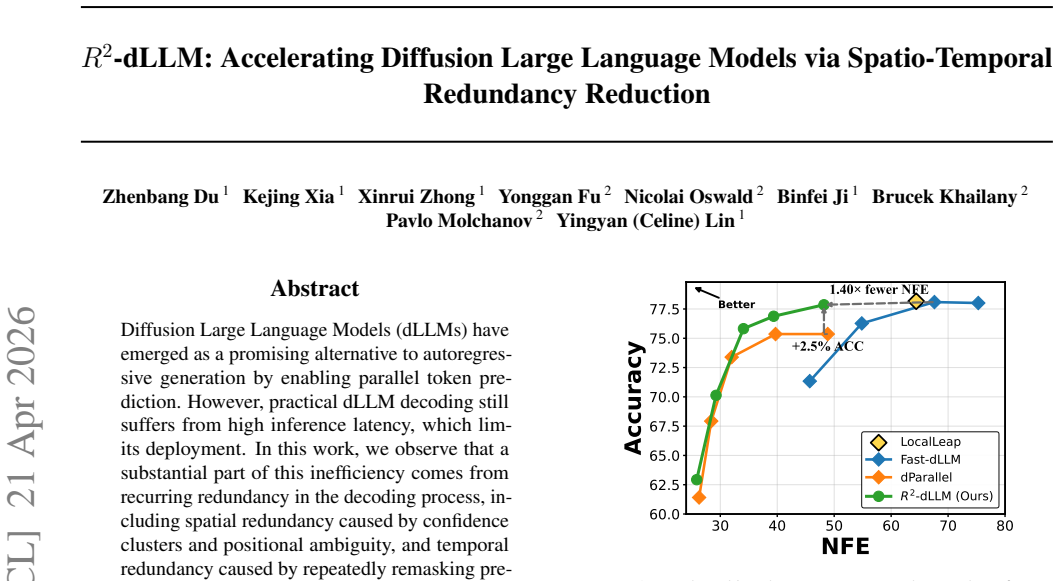
R²-dLLM: Accelerating Diffusion Large Language Models via Spatio-Temporal Redundancy Reduction
The pith
A machine-rendered reading of the paper's core claim, the machinery that carries it, and where it could break.
Core claim
The central discovery is that voltage pulses can drive bulk EuTe₄ into multiple discrete, nonvolatile metastable states at 300–400 K, and that these states arise not from changes in in-plane CDW ordering but from electric-field-induced switching of out-of-plane CDW phases in the moiré superstructure. The in-plane CDW wavevectors remain locked by a joint commensuration condition (q₁ + 2q₂ = 2b), while the CDW amplitude weakens and the diffraction peaks broaden, pointing to reduced correlation length and domain formation among the eight enumerated phase configurations of the stacked monolayer and bilayer CDWs.
What carries the argument
The moiré superstructure of EuTe₄, formed by the stacking of two incommensurate CDWs—a monolayer CDW with wavevector q₁ = 0.644(5)b* and a bilayer CDW with wavevector q₂ = 0.678(5)b* + 0.5c*—which are jointly locked to the lattice. The metastable states are interpreted as different out-of-plane phase arrangements (θ₁, θ₂, θ₃) of these CDW layers, with eight possible configurations enumerated in the paper's model.
Load-bearing premise
The claim that metastable states arise specifically from out-of-plane CDW phase domain formation rests on indirect evidence—XRD peak intensity suppression and broadening—rather than direct real-space imaging of the proposed domains. The eight-state model is a theoretical enumeration of possible phase combinations; no structural measurement confirms which specific configurations are actually realized. The paper also acknowledges that Joule heating cannot be fully excluded as a
What would settle it
If direct structural imaging (e.g., scanning tunneling microscopy or nanobeam diffraction) of the pulsed state fails to reveal domains with the predicted phase combinations, or if controlled heating experiments reproduce the same resistivity plateaus without an electric field, the domain-switching mechanism would be undermined in favor of a thermal or defect-migration explanation.
If this is right
- EuTe₄ could serve as a room-temperature multi-bit memory material, with each resistivity plateau representing a distinct stored state, operating across a 100 K window without cryogenic cooling.
- The moiré CDW stacking mechanism suggests a new design principle for nonvolatile memory: seek materials with stacked incommensurate orders where out-of-plane phase switching is accessible but in-plane periodicity is protected by joint commensuration.
- The eight-state phase model, if confirmed by direct real-space imaging, would provide a combinatorial framework for predicting the number and resistance values of accessible metastable states in other stacked CDW systems.
- The difference between bulk and thin-flake behavior (bulk shows multiple low-resistance states; flakes show hidden high-resistance states) implies that device geometry can be tuned to select different metastable regimes, expanding the engineering space for CDW-based memory.
Editorial analysis
A structured set of objections, weighed in public.
Referee Report
Summary. This manuscript reports electrically driven, nonvolatile metastable states in bulk EuTe4, a layered CDW material hosting an innate moiré superstructure from stacked incommensurate monolayer and bilayer CDWs. The authors combine in-situ transport, ARPES, and XRD measurements to show that voltage pulses produce discrete, reversible resistivity plateaus at 300–400 K, with preserved in-plane CDW wavevectors but suppressed CDW satellite intensity and broadened FWHM. They interpret these observations as arising from electric-field-induced switching of out-of-plane CDW phases, proposing an eight-state domain model. The experimental observations themselves—plateaus, nonvolatility, reversibility, and the XRD/ARPES signatures—are clearly presented and internally consistent.
Significance. Room-temperature, nonvolatile, multi-bit CDW memory in a bulk crystal is a practically significant result. The multi-messenger approach integrating transport, ARPES, and XRD with in-situ pulsed excitation is a strength, as is the systematic characterization across a wide temperature window. The observation that in-plane periodicity is robustly preserved (joint lock-in) while out-of-plane order is modulated is a notable materials-physics finding. The distinction drawn between bulk and thin-flake behavior (Sec. near p. 7–8) adds physical insight.
major comments (4)
- Joule heating confound (Fig. 1c, Fig. 4b, and Supplementary Information): The manuscript acknowledges that 'thermal contributions associated with Joule heating cannot be ruled out' (Results, near Fig. 1c) and that pulse-duration dependence is 'non-negligible' (Fig. 4b). Given that EuTe4 exhibits a giant thermal hysteresis spanning 100–500 K, Joule heating during voltage pulses could raise the sample temperature within this hysteresis loop, and the observed multi-state plateaus could partially reflect thermal cycling to different points on the known hysteresis curve rather than purely field-driven CDW domain switching. The XRD evidence (intensity suppression, FWHM broadening of CDW satellites, Fig. 3c–d) is equally consistent with thermally-induced CDW amplitude reduction as with field-driven phase domain formation. This is load-bearing for the central mechanistic claim. The Supplementary
- Information analysis is referenced but not summarized in the main text; a quantitative bound on the temperature rise during pulsing, or a control experiment (e.g., varying pulse duty cycle at fixed energy, or comparing field-driven vs. furnace-heated trajectories through the hysteresis loop), would substantially strengthen the claim that the mechanism is field-driven rather than thermal.
- Internal tension between conclusion point (2) and Fig. 4b: The conclusion states the metastable states are 'highly sensitive to electric field strength rather than pulse duration' (p. 8, point 2). However, Fig. 4b explicitly shows a pronounced dependence on pulse duration for longer pulses (10 µs to 100 µs), and Fig. 1c (blue regime) demonstrates a 'further decrease in resistance with the application of longer pulses.' These observations directly contradict the stated conclusion. The authors should either reconcile this tension with quantitative analysis (e.g., showing that field strength dominates when energy is held constant) or revise the conclusion to accurately reflect the role of pulse duration.
- Eight-state CDW domain model (Fig. 4c–d): The model enumerates eight possible CDW states defined by relative phases (θ1, θ2, θ3) between Te layers, but no direct structural measurement (e.g., real-space imaging or layer-resolved diffraction) confirms which specific phase combinations are realized. The model is used to interpret the XRD intensity suppression and FWHM broadening, but these observables are also consistent with simpler explanations (e.g., reduced CDW amplitude and correlation length without invoking discrete domain states). The authors should either provide additional evidence supporting the discrete eight-state picture or more clearly frame this as a proposed interpretation rather than an established mechanism.
minor comments (5)
- The abstract and title reference arXiv:2604.18995 (cs.CL) about diffusion LLMs, but the manuscript content is entirely about EuTe4 CDW physics (arXiv:2604.18998, cond-mat.str-el). This appears to be a metadata error that should be corrected.
- Fig. 2 is referenced in the text (p. 7, 'exceeding a 50% drop, see Fig. 2a') but is not included in the provided manuscript text. Please ensure all figures are present.
- The phrase 'andin-situtransport' (Abstract/Introduction) has a missing space; similar formatting issues appear elsewhere (e.g., 'andthe' in the Introduction).
- The ARPES results are mentioned only briefly in the main text and deferred to the Supplementary Information. A short summary of the key ARPES findings (gap changes, linear voltage response) in the main text would improve readability.
- The distinction between bulk and thin-flake behavior (p. 7–8) is important but somewhat buried. Consider a dedicated subsection or a summary table comparing the two regimes.
Simulated Author's Rebuttal
We thank the referee for a careful and constructive report. The referee raises three major points: (1) the Joule heating confound and whether the mechanism is field-driven versus thermal, (2) an internal tension between conclusion point (2) and the pulse-duration dependence shown in Fig. 4b, and (3) the evidentiary status of the eight-state CDW domain model. We address each below. We agree that points (1) and (3) require revision to the manuscript, and that point (2) requires a correction of the stated conclusion. We also note one standing limitation regarding direct layer-resolved structural confirmation of the domain model.
read point-by-point responses
-
Referee: Joule heating confound: the manuscript acknowledges thermal contributions cannot be ruled out, and the XRD evidence is equally consistent with thermally-induced CDW amplitude reduction. A quantitative bound on temperature rise or a control experiment is needed.
Authors: We agree that the Joule heating question is load-bearing for the mechanistic claim and that the manuscript does not currently present sufficient quantitative analysis in the main text. We will address this in revision. Specifically, we will (i) summarize the Supplementary Information Joule heating analysis in the main text, including an order-of-magnitude estimate of the temperature rise during pulsing based on the measured current, pulse duration, sample geometry, and thermal conductivity of EuTe4; (ii) add a discussion of why the asynchronous behavior between resistivity and XRD peak intensity (Fig. 3c) disfavors a purely thermal explanation—Joule heating would be expected to suppress CDW amplitude and resistivity in concert, whereas we observe substantial resistivity changes with only weak CDW peak intensity changes at low voltages; and (iii) explicitly acknowledge in the main text that a furnace-heated control trajectory through the hysteresis loop has not been performed and that this remains a limitation. We will also add a control experiment varying pulse duty cycle at fixed total energy, which we can perform on the existing device geometry. We agree that the current phrasing ('cannot be ruled out') is insufficient and will revise the mechanistic discussion to clearly delineate what the evidence supports (field-driven domain formation) from what remains unexcluded (thermal contributions to amplitude reduction). revision: partial
-
Referee: Internal tension between conclusion point (2) and Fig. 4b: the conclusion states metastable states are 'highly sensitive to electric field strength rather than pulse duration,' but Fig. 4b shows pronounced pulse-duration dependence for 10–100 µs pulses, and Fig. 1c (blue regime) shows further resistance decrease with longer pulses.
Authors: The referee is correct that the stated conclusion is too strong and is contradicted by the data shown in Fig. 4b and Fig. 1c. We will revise conclusion point (2) to accurately reflect the data. The intended meaning was that the threshold voltage for initiating switching is primarily field-controlled (i.e., below a critical field, no switching occurs regardless of pulse duration), but once above threshold, the degree of switching does depend on pulse duration, particularly for longer pulses. The current phrasing 'rather than pulse duration' misrepresents this. We will revise to state that metastable state formation requires a threshold electric field strength, but the extent of switching exhibits a non-negligible dependence on pulse duration, particularly for pulses exceeding 10 µs. We thank the referee for catching this inconsistency. revision: yes
-
Referee: Eight-state CDW domain model: no direct structural measurement confirms which specific phase combinations are realized, and the XRD observables are also consistent with simpler explanations (reduced CDW amplitude and correlation length without discrete domain states).
Authors: We agree that the eight-state model is a proposed interpretation rather than an established mechanism, and that the current XRD observables (intensity suppression, FWHM broadening) do not uniquely distinguish between discrete domain states and a simpler picture of reduced amplitude and correlation length. We will revise the manuscript to frame the eight-state model explicitly as a proposed interpretation. That said, we note two points in defense of the domain picture that we will also incorporate: (i) the asynchronous behavior between resistivity and CDW peak intensity at low voltages is not naturally explained by a uniform amplitude reduction, but is consistent with domain formation preceding amplitude suppression; and (ii) the multi-step, discrete nature of the resistance plateaus is more naturally explained by discrete domain configurations than by a continuous amplitude reduction. However, we acknowledge that these arguments are indirect. We do not have layer-resolved diffraction or real-space imaging confirming specific (θ1, θ2, θ3) phase combinations, and we will state this limitation explicitly. We will also note that the eight-state enumeration follows from the symmetry of the stacking geometry (three independent relative phases, each binary) and is thus the natural set of candidate states, but that direct confirmation requires experiments beyond the scope of this work. revision: partial
- We do not have layer-resolved structural measurements (e.g., real-space STM imaging of domain configurations or layer-resolved diffraction) that could directly confirm which specific phase combinations among the eight candidate states are realized. This is an experimental limitation that cannot be resolved within the scope of the current manuscript.
Circularity Check
No significant circularity: the central experimental observations are measured against external benchmarks and do not reduce to fitted parameters or self-citation chains.
full rationale
The paper reports experimental observations (resistivity plateaus, XRD peak intensity/FWHM changes, ARPES gap changes) in EuTe4 under voltage pulses. The central claims are grounded in independent measurements: transport data from oscilloscope/Keithley circuits, XRD from CHESS synchrotron, ARPES from synchrotron sources. None of these measurements are defined in terms of the paper's interpretive conclusions. The eight-state CDW domain model (Fig. 4c) is explicitly presented as a theoretical enumeration for interpretation ('we interpret the metastable states as a result of the formation of multiple types of CDW domains'), not as a fitted input that defines the output. Self-citations (refs. 27, 34, 35 by overlapping author groups including Lv, Zong, Su, Gedik) provide background on EuTe4's moiré structure and prior CDW characterization, but the present paper's key findings — voltage-induced metastable states in bulk crystals, their nonvolatility, multi-step nature, and XRD/ARPES signatures — are new experimental results that do not reduce to those cited works. The Joule heating concern raised by the skeptic is a correctness/confound issue, not a circularity issue: the paper acknowledges it openly ('thermal contributions associated with Joule heating cannot be ruled out') rather than defining it away. No step in the derivation chain reduces to its own inputs by construction.
Axiom & Free-Parameter Ledger
free parameters (3)
- Voltage pulse amplitudes (up to 14 V) =
variable, up to 14 V
- Pulse durations (10 µs to 100 ms) =
variable, 10 µs–100 ms
- Eight-state CDW phase model (Fig. 4c) =
N/A (theoretical enumeration)
axioms (4)
- domain assumption EuTe4 hosts coexisting monolayer and bilayer CDWs with incommensurate wavevectors q1 and q2 satisfying q1 + 2q2 = 2b (joint commensuration).
- domain assumption The thermal hysteresis in EuTe4 (100–500 K) originates from unconventional switching between 3D moiré superstructure configurations, not incommensurate-to-commensurate lock-in.
- ad hoc to paper Metastable states arise from out-of-plane CDW phase domain formation rather than new ordered phases or incommensurability changes.
- domain assumption Joule heating contributes to but does not dominate the metastable state formation.
invented entities (1)
-
Eight distinct CDW domain states defined by relative phases (θ1, θ2, θ3) between Te layers
no independent evidence
read the original abstract
Diffusion Large Language Models (dLLMs) have emerged as a promising alternative to autoregressive generation by enabling parallel token prediction. However, practical dLLM decoding still suffers from high inference latency, which limits deployment. In this work, we observe that a substantial part of this inefficiency comes from recurring redundancy in the decoding process, including spatial redundancy caused by confidence clusters and positional ambiguity, and temporal redundancy caused by repeatedly remasking predictions that have already stabilized. Motivated by these patterns, we propose $R^{2}$-dLLM, a unified framework for reducing decoding redundancy from both inference and training perspectives. At inference time, we introduce training-free decoding rules that aggregate local confidence and token predictions, and finalize temporally stable tokens to avoid redundant decoding steps. We further propose a redundancy-aware supervised fine-tuning pipeline that aligns the model with efficient decoding trajectories and reduces reliance on manually tuned thresholds. Experiments demonstrate that $R^{2}$-dLLM consistently reduces the number of decoding steps by up to 88\% compared to existing decoding strategies, while maintaining competitive generation quality across different models and tasks. These results validate that decoding redundancy is a central bottleneck in dLLMs, and that explicitly reducing it yields substantial practical efficiency gains. Our code and models are available at https://github.com/GATECH-EIC/R2-dLLM.
Figures


Reference graph
Works this paper leans on
-
[1]
Room-temperature memristive switching between charge density wave states
R. Venturini, M. Rupnik, J. Gašperlin, J. Lipič, P. Šutar, Y. Vaskivskyi, F. Ščepanović, D. Grabnar, D. Golež, and D. Mihailovic, Electrically driven non-volatile resistance switching between charge density wave states at room temperature (2024), arXiv:2412.13094
work page internal anchor Pith review Pith/arXiv arXiv 2024
-
[2]
S. D. Wilson and B. R. Ortiz, AV3Sb5 kagome supercon- ductors, Nature Reviews Materials9, 420 (2024)
work page 2024
-
[3]
T. W. Kim, Y. Yang, F. Li, and W. L. Kwan, Electri- calmemorydevicesbasedoninorganic/organicnanocom- posites, NPG Asia Materials4, e18 (2012)
work page 2012
-
[4]
D. K. Pradhan, D. C. Moore, A. M. Francis, J. Kupernik, W. J. Kennedy, N. R. Glavin, R. H. Olsson, and D. Jari- wala, Materials for high-temperature digital electronics, Nature Reviews Materials9, 790 (2024)
work page 2024
-
[5]
B. Lv, A. Zong, D. Wu, Z. Nie, Y. Su, D. Choi, B. Ilyas, B. T. Fichera, J. Li, E. Baldini, M. Mogi, Y.-B. Huang, H. C. Po, S. Meng, Y. Wang, N. Wang, and N. Gedik, Coexistence of Interacting Charge Density Waves in a Layered Semiconductor, Physical Review Letters132, 206401 (2024)
work page 2024
-
[6]
K. H. Oh, Y. Su, H. Ning, B. Q. Lv, A. Zong, D. Wu, Q. Liu, G. Kang, H. Choi, H.-W. J. Kim, S. Ha, J. Kim, S. Sarker, J. P. C. Ruff, X. Shen, D. Luo, S. Weathersby, P. Kramer, X. Cheng, D. Choi, D. Azoury, M. Mogi, B. J. Kim, N. L. Wang, H. Jang, and N. Gedik, Joint commen- suration in moiré charge-order superlattices drives shear topological defects (202...
work page internal anchor Pith review Pith/arXiv arXiv 2025
-
[7]
Grüner, The dynamics of charge-density waves, Rev
G. Grüner, The dynamics of charge-density waves, Rev. Mod. Phys.60, 1129 (1988)
work page 1988
-
[8]
B. Lv, T. Qian, and H. Ding, Angle-resolved photoemis- sion spectroscopy and its application to topological ma- terials, Nature Reviews Physics1, 609 (2019)
work page 2019
-
[9]
A. Zong, A. Kogar, Y.-Q. Bie, T. Rohwer, C. Lee, E. Bal- dini, E. Ergeçen, M. B. Yilmaz, B. Freelon, E. J. Sie, H. Zhou, J. Straquadine, P. Walmsley, P. E. Dolgirev, A. V. Rozhkov, I. R. Fisher, P. Jarillo-Herrero, B. V. Fine, and N. Gedik, Evidence for topological defects in a photoinduced phase transition, Nature Physics15, 27 (2019)
work page 2019
-
[10]
G. Orenstein, R. A. Duncan, G. A. d. l. P. Munoz, Y. Huang, V. Krapivin, Q. L. Nguyen, S. Teitelbaum, A. G. Singh, R. Mankowsky, H. Lemke, M. Sander, Y. Deng, C. Arrell, I. R. Fisher, D. A. Reis, and M. Trigo, Subdiffusive Dynamics of Topological Vortex Strings of a Charge Density Wave (2023)
work page 2023
- [11]
-
[12]
K. E. Nygren, D. C. Pagan, J. P. C. Ruff, E. Aren- holz, and J. D. Brock, “Cartography” in 7-Dimensions at CHESS: Mapping of Structure in Real Space, Reciprocal Space, and Time Using High-Energy X-rays, Synchrotron Radiation News33, 11 (2020)
work page 2020
-
[13]
Y. Su, Replication Data for: Room-temperature multi- stage metastability in a moiré superstructure (2026)
work page 2026
discussion (0)
Sign in with ORCID, Apple, or X to comment. Anyone can read and Pith papers without signing in.