REVIEW 2 major objections 6 minor 57 references
Three different FLRW connections in f(Q,C) gravity collapse to one cosmology once the connection equations are solved with vanishing integration constant, making the theory equivalent to f(R).
Reviewed by Pith at T0; open to challenge. T0 means a machine referee read the full paper against a public rubric. the ladder, T0–T4 →
T0 review · grok-4.5
2026-07-11 06:24 UTC pith:U52SDSDZ
load-bearing objection Clean structural result: the connection equations force a degenerate f(R)-equivalent sector where all three FLRW connections coincide; the non-degenerate numerics are honest but preliminary. the 2 major comments →
Degenerate and connection-dependent cosmological sectors in f(Q,C) gravity
The pith
A machine-rendered reading of the paper's core claim, the machinery that carries it, and where it could break.
Core claim
When the connection field equations are solved with vanishing integration constant, f(Q,C) is forced into the form g(Q+C) plus a linear term in (Q-C). In that sector the three FLRW-compatible connections produce identical modified Friedmann equations and the theory is dynamically equivalent to f(R) gravity. Only when the constant is nonzero does the choice of connection become physically relevant and introduce extra dynamical degrees of freedom.
What carries the argument
The connection field equation C_t=0, integrated once to give ḟ_Q - ḟ_C equal to a constant over a power of the scale factor (or involving the free connection function). Setting that constant to zero forces f(Q,C)=g(Q+C)+k/2(Q-C) and collapses the three branches.
Load-bearing premise
Matter is assumed to couple only to the metric, so there is no hypermomentum; without that assumption the connection equations and the claimed degeneracy change.
What would settle it
Construct an explicit f(Q,C) with nonzero integration constant that still satisfies the connection equation for one of the non-trivial FLRW connections, integrate the background equations, and check whether the resulting Hubble history is observationally distinguishable from both f(R) and the other two connections.
Editorial analysis
A structured set of objections, weighed in public.
Referee Report
Summary. The paper studies FLRW cosmology in symmetric teleparallel f(Q,C) gravity for the three affine connections compatible with cosmological symmetries. It shows that the connection field equations integrate to ḟ_Q − ḟ_C = α_0/a^n (n = 3 or 5 depending on the branch). When α_0 = 0 this forces f = g(Q+C) + (k/2)(Q−C), making the three connection branches share identical background equations and rendering the theory dynamically equivalent to f(R̊) gravity—a degenerate cosmological sector. Analytic de Sitter solutions are obtained for polynomial and exponential models in that sector. For α_0 ≠ 0 the degeneracy is lifted; a representative model f = Q + α QC is integrated numerically for all three connections and compared qualitatively to ΛCDM and CPL benchmarks.
Significance. If correct, the result cleanly organizes the landscape of f(Q,C) cosmology: a large, previously under-appreciated class of models is not connection-dependent at the background level and is equivalent to f(R̊), while genuine connection dependence requires a nonzero integration constant and introduces extra dynamical degrees of freedom. The derivation of the constraint from C_t = 0 and the subsequent collapse of the three branches is algebraically transparent and model-independent within the pure-metric-coupling sector. The analytic vacuum structure (polynomial and exponential) and the explicit numerical systems for Connections II and III provide a concrete starting point for later observational and stability analyses. The work is a useful structural contribution rather than a finished phenomenological model.
major comments (2)
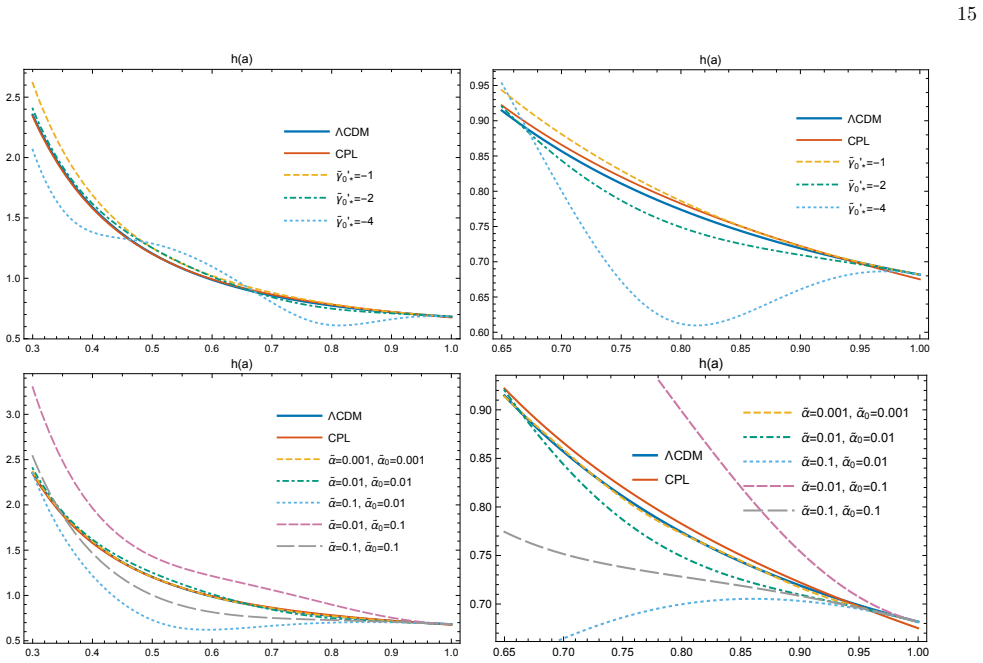
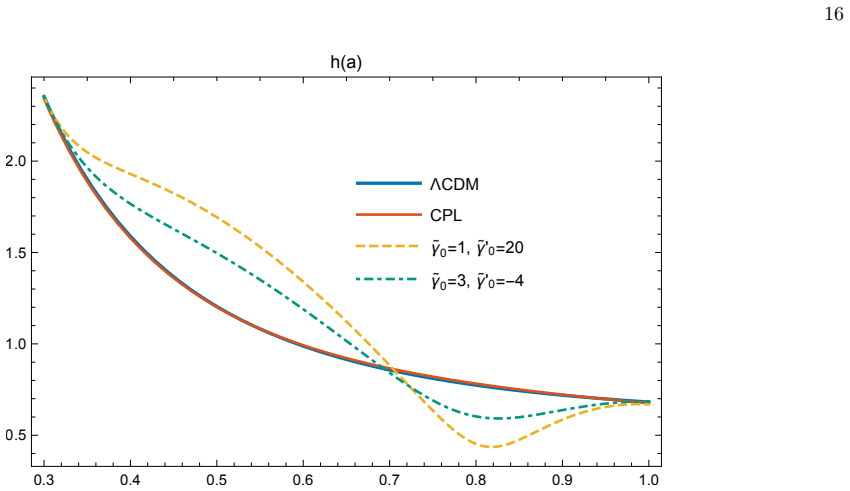
- Sec. V and the abstract claim that the non-degenerate sector yields “novel cosmological phenomenology” and “sufficient phenomenological flexibility” to address tensions. The numerical evidence consists of exploratory integrations with Ω_m and h_0 fixed to DESI ΛCDM values and with free (α, α_0, γ_0, γ′_0) chosen by hand (Figs. 2–5). No likelihood comparison, no early-universe (BBN/CMB) consistency check, and no linear-stability analysis of the extra connection modes are provided. The structural degeneracy result does not depend on these plots, but the stronger phenomenological claims should be substantially toned down or deferred to a dedicated observational study.
- Sec. III, after Eqs. (32) and (43): the paper notes that α_0 ≠ 0 “generally requires a nontrivial tuning between f(Q,C) and γ.” For the specific model f = Q + α QC the system is closed and solved dynamically, which is fine, but the manuscript never states under what conditions a generic f admits regular solutions with α_0 ≠ 0 without fine-tuning the functional form. A short existence/regularity discussion (or an explicit statement that only specially chosen f are treated) would make the scope of the non-degenerate sector clearer.
minor comments (6)
- Title of Sec. III and several headings show spacing artifacts (“COSMOLOGY INf(Q, C)GRA VITY”, “SYMMETRIC TELEP ARALLEL”). These are almost certainly PDF-extraction issues but should be cleaned in the production version.
- Eq. (55): the exponential model is written without the linear (Q−C) piece; a one-sentence remark that this corresponds to k = 0 would avoid confusion with the general form (45).
- Figs. 1–5: the dimensionless parameters α̃, α̃_0, γ̃ are defined in the text, but the figure captions do not restate the units or the fixed matter content; adding a short reminder would improve readability.
- Sec. II, after Eq. (13): vanishing hypermomentum is stated once. Given that it is the key assumption that makes C_λ = 0 guarantee energy-momentum conservation, a brief forward reference in the conclusions would help readers who skip the formalism.
- Connection I is repeatedly said to be “identical” to f(T,B) cosmology. A short citation pointer to the precise f(T,B) equations being matched would make the comparison sharper.
- In Eq. (48) and the subsequent rewrite (51), the condition Q+C ≠ 0 is noted parenthetically; it would be useful to state explicitly what happens on the Q+C = 0 locus (if anything nontrivial).
Circularity Check
No significant circularity: the degenerate-sector claim is an algebraic consequence of the connection equations, not an input renamed as a result.
full rationale
The paper’s central structural result—that α0=0 forces f(Q,C)=g(Q+C)+k/2(Q−C), collapses the three FLRW-compatible connections to identical background equations, and yields dynamical equivalence to f(R̊)—is obtained by integrating the connection field equations Ct=0 (Eqs. 32 and 43) and substituting into the metric equations (Sec. III). Q+C is connection-independent once the constraint holds; the linear (Q−C) piece is STEGR; the remainder is ordinary f(R̊). That chain is self-contained and does not assume the target equivalence. The three admissible connections themselves follow from geometric symmetry requirements (flatness, torsion-free, FLRW Killing vectors), not from a self-cited uniqueness theorem that forbids alternatives. Numerical Hubble curves in Sec. V fix matter parameters and h0 to external DESI ΛCDM/CPL benchmarks for qualitative illustration; the paper explicitly treats them as exploratory comparisons, not as fitted-then-repredicted quantities. Self-citations to the author’s earlier f(Q) work are present but are not load-bearing for the degeneracy derivation. No self-definitional loop, fitted-input-as-prediction, or ansatz-smuggled-via-citation step appears in the load-bearing chain. Score 0 is therefore the correct, proportionate finding.
Axiom & Free-Parameter Ledger
free parameters (5)
- α (QC coupling) =
exploratory values ~0.001–0.1 in dimensionless units
- α0 (connection integration constant) =
0 or exploratory ~0.001–0.1
- γ0, γ′0 (or γ∗0, γ∗′0) =
hand-chosen (e.g. γ0=1, γ′0=−1,0,1,…)
- k, n (polynomial model)
- α, β (exponential model)
axioms (5)
- domain assumption Affine connection is torsion-free and curvature-free (symmetric teleparallel geometry).
- domain assumption Matter has vanishing hypermomentum (no direct coupling to the connection).
- domain assumption FLRW isometries plus flat torsion-free conditions admit exactly three inequivalent connection branches Γ(I), Γ(II), Γ(III).
- domain assumption Energy-momentum is that of a perfect fluid with standard continuity equation once the connection equations hold.
- standard math Standard variational calculus and index contractions for nonmetricity scalars.
read the original abstract
We investigate cosmological solutions in $f(Q,C)$ gravity formulated within symmetric teleparallel geometry, where gravitation is described by the nonmetricity scalar $Q$ and the boundary term $C$, related to the Ricci scalar of General Relativity through $\mathring{R}=Q+C$ in the absence of curvature and torsion. The symmetry requirements of FLRW spacetime admit three distinct realizations of the affine connection, leading in principle to three different cosmological sectors within the same theory. We show that the connection field equations play a crucial role in determining the cosmological dynamics. In their simplest realization, these equations impose a constraint that renders the theory dynamically equivalent to $f(\mathring{R})$ gravity, causing the cosmological background equations associated with the three connection realizations to coincide. This defines a degenerate cosmological sector of $f(Q,C)$ gravity, in which three a priori distinct geometric constructions converge to the same cosmological dynamics. We then consider the complementary class of genuinely nonequivalent $f(Q,C)$ models, for which the choice of connection becomes physically relevant. In this regime, the connection sector introduces additional dynamical degrees of freedom and gives rise to novel cosmological phenomenology absent in $f(\mathring{R})$ gravity.
Figures


Reference graph
Works this paper leans on
-
[1]
Connection I For the connection Γ(I) the nonmetricity scalar and the boundary term read: Q=−6H 2 ,(22) C= 6(3H 2 + ˙H),(23) whereHis the Hubble function defined asH≡˙a/a. The no null field equations are: 1 2 f+ 3H2 − Q 2 fQ − 1 2 Cf C + 3H ˙fC =κρ ,(24) −1 2 f+ −3H2 −2 ˙H+ Q 2 fQ + 1 2 Cf C −2H ˙fQ − ¨fC =κp .(25) The remaining field equations, including ...
-
[2]
(30), which follows from variations with respect to the connection and is not automatically satisfied
Connection II For the connection Γ(II), the nonmetricity scalar and the boundary term read [32]: Q=−6H 2 + 9γH+ 3 ˙γ ,(26) C= 6(3H 2 + ˙H)−9γH−3 ˙γ .(27) The equations of motion that are not trivially satisfied in this case are: 1 2 f+ 3H2 − Q 2 fQ − 1 2 Cf C + 3 2 γ ˙fQ − ˙fC + 3H ˙fC =κρ ,(28) −1 2 f+ −3H2 −2 ˙H+ Q 2 fQ + 1 2 Cf C + 3 2 γ ˙fQ − ˙fC −2H ...
-
[3]
Connection III It is possible to simplify the equations obtained for this case through a redefinition in the components of the connection such as γ∗ = γ/a2, in a manner analogous to [ 43]. Then, for the connection Γ (III) the nonmetricity scalar and the boundary term reads: Q=−6H 2 + 3 a2 (γH+ ˙γ) = 3 3Hγ ∗ + ˙γ∗ −2H 2 ,(37) C= 6 3H2 + ˙H − 3 a2 (γH+ ˙γ) ...
-
[4]
In addition, we consider vacuum configurations withρ= 0 andp= 0
Maximally symmetric solutions We focus on maximally symmetric solutions by imposing a constant Hubble parameter, H = H0. In addition, we consider vacuum configurations withρ= 0 andp= 0. Then, Eqs. (28) and (29) take the same form: 6H2 0 k−12 nH2n 0 (n−2) = 0,(53) with three possible solutions: •H 0 = 0. This solution corresponds to a static spacetime with...
-
[5]
Maximally symmetric solutions As for the polynomial case, we consider maximally symmetric solutions by imposing a constant Hubble parameter, H=H 0, in vacuum withρ= 0 andp= 0. Then, Eqs. (28) and (29) takes the same form: 3H2 0 + α 2 e−12H 2 0 β 1 + 6H2 0 β −Λ = 0.(57) Unlike the polynomial case, the Minkowski branch is no longer automatically recovered. ...
-
[6]
E. Abdallaet al., Cosmology intertwined: A review of the particle physics, astrophysics, and cosmology associated with the cosmological tensions and anomalies, JHEAp34, 49 (2022), arXiv:2203.06142 [astro-ph.CO]
Pith/arXiv arXiv 2022
-
[7]
E. Di Valentinoet al.(CosmoVerse Network), The CosmoVerse White Paper: Addressing observational tensions in cosmology with systematics and fundamental physics, Phys. Dark Univ.49, 101965 (2025), arXiv:2504.01669 [astro-ph.CO]
Pith/arXiv arXiv 2025
-
[8]
Abdul Karimet al.(DESI), DESI DR2 results
M. Abdul Karimet al.(DESI), DESI DR2 results. II. Measurements of baryon acoustic oscillations and cosmological constraints, Phys. Rev. D112, 083515 (2025), arXiv:2503.14738 [astro-ph.CO]
Pith/arXiv arXiv 2025
-
[9]
E. Di Valentino, O. Mena, S. Pan, L. Visinelli, W. Yang, A. Melchiorri, D. F. Mota, A. G. Riess, and J. Silk, In the realm of the Hubble tension—a review of solutions, Class. Quant. Grav.38, 153001 (2021), arXiv:2103.01183 [astro-ph.CO]
Pith/arXiv arXiv 2021
-
[10]
Akramiet al.(CANTATA),Modified Gravity and Cosmology
Y. Akramiet al.(CANTATA),Modified Gravity and Cosmology. An Update by the CANTATA Network, edited by E. N. Saridakis, R. Lazkoz, V. Salzano, P. Vargas Moniz, S. Capozziello, J. Beltr´ an Jim´ enez, M. De Laurentis, and G. J. Olmo (Springer, 2021) arXiv:2105.12582 [gr-qc]
Pith/arXiv arXiv 2021
-
[11]
S. Capozziello and M. De Laurentis, Extended Theories of Gravity, Phys. Rept.509, 167 (2011), arXiv:1108.6266 [gr-qc]
Pith/arXiv arXiv 2011
-
[12]
T. Clifton, P. G. Ferreira, A. Padilla, and C. Skordis, Modified Gravity and Cosmology, Phys. Rept.513, 1 (2012), arXiv:1106.2476 [astro-ph.CO]
Pith/arXiv arXiv 2012
-
[13]
J. W. Maluf, The teleparallel equivalent of general relativity, Annalen Phys.525, 339 (2013), arXiv:1303.3897 [gr-qc]
Pith/arXiv arXiv 2013
-
[14]
J. Beltr´ an Jim´ enez, L. Heisenberg, and T. Koivisto, Coincident General Relativity, Phys. Rev. D98, 044048 (2018), arXiv:1710.03116 [gr-qc]
Pith/arXiv arXiv 2018
-
[15]
J. B. Jim´ enez, L. Heisenberg, and T. S. Koivisto, The Geometrical Trinity of Gravity, Universe5, 173 (2019), arXiv:1903.06830 [hep-th]
Pith/arXiv arXiv 2019
-
[16]
J. Beltr´ an Jim´ enez, L. Heisenberg, T. S. Koivisto, and S. Pekar, Cosmology inf(Q) geometry, Phys. Rev. D101, 103507 (2020), arXiv:1906.10027 [gr-qc]
Pith/arXiv arXiv 2020
-
[17]
R. Lazkoz, F. S. N. Lobo, M. Ortiz-Ba˜ nos, and V. Salzano, Observational constraints of f(Q) gravity, Phys. Rev. D100, 104027 (2019), arXiv:1907.13219 [gr-qc]
Pith/arXiv arXiv 2019
-
[18]
C. G. Boiza, M. Petronikolou, M. Bouhmadi-L´ opez, and E. N. Saridakis, Addressing H 0 and S 8 tensions within f(Q) cosmology, JCAP12, 011, arXiv:2505.18264 [astro-ph.CO]
-
[19]
I. Ayuso, R. Lazkoz, and V. Salzano, Observational constraints on cosmological solutions of f(Q) theories, Phys. Rev. D 103, 063505 (2021), arXiv:2012.00046 [astro-ph.CO]
Pith/arXiv arXiv 2021
-
[20]
S. Sahlu, A. de la Cruz-Dombriz, and A. Abebe, Structure growth in f (Q) cosmology, Mon. Not. Roy. Astron. Soc.539, 690 (2025), arXiv:2405.07361 [gr-qc]
Pith/arXiv arXiv 2025
-
[21]
I. Ayuso, R. Lazkoz, and J. P. Mimoso, DGP and DGP-like cosmologies from f(Q) actions, Phys. Rev. D105, 083534 (2022), arXiv:2111.05061 [astro-ph.CO]
Pith/arXiv arXiv 2022
-
[22]
G. Murtaza, A. De, T.-H. Loo, Y. K. Goh, and H. H. Liew, Phase-space analysis of an anisotropic universe in f(Q,C) gravity, Annals Phys.480, 170086 (2025), arXiv:2505.08274 [gr-qc]
Pith/arXiv arXiv 2025
-
[23]
Samaddar and S
A. Samaddar and S. S. Singh, Cosmological dynamics and thermodynamic behavior in f(Q,C) gravity: An analytical and observational approach, Phys. Dark Univ.47, 101792 (2025)
2025
- [24]
-
[25]
Sharif, M
M. Sharif, M. Zeeshan Gul, and M. H. Shahid, Cosmological implications and ghost dark energy model in f(Q,C) gravity, High Energy Dens. Phys.55, 101185 (2025)
2025
-
[26]
S. D. Sadatian and S. M. R. Hosseini, Cosmological inflation in the modified gravity model f(Q,C), Phys. Dark Univ.47, 101737 (2025)
2025
-
[27]
J. T. S. S. Junior, F. S. N. Lobo, and M. E. Rodrigues, Black holes and regular black holes in coincident f(Q,B Q) gravity coupled to nonlinear electrodynamics, Eur. Phys. J. C84, 332 (2024), arXiv:2402.02534 [gr-qc]
Pith/arXiv arXiv 2024
- [28]
-
[29]
S. A. Narawade, S. V. Lohakare, and B. Mishra, Stable f(Q) gravity model through non-trivial connection, Annals Phys. 474, 169913 (2025), arXiv:2408.12846 [gr-qc]
Pith/arXiv arXiv 2025
-
[30]
Y. Yang, X. Ren, B. Wang, Y.-F. Cai, and E. N. Saridakis, Data reconstruction of the dynamical connection function in f(Q) cosmology, Mon. Not. Roy. Astron. Soc.533, 2232 (2024), arXiv:2404.12140 [astro-ph.CO]
Pith/arXiv arXiv 2024
-
[31]
Paliathanasis, Testing non-coincident f(Q)-gravity with DESI DR2 BAO and GRBs, Phys
A. Paliathanasis, Testing non-coincident f(Q)-gravity with DESI DR2 BAO and GRBs, Phys. Dark Univ.49, 101993 (2025), arXiv:2504.11132 [gr-qc]
arXiv 2025
-
[32]
Paliathanasis, Dynamical analysis of fQ-cosmology, Phys
A. Paliathanasis, Dynamical analysis of fQ-cosmology, Phys. Dark Univ.41, 101255 (2023), arXiv:2304.04219 [gr-qc]
Pith/arXiv arXiv 2023
-
[33]
H. Shabani, A. De, and T.-H. Loo, Phase-space analysis of a novel cosmological model in f(Q) theory, Eur. Phys. J. C83, 535 (2023), arXiv:2304.02949 [gr-qc]
Pith/arXiv arXiv 2023
- [34]
-
[35]
Paliathanasis, Attractors inf(Q, B)-gravity, Phys
A. Paliathanasis, Attractors inf(Q, B)-gravity, Phys. Dark Univ.45, 101519 (2024)
2024
-
[36]
H. Shabani, A. De, and T.-H. Loo, The cosmological significance of boundary term in non-metricity gravity, Nucl. Phys. B 1017, 116965 (2025), arXiv:2406.13189 [gr-qc]
Pith/arXiv arXiv 2025
-
[37]
H. Shabani and A. De, Cosmological Scenarios in f(Q, C) gravity with a dynamical degree of freedom, (2025), arXiv:2509.24562 [gr-qc]
arXiv 2025
-
[38]
L. J¨ arv, M. R¨ unkla, M. Saal, and O. Vilson, Nonmetricity formulation of general relativity and its scalar-tensor extension, Phys. Rev. D97, 124025 (2018), arXiv:1802.00492 [gr-qc]
Pith/arXiv arXiv 2018
-
[39]
F. D’Ambrosio, L. Heisenberg, and S. Kuhn, Revisiting cosmologies in teleparallelism, Class. Quant. Grav.39, 025013 (2022), arXiv:2109.04209 [gr-qc]
Pith/arXiv arXiv 2022
-
[40]
A. De, T.-H. Loo, and E. N. Saridakis, Non-metricity with boundary terms:f(Q,C) gravity and cosmology, JCAP03, 050, arXiv:2308.00652 [gr-qc]
-
[41]
M. Hohmann, L. J¨ arv, M. Krˇ sˇ s´ ak, and C. Pfeifer, Modified teleparallel theories of gravity in symmetric spacetimes, Phys. Rev. D100, 084002 (2019), arXiv:1901.05472 [gr-qc]
Pith/arXiv arXiv 2019
-
[42]
S. Bahamonde, K. F. Dialektopoulos, C. Escamilla-Rivera, G. Farrugia, V. Gakis, M. Hendry, M. Hohmann, J. Levi Said, J. Mifsud, and E. Di Valentino, Teleparallel gravity: from theory to cosmology, Rept. Prog. Phys.86, 026901 (2023), arXiv:2106.13793 [gr-qc]
Pith/arXiv arXiv 2023
-
[43]
S. Bahamonde, C. G. B¨ ohmer, and M. Wright, Modified teleparallel theories of gravity, Phys. Rev. D92, 104042 (2015), arXiv:1508.05120 [gr-qc]
Pith/arXiv arXiv 2015
-
[44]
A. Paliathanasis and G. Leon, f(T,B) gravity in a Friedmann–Lemaˆ ıtre–Robertson–Walker universe with nonzero spatial curvature, Math. Methods Appl. Sci.46, 3905 (2023), arXiv:2201.12189 [gr-qc]
Pith/arXiv arXiv 2023
-
[45]
M. Caruana, G. Farrugia, and J. Levi Said, Cosmological bouncing solutions in f(T, B) gravity, Eur. Phys. J. C80, 640 (2020), arXiv:2007.09925 [gr-qc]
Pith/arXiv arXiv 2020
-
[46]
G. Farrugia, J. Levi Said, V. Gakis, and E. N. Saridakis, Gravitational Waves in Modified Teleparallel Theories, Phys. Rev. D97, 124064 (2018), arXiv:1804.07365 [gr-qc]
Pith/arXiv arXiv 2018
-
[47]
A. R. P. Moreira, J. E. G. Silva, F. C. E. Lima, and C. A. S. Almeida, Thick brane in f(T,B) gravity, Phys. Rev. D103, 064046 (2021), arXiv:2101.10054 [hep-th]
Pith/arXiv arXiv 2021
- [48]
-
[49]
S. D. Odintsov, D. S´ aez-Chill´ on G´ omez, and G. S. Sharov, Is exponential gravity a viable description for the whole cosmological history?, Eur. Phys. J. C77, 862 (2017), arXiv:1709.06800 [gr-qc]
Pith/arXiv arXiv 2017
-
[50]
L. Jaime, M. Salgado, and L. Patino, Cosmology in (R) exponential gravity, Springer Proc. Phys.157, 363 (2014), arXiv:1211.0015 [gr-qc]
Pith/arXiv arXiv 2014
-
[51]
S. D’Onofrio, S. Odintsov, and T. Schiavone, Exponential f(R) cosmology with massive neutrinos as a dynamical dark energy framework, (2025), arXiv:2511.06924 [gr-qc]
Pith/arXiv arXiv 2025
-
[52]
I. Ayuso, J. P. Mimoso, and N. J. Nunes, What if Newton’s Gravitational Constant Was Negative?, Galaxies7, 38 (2019), arXiv:1903.07604 [gr-qc]
Pith/arXiv arXiv 2019
-
[53]
Fujii and K.-i
Y. Fujii and K.-i. Maeda,The Scalar-Tensor Theory of Gravitation(Cambridge University Press, 2003)
2003
-
[54]
Dodelson,Modern Cosmology(Academic Press, Amsterdam, 2003)
S. Dodelson,Modern Cosmology(Academic Press, Amsterdam, 2003)
2003
-
[55]
R. J. Scherrer, Mapping the Chevallier-Polarski-Linder parametrization onto Physical Dark Energy Models, Phys. Rev. D 92, 043001 (2015), arXiv:1505.05781 [astro-ph.CO]
Pith/arXiv arXiv 2015
-
[56]
F. Gomez, S. Lepe, V. C. Orozco, and P. Salgado, Cosmology in 5D and 4D Einstein–Gauss–Bonnet gravity, Eur. Phys. J. C82, 906 (2022), arXiv:2207.09558 [hep-th]
Pith/arXiv arXiv 2022
-
[57]
A. Ashtekar and B. Gupt, Generalized effective description of loop quantum cosmology, Phys. Rev. D92, 084060 (2015), arXiv:1509.08899 [gr-qc]
Pith/arXiv arXiv 2015
discussion (0)
Sign in with ORCID, Apple, or X to comment. Anyone can read and Pith papers without signing in.