Super-Eddington accretion of black holes in early nuclear bursts gives birth to Little Red Dots
Pith reviewed 2026-06-28 22:08 UTC · model grok-4.3
The pith
A subset of black holes with super-Eddington accretion during nuclear bursts accounts for the Little Red Dots seen at high redshift.
A machine-rendered reading of the paper's core claim, the machinery that carries it, and where it could break.
Core claim
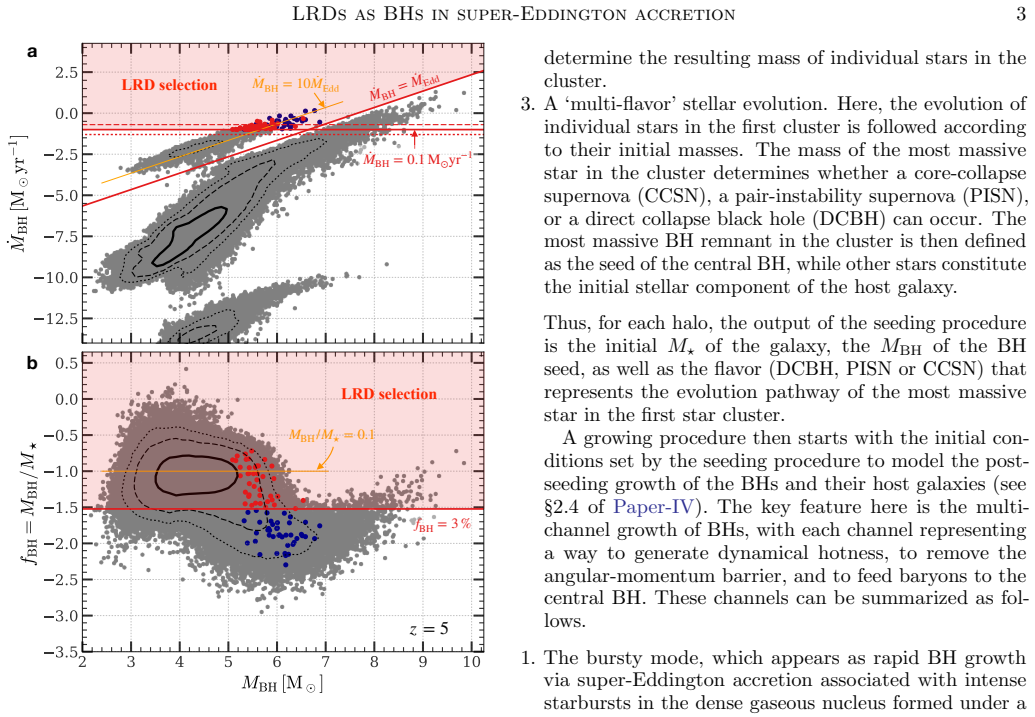
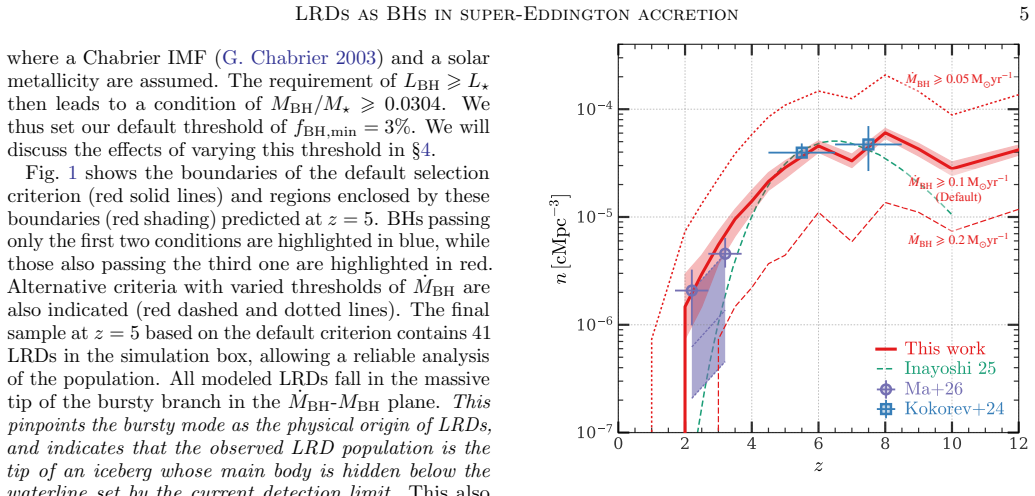
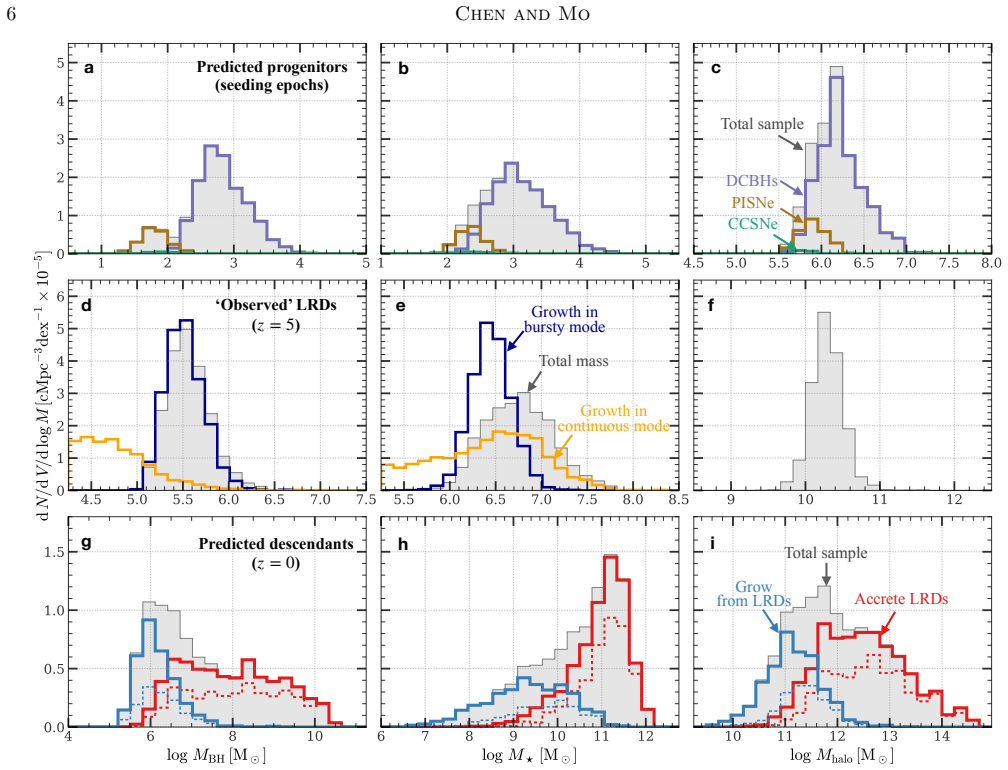
The LRD population at high redshift emerges naturally from a subset of BHs with super-Eddington accretion during nuclear bursts. The model suggests that the observed LRDs are the tip of the iceberg of a much larger population of less luminous BHs in the same subset. Most LRDs at z approximately 5 are seeded at z greater than or equal to 20 through direct-collapse BHs or pair-instability supernovae from Pop-III stars and have grown to black hole masses of 10^5 to 10^7 solar masses through nuclear bursts by their observed redshift.
What carries the argument
Selection of black holes by physically motivated criteria within the Chen et al. framework that undergo super-Eddington accretion during nuclear bursts.
If this is right
- The model supplies specific mass distributions for the black holes and their host galaxies or halos.
- It predicts a piece-wise redshift evolution of LRD number density.
- LRDs at z approximately 5 link directly to seeds at z greater than or equal to 20 and evolve into diverse descendants ranging from compact dwarf galaxies to brightest cluster galaxies at z equals 0.
Where Pith is reading between the lines
- Deeper surveys targeting fainter nuclear sources at similar redshifts could reveal the predicted larger population of less luminous black holes.
- The same accretion mechanism may apply to other rapidly growing high-redshift black hole populations detected by JWST.
- Follow-up observations of candidate descendant galaxies at intermediate redshifts could test whether LRDs evolve into the predicted range of local galaxy types.
Load-bearing premise
The set of criteria used to select the predicted black holes from the Chen et al. framework correctly identifies those that match the observed Little Red Dots.
What would settle it
A clear mismatch between the model's predicted black hole mass distribution, host halo masses, or piece-wise redshift evolution of number density and the distributions measured from JWST LRD samples would falsify the proposed connection.
Figures
read the original abstract
In a recent paper, Chen et al. developed a framework for modeling the seeding and growth of supermassive black holes (BHs) in the context of $\Lambda$CDM cosmogony. Here, we use a set of physically motivated criteria to select a population of predicted BHs and link them to Little Red Dots (LRDs) discovered by JWST. We show that the LRD population at high redshift ($z$) emerges naturally from a subset of BHs with super-Eddington accretion during nuclear bursts. The model suggests that the observed LRDs are the "tip of the iceberg" of a much larger population of less luminous BHs in the same subset. The model makes specific predictions for the LRD population, such as the mass distributions of their BHs and host galaxies/halos, and the piece-wise redshift evolution of their number density. The cosmological context of the model also allows us to link the observed LRD population to their progenitors (their BH seeds) and lower-$z$ descendant BHs, galaxies and halos. Most LRDs at $z\sim 5$ are seeded at $z \gtrsim 20$ through direct-collapse BHs or pair-instability supernovae from Pop-III stars, and have grown to $M_{\rm BH} \approx 10^5$--$10^7\,{\rm M}_\odot$ through nuclear bursts by their observed redshift. LRDs are predicted to have diverse descendants, ranging from compact dwarf galaxies to brightest cluster galaxies (BCGs) at $z=0$. These predictions are consistent with current observations and can be further tested. The success of this model indicates that the results presented here provide a robust foundation for building detailed models of the LRD population.
Editorial analysis
A structured set of objections, weighed in public.
Referee Report
Summary. The paper applies a set of physically motivated criteria to a subset of black holes from the Chen et al. framework for supermassive BH seeding and growth in ΛCDM cosmology. It claims that JWST Little Red Dots (LRDs) at high redshift emerge naturally as the super-Eddington accretion phase during nuclear bursts in this subset, with observed LRDs as the luminous 'tip of the iceberg' of a larger population. Predictions include BH masses of 10^5–10^7 M⊙, seeding at z ≳ 20 via direct-collapse or Pop-III pair-instability supernovae, piecewise redshift evolution of number density, and diverse z=0 descendants ranging from compact dwarfs to BCGs; the model is stated to be consistent with observations and to provide a robust foundation for detailed LRD modeling.
Significance. If the interpretive mapping holds, the work supplies a cosmological context linking high-z LRDs to early BH seeds and low-z descendants, with concrete predictions for mass distributions, halo properties, and number-density evolution that are in principle falsifiable with future data. No machine-checked proofs or parameter-free derivations are present; the result is an application of the prior Chen et al. framework rather than an independent derivation.
major comments (2)
- [Abstract] Abstract: the central claim that LRDs 'emerge naturally' from the selected subset and constitute the 'tip of the iceberg' lacks any quantitative validation; no direct comparison is shown to observed LRD number densities, luminosity functions, or color-selection criteria at z ∼ 5–7, nor are the selection-criteria thresholds or error budgets specified.
- [Abstract] Abstract: the assertion that 'the results presented here provide a robust foundation' and are 'consistent with current observations' rests entirely on the untested assumption that the physically motivated criteria correctly isolate the LRD population; without a forward-model comparison or cross-check against LRD-specific observables, this identification step remains the weakest link.
Simulated Author's Rebuttal
We thank the referee for the constructive comments. We address each major comment below.
read point-by-point responses
-
Referee: [Abstract] Abstract: the central claim that LRDs 'emerge naturally' from the selected subset and constitute the 'tip of the iceberg' lacks any quantitative validation; no direct comparison is shown to observed LRD number densities, luminosity functions, or color-selection criteria at z ∼ 5–7, nor are the selection-criteria thresholds or error budgets specified.
Authors: The claim follows directly from applying the physically motivated selection criteria to the Chen et al. framework, which isolates BHs undergoing super-Eddington nuclear bursts at the observed redshifts and masses; the 'tip of the iceberg' statement is a direct consequence of the model predicting a much larger underlying population. The selection thresholds are defined in the methods, and the paper reports the resulting mass range, seeding epochs, and piecewise number-density evolution. We agree, however, that the abstract itself contains no explicit numerical comparison to observed LRD number densities or luminosity functions. We will therefore revise the abstract to add a brief statement of the model's predicted number density at z∼5–7 and to qualify the identification as model-dependent. A full forward-model comparison to color-selection functions lies outside the present scope. revision: partial
-
Referee: [Abstract] Abstract: the assertion that 'the results presented here provide a robust foundation' and are 'consistent with current observations' rests entirely on the untested assumption that the physically motivated criteria correctly isolate the LRD population; without a forward-model comparison or cross-check against LRD-specific observables, this identification step remains the weakest link.
Authors: The identification rests on the assumption that the chosen criteria correctly map onto the LRD population; this assumption is physically motivated by the nuclear-burst and super-Eddington phases but is not independently validated against the full set of LRD observables in the present work. The stated consistency refers only to the broad match in redshift, BH-mass range, and the model's ability to produce such objects. We will revise the abstract to replace 'provide a robust foundation' with 'provide a cosmological context' and 'consistent with current observations' with 'makes predictions that are broadly consistent with the observed properties of LRDs', thereby removing the stronger phrasing. revision: yes
Axiom & Free-Parameter Ledger
free parameters (1)
- selection criteria thresholds
axioms (2)
- domain assumption LambdaCDM cosmogony governs black hole seeding and growth
- domain assumption The Chen et al. framework accurately models BH seeding and growth
Reference graph
Works this paper leans on
-
[1]
Akins, H. B., Casey, C. M., Lambrides, E., et al. 2025, ApJ, 991, 37, doi: 10.3847/1538-4357/ade984
-
[2]
2024, MNRAS, 527, 11372, doi: 10.1093/mnras/stad3902 Astropy Collaboration, Price-Whelan, A
Asada, Y., Sawicki, M., Abraham, R., et al. 2024, MNRAS, 527, 11372, doi: 10.1093/mnras/stad3902 Astropy Collaboration, Price-Whelan, A. M., Sip˝ ocz, B. M., et al. 2018, AJ, 156, 123, doi: 10.3847/1538-3881/aabc4f Astropy Collaboration, Price-Whelan, A. M., Lim, P. L., et al. 2022, ApJ, 935, 167, doi: 10.3847/1538-4357/ac7c74
-
[3]
Baggen, J. F. W., Scoggins, M. T., van Dokkum, P., et al. 2026, ApJ, 1002, L4, doi: 10.3847/2041-8213/ae58a5
-
[4]
Begelman, M. C., & Dexter, J. 2026, ApJ, 996, 48, doi: 10.3847/1538-4357/ae274a Bogd´ an,´A., Goulding, A. D., Natarajan, P., et al. 2023, Nature Astronomy, 8, 126, doi: 10.1038/s41550-023-02111-9
-
[5]
2024, Nature, 633, 318–322, doi: 10.1038/s41586-024-07860-9
Carniani, S., Hainline, K., D’Eugenio, F., et al. 2024, Nature, 633, 318, doi: 10.1038/s41586-024-07860-9
-
[6]
Carranza-Escudero, M., Conselice, C. J., Adams, N., et al. 2025, ApJ, 989, L50, doi: 10.3847/2041-8213/adf73d
-
[7]
2003, Publications of the Astronomical Society of the Pacific, 115, 763, doi: 10.1086/376392
Chabrier, G. 2003, Publications of the Astronomical Society of the Pacific, 115, 763, doi: 10.1086/376392
work page internal anchor Pith review doi:10.1086/376392 2003
-
[8]
Chen, C.-H., Ho, L. C., Li, R., & Zhuang, M.-Y. 2025, ApJ, 983, 60, doi: 10.3847/1538-4357/ada93a
-
[9]
2024, MNRAS, 532, 4340, doi: 10.1093/mnras/stae1757 10Chen and Mo
Chen, Y., Mo, H., & Wang, H. 2024, MNRAS, 532, 4340, doi: 10.1093/mnras/stae1757 10Chen and Mo
-
[10]
Chen, Y., Mo, H., & Wang, H. 2025a, A Two-Phase Model of Galaxy Formation: IV. Seeding and Growing Supermassive Black Holes in Dark Matter Halos, arXiv, doi: 10.48550/arXiv.2509.03283
work page internal anchor Pith review Pith/arXiv arXiv doi:10.48550/arxiv.2509.03283
-
[11]
2025b, MNRAS, 540, 1235, doi: 10.1093/mnras/staf791
Chen, Y., Mo, H., & Wang, H. 2025b, MNRAS, 540, 1235, doi: 10.1093/mnras/staf791
-
[12]
2023, Astrophysics Source Code Library, ascl:2301.030
Chen, Y., & Wang, K. 2023, Astrophysics Source Code Library, ascl:2301.030. https://ui.adsabs.harvard.edu/abs/2023ascl.soft01030C
2023
-
[13]
Cloonan, A. P., Whitaker, K. E., Manning, S. M., et al. 2026, arXiv e-prints, arXiv:2603.24700, doi: 10.48550/arXiv.2603.24700
-
[14]
Conroy, C., & Gunn, J. E. 2010, ApJ, 712, 833, doi: 10.1088/0004-637X/712/2/833
work page internal anchor Pith review doi:10.1088/0004-637x/712/2/833 2010
-
[15]
Conroy, C., Gunn, J. E., & White, M. 2009, ApJ, 699, 486, doi: 10.1088/0004-637X/699/1/486
work page internal anchor Pith review doi:10.1088/0004-637x/699/1/486 2009
-
[16]
Crain, R. A., Schaye, J., Bower, R. G., et al. 2015, MNRAS, 450, 1937, doi: 10.1093/mnras/stv725
-
[17]
2023, Nature Astronomy, 7, 622, doi: 10.1038/s41550-023-01918-w
Curtis-Lake, E., Carniani, S., Cameron, A., et al. 2023, Nature Astronomy, 7, 622, doi: 10.1038/s41550-023-01918-w de Graaff, A., Rix, H.-W., Naidu, R. P., et al. 2025, A&A, 701, A168, doi: 10.1051/0004-6361/202554681
-
[18]
2022, ApJ, 929, 120, doi: 10.3847/1538-4357/ac5aaa
Dong, F., Zhao, D., Han, J., et al. 2022, ApJ, 929, 120, doi: 10.3847/1538-4357/ac5aaa
-
[19]
2016, ApJ, 820, 131, doi: 10.3847/0004-637X/820/2/131
El-Badry, K., Wetzel, A., Geha, M., et al. 2016, ApJ, 820, 131, doi: 10.3847/0004-637X/820/2/131
-
[20]
Greene, J. E., Labbe, I., Goulding, A. D., et al. 2024, ApJ, 964, 39, doi: 10.3847/1538-4357/ad1e5f
-
[21]
Greene, J. E., Setton, D. J., Furtak, L. J., et al. 2026, ApJ, 996, 129, doi: 10.3847/1538-4357/ae1836
-
[22]
Greif, T. H., White, S. D. M., Klessen, R. S., & Springel, V. 2011, ApJ, 736, 147, doi: 10.1088/0004-637X/736/2/147
-
[23]
Hopkins, P. F., Gurvich, A. B., Shen, X., et al. 2023, MNRAS, 525, 2241, doi: 10.1093/mnras/stad1902
-
[24]
Hopkins, P. F., Grudic, M. Y., Su, K.-Y., et al. 2024, The Open Journal of Astrophysics, 7, 18, doi: 10.21105/astro.2309.13115
-
[25]
2025, ApJL, 988, L22, doi: 10.3847/2041-8213/adea66
Inayoshi, K. 2025, ApJL, 988, L22, doi: 10.3847/2041-8213/adea66
-
[26]
2026, ApJ, 1000, 90, doi: 10.3847/1538-4357/ae42ce
Inayoshi, K., Murase, K., & Kashiyama, K. 2026, ApJ, 1000, 90, doi: 10.3847/1538-4357/ae42ce
-
[27]
Ji, X., Maiolino, R., ¨Ubler, H., et al. 2025a, BlackTHUNDER – A Non-Stellar Balmer Break in a Black Hole-Dominated Little Red Dot at$z=7.04$, arXiv, doi: 10.48550/arXiv.2501.13082
-
[28]
2025b, MNRAS, 541, 2134, doi: 10.1093/mnras/staf1083
Ji, X., Maiolino, R., Ferland, G., et al. 2025b, MNRAS, 541, 2134, doi: 10.1093/mnras/staf1083
-
[29]
2021, MNRAS, 502, 621, doi: 10.1093/mnras/staa4034
Jiang, F., Dekel, A., Freundlich, J., et al. 2021, MNRAS, 502, 621, doi: 10.1093/mnras/staa4034
-
[30]
Jiang, F., Jia, Z., Zheng, H., et al. 2025, Formation of the Little Red Dots from the Core-collapse of Self-interacting Dark Matter Halos, arXiv, doi: 10.48550/arXiv.2503.23710
-
[31]
2025, ApJ, 988, 160, doi: 10.3847/1538-4357/ade439
Jiang, W., Han, J., Dong, F., & He, F. 2025, ApJ, 988, 160, doi: 10.3847/1538-4357/ade439
-
[32]
Kido, D., Ioka, K., Hotokezaka, K., Inayoshi, K., & Irwin, C. M. 2025, MNRAS, 544, 3407, doi: 10.1093/mnras/staf1898
-
[33]
Kokorev, V., Caputi, K. I., Greene, J. E., et al. 2024, ApJ, 968, 38, doi: 10.3847/1538-4357/ad4265
-
[34]
Koudmani, S., Somerville, R. S., Sijacki, D., et al. 2024, MNRAS, 532, 60, doi: 10.1093/mnras/stae1422
-
[35]
Labbe, I., Greene, J. E., Bezanson, R., et al. 2025, ApJ, 978, 92, doi: 10.3847/1538-4357/ad3551
-
[36]
Latif, M. A., Whalen, D. J., Khochfar, S., Herrington, N. P., & Woods, T. E. 2022, Nature, 607, 48, doi: 10.1038/s41586-022-04813-y
-
[37]
2025, MNRAS, 543, 1878, doi: 10.1093/mnras/staf1594
Li, H., Chen, Y., Wang, H., & Mo, H. 2025, MNRAS, 543, 1878, doi: 10.1093/mnras/staf1594
-
[38]
Li, Z., Inayoshi, K., Chen, K., Ichikawa, K., & Ho, L. C. 2025, ApJ, 980, 36, doi: 10.3847/1538-4357/ada5fb
-
[39]
Liu, H., Jiang, Y.-F., Quataert, E., Greene, J. E., & Ma, Y. 2025, ApJ, 994, 113, doi: 10.3847/1538-4357/ae0c19
-
[40]
2026, MNRAS, 548, stag562, doi: 10.1093/mnras/stag562
Ma, Q., Chen, Y., & Mo, H. 2026, MNRAS, 548, stag562, doi: 10.1093/mnras/stag562
-
[41]
Ma, Y., Greene, J. E., Setton, D. J., et al. 2026, ApJ, 1000, 59, doi: 10.3847/1538-4357/ae4596
-
[42]
2024, Nature, 627, 59, doi: 10.1038/s41586-024-07052-5
Maiolino, R., Scholtz, J., Witstok, J., et al. 2024, Nature, 627, 59, doi: 10.1038/s41586-024-07052-5
-
[43]
Matthee, J., Naidu, R. P., Brammer, G., et al. 2024, ApJ, 963, 129, doi: 10.3847/1538-4357/ad2345
-
[44]
2024, MNRAS, 532, 3808, doi: 10.1093/mnras/stae1727
Mo, H., Chen, Y., & Wang, H. 2024, MNRAS, 532, 3808, doi: 10.1093/mnras/stae1727
-
[45]
A "Black Hole Star" Reveals the Remarkable Gas-Enshrouded Hearts of the Little Red Dots
Naidu, R. P., Matthee, J., Katz, H., et al. 2025a, A ”Black Hole Star” Reveals the Remarkable Gas-Enshrouded Hearts of the Little Red Dots, arXiv, doi: 10.48550/arXiv.2503.16596
work page internal anchor Pith review Pith/arXiv arXiv doi:10.48550/arxiv.2503.16596
-
[46]
Naidu, R. P., Oesch, P. A., Brammer, G., et al. 2025b, A Cosmic Miracle: A Remarkably Luminous Galaxy at $z {\rm{spec}}=14.44$Confirmed with JWST, arXiv, doi: 10.48550/arXiv.2505.11263
-
[47]
2019, Computational Astrophysics and Cosmology, 6, 2, doi: 10.1186/s40668-019-0028-x
Nelson, D., Springel, V., Pillepich, A., et al. 2019, Computational Astrophysics and Cosmology, 6, 2, doi: 10.1186/s40668-019-0028-x P´ erez-Gonz´ alez, P. G., Barro, G., Rieke, G. H., et al. 2024, ApJ, 968, 4, doi: 10.3847/1538-4357/ad38bb
-
[48]
2025, A&A, 693, L2, doi: 10.1051/0004-6361/202452422
Perger, K., Fogasy, J., Frey, S., & Gab´ anyi, K.´E. 2025, A&A, 693, L2, doi: 10.1051/0004-6361/202452422
-
[49]
2018, MNRAS, 475, 648, doi:10.1093/mnras/stx3112 Planck Collaboration, Ade, P
Pillepich, A., Nelson, D., Hernquist, L., et al. 2018, MNRAS, 475, 648, doi: 10.1093/mnras/stx3112 LRDs as BHs in super-Eddington accretion11 Planck Collaboration, Ade, P. A. R., Aghanim, N., et al. 2016, A&A, 594, A13, doi: 10.1051/0004-6361/201525830
work page internal anchor Pith review doi:10.1093/mnras/stx3112 2018
-
[50]
G., Braff, L., Garg, A., Profumo, S., & Jeltema, T
Roberts, M. G., Braff, L., Garg, A., Profumo, S., & Jeltema, T. 2026, Journal of Cosmology and Astroparticle Physics, 2026, 003, doi: 10.1088/1475-7516/2026/05/003
-
[51]
Robitaille, T. P., Tollerud, E. J., Greenfield, P., et al. 2013, A&A, 558, A33, doi: 10.1051/0004-6361/201322068
-
[52]
Sijacki, D., Springel, V., Di Matteo, T., & Hernquist, L. 2007, MNRAS, 380, 877, doi: 10.1111/j.1365-2966.2007.12153.x
-
[53]
Sivasankaran, A., Blecha, L., Torrey, P., et al. 2025, MNRAS, 537, 817, doi: 10.1093/mnras/staf062 Sk´ ulad´ ottir,´A., Koutsouridou, I., Vanni, I., et al. 2024, ApJ, 968, L23, doi: 10.3847/2041-8213/ad4b1a
-
[54]
Somerville, R. S., Hopkins, P. F., Cox, T. J., Robertson, B. E., & Hernquist, L. 2008, MNRAS, 391, 481, doi: 10.1111/j.1365-2966.2008.13805.x
-
[55]
2023, MNRAS, 518, 4672, doi: 10.1093/mnras/stac3169
Izquierdo-Villalba, D. 2023, MNRAS, 518, 4672, doi: 10.1093/mnras/stac3169
-
[56]
Gurvich and Xiangcheng Ma and Lindsey Byrne and Kareem El-Badry and Daniel Anglés-Alcázar and T
Stern, J., Faucher-Gigu` ere, C.-A., Fielding, D., et al. 2021, ApJ, 911, 88, doi: 10.3847/1538-4357/abd776
-
[57]
Su, K.-Y., Bryan, G. L., Haiman, Z., et al. 2023, MNRAS, 520, 4258, doi: 10.1093/mnras/stad252
-
[58]
Tacchella, S., Eisenstein, D. J., Hainline, K., et al. 2023, ApJ, 952, 74, doi: 10.3847/1538-4357/acdbc6
-
[59]
Trinca, A., Lupi, A., Haardt, F., & Madau, P. 2026, You Can’t See Me: Super-Eddington Growth Hindering X-ray Detection in High-z Broad-Line AGNs, arXiv, doi: 10.48550/arXiv.2602.22305
work page internal anchor Pith review Pith/arXiv arXiv doi:10.48550/arxiv.2602.22305 2026
-
[60]
Wang, K., Peng, E. W., Liu, C., et al. 2023, Nature, 623, 296, doi: 10.1038/s41586-023-06650-z
-
[61]
Wang, Z., Jiang, F., Zheng, H., et al. 2026, Halo Assembly Bias in the Early Universe: A Clustering Probe of the Origin of the Little Red Dots, arXiv, doi: 10.48550/arXiv.2603.15736
-
[62]
Monthly Notices of the Royal Astronomical Society , author =
Weinberger, R., Springel, V., Hernquist, L., et al. 2017, MNRAS, 465, 3291, doi: 10.1093/mnras/stw2944
work page internal anchor Pith review doi:10.1093/mnras/stw2944 2017
-
[63]
Wise, J. H., Regan, J. A., O’Shea, B. W., et al. 2019, Nature, 566, 85, doi: 10.1038/s41586-019-0873-4
-
[64]
2023, Nature, 618, 712, doi: 10.1038/s41586-023-06028-1
Xing, Q.-F., Zhao, G., Liu, Z.-W., et al. 2023, Nature, 618, 712, doi: 10.1038/s41586-023-06028-1
-
[65]
2014, ARA&A, 52, 529, doi: 10.1146/annurev-astro-082812-141003
Yuan, F., & Narayan, R. 2014, ARA&A, 52, 529, doi: 10.1146/annurev-astro-082812-141003
work page internal anchor Pith review doi:10.1146/annurev-astro-082812-141003 2014
-
[66]
Yue, M., Eilers, A.-C., Ananna, T. T., et al. 2024, ApJ, 974, L26, doi: 10.3847/2041-8213/ad7eba
-
[67]
Zhang, Y., Ding, X., Yang, L., et al. 2025, Unveiling Extended Components of ’Little Red Dots’ in Rest-Frame Optical, arXiv, doi: 10.48550/arXiv.2510.25830
-
[68]
2025, Nature, 642, 47, doi: 10.1038/s41586-025-08965-5
Zhang, Z., Chen, Y., Rong, Y., et al. 2025, Nature, 642, 47, doi: 10.1038/s41586-025-08965-5
discussion (0)
Sign in with ORCID, Apple, or X to comment. Anyone can read and Pith papers without signing in.