PBHs and GWs from Scaling Monopoles
Pith reviewed 2026-07-01 04:16 UTC · model grok-4.3
The pith
Scaling monopole networks generate primordial black holes with a broad mass spectrum when the Higgs vev exceeds 0.1 Planck mass.
A machine-rendered reading of the paper's core claim, the machinery that carries it, and where it could break.
Core claim
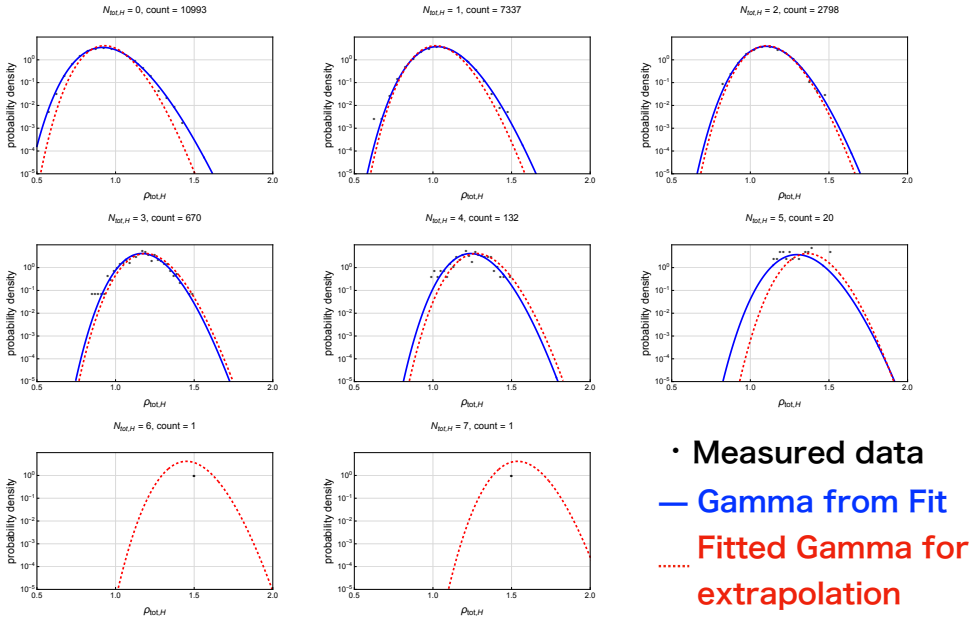
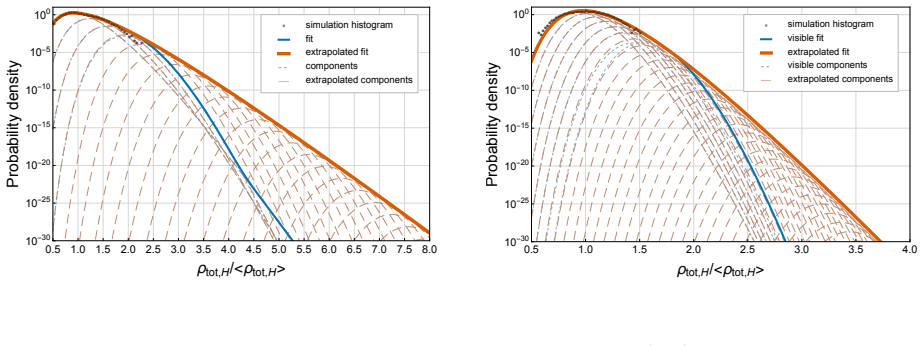
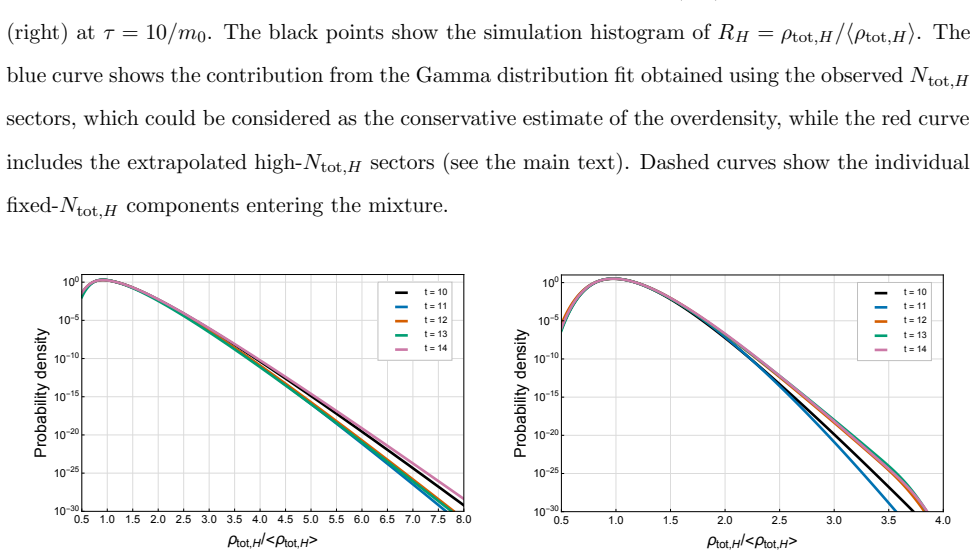
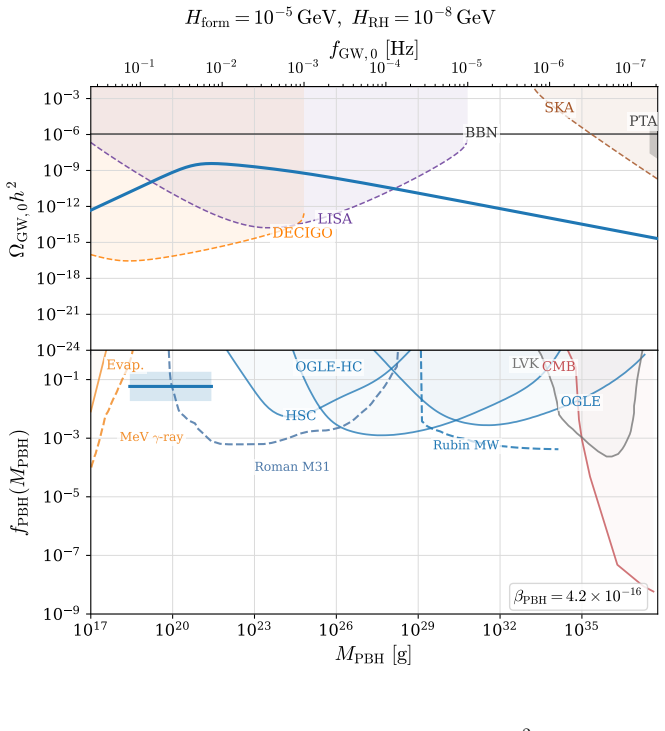
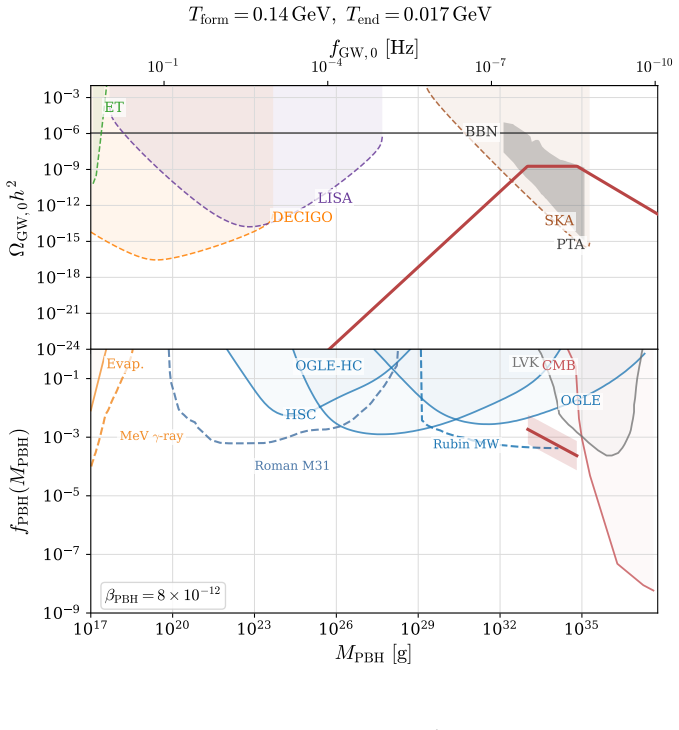
Monopoles with sufficiently weak gauge couplings or global symmetries form scaling networks in the early Universe. Lattice simulations show that the stochastic realization of monopole number in Hubble patches produces overdensities sufficient to trigger primordial black hole collapse when the Higgs vev satisfies v ≳ 0.1 M_pl, yielding a broad mass spectrum. Gravitational waves are generated concurrently with correlated spectra. When the scaling regime ends due to gauge boson mass, a non-negligible fraction of the resulting black holes carry magnetic charge whose Coulomb force is comparable to gravity, supplying a smoking-gun signature alongside the black hole and wave signals.
What carries the argument
Stochastic realization of the monopole number in Hubble patches that generates overdensities during the evolution of scaling monopole networks.
If this is right
- Primordial black holes form across a broad mass spectrum.
- Gravitational waves are emitted at the same epoch with amplitudes testable by future detectors and spectra correlated with the black hole spectrum.
- For gauged monopoles a non-negligible fraction of the black holes carry magnetic charge.
- The magnetic Coulomb force between charged black holes is comparable in strength to their gravitational attraction.
- Simple cosmological scenarios exist in which the black holes constitute the dominant dark matter.
Where Pith is reading between the lines
- The same stochastic-fluctuation mechanism could operate in scaling cosmic-string networks and produce a similar broad black-hole spectrum.
- Detection of magnetically charged black holes would distinguish this formation channel from other primordial-black-hole scenarios.
- If these black holes dominate dark matter, the model links monopole-network dynamics directly to dark-matter phenomenology through both abundance and charge distribution.
Load-bearing premise
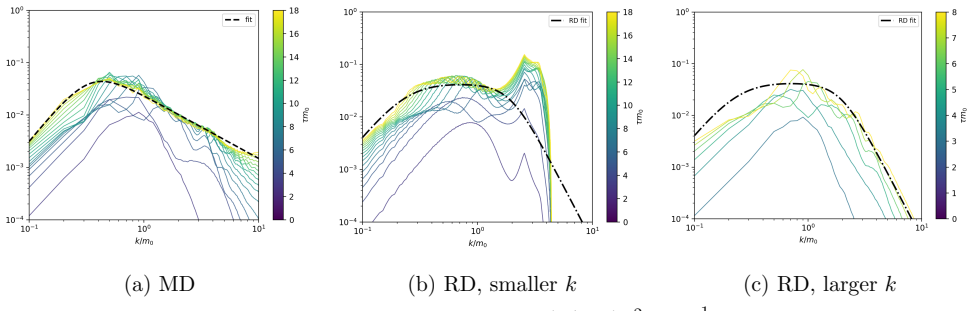
Classical lattice simulations give a reliable estimate of the overdensities created by stochastic monopole number fluctuations and show those overdensities are large enough to trigger black hole collapse.
What would settle it
A survey of the primordial black hole mass function that finds no broad component in the mass range predicted by the scaling-monopole overdensities, or a gravitational-wave background measurement showing no correlated spectrum at the expected frequencies.
Figures
read the original abstract
Monopoles with sufficiently weak gauge couplings, or from global symmetries, can form scaling networks in the early Universe whose average energy density tracks the cosmological background. In this work, we find, by performing classical lattice simulations to estimate the overdensities, that primordial black holes (PBHs) with a broad mass spectrum can be produced during this evolution if the Higgs expectation value $v$ satisfies $v\gtrsim 0.1 M_{\rm pl}$. The formation is driven by the stochastic realization of the monopole number in Hubble patches causing the overdensities. We also show that gravitational waves (GWs) generated by the scaling dynamics are produced at the same epoch, with spectra correlated with the PBH spectra and with amplitudes testable in future observations. Interestingly, if the scaling regime is terminated by the gauge boson mass for the gauged monopole, a non-negligible fraction of the PBHs can carry magnetic charge, and the resulting magnetic Coulomb force between such charged PBHs is predicted to be comparable to the gravitational force. Together with the PBH and GW signals, this provides a smoking-gun signature of the scenario. We also point out simple cosmological scenarios, which may also apply to PBH formation from scaling cosmic strings, that allow PBHs to constitute dominant dark matter.
Editorial analysis
A structured set of objections, weighed in public.
Referee Report
Summary. The paper claims that scaling monopole networks (gauged or global) produce primordial black holes (PBHs) with a broad mass spectrum when the Higgs vev satisfies v ≳ 0.1 M_pl. The mechanism is stochastic monopole-number fluctuations within Hubble patches that generate overdensities sufficient for collapse, as quantified by classical lattice simulations. Gravitational waves are also generated by the scaling dynamics with spectra correlated to the PBH mass function; for gauged monopoles terminated by the gauge-boson mass, a non-negligible fraction of PBHs carry magnetic charge, yielding a magnetic Coulomb force comparable to gravity. Simple cosmological scenarios are sketched in which these PBHs can constitute all dark matter.
Significance. If the lattice results hold, the work supplies a concrete, simulation-backed route from topological defects to PBHs whose mass spectrum and GW background are linked, plus a potential smoking-gun signature (magnetically charged PBHs). The scenario is falsifiable with future GW observatories and could address the dark-matter problem without additional free parameters beyond the monopole scale.
major comments (2)
- [Lattice simulations (referenced in abstract and § on numerical results)] The central claim that overdensities exceed the PBH collapse threshold (δ_c ≳ 0.67) for v ≳ 0.1 M_pl rests entirely on classical lattice simulations whose volume, resolution, number of realizations, convergence tests, and tail-extraction procedure are not reported. Without these diagnostics it is impossible to determine whether the rare high-δ tail is reliably sampled or whether finite-volume effects systematically bias the probability, directly undermining both the quoted v threshold and the predicted PBH abundance.
- [PBH formation and mass-spectrum section] The manuscript presents the v ≳ 0.1 M_pl threshold and the resulting PBH mass spectrum as direct outputs of the simulations without external analytic benchmarks, parameter-free derivations, or cross-checks against known scaling-network statistics. This leaves the quantitative result dependent on an unvalidated numerical setup whose systematic uncertainties are unspecified.
minor comments (2)
- [Introduction] Notation for the monopole velocity or coupling strength is introduced without an explicit definition or reference to the standard literature on scaling networks.
- [GW results] The GW spectrum plot (presumably Fig. X) lacks error bands or a statement of the number of realizations used to compute the average, making it difficult to judge the robustness of the claimed correlation with the PBH spectrum.
Simulated Author's Rebuttal
We thank the referee for the careful review and constructive comments on our manuscript. The two major comments both concern the transparency and validation of our lattice simulations and the presentation of the PBH results. We agree that additional details are warranted and will revise the manuscript to address these points directly.
read point-by-point responses
-
Referee: [Lattice simulations (referenced in abstract and § on numerical results)] The central claim that overdensities exceed the PBH collapse threshold (δ_c ≳ 0.67) for v ≳ 0.1 M_pl rests entirely on classical lattice simulations whose volume, resolution, number of realizations, convergence tests, and tail-extraction procedure are not reported. Without these diagnostics it is impossible to determine whether the rare high-δ tail is reliably sampled or whether finite-volume effects systematically bias the probability, directly undermining both the quoted v threshold and the predicted PBH abundance.
Authors: We agree that the current manuscript does not provide sufficient documentation of the simulation setup. In the revised version we will add a dedicated subsection (or appendix) specifying the lattice volume and spacing, the number of independent realizations, the convergence tests performed with varying grid sizes and volumes, and the precise procedure used to extract and fit the high-δ tail of the overdensity distribution. We have re-examined our existing runs and performed additional smaller-volume tests; these confirm that the probability of exceeding δ_c is stable for the volumes employed and that finite-volume bias is sub-dominant for the monopole correlation lengths relevant to v ≳ 0.1 M_pl. These diagnostics will be reported explicitly so that the reliability of the quoted threshold can be assessed. revision: yes
-
Referee: [PBH formation and mass-spectrum section] The manuscript presents the v ≳ 0.1 M_pl threshold and the resulting PBH mass spectrum as direct outputs of the simulations without external analytic benchmarks, parameter-free derivations, or cross-checks against known scaling-network statistics. This leaves the quantitative result dependent on an unvalidated numerical setup whose systematic uncertainties are unspecified.
Authors: We acknowledge that the manuscript would benefit from explicit cross-checks. In the revision we will include (i) a brief analytic estimate of the expected monopole-number variance within a Hubble volume based on the scaling solution, (ii) a comparison of the simulated monopole density evolution against the well-known analytic scaling law ρ_m ∝ 1/t², and (iii) a short discussion of the main systematic uncertainties (lattice spacing, initial conditions, and finite-volume effects) together with the tests already performed. While the quantitative PBH abundance necessarily relies on the lattice results because the stochastic tail is not analytically tractable, these additions will place the numerical output in the context of established scaling-network literature and make the systematic uncertainties transparent. revision: yes
Circularity Check
No significant circularity; results from independent lattice simulations
full rationale
The paper's central claims (PBH production for v ≳ 0.1 M_pl and correlated GW spectra) are obtained by performing classical lattice simulations to estimate overdensities from stochastic monopole number fluctuations in Hubble patches. This constitutes a direct numerical computation rather than any self-definitional loop, fitted parameter renamed as prediction, or load-bearing self-citation. No equations or steps in the provided text reduce the output quantities to the inputs by construction, and the simulations are presented as the source of the quantitative thresholds and spectra without invoking prior author work as a uniqueness theorem or ansatz.
Axiom & Free-Parameter Ledger
free parameters (1)
- v threshold for PBH formation
axioms (1)
- domain assumption Monopoles with weak gauge couplings or global symmetries form scaling networks whose energy density tracks the cosmological background.
Reference graph
Works this paper leans on
-
[1]
The essential ingredient is that the scalar field is not exactly massless during inflation
Population bias scenario We consider a simple population-bias scenario in which the monopole network has a finite lifetime. The essential ingredient is that the scalar field is not exactly massless during inflation. 20 For example, let us introduce the non-minimal coupling L ⊃ − 1 2 ξϕaϕaR,(C1) whereRis the Ricci scalar. During quasi-de Sitter inflation,R...
-
[2]
In this case we may even have the thermal mass to the Higgs field driving it to the origin as the usual phase transition and there is no population bias
Transientvscenario Another way to be consistent with the monopole limit is to havev=O(0.1)M pl during PBH formation, while reducing it after PBH formation. In this case we may even have the thermal mass to the Higgs field driving it to the origin as the usual phase transition and there is no population bias. Since the monopole-network energy density scale...
-
[3]
B. J. Carr and S. W. Hawking, Mon. Not. Roy. Astron. Soc.168, 399 (1974)
1974
-
[4]
B. J. Carr, Astrophys. J.201, 1 (1975)
1975
-
[5]
Primordial Black Holes - Perspectives in Gravitational Wave Astronomy -
M. Sasaki, T. Suyama, T. Tanaka, and S. Yokoyama, Class. Quant. Grav.35, 063001 (2018), arXiv:1801.05235 [astro-ph.CO]
work page internal anchor Pith review Pith/arXiv arXiv 2018
-
[6]
B. Carr, K. Kohri, Y. Sendouda, and J. Yokoyama, Rept. Prog. Phys.84, 116902 (2021), arXiv:2002.12778 [astro-ph.CO]
work page internal anchor Pith review Pith/arXiv arXiv 2021
-
[7]
P. Villanueva-Domingo, O. Mena, and S. Palomares-Ruiz, Front. Astron. Space Sci.8, 87 (2021), arXiv:2103.12087 [astro-ph.CO]
-
[8]
A. M. Green and B. J. Kavanagh, J. Phys. G48, 043001 (2021), arXiv:2007.10722 [astro-ph.CO]
work page internal anchor Pith review Pith/arXiv arXiv 2021
- [9]
-
[10]
S. W. Hawking, Phys. Lett. B231, 237 (1989)
1989
-
[11]
Polnarev and R
A. Polnarev and R. Zembowicz, Phys. Rev. D43, 1106 (1991)
1991
-
[12]
R. R. Caldwell and P. Casper, Phys. Rev. D53, 3002 (1996), arXiv:gr-qc/9509012
work page internal anchor Pith review Pith/arXiv arXiv 1996
-
[13]
J. H. MacGibbon, R. H. Brandenberger, and U. F. Wichoski, Phys. Rev. D57, 2158 (1998), arXiv:astro-ph/9707146
work page internal anchor Pith review Pith/arXiv arXiv 1998
-
[14]
Cosmic String Loop Collapse in Full General Relativity
T. Helfer, J. C. Aurrekoetxea, and E. A. Lim, Phys. Rev. D99, 104028 (2019), arXiv:1808.06678 [gr-qc]
work page internal anchor Pith review Pith/arXiv arXiv 2019
-
[15]
Effects of friction on cosmic strings
J. Garriga and M. Sakellariadou, Phys. Rev. D48, 2502 (1993), arXiv:hep-th/9303024
work page internal anchor Pith review Pith/arXiv arXiv 1993
-
[16]
C. James-Turner, D. P. B. Weil, A. M. Green, and E. J. Copeland, Phys. Rev. D101, 123526 (2020), arXiv:1911.12658 [astro-ph.CO]
-
[17]
Primordial Black Holes from the QCD axion
F. Ferrer, E. Masso, G. Panico, O. Pujolas, and F. Rompineve, Phys. Rev. Lett.122, 101301 (2019), arXiv:1807.01707 [hep-ph]. 30
work page internal anchor Pith review Pith/arXiv arXiv 2019
- [18]
-
[19]
Y. Gouttenoire and T. Volansky, Phys. Rev. D110, 043514 (2024), arXiv:2305.04942 [hep-ph]
-
[20]
N. Kitajima, J. Lee, K. Murai, F. Takahashi, and W. Yin, Phys. Lett. B851, 138586 (2024), arXiv:2306.17146 [hep-ph]
-
[21]
Y. Gouttenoire and E. Vitagliano, Phys. Rev. D110, L061306 (2024), arXiv:2306.17841 [gr-qc]
- [22]
-
[23]
H. Masubuchi, Y. Narita, and W. Yin, (2026), arXiv:2602.15825 [hep-ph]
-
[24]
T. Sugeno and W. Yin, JHEP04, 108 (2026), arXiv:2511.19429 [hep-ph]
-
[25]
M. Miyazaki, Y. Narita, D. Song, N. Yaginuma, and W. Yin, JHEP05, 119 (2026), arXiv:2509.13292 [hep-ph]
-
[26]
Primordial black holes from cosmic necklaces
T. Matsuda, JHEP04, 017 (2006), arXiv:hep-ph/0509062
work page internal anchor Pith review Pith/arXiv arXiv 2006
-
[27]
J. D. Bekenstein, Phys. Rev. D5, 1239 (1972)
1972
-
[28]
Ruffini and J
R. Ruffini and J. A. Wheeler, Phys. Today24, 30 (1971)
1971
- [29]
- [30]
- [31]
-
[32]
G. Bozzola and V. Paschalidis, Phys. Rev. Lett.126, 041103 (2021), arXiv:2006.15764 [gr-qc]
-
[33]
Maldacena, JHEP04, 079 (2021), arXiv:2004.06084 [hep-th]
J. Maldacena, JHEP04, 079 (2021), arXiv:2004.06084 [hep-th]
-
[34]
Yin, JHEP10, 177 (2025), arXiv:2412.17802 [hep-ph]
W. Yin, JHEP10, 177 (2025), arXiv:2412.17802 [hep-ph]
-
[35]
Yin, (2024), 10.1093/ptep/ptaf053, arXiv:2412.19798 [hep-ph]
W. Yin, (2024), 10.1093/ptep/ptaf053, arXiv:2412.19798 [hep-ph]
-
[36]
Barriola and A
M. Barriola and A. Vilenkin, Phys. Rev. Lett.63, 341 (1989)
1989
-
[37]
Vilenkin and E
A. Vilenkin and E. P. S. Shellard,Cosmic Strings and Other Topological Defects(Cambridge University Press, 2000)
2000
-
[38]
T. W. B. Kibble, J. Phys. A9, 1387 (1976)
1976
-
[39]
D. P. Bennett and S. H. Rhie, Phys. Rev. Lett.65, 1709 (1990)
1990
-
[40]
Cosmological Evolution of Global Monopoles
M. Yamaguchi, Phys. Rev. D64, 081301 (2001), arXiv:hep-ph/0103130
work page internal anchor Pith review Pith/arXiv arXiv 2001
-
[41]
C. J. A. P. Martins and A. Achucarro, Phys. Rev. D78, 083541 (2008), arXiv:0806.2671 [hep-ph]
work page internal anchor Pith review Pith/arXiv arXiv 2008
-
[42]
The Low-Energy Frontier of Particle Physics
J. Jaeckel and A. Ringwald, Ann. Rev. Nucl. Part. Sci.60, 405 (2010), arXiv:1002.0329 [hep-ph]. 31
work page internal anchor Pith review Pith/arXiv arXiv 2010
-
[43]
Exploring the Role of Axions and Other WISPs in the Dark Universe
A. Ringwald, Phys. Dark Univ.1, 116 (2012), arXiv:1210.5081 [hep-ph]
work page internal anchor Pith review Pith/arXiv arXiv 2012
-
[44]
P. Arias, D. Cadamuro, M. Goodsell, J. Jaeckel, J. Redondo, and A. Ringwald, JCAP06, 013 (2012), arXiv:1201.5902 [hep-ph]
work page internal anchor Pith review Pith/arXiv arXiv 2012
-
[45]
P. W. Graham, I. G. Irastorza, S. K. Lamoreaux, A. Lindner, and K. A. van Bibber, Ann. Rev. Nucl. Part. Sci.65, 485 (2015), arXiv:1602.00039 [hep-ex]
work page internal anchor Pith review Pith/arXiv arXiv 2015
-
[46]
D. J. E. Marsh, Phys. Rept.643, 1 (2016), arXiv:1510.07633 [astro-ph.CO]
work page internal anchor Pith review Pith/arXiv arXiv 2016
-
[47]
I. G. Irastorza and J. Redondo, Prog. Part. Nucl. Phys.102, 89 (2018), arXiv:1801.08127 [hep- ph]
work page internal anchor Pith review Pith/arXiv arXiv 2018
-
[48]
The landscape of QCD axion models
L. Di Luzio, M. Giannotti, E. Nardi, and L. Visinelli, Phys. Rept.870, 1 (2020), arXiv:2003.01100 [hep-ph]
work page internal anchor Pith review Pith/arXiv arXiv 2020
-
[49]
Albertuset al., (2026), arXiv:2602.09089 [hep-ph]
C. Albertuset al., (2026), arXiv:2602.09089 [hep-ph]
-
[50]
Arzaet al., (2026), arXiv:2603.03433 [hep-ph]
A. Arzaet al., (2026), arXiv:2603.03433 [hep-ph]
- [51]
- [52]
-
[53]
Threshold of primordial black hole formation
T. Harada, C.-M. Yoo, and K. Kohri, Phys. Rev. D88, 084051 (2013), [Erratum: Phys.Rev.D 89, 029903 (2014)], arXiv:1309.4201 [astro-ph.CO]
work page internal anchor Pith review Pith/arXiv arXiv 2013
-
[54]
A. Escriv` a, C. Germani, and R. K. Sheth, Phys. Rev. D101, 044022 (2020), arXiv:1907.13311 [gr-qc]
-
[55]
M. Y. Khlopov and A. G. Polnarev, Phys. Lett. B97, 383 (1980)
1980
-
[56]
Primordial black hole formation in the matter-dominated phase of the Universe
T. Harada, C.-M. Yoo, K. Kohri, K.-i. Nakao, and S. Jhingan, Astrophys. J.833, 61 (2016), arXiv:1609.01588 [astro-ph.CO]
work page internal anchor Pith review Pith/arXiv arXiv 2016
-
[57]
Spins of primordial black holes formed in the matter-dominated phase of the Universe
T. Harada, C.-M. Yoo, K. Kohri, and K.-I. Nakao, Phys. Rev. D96, 083517 (2017), [Erratum: Phys.Rev.D 99, 069904 (2019)], arXiv:1707.03595 [gr-qc]
work page internal anchor Pith review Pith/arXiv arXiv 2017
-
[58]
Dynamics of Topological Defects and Inflation
N. Sakai, H.-A. Shinkai, T. Tachizawa, and K.-i. Maeda, Phys. Rev. D53, 655 (1996), [Erratum: Phys.Rev.D 54, 2981 (1996)], arXiv:gr-qc/9506068
work page internal anchor Pith review Pith/arXiv arXiv 1996
-
[59]
A black hole solution to the cosmological monopole problem
D. Stojkovic and K. Freese, Phys. Lett. B606, 251 (2005), arXiv:hep-ph/0403248
work page internal anchor Pith review Pith/arXiv arXiv 2005
-
[60]
B. Carr, M. Raidal, T. Tenkanen, V. Vaskonen, and H. Veerm¨ ae, Phys. Rev. D96, 023514 (2017), arXiv:1705.05567 [astro-ph.CO]
work page internal anchor Pith review Pith/arXiv arXiv 2017
-
[61]
S. Sugiyama, M. Takada, N. Yasuda, and N. Tominaga, (2026), arXiv:2602.05840 [astro-ph.CO]
-
[62]
Constraints on Earth-mass primordial black holes from OGLE 5-year microlensing events
H. Niikura, M. Takada, S. Yokoyama, T. Sumi, and S. Masaki, Phys. Rev. D99, 083503 (2019), 32 arXiv:1901.07120 [astro-ph.CO]
work page internal anchor Pith review Pith/arXiv arXiv 2019
-
[63]
J. Smirnov, A. Goobar, T. Linden, and E. M¨ ortsell, Phys. Rev. Lett.132, 151401 (2024), arXiv:2211.00013 [astro-ph.CO]
-
[64]
M. Andr´ es-Carcasona, A. J. Iovino, V. Vaskonen, H. Veerm¨ ae, M. Mart´ ınez, O. Pujol` as, and L. M. Mir, Phys. Rev. D110, 023040 (2024), arXiv:2405.05732 [astro-ph.CO]
-
[65]
D. G. Figueroa, M. Hindmarsh, and J. Urrestilla, Phys. Rev. Lett.110, 101302 (2013), arXiv:1212.5458 [astro-ph.CO]
work page internal anchor Pith review Pith/arXiv arXiv 2013
-
[66]
E. Fenu, D. G. Figueroa, R. Durrer, and J. Garcia-Bellido, JCAP10, 005 (2009), arXiv:0908.0425 [astro-ph.CO]
work page internal anchor Pith review Pith/arXiv arXiv 2009
- [67]
-
[68]
New constraints on primordial gravitational waves from Planck 2015
L. Pagano, L. Salvati, and A. Melchiorri, Phys. Lett. B760, 823 (2016), arXiv:1508.02393 [astro-ph.CO]
work page internal anchor Pith review Pith/arXiv arXiv 2016
-
[69]
Gravitational wave astronomy with the SKA
G. Janssenet al., PoSAASKA14, 037 (2015), arXiv:1501.00127 [astro-ph.IM]
work page internal anchor Pith review Pith/arXiv arXiv 2015
-
[70]
The construction and use of LISA sensitivity curves
T. Robson, N. J. Cornish, and C. Liu, Class. Quant. Grav.36, 105011 (2019), arXiv:1803.01944 [astro-ph.HE]
work page internal anchor Pith review Pith/arXiv arXiv 2019
-
[71]
Detector configuration of DECIGO/BBO and identification of cosmological neutron-star binaries
K. Yagi and N. Seto, Phys. Rev. D83, 044011 (2011), [Erratum: Phys.Rev.D 95, 109901 (2017)], arXiv:1101.3940 [astro-ph.CO]
work page internal anchor Pith review Pith/arXiv arXiv 2011
-
[72]
Prospects of determination of reheating temperature after inflation by DECIGO
S. Kuroyanagi, K. Nakayama, and J. Yokoyama, PTEP2015, 013E02 (2015), arXiv:1410.6618 [astro-ph.CO]
work page internal anchor Pith review Pith/arXiv arXiv 2015
- [73]
-
[74]
P. Mr´ ozet al., Astrophys. J. Lett.976, L19 (2024), arXiv:2410.06251 [astro-ph.CO]
-
[75]
Mr´ ozet al., Nature632, 749 (2024), arXiv:2403.02386 [astro-ph.GA]
P. Mr´ ozet al., Nature632, 749 (2024), arXiv:2403.02386 [astro-ph.GA]
- [76]
-
[77]
B. J. Carr, K. Kohri, Y. Sendouda, and J. Yokoyama, Phys. Rev. D81, 104019 (2010), arXiv:0912.5297 [astro-ph.CO]
work page internal anchor Pith review Pith/arXiv arXiv 2010
- [78]
-
[79]
Probing the Fundamental Nature of Dark Matter with the Large Synoptic Survey Telescope
A. Drlica-Wagneret al.(LSST Dark Matter Group), (2019), arXiv:1902.01055 [astro-ph.CO]
work page internal anchor Pith review Pith/arXiv arXiv 2019
-
[80]
New Sensitivity Curves for Gravitational-Wave Signals from Cosmological Phase Transitions
K. Schmitz, JHEP01, 097 (2021), arXiv:2002.04615 [hep-ph]. 33
work page internal anchor Pith review Pith/arXiv arXiv 2021
discussion (0)
Sign in with ORCID, Apple, or X to comment. Anyone can read and Pith papers without signing in.