Equilibrium Statistics as Conditional Laws and Conservation-Induced Correlations
Pith reviewed 2026-06-30 09:11 UTC · model grok-4.3
The pith
Conditioning an unconstrained microscopic measure on additive conservation laws produces both standard equilibrium statistics and finite-rank covariances between modes.
A machine-rendered reading of the paper's core claim, the machinery that carries it, and where it could break.
Core claim
In this formulation, equilibrium arises as a conditional limit law of a closed system. The one-mode marginal gives Maxwell-Boltzmann, Bose-Einstein, and Fermi-Dirac statistics at leading saddle order, with the conserved quantities fixing the exponential tilt and the microscopic occupation measure determining the statistics. Expanding the two-mode marginal to Gaussian order gives the leading finite-rank covariance between modes induced by exact conservation. When contracted with observables linear in mode occupations, this covariance gives their leading exact-conservation contribution. Projected observables orthogonal to selected conserved quantities are defined by construction so that their
What carries the argument
The conditional distribution of mode occupations obtained by enforcing additive conservation laws on an otherwise unconstrained microscopic measure, from which one- and two-mode marginals are extracted at saddle-point and Gaussian order.
If this is right
- The one-mode marginal recovers Maxwell-Boltzmann, Bose-Einstein, and Fermi-Dirac statistics with the exponential tilt fixed by the conserved charges.
- The two-mode marginal supplies a finite-rank covariance between modes that is generated solely by exact conservation.
- Observables projected orthogonal to chosen conserved quantities have covariances containing no leading conservation contribution.
- In small collision systems the conservation-induced covariance survives standard nonflow suppressions and can be isolated by the projection procedure.
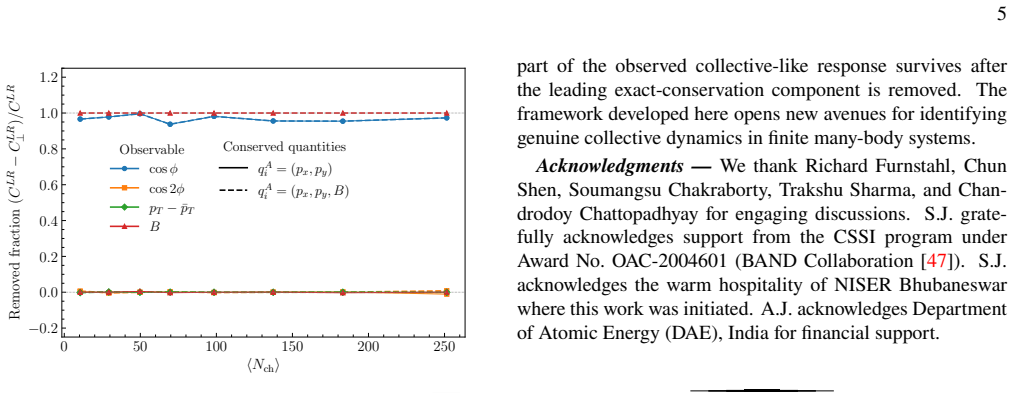
- Application to PYTHIA8/Angantyr p+Pb events at 5.02 TeV shows that the projection removes the conservation-aligned covariance while leaving the conservation-orthogonal part essentially unchanged.
Where Pith is reading between the lines
- The same conditional construction could be applied to any set of additive conserved quantities whose number is smaller than the number of modes, yielding analogous covariance structures.
- In the large-multiplicity limit the relative size of the conservation-induced covariance is expected to fall as 1 over multiplicity, consistent with the suppression already noted for small systems.
- The framework supplies a systematic way to subtract conservation effects before comparing measured correlations to models that omit exact conservation.
- Higher-order corrections beyond the Gaussian two-mode marginal would generate non-Gaussian cumulants that remain aligned with the conservation laws.
Load-bearing premise
The equilibrium distribution is exactly the conditional distribution that results from enforcing additive conservation laws on an otherwise unconstrained microscopic measure, and the saddle-point approximation suffices to obtain the claimed one- and two-mode marginals without higher-order corrections that would change the statistics or covariance structure.
What would settle it
An exact enumeration of the conditional distribution for a small finite system of modes whose conservation laws are enforced by hand, followed by direct comparison of its one- and two-mode marginals against the saddle-point and Gaussian predictions.
Figures
read the original abstract
We present a novel unified conditional-probability framework for relativistic systems in which conditioning on additive conservation laws simultaneously yields equilibrium occupation statistics and conservation-induced correlations. In this formulation, equilibrium arises as a conditional limit law of a closed system. The one-mode marginal gives Maxwell--Boltzmann, Bose--Einstein, and Fermi--Dirac statistics at leading saddle order, with the conserved quantities fixing the exponential tilt and the microscopic occupation measure determining the statistics. Expanding the two-mode marginal to Gaussian order gives the leading finite-rank covariance between modes induced by exact conservation. When contracted with observables linear in mode occupations, this covariance gives their leading exact-conservation contribution. We use this structure to define projected observables orthogonal to selected conserved quantities. By construction, their covariance has no leading exact-conservation contribution. In small collision systems, where conservation effects are less suppressed by multiplicity and can survive standard nonflow suppressions, this provides a direct way to isolate conservation-aligned contributions to long-range correlations. We demonstrate this with PYTHIA8/Angantyr-generated p+Pb events at $\sqrt{s_{\mathrm{NN}}}=5.02~\mathrm{TeV}$ by comparing ordinary and projected covariances, showing that the projection removes the conservation-aligned contribution while leaving the conservation-orthogonal covariance essentially unchanged.
Editorial analysis
A structured set of objections, weighed in public.
Referee Report
Summary. The paper proposes a unified conditional-probability framework in which equilibrium occupation statistics (Maxwell-Boltzmann, Bose-Einstein, Fermi-Dirac) and conservation-induced correlations arise simultaneously by conditioning an unconstrained microscopic measure on additive conservation laws. The one-mode marginal at leading saddle order reproduces the standard statistics, with conserved quantities supplying the exponential tilt and the microscopic occupation measure fixing the statistics type. The two-mode marginal expanded to Gaussian order yields the leading finite-rank covariance between modes induced by exact conservation; contraction with linear observables isolates the conservation contribution. Projected observables orthogonal to selected conserved quantities are defined so that their covariance has no leading conservation term. The framework is illustrated with PYTHIA8/Angantyr p+Pb events at √s_NN = 5.02 TeV, where ordinary versus projected covariances are compared to show removal of the conservation-aligned piece.
Significance. If the saddle-point derivation and error control hold, the work supplies a derivation of standard equilibrium statistics from conditioning rather than from an a-priori ansatz, together with a concrete method for isolating exact-conservation effects in small systems where they are not multiplicity-suppressed. The use of event-generator data to test the projection technique constitutes a reproducible, falsifiable check that strengthens the practical utility claim.
major comments (2)
- [Abstract] Abstract: the central claim that the one-mode marginal reproduces MB/BE/FD statistics at leading saddle order is asserted without an explicit derivation of the conditional limit law, the precise definition of the microscopic occupation measure, or an error bound on the saddle-point approximation. Because this step is load-bearing for the entire framework, the absence of the calculation prevents verification that higher-order terms do not alter the claimed statistics.
- [Abstract] Abstract (p+Pb demonstration): the manuscript applies the Gaussian two-mode expansion to p+Pb events at √s_NN = 5.02 TeV, where multiplicity is modest. No estimate of O(1/N) corrections to the covariance or proof of uniform validity of the leading saddle for the relevant occupation numbers is supplied. This directly affects the attribution of the observed covariance difference to exact conservation.
Simulated Author's Rebuttal
We thank the referee for their careful reading and constructive comments on the manuscript. We address the major comments point by point below, indicating where revisions will be made to improve clarity and completeness.
read point-by-point responses
-
Referee: [Abstract] Abstract: the central claim that the one-mode marginal reproduces MB/BE/FD statistics at leading saddle order is asserted without an explicit derivation of the conditional limit law, the precise definition of the microscopic occupation measure, or an error bound on the saddle-point approximation. Because this step is load-bearing for the entire framework, the absence of the calculation prevents verification that higher-order terms do not alter the claimed statistics.
Authors: The explicit saddle-point derivation of the one-mode conditional limit law, the definition of the microscopic occupation measure, and the leading-order error bound are presented in Sections II and III of the full manuscript. The abstract provides only a summary statement, as is standard. To address the concern, we will revise the abstract to include a brief clause referencing the conditional limit law and the occupation measure, and we will add an explicit statement of the error bound in the main text near the one-mode result. revision: yes
-
Referee: [Abstract] Abstract (p+Pb demonstration): the manuscript applies the Gaussian two-mode expansion to p+Pb events at √s_NN = 5.02 TeV, where multiplicity is modest. No estimate of O(1/N) corrections to the covariance or proof of uniform validity of the leading saddle for the relevant occupation numbers is supplied. This directly affects the attribution of the observed covariance difference to exact conservation.
Authors: We agree that the manuscript does not supply an explicit O(1/N) error estimate or a proof of uniform validity of the saddle-point approximation for the modest multiplicities encountered in the p+Pb sample. The numerical comparison with PYTHIA8/Angantyr events is presented as an empirical illustration of the projection technique rather than a rigorous validation of the approximation order. We will revise the relevant section to include a caveat acknowledging this limitation and clarifying that the observed difference is consistent with the leading-order prediction. revision: partial
Circularity Check
No circularity; conditional framework derives statistics directly from measure and saddle limit
full rationale
The paper constructs equilibrium as the conditional distribution under additive conservation laws applied to an unconstrained microscopic occupation measure. The one-mode marginal at leading saddle order then produces MB/BE/FD forms because the measure itself encodes the occupation statistics (Poisson/geometric/etc.) while conservation supplies the exponential tilt; the two-mode Gaussian expansion likewise produces the finite-rank covariance by direct expansion of the same conditional law. These steps are explicit mathematical consequences of the stated conditional limit and saddle approximation, with no parameter fitted to the target statistics, no self-citation invoked as a uniqueness theorem, and no renaming of known results. The derivation is therefore self-contained against external benchmarks and receives score 0.
Axiom & Free-Parameter Ledger
axioms (2)
- domain assumption Equilibrium occupation statistics are obtained exactly as the conditional distribution of a microscopic measure given additive conservation laws
- domain assumption Saddle-point approximation accurately captures the one-mode and two-mode marginals
Forward citations
Cited by 1 Pith paper
-
Subensemble Acceptance Method 3.0: General Corrections to Cumulants from Exact Conservation Constraints
SAM-3.0 derives canonical cumulants from grand-canonical joint cumulants via a closed recursion with multivariate partial exponential Bell polynomials for arbitrary numbers of conserved charges and observables.
Reference graph
Works this paper leans on
-
[1]
Observation of Long-Range Near-Side Angular Correlations in Proton-Proton Collisions at the LHC
Vardan Khachatryanet al.(CMS), “Observation of Long-Range Near-Side Angular Correlations in Proton-Proton Collisions at the LHC,” JHEP09, 091 (2010), arXiv:1009.4122 [hep-ex]
work page internal anchor Pith review Pith/arXiv arXiv 2010
-
[2]
Georges Aadet al.(ATLAS), “Observation of Long-Range El- liptic Azimuthal Anisotropies in √𝑠=13 and 2.76 TeV𝑝 𝑝Col- lisions with the ATLAS Detector,” Phys. Rev. Lett.116, 172301 (2016), arXiv:1509.04776 [hep-ex]
work page internal anchor Pith review Pith/arXiv arXiv 2016
-
[3]
Georges Aadet al.(ATLAS), “Observation of Associated Near- Side and Away-Side Long-Range Correlations in √𝑠𝑁 𝑁 =5.02 TeV Proton-Lead Collisions with the ATLAS Detector,” Phys. Rev. Lett.110, 182302 (2013), arXiv:1212.5198 [hep-ex]
work page internal anchor Pith review Pith/arXiv arXiv 2013
-
[4]
Betty Abelevet al.(ALICE), “Long-range angular correlations on the near and away side in𝑝-Pb collisions at √𝑠𝑁 𝑁 =5.02 TeV,” Phys. Lett. B719, 29–41 (2013), arXiv:1212.2001 [nucl- ex]
work page internal anchor Pith review Pith/arXiv arXiv 2013
-
[5]
Observation of long-range near-side angular correlations in proton-lead collisions at the LHC
Serguei Chatrchyanet al.(CMS), “Observation of Long-Range Near-Side Angular Correlations in Proton-Lead Collisions at the LHC,” Phys. Lett. B718, 795–814 (2013), arXiv:1210.5482 [nucl-ex]
work page internal anchor Pith review Pith/arXiv arXiv 2013
-
[6]
Collective flow and viscosity in relativistic heavy-ion collisions
Ulrich Heinz and Raimond Snellings, “Collective flow and vis- cosity in relativistic heavy-ion collisions,” Ann. Rev. Nucl. Part. Sci.63, 123–151 (2013), arXiv:1301.2826 [nucl-th]
work page internal anchor Pith review Pith/arXiv arXiv 2013
-
[7]
Small System Collectivity in Relativistic Hadron and Nuclear Collisions
James L. Nagle and William A. Zajc, “Small System Collectiv- ity in Relativistic Hadronic and Nuclear Collisions,” Ann. Rev. Nucl. Part. Sci.68, 211–235 (2018), arXiv:1801.03477 [nucl- ex]
work page internal anchor Pith review Pith/arXiv arXiv 2018
-
[8]
A Decade of Collectivity in Small Systems,
Jan Fiete Grosse-Oetringhaus and Urs Achim Wiedemann, “A Decade of Collectivity in Small Systems,” (2024), arXiv:2407.07484 [hep-ex]
-
[9]
Revealing long-range multi-particle collectivity in small collision systems via subevent cumulants
Jiangyong Jia, Mingliang Zhou, and Adam Trzupek, “Reveal- ing long-range multiparticle collectivity in small collision sys- tems via subevent cumulants,” Phys. Rev. C96, 034906 (2017), arXiv:1701.03830 [nucl-th]
work page internal anchor Pith review Pith/arXiv arXiv 2017
-
[10]
Morad Aaboudet al.(ATLAS), “Measurement of long-range multiparticle azimuthal correlations with the subevent cumulant method in𝑝 𝑝and𝑝+𝑃𝑏collisions with the ATLAS detector at the CERN Large Hadron Collider,” Phys. Rev. C97, 024904 (2018), arXiv:1708.03559 [hep-ex]
work page internal anchor Pith review Pith/arXiv arXiv 2018
-
[11]
Shreyasi Acharyaet al.(ALICE), “Long-range transverse mo- mentum correlations and radial flow in Pb−Pb collisions at the LHC,” Phys. Rev. Lett.136, 032302 (2026), arXiv:2504.04796 [nucl-ex]
-
[12]
Nonflow Subtraction Beyond Two-Particle Correlations
Zaining Wang, Jiangyong Jia, Jinhui Chen, Shengli Huang, Chunjian Zhang, and Zhengxi Yan, “Nonflow Subtraction Be- 6 yond Two-Particle Correlations,” (2026), arXiv:2606.10258 [nucl-th]
work page internal anchor Pith review Pith/arXiv arXiv 2026
-
[13]
Is the analysis of flow at the CERN SPS reliable?
Nicolas Borghini, Phuong Mai Dinh, and Jean-Yves Ollitrault, “Are flow measurements at SPS reliable?” Phys. Rev. C62, 034902 (2000), arXiv:nucl-th/0004026
work page internal anchor Pith review Pith/arXiv arXiv 2000
-
[14]
Effects of momentum conservation on the analysis of anisotropic flow
N. Borghini, P. M. Dinh, Jean-Yves Ollitrault, Arthur M. Poskanzer, and S. A. Voloshin, “Effects of momentum con- servation on the analysis of anisotropic flow,” Phys. Rev. C66, 014901 (2002), arXiv:nucl-th/0202013
work page internal anchor Pith review Pith/arXiv arXiv 2002
-
[15]
Nicolas Borghini, “Multiparticle correlations from momentum conservation,” Eur. Phys. J. C30, 381–385 (2003), arXiv:hep- ph/0302139
-
[16]
Momentum conservation and correlation analyses in heavy-ion collisions at ultrarelativistic energies
Nicolas Borghini, “Momentum conservation and correlation analyses in heavy-ion collisions at ultrarelativistic energies,” Phys. Rev. C75, 021904 (2007), arXiv:nucl-th/0612093
work page internal anchor Pith review Pith/arXiv arXiv 2007
-
[17]
Global Conservation Laws and Femtoscopy of Small Systems
Zbigniew Chajecki and Mike Lisa, “Global Conservation Laws and Femtoscopy of Small Systems,” Phys. Rev. C78, 064903 (2008), arXiv:0803.0022 [nucl-th]
work page internal anchor Pith review Pith/arXiv arXiv 2008
-
[18]
Volodymyr Vovchenko, “Correcting event-by-event fluctuations in heavy-ion collisions for exact global conservation laws with the generalized subensemble acceptance method,” Phys. Rev. C 105, 014903 (2022), arXiv:2106.13775 [hep-ph]
-
[19]
Fluctuations in heavy ion collisions and global conservation effects,
Roman V. Poberezhnyuk, Volodymyr Vovchenko, Oleh Savchuk, Volker Koch, Mark I. Gorenstein, and Horst Stoecker, “Fluctuations in heavy ion collisions and global conservation effects,” EPJ Web Conf.276, 01005 (2023), arXiv:2210.02960 [hep-ph]
-
[20]
Mehran Kardar,Statistical Physics of Particles(Cambridge Uni- versity Press, 2007)
2007
-
[21]
R. K. Pathria and Paul D. Beale,Statistical Mechanics, 3rd ed. (Academic Press, 2011)
2011
-
[22]
Maximum entropy and con- ditional probability,
J. van Campenhout and T. Cover, “Maximum entropy and con- ditional probability,” IEEE Transactions on Information Theory 27, 483–489 (1981)
1981
-
[23]
Sanov property, generalized I-projection and a condi- tional limit theorem,
I. Csisz ´ar, “Sanov property, generalized I-projection and a condi- tional limit theorem,” The Annals of Probability12, 768 (1984)
1984
-
[24]
Conditional limit theorems for exponential families and finite versions of de Finetti’s theorem,
P. Diaconis and D. A. Freedman, “Conditional limit theorems for exponential families and finite versions of de Finetti’s theorem,” Journal of Theoretical Probability1, 381–410 (1988)
1988
-
[25]
R. S. Ellis,Entropy, Large Deviations, and Statistical Mechanics (Springer, New York, 1985)
1985
-
[26]
Dembo and O
A. Dembo and O. Zeitouni,Large Deviations Techniques and Applications, 2nd ed. (Springer, New York, 1998)
1998
-
[27]
The theory of large deviations: from boltz- mann’s 1877 calculation to equilibrium macrostates in 2d turbu- lence,
Richard S. Ellis, “The theory of large deviations: from boltz- mann’s 1877 calculation to equilibrium macrostates in 2d turbu- lence,” Physica D: Nonlinear Phenomena133, 106–136 (1999)
1999
-
[28]
The large deviation approach to statistical me- chanics,
H. Touchette, “The large deviation approach to statistical me- chanics,” Physics Reports478, 1–69 (2009)
2009
-
[29]
Equivalence and nonequivalence of ensembles: Thermodynamic, macrostate, and measure levels,
H. Touchette, “Equivalence and nonequivalence of ensembles: Thermodynamic, macrostate, and measure levels,” Journal of Statistical Physics159, 987–1016 (2015)
2015
-
[30]
Das Maxwellsche Gesetz der Geschwindigkeitsverteilung in der Relativtheorie.Ann
Ferencz J¨ uttner, “Das maxwellsche gesetz der geschwindigkeitsverteilung in der relativtheo- rie,” Annalen der Physik339, 856–882 (1911), https://onlinelibrary.wiley.com/doi/pdf/10.1002/andp.19113390503
-
[31]
S. R. De Groot, W. A. Van Leeuwen, and C. G. Van Weert, Relativistic Kinetic Theory. Principles and Applications(North- Holland Publishing Company, 1980)
1980
-
[32]
Torbj ¨orn Sj¨ostrand, Stefan Ask, Jesper R. Christiansen, Richard Corke, Nishita Desai, Philip Ilten, Stephen Mrenna, Stefan Pres- tel, Christine O. Rasmussen, and Peter Z. Skands, “An introduc- tion to PYTHIA 8.2,” Comput. Phys. Commun.191, 159–177 (2015), arXiv:1410.3012 [hep-ph]
work page internal anchor Pith review Pith/arXiv arXiv 2015
-
[33]
The Angantyr model for Heavy-Ion Collisions in PYTHIA8
Christian Bierlich, G ¨osta Gustafson, Leif L ¨onnblad, and Harsh Shah, “The Angantyr model for Heavy-Ion Collisions in PYTHIA8,” JHEP10, 134 (2018), arXiv:1806.10820 [hep-ph]
work page internal anchor Pith review Pith/arXiv arXiv 2018
-
[34]
V. Illustrations of the Dynamical Theory of Gases. Part I. On the Motions and Collisions of Perfectly Elas- tic Spheres,
James Clerk Maxwell, “V. Illustrations of the Dynamical Theory of Gases. Part I. On the Motions and Collisions of Perfectly Elas- tic Spheres,” The London, Edinburgh, and Dublin Philosophical Magazine and Journal of Science19, 19–32 (1860)
-
[35]
¨Uber die Beziehung zwischen dem zweiten Hauptsatze der mechanischen W ¨armetheorie und der Wahrscheinlichkeitsrechnung, respective den S ¨atzen ¨ uber das W¨armegleichgewicht,
Ludwig Boltzmann, “ ¨Uber die Beziehung zwischen dem zweiten Hauptsatze der mechanischen W ¨armetheorie und der Wahrscheinlichkeitsrechnung, respective den S ¨atzen ¨ uber das W¨armegleichgewicht,” Sitzungsberichte der Kaiser- lichen Akademie der Wissenschaften, Wien, Mathematisch- Naturwissenschaftliche Classe76, 373–435 (1877)
-
[36]
Willard Gibbs,Elementary Principles in Statistical Mechanics (Charles Scribner’s Sons, New York, 1902)
J. Willard Gibbs,Elementary Principles in Statistical Mechanics (Charles Scribner’s Sons, New York, 1902)
1902
-
[37]
Plancks Gesetz und Lichtquantenhy- pothese,
Satyendra Nath Bose, “Plancks Gesetz und Lichtquantenhy- pothese,” Zeitschrift f¨ ur Physik26, 178–181 (1924)
1924
-
[38]
Quantentheorie des einatomigen idealen Gases,
Albert Einstein, “Quantentheorie des einatomigen idealen Gases,” Sitzungsberichte der Preussischen Akademie der Wis- senschaften, Physikalisch-mathematische Klasse , 261–267 (1924)
1924
-
[39]
Sulla quantizzazione del gas perfetto monoatomico,
Enrico Fermi, “Sulla quantizzazione del gas perfetto monoatomico,” Rendiconti Lincei3, 145–149 (1926)
1926
-
[40]
On the theory of quantum me- chanics,
Paul Adrien Maurice Dirac, “On the theory of quantum me- chanics,” Proceedings of the Royal Society of London. Series A, Containing Papers of a Mathematical and Physical Character 112, 661–677 (1926)
1926
-
[41]
Quantentheorie des einatomigen idealen Gases. Zweite Abhandlung,
Albert Einstein, “Quantentheorie des einatomigen idealen Gases. Zweite Abhandlung,” Sitzungsberichte der Preussischen Akademie der Wissenschaften, Physikalisch-mathematische Klasse , 3–14 (1925)
1925
-
[42]
Zur Elektronentheorie der Metalle auf Grund der Fermischen Statistik,
Arnold Sommerfeld, “Zur Elektronentheorie der Metalle auf Grund der Fermischen Statistik,” Zeitschrift f¨ ur Physik47, 1– 32 (1928)
1928
-
[43]
Signatures of the Tricritical Point in QCD
Misha A. Stephanov, K. Rajagopal, and Edward V. Shuryak, “Signatures of the tricritical point in QCD,” Phys. Rev. Lett.81, 4816–4819 (1998), arXiv:hep-ph/9806219
work page internal anchor Pith review Pith/arXiv arXiv 1998
-
[44]
Critical point fluctuations: Finite size and global charge conservation effects,
Roman V. Poberezhnyuk, Oleh Savchuk, Mark I. Gorenstein, Volodymyr Vovchenko, Kirill Taradiy, Viktor V. Begun, Leonid Satarov, Jan Steinheimer, and Horst Stoecker, “Critical point fluctuations: Finite size and global charge conservation effects,” Phys. Rev. C102, 024908 (2020), arXiv:2004.14358 [hep-ph]
-
[45]
Qualifying collective behavior in expanding ultracold gases as a function of particle number,
Stefan Floerchinger, Giuliano Giacalone, Lars H. Heyen, and Leena Tharwat, “Qualifying collective behavior in expanding ultracold gases as a function of particle number,” Phys. Rev. C 105, 044908 (2022), arXiv:2111.13591 [cond-mat.quant-gas]
-
[46]
Brandstetteret al., Nature Phys.21, 52 (2025), arXiv:2308.09699 [cond-mat.quant-gas]
Sandra Brandstetteret al., “Emergent interaction-driven elliptic flow of few fermionic atoms,” Nature Phys.21, 52–56 (2025), arXiv:2308.09699 [cond-mat.quant-gas]
-
[47]
Ö 𝑖 𝑊𝑖 (𝑛𝑖) # ∫ 𝑑𝑟 𝑄 𝑒 −𝜒 𝐴 𝑄 𝐴 𝛿 (𝑟) ∑︁ 𝑖 𝑞𝑖𝑛𝑖 −𝑄 ! = ∑︁ {𝑛𝑖 }
Bayesian Analysis of Nuclear Dynamics (BAND) Framework project (2020)https://bandframework.github.io/. 1 Supplemental Material Equilibrium Statistics as Conditional Laws and Conservation-Induced Correlations Sunil Jaiswal1,2 and Amaresh Jaiswal3 1Department of Physics and Astronomy, Wayne State University, Detroit, Michigan 48201, USA 2Department of Physi...
2020
discussion (0)
Sign in with ORCID, Apple, or X to comment. Anyone can read and Pith papers without signing in.