Unveiling a cosmic tango: Integral field spectroscopy and numerical simulations of Arp 143's interaction
Pith reviewed 2026-06-26 03:34 UTC · model grok-4.3
The pith
Simulations indicate Arp 143 formed from a head-on collision between an S0 and Sc galaxy after a flyby encounter.
A machine-rendered reading of the paper's core claim, the machinery that carries it, and where it could break.
Core claim
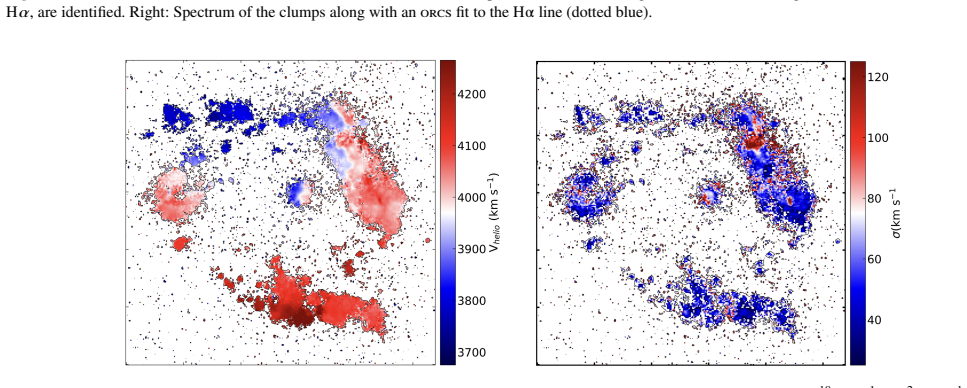
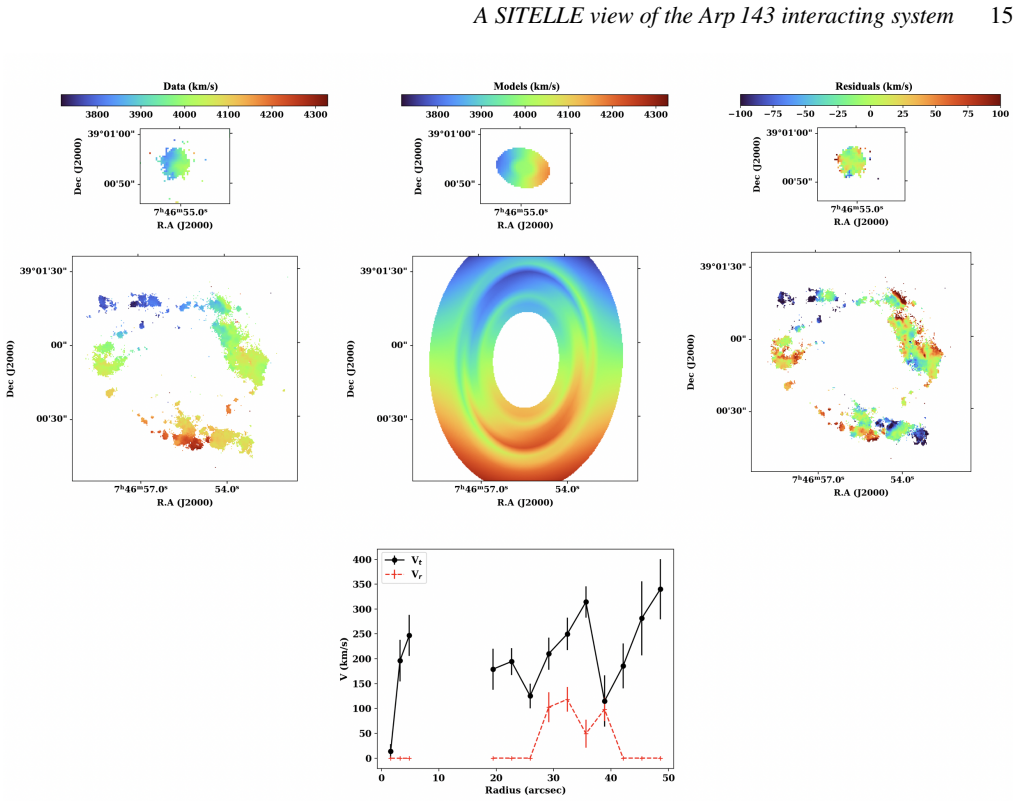
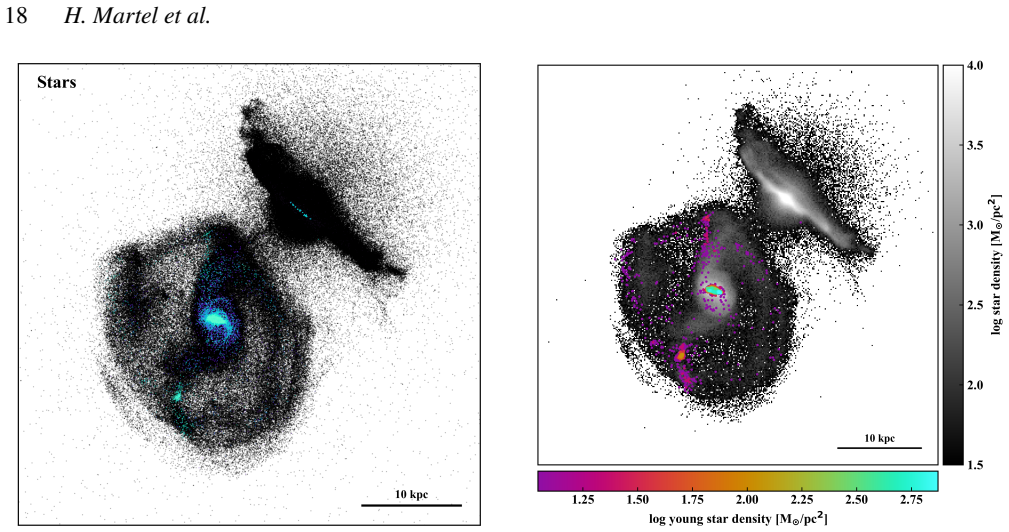
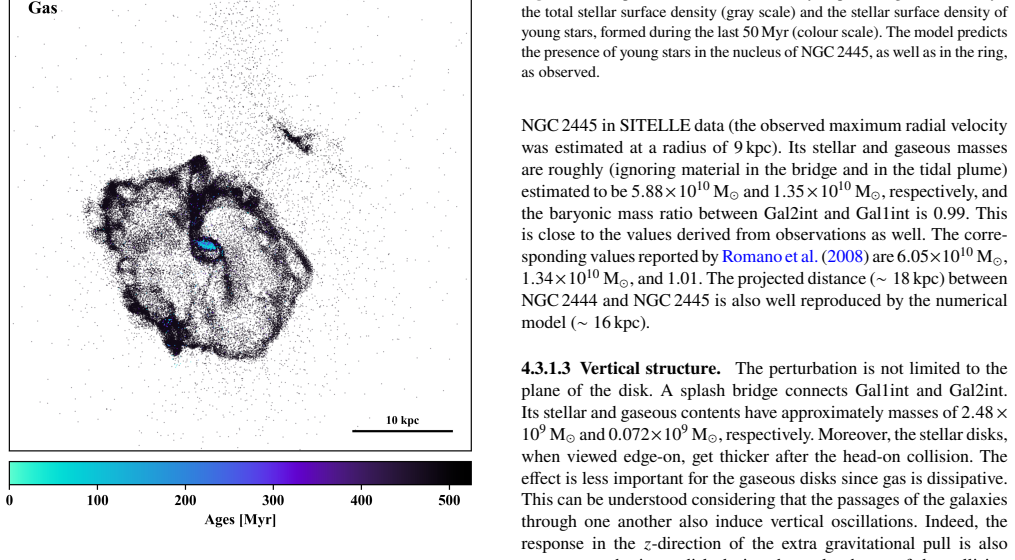
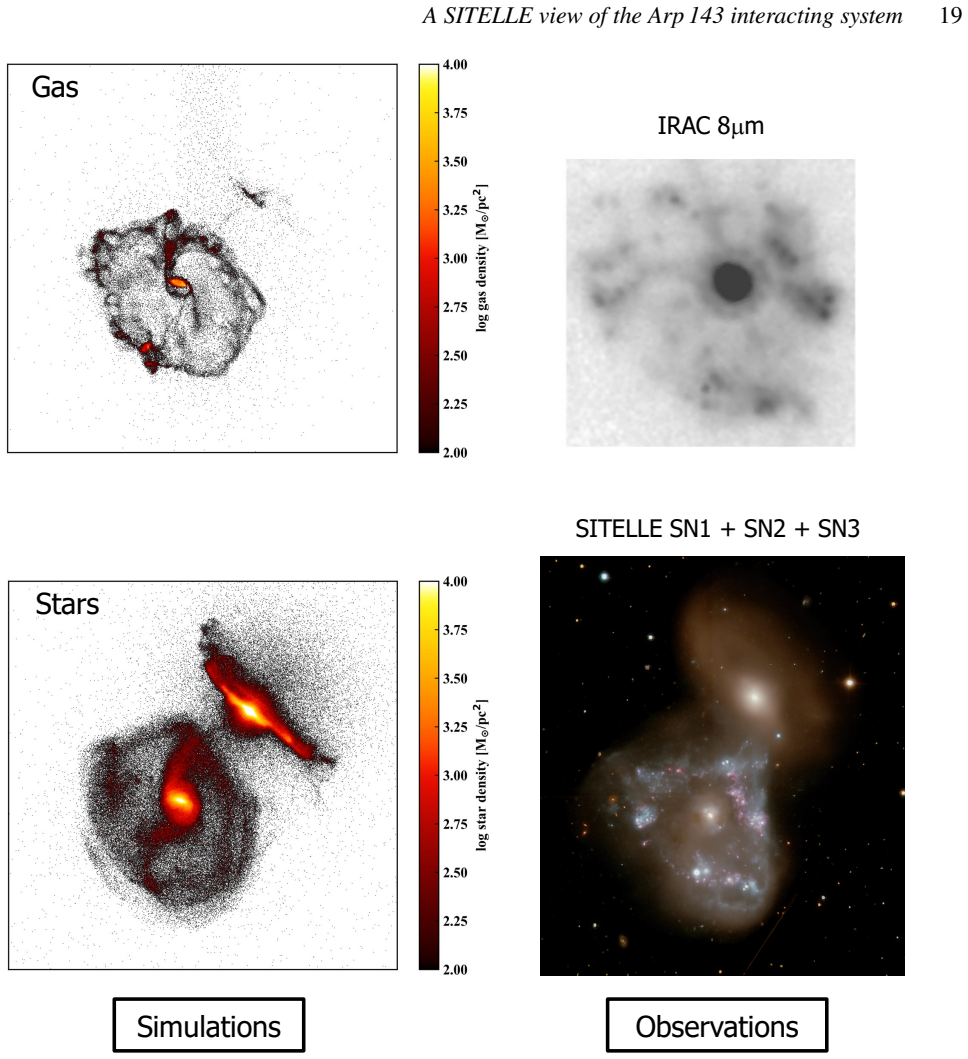
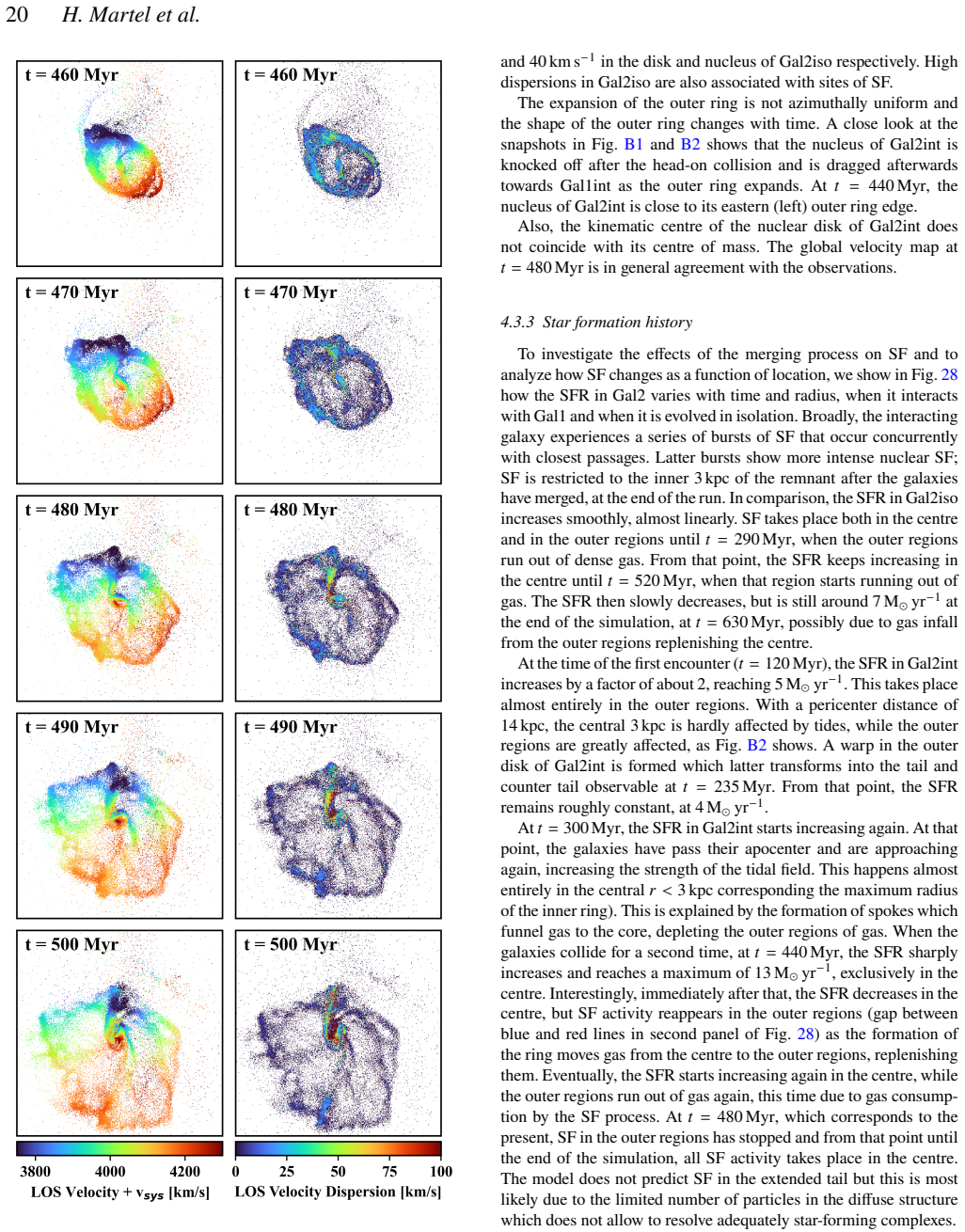
Spectral data cubes reveal strong non-circular flows in the expanding ring of NGC 2445, an off-centered nucleus, and oxygen abundances that are on average slightly sub-solar in the ring but near solar in the nucleus. The long tidal plume has a faint stellar counterpart visible in broad-band images. Chemodynamical simulations of the system match the observed kinematics, morphology, and chemical properties when the encounter starts with a flyby between the disk galaxy and the S0 that strips material into the plume, followed by a head-on collision that forms the ring.
What carries the argument
The chemodynamical evolution code that tests interaction histories and reproduces the observed kinematics, morphology, and chemical properties only under the head-on collision after flyby scenario.
If this is right
- The ring in NGC 2445 formed from the head-on collision phase.
- The long plume consists of debris stripped from the disk galaxy during the earlier flyby.
- Star-forming regions remain concentrated in the ring and nucleus because the interaction compresses gas there.
- The nucleus sits off-center relative to the ring as a direct result of the collision dynamics.
Where Pith is reading between the lines
- Similar chemodynamical modeling applied to other collisional ring galaxies could test whether head-on collisions after flybys are a common formation channel.
- The requirement for a preceding flyby implies that many ring systems may carry signatures of multi-stage encounters rather than single impacts.
- The measured abundance contrast between ring and nucleus could be used to time how quickly newly formed stars enrich the gas during the encounter.
Load-bearing premise
The chemodynamical simulations reproduce the observed kinematics, morphology, and chemical properties only under the specific head-on collision plus flyby scenario, and alternative interaction histories would not match the data equally well.
What would settle it
A simulation of an alternative interaction geometry or sequence, such as a non-head-on impact without a prior flyby, that matches the velocity maps, abundances, plume structure, and star-formation locations equally well would falsify the uniqueness of the proposed history.
Figures
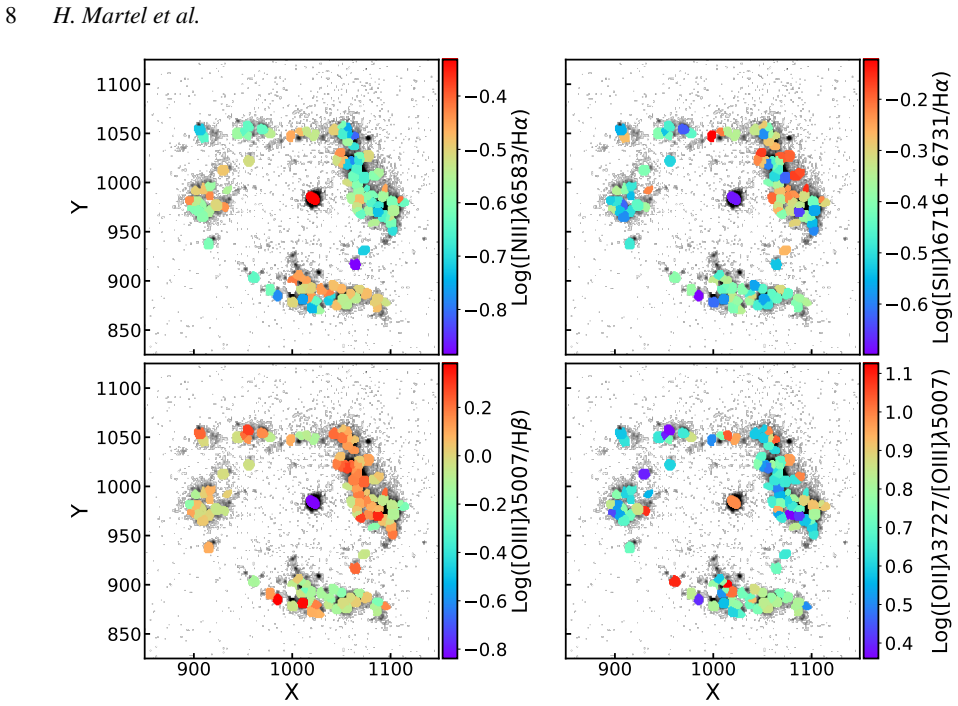
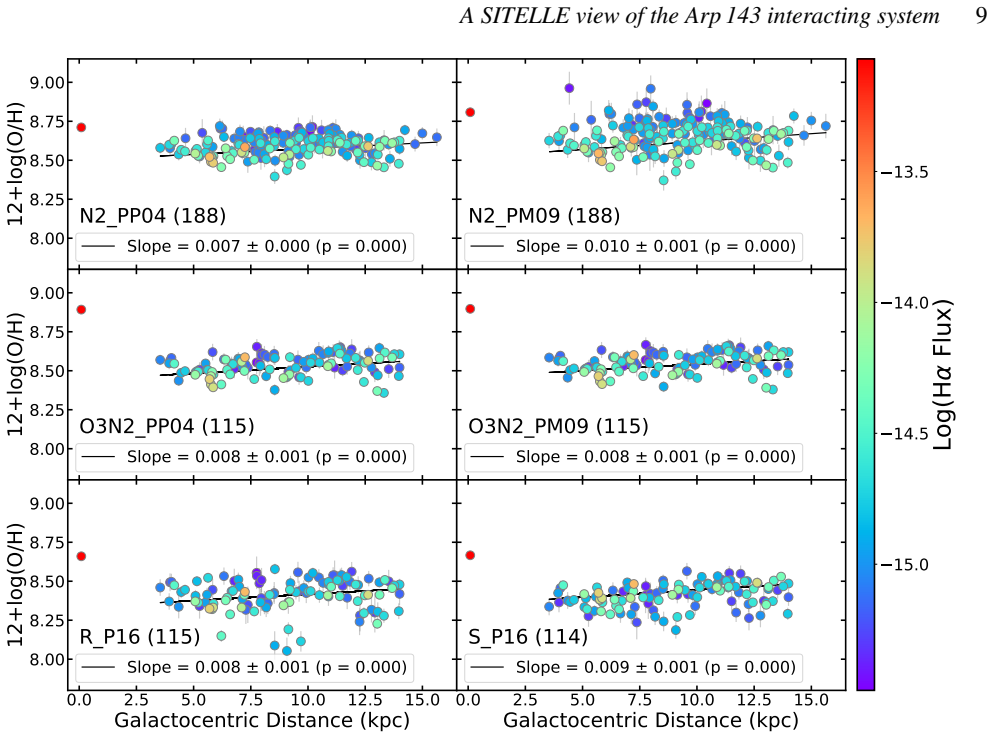
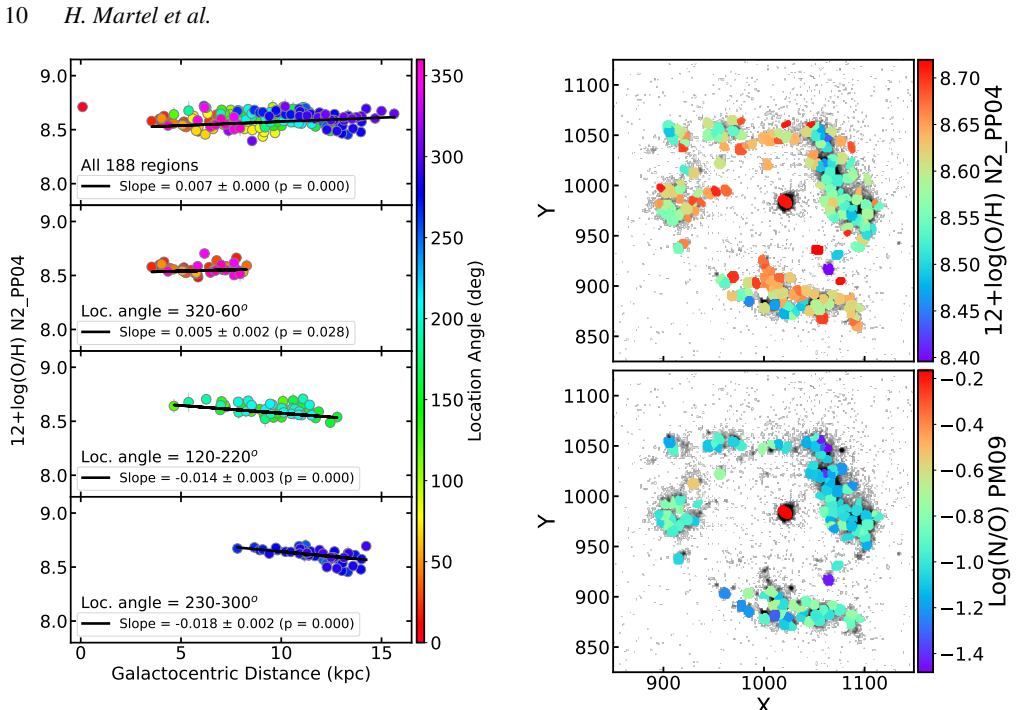
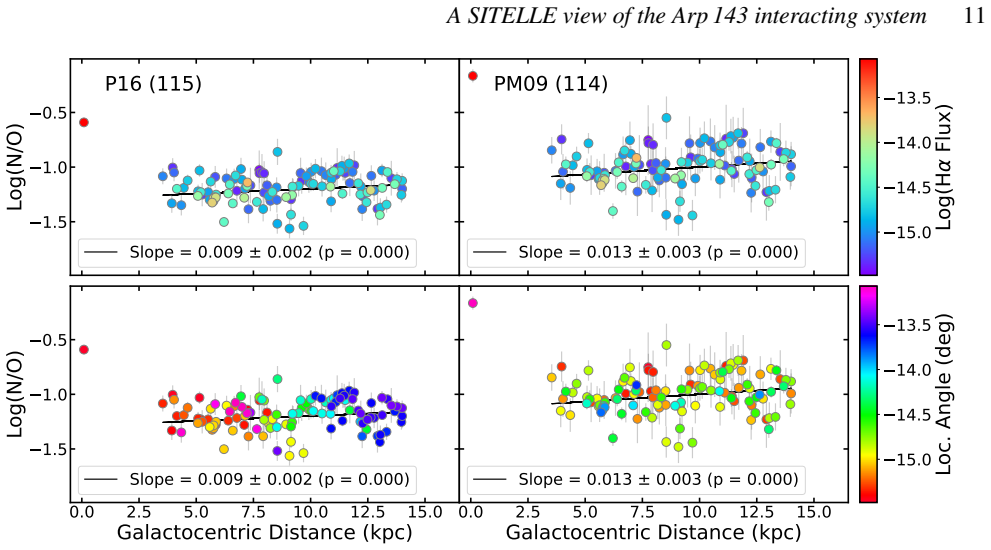
read the original abstract
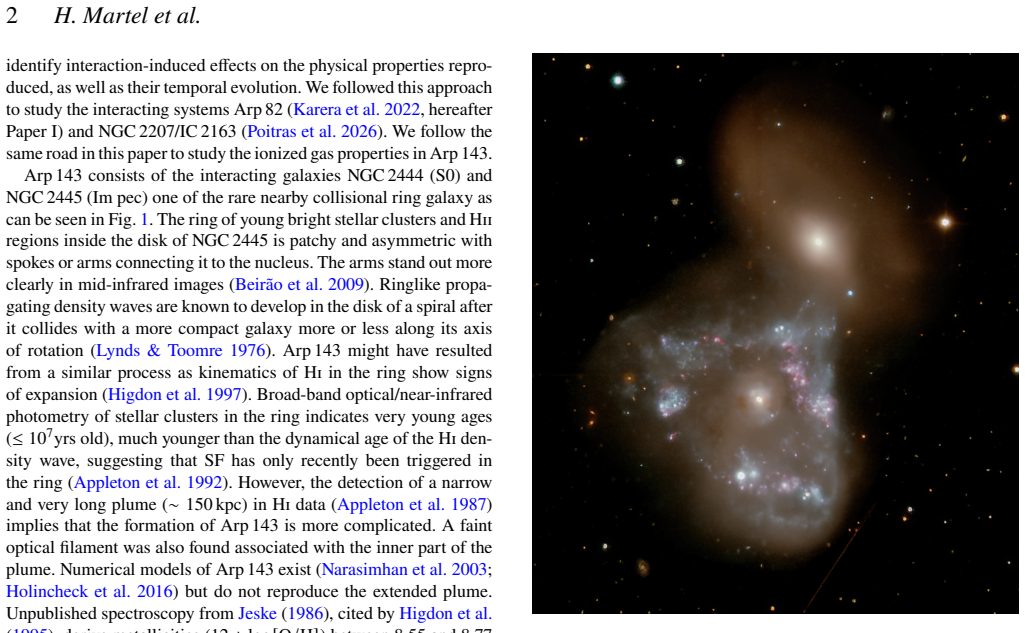
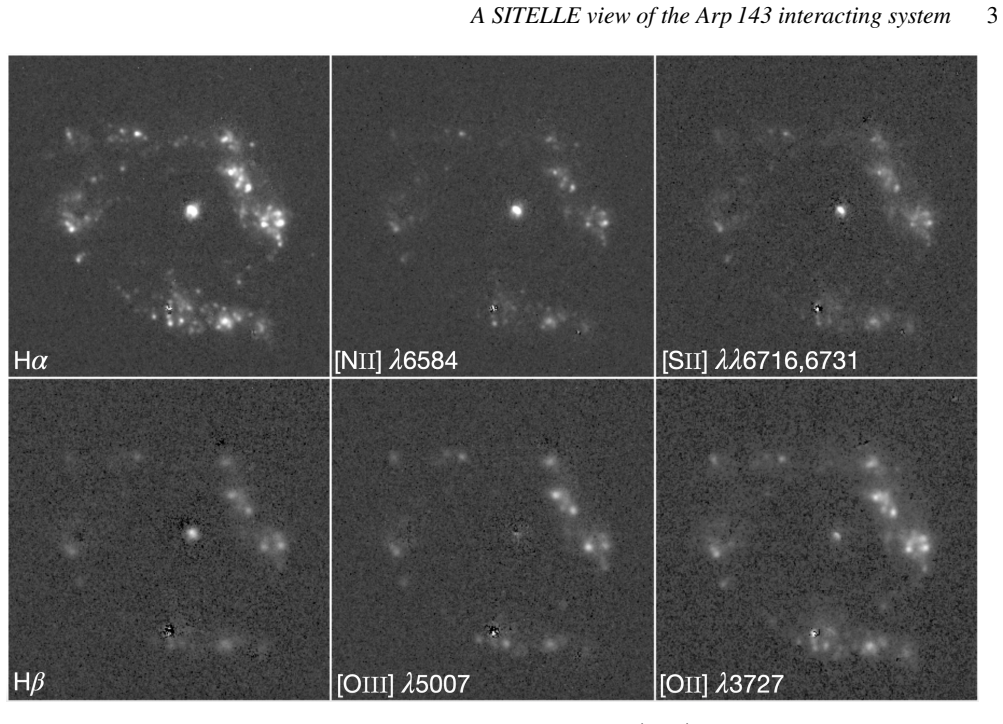
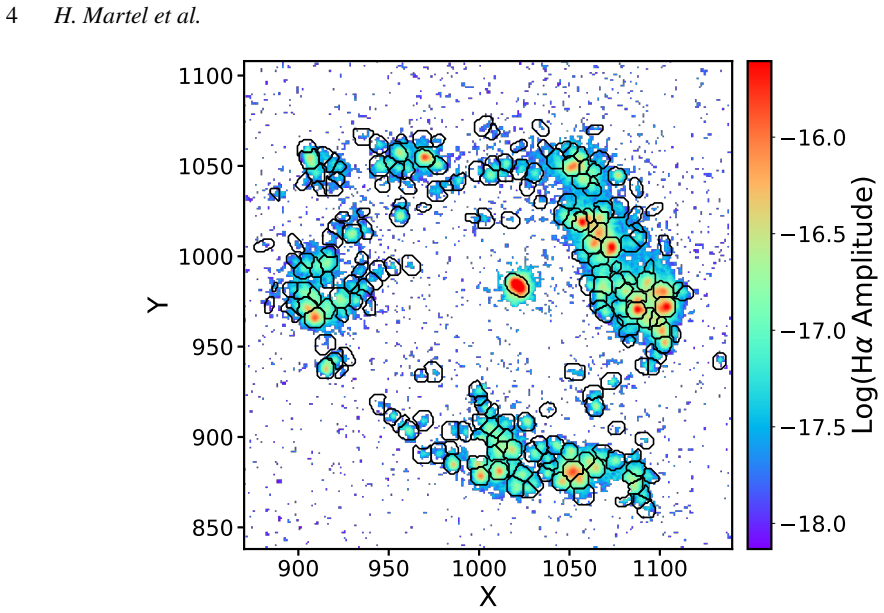
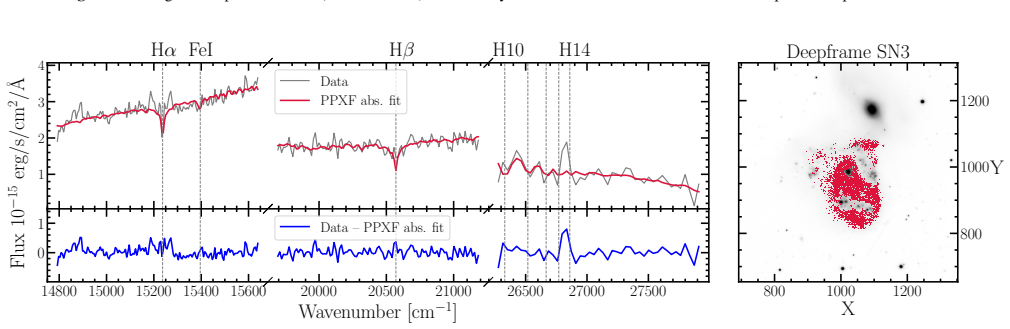
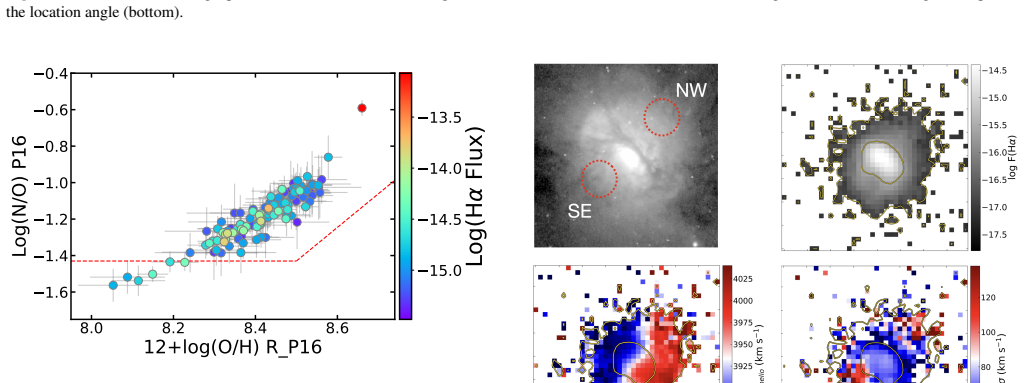
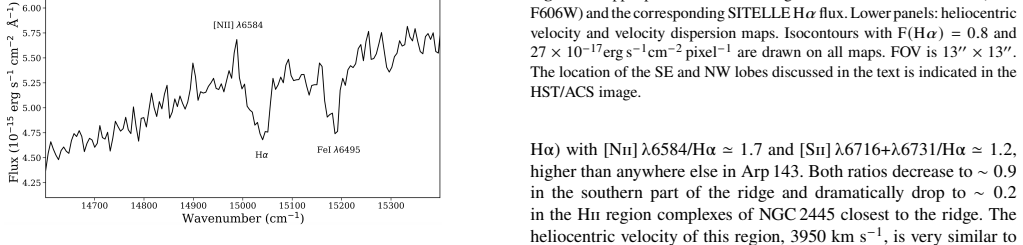
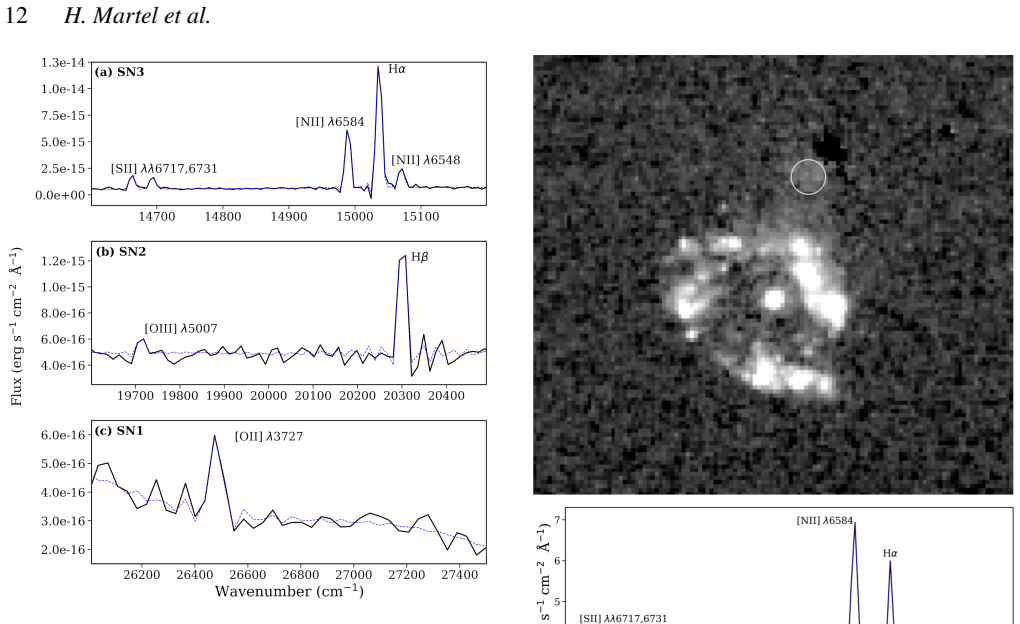
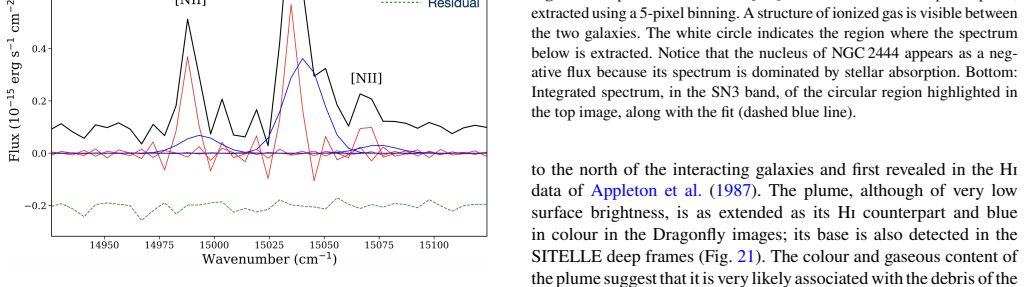
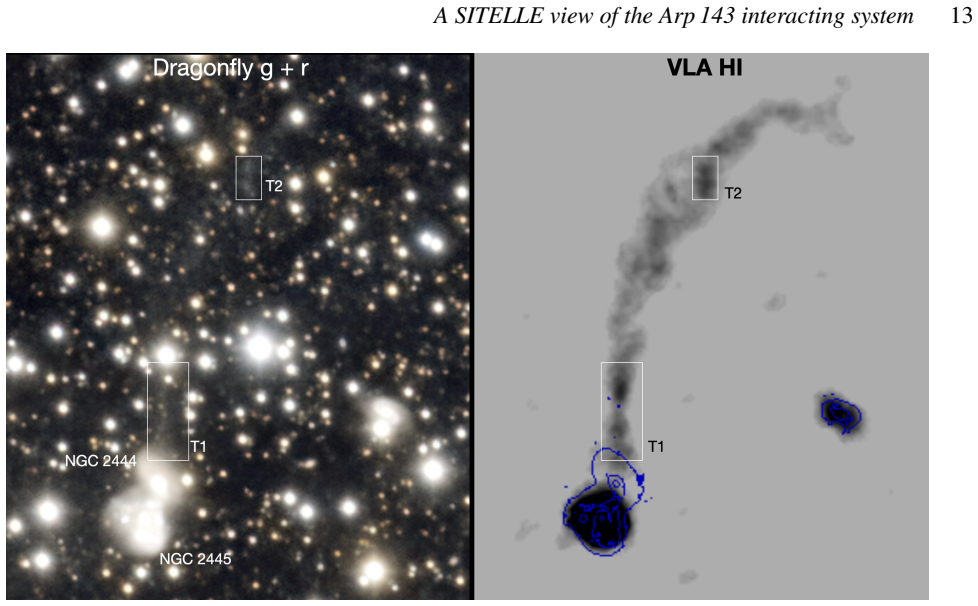
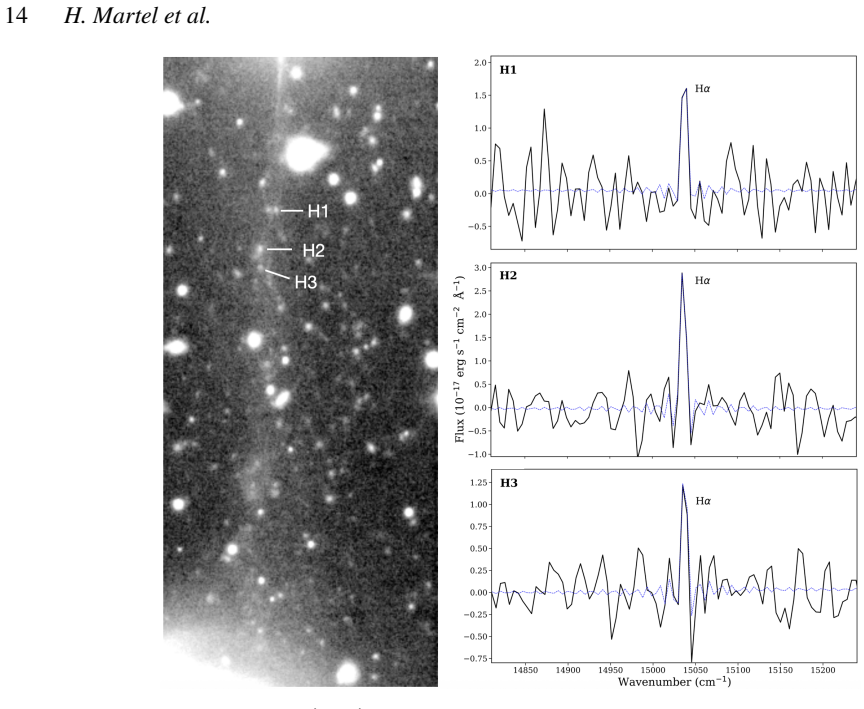
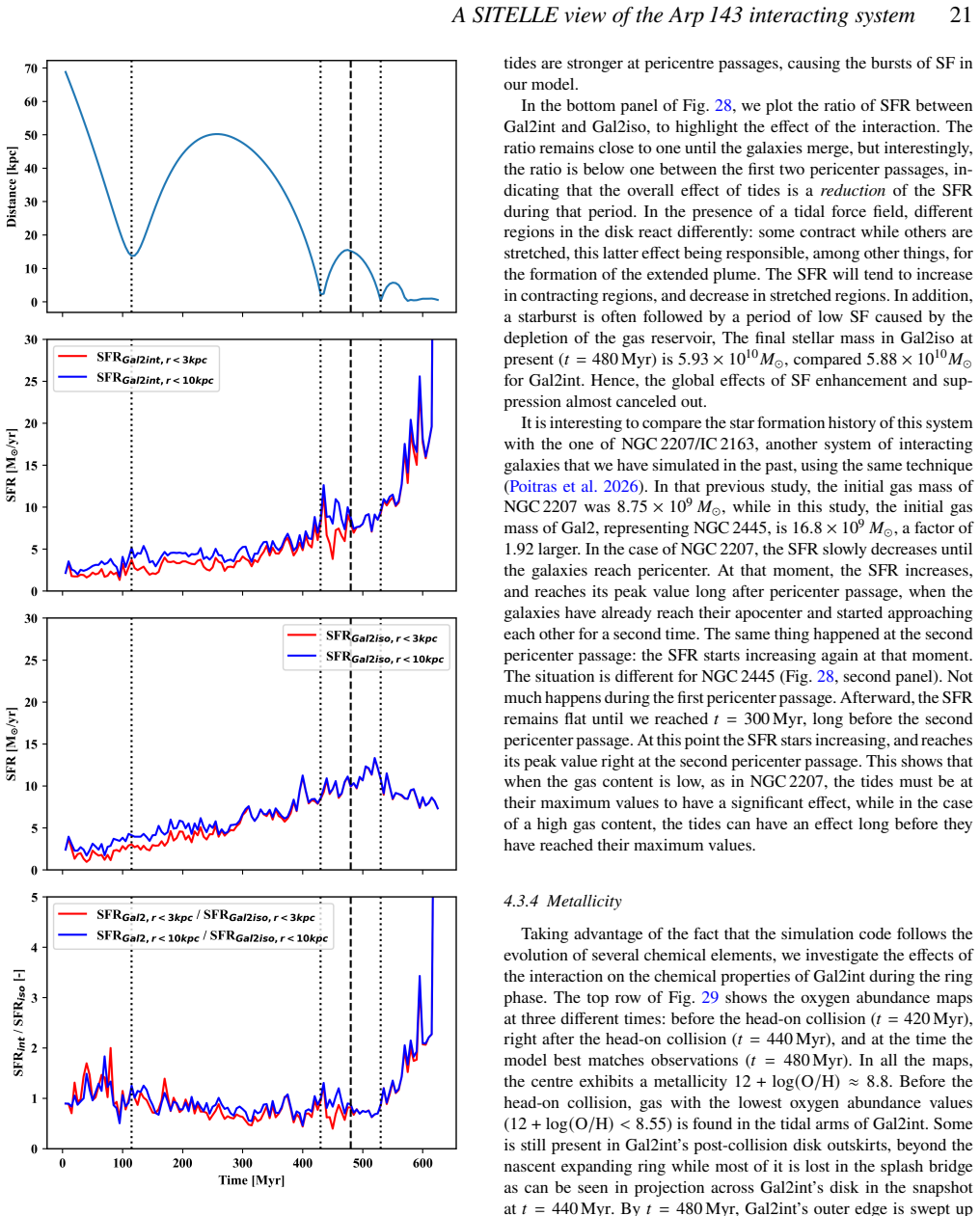
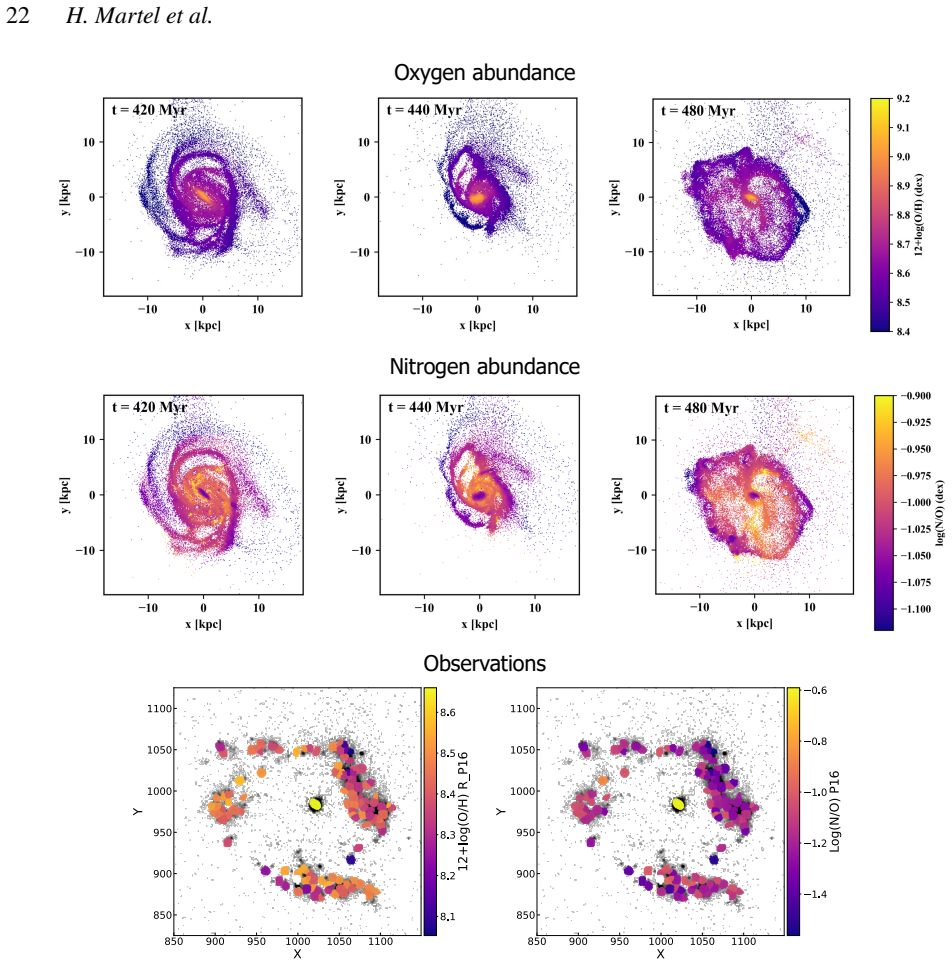
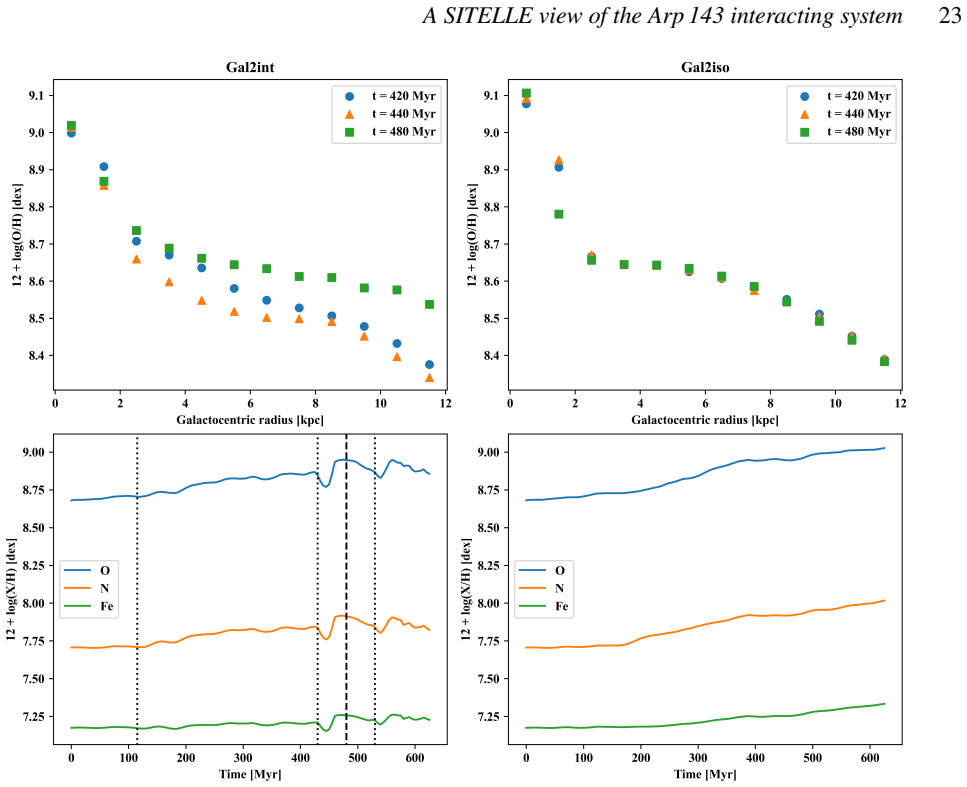
We present spectral data cubes of the interacting galaxy system Arp 143, composed of the ring galaxy NGC 2445 and the lenticular galaxy NGC 2444, obtained with the imaging Fourier transform spectrometer SITELLE at the Canada-France-Hawaii Telescope. Our data allow to probe the kinematics of the interaction and the chemical properties of the ionized gas. Star-forming regions are almost exclusively found in the ring and nucleus of NGC 2445 with the exception of a few very faint ones discovered at the base of the long tidal plume extending north of NGC 2444. Analysis of the H{\alpha} velocity map reveals strong non-circular flows in the ring of NGC 2445, which is expanding. Its nucleus is off-centered with respect to the ring. Oxygen abundance in the ring is on average slightly sub-solar whereas it is close to solar in the nucleus. Broad-band images obtained with the Dragonfly Telephoto array allow to identify the tenuous stellar counterpart of the radio tidal plume. The interaction between the two galaxies is simulated with a chemodynamical evolution code; these simulations suggest that Arp 143 has resulted from a head-on collision between a S0 and a Sc spiral galaxy following a flyby encounter that triggered the formation of the long plume from debris of the disk galaxy.
Editorial analysis
A structured set of objections, weighed in public.
Referee Report
Summary. The paper presents integral field spectroscopy of Arp 143 (NGC 2445 ring galaxy and NGC 2444 companion) obtained with SITELLE, analyzing Hα kinematics showing an expanding ring with non-circular flows and off-centered nucleus, plus oxygen abundances that are sub-solar in the ring and near-solar in the nucleus. Broadband Dragonfly imaging reveals the stellar counterpart to the tidal plume, and chemodynamical simulations are used to interpret the system as resulting from a head-on collision between an S0 and Sc galaxy following a flyby encounter that formed the plume from disk debris.
Significance. If the simulations are shown to provide a quantitatively good match, the work supplies a concrete reconstruction of an interaction history that links observed ring expansion, plume morphology, and chemical properties to a specific sequence of encounters. The IFS dataset and identification of faint star-forming regions in the plume are solid observational contributions; the interpretive value depends on demonstrating the robustness of the numerical model.
major comments (2)
- [Simulations section] Simulations section: the central interpretive claim rests on the chemodynamical models reproducing the observed kinematics, ring expansion, plume, and abundances under the proposed head-on collision plus flyby scenario. The manuscript must supply the explored parameter ranges (mass ratio, impact parameter, timing), the number of runs performed, and quantitative fit metrics (e.g., residuals to the velocity field or abundance map) so that readers can evaluate whether alternative histories are excluded or merely not tested.
- [Kinematics analysis] Kinematics analysis: the statements that the ring is expanding and exhibits strong non-circular flows are load-bearing for the interaction interpretation, yet no numerical values for expansion velocity, residual velocity dispersion after subtracting circular rotation, or comparison to a simple expanding-ring model are provided in the text or figures.
minor comments (2)
- The abstract phrasing 'these simulations suggest' is appropriately cautious, but the manuscript should consistently qualify the simulation result as one plausible history rather than the definitive one.
- Figure captions for the velocity and abundance maps should explicitly state the spatial resolution, seeing, and any smoothing applied.
Simulated Author's Rebuttal
Thank you for the detailed and constructive referee report. We address each major comment below and plan to revise the manuscript to incorporate the suggested improvements.
read point-by-point responses
-
Referee: [Simulations section] Simulations section: the central interpretive claim rests on the chemodynamical models reproducing the observed kinematics, ring expansion, plume, and abundances under the proposed head-on collision plus flyby scenario. The manuscript must supply the explored parameter ranges (mass ratio, impact parameter, timing), the number of runs performed, and quantitative fit metrics (e.g., residuals to the velocity field or abundance map) so that readers can evaluate whether alternative histories are excluded or merely not tested.
Authors: We agree that the simulations section requires additional documentation to support the central interpretive claims. The revised manuscript will include a dedicated subsection or table specifying the explored ranges of mass ratio, impact parameter, and timing, the total number of runs performed, and quantitative fit metrics (such as velocity field residuals and abundance map comparisons). This will allow readers to better assess the robustness and uniqueness of the proposed scenario. revision: yes
-
Referee: [Kinematics analysis] Kinematics analysis: the statements that the ring is expanding and exhibits strong non-circular flows are load-bearing for the interaction interpretation, yet no numerical values for expansion velocity, residual velocity dispersion after subtracting circular rotation, or comparison to a simple expanding-ring model are provided in the text or figures.
Authors: We acknowledge that the kinematics section would be strengthened by quantitative values. In the revision, we will add the measured ring expansion velocity, the residual velocity dispersion after subtracting the circular rotation component, and a direct comparison of the observed velocity field to a simple expanding-ring model, with supporting updates to the text and figures as needed. revision: yes
Circularity Check
No significant circularity detected
full rationale
The paper's central claim rests on new integral-field spectroscopy from SITELLE, Dragonfly imaging, and independent chemodynamical simulations that are run to match the observed kinematics, morphology, and abundances. No equations, fitted parameters, or self-citations are presented that reduce the interpretive conclusion to an input by construction. The abstract frames the head-on collision plus flyby scenario as one consistent history suggested by the models rather than a uniqueness theorem or renamed empirical pattern. This is the normal case of an observation-plus-modeling paper whose derivation chain remains externally falsifiable.
Axiom & Free-Parameter Ledger
free parameters (1)
- chemodynamical simulation parameters (mass ratio, impact parameter, timing)
axioms (1)
- domain assumption Standard galactic dynamics and chemical evolution models apply to interpret the velocity fields and oxygen abundances from emission lines.
Reference graph
Works this paper leans on
-
[1]
, year = 1966, month = nov, volume =
Atlas of Peculiar Galaxies. , year = 1966, month = nov, volume =. doi:10.1086/190147 , adsurl =
-
[2]
Nitrogen in Irregular Galaxies. , keywords =. doi:10.1086/169324 , adsurl =
-
[3]
A catalogue of southern peculiar galaxies and associations
-
[4]
Multiwavelength study of the radio emission from a tight galaxy pair Arp 143
Multiwavelength study of the radio emission from a tight galaxy pair Arp 143. , keywords =. doi:10.1093/mnras/stu1475 , archivePrefix =. 1407.7369 , primaryClass =
work page internal anchor Pith review Pith/arXiv arXiv doi:10.1093/mnras/stu1475
-
[5]
, year = 2026, month = jan, doi =
Integral field spectroscopy and numerical simulations of the NGC 2207/IC 2163 system. , year = 2026, month = jan, doi =
2026
-
[6]
SITELLE: Revised Flux Calibration. in prep. , keywords =. 2025 , month =. doi:, archivePrefix =. , primaryClass =
2025
-
[7]
Laval , keywords =
MSc Thesis, U. Laval , keywords =. 2025 , month =. doi:, archivePrefix =. , primaryClass =
2025
-
[8]
Improving the full spectrum fitting method: accurate convolution with Gauss-Hermite functions
Improving the full spectrum fitting method: accurate convolution with Gauss-Hermite functions. , keywords =. doi:10.1093/mnras/stw3020 , archivePrefix =. 1607.08538 , primaryClass =
work page internal anchor Pith review Pith/arXiv arXiv doi:10.1093/mnras/stw3020
-
[9]
Evolutionary stellar population synthesis at high spectral resolution: optical wavelengths. , keywords =. doi:10.1111/j.1365-2966.2005.08692.x , archivePrefix =. astro-ph/0501204 , primaryClass =
-
[10]
An Analysis of the Shapes of Ultraviolet Extinction Curves. III. an Atlas of Ultraviolet Extinction Curves. , keywords =. doi:10.1086/191413 , adsurl =
-
[11]
PyNeb: a new tool for analyzing emission lines. I. Code description and validation of results. , keywords =. doi:10.1051/0004-6361/201323152 , archivePrefix =. 1410.6662 , primaryClass =
work page internal anchor Pith review Pith/arXiv arXiv doi:10.1051/0004-6361/201323152
-
[12]
[OIII]/[NII] as an abundance indicator at high redshift. , keywords =. doi:10.1111/j.1365-2966.2004.07591.x , archivePrefix =. astro-ph/0401128 , primaryClass =
-
[13]
The impact of the nitrogen-to-oxygen ratio on ionized nebula diagnostics based on [NII] emission lines. , keywords =. doi:10.1111/j.1365-2966.2009.15145.x , archivePrefix =. 0905.4621 , primaryClass =
-
[14]
New calibrations for abundance determinations in HII regions
New calibrations for abundance determinations in H II regions. , keywords =. doi:10.1093/mnras/stw238 , archivePrefix =. 1601.08217 , primaryClass =
work page internal anchor Pith review Pith/arXiv arXiv doi:10.1093/mnras/stw238
-
[15]
The host galaxies and classification of active galactic nuclei. , keywords =. doi:10.1111/j.1365-2966.2006.10859.x , archivePrefix =. astro-ph/0605681 , primaryClass =
-
[16]
On The Cosmic Origins Of Carbon And Nitrogen
On the Cosmic Origins of Carbon and Nitrogen. , keywords =. doi:10.1086/309471 , archivePrefix =. astro-ph/0004299 , primaryClass =
work page internal anchor Pith review Pith/arXiv arXiv doi:10.1086/309471
-
[17]
The Mass-Metallicity Relation with the Direct Method on Stacked Spectra of SDSS Galaxies
The Mass-Metallicity Relation with the Direct Method on Stacked Spectra of SDSS Galaxies. , keywords =. doi:10.1088/0004-637X/765/2/140 , archivePrefix =. 1211.3418 , primaryClass =
work page internal anchor Pith review Pith/arXiv arXiv doi:10.1088/0004-637x/765/2/140
-
[18]
Optimal fitting of Gaussian-apodized or under-resolved emission lines in Fourier transform spectra providing new insights on the velocity structure of NGC 6720. , keywords =. doi:10.1093/mnras/stw2315 , archivePrefix =. 1608.05854 , primaryClass =
work page internal anchor Pith review Pith/arXiv arXiv doi:10.1093/mnras/stw2315
-
[19]
The Structural Properties of Isolated Galaxies, Spiral-Spiral Pairs, and Mergers: The Robustness of Galaxy Morphology during Secular Evolution. , keywords =. doi:10.1086/427134 , archivePrefix =. astro-ph/0410722 , primaryClass =
work page internal anchor Pith review Pith/arXiv arXiv doi:10.1086/427134
-
[20]
Data reduction and calibration accuracy of the imaging Fourier transform spectrometer SITELLE. , keywords =. doi:10.1093/mnras/stab1656 , adsurl =
-
[21]
Galaxy Pairs in the Sloan Digital Sky Survey. I. Star Formation, Active Galactic Nucleus Fraction, and the Mass-Metallicity Relation. , keywords =. doi:10.1088/0004-6256/135/5/1877 , archivePrefix =. 0803.0161 , primaryClass =
work page internal anchor Pith review Pith/arXiv arXiv doi:10.1088/0004-6256/135/5/1877
-
[22]
Galaxy pairs in the Sloan Digital Sky Survey - IV. Interactions trigger active galactic nuclei. , keywords =. doi:10.1111/j.1365-2966.2011.19624.x , archivePrefix =. 1108.2711 , primaryClass =
-
[23]
Galaxy pairs in the Sloan Digital Sky Survey - IX. Merger-induced AGN activity as traced by the Wide-field Infrared Survey Explorer. , keywords =. doi:10.1093/mnras/stu650 , archivePrefix =. 1403.7531 , primaryClass =
work page internal anchor Pith review Pith/arXiv arXiv doi:10.1093/mnras/stu650
-
[24]
Galaxy pairs in the SDSS - XIII. The connection between enhanced star formation and molecular gas properties in galaxy mergers. , keywords =. doi:10.1093/mnras/sty345 , archivePrefix =. 1802.02166 , primaryClass =
work page internal anchor Pith review Pith/arXiv arXiv doi:10.1093/mnras/sty345
-
[25]
Prevalence of neutral gas in centres of merging galaxies-II: nuclear H I and multiwavelength properties. , keywords =. doi:10.1093/mnras/stz2178 , archivePrefix =. 1908.02291 , primaryClass =
-
[26]
Galaxy pairs in the Sloan Digital Sky Survey - XI. A new method for measuring the influence of the closest companion out to wide separations. , keywords =. doi:10.1093/mnras/stw1494 , archivePrefix =. 1606.05885 , primaryClass =
work page internal anchor Pith review Pith/arXiv arXiv doi:10.1093/mnras/stw1494
-
[27]
Galaxy pairs in the Sloan Digital Sky Survey - V. Tracing changes in star formation rate and metallicity out to separations of 80 kpc. , keywords =. doi:10.1111/j.1365-2966.2012.21749.x , archivePrefix =. 1207.4791 , primaryClass =
-
[28]
Star formation efficiency in galaxy interactions and mergers: a statistical study
Star formation efficiency in galaxy interactions and mergers: a statistical study. , keywords =. doi:10.1051/0004-6361:20066959 , archivePrefix =. astro-ph/0703212 , primaryClass =
work page internal anchor Pith review Pith/arXiv arXiv doi:10.1051/0004-6361:20066959
-
[29]
Interacting galaxies on FIRE-2: the connection between enhanced star formation and interstellar gas content. , keywords =. doi:10.1093/mnras/stz417 , archivePrefix =. 1902.02305 , primaryClass =
work page internal anchor Pith review Pith/arXiv arXiv doi:10.1093/mnras/stz417 1902
-
[30]
Mapping galaxy encounters in numerical simulations: The spatial extent of induced star formation
Mapping galaxy encounters in numerical simulations: the spatial extent of induced star formation. , keywords =. doi:10.1093/mnras/stv094 , archivePrefix =. 1501.03573 , primaryClass =
work page internal anchor Pith review Pith/arXiv arXiv doi:10.1093/mnras/stv094
-
[31]
Energy input from quasars regulates the growth and activity of black holes and their host galaxies
Energy input from quasars regulates the growth and activity of black holes and their host galaxies. , keywords =. doi:10.1038/nature03335 , archivePrefix =. astro-ph/0502199 , primaryClass =
work page internal anchor Pith review Pith/arXiv arXiv doi:10.1038/nature03335
-
[32]
Gas-phase Oxygen Gradients in Strongly Interacting Galaxies. I. Early-stage Interactions. , keywords =. doi:10.1088/0004-637X/723/2/1255 , archivePrefix =. 1009.0761 , primaryClass =
work page internal anchor Pith review Pith/arXiv arXiv doi:10.1088/0004-637x/723/2/1255
-
[33]
A parsec-resolution simulation of the Antennae galaxies: formation of star clusters during the merger. , keywords =. doi:10.1093/mnras/stu2208 , archivePrefix =. 1410.5754 , primaryClass =
work page internal anchor Pith review Pith/arXiv arXiv doi:10.1093/mnras/stu2208
-
[34]
Birth, life and survival of Tidal Dwarf Galaxies
Birth, Life and Survival of Tidal Dwarf Galaxies. Dwarf Galaxies: Keys to Galaxy Formation and Evolution , year = 2012, series =. doi:10.1007/978-3-642-22018-0_37 , archivePrefix =. 1101.4834 , primaryClass =
work page internal anchor Pith review Pith/arXiv arXiv doi:10.1007/978-3-642-22018-0_37 2012
-
[35]
The interacting pair of galaxies Arp 82: integral field spectroscopy and numerical simulations. , keywords =. doi:10.1093/mnras/stac1486 , archivePrefix =. 2205.12387 , primaryClass =
-
[36]
Powerful H _ 2 Emission and Star Formation on the Interacting Galaxy System Arp 143: Observations with Spitzer and Galex. , keywords =. doi:10.1088/0004-637X/693/2/1650 , archivePrefix =. 0812.0450 , primaryClass =
work page internal anchor Pith review Pith/arXiv arXiv doi:10.1088/0004-637x/693/2/1650
-
[37]
, year = 1976, month = oct, volume =
On the interpretation of ring galaxies: the binary ring system II Hz 4. , year = 1976, month = oct, volume =. doi:10.1086/154730 , adsurl =
-
[38]
The Detection of Massive Molecular Complexes in the Ring Galaxy System Arp 143
The Detection of Massive Molecular Complexes in the Ring Galaxy System ARP 143. , keywords =. doi:10.1086/310974 , archivePrefix =. astro-ph/9709134 , primaryClass =
work page internal anchor Pith review Pith/arXiv arXiv doi:10.1086/310974
-
[39]
A Multiwavelength Study of the Peculiar Interacting Galaxies ARP 143 = VV 117: Evidence for an Emerging Ring Galaxy?. , keywords =. doi:10.1086/170957 , adsurl =
-
[40]
A giant intergalactic H I bubble near Arpl43. , keywords =. doi:10.1038/330140a0 , adsurl =
-
[41]
, year = 2003, month = sep, volume =
Tidal disruption model for the interacting pair of galaxies VV 117 (NGC 2444/45). , year = 2003, month = sep, volume =. doi:10.1023/A:1026345715631 , adsurl =
-
[42]
Galaxy Zoo: Mergers - Dynamical Models of Interacting Galaxies
Galaxy Zoo: Mergers - Dynamical models of interacting galaxies. , keywords =. doi:10.1093/mnras/stw649 , archivePrefix =. 1604.00435 , primaryClass =
work page internal anchor Pith review Pith/arXiv arXiv doi:10.1093/mnras/stw649
-
[43]
Ring Galaxies: an Investigation of the Physical Conditions in Closely Interacting Systems
-
[44]
The Detection of Molecular Gas in the Ring Galaxy ARP 143. , keywords =. doi:10.1086/187720 , adsurl =
-
[45]
Stellar Disks of Collisional Ring Galaxies. I. New Multiband Images, Radial Intensity and Color Profiles, and Confrontation with N-Body Simulations. , keywords =. doi:10.1088/0004-6256/136/3/1259 , archivePrefix =. 0807.1477 , primaryClass =
work page internal anchor Pith review Pith/arXiv arXiv doi:10.1088/0004-6256/136/3/1259
-
[46]
Advances in Astronomy , year = 2014, month = jan, volume =
Imaging FTS: A Different Approach to Integral Field Spectroscopy. Advances in Astronomy , year = 2014, month = jan, volume =. doi:10.1155/2014/293856 , adsurl =
-
[47]
SITELLE: An Imaging Fourier Transform Spectrometer for the Canada-France-Hawaii Telescope
SITELLE: an Imaging Fourier Transform Spectrometer for the Canada-France-Hawaii Telescope. , keywords =. doi:10.1093/mnras/stz627 , archivePrefix =. 1811.06644 , primaryClass =
work page internal anchor Pith review Pith/arXiv arXiv doi:10.1093/mnras/stz627
-
[48]
Ultra Low Surface Brightness Imaging with the Dragonfly Telephoto Array
Ultra-Low Surface Brightness Imaging with the Dragonfly Telephoto Array. , keywords =. doi:10.1086/674875 , archivePrefix =. 1401.5473 , primaryClass =
work page internal anchor Pith review Pith/arXiv arXiv doi:10.1086/674875
-
[49]
GCD+: a new chemodynamical approach to modelling supernovae and chemical enrichment in elliptical galaxies. , keywords =. doi:10.1046/j.1365-8711.2003.06356.x , archivePrefix =. astro-ph/0212401 , primaryClass =
-
[50]
Calibrating an updated SPH scheme within GCD+
Calibrating an updated smoothed particle hydrodynamics scheme within gcd+. , keywords =. doi:10.1093/mnras/sts161 , archivePrefix =. 0902.4002 , primaryClass =
work page internal anchor Pith review Pith/arXiv arXiv doi:10.1093/mnras/sts161
-
[51]
The Dragonfly Wide Field Survey. I. Telescope, Survey Design, and Data Characterization. , keywords =. doi:10.3847/1538-4357/ab88a8 , archivePrefix =. 1910.14045 , primaryClass =
-
[52]
Models of Ring Galaxies. I. The Growth and Disruption of Clouds in the Expanding Density Wave. , keywords =. doi:10.1086/165354 , adsurl =
-
[53]
Astronomical Data Analysis Software an Systems XXIV (ADASS XXIV) , year = 2015, editor =
ORBS, ORCS, OACS, a Software Suite for Data Reduction and Analysis of the Hyperspectral Imagers SITELLE and SpIOMM. Astronomical Data Analysis Software an Systems XXIV (ADASS XXIV) , year = 2015, editor =
2015
-
[54]
EAS Publications Series , year = 2011, editor =
Star formation in galaxy interactions and mergers. EAS Publications Series , year = 2011, editor =. doi:10.1051/eas/1151008 , archivePrefix =. 1106.1793 , primaryClass =
-
[55]
Detection of Extraplanar Diffuse Ionized Gas in M83
Detection of Extraplanar Diffuse Ionized Gas in M83. , keywords =. doi:10.3847/1538-4357/aa81ca , archivePrefix =. 1707.08126 , primaryClass =
work page internal anchor Pith review Pith/arXiv arXiv doi:10.3847/1538-4357/aa81ca
-
[56]
Modeling Non-Circular Motions in Disk Galaxies: Application to NGC 2976
Modeling Noncircular Motions in Disk Galaxies: Application to NGC 2976. , keywords =. doi:10.1086/518471 , archivePrefix =. astro-ph/0703688 , primaryClass =
work page internal anchor Pith review Pith/arXiv arXiv doi:10.1086/518471
-
[57]
Quantifying non-circular streaming motions in disc galaxies. , keywords =. doi:10.1111/j.1365-2966.2010.16430.x , archivePrefix =. 0912.5493 , primaryClass =
-
[58]
arXiv e-prints , keywords =
DiskFit: a code to fit simple non-axisymmetric galaxy models either to photometric images or to kinematic maps. arXiv e-prints , keywords =
-
[59]
The AGN contribution to the UV-FIR luminosities of interacting galaxies and its role in identifying the main sequence. , keywords =. doi:10.1093/mnras/staa2813 , archivePrefix =. 2009.05614 , primaryClass =
-
[60]
The X-Ray Luminosity Function of Ultra Luminous X-Ray Sources in Collisional Ring Galaxies
The X-Ray Luminosity Function of Ultraluminous X-Ray Sources in Collisional Ring Galaxies. , keywords =. doi:10.3847/1538-4357/aacb34 , archivePrefix =. 1806.02746 , primaryClass =
work page internal anchor Pith review Pith/arXiv arXiv doi:10.3847/1538-4357/aacb34
-
[61]
Imaging spectroscopy of 4285 H II region candidates
NGC628 with SITELLE: I. Imaging spectroscopy of 4285 H II region candidates. , keywords =. doi:10.1093/mnras/sty477 , archivePrefix =. 1704.05121 , primaryClass =
-
[62]
The Relationship between Infrared, Optical, and Ultraviolet Extinction. , keywords =. doi:10.1086/167900 , adsurl =
-
[63]
The Dust Opacity of Star-Forming Galaxies
The Dust Opacity of Star-forming Galaxies. , keywords =. doi:10.1086/324269 , archivePrefix =. astro-ph/0109035 , primaryClass =
work page internal anchor Pith review Pith/arXiv arXiv doi:10.1086/324269
-
[64]
Astrophysics of gaseous nebulae and active galactic nuclei
-
[65]
Classification parameters for the emission-line spectra of extragalactic objects. , keywords =. doi:10.1086/130766 , adsurl =
-
[66]
Theoretical Modeling of Starburst Galaxies. , keywords =. doi:10.1086/321545 , archivePrefix =. astro-ph/0106324 , primaryClass =
work page internal anchor Pith review Pith/arXiv arXiv doi:10.1086/321545
-
[67]
The host galaxies of active galactic nuclei. , keywords =. doi:10.1111/j.1365-2966.2003.07154.x , archivePrefix =. astro-ph/0304239 , primaryClass =
-
[68]
Observational evidence for AGN feedback in early-type galaxies. , keywords =. doi:10.1111/j.1365-2966.2007.12487.x , archivePrefix =. 0709.3015 , primaryClass =
-
[69]
Deriving model-based T$_e$-consistent chemical abundances in ionised gaseous nebulae
Deriving model-based T _ e -consistent chemical abundances in ionized gaseous nebulae. , keywords =. doi:10.1093/mnras/stu753 , archivePrefix =. 1404.3936 , primaryClass =
work page internal anchor Pith review Pith/arXiv arXiv doi:10.1093/mnras/stu753
-
[70]
Empirical and model-based calibrations of chemical abundances
Extreme emission-line galaxies in SDSS - I. Empirical and model-based calibrations of chemical abundances. , keywords =. doi:10.1093/mnras/stab862 , archivePrefix =. 2103.10464 , primaryClass =
-
[71]
The Galactic disk mass function: reconciliation of the HST and nearby determinations
The Galactic Disk Mass Function: Reconciliation of the Hubble Space Telescope and Nearby Determinations. , keywords =. doi:10.1086/374879 , archivePrefix =. astro-ph/0302511 , primaryClass =
work page internal anchor Pith review Pith/arXiv arXiv doi:10.1086/374879
-
[72]
The 2017 Release Cloudy. , keywords =. doi:10.48550/arXiv.1705.10877 , archivePrefix =. 1705.10877 , primaryClass =
-
[73]
Binary Population and Spectral Synthesis Version 2.1: Construction, Observational Verification, and New Results. , keywords =. doi:10.1017/pasa.2017.51 , archivePrefix =. 1710.02154 , primaryClass =
work page internal anchor Pith review Pith/arXiv arXiv doi:10.1017/pasa.2017.51 2017
-
[74]
Multiwavelength Observations of Collisional Ring Galaxies. III. Oxygen/Nitrogen Abundances and Star Formation Properties of Ring Knots. , keywords =. doi:10.1086/300629 , adsurl =
-
[75]
A Theoretical Recalibration of the Extragalactic H II Region Sequence. , keywords =. doi:10.1086/309538 , adsurl =
-
[76]
Metallicity and X-ray luminosity variations in NGC 922. , keywords =. doi:10.1093/mnras/staa3290 , archivePrefix =. 2010.11107 , primaryClass =
-
[77]
Ring Galaxies in the EAGLE Hydrodynamical Simulations
Ring galaxies in the EAGLE hydrodynamical simulations. , keywords =. doi:10.1093/mnras/sty2462 , archivePrefix =. 1807.08251 , primaryClass =
work page internal anchor Pith review Pith/arXiv arXiv doi:10.1093/mnras/sty2462
-
[78]
CALIFA spectroscopy of the interacting galaxy NGC 5394 (Arp 84): starbursts, enhanced [N II]6584 and signs of outflows and shocks. , keywords =. doi:10.1093/mnras/stv1669 , archivePrefix =. 1507.07150 , primaryClass =
work page internal anchor Pith review Pith/arXiv arXiv doi:10.1093/mnras/stv1669
-
[79]
Calibrating Extinction-Free Star Formation Rate Diagnostics with 33GHz Free-Free Emission in NGC6946
Calibrating Extinction-free Star Formation Rate Diagnostics with 33 GHz Free-free Emission in NGC 6946. , keywords =. doi:10.1088/0004-637X/737/2/67 , archivePrefix =. 1105.4877 , primaryClass =
work page internal anchor Pith review Pith/arXiv arXiv doi:10.1088/0004-637x/737/2/67
-
[80]
Ultra-luminous X-ray sources and remnants of massive metal-poor stars. , keywords =. doi:10.1111/j.1365-2966.2010.17048.x , archivePrefix =. 1005.3548 , primaryClass =
discussion (0)
Sign in with ORCID, Apple, or X to comment. Anyone can read and Pith papers without signing in.