Running into tension: primordial black holes from ultra-slow-roll inflation, spectral running, and the Hubble tension
Pith reviewed 2026-07-01 04:28 UTC · model grok-4.3
The pith
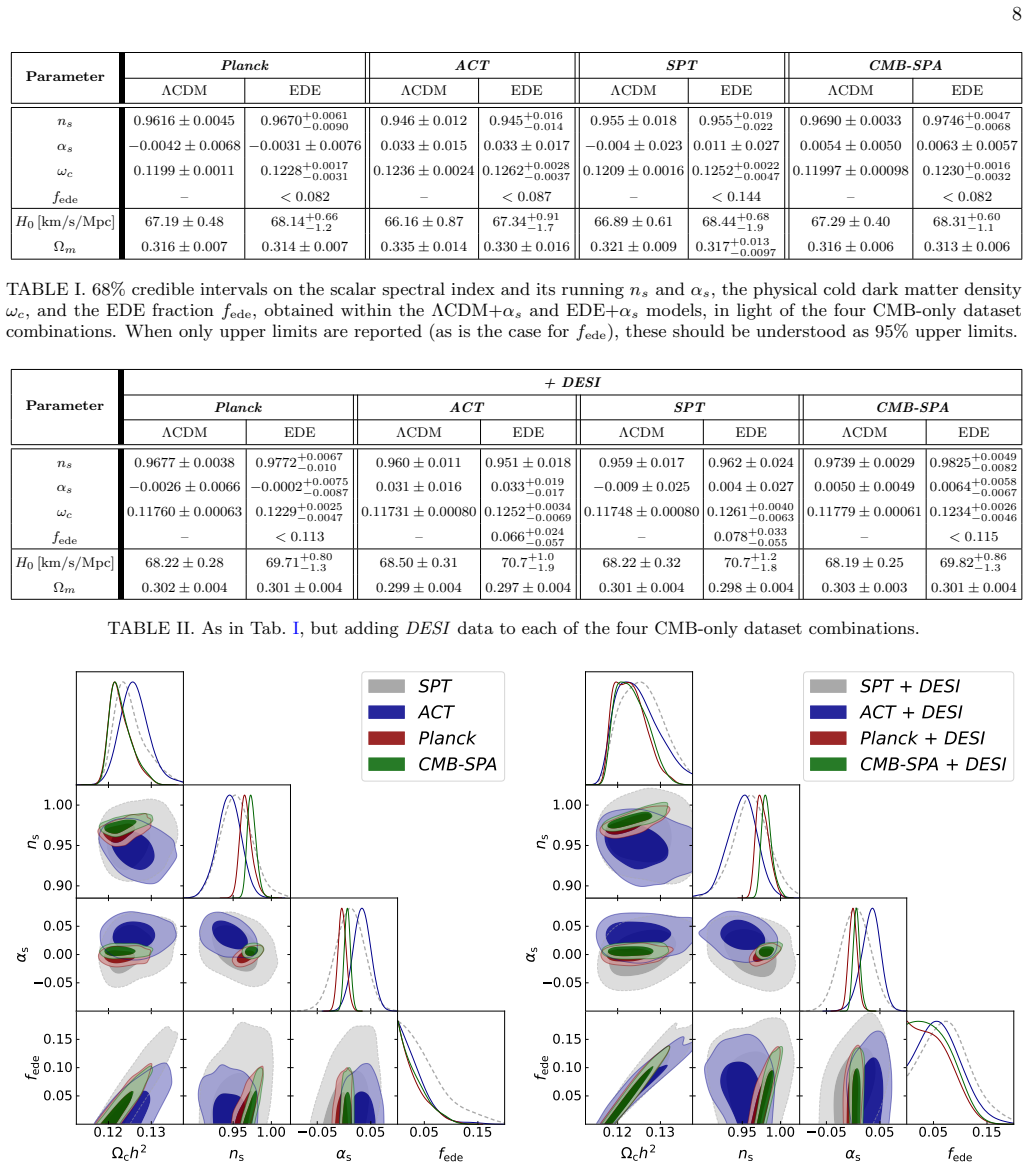
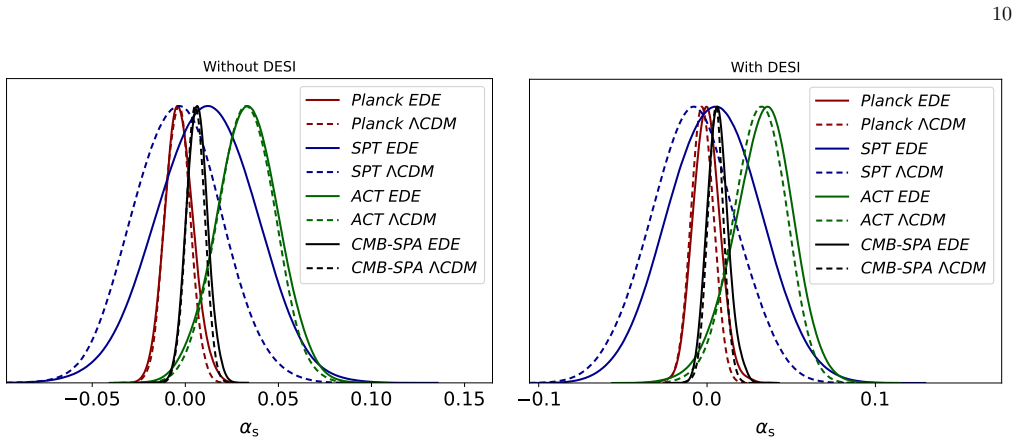
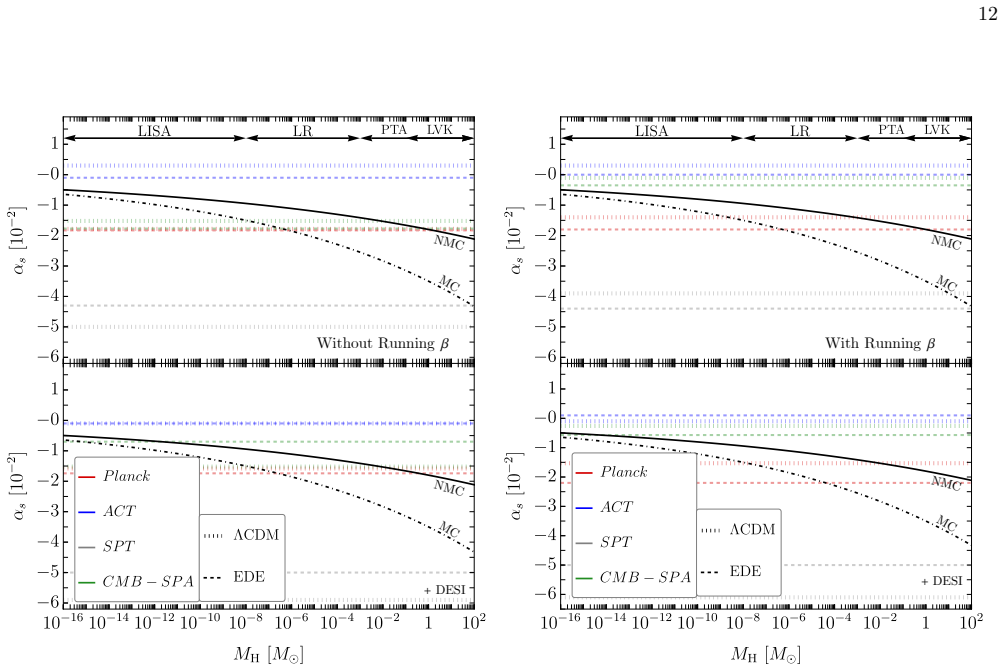
Early dark energy to ease the Hubble tension raises the inferred spectral running α_s, making ultra-slow-roll models for primordial black holes less viable.
A machine-rendered reading of the paper's core claim, the machinery that carries it, and where it could break.
Core claim
Moving from ΛCDM to EDE increases the inferred α_s: once the acoustic angular scale θ_s is fixed, EDE increases the diffusion-to-acoustic angular scale ratio θ_d/θ_s, and the shift in α_s compensates this extra damping by increasing small-scale power.
What carries the argument
The compensating shift in α_s that restores the observed small-scale power when EDE raises θ_d/θ_s at fixed θ_s.
If this is right
- USR inflation scenarios that produce PBHs become harder to reconcile with current CMB data once EDE is allowed.
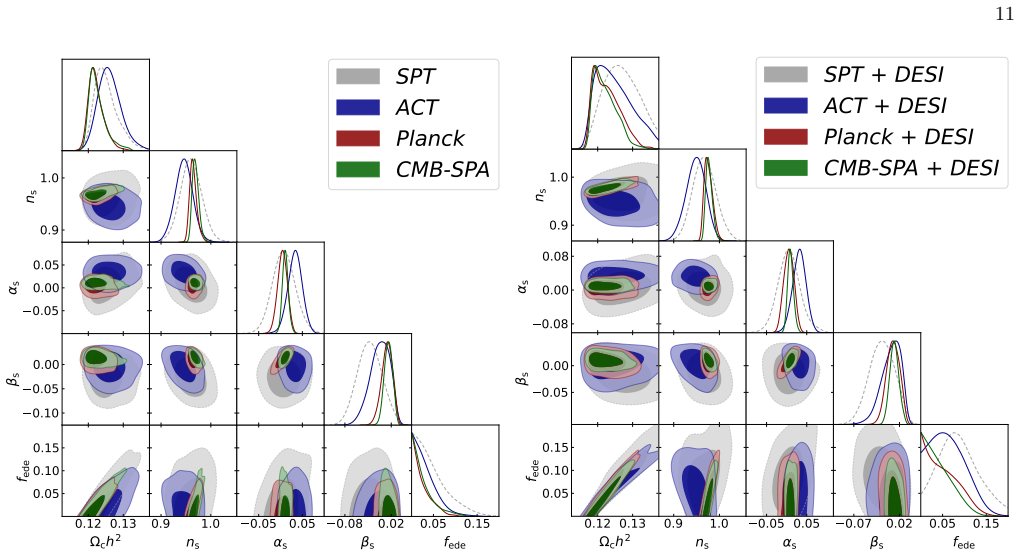
- Constraints on both α_s and β_s shift toward more positive values in EDE cosmologies compared with ΛCDM.
- Inflationary model selection that relies on CMB-inferred n_s and α_s should incorporate uncertainties in the pre-recombination expansion history.
Where Pith is reading between the lines
- Other proposed solutions to the Hubble tension that also alter the sound horizon or diffusion scale may produce similar upward shifts in α_s.
- PBH abundance calculations tied to USR models should be re-run with expansion histories that include early dark energy or equivalent pre-recombination modifications.
- Joint analyses of CMB and large-scale structure data that marginalize over EDE parameters could further test whether the positive α_s preference persists.
Load-bearing premise
The dominant change when EDE is added is an increase in θ_d/θ_s at fixed θ_s that is offset mainly by a positive adjustment in α_s.
What would settle it
A future CMB analysis that includes EDE but finds the best-fit α_s remains negative at the same significance as in ΛCDM would falsify the reported increase.
Figures
read the original abstract
Single-field ultra-slow-roll (USR) inflation is among the most studied mechanisms for primordial black hole (PBH) formation. These models predict a negative spectral running ($\alpha_s<0$), whose magnitude increases with the PBH mass. This is in tension with recent hints for positive running from Atacama Cosmology Telescope (ACT) Cosmic Microwave Background (CMB) data. However, inflationary parameters inferred from CMB data are sensitive to the assumed pre-recombination expansion history, which is precisely where new physics motivated by the Hubble tension should operate. Focusing on axion-like early dark energy (EDE) as a benchmark, we investigate the effect of such pre-recombination new physics on $\alpha_s$, and hence on the viability of USR PBH models, in light of state-of-the-art CMB data from Planck, ACT, and the South Pole Telescope, together with Baryon Acoustic Oscillation data from DESI DR2. Our analysis therefore provides an updated set of constraints on $\alpha_s$ and the running of the running $\beta_s$. For most dataset combinations, moving from $\Lambda$CDM to EDE increases the inferred $\alpha_s$: once the acoustic angular scale $\theta_s$ is fixed, EDE increases the diffusion-to-acoustic angular scale ratio $\theta_d/\theta_s$, and the shift in $\alpha_s$ compensates this extra damping by increasing small-scale power. In this sense, tension calls for tension: taking the Hubble tension seriously as an indication for new physics strengthens the challenges faced by USR PBH models. More broadly, our analysis stresses that inflationary model selection using CMB-inferred inflationary parameters such as $n_s$ and $\alpha_s$ may be premature, especially until the Hubble tension, and more generally the pre-recombination expansion history, is understood.
Editorial analysis
A structured set of objections, weighed in public.
Referee Report
Summary. The manuscript investigates how axion-like early dark energy (EDE), motivated by the Hubble tension, modifies the inferred scalar spectral running α_s (and running of the running β_s) when fitting state-of-the-art CMB data (Planck, ACT, SPT) together with DESI DR2 BAO. It argues that, at fixed acoustic scale θ_s, EDE raises the diffusion-to-acoustic ratio θ_d/θ_s, increasing Silk damping; the resulting positive shift in α_s compensates by boosting small-scale power. This shift is claimed to strengthen the tension between ultra-slow-roll (USR) inflation models (which predict α_s < 0 whose magnitude grows with PBH mass) and CMB constraints, implying that Hubble-tension-motivated new physics makes USR PBH scenarios less viable.
Significance. If the compensation mechanism is robustly demonstrated, the result would usefully illustrate the sensitivity of inflationary parameters to pre-recombination expansion history and caution against premature model selection based on current n_s and α_s constraints. The multi-experiment dataset combination (Planck+ACT+SPT+DESI) is a strength, as is the explicit linkage between Hubble-tension physics and PBH model viability.
major comments (2)
- [§4] §4 (or wherever the θ_d/θ_s compensation is derived): the central claim that the positive α_s shift is driven primarily by the increase in θ_d/θ_s at fixed θ_s lacks a quantitative isolation of this effect. A controlled comparison (e.g., fixing all other parameters and varying only the damping scale) or likelihood decomposition is needed to show that this term dominates over degeneracies with ω_cdm, A_s, or H0; without it the mechanism remains an unverified description rather than a demonstrated driver.
- [Results tables/figures] Results tables/figures (dataset-combination rows): the abstract asserts that 'for most dataset combinations' moving to EDE increases α_s, yet no numerical Δα_s values, uncertainties, or significance levels are referenced. Explicit reporting of the magnitude of the shift (e.g., in units of σ) for each combination is required to substantiate the claim that the tension with USR PBH models is strengthened.
minor comments (2)
- [Introduction] The definitions of θ_d and θ_s should be stated explicitly in the introduction or §2 rather than assumed from prior literature.
- [Introduction] Notation for the running parameters (α_s, β_s) is standard but the sign convention for 'positive running' should be reiterated when discussing the USR tension.
Simulated Author's Rebuttal
We thank the referee for their careful reading and for highlighting the potential significance of linking Hubble-tension-motivated EDE to shifts in inflationary parameters. We address each major comment below and will incorporate the requested clarifications in a revised manuscript.
read point-by-point responses
-
Referee: [§4] §4 (or wherever the θ_d/θ_s compensation is derived): the central claim that the positive α_s shift is driven primarily by the increase in θ_d/θ_s at fixed θ_s lacks a quantitative isolation of this effect. A controlled comparison (e.g., fixing all other parameters and varying only the damping scale) or likelihood decomposition is needed to show that this term dominates over degeneracies with ω_cdm, A_s, or H0; without it the mechanism remains an unverified description rather than a demonstrated driver.
Authors: We agree that an explicit quantitative isolation of the θ_d/θ_s effect would make the central mechanism more robust. In the revised manuscript we will add a controlled comparison: we will run additional chains in which ω_cdm, A_s and H0 are fixed to their ΛCDM best-fit values while only the EDE parameters that alter θ_d/θ_s are varied, and we will supplement this with a likelihood decomposition that isolates the contribution of the damping-scale term. These additions will demonstrate that the α_s shift is driven primarily by the increased θ_d/θ_s ratio rather than by the other degeneracies. revision: yes
-
Referee: Results tables/figures (dataset-combination rows): the abstract asserts that 'for most dataset combinations' moving to EDE increases α_s, yet no numerical Δα_s values, uncertainties, or significance levels are referenced. Explicit reporting of the magnitude of the shift (e.g., in units of σ) for each combination is required to substantiate the claim that the tension with USR PBH models is strengthened.
Authors: We accept that the abstract claim would be more convincing with explicit numerical values. In the revised manuscript we will augment the results tables (and add a supplementary table if needed) to report, for every dataset combination, the Δα_s shift, its uncertainty, and the significance level in σ units when moving from ΛCDM to EDE. This will allow a direct assessment of how the tension with USR PBH models is quantitatively affected. revision: yes
Circularity Check
No significant circularity; analysis uses external data and independent physical reasoning
full rationale
The paper reports results from fitting inflationary parameters (including α_s) to external CMB (Planck, ACT, SPT) and BAO (DESI DR2) datasets under both ΛCDM and EDE cosmologies. The central statement that EDE at fixed θ_s raises θ_d/θ_s (increasing damping) and thereby drives a compensating positive shift in α_s is presented as a post-fit physical interpretation rather than a self-defined or fitted input. No equations or claims reduce the reported α_s shift to a tautology, a self-citation chain, or a renamed fit. The derivation chain relies on standard Boltzmann solvers and likelihoods applied to independent observations; the EDE model is a benchmark with its own parameters, not constructed from the target α_s result. This is the normal case of a non-circular parameter-inference study.
Axiom & Free-Parameter Ledger
axioms (1)
- domain assumption Axion-like early dark energy provides a viable resolution to the Hubble tension
Reference graph
Works this paper leans on
-
[1]
theACTpreference for larger ns (more evident inACTDR4, but still evident in ACTDR6)
the dataset dependence of constraints on inflation- ary parameters, e.g. theACTpreference for larger ns (more evident inACTDR4, but still evident in ACTDR6)
-
[2]
the model-dependence, or more precisely early-time physics dependence, of constraints on inflationary parameters
-
[3]
Quantum Fields in Gravity, Cosmology and Black Holes
the more general dependence of inflationary con- straints on the assumed primordial power spec- trum, for instance the choice of whetherα s and βs are allowed to vary. As our work explicitly shows, constraints on inflation- ary parameters are particularly sensitive to the pre- recombination expansion history, which is itself a ma- jor open issue in cosmol...
-
[4]
Y. B. Zel’dovich and I. D. Novikov, Sov. Astron.10, 602 (1967)
1967
-
[5]
S. W. Hawking, Nature248, 30 (1974)
1974
-
[6]
G. F. Chapline, Nature253, 251 (1975)
1975
-
[7]
B. J. Carr, Astrophys. J.201, 1 (1975)
1975
- [8]
-
[9]
S. Choudhury and M. Sami, Phys. Rept.1103, 1 (2025), arXiv:2407.17006 [gr-qc]
-
[10]
Primordial Black Holes: A Review of Formation and Evolution
S. Shankaranarayanan, S. Bhattacharya, and A. Vid- yarthi, (2026), arXiv:2606.23846 [gr-qc]
work page internal anchor Pith review Pith/arXiv arXiv 2026
-
[11]
B. Carr, F. Kuhnel, and M. Sandstad, Phys. Rev. D 94, 083504 (2016), arXiv:1607.06077 [astro-ph.CO]
work page internal anchor Pith review Pith/arXiv arXiv 2016
-
[12]
A. M. Green and B. J. Kavanagh, J. Phys. G48, 043001 (2021), arXiv:2007.10722 [astro-ph.CO]
work page internal anchor Pith review Pith/arXiv arXiv 2021
- [13]
-
[14]
B. P. Abbottet al.(LIGO Scientific, Virgo), Phys. Rev. 16 X9, 031040 (2019), arXiv:1811.12907 [astro-ph.HE]
work page internal anchor Pith review Pith/arXiv arXiv 2019
- [15]
-
[16]
R. Abbottet al.(LIGO Scientific, Virgo), Phys. Rev. X 11, 021053 (2021), arXiv:2010.14527 [gr-qc]
work page internal anchor Pith review Pith/arXiv arXiv 2021
-
[17]
R. Abbottet al.(KAGRA, VIRGO, LIGO Scientific), Phys. Rev. X13, 041039 (2023), arXiv:2111.03606 [gr- qc]
work page internal anchor Pith review Pith/arXiv arXiv 2023
-
[18]
A. G. Abacet al.(LIGO Scientific, VIRGO, KAGRA), (2025), arXiv:2508.18082 [gr-qc]
work page internal anchor Pith review Pith/arXiv arXiv 2025
-
[19]
Abbottet al.(LIGO Scientific, VIRGO, KAGRA), Phys
R. Abbottet al.(LIGO Scientific, VIRGO, KAGRA), Phys. Rev. Lett.129, 061104 (2022), arXiv:2109.12197 [astro-ph.CO]
-
[20]
R. Abbottet al.(LVK), Mon. Not. Roy. Astron. Soc. 524, 5984 (2023), [Erratum: Mon.Not.Roy.Astron.Soc. 526, 6234 (2023)], arXiv:2212.01477 [astro-ph.HE]
-
[21]
M. Prunier, G. Morr´ as, J. F. N. Siles, S. Clesse, J. Garc´ ıa-Bellido, and E. Ruiz Morales, Phys. Dark Univ.46, 101582 (2024), arXiv:2311.16085 [gr-qc]
-
[22]
G. Morraset al., Phys. Dark Univ.42, 101285 (2023), arXiv:2301.11619 [gr-qc]
-
[23]
C. Yuan and Q.-G. Huang, JCAP09, 051 (2024), arXiv:2404.03328 [astro-ph.CO]
-
[24]
S. Bird, I. Cholis, J. B. Mu˜ noz, Y. Ali-Ha¨ ımoud, M. Kamionkowski, E. D. Kovetz, A. Raccanelli, and A. G. Riess, Phys. Rev. Lett.116, 201301 (2016), arXiv:1603.00464 [astro-ph.CO]
work page internal anchor Pith review Pith/arXiv arXiv 2016
-
[25]
B. J. Kavanagh, D. Gaggero, and G. Bertone, Phys. Rev. D98, 023536 (2018), arXiv:1805.09034 [astro- ph.CO]
work page internal anchor Pith review Pith/arXiv arXiv 2018
- [26]
-
[27]
G. H¨ utsi, M. Raidal, V. Vaskonen, and H. Veerm¨ ae, JCAP03, 068 (2021), arXiv:2012.02786 [astro-ph.CO]
-
[28]
V. De Luca, G. Franciolini, P. Pani, and A. Riotto, JCAP05, 003 (2021), arXiv:2102.03809 [astro-ph.CO]
-
[29]
G. Franciolini, I. Musco, P. Pani, and A. Urbano, Phys. Rev. D106, 123526 (2022), arXiv:2209.05959 [astro- ph.CO]
- [30]
-
[31]
M. Andr´ es-Carcasona, A. J. Iovino, V. Vaskonen, H. Veerm¨ ae, M. Mart´ ınez, O. Pujol` as, and L. M. Mir, Phys. Rev. D110, 023040 (2024), arXiv:2405.05732 [astro-ph.CO]
-
[32]
GW231123: A Possible Primordial Black Hole Origin
V. De Luca, G. Franciolini, and A. Riotto, (2025), arXiv:2508.09965 [astro-ph.CO]
work page internal anchor Pith review Pith/arXiv arXiv 2025
-
[33]
Constraints on primordial black holes from the first part of LIGO-Virgo-KAGRA fourth observing run
M. Andr´ es-Carcasona, A. J. Iovino, E. Vallejo-Pag` es, V. Vaskonen, H. Veerm¨ ae, M. Mart´ ınez, and L. M. Mir, (2026), arXiv:2605.15749 [astro-ph.CO]
work page internal anchor Pith review Pith/arXiv arXiv 2026
-
[34]
The NANOGrav 15-year Data Set: Evidence for a Gravitational-Wave Background
G. Agazieet al.(NANOGrav), Astrophys. J. Lett.951, L8 (2023), arXiv:2306.16213 [astro-ph.HE]
work page internal anchor Pith review Pith/arXiv arXiv 2023
-
[35]
J. Antoniadiset al.(EPTA, InPTA:), Astron. Astro- phys.678, A50 (2023), arXiv:2306.16214 [astro-ph.HE]
work page internal anchor Pith review Pith/arXiv arXiv 2023
-
[36]
D. J. Reardonet al., Astrophys. J. Lett.951, L6 (2023), arXiv:2306.16215 [astro-ph.HE]
work page internal anchor Pith review Pith/arXiv arXiv 2023
-
[37]
H. Xuet al., Res. Astron. Astrophys.23, 075024 (2023), arXiv:2306.16216 [astro-ph.HE]
work page internal anchor Pith review Pith/arXiv arXiv 2023
-
[38]
V. Vaskonen and H. Veerm¨ ae, Phys. Rev. Lett.126, 051303 (2021), arXiv:2009.07832 [astro-ph.CO]
- [39]
-
[40]
V. De Luca, G. Franciolini, and A. Riotto, Phys. Rev. Lett.126, 041303 (2021), arXiv:2009.08268 [astro- ph.CO]
-
[41]
N. Bhaumik and R. K. Jain, Phys. Rev. D104, 023531 (2021), arXiv:2009.10424 [astro-ph.CO]
-
[42]
K. Inomata, M. Kawasaki, K. Mukaida, and T. T. Yanagida, Phys. Rev. Lett.126, 131301 (2021), arXiv:2011.01270 [astro-ph.CO]
-
[43]
K. Kohri and T. Terada, Phys. Lett. B813, 136040 (2021), arXiv:2009.11853 [astro-ph.CO]
-
[44]
G. Dom` enech and S. Pi, Sci. China Phys. Mech. Astron. 65, 230411 (2022), arXiv:2010.03976 [astro-ph.CO]
-
[45]
S. Vagnozzi, Mon. Not. Roy. Astron. Soc.502, L11 (2021), arXiv:2009.13432 [astro-ph.CO]
-
[46]
R. Namba and M. Suzuki, Phys. Rev. D102, 123527 (2020), arXiv:2009.13909 [astro-ph.CO]
-
[47]
S. Sugiyama, V. Takhistov, E. Vitagliano, A. Kusenko, M. Sasaki, and M. Takada, Phys. Lett. B814, 136097 (2021), arXiv:2010.02189 [astro-ph.CO]
- [48]
- [49]
-
[50]
K. Rezazadeh, Z. Teimoori, S. Karimi, and K. Karami, Eur. Phys. J. C82, 758 (2022), arXiv:2110.01482 [gr- qc]
-
[51]
M. Kawasaki and H. Nakatsuka, JCAP05, 023 (2021), arXiv:2101.11244 [astro-ph.CO]
- [52]
- [53]
-
[54]
Yi, JCAP03, 048 (2023), arXiv:2206.01039 [gr-qc]
Z. Yi, JCAP03, 048 (2023), arXiv:2206.01039 [gr-qc]
- [55]
-
[56]
J.-X. Zhao, X.-H. Liu, and N. Li, Phys. Rev. D107, 043515 (2023), arXiv:2302.06886 [astro-ph.CO]
-
[57]
G. Ferrante, G. Franciolini, A. Iovino, Junior., and A. Urbano, JCAP06, 057 (2023), arXiv:2305.13382 [astro-ph.CO]
- [58]
-
[59]
Vagnozzi, JHEAp39, 81 (2023), arXiv:2306.16912 [astro-ph.CO]
S. Vagnozzi, JHEAp39, 81 (2023), arXiv:2306.16912 [astro-ph.CO]
-
[60]
G. Franciolini, A. Iovino, Junior., V. Vaskonen, and H. Veermae, Phys. Rev. Lett.131, 201401 (2023), arXiv:2306.17149 [astro-ph.CO]
-
[61]
A. J. Iovino, G. Perna, A. Riotto, and H. Veerm¨ ae, JCAP10, 050 (2024), arXiv:2406.20089 [astro-ph.CO]
work page internal anchor Pith review Pith/arXiv arXiv 2024
-
[62]
Y. Gouttenoire, S. Trifinopoulos, and M. Vanvlasselaer, JCAP02, 072 (2026), arXiv:2508.19328 [astro-ph.CO]
work page internal anchor Pith review Pith/arXiv arXiv 2026
-
[63]
Ivanov, P
P. Ivanov, P. Naselsky, and I. Novikov, Phys. Rev. D 50, 7173 (1994)
1994
- [64]
-
[65]
Primordial black holes from single field models of inflation
J. Garcia-Bellido and E. Ruiz Morales, Phys. Dark Univ.18, 47 (2017), arXiv:1702.03901 [astro-ph.CO]
work page internal anchor Pith review Pith/arXiv arXiv 2017
-
[66]
On primordial black holes from an inflection point
C. Germani and T. Prokopec, Phys. Dark Univ.18, 6 17 (2017), arXiv:1706.04226 [astro-ph.CO]
work page internal anchor Pith review Pith/arXiv arXiv 2017
-
[67]
Single Field Double Inflation and Primordial Black Holes
K. Kannike, L. Marzola, M. Raidal, and H. Veerm¨ ae, JCAP09, 020 (2017), arXiv:1705.06225 [astro-ph.CO]
work page internal anchor Pith review Pith/arXiv arXiv 2017
-
[68]
Primordial black holes and second order gravitational waves from ultra-slow-roll inflation
H. Di and Y. Gong, JCAP07, 007 (2018), arXiv:1707.09578 [astro-ph.CO]
work page internal anchor Pith review Pith/arXiv arXiv 2018
-
[69]
Primordial black hole dark matter from single field inflation
G. Ballesteros and M. Taoso, Phys. Rev. D97, 023501 (2018), arXiv:1709.05565 [hep-ph]
work page internal anchor Pith review Pith/arXiv arXiv 2018
-
[70]
Primordial Black Holes from String Inflation
M. Cicoli, V. A. Diaz, and F. G. Pedro, JCAP06, 034 (2018), arXiv:1803.02837 [hep-th]
work page internal anchor Pith review Pith/arXiv arXiv 2018
-
[71]
G. Ballesteros, J. Rey, M. Taoso, and A. Urbano, JCAP 07, 025 (2020), arXiv:2001.08220 [astro-ph.CO]
- [72]
- [73]
-
[74]
G. Ballesteros and J. Gamb´ ın Egea, JCAP07, 052 (2024), arXiv:2404.07196 [astro-ph.CO]
-
[75]
S. Allegrini, L. Del Grosso, A. J. Iovino, and A. Urbano, Phys. Rev. D111, 123557 (2025), arXiv:2412.14049 [astro-ph.CO]
- [76]
-
[77]
D. Totolou, T. Papanikolaou, and E. N. Saridakis, (2025), arXiv:2512.25044 [gr-qc]
- [78]
-
[79]
A. J. Iovino and A. Riotto, (2025), arXiv:2512.19668 [astro-ph.CO]
work page internal anchor Pith review Pith/arXiv arXiv 2025
-
[80]
Are Primordial Black Holes a Natural Dark Matter Candidate?
S. Profumo, (2026), arXiv:2606.12775 [hep-ph]
work page internal anchor Pith review Pith/arXiv arXiv 2026
discussion (0)
Sign in with ORCID, Apple, or X to comment. Anyone can read and Pith papers without signing in.