Regular black hole solutions and the quark chemical potential at the QCD phase transition
Pith reviewed 2026-06-29 15:49 UTC · model grok-4.3
The pith
Finite quark chemical potential does not produce regular black hole cores in the models studied.
A machine-rendered reading of the paper's core claim, the machinery that carries it, and where it could break.
Core claim
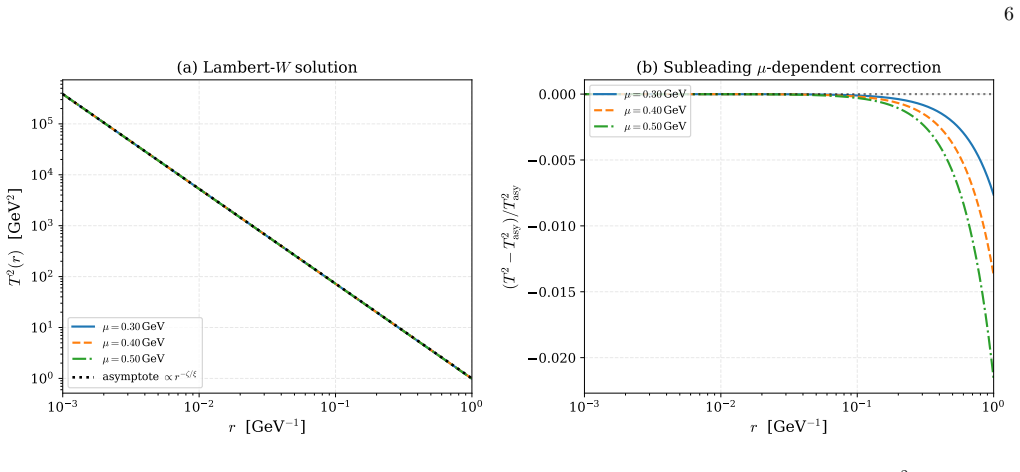
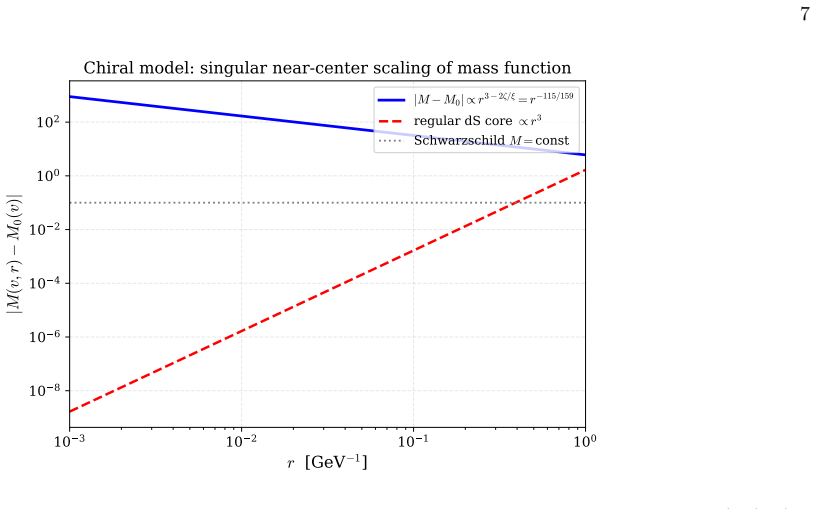
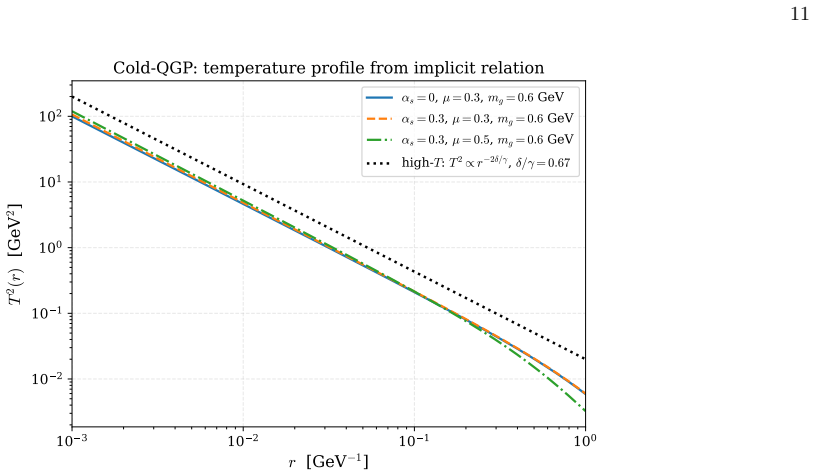
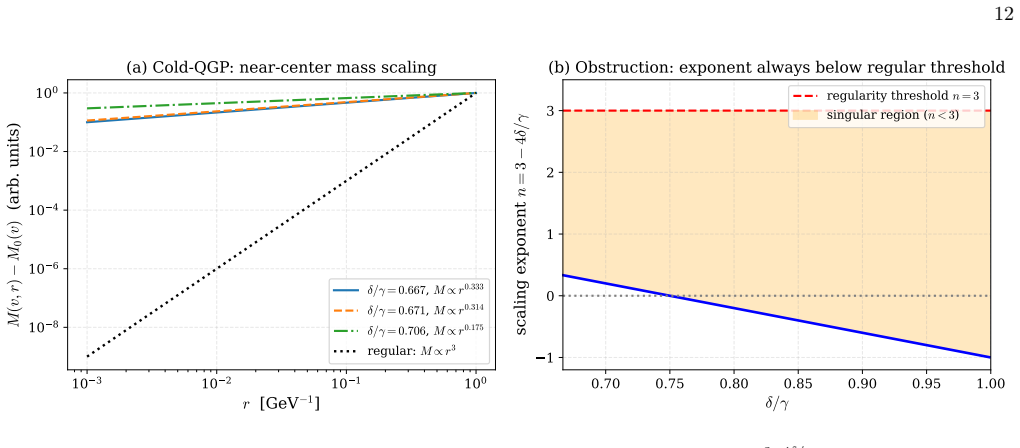
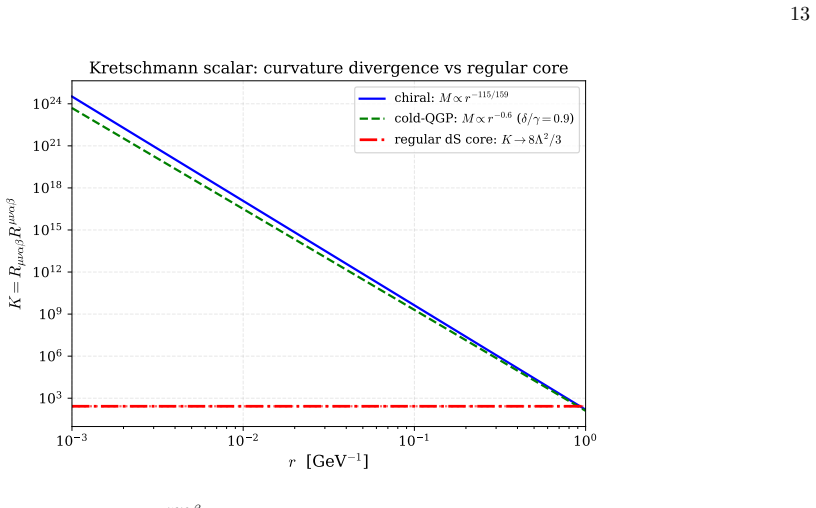
Motivated by prior work, the study couples two effective equations of state for QCD matter at finite temperature and chemical potential to the geometry of collapsing matter. Rather than assuming a regular mass profile, the radial temperature dependence is determined from the local conservation law and the mass function is reconstructed from the Einstein equations. In the three-flavor chiral quark model an exact Lambert-function solution exists but the physical coefficients select a singular near-center branch. In the cold-QGP mean-field model the temperature diverges near the center, making the source terms incompatible with a regular center. Thus finite quark chemical potential reshapes the
What carries the argument
The reconstruction of the mass function from the Einstein equations after determining the temperature profile via the local conservation law for the effective anisotropic fluid sourced by the QCD equations of state.
If this is right
- In the chiral model the exact solution for temperature selects the singular branch.
- In the cold-QGP model temperature divergence leads to incompatibility with the regular center condition.
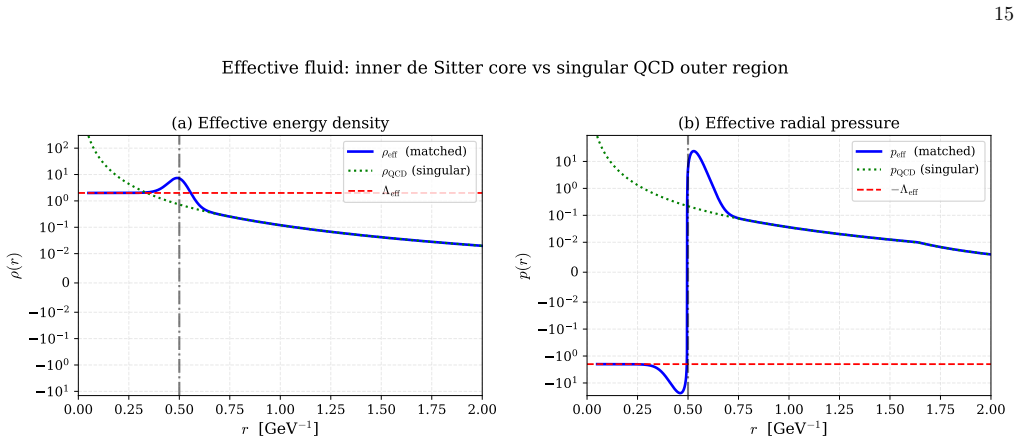
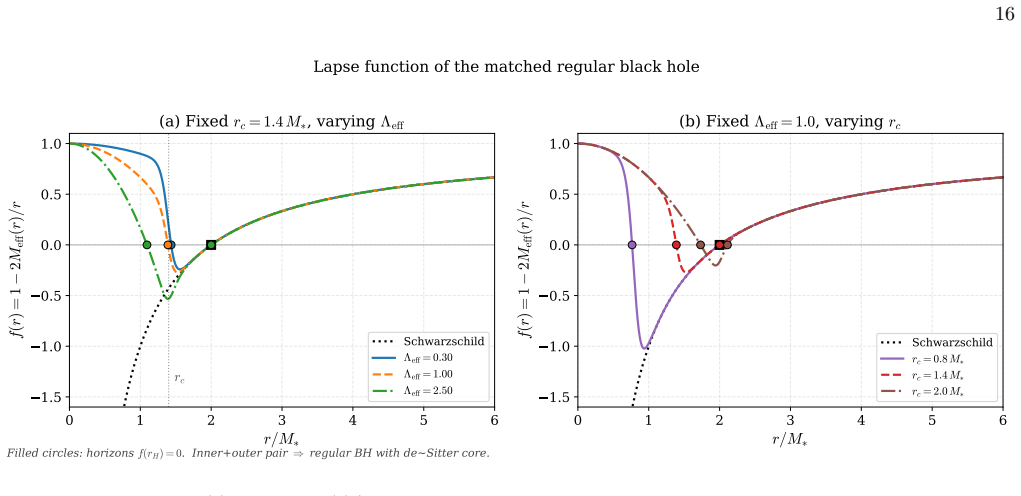
- Any regular black hole completion requires an additional inner vacuum-like phase.
- Further microphysics beyond the two models is necessary for self-regularization.
Where Pith is reading between the lines
- Extending the models to include explicit phase transitions to a vacuum energy dominated region could produce regular solutions.
- Applying the same reconstruction method to other high-density equations of state might reveal conditions under which regularity emerges.
- The result suggests that regular black holes in collapse scenarios may require physics outside standard QCD thermodynamics at finite density.
Load-bearing premise
The two chosen effective equations of state accurately capture the thermodynamics at finite chemical potential during gravitational collapse.
What would settle it
A derivation using a different equation of state that incorporates an inner vacuum phase and yields a finite central mass function with regular geometry would show the conclusion does not hold for all possible microphysics.
Figures
read the original abstract
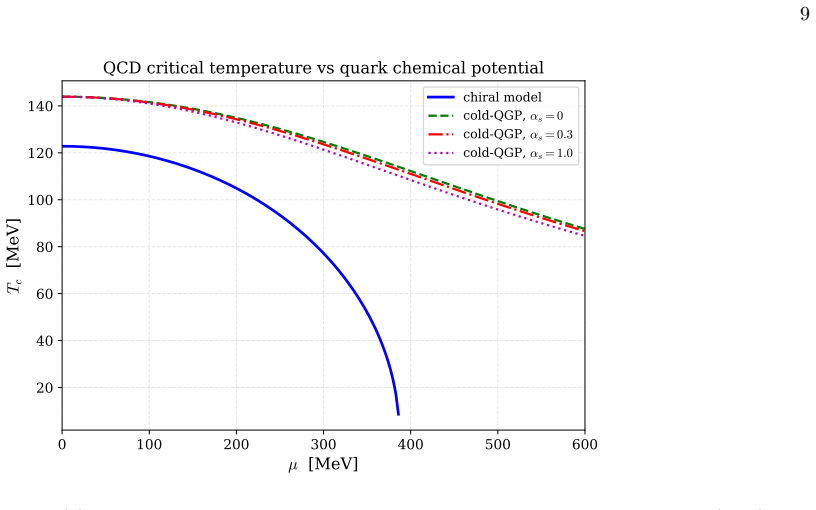
Motivated by Refs.[1, 2], we investigate whether quantum chromodynamics (QCD)-inspired matter at finite quark chemical potential can dynamically support \emph{regular} black-hole interiors during gravitational collapse. To this end, we couple two effective equations of state, namely a three-flavor chiral quark model at finite temperature and chemical potential and a cold-QGP mean-field model with a dynamical gluon mass, to a spherically symmetric advanced Eddington--Finkelstein geometry. The matter source is treated as an effective anisotropic fluid. Rather than assuming a regular mass profile a priori, we determine the radial temperature dependence from the local conservation law and reconstruct the mass function from the Einstein equations. In the chiral model, the conservation equation admits an exact Lambert-function solution, but the physical coefficients select a singular near-center branch. In the cold-QGP model, the exact implicit temperature-radius relation drives the temperature to diverge near the center, causing the thermodynamic source terms and the reconstructed mass function to become incompatible with the regular-center condition. We therefore find that, within the effective framework adopted here, finite quark chemical potential reshapes the thermodynamics of the collapse phase but does not by itself provide a self-regularizing black-hole core. Any regular completion must invoke an additional inner vacuum-like phase or further microphysics beyond the two QCD-inspired equations of state considered in this work.
Editorial analysis
A structured set of objections, weighed in public.
Referee Report
Summary. The paper investigates whether two QCD-inspired equations of state at finite quark chemical potential (a three-flavor chiral quark model and a cold-QGP mean-field model with dynamical gluon mass) can dynamically support regular black-hole interiors. Treating the source as an anisotropic fluid in advanced Eddington-Finkelstein coordinates, the authors solve the local conservation law for the radial temperature profile T(r) (exact Lambert-W branch in the chiral case; implicit relation in the cold-QGP case), substitute into the EOS to obtain the stress-energy, and reconstruct the mass function m(r) via the Einstein equations. Both models yield singular central behavior, leading to the conclusion that finite chemical potential reshapes collapse thermodynamics but does not by itself produce a self-regularizing core; an additional inner vacuum-like phase or further microphysics is required.
Significance. If the derivations hold, the work supplies a concrete negative result within standard effective QCD frameworks, showing that finite mu alone is insufficient for regularity and thereby sharpening the requirements for matter-supported regular black holes. The explicit analytic temperature solutions and direct Einstein reconstruction (without a priori regular m(r) assumptions) constitute a methodological strength and a falsifiable diagnostic that can be checked against other EOS choices.
minor comments (3)
- The regularity diagnostic (finite m(0) with m'(0)=0) is standard, but a brief explicit statement of the coordinate system and the precise Einstein-equation component used for m(r) reconstruction would aid readers unfamiliar with advanced Eddington-Finkelstein coordinates.
- The abstract states that 'physical coefficients select a singular near-center branch' for the Lambert-W solution; the main text should tabulate the numerical values of those coefficients and the branch-selection criterion for reproducibility.
- A short comparison table listing the key thermodynamic quantities (energy density, pressure components, temperature behavior) at small r for both models would make the contrast between the two singular outcomes more immediate.
Simulated Author's Rebuttal
We thank the referee for the supportive summary of our work and the recommendation of minor revision. The referee's description accurately captures the methodology and the negative result that finite chemical potential alone does not yield regular cores in the two QCD-inspired models considered.
Circularity Check
No significant circularity
full rationale
The paper derives its central negative result by solving the standard local conservation equation for T(r) (yielding an exact Lambert-W branch in the chiral model and an implicit relation in the cold-QGP model) and then substituting the resulting stress-energy into the Einstein equations to reconstruct m(r) in advanced Eddington-Finkelstein coordinates. Both routes produce singular central behavior under the supplied effective equations of state, with the regularity diagnostic (finite m(0) and m'(0)=0) following directly from the definitions. No parameter is fitted and then relabeled as a prediction, no self-citation supplies a load-bearing uniqueness theorem or ansatz, and the derivation does not reduce to its inputs by construction. The treatment remains self-contained against the external Einstein and conservation equations.
Axiom & Free-Parameter Ledger
axioms (2)
- domain assumption Spherically symmetric advanced Eddington-Finkelstein geometry
- domain assumption Matter source treated as effective anisotropic fluid
Reference graph
Works this paper leans on
-
[1]
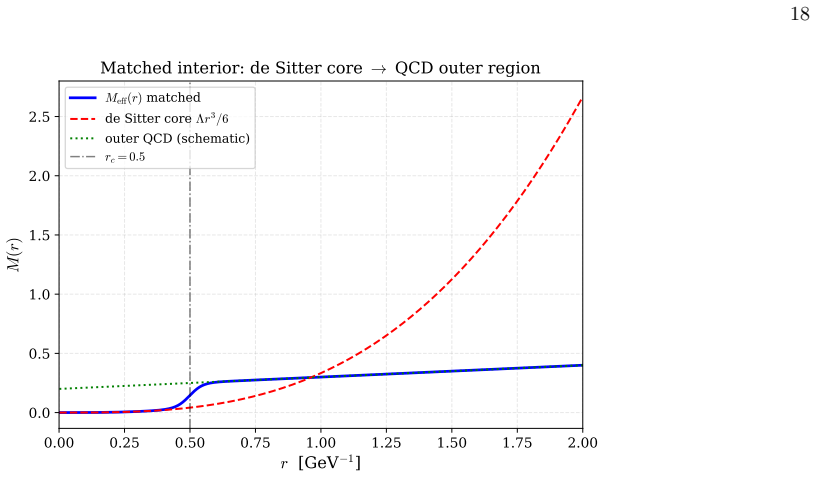
regularity at the center, Eq. (VII.4); 18 0.00 0.25 0.50 0.75 1.00 1.25 1.50 1.75 2.00 r [GeV−1] 0.0 0.5 1.0 1.5 2.0 2.5M(r) Matched interior: de Sitter core → QCD outer region Meff(r) matched de Sitter core Λr3/6 outer QCD (schematic) rc = 0.5 FIG. 9. Explicit construction of the matched mass function Meff(r) using the smooth interpolator with transition...
-
[2]
positivity of the total energy density in the transition region,ρ eff ≥0
-
[3]
The effective completion necessarily modifies the energy conditions in the interior
existence of at least one apparent horizon, determined by 1− 2Meff(v, r) r = 0.(VII.19) These conditions can be used to delimit the region of parameter space in which the geometry describes a regular black hole rather than a horizonless compact object. The effective completion necessarily modifies the energy conditions in the interior. In the core region ...
-
[4]
S. Capozziello, M. Khodadi, and G. Lambiase, Phys. Lett. B789, 626 (2019), arXiv:1808.06188 [gr-qc]
work page internal anchor Pith review Pith/arXiv arXiv 2019
-
[5]
V. Vertogradov and A. ¨Ovg¨ un, JCAP06, 051 (2025), arXiv:2504.07561 [gr-qc]
-
[6]
B. P. Abbottet al.(LIGO Scientific, Virgo), Phys. Rev. Lett.116, 061102 (2016), arXiv:1602.03837 [gr-qc]
work page internal anchor Pith review Pith/arXiv arXiv 2016
-
[7]
Viewing the Shadow of the Black Hole at the Galactic Center
H. Falcke, F. Melia, and E. Agol, Astrophys. J. Lett.528, L13 (2000), arXiv:astro-ph/9912263
work page internal anchor Pith review Pith/arXiv arXiv 2000
-
[8]
First M87 Event Horizon Telescope Results. I. The Shadow of the Supermassive Black Hole
K. Akiyamaet al.(Event Horizon Telescope), Astrophys. J. Lett.875, L1 (2019), arXiv:1906.11238 [astro-ph.GA]
work page internal anchor Pith review Pith/arXiv arXiv 2019
-
[9]
K. Akiyamaet al.(Event Horizon Telescope), Astrophys. J. Lett.930, L12 (2022), arXiv:2311.08680 [astro-ph.HE]
work page internal anchor Pith review Pith/arXiv arXiv 2022
- [10]
-
[11]
S. Vagnozzi and L. Visinelli, Phys. Rev. D100, 024020 (2019), arXiv:1905.12421 [gr-qc]. 20
-
[12]
A. Allahyari, M. Khodadi, S. Vagnozzi, and D. F. Mota, JCAP02, 003 (2020), arXiv:1912.08231 [gr-qc]
-
[13]
A. F. Zakharov, Eur. Phys. J. C78, 689 (2018), arXiv:1804.10374 [gr-qc]
work page internal anchor Pith review Pith/arXiv arXiv 2018
-
[14]
A. F. Zakharov, P. Jovanovi´ c, D. Borka, and V. Borka Jovanovi´ c, JCAP04, 050 (2018), arXiv:1801.04679 [gr-qc]
work page internal anchor Pith review Pith/arXiv arXiv 2018
- [15]
-
[16]
S. Vagnozziet al., Class. Quant. Grav.40, 165007 (2023), arXiv:2205.07787 [gr-qc]
work page internal anchor Pith review Pith/arXiv arXiv 2023
-
[17]
X.-M. Kuang, Z.-Y. Tang, B. Wang, and A. Wang, Phys. Rev. D106, 064012 (2022), arXiv:2206.05878 [gr-qc]
-
[18]
X.-M. Kuang and A. ¨Ovg¨ un, Annals Phys.447, 169147 (2022), arXiv:2205.11003 [gr-qc]
- [19]
-
[20]
Families of regular spacetimes and energy conditions
Z.-L. Wang and E. Battista, (2026), arXiv:2605.03428 [gr-qc]
work page internal anchor Pith review Pith/arXiv arXiv 2026
-
[21]
Energy conditions in static, spherically symmetric spacetimes and effective geometries
Z.-L. Wang and E. Battista, (2026), arXiv:2604.16545 [gr-qc]
work page internal anchor Pith review Pith/arXiv arXiv 2026
-
[22]
E. Battista, S. Capozziello, and S. Pastore, Eur. Phys. J. C86, 298 (2026), arXiv:2603.00596 [gr-qc]
-
[23]
Shadow signatures and energy accumulation in Lorentzian-Euclidean black holes
E. Battista, S. Capozziello, and C.-Y. Chen, (2026), 10.1103/zf2w-7fqn, arXiv:2601.10806 [gr-qc]
work page internal anchor Pith review Pith/arXiv arXiv doi:10.1103/zf2w-7fqn 2026
-
[24]
S. Capozziello, E. Battista, and S. De Bianchi, Phys. Rev. D112, 044009 (2025), arXiv:2507.08431 [gr-qc]
-
[25]
S. De Bianchi, S. Capozziello, and E. Battista, Found. Phys.55, 36 (2025), arXiv:2504.17570 [gr-qc]
-
[26]
Z.-L. Wang and E. Battista, Eur. Phys. J. C85, 304 (2025), arXiv:2501.14516 [gr-qc]
-
[27]
E. Battista, S. Capozziello, and A. Errehymy, Eur. Phys. J. C84, 1314 (2024), arXiv:2409.09750 [gr-qc]
-
[28]
S. Capozziello, S. De Bianchi, and E. Battista, Phys. Rev. D109, 104060 (2024), arXiv:2404.17267 [gr-qc]
-
[29]
V. De Falco, E. Battista, D. Usseglio, and S. Capozziello, Eur. Phys. J. C84, 137 (2024), arXiv:2401.13374 [gr-qc]
-
[30]
E. Battista, Phys. Rev. D109, 026004 (2024), arXiv:2312.00450 [gr-qc]
- [31]
-
[32]
Boundary-only weak deflection angles from isothermal optical geometry
A. ¨Ovg¨ un and R. C. Pantig, Class. Quant. Grav.43, 085011 (2026), arXiv:2601.06864 [gr-qc]
work page internal anchor Pith review Pith/arXiv arXiv 2026
-
[33]
R. C. Pantig and A. ¨Ovg¨ un, Phys. Rev. D113, 104037 (2026), arXiv:2604.16807 [gr-qc]
work page internal anchor Pith review Pith/arXiv arXiv 2026
-
[34]
Influence of a plasma on the shadow of a spherically symmetric black hole
V. Perlick, O. Y. Tsupko, and G. S. Bisnovatyi-Kogan, Phys. Rev. D92, 104031 (2015), arXiv:1507.04217 [gr-qc]
work page internal anchor Pith review Pith/arXiv arXiv 2015
-
[35]
The geometry of photon surfaces
C.-M. Claudel, K. S. Virbhadra, and G. F. R. Ellis, J. Math. Phys.42, 818 (2001), arXiv:gr-qc/0005050
work page internal anchor Pith review Pith/arXiv arXiv 2001
-
[36]
K. S. Virbhadra and G. F. R. Ellis, Phys. Rev. D62, 084003 (2000), arXiv:astro-ph/9904193
work page internal anchor Pith review Pith/arXiv arXiv 2000
-
[37]
K. S. Virbhadra and C. R. Keeton, Phys. Rev. D77, 124014 (2008), arXiv:0710.2333 [gr-qc]
work page internal anchor Pith review Pith/arXiv arXiv 2008
- [38]
- [39]
- [40]
-
[41]
M. Zhang and M. Guo, Eur. Phys. J. C80, 790 (2020), arXiv:1909.07033 [gr-qc]
- [42]
-
[43]
V. Vertogradov and A. ¨Ovg¨ un, Phys. Lett. B854, 138758 (2024), arXiv:2404.18536 [gr-qc]
-
[44]
V. Vertogradov and A. ¨Ovg¨ un, Phys. Dark Univ.45, 101541 (2024), arXiv:2404.04046 [gr-qc]
-
[45]
R. Shaikh and P. S. Joshi, JCAP10, 064 (2019), arXiv:1909.10322 [gr-qc]
- [46]
-
[47]
Y. Meng, X.-M. Kuang, and Z.-Y. Tang, Phys. Rev. D106, 064006 (2022), arXiv:2204.00897 [gr-qc]
- [48]
-
[49]
J. R. Oppenheimer and H. Snyder, Phys. Rev.56, 455 (1939)
1939
-
[50]
Datt, Zeitschrift fur Physik108, 314 (1938)
B. Datt, Zeitschrift fur Physik108, 314 (1938)
1938
-
[51]
Penrose, Phys
R. Penrose, Phys. Rev. Lett.14, 57 (1965)
1965
-
[52]
S. W. Hawking and R. Penrose, Proc. Roy. Soc. Lond. A314, 529 (1970)
1970
-
[53]
Penrose, Riv
R. Penrose, Riv. Nuovo Cim.1, 252 (1969)
1969
-
[54]
Bardeen, inProceedings of the 5th International Conference on Gravitation and the Theory of Relativity(1968) p
J. Bardeen, inProceedings of the 5th International Conference on Gravitation and the Theory of Relativity(1968) p. 87
1968
-
[55]
Dymnikova, Gen
I. Dymnikova, Gen. Rel. Grav.24, 235 (1992)
1992
-
[56]
S. Ansoldi, inConference on Black Holes and Naked Singularities(2008) arXiv:0802.0330 [gr-qc]
work page internal anchor Pith review Pith/arXiv arXiv 2008
- [57]
-
[58]
Bambi, ed.,Regular Black Holes
C. Bambi, ed.,Regular Black Holes. Towards a New Paradigm of Gravitational Collapse, Springer Series in Astrophysics and Cosmology (Springer, 2023) arXiv:2307.13249 [gr-qc]
-
[59]
A. D. Sakharov, Soviet Journal of Experimental and Theoretical Physics22, 241 (1966)
1966
-
[60]
E. B. Gliner, Soviet Journal of Experimental and Theoretical Physics22, 378 (1966)
1966
-
[61]
Regular Black Hole in General Relativity Coupled to Nonlinear Electrodynamics
E. Ayon-Beato and A. Garcia, Phys. Rev. Lett.80, 5056 (1998), arXiv:gr-qc/9911046
work page internal anchor Pith review Pith/arXiv arXiv 1998
-
[62]
Non-Singular Charged Black Hole Solution for Non-Linear Source
E. Ayon-Beato and A. Garcia, Gen. Rel. Grav.31, 629 (1999), arXiv:gr-qc/9911084
work page internal anchor Pith review Pith/arXiv arXiv 1999
-
[63]
New Regular Black Hole Solution from Nonlinear Electrodynamics
E. Ayon-Beato and A. Garcia, Phys. Lett. B464, 25 (1999), arXiv:hep-th/9911174
work page internal anchor Pith review Pith/arXiv arXiv 1999
-
[64]
K. A. Bronnikov, Phys. Rev. D63, 044005 (2001), arXiv:gr-qc/0006014
work page internal anchor Pith review Pith/arXiv arXiv 2001
-
[65]
K. A. Bronnikov, V. N. Melnikov, and H. Dehnen, Gen. Rel. Grav.39, 973 (2007), arXiv:gr-qc/0611022
work page internal anchor Pith review Pith/arXiv arXiv 2007
- [66]
-
[67]
Construction of Regular Black Holes in General Relativity
Z.-Y. Fan and X. Wang, Phys. Rev. D94, 124027 (2016), arXiv:1610.02636 [gr-qc]
work page internal anchor Pith review Pith/arXiv arXiv 2016
-
[68]
Critical phenomena of regular black holes in anti-de Sitter space-time
Z.-Y. Fan, Eur. Phys. J. C77, 266 (2017), arXiv:1609.04489 [hep-th]
work page internal anchor Pith review Pith/arXiv arXiv 2017
- [69]
-
[70]
The Bardeen Model as a Nonlinear Magnetic Monopole
E. Ayon-Beato and A. Garcia, Phys. Lett. B493, 149 (2000), arXiv:gr-qc/0009077
work page internal anchor Pith review Pith/arXiv arXiv 2000
-
[71]
I. Dymnikova and M. Khlopov, Int. J. Mod. Phys. D24, 1545002 (2015), arXiv:1510.01351 [gr-qc]
work page internal anchor Pith review Pith/arXiv arXiv 2015
-
[72]
D. V. Singh, S. G. Ghosh, and S. D. Maharaj, Nucl. Phys. B981, 115854 (2022). 21
2022
- [73]
- [74]
-
[75]
Noncommutative geometry inspired Schwarzschild black hole
P. Nicolini, A. Smailagic, and E. Spallucci, Phys. Lett. B632, 547 (2006), arXiv:gr-qc/0510112
work page internal anchor Pith review Pith/arXiv arXiv 2006
-
[76]
H. Culetu, Int. J. Mod. Phys. D31, 2250124 (2022), arXiv:2202.03426 [gr-qc]
-
[77]
S. A. Hayward, Phys. Rev. Lett.96, 031103 (2006), arXiv:gr-qc/0506126
work page internal anchor Pith review Pith/arXiv arXiv 2006
-
[78]
Gravitational Collapse with a Cosmological Constant
D. Markovic and S. Shapiro, Phys. Rev. D61, 084029 (2000), arXiv:gr-qc/9912066
work page internal anchor Pith review Pith/arXiv arXiv 2000
-
[79]
A model for non-singular black hole collapse and evaporation
S. Hossenfelder, L. Modesto, and I. Premont-Schwarz, Phys. Rev. D81, 044036 (2010), arXiv:0912.1823 [gr-qc]
work page internal anchor Pith review Pith/arXiv arXiv 2010
-
[80]
Semiclassical collapse of a sphere of dust
R. Casadio and G. Venturi, Class. Quant. Grav.13, 2715 (1996), arXiv:gr-qc/9512032
work page internal anchor Pith review Pith/arXiv arXiv 1996
discussion (0)
Sign in with ORCID, Apple, or X to comment. Anyone can read and Pith papers without signing in.