REVIEW 2 major objections 7 minor 22 references
Reviewed by Pith at T0; open to challenge.
T0 means a machine referee read the full paper against a public rubric. The mark states how deep the mechanical check went, never who wrote it. the ladder, T0–T4 →
T0 review · glm-5.2
When the instruction names the answer, world models copy, not perceive
2026-07-09 22:47 UTC pith:ZTRQBSB3
load-bearing objection Solid diagnostic finding with a clean fix; the independence sub-claim is the weak link the 2 major comments →
Grounding Spatial Relations in a Compact World Model: Instruction Leakage and a Goal-Free Dynamics Fix
The pith
A machine-rendered reading of the paper's core claim, the machinery that carries it, and where it could break.
Core claim
The paper identifies and characterizes instruction leakage in goal-conditioned world models: when a language instruction directly names the spatial relation being evaluated, a goal-conditioned predictor achieves high relation-readout accuracy not by perceiving the scene but by transcribing the instruction into its predicted coordinates. Withholding the goal collapses accuracy from 0.90 to 0.27 (chance), and feeding a counterfactual instruction makes the model follow the false goal 94.5% of the time. The leakage is governed by transcribability — whether the instruction names the scored quantity — and does not depend on the predictive strength of the action or state inputs. Removing the goal 从
What carries the argument
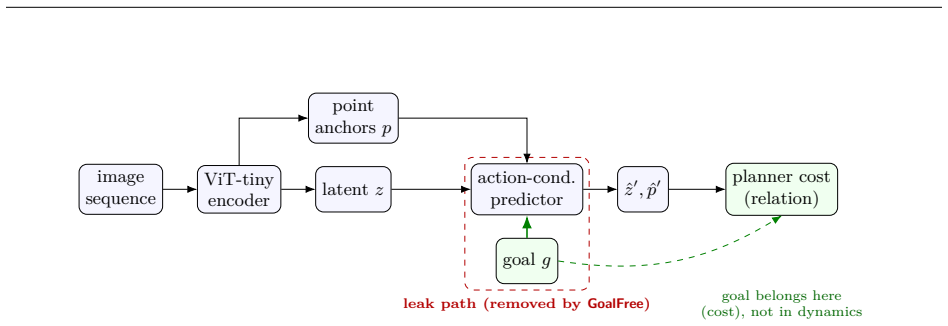
The central mechanism is instruction leakage: a goal-conditioned dynamics predictor copies the relation named in the language instruction into its predicted anchor coordinates, bypassing scene perception entirely. The detection instrument is a pair of controls — goal-withheld (zero the goal tokens, recompute the readout) and counterfactual-goal (feed a goal naming a different relation, measure whether anchors follow the false instruction or the true scene). The fix is goal-free dynamics: the predictor never sees the goal, which enters only through the planner's cost function, combined with supervised supervision of the read (perception) path.
Load-bearing premise
The claim that leakage is independent of non-instruction input strength rests primarily on a dose-response experiment in the authors' own synthetic tabletop environment, where per-step motion is large enough for the probe to be reliable. External benchmarks like Language-Table have roughly ten times smaller motion, making their probes low-signal, so the generalization from one synthetic environment to any goal-conditioned world model depends on that environment being structur
What would settle it
Feed a goal-conditioned world model a counterfactual instruction (one naming a relation different from the true scene) and measure whether the predicted anchors follow the false instruction or the true scene. If the model perceives rather than transcribes, the anchors should follow the true scene. If it transcribes, they follow the false instruction.
Editorial analysis
A structured set of objections, weighed in public.
Referee Report
Summary. This paper identifies and characterizes a failure mode in goal-conditioned world models: when a language instruction directly names the scored relation (e.g., 'put X left of Y'), the dynamics predictor can transcribe the instruction into predicted anchors rather than perceiving the scene. The authors demonstrate this 'instruction leakage' on a controlled 2D tabletop, the external BabyAI benchmark, and Language-Table, using two clean controls: goal-withholding (collapsing readout accuracy from 0.90 to 0.27) and counterfactual goal substitution (94.5% false-instruction following). They further show that Language-Table, whose instructions name referents but not the scored direction, does not leak until the instruction is augmented to name the direction. The proposed fix—removing the goal from the dynamics and supervising the read path—recovers instruction-independent grounding (0.88, identical with and without the goal). The paper is methodologically careful, with validated positive controls, multi-seed replication for headline claims, and honest reporting of boundaries (the fix ties rather than beats the no-goal baseline on control; grounding collapses at maximal ambiguity).
Significance. The paper makes a valuable methodological contribution: it provides a falsifiable characterization of when instruction leakage occurs (transcribability), a validated detection protocol (goal-withheld and counterfactual probes with an engineered-leaky positive control at 0.97), and a simple architectural remedy. The cross-environment validation (tabletop, BabyAI, Language-Table) and the dose-response ablation (Table 3) are commendable. The honesty about the control result (a tie, not a win) and the ambiguity boundary (Fig. 4) strengthens the work. The characterization that leakage is governed by transcribability and is independent of non-instruction predictor strength is the central novel claim, and the three-setting evidence for the transcribability axis is solid. The independence sub-claim (Part 2 of the central claim) is more fragile, as detailed below.
major comments (2)
- §5.4, Table 3 and the abstract's central claim: The independence claim ('leakage is essentially independent of how predictive the non-instruction inputs are') rests on the action-ablation dose-response, but the load-bearing positive evidence is the synthetic regime (cosine 0.975→0.986 as α:1→0). This is near-tautological in the full-transcription setting: when the instruction directly names the answer, a complete shortcut exists, so the model uses it regardless of action quality—this is what shortcuts do by definition. The informative test would be a partially transcribable instruction (e.g., instruction names the relation but not which objects are target/anchor, forcing the model to combine instruction and scene). In that regime, degrading the action or scene could plausibly shift reliance toward the instruction, and predictor-competition would predict increased leakage. This regime is未
- Abstract and §5.4: The claim that the protocol and remedy 'apply to any goal-conditioned world model whose instruction names the scored quantity' overreaches the evidence base. All three settings are 2D or symbolic gridworlds with discrete relations and short templated instructions. The authors acknowledge in §7(ii) that there is no 3D or real-world validation, and in §7(iii) that no released pretrained model was probed. The transcribability mechanism should generalize in principle, but the strength of the independence sub-claim and the universality of the remedy would be better supported by at least one higher-dimensional or continuous-relation setting. The authors should qualify the abstract's 'any' to match the settings tested.
minor comments (7)
- §5.2, Fig. 4: The across-ambiguity non-transfer result (a=2 model reads 0.86 at a=2 but falls to 0.26–0.33 at other ambiguities including easier a=0) is interesting but underexplored. A brief discussion of whether this is a memorization artifact or a fundamental limitation of per-ambiguity training would help the reader.
- Table 1: The 'n/a' entries for ObjToken (object latents) make it hard to compare against the anchor-based models. A brief note on why the geometric readout cannot be applied (the slot convention issue is mentioned in §7(vi) but not at the table) would clarify whether this is a limitation of the metric or the design.
- §3, 'PrismWM': The name appears without explanation of its etymology. A brief gloss would help.
- §5.3: The control result is described as 'a tie, not a win' and the authors are commended for this honesty. However, the framing that 'goal-conditioning was the thing dragging GoalDyn down' could be read as slightly circular: GoalDyn is the authors' own architecture with goal-in-dynamics, so showing it underperforms NoGoal confirms the design choice but does not independently motivate it. A sentence acknowledging that this is a consistency check on their own design, not an external validation, would be fairer.
- Fig. 2a: The y-axis label 'predicted-anchor accuracy (amb2)' could be misread as anchor localization accuracy rather than relation-readout accuracy. Clarifying that this is the geometric relation readout from predicted anchors would help.
- §5.4, Language-Table: The counterfactual cosine for the +direction regime (0.174→0.032) is acknowledged as low-signal due to ~10× smaller per-step motion (footnote 1). The footnote's reasoning that the magnitude column 'refutes' the vanishing-motion floor is somewhat terse; a one-sentence explanation of why constant magnitude rules out the floor would help the reader.
- References: Several citations are to 2026-dated arXiv preprints (Maes et al., Nam et al., Zhang et al., etc.). These should be verified for correctness and whether they have been published or updated since submission.
Circularity Check
No circularity found: the derivation chain is empirical with externally-defined probes
full rationale
The paper's central claim is an empirical characterization, not a formal derivation, so the self-definitional and fitted-input patterns do not apply. The leakage detection probes (goal-withheld and counterfactual goal substitution) are defined operationally and are external to the training objective — they are not quantities the model was optimized to produce, so observing their failure is not circular. The fix (GoalFree) removes the goal from the dynamics by construction; the paper explicitly acknowledges that goal-invariance of the readout is then trivially true ('by construction there is nothing to leak,' §5.3) and does not present this invariance as a finding. The actual finding is the 0.88 accuracy level itself — that the model can perceive the relation when forced to — which is an empirical result, not a tautology. The transcribability characterization is supported by contrasting three settings (tabletop/BabyAI leak, Language-Table referent-only does not, +direction token induces leak), which is independent evidence rather than a self-citation chain. No cited theorem or prior result by the same authors is load-bearing for the central claim. The dose-response ablation (Table 3) is a within-task experiment, not a fitted-parameter-renamed-as-prediction. The skeptic's concern that the independence claim is near-tautological in the full-transcription regime is a correctness/generalization concern (the informative partial-transcription regime is untested), not a circularity in the derivation chain.
Axiom & Free-Parameter Ledger
free parameters (4)
- Number of objects N =
4
- Ambiguity levels a =
0-4
- Action scaling alpha =
1.0, 0.5, 0.0
- JEPA latent dimension =
not stated
axioms (4)
- domain assumption The encode and read path never uses the goal (its readout is identical with and without the goal for every model).
- domain assumption Leakage-controlled readouts must run on the training render distribution.
- domain assumption The geometric readout (observed-anchor accuracy) is a fair measure of supervised anchors.
- domain assumption The counterfactual probe is a valid instrument (validated by positive control at 0.97).
invented entities (2)
-
PrismWM
independent evidence
-
Reference anchors (metric point anchors p)
independent evidence
read the original abstract
Compact world models that condition on a language goal promise to ground relations such as ``put the red block left of the blue block'' using a sparse set of explicit \emph{reference anchors}. We ask when such references actually ground a relation, and identify a trap: a goal-conditioned predictor reaches a striking $0.90$ relation-readout accuracy, yet this is \emph{instruction transcription}, not perception. Withholding the goal collapses it to chance ($0.90\!\to\!0.27$, three seeds) and a counterfactual instruction makes the predicted anchors follow the \emph{false} instruction $94.5\%$ of the time (true scene $2.3\%$; $N{=}256$). Tested across three settings and a within-task ablation, our central claim characterizes the confound: \textbf{instruction leakage occurs when the scored quantity is transcribable from the instruction (when the instruction names the answer) and is essentially independent of how predictive the non-instruction inputs are.} Our tabletop and the external BabyAI benchmark leak, whereas a Language-Table forward-dynamics world model whose instruction names \emph{referents} does not, until the instruction is augmented to name the direction; and degrading the action never increases leakage, the opposite of what predictor-competition predicts. The diagnosis prescribes the fix: keep the goal out of the dynamics (it belongs to the planner's cost) and supervise the \emph{read} path, recovering genuine, instruction-independent grounding ($0.88$, identical with and without the goal). The detection protocol and remedy apply to any goal-conditioned world model whose instruction names the scored quantity.
Figures


Reference graph
Works this paper leans on
-
[1]
Don't Just Assume; Look and Answer: Overcoming Priors for Visual Question Answering
Aishwarya Agrawal, Dhruv Batra, Devi Parikh, and Aniruddha Kembhavi. Don’t just assume; look and answer: Overcoming priors for visual question answering, june 2018.arXiv preprint arXiv:1712.00377. Mahmoud Assran, Quentin Duval, Ishan Misra, Piotr Bojanowski, Pascal Vincent, Michael G. Rabbat, Yann LeCun, and Nicolas Ballas. Self-supervised learning from i...
work page internal anchor Pith review Pith/arXiv arXiv 2018
-
[2]
V-JEPA 2: Self-Supervised Video Models Enable Understanding, Prediction and Planning
URLhttps://api.semanticscholar.org/CorpusID:255999752. Mido Assran, Adrien Bardes, David Fan, Quentin Garrido, Russell Howes, Matthew Muckley, Ammar Rizvi, Claire Roberts, Koustuv Sinha, Artem Zholus, et al. V-jepa 2: Self-supervised video models enable understanding, prediction and planning.arXiv preprint arXiv:2506.09985,
work page internal anchor Pith review Pith/arXiv arXiv
-
[3]
Planning with Reasoning using Vision Language World Model
Delong Chen, Theo Moutakanni, Willy Chung, Yejin Bang, Ziwei Ji, Allen Bolourchi, and Pascale Fung. Planning with reasoning using vision language world model.arXiv preprint arXiv:2509.02722, 2025a. Jiaming Chen, Wentao Zhao, Ziyu Meng, Donghui Mao, Ran Song, Wei Pan, and Wei Zhang. Vision- language model predictive control for manipulation planning and tr...
work page internal anchor Pith review Pith/arXiv arXiv
-
[4]
Suchin Gururangan, Swabha Swayamdipta, Omer Levy, Roy Schwartz, Samuel R Bowman, and Noah A Smith
URLhttps://api.semanticscholar.org/CorpusID:8081284. Suchin Gururangan, Swabha Swayamdipta, Omer Levy, Roy Schwartz, Samuel R Bowman, and Noah A Smith. Annotation artifacts in natural language inference data. InProceedings of the 2018 Conference of the North American Chapter of the Association for Computational Linguistics: Human Language Tech- nologies, ...
work page 2018
-
[5]
Learning Latent Dynamics for Planning from Pixels
URLhttps://api.semanticscholar.org/CorpusID:52171619. Danijar Hafner, Timothy P. Lillicrap, Ian S. Fischer, Ruben Villegas, David R Ha, Honglak Lee, and James Davidson. Learning latent dynamics for planning from pixels.ArXiv, abs/1811.04551,
work page internal anchor Pith review Pith/arXiv arXiv
-
[6]
Dream to Control: Learning Behaviors by Latent Imagination
URLhttps: //api.semanticscholar.org/CorpusID:53280207. Danijar Hafner, Timothy Lillicrap, Jimmy Ba, and Mohammad Norouzi. Dream to control: Learning behaviors by latent imagination.arXiv preprint arXiv:1912.01603,
work page internal anchor Pith review Pith/arXiv arXiv 1912
-
[7]
Td-mpc2: Scalable, robust world models for continuous control
Nick Hansen, Hao Su, and Xiaolong Wang. Td-mpc2: Scalable, robust world models for continuous control. InInternational Conference on Learning Representations, volume 2024, pp. 47376–47405,
work page 2024
-
[8]
ParticleFormer: A 3D Point Cloud World Model for Multi-Object, Multi-Material Robotic Manipulation
SuningHuang, QianzhongChen, XiaohanZhang, JiankaiSun, andMacSchwager. Particleformer: A3dpoint cloud world model for multi-object, multi-material robotic manipulation.arXiv preprint arXiv:2506.23126, 2025a. Yuanhui Huang, Weiliang Chen, Wenzhao Zheng, Xin Tao, Pengfei Wan, Jie Zhou, and Jiwen Lu. Terra: Explorable native 3d world model with point latents....
work page internal anchor Pith review Pith/arXiv arXiv
-
[9]
Justin Johnson, Bharath Hariharan, Laurens van der Maaten, Li Fei-Fei, C
URLhttps://api.semanticscholar.org/ CorpusID:260844398. Justin Johnson, Bharath Hariharan, Laurens van der Maaten, Li Fei-Fei, C. Lawrence Zitnick, and Ross B. Girshick. Clevr: A diagnostic dataset for compositional language and elementary visual reasoning.2017 IEEE Conference on Computer Vision and Pattern Recognition (CVPR), pp. 1988–1997,
work page 2017
-
[10]
URL https://api.semanticscholar.org/CorpusID:15458100. JisooKim, JungbinCho, SanghyeokChu, AnanyaBal, JinhyungKim, GunheeLee, SihaengLee, SeungHwan Kim, BohyungHan, HyunminLee, etal. Pri4r: Learningworlddynamicsforvision-language-actionmodels with privileged 4d representation.arXiv preprint arXiv:2603.01549,
-
[11]
A path towards autonomous machine intelligence version 0.9
Yann LeCun et al. A path towards autonomous machine intelligence version 0.9. 2, 2022-06-27.Open Review, 62(1):1–62,
work page 2022
-
[12]
Object-Centric Learning with Slot Attention
Francesco Locatello, Dirk Weissenborn, Thomas Unterthiner, Aravindh Mahendran, Georg Heigold, Jakob Uszkoreit, Alexey Dosovitskiy, and Thomas Kipf. Object-centric learning with slot attention.ArXiv, abs/2006.15055,
work page internal anchor Pith review Pith/arXiv arXiv 2006
-
[13]
Yuanhuiyi Lyu, Chi Kit Wong, Chenfei Liao, Lutao Jiang, Xu Zheng, Zexin Lu, Linfeng Zhang, and Xuming Hu. Understanding-in-generation: Reinforcing generative capability of unified model via infusing under- standing into generation.arXiv preprint arXiv:2509.18639,
-
[14]
LeWorldModel: Stable End-to-End Joint-Embedding Predictive Architecture from Pixels
Lucas Maes, Quentin Le Lidec, Damien Scieur, Yann LeCun, and Randall Balestriero. Leworldmodel: Stable end-to-end joint-embedding predictive architecture from pixels.arXiv preprint arXiv:2603.19312,
work page internal anchor Pith review Pith/arXiv arXiv
-
[15]
SOLD: Slot Object-Centric Latent Dynamics Models for Relational Manipulation Learning from Pixels
Malte Mosbach, Jan Niklas Ewertz, Angel Villar-Corrales, and Sven Behnke. Sold: Slot object-centric latent dynamics models for relational manipulation learning from pixels.arXiv preprint arXiv:2410.08822,
work page internal anchor Pith review Pith/arXiv arXiv
-
[16]
Causal-JEPA: Learning World Models through Object-Level Latent Masking
12 Heejeong Nam, Quentin Le Lidec, Lucas Maes, Yann LeCun, and Randall Balestriero. Causal-jepa: Learning world models through object-level latent interventions.arXiv preprint arXiv:2602.11389,
work page internal anchor Pith review Pith/arXiv arXiv
-
[17]
The Pitfalls of Simplicity Bias in Neural Networks
Harshay Shah, Kaustav Tamuly, Aditi Raghunathan, Prateek Jain, and Praneeth Netrapalli. The pitfalls of simplicity bias in neural networks.ArXiv, abs/2006.07710,
work page internal anchor Pith review Pith/arXiv arXiv 2006
-
[18]
CLIPort: What and Where Pathways for Robotic Manipulation
URLhttps://api.semanticscholar. org/CorpusID:219687117. Mohit Shridhar, Lucas Manuelli, and Dieter Fox. Cliport: What and where pathways for robotic manipula- tion.ArXiv, abs/2109.12098,
work page internal anchor Pith review Pith/arXiv arXiv
-
[19]
URLhttps://api.semanticscholar.org/CorpusID:237396838. Jingwen Sun, Wenyao Zhang, Zekun Qi, Shaojie Ren, Zezhi Liu, Hanxin Zhu, Guangzhong Sun, Xin Jin, and Zhibo Chen. Vla-jepa: Enhancing vision-language-action model with latent world model.arXiv preprint arXiv:2602.10098,
-
[20]
Factored Latent Action World Models
Zizhao Wang, Chang Shi, Jiaheng Hu, Kevin Rohling, Roberto Martín-Martín, Amy Zhang, and Peter Stone. Factored latent action world models.arXiv preprint arXiv:2602.16229, 2026a. Zizhao Wang, Kaixin Wang, Li Zhao, Peter Stone, and Jiang Bian. Dyn-o: Building structured world mod- els with object-centric representations.Advances in Neural Information Proces...
work page internal anchor Pith review Pith/arXiv arXiv
-
[21]
ThinkJEPA: Empowering Latent World Models with Large Vision-Language Reasoning Model
Haichao Zhang, Yijiang Li, Shwai He, Tushar Nagarajan, Mingfei Chen, Jianglin Lu, Ang Li, and Yun Fu. Thinkjepa: Empowering latent world models with large vision-language reasoning model.arXiv preprint arXiv:2603.22281,
work page internal anchor Pith review Pith/arXiv arXiv
-
[22]
DINO-WM: World Models on Pre-trained Visual Features enable Zero-shot Planning
Gaoyue Zhou, Hengkai Pan, Yann LeCun, and Lerrel Pinto. Dino-wm: World models on pre-trained visual features enable zero-shot planning.arXiv preprint arXiv:2411.04983,
work page internal anchor Pith review Pith/arXiv arXiv
discussion (0)
Sign in with ORCID, Apple, or X to comment. Anyone can read and Pith papers without signing in.