REVIEW 2 major objections 3 minor 67 references
This paper derives a bulk dual for the work distribution of a two-point measurement in a holographic CFT, turning the Tasaki-Crooks fluctuation theorem into a gravitational statement that is verified in an explicit AdS3 example.
Reviewed by Pith at T0; open to challenge. T0 means a machine referee read the full paper against a public rubric. the ladder, T0–T4 →
T0 review · deepseek-v4-flash
2026-08-03 22:28 UTC pith:F2NL5MVJ
load-bearing objection A clean and useful holographic translation of the Tasaki–Crooks theorem with an explicit BTZ example; the gaps are verification details, not fatal flaws. the 2 major comments →
Work distribution and fluctuation theorem in AdS/CFT
The pith
A machine-rendered reading of the paper's core claim, the machinery that carries it, and where it could break.
Core claim
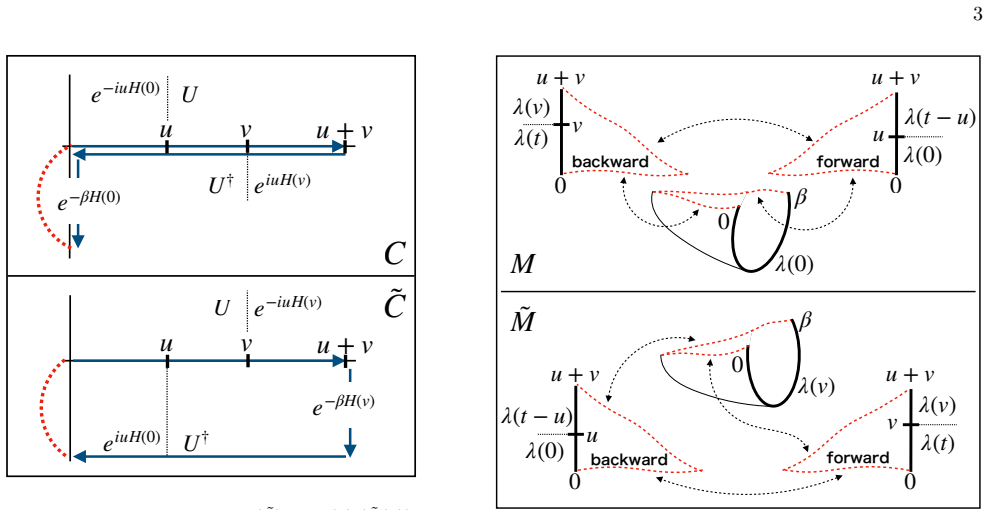
The central claim is that the characteristic function G(u) for the two-point-measurement work distribution equals e^{iS[Φ;M]}/Z(0), where M is the piecewise Lorentzian-Euclidean spacetime whose boundary follows the closed-time contour, and S is the bulk action evaluated on the classical saddle. The paper constructs M explicitly by gluing a forward Lorentzian segment, a backward Lorentzian segment, and a Euclidean segment with junction conditions that enforce 'smoothness' in the sense of the real-time gauge/gravity dictionary. In the example of a free scalar in AdS3 with a BTZ background, the solution on M is given in closed form, the action is evaluated to O(λ^2), and the resulting p(W) is c
What carries the argument
The gravitational Schwinger-Keldysh spacetime M (and its time-reversed partner M̃), which is a bulk manifold with two Lorentzian segments (forward and backward in boundary time) joined to a Euclidean segment by junction surfaces, with boundary sources specifying the CFT deformation. The 'smoothness' junction conditions on the fields—∂_tΦ_f = ∂_tΦ_b at t_f=t_b=u+v, ∂_tΦ_b = i∂_τΦ_e at t_b=0, τ=0, and ∂_tΦ_f = i∂_τΦ_e at t_f=0, τ=β—are what enforce continuity of the closed-time contour and are the mechanism that gives G(u) its β dependence. The real-time gauge/gravity dictionary supplies the rule that backward segments contribute with a minus sign and Euclidean segments with a factor of i, whi
Load-bearing premise
The load-bearing assumption is that the 'smoothness' junction conditions gluing the forward, backward, and Euclidean bulk segments faithfully represent the boundary two-point-measurement contour and that the classical saddle dominates the path integral, so that G(u) = e^{iS[Φ;M]}/Z(0) is the true boundary characteristic function.
What would settle it
Compute the boundary two-point-measurement work distribution p(W) to order λ^2 in a free scalar CFT (or via the interferometric protocol cited in the paper) and compare it with the bulk formula (21). The bulk expression predicts a specific dependence on β, the horizon radius r_+, and the thermal factor n_ω; any mismatch in these functional forms would show that the Schwinger-Keldysh spacetime M does not encode the boundary work statistics.
If this is right
- The Tasaki-Crooks relation holds in the bulk: for the explicit AdS3 model, the forward and reverse work distributions are equal, so the fluctuation theorem (11) is satisfied with ΔF=0 for the cyclic protocol.
- The mean work computed from the holographic work distribution agrees with the change in Brown-York energy of the bulk initial-value problem, so p(W) captures real-time gravitational dynamics and not just a formal boundary definition.
- All moments of the work distribution are in principle computable from bulk saddle points, offering a way to access nonequilibrium properties of strongly coupled systems without solving quantum gravity.
- The dictionary should extend straightforwardly to multi-trace deformations, operators with spin or charge, and higher orders in the source, where the theorem must continue to hold.
- The bulk formulation provides a gravitational realization of a fluctuation theorem, suggesting that the second law of black hole thermodynamics may be derived from a more detailed fluctuation relation.
Where Pith is reading between the lines
- By interpreting the junction conditions as the bulk avatars of the two projective measurements, one may reconstruct the off-shell quantum processes that 'unravel' the classical bulk trajectory; this is a natural route to a bulk TPM definition and to computing higher moments via quantum corrections to the saddle.
- The agreement between ⟨W⟩ and the Brown-York change is checked at second order in the source; a natural extension would be to compute the second moment and compare it with a bulk calculation of energy fluctuations, which would test whether the distribution captures more than the mean.
- The construction suggests a direct bulk derivation of the Jarzynski equality: since the characteristic function is an exponential of the action, the free-energy difference is encoded in the Euclidean segment, and the average of e^{-βW} should be computable from pure saddle data.
- One testable prediction is that the β-dependence of the work distribution at finite momentum k encodes the thermal occupation factors n_ω = 1/(e^{βω}-1) visible in (30); an independent boundary computation via an interferometric protocol could look for this signature.
Editorial analysis
A structured set of objections, weighed in public.
Referee Report
Summary. The paper derives a bulk (AdS/CFT) dual of the work distribution p(W) defined by the two-point measurement (TPM) protocol on the boundary, and recasts the Tasaki–Crooks (TC) fluctuation theorem in bulk language. The main technical claim is that the characteristic function G(u) of p(W) is given by a gravitational Schwinger–Keldysh path integral (Eq. 17), using the Skenderis–van Rees real-time holographic prescription. The authors then compute G(u) explicitly to O(λ²) for a free scalar field on a BTZ black hole in AdS₃/CFT₂, Fourier-transform to obtain p(W) (Eq. 21), verify the detailed-balance form of TC, and argue that ⟨W⟩ agrees with the change in Brown–York energy obtained from the bulk initial-value problem. The central derivation is a translation of a known boundary identity through an established holographic dictionary, with the example serving as a consistency check.
Significance. If the central claims hold, the paper provides a concrete holographic realization of quantum work statistics and fluctuation theorems, connecting TC to real-time bulk dynamics. The main strengths are the use of a well-established real-time dictionary, the explicit and internally consistent O(λ²) example, and the verification of normalization and TC in that example. The paper is honest about what remains speculative, in particular the off-shell quantum-gravity interpretation of the TPM. The result would be a useful step toward formulating fluctuation theorems in quantum gravity, although the present work stops short of identifying the precise bulk process that p(W) constrains.
major comments (2)
- [Section 2 (after Eq. 16)] The passage 'Strictly speaking, in quantum field theories, we have to circumvent the TPM to define p(W), and a way is proposed in [46] ... The formal expressions in this section are not modified' is too terse for a load-bearing point. The TPM characteristic function (8) is defined by projective measurements onto eigenstates of the full interacting CFT Hamiltonian, which are not well-defined in the continuum. Reference [46] defines work distributions for quantum fields, but the paper does not state whether that construction applies to a holographic CFT with single-trace deformations of the form (16), whether the initial state is the exact Gibbs state, or whether the resulting characteristic function reduces to (8). Without this justification, the bulk computation computes a boundary generating function, but calling it the TPM work distribution is not fully supported. Please specify the as
- [Section 'An example: scalar field' and End Matter] The claim that ⟨W⟩ computed from p(W) agrees with the Brown–York energy change obtained from the bulk initial-value problem is asserted rather than demonstrated: 'We find that the values agree; because a spatially homogeneous source entails a trivial volume divergence, we compare energy densities.' This agreement is offered as evidence that p(W) actually encodes bulk real-time dynamics, which is central to the paper's interpretive claim. The calculation should be shown, or at least a precise equation-by-equation mapping to Eq. (4.15) of [38] should be provided. As written, the reader cannot verify the identification.
minor comments (3)
- [Eq. (21)] The probability density p(W) is expressed in terms of q, which is itself defined as the integral of p(W) over W≠0. This is a self-consistent normalization condition, but it is not an explicit closed form. It would be clearer to write q = ∫_{W≠0} dW [second term of (21)] or state that q is fixed by normalization to O(λ²).
- [Eq. (24)] The integrand is said to be positive, reflecting (15). Positivity relies on the evenness of |λ_{ω,k} Γ(γ_{ω,k})Γ(γ_{ω,-k})|² under (ω,k)→(−ω,−k). This follows if λ is real and the boundary is noncompact; please state this explicitly.
- [End Matter, junction conditions] The junction conditions are stated as ∂_tΦ_f = ∂_tΦ_b at t_f = t_b = u+v, etc. It would help to specify which sign convention is used for the Lorentzian action on the backward segment, since the stationarity condition iS_f − iS_b − S_e is only quoted. A one-line derivation or a precise reference to equations in [39,40] would improve reproducibility.
Circularity Check
No circular derivation: the bulk work distribution is a standard real-time AdS/CFT translation, TC is verified by explicit calculation, and the [38] agreement is a non-load-bearing consistency check.
full rationale
The derivation chain is: (i) define the boundary characteristic function G(u) in Eq. (8) via the TPM; (ii) translate it to a bulk Schwinger-Keldysh on-shell action using the Skenderis-van Rees real-time dictionary [39,40], giving Eq. (17); (iii) compute p(W) from G(u) in the free-scalar BTZ example, Eq. (21) from Eq. (30); (iv) verify TC by computation. No step reduces to its own input by construction. Eq. (17) is an application of the established real-time gauge/gravity duality, not an ansatz chosen to reproduce TC. The normalization of Eq. (17) is fixed by the boundary condition G=1 for constant source, which follows from the boundary definition (8) and is not a fitted prediction. The example is a genuine calculation: the junction conditions are imported from [39,40] and the resulting on-shell action is nontrivial. The Tasaki–Crooks check p~(W)=p(W) with Z(0)=Z(v) is verified against the explicit form of p(W), not assumed. The agreement of ⟨W⟩ with Eq. (4.15) of [38] is a consistency check supporting the gravitational-dynamics interpretation; although [38] shares an author, the current paper does not rely on that citation to derive its central result. If the comparison were absent, the bulk TC and p(W) computation would still stand. The only caveats are non-circular: the QFT TPM definition is deferred to [46] with 'the formal expressions are not modified', and the [38] agreement is asserted rather than shown line-by-line. These are conditions for full acceptance, not demonstrations of circularity. No fitted parameters are called predictions, and no uniqueness theorem or load-bearing self-citation chain is invoked.
Axiom & Free-Parameter Ledger
axioms (6)
- domain assumption AdS/CFT dictionary: bulk path integrals on a spacetime M with boundary sources equal boundary CFT correlation functions, including real-time (Schwinger-Keldysh) contours.
- domain assumption Large-N saddle-point approximation: the bulk SK path integral is dominated by the classical solution Φ with given boundary conditions.
- domain assumption Skenderis-van Rees gluing ('smoothness') conditions across forward/backward/Euclidean segments, including Eq. (29) relying on the ingoing-mode causality of f_{ω,k}.
- domain assumption Time-reversal invariance of the CFT: Θ (with P and/or C if needed) leaves I_CFT invariant, so the reverse process is dual to the time-reversed bulk contour.
- domain assumption TPM work distribution has a legitimate QFT definition that reduces to the formal TPM expressions [46].
- domain assumption BTZ is the dominant Euclidean saddle of the thermal state Z(0).
invented entities (1)
-
Off-shell Brown-York energy (speculative notion of what p(W) measures in quantum gravity)
no independent evidence
read the original abstract
From the AdS/CFT dictionary, we derive a bulk dual of the work distribution defined by the two-point measurement on the boundary, yielding a bulk formulation of the Tasaki-Crooks fluctuation theorem. We argue that this does not merely supply a holographic prescription for the work distribution; it encodes the mean energy change and fluctuations of bulk real-time dynamics associated with the two-point measurement.
Figures
Reference graph
Works this paper leans on
-
[1]
J. M. Bardeen, B. Carter, and S. W. Hawking. The four laws of black hole mechanics.Communications in Math- ematical Physics, 31(2):161–170, 1973
1973
-
[2]
gravitational FT
coupled to a sourceλwithλ(0) =λ(v) = 0 (i.e., Z(0) =Z(v)), and we carry out the perturbative expan- sion toO(λ 2). On the bulk side, we suppose the BTZ black hole to realize the dominant saddle ofZ(0). The bulk dual ofOis a real scalar field Φ, and a free theory suffices toO(λ 2): S=− 1 2 Z d3x√−g gµν∂µΦ∂νΦ +m 2Φ2 +S ct,(19) gµνdxµdxν =−(r 2 −r 2 +)dt2 + ...
-
[3]
Robert M. Wald. Black hole entropy is the Noether charge.Phys. Rev. D, 48(8):R3427–R3431, 1993.arXiv: gr-qc/9307038,doi:10.1103/PhysRevD.48.R3427
Pith/arXiv arXiv 1993
-
[4]
S. W. Hawking and J. B. Hartle. Energy and angular momentum flow into a black hole.Communications in Mathematical Physics, 27(4):283–290, 1972
1972
-
[5]
S. W. Hawking. Black holes in general relativity.Commu- nications in Mathematical Physics, 25(2):152–166, 1972
1972
-
[6]
J. D. Bekenstein. Black holes and the second law.Lettere al Nuovo Cimento (1971-1985), 4(15):737–740, 1972
1971
-
[7]
Jacob D. Bekenstein. Generalized second law of thermo- dynamics in black-hole physics.Phys. Rev. D, 9:3292– 3300, Jun 1974. URL:https://link.aps.org/doi/ 10.1103/PhysRevD.9.3292,doi:10.1103/PhysRevD.9. 3292
-
[8]
Jacob D. Bekenstein. Black holes and entropy.Phys. Rev. D, 7:2333–2346, 1973.doi:10.1103/PhysRevD.7.2333
-
[9]
S. Carlip. Black Hole Thermodynamics.Int. J. Mod. Phys. D, 23:1430023, 2014.arXiv:1410.1486,doi:10. 1142/S0218271814300237
Pith/arXiv arXiv 2014
-
[10]
Aron C. Wall. Ten Proofs of the Generalized Second Law.JHEP, 06:021, 2009.arXiv:0901.3865,doi:10. 1088/1126-6708/2009/06/021
Pith/arXiv arXiv 2009
-
[11]
Black Hole Thermodynamics: General Relativity and Beyond.Gen
Sudipta Sarkar. Black Hole Thermodynamics: General Relativity and Beyond.Gen. Rel. Grav., 51(5):63, 2019. arXiv:1905.04466,doi:10.1007/s10714-019-2545-y
Pith/arXiv arXiv 2019
-
[12]
Aron C. Wall. A Survey of Black Hole Thermodynamics. 4 2018.arXiv:1804.10610
Pith/arXiv arXiv 2018
-
[13]
Thermodynamics of space-time: The Einstein equation of state.Phys
Ted Jacobson. Thermodynamics of space-time: The Einstein equation of state.Phys. Rev. Lett., 75:1260– 1263, 1995.arXiv:gr-qc/9504004,doi:10.1103/ PhysRevLett.75.1260
Pith/arXiv arXiv 1995
-
[14]
Microscopic ori- gin of the Bekenstein-Hawking entropy.Phys
Andrew Strominger and Cumrun Vafa. Microscopic ori- gin of the Bekenstein-Hawking entropy.Phys. Lett. B, 379:99–104, 1996.arXiv:hep-th/9601029,doi:10. 1016/0370-2693(96)00345-0
Pith/arXiv arXiv 1996
-
[15]
Gavin E. Crooks. Entropy production fluctuation the- orem and the nonequilibrium work relation for free en- ergy differences.Phys. Rev. E, 60:2721–2726, Sep 1999. URL:https://link.aps.org/doi/10.1103/PhysRevE. 60.2721,doi:10.1103/PhysRevE.60.2721
doi:10.1103/physreve 1999
-
[16]
Hamiltonian derivation of a de- tailed fluctuation theorem.Journal of Statistical Physics, 98:77–102, 2000
Christopher Jarzynski. Hamiltonian derivation of a de- tailed fluctuation theorem.Journal of Statistical Physics, 98:77–102, 2000
2000
-
[17]
Jarzynski relations for quantum systems and some applications.arXiv preprint cond-mat/0009244, 2000
Hal Tasaki. Jarzynski relations for quantum systems and some applications.arXiv preprint cond-mat/0009244, 2000
Pith/arXiv arXiv 2000
-
[18]
Jorge Kurchan. A Quantum Fluctuation Theorem. 7 2000.arXiv:cond-mat/0007360
Pith/arXiv arXiv 2000
-
[19]
Non- equilibrium fluctuations of black hole horizons and the generalized second law.Phys
Satoshi Iso, Susumu Okazawa, and Sen Zhang. Non- equilibrium fluctuations of black hole horizons and the generalized second law.Phys. Lett. B, 705:152–156, 2011. arXiv:1008.1184,doi:10.1016/j.physletb.2011.09. 114
Pith/arXiv arXiv 2011
-
[20]
verified its consistency using a scalar field on the Schwarzschild background. FTs for matter and for local systems on curved spacetimes have been widely devel- oped as well [21–25]. Independently, [26–30] used Jarzyn- ski equality for studying black hole thermodynamics. Because quantum gravity remains unknown, deriva- tions of FTs for dynamical gravity n...
Pith/arXiv arXiv 2025
-
[21]
S. Massar and R. Parentani. How the change in hori- zon area drives black hole evaporation.Nucl. Phys. B, 575:333–356, 2000.arXiv:gr-qc/9903027,doi:10. 1016/S0550-3213(00)00067-5
Pith/arXiv arXiv 2000
-
[22]
Stochastic Equations in Black Hole Backgrounds and Non-equilibrium Fluc- tuation Theorems.Nucl
Satoshi Iso and Susumu Okazawa. Stochastic Equations in Black Hole Backgrounds and Non-equilibrium Fluc- tuation Theorems.Nucl. Phys. B, 851:380–419, 2011. arXiv:1104.2461,doi:10.1016/j.nuclphysb.2011.05. 021
Pith/arXiv arXiv 2011
-
[23]
Quantum thermodynamics for a model of an expanding universe
Nana Liu, John Goold, Ivette Fuentes, Vlatko Vedral, Kavan Modi, and David Edward Bruschi. Quantum thermodynamics for a model of an expanding universe. Class. Quant. Grav., 33:035003, 2016.arXiv:1409.5283, doi:10.1088/0264-9381/33/3/035003
Pith/arXiv arXiv 2016
-
[24]
Marcos L. W. Basso, Jonas Maziero, and Lucas C. C´ eleri. The irreversibility of relativistic time-dilation.Class. Quant. Grav., 40(19):195001, 2023.arXiv:2307.12778, doi:10.1088/1361-6382/acf089
Pith/arXiv arXiv 2023
-
[25]
Marcos L. W. Basso, Jonas Maziero, and Lucas Chibebe C´ eleri. Quantum Detailed Fluctuation Theorem in Curved Spacetimes: The Observer Dependent Nature of Entropy Production.Phys. Rev. Lett., 134(5):050406, 2025.arXiv:2405.03902,doi:10.1103/PhysRevLett. 134.050406
Pith/arXiv arXiv 2025
-
[26]
General rela- tivistic fluctuation theorems.Phys
Yifan Cai, Tao Wang, and Liu Zhao. General rela- tivistic fluctuation theorems.Phys. Lett. B, 860:139220, 2025.arXiv:2407.09912,doi:10.1016/j.physletb. 2024.139220
Pith/arXiv arXiv 2025
-
[27]
Rafael L. S. Costa, Marcos L. W. Basso, Jonas Maziero, and Lucas C. C´ eleri. Work distribution of quantum fields in static curved spacetimes. 10 2025.arXiv:2510.08265
arXiv 2025
-
[28]
Behnam Pourhassan, Salman Sajad Wani, Saheb Soroushfar, and Mir Faizal. Quantum work and in- formation geometry of a quantum Myers-Perry black hole.JHEP, 10:027, 2021.arXiv:2102.03296,doi: 10.1007/JHEP10(2021)027
Pith/arXiv arXiv 2021
-
[29]
Ait- enov, and Salman Sajad Wani
Behnam Pourhassan, Houcine Aounallah, Mir Faizal, Sudhaker Upadhyay, Saheb Soroushfar, Yermek O. Ait- enov, and Salman Sajad Wani. Quantum thermodynam- ics of an M2-M5 brane system.JHEP, 05:030, 2022. arXiv:2201.11073,doi:10.1007/JHEP05(2022)030
Pith/arXiv arXiv 2022
-
[30]
Quantum thermodynamics of a quantum sized AdS black hole.Nucl
Behnam Pourhassan, Mahdi Atashi, Houcine Aounallah, 7 Salman Sajad Wani, Mir Faizal, and Barun Majumder. Quantum thermodynamics of a quantum sized AdS black hole.Nucl. Phys. B, 980:115842, 2022.arXiv:2205. 13584,doi:10.1016/j.nuclphysb.2022.115842
arXiv 2022
-
[31]
Behnam Pourhassan, Izzet Sakalli, Xiaoping Shi, Mir Faizal, and Salman Sajad Wani. Quantum Thermo- dynamics of anα ′-Corrected Reissner-Nordstr¨ om Black Hole.EPL, 144(2):29001, 2023.arXiv:2301.00687, doi:10.1209/0295-5075/acfff0
Pith/arXiv arXiv 2023
-
[32]
Thermodynamic phase description of charged 4D Gauss-Bonnet black holes in quantum regime
Syed Masood. Thermodynamic phase description of charged 4D Gauss-Bonnet black holes in quantum regime. 6 2024.arXiv:2406.05820
arXiv 2024
-
[33]
The Large N limit of super- conformal field theories and supergravity.Adv
Juan Martin Maldacena. The Large N limit of super- conformal field theories and supergravity.Adv. Theor. Math. Phys., 2:231–252, 1998.arXiv:hep-th/9711200, doi:10.1023/A:1026654312961
Pith/arXiv arXiv 1998
-
[34]
S. S. Gubser, Igor R. Klebanov, and Alexander M. Polyakov. Gauge theory correlators from noncriti- cal string theory.Phys. Lett. B, 428:105–114, 1998. arXiv:hep-th/9802109,doi:10.1016/S0370-2693(98) 00377-3
Pith/arXiv arXiv 1998
-
[35]
Anti-de Sitter space and holography
Edward Witten. Anti-de Sitter space and holography. Adv. Theor. Math. Phys., 2:253–291, 1998.arXiv: hep-th/9802150,doi:10.4310/ATMP.1998.v2.n2.a2
Pith/arXiv arXiv 1998
-
[36]
Netta Engelhardt and Aron C. Wall. Decoding the Ap- parent Horizon: Coarse-Grained Holographic Entropy. Phys. Rev. Lett., 121(21):211301, 2018.arXiv:1706. 02038,doi:10.1103/PhysRevLett.121.211301
-
[37]
Netta Engelhardt and Aron C. Wall. Coarse Graining Holographic Black Holes.JHEP, 05:160, 2019.arXiv: 1806.01281,doi:10.1007/JHEP05(2019)160
Pith/arXiv arXiv 2019
-
[38]
Venkatesa Chandrasekaran, Geoff Penington, and Ed- ward Witten. Large N algebras and generalized en- tropy.JHEP, 04:009, 2023.arXiv:2209.10454,doi: 10.1007/JHEP04(2023)009
Pith/arXiv arXiv 2023
-
[39]
Daichi Takeda. Coarse-graining black holes out of equi- librium with boundary observables on time slice.JHEP, 05:319, 2024. [Erratum: JHEP 10, 154 (2024)].arXiv: 2403.07275,doi:10.1007/JHEP05(2024)319
Pith/arXiv arXiv 2024
-
[40]
Tomohiro Shigemura, Keito Shimizu, Sotaro Sugishita, Daichi Takeda, and Takuya Yoda. Heat and work in black hole thermodynamics via holography.JHEP, 05:069, 2025.arXiv:2412.15697,doi:10.1007/JHEP05(2025) 069
Pith/arXiv arXiv 2025
-
[41]
Kostas Skenderis and Balt C. van Rees. Real-time gauge/gravity duality.Phys. Rev. Lett., 101:081601, 2008.arXiv:0805.0150,doi:10.1103/PhysRevLett. 101.081601
Pith/arXiv arXiv 2008
-
[42]
Kostas Skenderis and Balt C. van Rees. Real-time gauge/gravity duality: Prescription, Renormalization and Examples.JHEP, 05:085, 2009.arXiv:0812.2909, doi:10.1088/1126-6708/2009/05/085
Pith/arXiv arXiv 2009
-
[43]
A pre- scription for holographic Schwinger-Keldysh contour in non-equilibrium systems
Paolo Glorioso, Michael Crossley, and Hong Liu. A pre- scription for holographic Schwinger-Keldysh contour in non-equilibrium systems. 12 2018.arXiv:1812.08785
Pith/arXiv arXiv 2018
-
[44]
Fluctua- tion theorems: Work is not an observable.Physical Re- view E—Statistical, Nonlinear, and Soft Matter Physics, 75(5):050102, 2007
Peter Talkner, Eric Lutz, and Peter H¨ anggi. Fluctua- tion theorems: Work is not an observable.Physical Re- view E—Statistical, Nonlinear, and Soft Matter Physics, 75(5):050102, 2007
2007
-
[45]
The tasaki–crooks quantum fluctuation theorem.Journal of Physics A: Mathematical and Theoretical, 40(26):F569, 2007
Peter Talkner and Peter H¨ anggi. The tasaki–crooks quantum fluctuation theorem.Journal of Physics A: Mathematical and Theoretical, 40(26):F569, 2007
2007
-
[46]
Quantum work relations and response theory.Physical review letters, 100(23):230404, 2008
David Andrieux and Pierre Gaspard. Quantum work relations and response theory.Physical review letters, 100(23):230404, 2008
2008
-
[47]
Nonequilibrium equality for free energy differences.Physical Review Letters, 78(14):2690, 1997
Christopher Jarzynski. Nonequilibrium equality for free energy differences.Physical Review Letters, 78(14):2690, 1997
1997
-
[48]
Alhambra, and Eduardo Mart ´ ın-Mart ´ ınez
Alvaro Ortega, Emma McKay, ´Alvaro M. Alhambra, and Eduardo Mart ´ ın-Mart ´ ınez. Work distributions on quantum fields.Phys. Rev. Lett., 122(24):240604, 2019.arXiv:1902.03258,doi:10.1103/PhysRevLett. 122.240604
Pith/arXiv arXiv 2019
-
[49]
R. Dorner, S. R. Clark, L. Heaney, R. Fazio, J. Goold, and V. Vedral. Extracting quantum work statistics and fluctuation theorems by single- qubit interferometry.Phys. Rev. Lett., 110:230601, Jun 2013. URL:https://link.aps.org/doi/10.1103/ PhysRevLett.110.230601,doi:10.1103/PhysRevLett. 110.230601
-
[50]
Detecting the work statistics through Ramsey-like interferometry.Int
Laura Mazzola, Gabriele De Chiara, and Mauro Pa- ternostro. Detecting the work statistics through Ramsey-like interferometry.Int. J. Quant. Inf., 12(02):1461007, 2014.arXiv:1401.0566,doi:10.1142/ s0219749914610073
Pith/arXiv arXiv 2014
-
[51]
Balt C. van Rees. Real-time gauge/gravity duality and ingoing boundary conditions.Nucl. Phys. B Proc. Suppl., 192-193:193–196, 2009.arXiv:0902.4010,doi:10.1016/ j.nuclphysbps.2009.07.078
Pith/arXiv arXiv 2009
-
[52]
J. David Brown and James W. York, Jr. Quasilocal energy and conserved charges derived from the gravita- tional action.Phys. Rev. D, 47:1407–1419, 1993.arXiv: gr-qc/9209012,doi:10.1103/PhysRevD.47.1407
Pith/arXiv arXiv 1993
-
[53]
A Stress ten- sor for Anti-de Sitter gravity.Commun
Vijay Balasubramanian and Per Kraus. A Stress ten- sor for Anti-de Sitter gravity.Commun. Math. Phys., 208:413–428, 1999.arXiv:hep-th/9902121,doi:10. 1007/s002200050764
Pith/arXiv arXiv 1999
-
[54]
J. B. Hartle and S. W. Hawking. Path Integral Derivation of Black Hole Radiance.Phys. Rev. D, 13:2188–2203, 1976.doi:10.1103/PhysRevD.13.2188
-
[55]
Solodukhin, and Kostas Skenderis
Sebastian de Haro, Sergey N. Solodukhin, and Kostas Skenderis. Holographic reconstruction of space-time and renormalization in the AdS / CFT correspondence.Com- mun. Math. Phys., 217:595–622, 2001.arXiv:hep-th/ 0002230,doi:10.1007/s002200100381
-
[56]
Ofer Aharony, Micha Berkooz, and Eva Silverstein. Mul- tiple trace operators and nonlocal string theories.JHEP, 08:006, 2001.arXiv:hep-th/0105309,doi:10.1088/ 1126-6708/2001/08/006
Pith/arXiv arXiv 2001
-
[57]
Multitrace operators, boundary condi- tions, and AdS / CFT correspondence
Edward Witten. Multitrace operators, boundary condi- tions, and AdS / CFT correspondence. 12 2001.arXiv: hep-th/0112258
Pith/arXiv arXiv 2001
-
[58]
Micha Berkooz, Amit Sever, and Assaf Shomer. ’Dou- ble trace’ deformations, boundary conditions and space- time singularities.JHEP, 05:034, 2002.arXiv:hep-th/ 0112264,doi:10.1088/1126-6708/2002/05/034
-
[59]
Amit Sever and Assaf Shomer. A Note on multitrace deformations and AdS/CFT.JHEP, 07:027, 2002.arXiv:hep-th/0203168,doi:10.1088/ 1126-6708/2002/07/027
Pith/arXiv arXiv 2002
-
[60]
Ofer Aharony, Micha Berkooz, and Boaz Katz. Non- local effects of multi-trace deformations in the AdS/CFT correspondence.JHEP, 10:097, 2005.arXiv:hep-th/ 0504177,doi:10.1088/1126-6708/2005/10/097
-
[61]
Ofer Aharony, Adam B. Clark, and Andreas Karch. The CFT/AdS correspondence, massive gravitons and a con- nectivity index conjecture.Phys. Rev. D, 74:086006, 2006.arXiv:hep-th/0608089,doi:10.1103/PhysRevD. 8 74.086006
Pith/arXiv arXiv 2006
-
[62]
An introduction to stochastic thermo- dynamics.Fundamental Theories of Physics
Naoto Shiraishi. An introduction to stochastic thermo- dynamics.Fundamental Theories of Physics. Springer, Singapore, 2023
2023
-
[63]
Nonequilibrium fluctuations, fluctuation the- orems, and counting statistics in quantum systems.Re- views of modern physics, 81(4):1665–1702, 2009
Massimiliano Esposito, Upendra Harbola, and Shaul Mukamel. Nonequilibrium fluctuations, fluctuation the- orems, and counting statistics in quantum systems.Re- views of modern physics, 81(4):1665–1702, 2009
2009
-
[64]
AdS Higgs mechanism from double trace deformed CFT
Andreas Karch, Mianqi Wang, and Merna Youssef. AdS Higgs mechanism from double trace deformed CFT. JHEP, 02:044, 2024.arXiv:2311.10135,doi:10.1007/ JHEP02(2024)044
Pith/arXiv arXiv 2024
-
[65]
Hao Geng. Open AdS/CFT via a double-trace defor- mation.JHEP, 09:012, 2024.arXiv:2311.13633,doi: 10.1007/JHEP09(2024)012
Pith/arXiv arXiv 2024
-
[66]
Dissipation in Open Holography
Andreas Karch and Merna Youssef. Dissipation in Open Holography. 9 2025.arXiv:2509.14312
arXiv 2025
-
[67]
Lindblad dynamics in holography.Phys
Takanori Ishii and Daichi Takeda. Lindblad dynamics in holography.Phys. Rev. D, 112(4):046020, 2025.arXiv: 2504.17320,doi:10.1103/l2rx-t9dd
Pith/arXiv arXiv 2025
discussion (0)
Sign in with ORCID, Apple, or X to comment. Anyone can read and Pith papers without signing in.