Photon rings and shadows of black holes with non-minimal couplings between curvature and electromagnetic field
Pith reviewed 2026-05-10 08:20 UTC · model grok-4.3
The pith
Three distinct non-minimal curvature-EM couplings produce different enlargements or reductions of black hole shadows and alter photon ring separations in characteristic ways.
A machine-rendered reading of the paper's core claim, the machinery that carries it, and where it could break.
Core claim
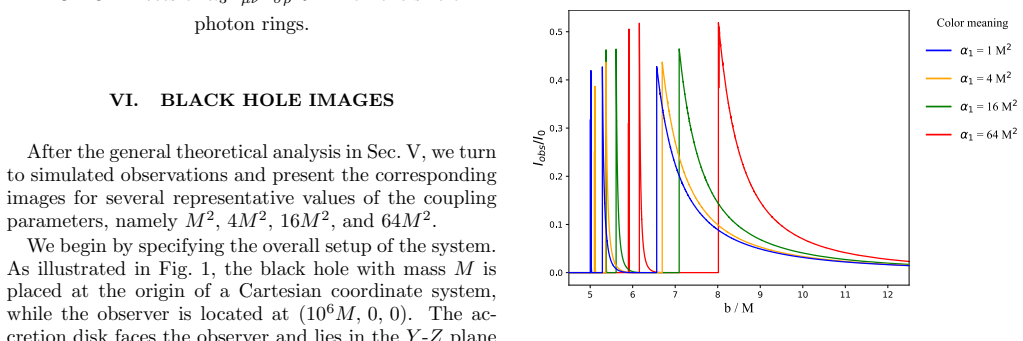
The coupling FμνFσρRμνσρ significantly enlarges the shadow and the zeroth-first ring separation but rapidly suppresses higher-order ring spacings, while F²R reduces shadow size, makes zeroth and first rings nearly coincide, and increases higher-order separations.
Load-bearing premise
The series expansion method around the Schwarzschild background remains accurate enough near the photon sphere for the chosen coupling strengths; the paper does not quantify the radius of convergence or compare with exact numerical solutions.
Figures




read the original abstract
We investigate black holes with non-minimal couplings between the electromagnetic field and spacetime curvature, focusing on their event horizons, shadows, and photon rings. Such couplings can naturally arise from both classical effective field theories of gravity and quantum effects in curved spacetime. Starting from a general action with three independent coupling terms, we derive static and spherically symmetric black hole solutions using a series expansion method. We find that all couplings enlarge the event horizon and photon sphere, while their observational consequences differ. The coupling $F^\mu_{\ \nu}F_{\mu\rho}R^{\nu\rho}$ slightly increases the shadow size and the separation between the zeroth- and first-order photon rings, leaving higher-order spacings nearly unchanged. The coupling $F_{\mu\nu}F_{\sigma\rho}R^{\mu\nu\sigma\rho}$ significantly enlarges the shadow and the zeroth-first ring separation, but rapidly suppresses the spacing between higher-order rings. In contrast, the $F^2R$ coupling reduces the shadow size and causes the zeroth- and first-order rings to nearly coincide, leading to an enhanced brightness, while increasing the separation of higher-order rings and leaving them easier to resolve observationally. We further generate black hole images via backward ray tracing and confirm these features within the observationally resolvable regime. These findings can make observational constraints on the non-minimal couplings or might provide new evidence for the modifications to gravity caused by classical or quantum effects.
Editorial analysis
A structured set of objections, weighed in public.
Referee Report
Summary. The manuscript derives static spherically symmetric black hole solutions in Einstein-Maxwell theory augmented by three non-minimal curvature-electromagnetic couplings, using a perturbative series expansion around the Schwarzschild metric. It then computes the resulting event horizons, photon spheres, shadow sizes, and photon ring separations, claiming that the couplings produce qualitatively distinct observational signatures (e.g., FμνFσρRμνσρ enlarges the shadow and zeroth-first ring gap while suppressing higher-order spacings, while F²R reduces shadow size and makes zeroth and first rings nearly coincide). These features are illustrated with backward ray-traced images.
Significance. If the perturbative metrics remain accurate near the photon sphere, the work supplies concrete, distinguishable predictions for how non-minimal couplings affect EHT-accessible observables and could help constrain effective-field-theory or quantum-gravity corrections. The explicit comparison of the three couplings and the use of ray tracing to generate images are strengths that make the claims falsifiable with current or near-future data.
major comments (1)
- [§3] §3 (series expansion of the metric): all reported changes in shadow radius and photon-ring separations are computed from metric functions obtained by substituting the ansatz into the modified field equations and solving order-by-order in the coupling constants. No radius-of-convergence estimate or direct comparison against numerically integrated exact solutions is provided for the photon-sphere region (r≈3M). If O(λ²) or non-perturbative corrections alter the effective potential for null geodesics by even a few percent, the claimed differential impacts (enlargement vs. suppression of ring spacings) would not hold.
minor comments (2)
- [Abstract] The abstract states that 'all couplings enlarge the event horizon and photon sphere' but does not specify the perturbative order retained in the metric functions; adding this information would clarify the domain of validity.
- [Figures] Figure captions for the ray-traced images do not indicate the range of impact parameters or the resolution used to resolve higher-order rings; this makes it harder to assess which features lie within the 'observationally resolvable regime' mentioned in the text.
Simulated Author's Rebuttal
We thank the referee for the thorough review and for identifying a key point about the perturbative expansion. We address the concern regarding the validity of the series solutions near the photon sphere below and outline the revisions we will make.
read point-by-point responses
-
Referee: [§3] §3 (series expansion of the metric): all reported changes in shadow radius and photon-ring separations are computed from metric functions obtained by substituting the ansatz into the modified field equations and solving order-by-order in the coupling constants. No radius-of-convergence estimate or direct comparison against numerically integrated exact solutions is provided for the photon-sphere region (r≈3M). If O(λ²) or non-perturbative corrections alter the effective potential for null geodesics by even a few percent, the claimed differential impacts (enlargement vs. suppression of ring spacings) would not hold.
Authors: We agree that an explicit discussion of the perturbative regime's validity at r ≈ 3M would strengthen the manuscript. All reported differences in shadow radii and photon-ring separations are first-order effects in the coupling constants λ. Within the effective-field-theory framework adopted in the paper, the couplings are assumed small enough that O(λ²) corrections remain negligible; the qualitative distinctions between the three couplings (e.g., enlargement versus suppression of specific ring spacings) already appear at linear order. In the revised version we will add a short paragraph in §3 that estimates the size of the next-order metric corrections at the photon sphere by inspecting the structure of the modified field equations, thereby providing a rough radius-of-convergence indicator. A full numerical integration of the exact, non-perturbative equations for each coupling is computationally demanding and lies outside the analytic scope of the present work; we therefore retain the perturbative approach while clarifying its domain of applicability. revision: partial
Circularity Check
Derivation chain is self-contained from action to observables
full rationale
The paper begins with a general action containing three independent non-minimal coupling terms, substitutes a static spherically symmetric metric ansatz, and obtains the metric functions by direct series expansion of the resulting modified field equations around the Schwarzschild background. Photon-sphere locations, shadow radii, and ring separations are then computed from these metric functions via the standard null-geodesic effective-potential condition. No parameters are fitted to data and subsequently relabeled as predictions; no uniqueness theorems or ansatze are imported via self-citation; and no step reduces by construction to its own input. The reported differences among the three couplings therefore follow from the explicit series solutions rather than from any definitional or self-referential loop.
Axiom & Free-Parameter Ledger
free parameters (1)
- three coupling constants
axioms (2)
- domain assumption The spacetime is static and spherically symmetric.
- domain assumption The non-minimal couplings arise from classical effective field theory or quantum effects.
Reference graph
Works this paper leans on
-
[1]
Equations of motion 14
-
[2]
Equations of motion for numerical integration 17 C
Series solution 16 B. Equations of motion for numerical integration 17 C. Backward ray-tracing approach 18
-
[3]
Coordinate transformation 18
-
[4]
Backward ray-tracing approach 19 References 20 arXiv:2604.16551v1 [gr-qc] 17 Apr 2026 2 I. INTRODUCTION The study of black hole shadows and photon rings has attracted considerable attention since the Event Horizon Telescope (EHT) Collaboration produced black hole im- ages of M87* [1–9] and Sgr A*[10–17]. Black hole shad- ows and photon rings encode rich i...
work page internal anchor Pith review Pith/arXiv arXiv 2026
-
[5]
computed the coefficientsα 1,α 2 andα 3 by calculat- ing the one-loop vacuum-polarization diagrams by using the Schwinger–de Witt’s effective action approach. They found thatα i ∝ e2 m2e witheandm e the charge and mass of electrons. It is important to note that Drummond and Hathrell’s analysis is suitable for electromagnetic waves with energies much less ...
-
[6]
Equations of motion Let’s start with the action Eq. (1) and Lagrangian Eq.(5). Utilizing chain rule, we can obtain the equation δS δΞ = δgµν δΞ δS δgµν = 0,(A1) where Ξ =U, N, ϕdenotes the undetermined func- tion in the metric ansatz Eq. (3), and the fact that the energy-momentum tenser of metric vanishes, i.e.T µν = 2√−g δS δgµν = 0, is also taken into a...
-
[7]
Series solution Since analytic solutions to Eq. (A2), Eq. (A3), and Eq. (A4) are hard to obtain, we seek for series solu- tions. Given that the spacetime solution is expected to be asymptotically flat, the series can be assumed to take the following form ϕ= c1 r + c2 r2 + c3 r3 + c4 r4 + c5 r5 +· · ·, N=b 0 + b1 r + b2 r2 + b3 r3 + b4 r4 + b5 r5 +· · ·, U...
-
[8]
Coordinate transformation The geodesic of photonss(λ) obtained from EoM, Eq. (17) and Eq. (19), is expressed in the Boyer– Lindquist coordinates with tangent vector ˙s= ˙t∂t + ˙r∂r + ˙θ∂θ + ˙φ∂φ ,(C1) which do not correspond to the coordinates perceived by the observer. Therefore, a series of coordinate transfor- mations, as illustrated in Fig. 24, are re...
work page 2000
-
[9]
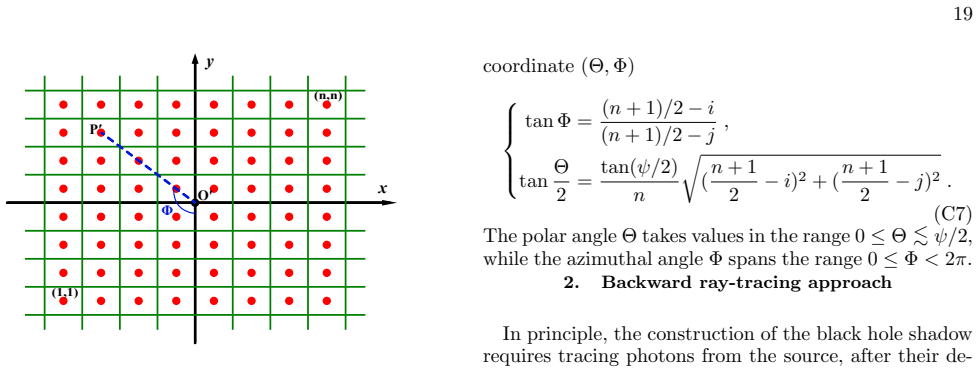
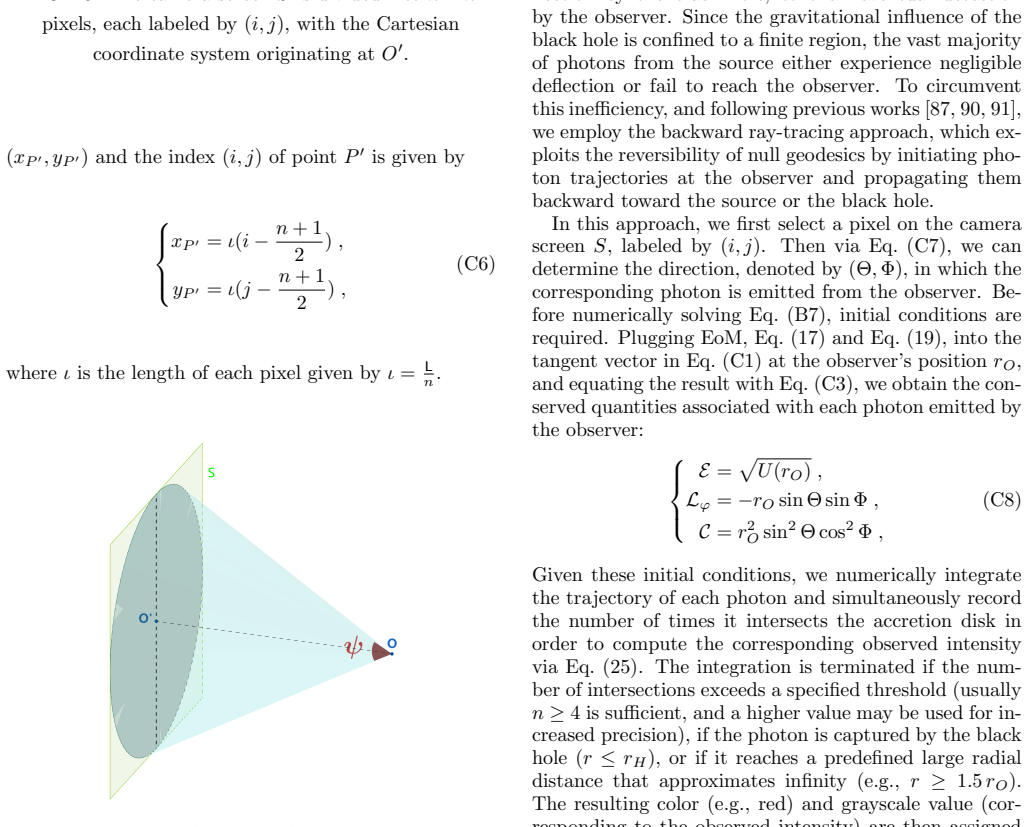
Backward ray-tracing approach In principle, the construction of the black hole shadow requires tracing photons from the source, after their de- flection by the black hole, to their eventual detection by the observer. Since the gravitational influence of the black hole is confined to a finite region, the vast majority of photons from the source either expe...
-
[10]
First M87 Event Horizon Telescope Results. I. The Shadow of the Supermassive Black Hole
K. Akiyamaet al.(Event Horizon Telescope), First M87 Event Horizon Telescope Results. I. The Shadow of the Supermassive Black Hole, Astrophys. J. Lett.875, L1 (2019), arXiv:1906.11238 [astro-ph.GA]
work page internal anchor Pith review arXiv 2019
-
[11]
First M87 Event Horizon Telescope Results. II. Array and Instrumentation
K. Akiyamaet al.(Event Horizon Telescope), First M87 Event Horizon Telescope Results. II. Array and Instrumentation, Astrophys. J. Lett.875, L2 (2019), arXiv:1906.11239 [astro-ph.IM]
work page Pith review arXiv 2019
-
[12]
First M87 Event Horizon Telescope Results. III. Data Processing and Calibration
K. Akiyamaet al.(Event Horizon Telescope), First M87 Event Horizon Telescope Results. III. Data Processing and Calibration, Astrophys. J. Lett.875, L3 (2019), arXiv:1906.11240 [astro-ph.GA]
work page Pith review arXiv 2019
-
[13]
First M87 Event Horizon Telescope Results. IV. Imaging the Central Supermassive Black Hole
K. Akiyamaet al.(Event Horizon Telescope), First M87 Event Horizon Telescope Results. IV. Imaging the Cen- tral Supermassive Black Hole, Astrophys. J. Lett.875, L4 (2019), arXiv:1906.11241 [astro-ph.GA]
work page Pith review arXiv 2019
-
[14]
First M87 Event Horizon Telescope Results. V. Physical Origin of the Asymmetric Ring
K. Akiyamaet al.(Event Horizon Telescope), First M87 Event Horizon Telescope Results. V. Physical Origin of the Asymmetric Ring, Astrophys. J. Lett.875, L5 (2019), arXiv:1906.11242 [astro-ph.GA]
work page Pith review arXiv 2019
-
[15]
First M87 Event Horizon Telescope Results. VI. The Shadow and Mass of the Central Black Hole
K. Akiyamaet al.(Event Horizon Telescope), First M87 Event Horizon Telescope Results. VI. The Shadow and Mass of the Central Black Hole, Astrophys. J. Lett.875, L6 (2019), arXiv:1906.11243 [astro-ph.GA]
work page Pith review arXiv 2019
-
[16]
First M87 Event Horizon Telescope Results. VII. Polariza- tion of the Ring,
K. Akiyamaet al.(Event Horizon Telescope), First M87 Event Horizon Telescope Results. VII. Polariza- tion of the Ring, Astrophys. J. Lett.910, L12 (2021), arXiv:2105.01169 [astro-ph.HE]
-
[17]
K. Akiyamaet al.(Event Horizon Telescope), First M87 Event Horizon Telescope Results. VIII. Magnetic Field Structure near The Event Horizon, Astrophys. J. Lett. 910, L13 (2021), arXiv:2105.01173 [astro-ph.HE]
-
[18]
First M87 Event Horizon Telescope Results. IX. Detection of Near-horizon Circular Polarization,
K. Akiyamaet al.(Event Horizon Telescope), First M87 Event Horizon Telescope Results. IX. Detection of Near- horizon Circular Polarization, Astrophys. J. Lett.957, L20 (2023), arXiv:2311.10976 [astro-ph.HE]
-
[19]
K. Akiyamaet al.(Event Horizon Telescope), First Sagittarius A* Event Horizon Telescope Results. I. The Shadow of the Supermassive Black Hole in the Center of the Milky Way, Astrophys. J. Lett.930, L12 (2022), arXiv:2311.08680 [astro-ph.HE]
work page internal anchor Pith review arXiv 2022
-
[20]
K. Akiyamaet al.(Event Horizon Telescope), First Sagit- tarius A* Event Horizon Telescope Results. II. EHT and Multiwavelength Observations, Data Processing, and Calibration, Astrophys. J. Lett.930, L13 (2022), arXiv:2311.08679 [astro-ph.HE]
-
[21]
Akiyamaet al.[Event Horizon Telescope], First Sagittar- ius A* Event Horizon Telescope Results
K. Akiyamaet al.(Event Horizon Telescope), First Sagit- tarius A* Event Horizon Telescope Results. III. Imaging of the Galactic Center Supermassive Black Hole, Astro- phys. J. Lett.930, L14 (2022), arXiv:2311.09479 [astro- ph.HE]
-
[22]
Akiyamaet al.(Event Horizon Telescope), Astrophys
K. Akiyamaet al.(Event Horizon Telescope), First Sagit- tarius A* Event Horizon Telescope Results. IV. Vari- ability, Morphology, and Black Hole Mass, Astrophys. J. Lett.930, L15 (2022), arXiv:2311.08697 [astro-ph.HE]
-
[23]
Akiyamaet al.(Event Horizon Telescope), Astrophys
K. Akiyamaet al.(Event Horizon Telescope), First Sagit- tarius A* Event Horizon Telescope Results. V. Testing Astrophysical Models of the Galactic Center Black Hole, Astrophys. J. Lett.930, L16 (2022), arXiv:2311.09478 [astro-ph.HE]
-
[24]
K. Akiyamaet al.(Event Horizon Telescope), First Sagit- tarius A* Event Horizon Telescope Results. VI. Test- ing the Black Hole Metric, Astrophys. J. Lett.930, L17 (2022), arXiv:2311.09484 [astro-ph.HE]
-
[25]
Akiyamaet al.(Event Horizon Telescope), First Sagit- tarius A* Event Horizon Telescope Results
K. Akiyamaet al.(Event Horizon Telescope), First Sagit- tarius A* Event Horizon Telescope Results. VII. Polar- ization of the Ring, Astrophys. J. Lett.964, L25 (2024)
work page 2024
-
[26]
Akiyamaet al.(Event Horizon Telescope), First Sagit- tarius A* Event Horizon Telescope Results
K. Akiyamaet al.(Event Horizon Telescope), First Sagit- tarius A* Event Horizon Telescope Results. VIII. Phys- ical Interpretation of the Polarized Ring, Astrophys. J. Lett.964, L26 (2024)
work page 2024
- [27]
- [28]
- [29]
-
[30]
Testing General Relativity with the Event Horizon Telescope,
D. Psaltis, Testing General Relativity with the Event Horizon Telescope, Gen. Rel. Grav.51, 137 (2019), arXiv:1806.09740 [astro-ph.HE]
- [31]
-
[32]
Photon Regions and Shadows of Kerr-Newman-NUT Black Holes with a Cosmological Constant
A. Grenzebach, V. Perlick, and C. L¨ ammerzahl, Photon Regions and Shadows of Kerr-Newman-NUT Black Holes with a Cosmological Constant, Phys. Rev. D89, 124004 (2014), arXiv:1403.5234 [gr-qc]
work page Pith review arXiv 2014
- [33]
-
[34]
A. ¨Ovg¨ un,˙I. Sakallı, and J. Saavedra, Shadow cast and Deflection angle of Kerr-Newman-Kasuya spacetime, JCAP10, 041, arXiv:1807.00388 [gr-qc]
-
[35]
M. Wang, S. Chen, and J. Jing, Shadow casted by a Konoplya-Zhidenko rotating non-Kerr black hole, JCAP 10, 051, arXiv:1707.09451 [gr-qc]
- [36]
-
[37]
R. Shaikh, Black hole shadow in a general rotating space- time obtained through Newman-Janis algorithm, Phys. Rev. D100, 024028 (2019), arXiv:1904.08322 [gr-qc]
-
[38]
Shapes of rotating nonsingular black hole shadows
M. Amir and S. G. Ghosh, Shapes of rotating nonsingu- lar black hole shadows, Phys. Rev. D94, 024054 (2016), arXiv:1603.06382 [gr-qc]
work page Pith review arXiv 2016
-
[39]
Shadow of rotating regular black holes
A. Abdujabbarov, M. Amir, B. Ahmedov, and S. G. Ghosh, Shadow of rotating regular black holes, Phys. Rev. D93, 104004 (2016), arXiv:1604.03809 [gr-qc]
work page Pith review arXiv 2016
-
[40]
Influence of a plasma on the shadow of a spherically symmetric black hole
V. Perlick, O. Y. Tsupko, and G. S. Bisnovatyi-Kogan, Influence of a plasma on the shadow of a spherically symmetric black hole, Phys. Rev. D92, 104031 (2015), arXiv:1507.04217 [gr-qc]
work page Pith review arXiv 2015
- [41]
- [42]
- [43]
- [44]
- [45]
-
[46]
Y. Meng, X.-M. Kuang, X.-J. Wang, B. Wang, and J.-P. Wu, Images from disk and spherical accretions of hairy Schwarzschild black holes, Phys. Rev. D108, 064013 (2023), arXiv:2306.10459 [gr-qc]
-
[47]
Y. Meng, X.-M. Kuang, X.-J. Wang, B. Wang, and J.- P. Wu, Images of hairy Reissner–Nordstr¨ om black hole illuminated by static accretions, Eur. Phys. J. C84, 305 (2024), arXiv:2401.05634 [gr-qc]
- [48]
-
[49]
Shadow of a rotating braneworld black hole
L. Amarilla and E. F. Eiroa, Shadow of a rotating braneworld black hole, Phys. Rev. D85, 064019 (2012), arXiv:1112.6349 [gr-qc]
work page Pith review arXiv 2012
-
[50]
M. Zhang and M. Guo, Can shadows reflect phase struc- tures of black holes?, Eur. Phys. J. C80, 790 (2020), arXiv:1909.07033 [gr-qc]
-
[51]
H. Lu and H.-D. Lyu, Schwarzschild black holes have the largest size, Phys. Rev. D101, 044059 (2020), arXiv:1911.02019 [gr-qc]
-
[52]
H.-M. Wang, Y.-M. Xu, and S.-W. Wei, Shadows of Kerr- like black holes in a modified gravity theory, JCAP03, 046, arXiv:1810.12767 [gr-qc]
- [53]
- [54]
-
[55]
R. Kumar and S. G. Ghosh, Rotating black holes in 4D Einstein-Gauss-Bonnet gravity and its shadow, JCAP 07, 053, arXiv:2003.08927 [gr-qc]
- [56]
-
[57]
A. ¨Ovg¨ un,˙I. Sakallı, J. Saavedra, and C. Leiva, Shadow cast of noncommutative black holes in Rastall gravity, Mod. Phys. Lett. A35, 2050163 (2020), arXiv:1906.05954 [hep-th]
-
[58]
E. Contreras, J. M. Ramirez-Velasquez, ´A. Rinc´ on, G. Panotopoulos, and P. Bargue˜ no, Black hole shadow of a rotating polytropic black hole by the Newman–Janis algorithm without complexification, Eur. Phys. J. C79, 802 (2019), arXiv:1905.11443 [gr-qc]
-
[59]
E. Contreras, ´A. Rinc´ on, G. Panotopoulos, and P. Bar- gue˜ no, Geodesic analysis and black hole shadows on a general non-extremal rotating black hole in five- dimensional gauged supergravity, Annals Phys.432, 168567 (2021), arXiv:2010.03734 [gr-qc]
- [60]
-
[61]
Chen, JCAP05, 040 (2020), arXiv:2004.01440 [gr- qc]
C.-Y. Chen, Rotating black holes withoutZ 2 sym- 22 metry and their shadow images, JCAP05, 040, arXiv:2004.01440 [gr-qc]
-
[62]
B. Eslam Panah, K. Jafarzade, and S. H. Hendi, Charged 4D Einstein-Gauss-Bonnet-AdS black holes: Shadow, en- ergy emission, deflection angle and heat engine, Nucl. Phys. B961, 115269 (2020), arXiv:2004.04058 [hep-th]
-
[63]
X.-X. Zeng, H.-Q. Zhang, and H. Zhang, Shadows and photon spheres with spherical accretions in the four- dimensional Gauss–Bonnet black hole, Eur. Phys. J. C 80, 872 (2020), arXiv:2004.12074 [gr-qc]
- [64]
- [65]
- [66]
-
[67]
S.-H. Xiong, Y.-Z. Li, X.-M. Kuang, and J. Matyjasek, The shadow and quasinormal modes of the asymptoti- cally flat hairy black holes with a dilaton potential, Eur. Phys. J. C85, 1143 (2025), arXiv:2508.03270 [gr-qc]
- [68]
-
[69]
A. B. Balakin and J. P. S. Lemos, Non-minimal coupling for the gravitational and electromagnetic fields: a general system of equations, Classical and Quantum Gravity22, 1867–1880 (2005)
work page 2005
- [70]
-
[71]
M. S. Turner and L. M. Widrow, Inflation-produced, large-scale magnetic fields, Phys. Rev. D37, 2743 (1988)
work page 1988
-
[72]
G. W. Horndeski, Conservation of charge and the Einstein–Maxwell field equations, Journal of Mathematical Physics17, 1980 (1976), https://pubs.aip.org/aip/jmp/article- pdf/17/11/1980/19259474/1980 1 online.pdf
work page 1980
-
[73]
Stability of Horndeski vector-tensor interactions
J. Beltran Jimenez, R. Durrer, L. Heisenberg, and M. Thorsrud, Stability of Horndeski vector-tensor inter- actions, JCAP10, 064, arXiv:1308.1867 [hep-th]
-
[74]
I. T. Drummond and S. Hathrell, QED vacuum polar- ization in a background gravitational field and its effect on the velocity of photons, Physical Review D22, 343 (1980)
work page 1980
-
[75]
Gravitational corrections to the Euler-Heisenberg Lagrangian
F. Bastianelli, J. M. Davila, and C. Schubert, Gravita- tional corrections to the Euler-Heisenberg Lagrangian, JHEP03, 086, arXiv:0812.4849 [hep-th]
-
[76]
B. Knorr and A. Platania, Unearthing the intersections: positivity bounds, weak gravity conjecture, and asymp- totic safety landscapes from photon-graviton flows, JHEP 03, 003, arXiv:2405.08860 [hep-th]
- [77]
-
[78]
H. A. Buchdahl, On a Lagrangian for non-minimally cou- pled gravitational and electromagnetic fields, Journal of Physics A: Mathematical and General12, 1037 (1979)
work page 1979
-
[79]
R. Carballo-Rubio, H. Delaporte, A. Eichhorn, and P. G. S. Fernandes, Nonminimal light-curvature cou- plings and black-hole imaging, Phys. Rev. D112, 103016 (2025), arXiv:2505.21431 [astro-ph.HE]
-
[80]
S. Jana and S. Shankaranarayanan, Non-Minimally Cou- pled Electromagnetic Fields and Observable Implications for Primordial Black Holes, Universe10, 270 (2024), arXiv:2110.06056 [gr-qc]
discussion (0)
Sign in with ORCID, Apple, or X to comment. Anyone can read and Pith papers without signing in.