REVIEW 2 major objections 1 cited by
Reviewed by Pith at T0; open to challenge.
T0 means a machine referee read the full paper against a public rubric. The mark states how deep the mechanical check went, never who wrote it. the ladder, T0–T4 →
T0 review · grok-4.3
RubricRefine generates task-specific rubrics to verify and repair tool-use code for inter-tool contract violations before any execution occurs.
2026-05-20 22:08 UTC pith:24LDJL2T
load-bearing objection RubricRefine gives a practical pre-execution rubric check that lifts multi-tool reliability to 0.86 without runtime costs, though the LLM judge step needs tighter validation. the 2 major comments →
RubricRefine: Improving Tool-Use Agent Reliability with Training-Free Pre-Execution Refinement
The pith
A machine-rendered reading of the paper's core claim, the machinery that carries it, and where it could break.
Core claim
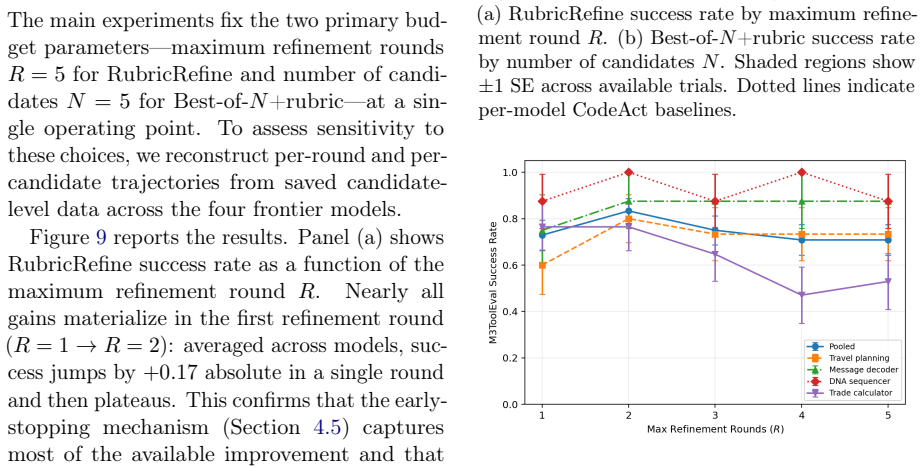
RubricRefine is a training-free pre-execution method that produces task- and registry-specific rubrics, scores candidate code against explicit semantic contract checks for violations such as wrong output shape or incorrect tool routing, and iteratively repairs detected failures before execution, reaching 0.86 average success on M3ToolEval across seven models with zero execution attempts and up to 2.6 times lower latency than prior inference-time baselines.
What carries the argument
RubricRefine, the process of generating task-specific rubrics from the query and tool registry then scoring and repairing code against explicit contract checks before any execution.
Load-bearing premise
The dominant failures in tool-use agents are inter-tool contract violations that complete without raising runtime errors, and LLM-generated rubrics can reliably detect and repair these before execution.
What would settle it
Running the same models and tasks but replacing the main failure mode with runtime errors that do raise exceptions during execution, then checking whether RubricRefine still outperforms execution-feedback baselines.
If this is right
- Tool-use agents reach higher reliability without consuming any execution attempts or runtime feedback signals.
- Latency drops by up to 2.6 times relative to methods that rely on actual tool runs for revision.
- Performance gains concentrate on multi-step tasks that involve multiple interdependent tool calls.
- Rubric-category ablations show that explicit checks for output shape and argument provenance drive most of the improvement.
Where Pith is reading between the lines
- Similar rubric generation could be added to agent frameworks to catch contract issues in planning or multi-agent coordination where hidden violations also occur.
- The flat performance on single-step tasks suggests the method would benefit from hybrid use with execution feedback when tasks lack inter-tool structure.
- Applying the approach to new tool registries would test whether rubric generation scales when the set of available functions changes.
Editorial analysis
A structured set of objections, weighed in public.
Referee Report
Summary. The paper presents RubricRefine, a training-free method for pre-execution refinement of tool-use agent code. It generates task-specific rubrics to score and repair inter-tool contract violations before execution, achieving an average of 0.86 on M3ToolEval across seven models with zero executions and reduced latency compared to baselines. It shows limited improvement on single-step tasks and includes ablations on rubric categories and calibration.
Significance. This approach addresses a key limitation in iterative self-refinement for tool-use by focusing on semantic contracts without runtime feedback. If validated, the gains in reliability and efficiency could advance the development of more robust LLM agents for complex multi-tool tasks. The empirical focus on when the method works (multi vs single step) is a strength.
major comments (2)
- §5.3 Calibration Analysis: The calibration analysis provides internal consistency checks but lacks external validation against human-annotated ground truth for detected contract violations. This is critical as the method depends on the LLM judge reliably identifying actual inter-tool violations (wrong shapes, routing, provenance) rather than surface issues; without this, the 0.86 performance and generalization claims are at risk.
- Table 1 (Results on M3ToolEval): The reported improvements (0.86 vs. 0.65-0.75) and latency reductions do not specify the exact implementation details of the prior inference-time baselines, such as whether they used the same LLM for refinement or equivalent iteration counts, which is necessary to substantiate the 2.6× latency improvement claim.
Simulated Author's Rebuttal
We thank the referee for the constructive feedback on our manuscript. We address each major comment point by point below, providing clarifications and indicating revisions where the concerns are valid and can be addressed without misrepresenting our results.
read point-by-point responses
-
Referee: §5.3 Calibration Analysis: The calibration analysis provides internal consistency checks but lacks external validation against human-annotated ground truth for detected contract violations. This is critical as the method depends on the LLM judge reliably identifying actual inter-tool violations (wrong shapes, routing, provenance) rather than surface issues; without this, the 0.86 performance and generalization claims are at risk.
Authors: We acknowledge that the calibration analysis in §5.3 is based on internal consistency metrics, such as agreement across rubric categories and correlation with downstream task success, rather than direct comparison to human-annotated ground truth for contract violations. This is a fair observation, as external validation would more definitively rule out the possibility that the LLM judge is detecting surface-level issues instead of true semantic contract violations. We have revised the manuscript to explicitly discuss this as a limitation in §5.3 and the conclusion, while noting that the multi-model empirical gains on M3ToolEval and the rubric ablation provide supporting evidence for the judge's utility. A full human study is beyond the current scope but could be pursued in follow-up work. revision: partial
-
Referee: Table 1 (Results on M3ToolEval): The reported improvements (0.86 vs. 0.65-0.75) and latency reductions do not specify the exact implementation details of the prior inference-time baselines, such as whether they used the same LLM for refinement or equivalent iteration counts, which is necessary to substantiate the 2.6× latency improvement claim.
Authors: We agree that additional implementation details for the baselines are needed to make the latency comparison fully transparent. The original experimental setup referenced prior inference-time methods but did not explicitly restate that the same base LLMs were used for refinement steps and that iteration budgets were aligned for fairness. We have revised Table 1's caption and added a dedicated paragraph in the experimental details section to specify these points, confirming equivalent LLM usage and iteration matching. This directly supports the reported 2.6× latency advantage of RubricRefine, which stems from its pre-execution nature requiring no runtime attempts. revision: yes
Circularity Check
No significant circularity; empirical method with independent benchmark validation
full rationale
The paper defines RubricRefine explicitly as a training-free process that generates task- and registry-specific rubrics, applies LLM scoring for inter-tool contract checks, and performs iterative repair prior to execution. Central performance numbers (0.86 average on M3ToolEval, flat results on API-Bank) are obtained via direct comparison against baselines on fixed external benchmarks, accompanied by rubric-category ablation and calibration analysis. No equations, parameter fits, or self-citations are present that would reduce any claimed result to its own inputs by construction. The method's logic and evaluation remain self-contained against external test sets rather than relying on self-referential definitions or load-bearing prior author work.
Axiom & Free-Parameter Ledger
axioms (1)
- domain assumption Large language models can generate accurate task- and registry-specific rubrics that capture semantic contract violations in tool-use code.
read the original abstract
Iterative self-refinement is a popular inference-time reliability technique, but its effectiveness in code-mode tool use depends heavily on the structure of the feedback signal: unstructured critique helps inconsistently across models, and even revision with real execution feedback improves only modestly ($0.75$ vs. $0.65$ baseline). The dominant failures are inter-tool contract violations (wrong output shape, incorrect tool routing, broken argument provenance) that run to completion without raising errors, making runtime feedback insufficient. We introduce RubricRefine, a training-free method for pre-execution semantic contract verification that generates task- and registry-specific rubrics, scores candidate code against explicit contract checks, and iteratively repairs failures before any execution occurs. RubricRefine reaches $0.86$, averaged across seven models, on M3ToolEval with zero execution attempts, improving over prior inference-time baselines with up to $2.6\times$ lower latency. Performance remains flat on the predominantly single-step API-Bank, consistent with the method's reliance on inter-tool contract structure. A rubric-category ablation and calibration analysis further characterize when and why the method works.
Figures



Lean theorems connected to this paper
-
IndisputableMonolith/Foundation/RealityFromDistinction.leanreality_from_one_distinction unclear?
unclearRelation between the paper passage and the cited Recognition theorem.
RubricRefine ... generates task- and registry-specific rubrics, scores candidate code against explicit contract checks, and iteratively repairs failures before any execution occurs.
-
IndisputableMonolith/Cost/FunctionalEquation.leanwashburn_uniqueness_aczel unclear?
unclearRelation between the paper passage and the cited Recognition theorem.
The dominant failures are inter-tool contract violations (wrong output shape, incorrect tool routing, broken argument provenance)
What do these tags mean?
- matches
- The paper's claim is directly supported by a theorem in the formal canon.
- supports
- The theorem supports part of the paper's argument, but the paper may add assumptions or extra steps.
- extends
- The paper goes beyond the formal theorem; the theorem is a base layer rather than the whole result.
- uses
- The paper appears to rely on the theorem as machinery.
- contradicts
- The paper's claim conflicts with a theorem or certificate in the canon.
- unclear
- Pith found a possible connection, but the passage is too broad, indirect, or ambiguous to say the theorem truly supports the claim.
Forward citations
Cited by 1 Pith paper
-
Recursive Self-Improvement in AI: From Bounded Self-Refinement to Autonomous Research Loops
A survey of 1,250 papers organizes AI self-improvement along two axes—what is improved and loop closure—finding that demonstrated self-improvement strength tracks a verification hierarchy from formal verifiers down to...
Reference graph
Works this paper leans on
-
[1]
Self-Distillation Zero: Self-Revision Turns Binary Rewards into Dense Supervision
Yinghui He, Simran Kaur, Adithya Bhaskar, Yongjin Yang, Jiarui Liu, Narutatsu Ri, Liam Fowl, Abhishek Panigrahi, Danqi Chen, and Sanjeev Arora. Self-distillation zero: Self-revision turns binary rewards into dense supervision. arXiv:2604.12002, 2026. URL: https://arxiv.org/abs/2604.12002
work page internal anchor Pith review Pith/arXiv arXiv 2026
-
[2]
Executable code actions elicit better llm agents
Xingyao Wang, Yangyi Chen, Lifan Yuan, Yizhe Zhang, Yunzhu Li, Hao Peng, and Heng Ji. Executable code actions elicit better LLM agents. In Proceedings of ICML, 2024. arXiv:2402.01030. URL: https://proceedings.mlr.press/v235/wang24h.html
-
[3]
Api-bank: A comprehensive benchmark for tool-augmented llms
Minghao Li, Yingxiu Zhao, Bowen Yu, Feifan Song, Hangyu Li, Haiyang Yu, Zhoujun Li, Fei Huang, and Yongbin Li. API-Bank : A comprehensive benchmark for tool-augmented LLMs . In Proceedings of EMNLP, 2023. DOI: https://doi.org/10.18653/v1/2023.emnlp-main.187. URL: https://aclanthology.org/2023.emnlp-main.187/
-
[4]
Self-refine: Iterative refinement with self-feedback
Aman Madaan et al. Self-refine: Iterative refinement with self-feedback. In Proceedings of NeurIPS, 2023. URL: https://openreview.net/forum?id=S37hOerQLB
work page 2023
-
[5]
Language Models (Mostly) Know What They Know
Saurav Kadavath et al. Language models (mostly) know what they know. arXiv:2207.05221, 2022. URL: https://arxiv.org/abs/2207.05221
work page internal anchor Pith review Pith/arXiv arXiv 2022
-
[6]
Alexandru Niculescu-Mizil and Rich Caruana. Predicting good probabilities with supervised learning. In Proceedings of ICML, 2005. DOI: https://doi.org/10.1145/1102351.1102430
-
[7]
Chuan Guo, Geoff Pleiss, Yu Sun, and Kilian Q. Weinberger. On calibration of modern neural networks. In Proceedings of ICML, 2017. URL: https://proceedings.mlr.press/v70/guo17a.html
work page 2017
-
[8]
Meelis Kull, Telmo Silva Filho, and Peter Flach. Beta calibration: a well-founded and easily implemented improvement on logistic calibration for binary classifiers. In Proceedings of AISTATS, 2017. URL: https://proceedings.mlr.press/v54/kull17a.html
work page 2017
-
[9]
smolagents: a smol library to build great agentic systems
Aymeric Roucher, Albert Villanova del Moral, Thomas Wolf, Leandro von Werra, and Erik Kaunism\"aki. smolagents: a smol library to build great agentic systems. GitHub repository, 2025. URL: https://github.com/huggingface/smolagents
work page 2025
-
[10]
Code Mode: the better way to use MCP
Kenton Varda and Sunil Pai. Code Mode: the better way to use MCP . Cloudflare blog, 2025. URL: https://blog.cloudflare.com/code-mode/
work page 2025
-
[11]
Scaling LLM Test-Time Compute Optimally can be More Effective than Scaling Model Parameters
Charlie Snell, Jaehoon Lee, Kelvin Xu, and Aviral Kumar. Scaling LLM test-time compute optimally can be more effective than scaling model parameters. arXiv:2408.03314, 2024. URL: https://arxiv.org/abs/2408.03314
work page internal anchor Pith review Pith/arXiv arXiv 2024
-
[12]
Hunter Lightman et al. Let's verify step by step. In Proceedings of ICLR, 2024. URL: https://openreview.net/forum?id=v8L0pN6EOi
work page 2024
-
[13]
Ryo Kamoi, Yusen Zhang, Nan Zhang, Jiawei Han, and Rui Zhang. When can LLMs actually correct their own mistakes? A critical survey of self-correction of LLMs . TACL, 2024. DOI: https://doi.org/10.1162/tacl_a_00713. URL: https://aclanthology.org/2024.tacl-1.78/
-
[14]
PreFlect : From retrospective to prospective reflection in large language model agents
Hanyu Wang, Yuanpu Cao, Lu Lin, and Jinghui Chen. PreFlect : From retrospective to prospective reflection in large language model agents. arXiv:2602.07187, 2026. URL: https://arxiv.org/abs/2602.07187
-
[15]
CRITIC : Large language models can self-correct with tool-interactive critiquing
Zhibin Gou et al. CRITIC : Large language models can self-correct with tool-interactive critiquing. In Proceedings of ICLR, 2024. URL: https://openreview.net/forum?id=Sx038qxjek
work page 2024
-
[16]
arXiv preprint arXiv:2409.00920 , year=
Weiwen Liu et al. ToolACE : Winning the points of LLM function calling. arXiv:2409.00920, 2024. URL: https://arxiv.org/abs/2409.00920
-
[17]
Facilitating multi-turn function calling for LLMs via compositional instruction tuning
Mingyang Chen et al. Facilitating multi-turn function calling for LLMs via compositional instruction tuning. In Proceedings of ICLR, 2025. URL: https://openreview.net/forum?id=owP2mymrTD
work page 2025
-
[18]
Advancing tool-augmented large language models via meta-verification and reflection learning
Zhiyuan Ma et al. Advancing tool-augmented large language models via meta-verification and reflection learning. In Proceedings of KDD, 2025. DOI: https://doi.org/10.1145/3711896.3736835
-
[19]
Bingguang Hao et al. FunReason : Enhancing large language models' function calling via self-refinement multiscale loss and automated data refinement. arXiv:2505.20192, 2025. URL: https://arxiv.org/abs/2505.20192
-
[20]
Shaokun Zhang et al. Nemotron-Research-Tool-N1: Exploring tool-using language models with reinforced reasoning. arXiv:2505.00024, 2025. URL: https://arxiv.org/abs/2505.00024
-
[21]
ReTool: Reinforcement Learning for Strategic Tool Use in LLMs
Jiazhan Feng et al. ReTool : Reinforcement learning for strategic tool use in LLMs . arXiv:2504.11536, 2025. URL: https://arxiv.org/abs/2504.11536
work page internal anchor Pith review Pith/arXiv arXiv 2025
-
[22]
GEAR : Augmenting language models with generalizable and efficient tool resolution
Yining Lu, Haoping Yu, and Daniel Khashabi. GEAR : Augmenting language models with generalizable and efficient tool resolution. In Proceedings of EACL, 2024. URL: https://aclanthology.org/2024.eacl-long.7/
work page 2024
-
[23]
Chain-of-Tools: Utilizing massive unseen tools in the CoT reasoning of frozen language models
Mengsong Wu et al. Chain-of-Tools: Utilizing massive unseen tools in the CoT reasoning of frozen language models. arXiv:2503.16779, 2025. URL: https://arxiv.org/abs/2503.16779
-
[24]
Elias Lumer et al. Graph RAG -Tool Fusion. arXiv:2502.07223, 2025. URL: https://arxiv.org/abs/2502.07223
-
[25]
ToolLLM: Facilitating large language models to master 16000+ real-world APIs
Yujia Qin, Shihao Liang, Yining Ye, Kunlun Zhu, Lan Yan, Yaxi Lu, Yankai Lin, Xin Cong, Xiangru Tang, Bill Qian, Sihan Zhao, Lauren Hong, Runchu Tian, Ruobing Xie, Jie Zhou, Mark Gerstein, Dahai Li, Zhiyuan Liu, and Maosong Sun. ToolLLM: Facilitating large language models to master 16000+ real-world APIs . In Proceedings of ICLR, 2024. URL: https://openre...
work page 2024
-
[26]
Patil, Huanzhi Mao, Fanjia Yan, Charlie Cheng-Jie Ji, Vishnu Suresh, Ion Stoica, and Joseph E
Shishir G. Patil, Huanzhi Mao, Fanjia Yan, Charlie Cheng-Jie Ji, Vishnu Suresh, Ion Stoica, and Joseph E. Gonzalez. The Berkeley function calling leaderboard ( BFCL ): From tool use to agentic evaluation of large language models. In Proceedings of ICML, 2025. URL: https://proceedings.mlr.press/v267/patil25a.html
work page 2025
-
[27]
Constitutional AI: Harmlessness from AI Feedback
Yuntao Bai et al. Constitutional AI : Harmlessness from AI feedback. arXiv:2212.08073, 2022. URL: https://arxiv.org/abs/2212.08073
work page internal anchor Pith review Pith/arXiv arXiv 2022
-
[28]
Judging LLM -as-a-judge with MT-Bench and Chatbot Arena
Lianmin Zheng et al. Judging LLM -as-a-judge with MT-Bench and Chatbot Arena . In Proceedings of NeurIPS, 2023. URL: https://proceedings.neurips.cc/paper_files/paper/2023/hash/91f18a1287b398d378ef22505bf41832-Paper-Datasets_and_Benchmarks.pdf
work page 2023
-
[29]
Prometheus: Inducing fine-grained evaluation capability in language models
Seungone Kim et al. Prometheus: Inducing fine-grained evaluation capability in language models. In Proceedings of ICLR, 2024. URL: https://openreview.net/forum?id=8euJaTveKw
work page 2024
-
[30]
Balwani, Denis Peskoff, Marcos Ayestaran, Sean M
Manasi Sharma et al. ResearchRubrics : A benchmark of prompts and rubrics for evaluating deep research agents. arXiv:2511.07685, 2025. URL: https://arxiv.org/abs/2511.07685
-
[31]
Rubrics as Rewards: Reinforcement Learning Beyond Verifiable Domains
Anisha Gunjal et al. Rubrics as Rewards: Reinforcement learning beyond verifiable domains. arXiv:2507.17746, 2025. URL: https://arxiv.org/abs/2507.17746
work page internal anchor Pith review Pith/arXiv arXiv 2025
-
[32]
arXiv preprint arXiv:2601.04171
Mohit Raghavendra et al. Agentic Rubrics as contextual verifiers for SWE agents. arXiv:2601.04171, 2026. URL: https://arxiv.org/abs/2601.04171
-
[33]
Morris H. DeGroot and Stephen E. Fienberg. The comparison and evaluation of forecasters. Journal of the Royal Statistical Society: Series D (The Statistician), 32(1-2):12--22, 1983. DOI: https://doi.org/10.2307/2987588
-
[34]
Mahdi Pakdaman Naeini, Gregory F. Cooper, and Milos Hauskrecht. Obtaining well calibrated probabilities using Bayesian binning. In Proceedings of AAAI, 2015. URL: https://ojs.aaai.org/index.php/AAAI/article/view/9602
work page 2015
-
[35]
Enabling calibration in the zero-shot inference of large vision-language models
Will LeVine, Benjamin Pikus, Pranav Raja, and Fernando Amat Gil. Enabling calibration in the zero-shot inference of large vision-language models. In Proceedings of ICLR (Tiny Papers), 2023. arXiv:2303.12748. URL: https://openreview.net/forum?id=na1T7ZGYb4
-
[36]
Accurate layerwise interpretable competence estimation
Vickram Rajendran and William LeVine. Accurate layerwise interpretable competence estimation. Advances in Neural Information Processing Systems, 32, 2019. URL: https://proceedings.neurips.cc/paper_files/paper/2019/file/a11da6bd58b95b334f8cd49f00918f16-Paper.pdf
work page 2019
-
[37]
Meelis Kull, Miquel Perello Nieto, Markus K\"angsepp, Telmo Silva Filho, Hao Song, and Peter Flach. Beyond temperature scaling: Obtaining well-calibrated multi-class probabilities with Dirichlet calibration. Advances in Neural Information Processing Systems, 32, 2019. URL: https://proceedings.neurips.cc/paper_files/paper/2019/file/8ca01ea920679a0fe3728441...
work page 2019
-
[38]
Revisiting the calibration of modern neural networks
Matthias Minderer, Josip Djolonga, Rob Romijnders, Frances Hubis, Xiaohua Zhai, Neil Houlsby, Dustin Tran, and Mario Lucic. Revisiting the calibration of modern neural networks. Advances in Neural Information Processing Systems, 34:15682--15694, 2021. URL: https://proceedings.neurips.cc/paper_files/paper/2021/file/8420d359404024567b5aefda1231af24-Paper.pdf
work page 2021
-
[39]
Teaching Large Language Models to Self-Debug
Xinyun Chen, Maxwell Lin, Nathanael Sch\"arli, and Denny Zhou. Teaching large language models to self-debug. In Proceedings of ICLR, 2024. arXiv:2304.05128. URL: https://openreview.net/forum?id=KuPixIqPiq
work page internal anchor Pith review Pith/arXiv arXiv 2024
-
[40]
CodeT: Code Generation with Generated Tests
Bei Chen, Fengji Zhang, Anh Nguyen, Daoguang Zan, Zeqi Lin, Jian-Guang Lou, and Weizhu Chen. CodeT : Code generation with generated tests. arXiv preprint, 2022. arXiv:2207.10397. URL: https://arxiv.org/abs/2207.10397
work page internal anchor Pith review Pith/arXiv arXiv 2022
-
[41]
Code Generation with AlphaCodium: From Prompt Engineering to Flow Engineering
Tal Ridnik, Dedy Kredo, and Itamar Friedman. Code generation with AlphaCodium : From prompt engineering to flow engineering. arXiv preprint, 2024. arXiv:2401.08500. URL: https://arxiv.org/abs/2401.08500
work page Pith review arXiv 2024
-
[42]
Reflexion: Language agents with verbal reinforcement learning
Noah Shinn, Federico Cassano, Ashwin Gopinath, Karthik Narasimhan, and Shunyu Yao. Reflexion: Language agents with verbal reinforcement learning. In Proceedings of NeurIPS, 2023. URL: https://proceedings.neurips.cc/paper_files/paper/2023/file/1b44b878bb782e6954cd888628510e90-Paper-Conference.pdf
work page 2023
-
[43]
Griffiths, Yuan Cao, and Karthik Narasimhan
Shunyu Yao, Dian Yu, Jeffrey Zhao, Izhak Shafran, Thomas L. Griffiths, Yuan Cao, and Karthik Narasimhan. Tree of thoughts: Deliberate problem solving with large language models. In Proceedings of NeurIPS, 2023. URL: https://proceedings.neurips.cc/paper_files/paper/2023/file/271db9922b8d1f4dd7aaef84ed5ac703-Paper-Conference.pdf
work page 2023
-
[44]
Google DeepMind. Gemma 4. 2026. URL: https://deepmind.google/models/gemma/gemma-4/
work page 2026
-
[45]
Large language models cannot self-correct reasoning yet
Jie Huang, Xinyun Chen, Swaroop Mishra, Huaixiu Steven Zheng, Adams Wei Yu, Xinying Song, and Denny Zhou. Large language models cannot self-correct reasoning yet. In Proceedings of ICLR, 2024. URL: https://openreview.net/forum?id=IkmD3fKBPQ
work page 2024
-
[46]
Chasing the tail: Effective rubric-based reward modeling for large language model post-training
Junkai Zhang, Zihao Wang, Lin Gui, Swarnashree Mysore Sathyendra, Jaehwan Jeong, Victor Veitch, Wei Wang, Yunzhong He, Bing Liu, and Lifeng Jin. Chasing the tail: Effective rubric-based reward modeling for large language model post-training. In Proceedings of ICLR, 2026. arXiv:2509.21500. URL: https://arxiv.org/abs/2509.21500
-
[47]
LLM -as-a-Verifier: A general-purpose verification framework
Jacky Kwok, Shulu Li, Pranav Atreya, Yuejiang Liu, Marco Pavone, Ion Stoica, and Azalia Mirhoseini. LLM -as-a-Verifier: A general-purpose verification framework. Project page, 2026. URL: https://llm-as-a-verifier.notion.site/
work page 2026
-
[48]
Hung Le, Yue Wang, Akhilesh Deepak Gotmare, Silvio Savarese, and Steven C.H. Hoi. CodeRL : Mastering code generation through pretrained models and deep reinforcement learning. In Proceedings of NeurIPS, 2022. URL: https://proceedings.neurips.cc/paper_files/paper/2022/file/8636419dea1aa9fbd25fc4248e702da4-Paper-Conference.pdf
-
[49]
Ansong Ni, Srini Iyer, Dragomir Radev, Veselin Stoyanov, Wen-tau Yih, Sida I. Wang, and Xi Victoria Lin. LEVER : Learning to verify language-to-code generation with execution. In Proceedings of ICML, 2023. URL: https://proceedings.mlr.press/v202/ni23b.html
work page 2023
-
[50]
Yujia Li et al. Competition-level code generation with AlphaCode . Science, 378(6624):1092--1097, 2022. DOI: https://doi.org/10.1126/science.abq1158
-
[51]
Language Agent Tree Search Unifies Reasoning Acting and Planning in Language Models
Andy Zhou, Kai Yan, Michal Shlapentokh-Rothman, Haohan Wang, and Yu-Xiong Wang. Language agent tree search unifies reasoning, acting, and planning in language models. arXiv:2310.04406, 2023. URL: https://arxiv.org/abs/2310.04406
work page internal anchor Pith review Pith/arXiv arXiv 2023
-
[52]
Will LeVine and Bijan Varjavand. Relevance isn't all you need: Scaling RAG systems with inference-time compute via multi-criteria reranking. arXiv:2504.07104, 2025. URL: https://arxiv.org/abs/2504.07104
discussion (0)
Sign in with ORCID, Apple, or X to comment. Anyone can read and Pith papers without signing in.