REVIEW 3 minor 1 cited by
Reviewed by Pith at T0; open to challenge.
T0 means a machine referee read the full paper against a public rubric. The mark states how deep the mechanical check went, never who wrote it. the ladder, T0–T4 →
T0 review · grok-4.3
A mass-rescaled difference of muon and electron anomalous magnetic moments cancels short-range hadronic effects and reduces their uncertainty by about 85 percent.
2026-06-27 19:11 UTC pith:BGFSNCLE
load-bearing objection The paper defines a_{μ-e} to cancel leading short-distance HVP and cut its uncertainty by ~85%, a clean but incremental organizational tool for the g-2 discrepancy.
Lepton g-2 non-universality of hadronic contributions and a sub-GeV window to New Physics
The pith
A machine-rendered reading of the paper's core claim, the machinery that carries it, and where it could break.
Core claim
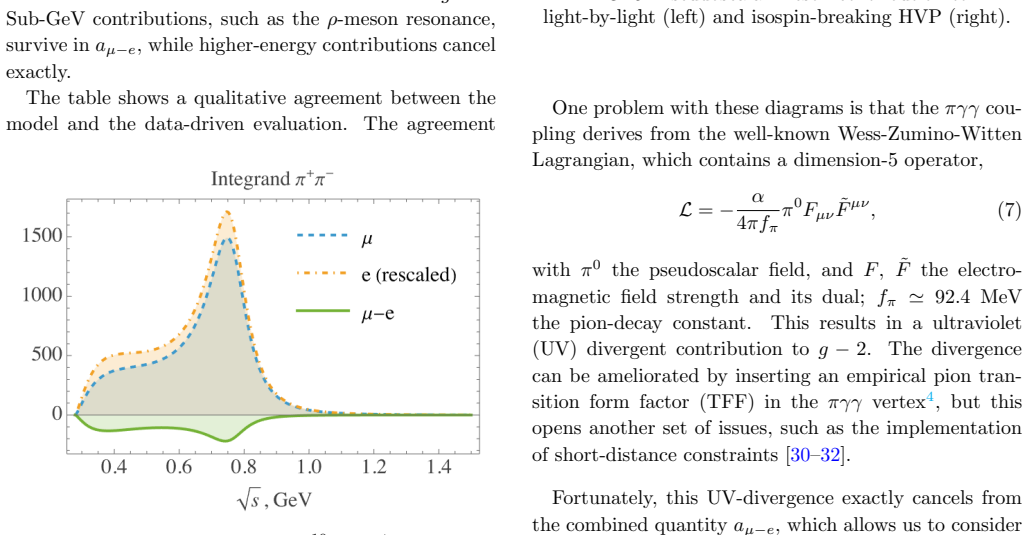
The central claim is that the linear combination a_{μ-e} ≡ a_μ − (m_μ/m_e)^2 a_e serves as a natural low-energy window quantity that directly probes the discrepancy between data-driven and lattice-QCD evaluations of hadronic contributions. The rescaling ensures an exact cancellation of the short-range effects, thereby improving the UV behavior and bypassing a number of issues that arise in a_μ or a_e separately. The hadronic-vacuum-polarization effect in a^{HVP}_{μ-e}, together with its uncertainty, is reduced as compared to a^{HVP}_μ by ∼85%. This is promising for tests of New Physics, conditional to significant improvements in experimental measurements of a_e and α, and opens a window to f
What carries the argument
The linear combination a_{μ-e} ≡ a_μ − (m_μ/m_e)^2 a_e, whose mass-squared rescaling produces exact cancellation of short-range hadronic vacuum polarization.
Load-bearing premise
Short-range hadronic effects remain identical for the muon and electron after the mass-squared rescaling so that they cancel exactly in the combination.
What would settle it
A high-precision determination of a_{μ-e} that shows a hadronic contribution larger than the predicted 15 percent remnant or that deviates from zero by an amount inconsistent with the expected New Physics window would falsify the claimed reduction and cancellation.
If this is right
- The hadronic-vacuum-polarization contribution and its uncertainty in a^{HVP}_{μ-e} shrink by ∼85% compared with a^{HVP}_μ.
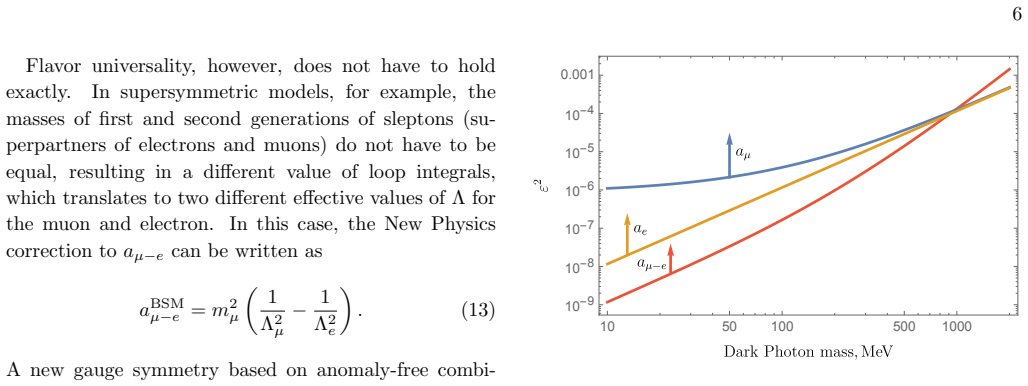
- The combination provides a direct test of New Physics scenarios that exhibit some degree of flavor non-universality between muons and electrons.
- It also constrains flavor-universal new states with masses below 1 GeV once experimental inputs improve.
- Progress in measuring a_e and the fine-structure constant α directly tightens the sensitivity of this observable to new physics.
Where Pith is reading between the lines
- The same rescaling technique could be applied to other lepton observables to isolate long-distance effects from short-distance contamination.
- Agreement between data-driven and lattice evaluations in a_{μ-e} would indicate that the existing muon g-2 tension originates outside the hadronic sector.
- Future experiments that measure both lepton moments to high precision could use this combination as a dedicated search channel for light new particles.
Editorial analysis
A structured set of objections, weighed in public.
Referee Report
Summary. The manuscript proposes the linear combination a_{\mu-e} \equiv a_\mu - (m_\mu/m_e)^2 a_e as a low-energy window quantity to probe hadronic vacuum polarization (HVP) contributions. It claims that the mass-squared rescaling produces an exact cancellation of short-range HVP effects, improving UV behavior relative to a_\mu or a_e separately. The hadronic contribution and its uncertainty in a^{HVP}_{\mu-e} are stated to be reduced by \sim 85\% compared with a^{HVP}_\mu. This is presented as a potential probe of the data-driven versus lattice-QCD discrepancy in HVP and as a window to new physics with flavor non-universality or sub-GeV states, conditional on improved a_e and \alpha measurements.
Significance. If the cancellation and numerical reduction hold, the construction supplies a parameter-free observable that isolates the low-s regime of HVP more cleanly than the separate lepton moments. The absence of free parameters or fitted quantities, together with the direct use of the known UV asymptotics of the HVP kernel, is a clear strength. The approach could usefully complement existing g-2 analyses for testing non-universal new-physics scenarios, provided the required experimental advances in a_e materialize.
minor comments (3)
- [Abstract, §1] Abstract and §1: the statement that the rescaling 'bypasses a number of issues' would be clearer if the specific issues (e.g., UV sensitivity, scheme dependence) were enumerated explicitly rather than left implicit.
- The numerical claim of an ∼85% reduction is central to the quantitative appeal; a short table or paragraph breaking down the residual contribution by s-region (low-s vs. intermediate) would allow readers to verify the factor without re-deriving the integral.
- Notation: define a^{HVP}_{\mu-e} at first appearance and ensure consistent use of the superscript throughout; the current text occasionally reverts to a_{\mu-e} without the HVP label.
Simulated Author's Rebuttal
We thank the referee for the supportive review and accurate summary of our proposal for the a_{\mu-e} combination. The recommendation of minor revision is noted; however, the report contains no specific major comments requiring point-by-point response.
Circularity Check
No significant circularity; derivation is self-contained
full rationale
The paper defines the quantity a_{\mu-e} explicitly as a linear combination chosen to exploit the known large-s asymptotic of the HVP kernel K(s/m_l^2) ~ m_l^2/s. This cancellation is a direct algebraic consequence of the definition and the standard kernel form, not a reduction to fitted inputs or self-citations. The ~85% reduction is presented as a numerical integral result over R(s) with the differing kernels; no parameters are fitted to data and then relabeled as predictions. No self-citation load-bearing steps, uniqueness theorems, or ansatze smuggled via prior work appear in the provided text. The construction is independent of the target discrepancy and remains falsifiable by external measurements of a_e and alpha.
Axiom & Free-Parameter Ledger
axioms (1)
- standard math Short-range contributions to lepton anomalous magnetic moments scale proportionally to the square of the lepton mass
read the original abstract
We propose the linear combination of the anomalous magnetic moments of the muon and electron, $a_{\mu-e} \equiv a_\mu - (m_\mu/m_e)^2 a_e$, as a natural low-energy window quantity that may directly probe the current discrepancy between the data-driven and lattice-QCD evaluations of hadronic contributions. The rescaling ensures an exact cancellation of the short-range effects, thereby improving the UV behavior and bypassing a number of issues that arise in $a_\mu$ or $a_e$ separately. The hadronic-vacuum-polarization effect in $a^{\rm HVP}_{\mu-e}$, together with its uncertainty, is reduced as compared to $a^{\rm HVP}_{\mu}$ by $\sim 85\%$. This is promising for tests of New Physics, conditional to significant improvements in experimental measurements of $a_e$ and $\alpha$. One can foresee the improvements in tests of New Physics with some degree of flavor non-universality, as well as for the flavor-universal sub-GeV states.
Figures
Forward citations
Cited by 1 Pith paper
-
Hadronic vacuum polarization in hydrogen-like atoms and ions amid the interplay of recoil and finite-size effects
The hVP contribution to the HFS in muonic hydrogen is 2.153(11) µeV, deviating from previous evaluations by ~10x the anticipated experimental precision, due to corrected recoil and finite-size interplay.
Reference graph
Works this paper leans on
- [1]
- [2]
-
[3]
Melnikov and A
K. Melnikov and A. Vainshtein,Theory of the muon anomalous magnetic moment, Springer Tracts Mod. Phys., Vol. 216 (2006) pp. 1–176
2006
-
[4]
Jegerlehner,The Anomalous Magnetic Moment of the Muon, Springer Tracts Mod
F. Jegerlehner,The Anomalous Magnetic Moment of the Muon, Springer Tracts Mod. Phys., Vol. 274 (2017) pp. 1–693
2017
-
[5]
The anomalous magnetic moment of the muon in the Standard Model
T. Aoyamaet al., The anomalous magnetic moment of the muon in the Standard Model, Phys. Rept.887, 1 (2020), arXiv:2006.04822 [hep-ph]. 5 Generally, this feature should be derived via Schwinger’s sum rule, of which the dispersive representation for the HVP contri- bution is a particular case [38]
work page internal anchor Pith review Pith/arXiv arXiv 2020
-
[6]
The anomalous magnetic moment of the muon in the Standard Model: an update
R. Alibertiet al., The anomalous magnetic moment of the muon in the standard model: an update, Phys. Rept. 1143, 1 (2025), arXiv:2505.21476 [hep-ph]
work page internal anchor Pith review Pith/arXiv arXiv 2025
-
[7]
G. F. Giudice, P. Paradisi, and A. Strumia, Correlation between the Higgs Decay Rate to Two Photons and the Muon g - 2, JHEP10, 186, arXiv:1207.6393 [hep-ph]
work page internal anchor Pith review Pith/arXiv arXiv
-
[8]
S. G. Karshenboim and V. A. Shelyuto, Hadronic vacuum-polarization contribution to various QED ob- servables, Eur. Phys. J. D75, 49 (2021)
2021
-
[9]
L. Di Luzio, A. Keshavarzi, A. Masiero, and P. Paradisi, Model-Independent Tests of the Hadronic Vacuum Polar- ization Contribution to the Muon g-2, Phys. Rev. Lett. 134, 011902 (2025), arXiv:2408.01123 [hep-ph]
-
[10]
D. Giusti and S. Simula, Ratios of the hadronic contributions to the leptong−2 from Lattice QCD+QED simulations, Phys. Rev. D102, 054503 (2020), arXiv:2003.12086 [hep-lat]
-
[11]
The proton structure in and out of muonic hydrogen
A. Antognini, F. Hagelstein, and V. Pascalutsa, The pro- ton structure in and out of muonic hydrogen, Ann. Rev. Nucl. Part. Sci.72, 389 (2022), arXiv:2205.10076 [nucl- th]. 8
work page Pith review arXiv 2022
-
[12]
T. Blum, P. A. Boyle, V. G¨ ulpers, T. Izubuchi, L. Jin, C. Jung, A. J¨ uttner, C. Lehner, A. Portelli, and J. T. Tsang (RBC, UKQCD), Calculation of the hadronic vac- uum polarization contribution to the muon anomalous magnetic moment, Phys. Rev. Lett.121, 022003 (2018), arXiv:1801.07224 [hep-lat]
work page internal anchor Pith review Pith/arXiv arXiv 2018
-
[13]
Hybrid calculation of hadronic vacuum polarization in muon g-2 to 0.48\%
A. Boccalettiet al., Hybrid calculation of hadronic vac- uum polarization in muon g−2 to 0.48%, Nature653, 373 (2026), arXiv:2407.10913 [hep-lat]
work page internal anchor Pith review Pith/arXiv arXiv 2026
-
[14]
S. Borsanyiet al.(Budapest-Marseille-Wuppertal), Hadronic vacuum polarization contribution to the anomalous magnetic moments of leptons from first principles, Phys. Rev. Lett.121, 022002 (2018), arXiv:1711.04980 [hep-lat]
work page internal anchor Pith review Pith/arXiv arXiv 2018
-
[15]
The $g-2$ of charged leptons, $\alpha(M_Z^2)$ and the hyperfine splitting of muonium
A. Keshavarzi, D. Nomura, and T. Teubner,g−2 of charged leptons,α(M 2 Z) , and the hyperfine split- ting of muonium, Phys. Rev.D 101, 014029 (2020), arXiv:1911.00367 [hep-ph]
work page Pith review arXiv 2020
- [16]
-
[17]
The Low-Energy Effective Theory of Axions and ALPs
M. Bauer, M. Neubert, S. Renner, M. Schnubel, and A. Thamm, The Low-Energy Effective Theory of Axions and ALPs, JHEP04, 063, arXiv:2012.12272 [hep-ph]
work page Pith review arXiv 2012
- [18]
-
[19]
A. Pustyntsev and M. Vanderhaeghen, Implications of recent (g-2)µmeasurements for MeV-GeV dark sector searches, Phys. Rev. D112, 095001 (2025), arXiv:2506.17750 [hep-ph]
-
[20]
Bouchiat and L
C. Bouchiat and L. Michel, La r´ esonance dans la diffusion m´ esonπ— m´ esonπet le moment magn´ etique anormal du m´ esonµ, J. Phys. Radium22, 121 (1961)
1961
-
[21]
S. J. Brodsky and E. de Rafael, Suggested boson-lepton pair couplings and the anomalous magnetic moment of the muon, Phys. Rev.168, 1620 (1968)
1968
-
[22]
B. E. Lautrup and E. De Rafael, Calculation of the sixth- order contribution from the fourth-order vacuum polar- ization to the difference of the anomalous magnetic mo- ments of muon and electron, Phys. Rev.174, 1835 (1968)
1968
-
[23]
Gourdin and E
M. Gourdin and E. De Rafael, Hadronic contributions to the muon g-factor, Nucl. Phys. B10, 667 (1969)
1969
-
[24]
Vector Correlators in Lattice QCD: methods and applications
D. Bernecker and H. B. Meyer, Vector Correlators in Lat- tice QCD: Methods and applications, Eur. Phys. J. A47, 148 (2011), arXiv:1107.4388 [hep-lat]
work page internal anchor Pith review Pith/arXiv arXiv 2011
-
[25]
Higher-order hadronic vacuum polarization contribution to the muon $g-2$ from lattice QCD
A. Beltran, A. Conigli, S. Kuberski, H. B. Meyer, K. Ot- tnad, and H. Wittig, Higher-order hadronic vacuum po- larization contribution to the muong−2 from lattice QCD (2026), arXiv:2603.06806 [hep-lat]
work page internal anchor Pith review Pith/arXiv arXiv 2026
-
[26]
M. E. Peskin and D. V. Schroeder,An Introduction to quantum field theory(Addison-Wesley, 1995)
1995
-
[27]
V. Biloshytskyi, D. Erb, H. B. Meyer, J. Parrino, and V. Pascalutsa, Field-theoretic versus data-driven evalua- tions of electromagnetic corrections to hadronic vacuum polarization in (g−2) µ, Eur. Phys. J. C86, 497 (2026), arXiv:2509.08115 [hep-ph]
work page internal anchor Pith review Pith/arXiv arXiv 2026
-
[28]
LHC as an Axion Factory: Probing an Axion Explanation for $(g-2)_\mu$ with Exotic Higgs Decays
M. Bauer, M. Neubert, and A. Thamm, LHC as an Ax- ion Factory: Probing an Axion Explanation for (g−2) µ with Exotic Higgs Decays, Phys. Rev. Lett.119, 031802 (2017), arXiv:1704.08207 [hep-ph]
work page internal anchor Pith review Pith/arXiv arXiv 2017
-
[29]
Collider Probes of Axion-Like Particles
M. Bauer, M. Neubert, and A. Thamm, Collider Probes of Axion-Like Particles, JHEP12, 044, arXiv:1708.00443 [hep-ph]
work page internal anchor Pith review Pith/arXiv arXiv
-
[30]
Hadronic light-by-light scattering contribution to the muon anomalous magnetic moment revisited
K. Melnikov and A. Vainshtein, Hadronic light-by-light scattering contribution to the muon anomalous mag- netic moment revisited, Phys. Rev.D 70, 113006 (2004), arXiv:hep-ph/0312226 [hep-ph]
work page internal anchor Pith review Pith/arXiv arXiv 2004
-
[31]
J. Bijnens, N. Hermansson-Truedsson, and A. Rodr´ ıguez- S´ anchez, Short-distance constraints for the HLbL contri- bution to the muon anomalous magnetic moment, Phys. Lett.B798, 134994 (2019), arXiv:1908.03331 [hep-ph]
-
[32]
G. Colangelo, F. Hagelstein, M. Hoferichter, L. Laub, and P. Stoffer, Short-distance constraints on hadronic light-by-light scattering in the anomalous magnetic mo- ment of the muon, Phys. Rev. D101, 051501 (2020), arXiv:1910.11881 [hep-ph]
-
[33]
I. R. Blokland, A. Czarnecki, and K. Melnikov, Pion pole contribution to hadronic light by light scattering and muon anomalous magnetic moment, Phys. Rev. Lett.88, 071803 (2002), arXiv:hep-ph/0112117
work page internal anchor Pith review Pith/arXiv arXiv 2002
-
[34]
U-boson production in e+e- annihilations, psi and Upsilon decays, and Light Dark Matter
P. Fayet, U-boson production in e+ e- annihilations, psi and Upsilon decays, and Light Dark Matter, Phys. Rev. D75, 115017 (2007), arXiv:hep-ph/0702176
work page internal anchor Pith review Pith/arXiv arXiv 2007
-
[35]
Secluded U(1) below the weak scale
M. Pospelov, Secluded U(1) below the weak scale, Phys. Rev. D80, 095002 (2009), arXiv:0811.1030 [hep-ph]
work page internal anchor Pith review Pith/arXiv arXiv 2009
-
[36]
LHC Signals for a SuperUnified Theory of Dark Matter
N. Arkani-Hamed and N. Weiner, LHC Signals for a SuperUnified Theory of Dark Matter, JHEP12, 104, arXiv:0810.0714 [hep-ph]
work page internal anchor Pith review Pith/arXiv arXiv
-
[37]
G. Gabrielse and G. Venanzoni, Measured Lepton Mag- netic Moments (2025), arXiv:2507.11268 [hep-ex]
-
[38]
Dissecting the hadronic contributions to $(g-2)_\mu $ by Schwinger's sum rule
F. Hagelstein and V. Pascalutsa, Dissecting the Hadronic Contributions to (g−2)µ by Schwinger’s Sum Rule, Phys. Rev. Lett.120, 072002 (2018), arXiv:1710.04571 [hep- ph]
work page internal anchor Pith review Pith/arXiv arXiv 2018
- [39]
-
[40]
Morel, Z
L. Morel, Z. Yao, P. Clad´ e, and S. Guellati-Kh´ elifa, De- termination of the fine-structure constant with an accu- racy of 81 parts per trillion, Nature588, 61 (2020)
2020
-
[41]
R. H. Parker, C. Yu, W. Zhong, B. Estey, and H. M¨ uller, Measurement of the fine-structure constant as a test of the Standard Model, Science360, 191 (2018), arXiv:1812.04130 [physics.atom-ph]
work page internal anchor Pith review Pith/arXiv arXiv 2018
discussion (0)
Sign in with ORCID, Apple, or X to comment. Anyone can read and Pith papers without signing in.