REVIEW 1 major objections 1 minor 1 cited by
At second order, black hole entropy equals the area of the apparent horizon when the null energy condition holds.
Reviewed by Pith at T0; open to challenge. T0 means a machine referee read the full paper against a public rubric. the ladder, T0–T4 →
T0 review · grok-4.3
2026-06-30 10:32 UTC pith:DLT5MNXR
load-bearing objection The paper extends the area law for black hole entropy to second-order perturbations by introducing a modified canonical energy and deriving a balance law that holds under the null energy condition. the 1 major comments →
The entropy of black hole under second-order deviation from equilibrium
The pith
A machine-rendered reading of the paper's core claim, the machinery that carries it, and where it could break.
Core claim
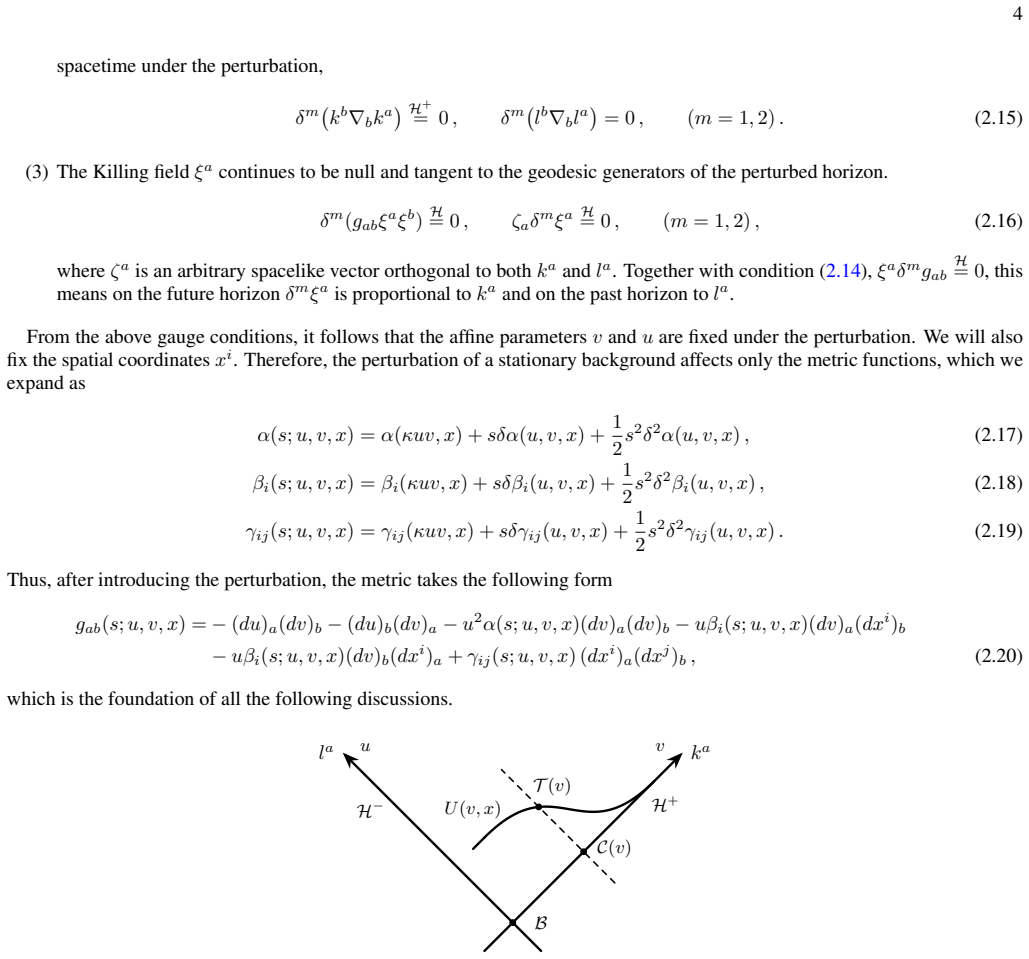
On a general stationary background possessing a bifurcate Killing horizon, the geometry of the apparent horizon is expanded perturbatively to second order in Gaussian null coordinates. A modified canonical energy is defined so that a balance law equates the second-order entropy variation to the energy flux crossing the horizon. When the null energy condition holds for the matter, this balance shows that entropy is given precisely by the apparent-horizon area and that the second law is satisfied at this order. The authors also note that the area law may persist even if the null energy condition is violated.
What carries the argument
Modified canonical energy in the covariant phase space formalism, used to derive the balance law that equates second-order entropy variation to energy flux.
Load-bearing premise
The second-order perturbative expansion in Gaussian null coordinates on a stationary background with a bifurcate Killing horizon is valid and the modified canonical energy correctly accounts for the flux.
What would settle it
An explicit second-order calculation or numerical evolution in which the entropy variation fails to equal the change in apparent-horizon area while the null energy condition holds for the matter.
If this is right
- The second law of black hole thermodynamics holds at second order around equilibrium.
- The apparent-horizon area continues to serve as the entropy even for dynamical black holes under the null energy condition.
- A balance law relates entropy change directly to the matter energy influx at this perturbative order.
- The area law may remain valid in regimes where the null energy condition is violated.
Where Pith is reading between the lines
- The result suggests thermodynamic relations could survive in fully dynamical settings such as mergers provided the null energy condition is approximately satisfied.
- If the null energy condition fails, one may need to identify a different geometric quantity that still functions as entropy.
- The perturbative framework could be checked by comparing against numerical-relativity simulations of perturbed horizons.
Editorial analysis
A structured set of objections, weighed in public.
Referee Report
Summary. The paper claims that, for second-order perturbations around a general stationary black hole with a bifurcate Killing horizon, the entropy of the dynamical black hole is given precisely by the area of the apparent horizon (when the null energy condition holds for infalling matter) and that the entropy variation obeys the second law. The derivation uses Gaussian null coordinates to expand the apparent-horizon geometry to second order, introduces a modified canonical energy within the covariant phase space formalism, and establishes a balance law relating the second-order entropy variation to the matter energy flux.
Significance. If the central derivations hold, the result extends the classical area theorem and first-law balance to second order in a coordinate-independent manner on a general stationary background. This strengthens the thermodynamic interpretation of dynamical black holes beyond linear perturbations and provides a concrete perturbative check of the second law. The explicit construction of a balance law via covariant phase space is a technical strength.
major comments (1)
- [Section introducing the modified canonical energy (covariant phase space construction)] The central balance law (and therefore the claim that entropy equals apparent-horizon area) rests on the definition of the new 'modified canonical energy.' It is not shown whether this modification is uniquely fixed by the requirement that the balance law reproduce the standard first-order result or whether it is constructed ad hoc to cancel unwanted second-order terms. An explicit comparison between the standard canonical energy and the modified version, together with a demonstration that the modification does not presuppose the desired balance law, is required.
minor comments (1)
- [Abstract] The abstract states the result at second order but does not indicate whether the Gaussian-null-coordinate expansion is performed with a specific choice of affine parameter or whether residual gauge freedom remains at second order.
Simulated Author's Rebuttal
We thank the referee for their careful reading of the manuscript and for highlighting the need for greater clarity on the construction of the modified canonical energy. We address the major comment below and will incorporate the requested material in a revised version.
read point-by-point responses
-
Referee: [Section introducing the modified canonical energy (covariant phase space construction)] The central balance law (and therefore the claim that entropy equals apparent-horizon area) rests on the definition of the new 'modified canonical energy.' It is not shown whether this modification is uniquely fixed by the requirement that the balance law reproduce the standard first-order result or whether it is constructed ad hoc to cancel unwanted second-order terms. An explicit comparison between the standard canonical energy and the modified version, together with a demonstration that the modification does not presuppose the desired balance law, is required.
Authors: We agree that the manuscript would benefit from an explicit comparison. The modified canonical energy is introduced to ensure that the first-order balance law is recovered exactly while the second-order terms arising from the Gaussian-null-coordinate expansion of the apparent horizon are consistently included; the modification is fixed by requiring covariance and agreement with the linear result on the bifurcate Killing horizon. In the revised manuscript we will add a dedicated paragraph (or short subsection) that (i) writes the standard canonical energy alongside the modified expression, (ii) shows term-by-term how the extra pieces are determined by the second-order geometry and the null-energy-condition contribution, and (iii) verifies that the construction does not presuppose the final entropy-area equality at second order. This addition will make the logical independence of the definition from the desired balance law transparent. revision: yes
Circularity Check
No significant circularity detected
full rationale
The paper performs a standard second-order perturbative analysis in Gaussian null coordinates on a stationary background with bifurcate Killing horizon, using covariant phase space methods. It introduces a modified canonical energy specifically to incorporate matter contributions and derives a balance law relating entropy variation to energy flux. The result that entropy equals apparent-horizon area (under NEC) follows from applying this balance law to the geometry of the apparent horizon, without reducing by definition or self-citation to the input assumptions. The setup is self-contained against external benchmarks such as first-order results and does not rely on load-bearing self-citations or ansatze smuggled via prior work. No quoted equations exhibit a prediction equivalent to its inputs by construction.
Axiom & Free-Parameter Ledger
axioms (2)
- domain assumption The background is a general stationary spacetime with a bifurcate Killing horizon
- domain assumption Null energy condition holds for infalling matter
invented entities (1)
-
modified canonical energy
no independent evidence
read the original abstract
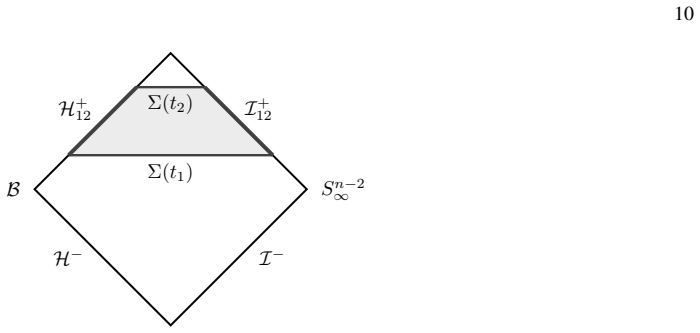
We investigate the entropy of a dynamical black hole arising from second-order perturbations of a general stationary background with a bifurcate Killing horizon. Using Gaussian null coordinates, we study the geometry of the apparent horizon perturbatively up to second order. Within the covariant phase space formalism, to explore the contribution of matter fields, we introduce a new modified canonical energy, and establish a balance law relating the second-order variation of the entropy to the energy flux entering the black hole. We show that the entropy is given precisely by the area of the apparent horizon at second order when the null energy condition holds for the infalling matter, and that the variation of the entropy also obeys the second law. We also discuss the possibility that the area law continues to hold when the null energy condition is violated.
Figures
Forward citations
Cited by 1 Pith paper
-
A comparison of two constructions for dynamical corrections to Wald entropy
For small perturbations, the dynamical entropy S_dyn and Wall's entropy S_Wall satisfy S_dyn = (1-v∂_v)S_Wall, and this paper gives a local algorithm that reconstructs S_Wall from S_dyn once a bifurcation-surface cond...
Reference graph
Works this paper leans on
-
[1]
modified canonical energy(n−1)-forms
For this purpose, we choose the Bondi gauge for the physical background metricg ab. The corresponding unphysical background metric ˆgab = Ω2gab, where the conformal factor isΩ = 1/r, then admits, in a neighborhood ofI +, the asymptotic form ˆgab = (dΩ)a(dˆu)b + (dΩ)b(dˆu)a + ˆγij(dxi)a(dxj)b +O(Ω).(3.19) Hereˆuis a future directed affine parameter on the ...
-
[2]
Case I In this case, we assume that the null energy condition holds and show thatδθ v = 0. In the following, we prove this statement using the method of [29], together with the boundary conditions and a consequence of the null energy condition. First, we assume thatδθ v →0at late times along the event horizon, which means that the perturbed black hole eve...
-
[3]
(4.41) and (4.42) may no longer hold
Case II In this case, we no longer impose the null energy condition, thus the two conditions in Eqs. (4.41) and (4.42) may no longer hold. Comparing Eq. (4.39) with Eq. (2.44), it appears that under second-order perturbations the area of the apparent horizon is not always proportional to the dynamical black hole entropy, since there remain extra terms tha...
-
[4]
R. M. Wald, Living Rev. Rel.4, 6 (2001), arXiv:gr-qc/9912119
work page internal anchor Pith review Pith/arXiv arXiv 2001
-
[5]
Microscopic Origin of the Bekenstein-Hawking Entropy
A. Strominger and C. Vafa, Phys. Lett. B379, 99 (1996), arXiv:hep-th/9601029
work page internal anchor Pith review Pith/arXiv arXiv 1996
-
[6]
J. M. Maldacena, Adv. Theor. Math. Phys.2, 231 (1998), arXiv:hep-th/9711200
work page internal anchor Pith review Pith/arXiv arXiv 1998
-
[7]
D. Harlow, Rev. Mod. Phys.88, 015002 (2016), arXiv:1409.1231 [hep-th]
-
[8]
J. D. Bekenstein, Phys. Rev. D7, 2333 (1973)
work page 1973
-
[9]
J. M. Bardeen, B. Carter, and S. W. Hawking, Commun. Math. Phys.31, 161 (1973)
work page 1973
-
[10]
S. W. Hawking, Commun. Math. Phys.43, 199 (1975), [Erratum: Commun.Math.Phys. 46, 206 (1976)]
work page 1975
- [11]
-
[12]
R. M. Wald, J. Math. Phys.31, 2378 (1990)
work page 1990
-
[13]
R. M. Wald, Phys. Rev. D48, R3427 (1993), arXiv:gr-qc/9307038
work page internal anchor Pith review Pith/arXiv arXiv 1993
-
[14]
Some Properties of Noether Charge and a Proposal for Dynamical Black Hole Entropy
V . Iyer and R. M. Wald, Phys. Rev. D50, 846 (1994), arXiv:gr-qc/9403028
work page internal anchor Pith review Pith/arXiv arXiv 1994
-
[15]
S. Hollands, R. M. Wald, and V . G. Zhang, Phys. Rev. D110, 024070 (2024), arXiv:2402.00818 [hep-th]
-
[16]
Holographic Entanglement Entropy for General Higher Derivative Gravity
X. Dong, JHEP01, 044 (2014), arXiv:1310.5713 [hep-th]
work page internal anchor Pith review Pith/arXiv arXiv 2014
-
[17]
A. C. Wall, Int. J. Mod. Phys. D24, 1544014 (2015), arXiv:1504.08040 [gr-qc]
work page internal anchor Pith review Pith/arXiv arXiv 2015
-
[18]
A. Rignon-Bret, Phys. Rev. D108, 044069 (2023), arXiv:2303.07262 [gr-qc]
-
[19]
H. Furugori, K. Nishii, D. Yoshida, and K. Yoshimura, Phys. Rev. D112, 104049 (2025), arXiv:2507.14105 [gr-qc]
- [20]
-
[21]
Thermodynamics of Black Holes, far from Equilibrium
A. Ashtekar, D. E. Paraizo, and J. Shu, (2025), arXiv:2512.11659 [gr-qc]
work page internal anchor Pith review Pith/arXiv arXiv 2025
-
[22]
Thermodynamics of dynamical black holes beyond perturbation theory
A. Ashtekar, D. E. Paraizo, and J. Shu, (2026), arXiv:2604.00170 [gr-qc]
work page internal anchor Pith review Pith/arXiv arXiv 2026
-
[23]
A. Ashtekar and B. Krishnan, Living Reviews in Relativity7(2004), 10.12942/lrr-2004-10
- [24]
-
[25]
W. Jia, Q. Qi, and C. Gao, (2025), arXiv:2509.05700 [hep-th]
work page internal anchor Pith review Pith/arXiv arXiv 2025
-
[26]
S. Hollands, ´A. D. Kov´acs, and H. S. Reall, JHEP08, 258 (2022), arXiv:2205.15341 [hep-th]
-
[27]
S. Bhattacharyya, P. Dhivakar, A. Dinda, N. Kundu, M. Patra, and S. Roy, JHEP09, 169 (2021), arXiv:2105.06455 [hep-th]
-
[28]
Stability of Black Holes and Black Branes
S. Hollands and R. M. Wald, Commun. Math. Phys.321, 629 (2013), arXiv:1201.0463 [gr-qc]
work page internal anchor Pith review Pith/arXiv arXiv 2013
-
[29]
V . Iyer and R. M. Wald, Phys. Rev. D52, 4430 (1995), arXiv:gr-qc/9503052
work page internal anchor Pith review Pith/arXiv arXiv 1995
-
[30]
Asymptotic flatness at null infinity in higher dimensional gravity
S. Hollands and A. Ishibashi, in 7th Hungarian Relativity Workshop (RW 2003) (2003) pp. 51–61, arXiv:hep-th/0311178
work page internal anchor Pith review Pith/arXiv arXiv 2003
-
[31]
R. M. Wald and A. Zoupas, Phys. Rev. D61, 084027 (2000), arXiv:gr-qc/9911095
work page internal anchor Pith review Pith/arXiv arXiv 2000
-
[32]
R. D. Sorkin and M. Varadarajan, Class. Quant. Grav.13, 1949 (1996), arXiv:gr-qc/9510031
work page internal anchor Pith review Pith/arXiv arXiv 1949
-
[33]
R. D. Sorkin, in Heat Kernels and Quantum Gravity (1995) arXiv:gr-qc/9508002
work page internal anchor Pith review Pith/arXiv arXiv 1995
discussion (0)
Sign in with ORCID, Apple, or X to comment. Anyone can read and Pith papers without signing in.